Facebook to admit ownership of Instagram, WhatsApp in barely visible small-print

For the first time in more than half a decade, Facebook wants to inform you that it owns Instagram, the hyper-popular rival social networking app it acquired for a $1BN steal back in 2012.

Ditto messaging platform WhatsApp — which Mark Zuckerberg splurged $19BN on a couple of years later to keep feeding eyeballs into his growth engine.

Facebook is adding its own brand name alongside the other two — in the following format: ‘Instagram from Facebook’; ‘WhatsApp from Facebook.’

The cheap perfume style rebranding was first reported by The Information which cites three people familiar with the matter who told it employees for the two apps were recently notified internally of the plan to rebrand.

“The move to add Facebook’s name to the apps has been met with surprise and confusion internally, reflecting the autonomy that the units have operated under,” it said. Although it also reported that CEO Mark Zuckerberg has also been frustrated that Facebook doesn’t get more credit for the growth of Instagram and WhatsApp.

So it sounds like Facebook may be hoping for a little reverse osmosis brand-washing — aka leveraging the popularity of its cleaner social apps to detoxify the scandal-hit mothership.

Not that Facebook is saying anything like that publicly, of course.

In a statement to The Information confirming the rebranding it explained it thus: “We want to be clearer about the products and services that are part of Facebook.”

The rebranding also comes at a time when Facebook is facing at least two antitrust investigations on its home turf — where calls for Facebook and other big tech giants to be broken up are now a regular feature of the campaign trail…

We can only surmise the legal advice Facebook must be receiving vis-a-vis what it should do to try to close down break up arguments that could deprive it of its pair of golden growth geese.

Arguments such as the fact most Instagram (and WhatsApp) users don’t even know they’re using a Facebook-owned app. Hence, as things stand, it would be pretty difficult for Facebook’s lawyers to successfully argue Instagram and WhatsApp users would be harmed if the apps were cut free by a break-up order.

But now — with the clumsy ‘from Facebook’ construction — Facebook can at least try to make a case that users are in a knowing relationship with Facebook in which they willingly, even if not lovingly, place their eyeballs in Zuckerberg’s bucket.

In which case Facebook is not telling you the Instagram user that it owns Instagram for your benefit. Not even slightly.

Note, for example, the use of the comparative adjective “clearer” in Facebook’s statement to explain its intent for the rebranding — rather than a simple statement: ‘we want to be clear’.

It’s definitely not saying it’s going to individually broadcast its ownership of Instagram and WhatsApp to each and every user on those networks. More like it’s going to try to creep the Facebook brand in. Which is far more in corporate character.

At the time of writing a five day old update of of Instagram’s iOS app already features the new construction — although it looks far more dark pattern than splashy rebrand, with just the faintest whisker of grey text at the base of the screen to disclose that you’re about to be sucked into the Facebook empire (vs a giant big blue ‘Create new account’ button winking to be tapped up top… )

Here’s the landing screen — with the new branding. Blink and you’ll miss it…

image2

So not full disclosure then. More like just an easily overlooked dab of the legal stuff — to try to manage antitrust risk vs the risk of Facebook brand toxicity poisoning the (cleaner) wells of Instagram and WhatsApp.

There are signs the company is experimenting in some extremely dilute cross-brand-washing too.

The iOS app description for Instagram includes the new branding — tagged to an ad style slogan that gushes: “Bringing you closer to the people and things you love.”  But, frankly, who reads app descriptions?
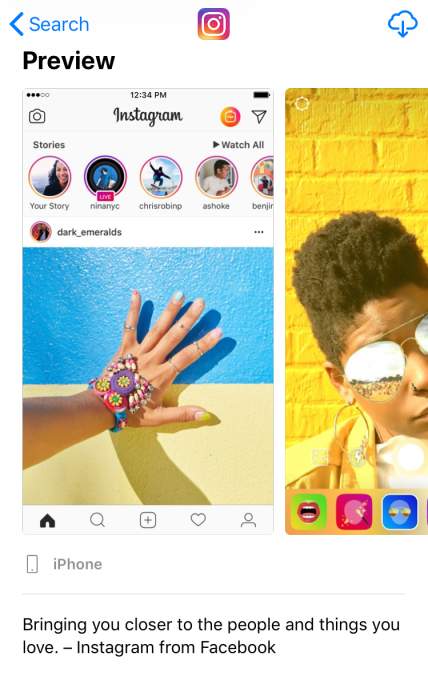
image1

Up until pretty recently, both Instagram and WhatsApp had a degree of independence from their rapacious corporate parent — granted brand and operational independence under the original acquisition terms and leadership of their original founders.

Not any more, though. Instagram’s founders cleared out last year. While WhatsApp’s jumped ship between 2017 and 2018.

Zuckerberg lieutenants and/or long time Facebookers are now running both app businesses. The takeover is complete.

Facebook is also busy working on entangling the backends of its three networks — under a claimed ‘pivot to privacy‘ which it announced earlier this year.

This also appears intended to try to put regulators off by making breaking up Facebook much harder than it would be if you could just split it along existing app lines. Theories of user harm potentially get more complicated if you can demonstrate cross-platform chatter.

The accompanying 3,000+ word screed from Zuckerberg introduced the singular notion of “the Facebook network”; aka one pool for users to splash in, three differently colored slides to funnel you in there.

“In a few years, I expect future versions of Messenger and WhatsApp to become the main ways people communicate on the Facebook network,” he wrote. “If this evolution is successful, interacting with your friends and family across the Facebook network will become a fundamentally more private experience.”

The ‘from Facebook’ rebranding thus looks like just a little light covering fire for the really grand dodge Facebook is hoping to pull off as the break-up bullet speeds down the pipe: Aka Entangling its core businesses at the infrastructure level.

From three networks to one massive Facebook-owned user data pool. 

One network to rule them all, one network to find them,
One network to bring them all, and in the regulatory darkness bind them


MaC Ventures, the brainchild of Adrian Fenty and Marlon Nichols, is quietly making its first investments

MaC Ventures, the new Los Angeles-based investment firm formed from the merger of Cross Culture Ventures and M Ventures, has quietly started deploying capital from its fund.

One of the firm’s first disclosed investments is Edge Delta, which announced a $3 million seed round earlier this week.

The Seattle-based company, which has a tool to predict and identify faulty code and potential security issues in software designed for mobile environments, reflects the new continuing focus on companies that reflect the changing cultural environments throughout the commercial, cultural and technological worlds.

And if anyone knows anything about downtime and application failures, it would be the two co-founders who have held positions at Microsoft, Twitter and Sumo Logic. That’s the background Ozan Unlu, a Microsoft and Sumo Logic alum, and Fatih Yildiz, who spent years at Twitter and Microsoft, will leverage as they pitch their services. 

“We have reached the inflection point for centralized security analytics, SIEM products like Splunk are struggling to scale and a lack of mature SaaS offerings mean that if customers want to keep up with growth in their environments, innovation is required,” said Will Peteroy, founder and chief executive of ICEBRG (acquired in 2018) and chief technology officer for Security at Gigamon, in a statement.

That innovation is something that M Ventures and Cross Culture have tried to identify according to previous statements from both founders. And the merger between both firms was likely about growth and scale. Both firms have co-invested on a number of deals and both share the same emphasis on cultural shifts that create new opportunities.

Shared portfolio companies between the two firms include Blavity, BlocPower and Mayvenn, and each reflect a different aspect of the firms’ commitment to the transformations impacting culture and community in the twenty-first century.

BlocPower is focused on urban resiliency and health in the face of new challenges to the power grid; Blavity has become the online community for black creativity and news; and Mayvenn is leveraging the economics of community to create new entrepreneurs and enable new businesses.

For Adrian Fenty and Marlon Nichols — the two managing general partners of the new fund — and general partners Charles King and Michael Palank and partner Alyson DeNardo, MaC Ventures is a logical next step in their progression in the venture business.

Fenty, the former mayor of Washington, DC and an early special advisor to Andreessen Horowitz seven years ago, has long been interested in the intersection of technology and governance and said that politics was a great introduction to the venture world in an interview with TechCrunch when he joined Andreessen:

“As a mayor you have a lot of districts you work with, and every day is different,” Fenty said, noting that the same could be said for VCs who work with different startups. However, the pace will likely be a bit quicker in this space than it is in the political realm. “I believe that change should happen fast and in big ways, and that’s the tech industry,” he said. “Some of these entrepreneurs and CEOs, their energy and ability to come up with new ideas is infectious.”

As for Nichols, the introduction to venture capital came through work at Intel Capital before striking out with Troy Carter, a limited partner in the MaC Ventures fund, to form Cross Culture.

As the new firm finds its legs, it’s likely that some of the guiding principles that Nichols expressed when talking about Cross Culture will carry over to the new vehicle.

“This is the time to be here,” Nichols said in an interview earlier this year. “If you are going to invest in the companies of tomorrow you have to go where the world is moving to — and that’s black and brown, honestly.”

The SEC wants disgraced VC Mike Rothenberg to cough up more than $30 million

Nearly three years ago, TechCrunch reported on suspected fraud committed by Mike Rothenberg, a self-described “millennial venture capitalist” who’d made a name for himself not only by eponymously branding his venture firm but for spending lavishly to woo startup founders, including on Napa Valley wine tours, at luxury boxes at Golden State Warriors games and, most famously, hosting an annual “founder field day” at the San Francisco Giants’ baseball stadium that later inspired a scene in the HBO show “Silicon Valley.”

The Securities & Exchange Commission had initially reached out to Rothenberg in June of 2016 and by last August, he’d been formally charged for misappropriating up to $7 million of his investors’ capital. He settled with the agency without making an admission of guilt, and, as part of the settlement, he stepped down from what was left of the firm and agreed to be barred from the brokerage and investment advisory business with a right to reapply after five years.

Now, comes the money part. Following a forensic audit conducted in partnership with the accounting firm Deloitte, the SEC is seeking $18.8 million in disgorgement penalties from Rothenberg, and an additional $9 million civil penalty. The SEC is also asking that Rothenberg be forced to pay pre-judgment interest of $3,663,323.47.

How it arrived at that math: According to a new lawsuit filed on Wednesday, the SEC argues that Rothenberg raised a net amount of approximately $45.9 million across six venture funds from at least 200 investors, but that he took “fees” on their capital that far exceeded what his firm was entitled to during the life of those funds, covering up these “misdeeds” by “modifying accounting entries to make his misappropriation look like investments, entering into undisclosed transactions to paper over diverted money, and shuffling investments from one [f]und to another to conceal prior diversions.”

Ultimately, it says, Deloitte’s examination demonstrated that Rothenberg misappropriated $18.8 million that rightfully belong to Rothenberg Ventures, $3.8 million of which was transferred to Rothenberg personally; $8.8 million of which was used to fund other entities under his control (including a car racing team and a virtual reality studio); and $5.7 of which was used to pay the firm’s expenses “over and above” the management and administrative fees it was entitled to per its management agreements.

We reached out to Rothenberg this morning. He has not yet responded to our request to discuss the development.

It sounds from the filing like he won’t have much wiggle room. According to the SEC’s suit, the “Rothenberg Judgment” agreed upon last summer left monetary relief to be decided by a court’s judgment, one that “provides that Rothenberg accepts the facts alleged in the complaint as true, and does not contest his liability for the violations alleged, for the purposes of this motion and at any hearing on this motion.”

In the meantime, the lawsuit contains interesting nuggets, including an alleged maneuver in which Rothenberg raised $1.3 million to invest in the game engine company Unity but never actually bought shares in the company, instead diverting the capital to other entities. (He eventually paid back $1 million to one investor who repeatedly asked for the money back, but not the other $300,000.)

Rothenberg also sold a stake in the stock-trading firm Robinhood for $5.4 million, says the SEC, but rather than funnel any proceeds to investors, he again directed the money elsewhere, including, evidently, to pay for a luxury suite during Golden State Warriors games for which he shelled out $136,000.

In a move that one Rothenberg investor finds particularly galling, the SEC claims that Rothenberg then turned around and rented that box through an online marketplace that enables people to buy and sell suites at various sports and entertainment venues, receiving at least $56,000 from the practice.

In an apparent effort to keep up appearances, Rothenberg also gave $30,000 to the Stanford University Athletics Department (he attended Stanford as an undergrad) and spent thousands of dollars on ballet tickets last year and early this year, says the SEC’s filing.

Regardless of what happens next, one small victor in the SEC’s detailed findings is Silicon Valley Bank, a sprawling enterprise that has aggressively courted the tech industry since its 1983 founding. Last year, at the same time that Rothenberg was agreeing to be barred from the industry, he made a continued show of his innocence by filing suit against SVB to “vindicate the interests of its funds and investors,” the firm said in a statement at the time.

The implication was that SVB was at fault for some of Rothenberg’s woes because it had not properly wired money to the correct accounts, but the SEC says that SVB was defrauded, providing Rothenberg a $4 million line of credit after being presented with fabricated documents.

A loser — other than Rothenberg and the many people who now feel cheated by him — is Harvard Business School, which once used Rothenberg Ventures as a case study for its students following Rothenberg’s graduation from the program in 2013. As we’ve reported previously, that case study — funded by HBS before any hint of trouble at the firm had surfaced  — was co-authored by two professors who had a “significant financial interest in Rothenberg Ventures,” as stated prominently in a curriculum footnote.

Presumably, those ties gave confidence to at least some of the investors in Silicon Valley and elsewhere who later provided Rothenberg with money to invest on their behalf.

You can read the SEC’s 20-page motion for disgorgement and penalties below, along with the 48-page report assembled by Deloitte’s forensic accounting partner, Gerry Fujimoto.

SEC vs. Mike Rothenberg by TechCrunch on Scribd

Forensic report re Mike Rothenberg/Rothenberg Ventures by TechCrunch on Scribd

Additional reporting by TechCrunch’s Sarah Perez.

Above: Rothenberg Ventures during better days.

United Airlines CISO Emily Heath joins TC Sessions: Enterprise this September

In an era of massive data breaches, most recently the Capital One fiasco, the risk of a cyberattack and the costly consequences are the top existential threat to corporations big and small. At TechCrunch’s first-ever enterprise-focused event (p.s. early-bird sales end August 9), that topic will be front and center throughout the day.

That’s why we’re delighted to announce United’s chief information security officer Emily Heath will join TC Sessions: Enterprise in San Francisco on September 5, where we will discuss and learn how one of the world’s largest airlines keeps its networks safe.

Joining her to talk enterprise security will be a16z partner Martin Casado and DUO / Cisco’s head of advisory CISOs Wendy Nather, among others still to be announced.

At United, Heath oversees the airline’s cybersecurity program and its IT regulatory, governance and risk management.

The U.S.-based airline has more than 90,000 employees serving 4,500 flights a day to 338 airports, including New York, San Francisco, Los Angeles and Washington, D.C.

A native of Manchester, U.K., Heath served as a former police detective in the U.K. Financial Crimes Unit where she led investigations into international investment fraud, money laundering and large scale cases of identity theft — and ran joint investigations with the FBI, SEC and London’s Serious Fraud Office.

Heath and her teams have been the recipients of CSO Magazine’s CSO50 Awards for their work in cybersecurity and risk.

At TC Sessions: Enterprise, Heath will join a panel of cybersecurity experts to discuss security on enterprise networks large and small — from preventing data from leaking to keeping bad actors out of their network — where we’ll learn how a modern CSO moves fast without breaking things.

Join hundreds of today’s leading enterprise experts for this single-day event when you purchase a ticket to the show. The $249 early-bird sale ends Friday, August 9. Make sure to grab your tickets today and save $100 before prices go up.

Nyca Partners raises $210M to invest in fintech startups

Nyca Partners, a firm with investments in financial technology businesses including PayRange, Trellis, Affirm and Acorns, has collected another $210 million for its third venture capital fund.

Located in New York, Nyca’s debut fund closed on $31 million in 2014. Its second fund, a similarly focused fintech effort, raised $125 million in 2017.

Venture capital investment in fintech is poised to reach new heights in 2019, according to PitchBook. So far this year, investors have bet $8.6 billion on U.S.-based fintech upstarts. Last year, investment in the space reached an all-time high of more than $12 billion, with Robinhood, Coinbase and Plaid all raising multi-hundred-million-dollar rounds.

“Much has changed since we launched Nyca,” the firm wrote in a blog post announcing the fund. “In 2014 the fintech landscape was still a relatively small community of investors and several hundred companies, dominated by credit and payments strategies, and incipient crypto enthusiasts. Most regulators around the world were generally uninformed about the dramatic changes taking place in financial technology and with it the potential impact on banking, investing and insurance practices. In mid-2019, we estimate there are fifteen thousand funded fintech start-ups. Some have become very large companies extremely quickly, and entrepreneurs are creating new models and ideas with breathtaking speed.”

Nyca managing partner Hans Morris has a long history in the financial space. Most recently, he was managing director at General Atlantic; before that, he served as president of Visa and spent nearly three decades at Citigroup in roles including chief financial officer and head of finance.

The firm is also led by Ravi Mohan, partner and chief operating officer, who spent 25 years at Citigroup and JP Morgan Chase .

As part of the new fundraise, Nyca has promoted David Sica to partner. Prior to joining Nyca, Sica was a director at Visa.

Nyca announces its new fund just days after Oak HC/FT, another fintech-focused fund, raised $800 million to invest in the space.

Northrup Grumman is among the companies tapped to make the US Army’s drone-killing lasers

Northrop Grumman is going to be working on the U.S. Army’s long-planned drone-killing lasers.

The Army wants to mount 50 kilowatt laser systems on top of its General Dynamics-designed Stryker vehicle as part of its U.S. Army Maneuver Short Range Air Defense (M-SHORAD) directed energy prototyping initiative.

Basically, the army wants to use these lasers to protect frontline combat troops against drone attacks.

The initiative includes integrating a directed energy weapon system on a Stryker vehicle as a pathfinding effort toward the U.S. Army M-SHORAD objective to provide more comprehensive protection of frontline combat units.

“Northrop Grumman is eager to leverage its portfolio of innovative, proven technologies and integration expertise to accelerate delivery of next-generation protection to our maneuver forces,” said Dan Verwiel, vice president and general manager, missile defense and protective systems, Northrop Grumman, in a statement.

The drone, helicopter, rocket, artillery and mortar defense system that the Army is looking to mount on a group of Stryker all-terrain vehicles could come from either Northrop Grumman or Raytheon, which was also tapped to develop tech for the project.

“The time is now to get directed energy weapons to the battlefield,” said Lt. Gen. L. Neil Thurgood, director of hypersonics, directed energy, space and rapid acquisition, in a statement. “The Army recognizes the need for directed energy lasers as part of the Army’s modernization plan. This is no longer a research effort or a demonstration effort. It is a strategic combat capability, and we are on the right path to get it in soldiers’ hands.”

For the Army, lasers extend the promise of reducing supply chain hurdles that are associated with conventional kinetic weapons. In May, the Army gave the green light to a strategy for accelerated prototyping and field use of a wide array of lasers for infantry, vehicles and air support.

While Raytheon and Northrop Grumman have both been tapped by the Army, the military will also entertain pitches from other vendors that want to carry out their own research, according to the Army.

It’s a potential $490 million contract for whoever wins the demonstration, and the Army expects to have the vehicles equipped in fiscal year 2022.

“Both the Army and commercial industry have made substantial improvements in the efficiency of high energy lasers — to the point where we can get militarily significant laser power onto a tactically relevant platform,” said Dr. Craig Robin, RCCTO Senior Research Scientist for Directed Energy Applications, in a statement. “Now, we are in position to quickly prototype, compete for the best solution, and deliver to a combat unit.”

Daily Crunch: Apple responds to Siri privacy concerns

The Daily Crunch is TechCrunch’s roundup of our biggest and most important stories. If you’d like to get this delivered to your inbox every day at around 9am Pacific, you can subscribe here.

1. Apple suspends Siri response grading after privacy concerns

After The Guardian ran a story last week about how Siri recordings are used for quality control, Apple says it’s suspending the program worldwide while it reviews the process.

The practice, known as grading, involves sharing audio snippets with contractors, who determine whether Siri is hearing the requests accurately. Apple says that in the future, users will be able to choose whether or not they participate in the grading.

2. DoorDash is buying Caviar from Square in a deal worth $410 million

Square bought Caviar about five years ago in a deal worth about $90 million. Now, Caviar has found a new home with DoorDash.

3. President throws latest wrench in $10B JEDI cloud contract selection process

Throughout the months-long selection process, the Pentagon repeatedly denied accusations that the contract was somehow written to make Amazon a favored vendor, but The Washington Post reports President Trump has asked his newly appointed defense secretary to examine the process.

LAS VEGAS, NV – APRIL 21: Twitch streamer and professional gamer Tyler “Ninja” Blevins streams during Ninja Vegas ’18 at Esports Arena Las Vegas at Luxor Hotel and Casino on April 21, 2018 in Las Vegas, Nevada.  (Photo by Ethan Miller/Getty Images)

4. Following Ninja’s news, Mixer pops to top of the App Store’s free charts

Yesterday, Tyler “Ninja” Blevins announced that he’s leaving Twitch, moving his streaming career over to Microsoft’s Mixer platform. This morning, Mixer shot to the top of the App Store’s free app charts.

5. Google ordered to halt human review of voice AI recordings over privacy risks

Apple isn’t the only company to face scrutiny over its handling of user audio recordings.

6. UrbanClap, India’s largest home services startup, raises $75M

Through its platform, UrbanClap matches service people such as cleaners, repair staff and beauticians with customers across 10 cities in India, as well as Dubai and Abu Dhabi.

7. Why AWS gains big storage efficiencies with E8 acquisition

The team at Amazon Web Services is always looking to find an edge and reduce the costs of operations in its data centers. (Extra Crunch membership required.)

Early-bird pricing ends next week for TC Sessions: Enterprise 2019

Here are five words you’ll never hear spring from the mouth of an early-stage startupper. “I don’t mind paying more.” We feel you, and that’s why we’re letting you know that the price of admission to TC Sessions Enterprise 2019, which takes place on September 5, goes up next week.

Our $249 early-bird ticket price remains in play until 11:59 p.m. (PT) on August 9. Buy your ticket now and save $100.

Now that you’ve scored the best possible price, get ready to experience a full day focused on what’s around the corner for enterprise — the biggest and richest startup category in Silicon Valley. More than 1,000 attendees, including many of the industry’s top founders, CEOs, investors and technologists, will join TechCrunch’s editors onstage for interviews covering all the big enterprise topics — AI, the cloud, Kubernetes, data and security, marketing automation and event quantum computing, to name a few.

This conference features more than 20 sessions on the main stage, plus separate Q&As with the speakers and breakout sessions. Check out the agenda here.

Just to peek at one session, TechCrunch’s Connie Loizos will interview three top VCs — Jason Green (Emergence Capital), Maha Ibrahim (Canaan Partners) and Rebecca Lynn (Canvas Ventures) — in a session entitled Investing with an Eye to the Future. In an ever-changing technological landscape, it’s not easy for VCs to know what’s coming next and how to place their bets. Yet, it’s the job of investors to peer around the corner and find the next big thing, whether that’s in AI, serverless, blockchain, edge computing or other emerging technologies. Our panel will look at the challenges of enterprise investing, what they look for in enterprise startups and how they decide where to put their money.

Want to boost your ROI? Take advantage of our group discount — save 20% when you buy four or more tickets at once. And remember, for every ticket you buy to TC Sessions: Enterprise, we’ll register you for a free Expo Only pass to TechCrunch Disrupt SF on October 2-4.

TC Sessions: Enterprise takes place September 5, but your chance to save $100 ends next week. No one enjoys paying more, so buy an early-bird ticket today, cross it off your to-do list and enjoy your savings.

Is your company interested in sponsoring or exhibiting at TC Sessions: Enterprise 2019? Contact our sponsorship sales team by filling out this form.

Don’t miss this epic Twitter fight between the IAB’s CEO and actual publishers

Grab popcorn. As internet fights go, this one deserves your full attention — because the fight is over your attention. Your eyeballs and the creepy ads that trade data on you to try to swivel ’em.

A Clockwork Orange Eyes GIF - Find & Share on GIPHY

In the blue corner, the Internet Advertising Association’s CEO, Randall Rothenberg, who has been taking to Twitter increasingly loudly in recent days to savage Europe’s privacy framework, the GDPR, and bleat dire warnings about California’s Consumer Privacy Act (CCPA) — including amplifying studies he claims show “the negative impact” on publishers.

Exhibit A, tweeted August 1:

More on the negative impact of #GDPR on publishers (and more reasons @iab is trying to fix #CCPA so publishers, brands, & retailers don’t get killed). https://t.co/BWtGNYGTJq

Randall Rothenberg (@r2rothenberg) July 31, 2019

NB: The IAB is a mixed membership industry organization which combines advertisers, brands, publishers, data brokers* and adtech platform tech giants — including the dominant adtech duopoly, Google and Facebook, who take home ~60% of digital ad spend. The only entity capable of putting a dent in the duopoly, Amazon, is also in the club. Its membership reflects the sprawling interests attached to the online ad industry, and, well, the personal data that currently feeds it (your eyeballs again!), although some members clearly have pots more money to spend on lobbying against digital privacy regs than others.

In a what now looks to have been a deleted tweet last month, Rothenberg publicly professed himself proud to have Facebook as a member of his “publisher defence” club. Though, admittedly, per the above tweet, he’s also worried about brands and retailers getting “killed.” He doesn’t need to worry about Google and Facebook’s demise because that would just be ridiculous.

Now, in the — I wish I could call it “red top” corner, except these newspaper guys are anything but tabloid — we find premium publishers biting back at Rothenberg’s attempts to trash-talk online privacy legislation.

Here’s The New York Times’ data governance & privacy guy, Robin Berjon, demolishing Rothenberg via the exquisite medium of quote-tweet

One of the primary reasons we need the #GDPR and #CCPA (and more) today is because the @iab, under @r2rothenberg's leadership, has been given 20 years to self-regulate and has used the time to do [checks notes] nothing whatsoever.https://t.co/hBS9d671LU

— Robin Berjon (@robinberjon) August 1, 2019

I’m going to quote Berjon in full because every single tweet packs a beautifully articulated punch:

  • One of the primary reasons we need the #GDPR and #CCPA (and more) today is because the @iab, under @r2rothenberg’s leadership, has been given 20 years to self-regulate and has used the time to do [checks notes] nothing whatsoever.
  • I have spent much of my adult life working in self-regulatory environments. They are never perfect, but when they work they really deliver.
  • #Adtech had a chance to self-reg when the FTC asked them to — from which we got the joke known as AdChoices.
  • They got a second major chance with DNT. But the notion of a level playing field between #adtech and consumers didn’t work for them so they did everything to prevent it from existing.
  • At some point it became evident that the @iab lacked the vision and leadership to shepherd the industry towards healthy, sustainable behaviour. That’s when regulation became unavoidable. No one has done as much as the @iab has to bring about strong privacy regulation.
  • And to make things funnier the article that @r2rothenberg was citing as supporting his view is… calling for stronger enforcement of the #GDPR.
  • If that’s not a metaphor for where the @iab’s at, I don’t know what is.

Next time Facebook talks about how it can self-regulate its access to data I suggest you cc that entire thread.

Also chipping in on Twitter to champion Berjon’s view about the IAB’s leadership vacuum in cleaning up the creepy online ad complex, is Aram Zucker-Scharff, aka the ad engineering director at — checks notes — The Washington Post.

His punch is more of a jab — but one that’s no less painful for the IAB’s current leadership.

“I say this rarely, but this is a must read,” he writes, in a quote tweet pointing to Berjon’s entire thread.

I say this rarely, but this is a must read, Thread: https://t.co/FxKmT9bp7r

— Aram Zucker-Scharff (@Chronotope) August 2, 2019

Another top-tier publisher’s commercial chief also told us in confidence that they “totally agree with Robin” — although they didn’t want to go on the record today.

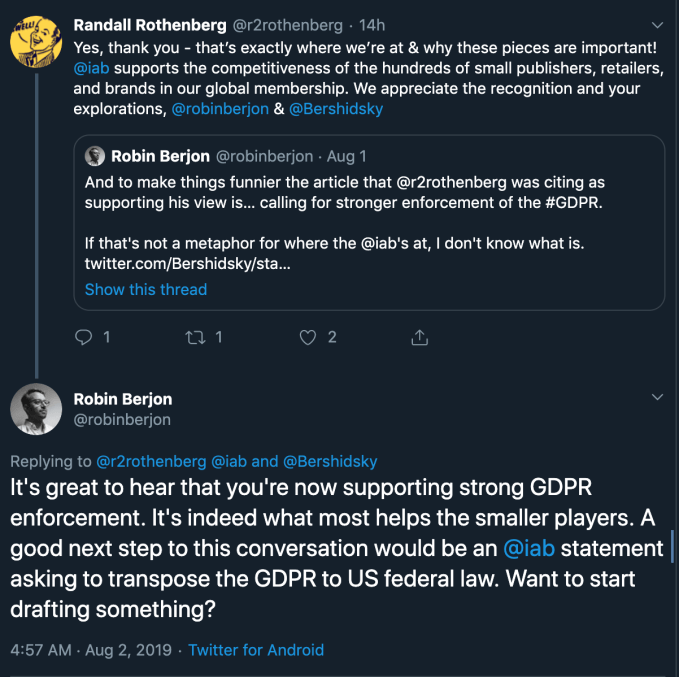
In an interesting twist to this “mixed member online ad industry association vs people who work with ads and data at actual publishers” slugfest, Rothenberg replied to Berjon’s thread, literally thanking him for the absolute battering.

Yes, thank you – that’s exactly where we’re at & why these pieces are important!” he tweeted, presumably still dazed and confused from all the body blows he’d just taken. “@iab supports the competitiveness of the hundreds of small publishers, retailers, and brands in our global membership. We appreciate the recognition and your explorations,@robinberjon.”

Yes, thank you – that’s exactly where we’re at & why these pieces are important! @iab supports the competitiveness of the hundreds of small publishers, retailers, and brands in our global membership. We appreciate the recognition and your explorations, @robinberjon & @Bershidsky https://t.co/WDxrWIyHXd

— Randall Rothenberg (@r2rothenberg) August 2, 2019

Rothenberg also took the time to thank Bloomberg columnist Leonid Bershidsky, who’d chipped into the thread to point out that the article Rothenberg had furiously retweeted actually says the GDPR “should be enforced more rigorously against big companies, not that the GDPR itself is bad or wrong.”

Who is Bershidsky? Er, just the author of the article Rothenberg tried to nega-spin. So… uh… owned.

May I point out that the piece that's cited here (mine) says the GDPR should be enforced more rigorously against big companies, not that the GDPR itself is bad or wrong?

— Leonid Bershidsky (@Bershidsky) August 1, 2019

But there’s more! Berjon tweeted a response to Rothenberg’s thanks for what the latter tortuously referred to as “your explorations” — I mean, the mind just boggles as to what he was thinking to come up with that euphemism — thanking him for reversing his position on GDPR, and for reversing his prior leadership vacuum on supporting robustly enforced online privacy laws. 

It’s great to hear that you’re now supporting strong GDPR enforcement,” he writes. “It’s indeed what most helps the smaller players. A good next step to this conversation would be an @iab statement asking to transpose the GDPR to US federal law. Want to start drafting something?”

It's great to hear that you're now supporting strong GDPR enforcement. It's indeed what most helps the smaller players. A good next step to this conversation would be an @iab statement asking to transpose the GDPR to US federal law. Want to start drafting something?

— Robin Berjon (@robinberjon) August 2, 2019

We’ve asked the IAB if, in light of Rothenberg’s tweet, it now wishes to share a public statement in support of transposing the GDPR into U.S. law. We’ll be sure to update this post if it says anything at all.

We’ve also screengrabbed the vinegar strokes of this epic fight — as an insurance policy against any further instances of the IAB hitting the tweet delete button. (Plus, I mean, you might want to print it out and get it framed.)

Screenshot 2019 08 02 at 18.48.08

Some light related reading can be found here:

The evolving airspace ecosystem

Tess Hatch
Contributor

Tess Hatch is an investor at Bessemer Venture Partners, where she invests in frontier technology, specifically commercial space, quantum computing and drones.

More posts by this contributor

Imagine a world where drones deliver emergency medical supplies to people in need. Or shuttle commuters from place to place avoiding ground traffic and breaking down the geographical divide between cities and suburbs.

Autonomous drones could spray pesticides on crops, monitor construction sites, or film adventure seekers skiing down mountains.

Potential drone applications are limited only by our imaginations… and our ability to operate them safely.

Right now the FAA is working together with the tech industry to build new rules of engagement to ensure that these unmanned aerial vehicles avoid a collision without the eyes of human pilots.

These regulatory hurdles are the last obstacle to letting the market for autonomous drones soar.

The current airspace ecosystem

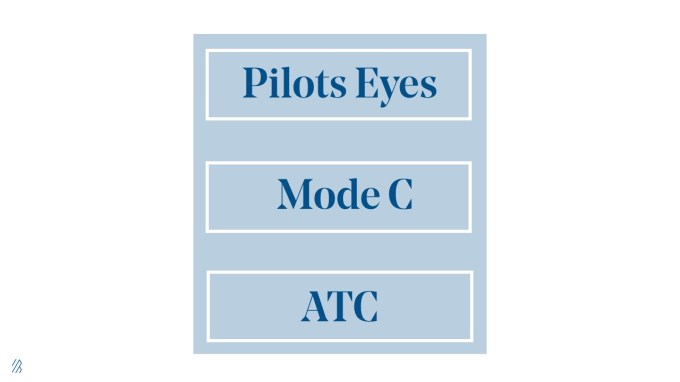
Aircraft, from Cessna 152s to Airbus 380s, are the most common vehicles that populate and cruise the airspace. And they all require a pilot’s eyes to operate.

In the case of commercial aircraft, they also require a Mode C Transponder, which determines the aircraft’s altitude. All commercial and most private aircraft also have to communicate with Air Traffic Control (ATC), people on the ground who logistically coordinate which aircraft taxi, take off, and land at airports.

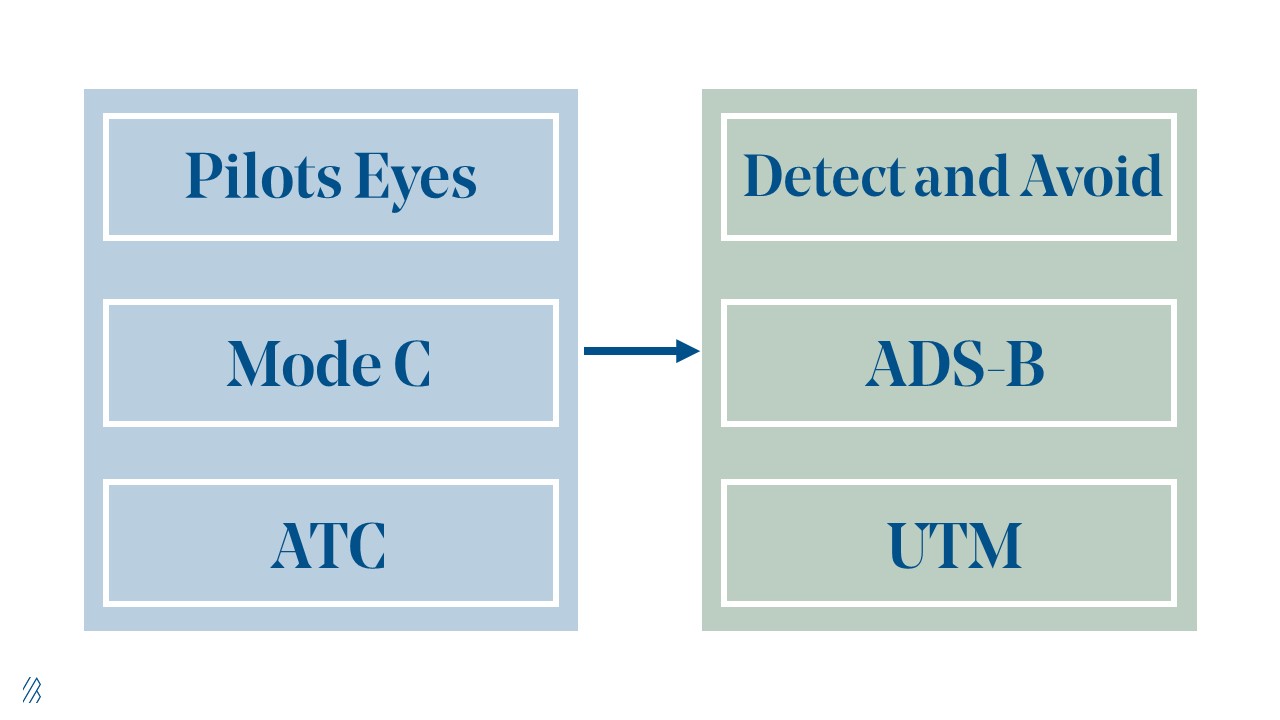
This is a system with three layers of protection and vigilance to avoid horrific and often fatal crashes: ATC, Mode C, and the pilot’s eyes. With unmanned aircraft, this universally accepted system for keeping the National Airspace System safe will have to change.

TessHatch EvolvingAirspaceEcosystem graphic01

Digitizing the airspace for drones flown by artificial intelligence

Objects that don’t have humans on board can’t use eyes to avoid collision, or communicate and listen to ATC. As a substitute for humans and eyes, these vehicles must rely on several new systems, largely using artificial intelligence. And these systems will require that the current ecosystem operate digitally in real time.

In the very near future, Unmanned Traffic Management (UTM) hopes to seamlessly integrate with today’s version of ATC. 

GettyImages 649629414

Image courtesy of Getty Images

UTM strives for the digital sharing of each user’s planned flight details with the goal for each user (e.g. “pilot”) to have the same situational awareness of the airspace. That way, as drones navigate the skies they will know whether or not they’re impeding any other traffic in the sky. Companies like Airmap and Unifly are working on such systems. While UTM is a great idea, it’s hard to standardize such a system because it will be nearly impossible to convince or require 100 percent of manned pilots to use it. There will always be non-cooperative aircraft, just like there will always be automobile drivers who do not wear their seat belts even though the benefits of doing so are obvious and compelling.

Therefore, we will need to aggregate other layers of safety on top of UTM to ensure our airspace is safe. Specifically, the Mode C Transponder will be updated to an Automatic Dependent Surveillance-Broadcast (ADS-B) sensor. This enhanced sensor transmits aircraft-to-aircraft and provides significant additional real-time precision to help both pilots and controllers achieve shared situational awareness.

As the last critical layer of safety and redundancy, if for whatever reason a manned aircraft pilot doesn’t enter her flight path in the UTM system or the aircraft doesn’t have a working ADS-B sensor, both common scenarios, the drone needs to have an equivalent to the pilot’s eyes to avoid another flying object.

TessHatch EvolvingAirspaceEcosystem graphic02 revised

Bessemer portfolio company, Iris Automation has developed a system that provides drones with eyes in the sky. The system uses a small module with a camera that feeds into a real-time, onboard computer vision and deep learning algorithm to detect, track, classify, and if needed, avoid, other objects in the airspace to keep the drone safe throughout its flight.

At present, Iris is the only company with an FAA beyond visual line-of-sight (BVLOS) waiver and is the only certified detect and avoid (DAA) system in the market. The BVLOS system doesn’t require a visual observer on the ground and the entire system fits into the palm of your hand, weighing only 350 grams.

The wild blue yonder of drone ubiquity

One day drones will ubiquitously operate in our airspace preventing disasters and making our lives safer, easier, and better. They’ll put out fires, deliver late night take out, and inspect our infrastructures such as bridges, railways, and pipelines.

In order for all this to happen, it will be necessary for pilots, drone users, manufacturers, and the FAA to embrace and use this new digital technology and ecosystem. When they do, the virtually endless possibilities associated with drone technology can be realized in a way that will make the skies even safer.