Blade raises $4.3M from Coinbase, SV Angel to reshape cryptocurrency derivatives trading

Exchanges like Coinbase have ballooned in size by taking the mechanics of equity markets and fitting them to cryptocurrency markets, but as the space expands in its scope and craftiness, new exchanges trading asset classes native to cryptocurrency are taking off and attracting the attention of top Silicon Valley VCs. Oh, and Coinbase, too.

Blade is a new cryptocurrency derivatives exchange launching in three weeks. Prior to starting the company, CEO Jeff Byun and his co-founder Henry Lee founded OrderAhead, a delivery startup platform that was eventually acquired in-part by Square in 2017. The pair’s newest company shares little in common with their previous venture, but they are bringing aboard some of the same investors to support them.

Blade is announcing that they’ve raised $4.3 million in seed funding from a host of investors, including Coinbase, SV Angel, A.Capital, Slow Ventures, Justin Kan and Adam D’Angelo.

The exchange is tackling perpetual swap contracts.

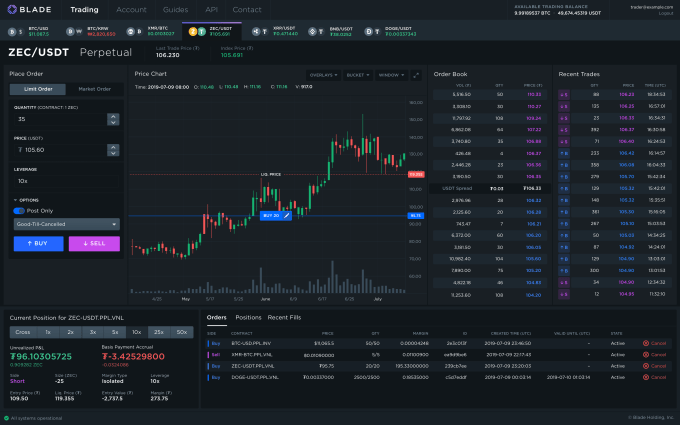
Perpetuals are a crypto-native trading instrument that Byun says are “arguably the fastest growing segment of cryptocurrency trading.” They allow traders to bet on the future values of cryptocurrencies in relation to another and the instruments have no expiration dates, unlike fixed maturity futures. Traders can bet on how the price of Bitcoin can increase relative to USD, but they can also make bets relative to other altcoins like Monero, DogeCoin, Zcash, Ripple and Binance Coin. Here’s what’s on the Blade menu at the moment.

Blade’s noteworthy spins on perpetuals trading — compared to other exchanges — are that most of the contracts will be set up on simplified vanilla contracts, the perpetuals will also be margined/settled in USD Tether and the company is offering higher leverages (up to 150x on BTC-USD and BTC-KRW) on trades.

BLADE Image 1 for TC Trading Dashboard 1

Blade is raising funds from Silicon Valley’s VCs, but U.S. investors won’t be legally able to participate in the exchange. U.S. government agencies have been a bit more stringent in regulating cryptocurrencies, so there’s more trading activity taking place on exchanges outside the jurisdiction. Blade itself is an offshore entity with a U.S. subsidiary; its primary market is East Asia.

“It’s kind of a bifurcated market,” Byun tells TechCrunch. “Either you have exchanges like Coinbase or Gemini or Bitrex that cater to the U.S. market that are highly regulated or the exchanges that cater to the non-U.S. market that are much less regulated, but that’s where most of the volume is.”

While the company is still three weeks away from launch, the founders have bold ambitions.

“In the long term, we want to be the CME (Chicago Mercantile Exchange) of crypto,” Byun tells me. “Coinbase and Binance are building this foundational structure for crypto, but I think we are too and in a sense that derivatives are at their core about risk transfer, we want to be building the foundational layer for risk transfer in the crypto markets.”

Verizon is selling Tumblr to WordPress parent, Automattic

Six years after Yahoo purchased Tumblr for north of $1 billion, its parent corporation is selling the once-dominant blogging platform. WordPress owner Automattic Inc. has agreed to take the service off of Verizon’s hands. Terms of the deal are undisclosed, but the number is “nominal,” compared to its original asking price, per an article in The Wall Street Journal.

Axios is reporting that the asking price for the platform is “well below $20 million,” a fraction of a fraction of its 2013 price tag.

Once the hottest game in town, the intervening half-decade has been tough on Tumblr, as sites like Facebook, Instagram, Reddit and the like have since left the platform in the dust. More recently, a decision to ban porn from the platform has had a marked negative impact on the service’s traffic. According to Sensor Tower, first-time users for Tumblr’s mobile app declined 33% year-over-year last quarter.

“Tumblr is one of the Web’s most iconic brands,” Automattic CEO Matt Mullenweg said of the news. “It is an essential venue to share new ideas, cultures and experiences, helping millions create and build communities around their shared interests. We are excited to add it to our lineup, which already includes WordPress .com, WooCommerce, Jetpack, Simplenote, Longreads, and more.”

The news certainly isn’t surprising. In May, it was reported that Verizon was looking for a new owner for the site it inherited through its acquisition of Yahoo. Tumblr was Yahoo’s largest acquisition at the time, as then-CEO Marissa Mayer “promise[d] not to screw it up” in a statement made at the time.

Tumblr proved not to be a great fit for Yahoo — and even less so Verizon, which rolled the platform into its short-lived Oath business and later the Verizon Media Group (also TechCrunch’s umbrella company). On the face of it, at least, Automattic seems a much better match. The company runs WordPress.com, one of the internet’s most popular publishing tools, along with Jetpack and Simplenote. As part of the deal, the company will take on 200 Tumblr staffers.

“We couldn’t be more excited to be joining a team that has a similar mission. Many of you know WordPress.com, Automattic’s flagship product. WordPress.com and Tumblr were both early pioneers among blogging platforms,” Tumblr fittingly wrote in a blog post. “Automattic shares our vision to build passionate communities around shared interests and to democratize publishing so that anyone with a story can tell it, especially when they come from under-heard voices and marginalized communities.”

“Today’s announcement is the culmination of a thoughtful, thorough and strategic process,” Verizon Media CEO Guru Gowrappan said in a statement. “Tumblr is a marquee brand that has started movements, allowed for true identities to blossom and become home to many creative communities and fandoms. We are proud of what the team has accomplished and are happy to have found the perfect partner in Automattic, whose expertise and track record will unlock new and exciting possibilities for Tumblr and its users.”

This hacker’s iPhone charging cable can hijack your computer

Most people don’t think twice about picking up a phone charging cable and plugging it in. But one hacker’s project wants to change that and raise awareness of the dangers of potentially malicious charging cables.

A hacker who goes by the online handle MG took an innocent-looking Apple USB Lightning cable and rigged it with a small Wi-Fi-enabled implant, which, when plugged into a computer, lets a nearby hacker run commands as if they were sitting in front of the screen.

Dubbed the O.MG cable, it looks and works almost indistinguishably from an iPhone charging cable. But all an attacker has to do is swap out the legitimate cable for the malicious cable and wait until a target plugs it into their computer. From a nearby device and within Wi-Fi range (or attached to a nearby Wi-Fi network), an attacker can wirelessly transmit malicious payloads on the computer, either from pre-set commands or an attacker’s own code.

Once plugged in, an attacker can remotely control the affected computer to send realistic-looking phishing pages to a victim’s screen, or remotely lock a computer screen to collect the user’s password when they log back in.

MG focused his first attempt on an Apple Lightning cable, but the implant can be used in almost any cable and against most target computers.

“This specific Lightning cable allows for cross-platform attack payloads, and the implant I have created is easily adapted to other USB cable types,” MG said. “Apple just happens to be the most difficult to implant, so it was a good proof of capabilities.”

In his day job as a red teamer at Verizon Media (which owns TechCrunch), he develops innovative hacking methods and techniques to identify and fix security vulnerabilities before malicious attackers find them. Although a personal project, MG said his malicious cable can help red teamers think about defending against different kinds of threats.

“Suddenly we now have victim-deployed hardware that may not be noticed for much longer periods of time,” he explained. “This changes how you think about defense tactics. We have seen that the NSA has had similar capabilities for over a decade, but it isn’t really in most people’s threat models because it isn’t seen as common enough.”

“Most people know not to plug in random flash drives these days, but they aren’t expecting a cable to be a threat,” he said. “So this helps drive home education that goes deeper.”

MG spent thousands of dollars of his own money and countless hours working on his project. Each cable took him about four hours to assemble. He also worked with several other hackers to write some of the code and develop exploits, and gave away his supply of hand-built cables to Def Con attendees with a plan to sell them online in the near future, he said.

But the O.MG cable isn’t done yet. MG said he’s working with others to improve the cable’s functionality and expand its feature set.

“It really just comes down to time and resources at this point. I have a huge list in my head that needs to become reality,” he said.

(via Motherboard)

Nio electric vehicles sales took a hit as it scrambled to handle battery recall

Nio delivered just 837 electric vehicles in July, a nearly 38% drop from the previous month that was largely caused by a voluntary recall of its high-performance ES8 SUV.

The Chinese automotive startup issued a voluntary recall in June of nearly 5,000 ES8 SUVs after a series of battery fires in China and a subsequent investigation revealed a vulnerability in the design of the battery pack that could cause a short circuit. The recall affected a quarter of the ES8 vehicles sold since they went on sale in June 2018.

Nio was able to complete its recall for the 4,803 ES8s by prioritizing battery manufacturing capacity for this effort, which significantly affected production and delivery results, NIO founder, chairman and CEO William Li said Monday in a statement.

“On the positive side, we completed the ES8 battery recall in approximately half the time compared to our original timeline,” Li said, adding that the customer confidence is returning. “Looking ahead, with battery capacity allocation back to normal, we will accelerate deliveries and make up for the delivery loss impacted by the recall.”

Nio expects August to be a “much stronger month” with a target to deliver between 2,000 and 2,500 vehicles, according to Li. That’s a considerable jump from what Nio has been able to achieve in the past several months, even without the added battery recall problem.

Nio delivered 1,340 vehicles in June, 1,089 in May and 1,124 in April. As of July 31, 2019, aggregate deliveries of the company’s ES8 and ES6 reached 19,727 vehicles, of which 8,379 vehicles were delivered in 2019.

Deliveries of the ES8 initially surpassed expectations, but they have since slowed in 2019. Now, Nio will have to double deliveries in August to meet its target.

Other factors, and ones that might prove more chronic, also affected delivery numbers in July. Li noted that anticipated reductions in EV subsidies and macroeconomic conditions in China such as a decline in passenger vehicle sales and the U.S.-China trade conflict as other causes.

The souring economic picture in China has already prompted Nio to cut its workforce by 4.5%, shift its vehicle production plans and reduce R&D spending. Nio reported in May a loss of $390.9 million in the first quarter from a slowdown in sales that was primarily driven by the EV subsidy reduction in China and macroeconomic trends in the country that have been exacerbated by the U.S.-China trade war, Li said at the time.

Daily Crunch: Twitter tests reply subscriptions

The Daily Crunch is TechCrunch’s roundup of our biggest and most important stories. If you’d like to get this delivered to your inbox every day at around 9am Pacific, you can subscribe here.

1. Twitter’s latest test lets users subscribe to a tweet’s replies

Many people already receive push notifications when selected accounts send out new tweets. Now you’ll be able to set up something similar for individual tweets, so you receive a notification every time there’s a reply.

And this is just one of a number of features that Twitter is testing to personalize conversation views.

2. ByteDance launches a new search portal that returns a mix of results from the Web and its own platforms

The Chinese company that owns social app TikTok and news aggregator Toutiao launched a new portal called Toutiao Search. This could set up ByteDance as a competitor to Baidu, while also driving traffic to various ByteDance properties.

3. Lucidworks raises $100M to expand in AI-powered search-as-a-service for organizations

Lucidworks has raised around $200 million in funding to date, and it says it’s been doubling revenues annually for the past three years.

bosch 3d display

4. Bosch is working on glasses-free 3D displays for in-car use

These 3D displays use passive 3D tech, which means you won’t need to wear glasses to see the effect. It also skips eye tracking, which is a key ingredient for most high-quality glasses-free 3D displays today.

5. How a Swedish saxophonist built Kobalt, the world’s next music unicorn

Combining a technology platform to better track ownership rights and royalties of songs with a new approach to representing musicians in their careers, Kobalt has risen from the ashes of the 2000 dot-com bubble to become a major player in the streaming music era. (Extra Crunch membership required.)

6. Adobe’s Amit Ahuja will be talking customer experience at TechCrunch Sessions: Enterprise

Customer experience is a term we’re hearing a lot of these days, and we’ll be discussing that very topic with Amit Ahuja, Adobe’s vice president of ecosystem development, at our big enterprise event in September.

7. Startups seek sperm … and venture capital backing

That headline is not a joke: This week’s Equity is about male reproductive health startups. Meanwhile, Original Content reviews the new Netflix series “Another life.”

PopBase launches its platform for social media stars to share and monetize their work

It’s been almost a year since PopBase first launched on the Battlefield Stage at TechCrunch Disrupt SF 2018.

In the ensuing months the company has been working hard to sign up influencers and get its platform for social media stars ready for prime time. The company is launching its early access release today… enabling social media stars of all stripes to use PopBase as a new tool for exclusive distribution and monetization.

The company has already signed up an impressive roster of talent. The list includes YouTube entertainers like Snarled, Caleb Hyles and Mr. Creepy Pasta, who collectively have around 4.3 million followers, and emerging TikTok stars like Leanne Bailey and Mihaiu Dania, who have 6.5 million followers between them.

Snarled

Logo for Snarled

Social media entertainers today have very few channels available to them to monetize their following. YouTube doesn’t pay that well, they say, and other, newer platforms like TikTok are still ironing out the kinks of how to monetize their incredible reach.

As we reported at the time of its launch, PopBase is designed to take the relationship between a social media celebrity and their audience beyond videos and encourage a more interactive experience.

As we reported at the time of the company’s launch, that means interactive quizzes and exclusive video clips, but the company plans to enable games, augmented reality experiences, collectibles and more.

For Binary Bubbles, the Los Angeles-based company behind PopBase, it’s a chance to help creative users of social media monetize their work.

Creators take a 60% cut of all revenue with the remainder going to Binary Bubbles. But creators who really succeed in generating revenue through the channel could see their share of the proceeds rise to 70%, according to chief executive Lisa Wong.

“PopBase is all about brand expansion,” said Wong, in a statement. “The platform was built to allow creators to expand their brand into new mediums. Our tools were built by creators, for creators. We believe that creators today are special, building their brands on personality, responsiveness, and playfulness. And we’re designing our tools and tech to leverage that.”

Wong, who spent over 25 years working in the video game industry for companies like Sony PlayStation and Activision, started Binary Bubbles in January 2017 alongside CTO Richard Weeks and CBDO Amit Tishler. Wong reconnected with Weeks — a programmer whose past employers include Lucas Art — when they both worked on an AR project, and the addition of Tishler, who is an artist/animator, rounded out the founding team.

How young VCs bootstrap new venture firms

We spend a lot of time talking about new funds, and new startup venture raises, but we spend little time talking about the cash flow challenges of running a venture fund. Let’s change that today.

Starting a new venture fund is extremely challenging. In addition to just the monstrous task of fundraising — which can take as long as two years in some cases to lock down all the limited partners (LPs) on the same terms — the economics for a debut fund are often just terrible.

Take a sort of starter $20 million seed fund with two general partners using the industry’s oft-quoted (but not really all that common) “2 & 20” compensation model. This hypothetical fund rakes in $400,000 a year in management fees (2% of $20 million) to cover all costs of the fund: office rent, staff costs, legal fees, tax preparation and accounting services in addition to the travel and entertainment costs of trying to woo founders. Whatever remains is split between those two GPs as their salaries. It’s not uncommon for new partners to make $50,000 — or even nothing — in the early years of a new firm, which is one reason the industry is stacked with ultra-wealthy individuals.

For young financiers looking to break into the industry, the situation is bleak, which is one reason why fund managers have gotten very creative around how to structure their management fees in order to bootstrap a venture firm in its early years.

These sorts of fund details are often kept tight-lipped, but thanks to the Mike Rothenberg case, we now actually have real data from a new firm and how it structured its fees for asset growth. From discussions with others in the industry, the models that Rothenberg Ventures used are reasonably available for investment managers looking to build new franchises.

All data for this analysis comes from Exhibit A — the Expert Report of Gerald T. Fujimoto, a forensic accountant who evaluated Rothenberg Ventures as part of the SEC’s lawsuit against Mike Rothenberg (Case No. 3:18-cv-05080). The exhibit was filed July 29, 2019. TechCrunch did not attempt to verify the work of the forensic accountant, since this analysis makes no claims about Rothenberg Ventures, but uses the data for illustrating how funds are structured in today’s work.

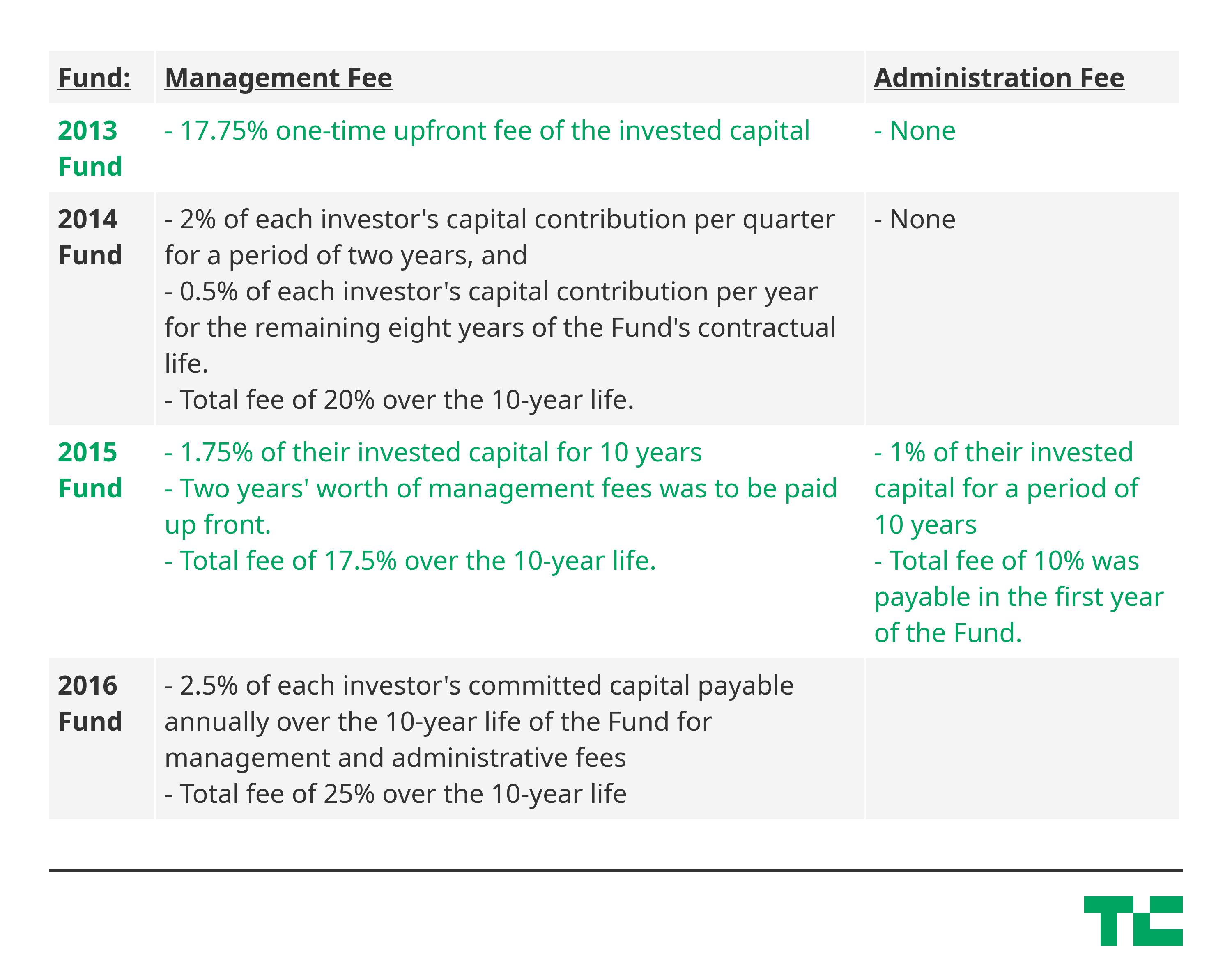
Below is a recreation of the fund structures as reported in the SEC’s case against Mike Rothenberg. Rothenberg Ventures raised a series of four venture funds with fee structures that vary widely from the traditional 2 & 20 model, which assumes a 2% annual management fee for each of the 10 years of a fund’s life (further extensions beyond 10 years don’t usually offer significant fees, although every fund is structured differently). That equation means that management fees generally represent 20% of a fund’s committed capital.
sec v michael rothenberg exhibit a

Source: SEC v. Michael Rothenberg (Exhibit A)

For the firm’s debut fund, Rothenberg entirely eliminated the slow and orderly parceling out of fees in lieu of a one-time 17.75% fee upon the closing of the $2.6 million fund. That meant an immediate infusion of about $470,000 into the firm, but no continual fees thereafter. This sort of heavy upfront payment is not uncommon in the industry, although it is less common to have literally the sum total of management fees for a 10-year fund paid out entirely on its first day.

From an LP perspective, this sort of fee structure indicates that the firm almost certainly would have had to raise additional funds almost as soon as the first one closed, since the fees of future venture funds would be needed to cover the management costs of the first fund in its later years.

In short: This is what a bootstrap looks like in venture capital.

Now, continuing to the second fund (2014), we see a bit more of a traditional parceling out of fees over the course of the fund, although still with a heavy upfront skew. The fund pays out the typical 20% of invested capital in total, but 80% of that amount was paid out in the first two years. Again, the implicit assumption with this sort of bootstrap is that the firm will succeed and raise additional capital (and therefore management fees) to keep the operation going.

We then see the same pattern in the 2015 fund, with fees having a normal structure, but then with more aggressive upfront payouts required. So while the fund had a flat payout every year for its management fee, two years of that fee was to be paid out immediately upon close. Similarly, the administrative fee was flat — but paid out entirely in the first year of the firm’s operation.

Finally, the fourth fund (2016) returns to a more typical, flat fee structure at 2.5% per year with no provisions for upfront payment.

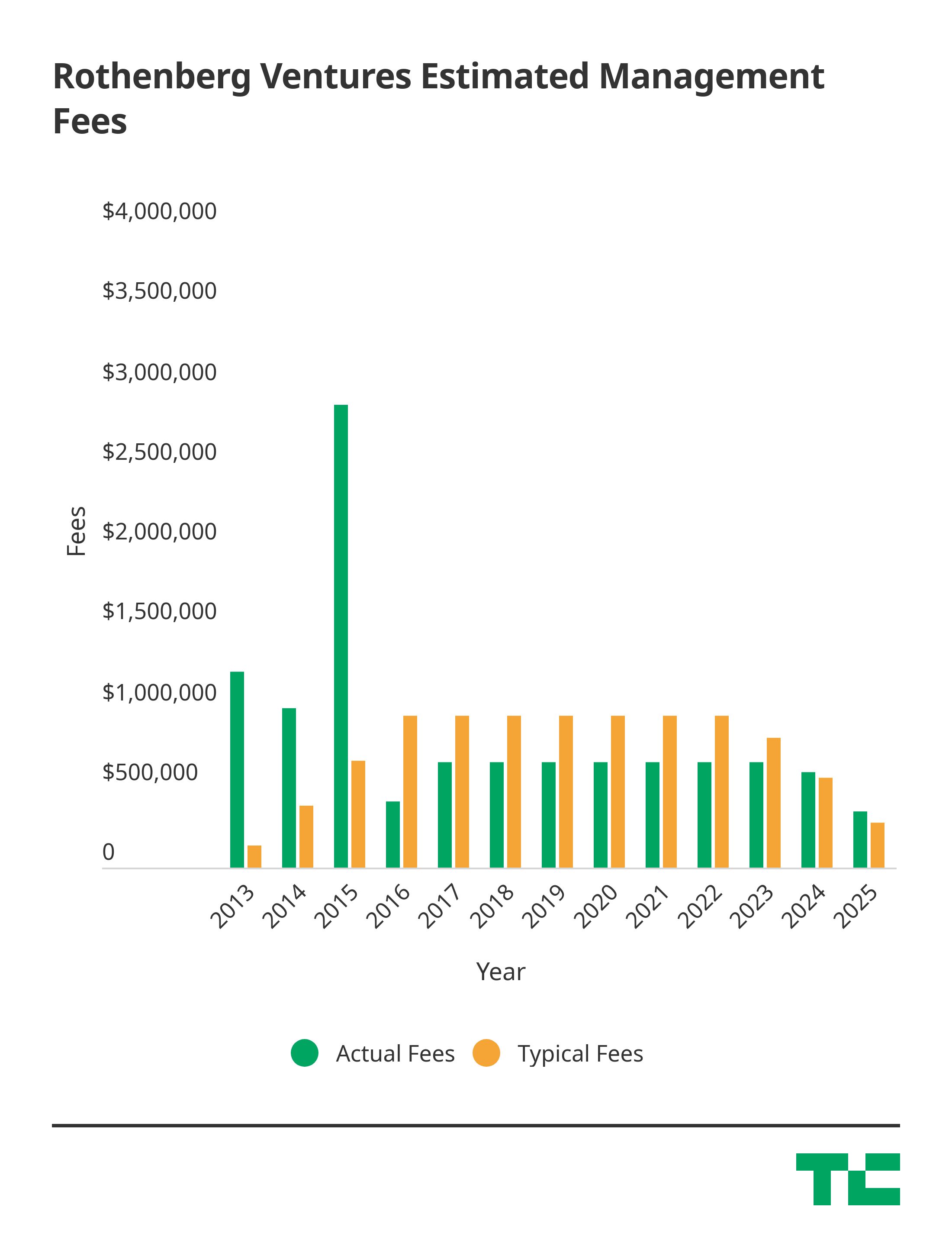
Why does this all matter? Let’s go through a back-of-the-napkin exercise of what these numbers really meant for the operations of the fund:
copy kobalt streaming service total maus paid maus

Data from SEC Case, Exhibit A

As we can clearly see here, all of those management fees upfront really did give the firm far more resources in the early years than it might have otherwise had. Over the first three years, the firm had access to roughly $5.1 million in fees, whereas with a traditional 2% annual structure, the firm would have had access to just $1.2 million. Of course, that bootstrap comes at a cost in the later years, when the firm would have more resources to manage the fund.

Nonetheless, those upfront payments helped the firm tremendously punch above its own weight. With its $1.2 million of fees in year one, it essentially had the resources of a $60 million fund — yet it had only raised $6.7 million. It similarly punched above its weight the next few years as it raised new funds with aggressive upfront fee schedules as well.

Of course, there’s a heavy burden with this approach — it’s a bet-it-all strategy that leaves little room for error (such as a series of failed investments) that might make future fundraising hard. It’s a rocket with no ejection seat, but when it works, it can compress the time to venture fund leader dramatically — maybe even by as much as a decade.

Ultimately, VCs like to bet, and they certainly like to bet on themselves, which is why these sorts of cash-flow optimizations are prevalent for new firms. No one assumes that their firm is going to fail. Plus, these sorts of management fee structures are also among the few tools a non-wealthy individual can use to even get a new fund underway. For new fund managers and for others considering jumping into the VC industry, a nuanced understanding of the risks and opportunities of mortgaging future dollars for present spend is critical — not only for one’s integrity and stress levels, but hopefully to avoid those SEC investigators and forensic accountants, as well.

London edtech startup pi-top sees layoffs after major contract loss

London-based edtech startup pi-top has cut a number of staff, TechCrunch has learned.

According to our sources, the company has reduced its headcount in recent weeks, with staff being told cuts are a result of restructuring as it seeks to implement a new strategy.

One source told us pi-top recently lost out on a large education contract.

Another source said sales at pi-top have been much lower than predicted — with all major bids being lost.

Pi-top confirmed to TechCrunch that it has let staff go, saying it has reduced headcount from 72 to 60 people across its offices in London, Austin and Shenzhen.

Our sources suggest the total number of layoffs could be up to a third. 

In a statement, pi-top told us:

pi-top has become one of the fastest growing ed-tech companies in the market in 4.5 years.  We have a unique vision to increase access to coding and technical education through project based learning to inspire a new generation of makers.

As part of this vision we built up our global team with a view to winning a particularly exciting national project in a developing nation, where we had a previous large scale successful implementation. We were disappointed this tender ultimately fell through due to economic factors in the region and have subsequently made the unfortunate but unavoidable decision to reduce our team size from 72 to 60 people across our offices in London, Austin and Shenzhen.

Moving forward we are focusing on our growth within the USA where we continue to enjoy widespread success. We are rolling out our new learning platform pi-top Further which will enable schools everywhere to access a world of content enhanced by practical hands-on project based learning outcomes. We have recently completed a successful Kickstarter campaign and we look forward to releasing our newest product pi-top [4].

We are also proud to have appointed Stanley Buchesky as our new Executive Chairman. Stanley brings a wealth of experience in the ed-tech sector and will be a great asset to our strategy going forward.

Pi-top sells hardware and software designed for educational use in schools. It’s one of a large number of edtech startups that have sought to tap into the popularity of the “learn to code” movement by piggybacking atop the (also British) low-cost Raspberry Pi microprocessor — which provides the computing power for all pi-top’s products.

Pi-top adds its own OS and additional education-focused software to the Pi, as well as proprietary cases — including a bright green laptop housing with a built-in rail for breadboarding electronics.

Its most recent product, the pi-top 4, which was announced back in January, looks intended to move the company away from its first focus on educational desktop computing to more modular and embeddable hardware hacking that could be used by schools to power a wider variety of robotics and electronics projects.

Despite raising $16M in VC funding just over a year ago, pi-top opted to run a crowdfunding campaign for the pi-top 4 — going on to raise almost $200,000 on Kickstarter from 521 backers.

Pi-top 4 backers have been told to expect the device to ship in November.

Venmo launches instant transfers to bank accounts

PayPal -owned payments app Venmo today announced support for instant transfers to U.S. bank accounts. The feature is an optional alternative to Venmo’s standard bank transfer service, which typically takes one to three business days to process transactions. With Instant Transfer, however, funds from your Venmo account can hit your bank account within minutes.

As of January 2018, Venmo has offered Instant Transfers to eligible Visa and Mastercard debit cards for a small fee. At launch, the fee was a flat $0.25, but Venmo bumped it up to 1% of the transferred amount last October. Now, the minimum fee is $0.25 and the maximum fee is $10. Of course, users can still choose the standard transfer option if they don’t want to pay for the convenience of instant payments.

While transferring to a debit card is useful for gaining quick access to cash stored in Vemno, not everyone carries a debit card nor do they always want their funds to go to that card. Bank transfers can also aid small business customers or gig economy workers by moving their Venmo cash to their main account for paying bills, rent and other automatically debited transactions.

The news of an expanded Instant Transfer service comes at a time when Venmo is seeing increased competition from rivals, including Square’s Cash App and the bank-operated Venmo challenger, Zelle. Thanks to its built-in customer base and integrations with U.S. banking apps, Zelle reported $44 billion sent on 171 million transactions in Q2 2019, making it the largest peer-to-peer payment app in the U.S. by a wide margin. Venmo’s payment volume in Q2, meanwhile, was $24 billion.

However, with more than 40 million active accounts, Venmo has more users than some of the U.S.’s bigger banks. And it’s still growing.

Offering an expanded fee-based Instant Transfer service to its customers could increase Venmo’s revenue and help push the service to profitability, along with its other plans — like launching its own credit card, for instance.

Venmo parent company PayPal has also offered instant transfers to bank accounts as of March after first announcing its plans back in 2017.


Postmates to drop IPO filing next month

Postmates plans to make its IPO paperwork public in September, TechCrunch has learned. Despite previous reports indicating the on-demand delivery company is seeking an M&A exit, sources close to the matter say Postmates is on track to go complete an initial public offering this year.

With the S-1 dropping in September, San Francisco-based Postmates is expected to debut on the stock exchange by the end of the third fiscal quarter of 2019. The company has tapped JP Morgan Chase and Bank of America Corp. as lead underwriters, Bloomberg previously reported, though other details of the float, including the size and price range of the proposed offering, have yet to be announced.

“We can’t comment on the IPO process and we don’t comment on rumor or speculation,” a Postmates spokesperson told TechCrunch.

In February, Postmates confidentially filed with the U.S. Securities and Exchange Commission for an IPO. Shortly after, Postmates held M&A talks with DoorDash, another food delivery unicorn, according to people familiar with the matter, but failed to come to mutually favorable terms. DoorDash declined to comment for this story.

Postmates has raised $681 million to date with its latest round coming in earlier this year at a $1.85 billion valuation. DoorDash, on the other hand, reached a $12.6 billion valuation in May with a $600 million Series G.

As Postmates gears up for its IPO, the food delivery business continues to consolidate. DoorDash last week purchased another food delivery service, Caviar, from Square in a deal worth $410 million. Uber is said to have considered buying Caviar, which had been looking for a buyer at least since 2016, according to Bloomberg.

DoorDash has been under heavy scrutiny as of late for the way it pays its drivers. Back in February, we reported how DoorDash offsets the amount it pays drivers with tips from customers. It wasn’t until after much backlash that DoorDash finally said it would change its policies. DoorDash has yet to implement the new policy.

How Postmates will fare on the public markets is up for debate. The billion-dollar company will go head-to-head with other public businesses in the space, including powerhouses Uber and Grubhub.

Uber last week shared disappointing second-quarter earnings. The company’s food delivery unit, UberEats, however, continues to grow at an impressive rate. UberEats did $3.39 billion in gross bookings last quarter with monthly active platform consumers (MAPCs) growing more than 140% year-over-year. Still, the unit is years away from profitability, Uber chief Dara Khosrowshahi told CNBC on Thursday.

Postmates’ updated IPO plans follow a report from Bloomberg that WeWork expects to make its IPO prospectus available in the next week. Eyes will be on both WeWork, which hopes to raise more than $3.5 billion, and Postmates, as the companies occupy two unproven categories.

Postmates follows Uber, Lyft, Pinterest and many others to the public markets in 2019, a year when many of Silicon Valley’s most notable unicorns finally decided to make the transition from private to public.

Postmates, founded in 2011 by Bastian Lehmann, is backed by Spark Capital, Founders Fund, Uncork Capital, Slow Ventures, Tiger Global, Blackrock and others.

Polarity raises $8.1M for its AI software that constantly analyzes employee screens and highlights key info

Reference docs and spreadsheets seemingly make the world go ’round, but what if employees could just close those tabs for good without losing that knowledge?

One startup is taking on that complicated challenge. Predictably, the solution is quite complicated, as well, from a tech perspective, involving an AI solution that analyzes everything on your PC screen — all the time — and highlights text onscreen for which you could use a little bit more context. The team at Polarity wants its tech to help teams lower the knowledge barrier to getting stuff done and allow people to focus more on procedure and strategy than memorizing file numbers, IP addresses and jargon.

The Connecticut startup just closed an $8.1 million “AA” round led by TechOperators, with Shasta Ventures, Strategic Cyber Ventures, Gula Tech Adventures and Kaiser Permanente Ventures also participating in the round. The startup closed its $3.5 million Series A in early 2017.

Interestingly, the enterprise-centric startup pitches itself as an AR company, augmenting what’s happening on your laptop screen much like a pair of AR glasses could.

The startup’s computer vision software that uses character recognition to analyze what’s on a user’s screen can be helpful for enterprise teams importing things like a company Rolodex so that bios are always collectively a click away, but the real utility comes from team-wide flagging of things like suspicious IP addresses that will allow entire teams to learn about new threats and issues at the same time without having to constantly check in with their co-workers. The startup’s current product has a big focus on analysts and security teams.

Polarity before and after two

via Polarity

Using character recognition to analyze a screen for specific keywords is useful in itself, but that’s also largely a solved computer vision problem.

Polarity’s big advance has been getting these processes to occur consistently on-device without crushing a device’s CPU. CEO Paul Battista says that for the average customer, Polarity’s software generally eats up about 3-6% of their computer’s processing power, though it can spike much higher if the system is getting fed a ton of new information at once.

“We spent years building the tech to accomplish [efficiency], readjusting how people think of [object character recognition] and then doing it in real time,” Battista tells me. “The more data that you have onscreen, the more power you use. So it does use a significant percentage of the CPU.”

Why bother with all of this AI trickery and CPU efficiency when you could pull this functionality off in certain apps with an API? The whole deliverable here is that it doesn’t matter if you’re working in Chrome, or Excel or pulling up a scanned document, the software is analyzing what’s actually being rendered onscreen, not what the individual app is communicating.

When it comes to a piece of software analyzing everything on your screen at all times, there are certainly some privacy concerns, not only from the employee’s perspective but from a company’s security perspective.

Battista says the intent with this product isn’t to be some piece of corporate spyware, and that it won’t be something running in the background — it’s an app that users will launch. “If [companies] wanted to they could collect all of the data on everybody’s screens, but we don’t have any customers doing that. The software is built to have a user interface for users to interact with so if the user didn’t choose to subscribe or turn on a metric, then [the company] wouldn’t be able to force them to collect it in the current product.”

Battista says that teams at seven Fortune 100 companies are currently paying for Polarity, with many more in pilot programs. The team is currently around 20 people and with this latest fundraise, Battista wants to double the size of the team in the next 18 months as they look to scale to larger rollouts at major companies.

Huawei’s new OS isn’t an Android replacement… yet

If making an Android alternative was easy, we’d have a lot more of them. Huawei’s HarmonyOS won’t be replacing the mobile operating system for the company anytime soon, and Huawei has made it pretty clear that it would much rather go back to working with Google than go it alone.

Of course, that might not be an option.

The truth is that Huawei and Google were actually getting pretty chummy. They’d worked together plenty, and according to recent rumors, were getting ready to release a smart speaker in a partnership akin to what Google’s been doing with Lenovo in recent years. That was, of course, before Huawei was added to a U.S. “entity list” that ground those plans to a halt.

SpaceX, Blue Origin, ULA and Northrop Grumman bid for US national security launch contract

The U.S. Air Force is looking to lock in its launch providers for national security satellite missions to take place between 2022 and 2026, and the bids for this so-called “Phase 2” procurement contract are now in. The field of competitors looking to become one of the two companies chosen is a who’s who of U.S. commercial launch providers at the moment, including SpaceX, Blue Origin, ULA and Northrop Grumman.

Both Northrop Grumman and Blue Origin are new entrants in this particular launch contracting area, while SpaceX and ULA are existing providers that handle U.S. national security missions. SpaceX additionally has a bit of a head start, since its Falcon rockets are the only proven, certified launch vehicles included in the bids submitted, while ULA has offered up its new Vulcan Centaur, which is tailor-made for the job but not yet certified and flight-proven; the others are still seeking certification.

“SpaceX means to serve as the Air Force’s long-term provider for space launch, offering existing, certified and proven launch systems capable of carrying out the full spectrum of national security space launch missions and requirements,” said SpaceX COO and president Gwynne Shotwell in an emailed statement, regarding this new bid.

SpaceX clearly sees its Falcon launch system as a key competitive advantage, as it’s flying currently for USAF and national security missions — the company says that this represents the lowest risk for the government overall in terms of providers for this mission, and with known costs, as well.

The Air Force will make its final selection about the two winning providers in 2020.