Lumineye helps first responders identify people through walls

Any first responder knows that situational awareness is key. In domestic violence disputes, hostage rescue or human trafficking situations, first responders often need help determining where humans are behind closed doors.

That’s why Megan Lacy, Corbin Hennen and Rob Kleffner developed Lumineye, a 3D-printed radar device that uses signal analysis software to differentiate moving and breathing humans from other objects, through walls.

Lumineye uses pulse radar technology that works like echolocation (how bats and dolphins communicate). It sends signals and listens for how long it takes for a pulse to bounce back. The software analyzes these pulses to determine the approximate size, range and movement characteristics of a signal.

On the software side, Lumineye’s app will tell a user how far away a person is when they’re moving and breathing. It’s one dimensional, so it doesn’t tell the user whether the subject is to the right or left. But the device can detect humans out to 50 feet in open air; that range decreases depending upon the materials placed in between, like drywall, brick or concrete.

One scenario the team gave to describe the advantages of using Lumineye was the instance of hostage rescue. In this type of situation, it’s crucial for first responders to know how many people are in a room and how far away they are from one another. That’s where the use of multiple devices and triangulation from something like Lumineye could change a responding team’s tactical rescue approach.

Machines that currently exist to make these kind of detections are heavy and cumbersome. The team behind Lumineye was inspired to manufacture a more portable option that won’t weigh down teams during longer emergency response situations that can sometimes last for up to 12 hours or overnight. The prototype combines the detection hardware with an ordinary smartphone. It’s about 10 x 5 inches and weighs 1.5 pounds.

Lumineye wants to grow out its functionality to become more of a ubiquitous device. The team of four is planning to continue manufacturing the device, selling it directly to customers.


Lumineye Device BreathingMode

Lumineye’s device can detect humans through walls using radio frequencies

Lumineye has just started its pilot programs, and recently spent a Saturday at a FEMA event testing out the the device’s ability to detect people covered in rubble piles. The company was born out of the Boise, Idaho cohort of Stanford’s Hacking4Defense program, a course meant to connect Silicon Valley innovations with the U.S. Department of Defense and Intelligence Community. The Idaho-based startup is graduating from Y Combinator’s Summer 2019 class.

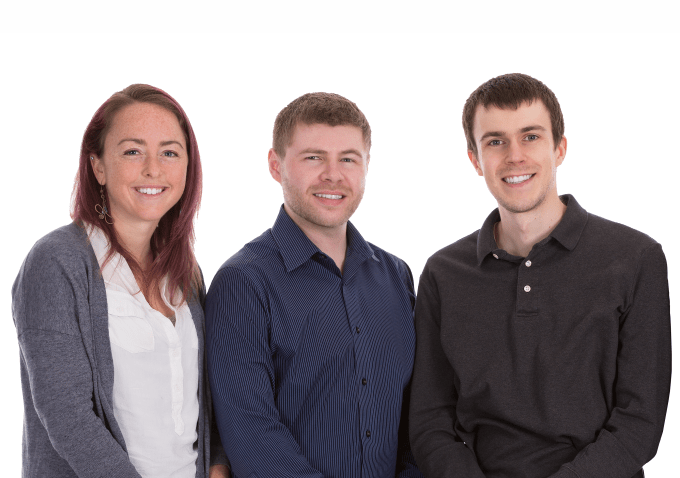
Lumineye TeamPicture 1

Megan Lacy, Corbin Hennen and Rob Kleffner

China’s Transsion and Kenya’s Wapi Capital partner on Africa fund

Chinese mobile-phone and device maker Transsion is teaming up with Kenya’s Wapi Capital to source and fund early-stage African fintech startups.

Headquartered in Shenzhen, Transsion is a top-seller of smartphones in Africa that recently confirmed its imminent IPO.

Wapi Capital is the venture fund of Kenyan fintech startup Wapi Pay—a Nairobi based company that facilitates digital payments between African and Asia via mobile money or bank accounts.

Investments for the new partnership will come from Transsion’s Future Hub, an incubator and seed fund for African startups opened by Transsion in 2019.

Starting September 2019, Transsion will work with Wapi Capital to select early-stage African fintech companies for equity-based investments of up to $100,000, Transsion Future Hub Senior Investor Laura Li told TechCrunch via email.

Wapi Capital won’t contribute funds to Transsion’s Africa investments, but will help determine the viability and scale of the startups, including due diligence and deal flow, according to Wapi Pay co-founder Eddie Ndichu.

Wapi Pay and Transsion Future Hub will consider ventures from all 54 African countries and interested startups can reach out directly to either organization, Ndichu and Li confirmed.

The Wapi Capital fintech partnership is not Transsion’s sole VC focus in Africa. Though an exact fund size hasn’t been disclosed, the Transsion Future Hub will also make startup investments on the continent in adtech, fintech, e-commerce, logistics, and media and entertainment, according to Li.

Transsion Future Hub’s existing portfolio includes Africa focused browser company Phoenix, content aggregator Scoop, and music service Boomplay.

Wapi Capital adds to the list of African located and run venture funds—which have been growing in recent years—according to a 2018 study by TechCrunch and Crunchbase. Wapi Capital will also start making its own investments and is looking to raise $1 million this year and $10 million over the next three years, according to Ndichu, who co-founded the fund and Wapi Pay with his twin brother Paul.

Transsion’s commitment to African startup investments comes as the company is on the verge of listing on China’s new Nasdaq-style STAR Market tech exchange. Transsion confirmed to TechCrunch this month the IPO is in process and that it could raise up to 3 billion yuan (or $426 million).

Transsion sold 124 million phones globally in 2018, per company data. In Africa, Transsion holds 54% of the feature phone market — through its brands Tecno, Infinix and Itel — and in smartphone sales is second to Samsung and before Huawei, according to International Data Corporation stats.

Transsion has R&D centers in Nigeria and Kenya and its sales network in Africa includes retail shops in Nigeria, Kenya, Tanzania, Ethiopia and Egypt. The company also has a manufacturing facility in Ethiopia.

Transsion’s move into venture investing tracks greater influence from China in African tech.

China’s engagement with African startups has been light compared to China’s deal-making on infrastructure and commodities.

Transsion’s Wapi Pay partnership is the second recent event — after Chinese owned Opera’s big venture spending in Nigeria — to reflect greater Chinese influence and investment in the continent’s digital scene.


Twitter leads $100M round in top Indian regional social media platform ShareChat

Is there room for another social media platform? ShareChat, a four-year-old social network in India that serves tens of million of people in regional languages, just answered that question with a $100 million financing round led by global giant Twitter .

Other than Twitter, TrustBridge Partners, and existing investors Shunwei Capital, Lightspeed Venture Partners, SAIF Capital, India Quotient and Morningside Venture Capital also participated in the Series D round of ShareChat.

The new round, which pushes ShareChat’s all-time raise to $224 million, valued the firm at about $650 million, a person familiar with the matter told TechCrunch. ShareChat declined to comment on the valuation.

Screen Shot 2019 08 16 at 8.38.38 AM

“Twitter and ShareChat are aligned on the broader purpose of serving the public conversation, helping the world learn faster and solve common challenges. This investment will help ShareChat grow and provide the company’s management team access to Twitter’s executives as thought partners,” said Manish Maheshwari, managing director of Twitter India, in a prepared statement.

Twitter, like many other Silicon Valley firms, counts India as one of its key markets. And like Twitter, other Silicon Valley firms are also increasingly investing in Indian startups.

ShareChat serves 60 million users each month in 15 regional languages, Ankush Sachdeva, co-founder and CEO of the firm, told TechCrunch in an interview. The platform currently does not support English, and has no plans to change that, Sachdeva said.

That choice is what has driven users to ShareChat, he explained. The early incarnation of the social media platform supported English language. It saw most of its users choose English as their preferred language, but this also led to another interesting development: Their engagement with the app significantly reduced.

The origin story

“For some reason, everyone wanted to converse in English. There was an inherent bias to pick English even when they did not know it.” (Only about 10% of India’s 1.3 billion people speak English. Hindi, a regional language, on the other hand, is spoken by about half a billion people, according to official government figures.)

So ShareChat pulled support for English. Today, an average user spends 22 minutes on the app each day, Sachdeva said. The learning in the early days to remove English is just one of the many things that has shaped ShareChat to what it is today and led to its growth.

In 2014, Sachdeva and two of his friends — Bhanu Singh and Farid Ahsan, all of whom met at the prestigious institute IIT Kanpur — got the idea of building a debate platform by looking at the kind of discussions people were having on Facebook groups.

They identified that cricket and movie stars were popular conversation topics, so they created WhatsApp groups and aggressively posted links to those groups on Facebook to attract users.

It was then when they built chatbots to allow users to discover different genres of jokes, recommendations for phones and food recipes, among other things. But they soon realized that users weren’t interested in most of such offerings.

“Nobody cared about our smartphone recommendations. All they wanted was to download wallpapers, ringtones, copy jokes and move on. They just wanted content.”

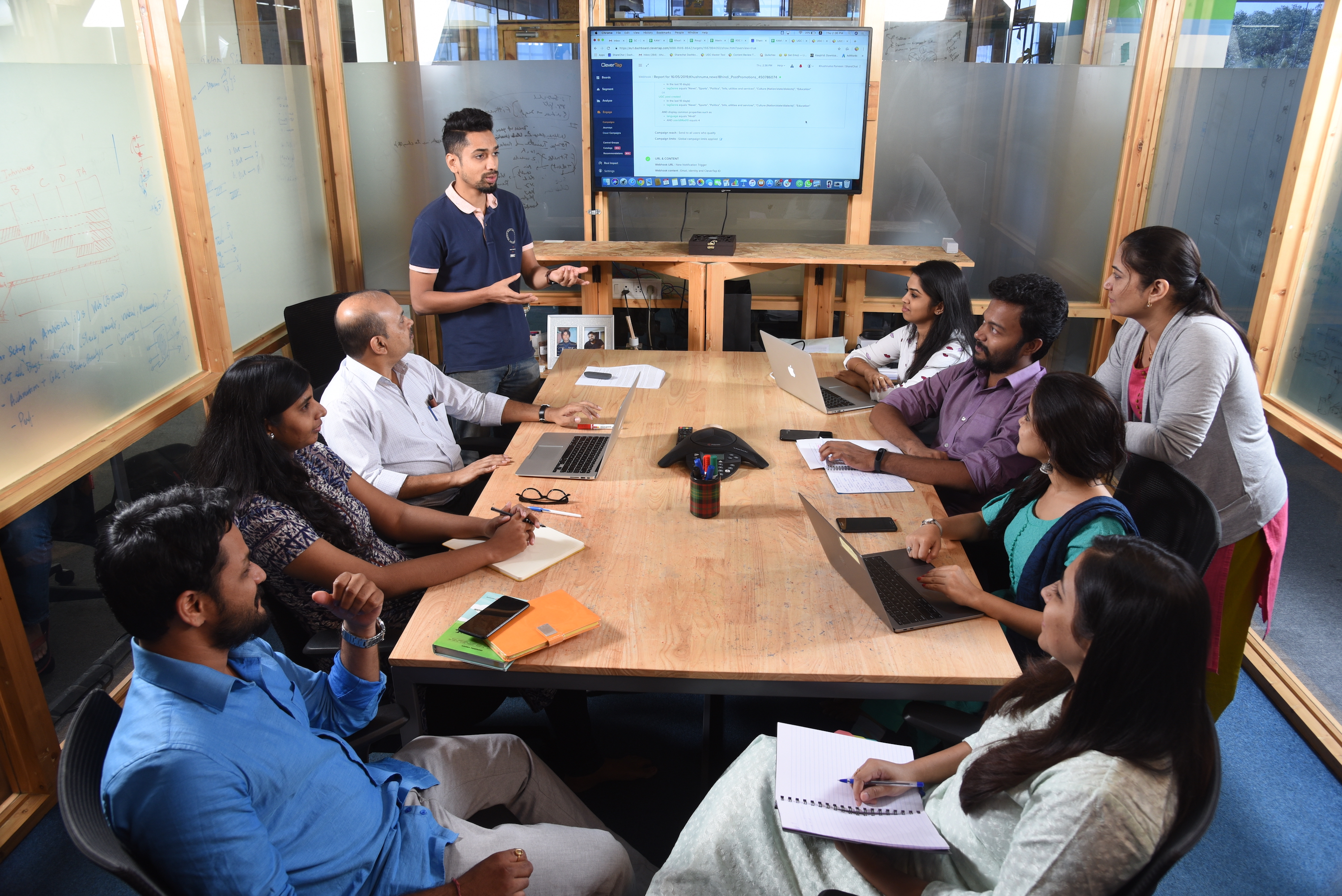
sharechat team

So in 2015, Sachdeva and company moved on from chatbots and created an app where users can easily produce, discover and share content in the languages they understand. (Today, user generated content is one of the key attractions of the platform, with about 15% of its user base actively producing content.)

A year later, ShareChat, like tens of thousands of other businesses, was in for a pleasant surprise. India’s richest man, Mukesh Ambani, launched his new telecom network Reliance Jio, which offered users access to the bulk of data at little to no charge for an extended period of time.

This immediately changed the way millions of people in the country, who once cared about each megabyte they consumed online, interacted with the internet. On ShareChat people quickly started to move from sharing jokes and other messages in text format to images and then videos.

Path ahead and monetization

That momentum continues to today. ShareChat now plans to give users more incentive — including money — and tools to produce content on the platform to drive engagement. “There remains a huge hunger for content in vernacular languages,” Sachdeva said.

Speaking of money, ShareChat has experimented with ads on the app and its site, but revenue generation isn’t currently its primary focus, Sachdeva said. “We’re in the Series D now so there is obviously an obligation we have to our investors to make money. But we all believe that we need to focus on growth at this stage,” he said.

ShareChat, which is headquartered in Bangalore, also has many users in Bangladesh, Nepal and the Middle East, where many users speak Indian regional languages. But the startup currently plans to focus largely on expanding its user base in India, hopefully doubling it in the next one year, he said.

It will use the new capital to strengthen the technology infrastructure and hire more tech talent. Sachdeva said ShareChat is looking to open an office in San Francisco to hire local engineers there.

A handful of local and global giants have emerged in India in recent years to cater to people in small cities and villages, who are just getting online. Pratilipi, a storytelling platform has amassed more than 5 million users, for instance. It recently raised $15 million to expand its user base and help users strike deals with content studios.

Perhaps no other app poses a bigger challenge to ShareChat than TikTok, an app where users share short-form videos. TikTok, owned by one of the world’s most valued startups, has over 120 million users in India and sees content in many Indian languages.

But the app — with its ever growing ambitions — also tends to land itself in hot water in India every few weeks. In all sensitive corners of the country. On that front, ShareChat has an advantage. Over the years, it has emerged as an outlier in the country that has strongly supported proposed laws by the Indian government that seek to make social apps more accountable for content that circulates on their platforms. Though it is grappling with some of this issue, too.

Apple is suing Corellium

Apple is suing virtualization software company Corellium, according to documents filed today in Florida.

Corellium allows customers to create and interact with virtual iOS devices — a software iPhone, for example, running actual iOS firmware, all within the browser. Apple says this is copyright infringement, and is demanding Corellium stops “all uses of” its iOS virtualization products and pays Apple unspecified “damages and lost profits”

Corellium could allow, for example, a security researcher to quickly fire up a simulated iPhone and hunt for potential bugs. If one is discovered, they can quickly load up prior versions of iOS to see how long this bug has been around. If a bug “bricks” the virtual iOS device and renders it unusable, it’s a matter of just booting up a new one rather than obtaining a whole new phone. Virtualized devices can be paused, giving researchers a detailed look at its precise state at any given moment .

Forbes did a deep dive on the company last year. As they point out, two of the company’s co-founders were some of the earliest members of the iPhone jailbreak scene, giving them an understanding better than nearly anyone else in the world as to how iPhones, iPads, etc work under the hood.

In its complaint, Apple writes:

The product Corellium offers is a “virtual” version of Apple mobile hardware products, accessible to anyone with a web browser. Specifically, Corellium serves up what it touts as a perfect digital facsimile of a broad range of Apple’s market-leading devices—recreating with fastidious attention to detail not just the way the operating system and applications appear visually to bona fide purchasers, but also the underlying computer code. Corellium does so with no license or permission from Apple.

This news comes just days after Apple announced that it would be launching a “iOS Security Research Device Program”, in which select security researchers would be given access to less-locked down iOS devices in order to help them find vulnerabilities.

Toolkit for digital abuse could help victims protect themselves

Domestic abuse comes in digital forms as well as physical and emotional, but a lack of tools to address this kind of behavior leaves many victims unprotected and desperate for help. This Cornell project aims to define and detect digital abuse in a systematic way.

Digital abuse may be many things: hacking the victim’s computer, using knowledge of passwords or personal date to impersonate them or interfere with their presence online, accessing photos to track their location, and so on. As with other forms of abuse, there are as many patterns as there are people who suffer from it.

But with something like emotional abuse, there are decades of studies and clinical approaches to address how to categorize and cope with it. Not so with newer phenomena like being hacked or stalked via social media. That means there’s little standard playbook for them, and both abused and those helping them are left scrambling for answers.

“Prior to this work, people were reporting that the abusers were very sophisticated hackers, and clients were receiving inconsistent advice. Some people were saying, ‘Throw your device out.’ Other people were saying, ‘Delete the app.’ But there wasn’t a clear understanding of how this abuse was happening and why it was happening,” explained Diana Freed, a doctoral student at Cornell Tech and co-author of a new paper about digital abuse.

“They were making their best efforts, but there was no uniform way to address this,” said co-author Sam Havron. “They were using Google to try to help clients with their abuse situations.”

Investigating this problem with the help of a National Science Foundation grant to examine the role of tech in domestic abuse, they and some professor collaborators at Cornell and NYU came up with a new approach.

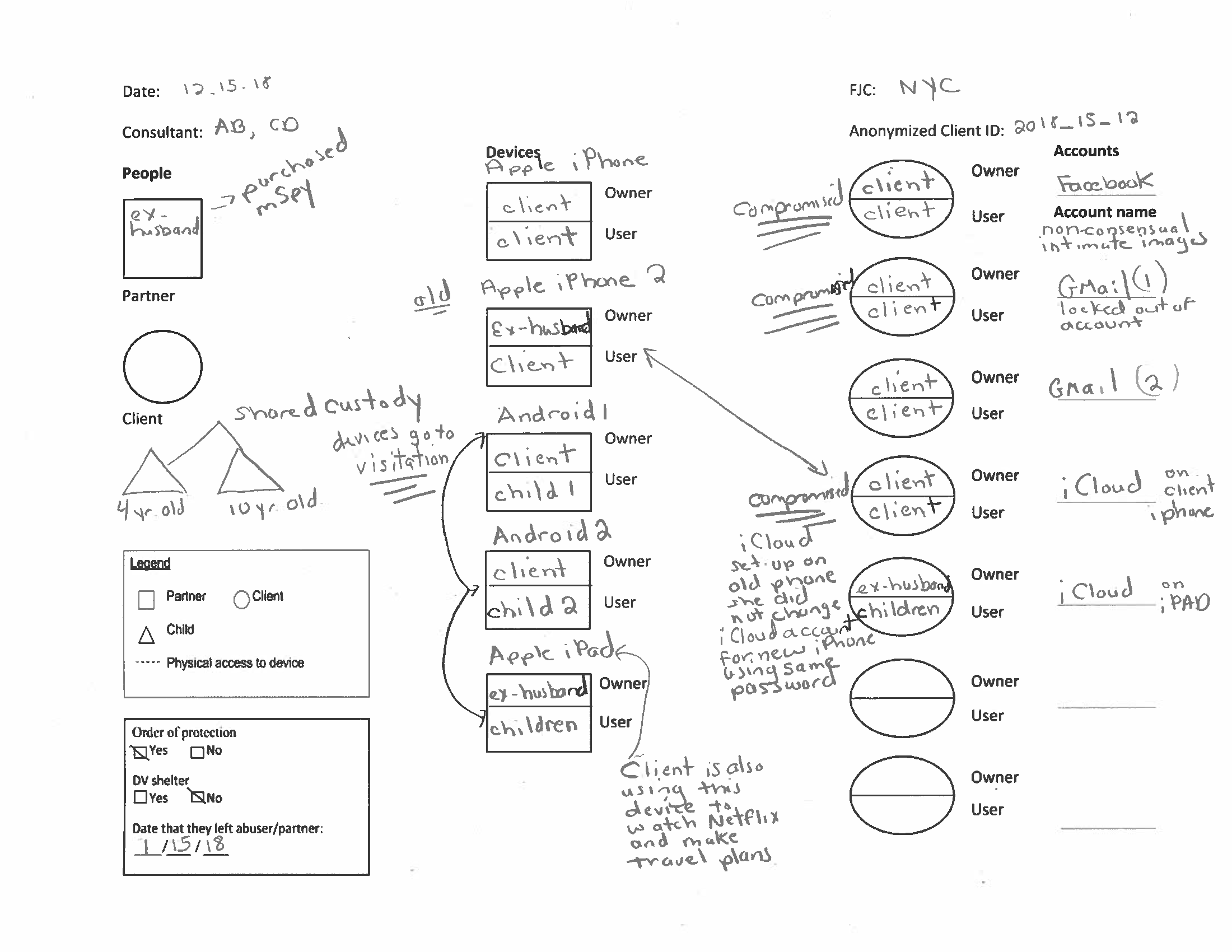
There’s a standardized questionnaire to characterize the type of tech-based being experienced. It may not occur to someone who isn’t tech-savvy that their partner may know their passwords, or that there are social media settings they can use to prevent that partner from seeing their posts. This information and other data are added to a sort of digital presence diagram the team calls the “technograph” and which helps the victim visualize their technological assets and exposure.

technograph filled

The team also created a device they call the IPV Spyware Discovery, or ISDi. It’s basically spyware scanning software loaded on a device that can check the victim’s device without having to install anything. This is important because an abuser may have installed tracking software that would alert them if the victim is trying to remove it. Sound extreme? Not to people fighting a custody battle who can’t seem to escape the all-seeing eye of an abusive ex. And these spying tools are readily available for purchase.

“It’s consistent, it’s data-driven and it takes into account at each phase what the abuser will know if the client makes changes. This is giving people a more accurate way to make decisions and providing them with a comprehensive understanding of how things are happening,” explained Freed.

Even if the abuse can’t be instantly counteracted, it can be helpful simply to understand it and know that there are some steps that can be taken to help.

The authors have been piloting their work at New York’s Family Justice Centers, and following some testing have released the complete set of documents and tools for anyone to use.

This isn’t the team’s first piece of work on the topic — you can read their other papers and learn more about their ongoing research at the Intimate Partner Violence Tech Research program site.

Cloudflare, in its IPO filing, thanks a third cofounder: Lee Holloway

Not every co-founder is acknowledged at the companies that they help to launch. Sometimes, they quit or they’re elbowed out. Often, they’re conveniently written out of the company’s history.

In the case of Cloudflare, a third co-founder who began the company with its higher-profile CEO, Matthew Prince, and its COO, Michelle Zatlyn, is little known outside the company for a very different reason. As Cloudflare states in an S-1 IPO filing that it made public today, “Tragically, Lee stepped down from Cloudflare in 2015, suffering the debilitating effects of Frontotemporal Dementia, a rare neurological disease.”

Frontotemporal dementia impacts between 50,000 and 60,000 Americans, according to a rough estimate cited by the Alzheimer’s Association, and it tends to impact younger people, often beginning in their 40s.

Though the cause isn’t known, a person’s risk for developing frontotemporal dementia — wherein the frontal and temporal lobes of the brain shrink — is higher if there’s a family history of dementia, according to the Mayo Clinic.

Cloudflare did not respond today to questions about Holloway, but Prince and Zatlyn, in a section of the filing addressed to potential shareholders, credit Holloway as the “genius who architected our platform and recruited and led our early technical team.” In fact, they write, when picking a code name for the company’s IPO, they chose “Project Holloway” to honor his contribution, because the “technical decisions Lee made, and the engineering team he built, are fundamental to the business we have become.”

Holloway’s beneficiaries will be rewarded for that work. According to the S-1, trusts affiliated with him own 18% of the company’s Series A shares (or common shares) and 3.2% of the company’s total outstanding shares. Prince meanwhile owns 20.2% of the company’s class B shares and 16.6% of all outstanding shares, and Zatlyn has 6.8% of the company’s class B shares and 5.6% of the overall shares outstanding.

If Cloudflare goes public at the $3.2 billion valuation that it was last assigned by its private investors, Holloway’s family and other trust recipients could see upwards of $100 million.

That’s none too shabby for a computer geek who attended Monte Vista High School in Danville, Calif., before working as an engineer at the bubble-era home improvement site HomeWarehouse.com. Its assets were sold in 2000 to Walmart.com in an apparent fire sale; at the time, then-CEO Jeanne Jackson told the San Francisco Chronicle that Walmart was “very impressed with the commerce platform developed by the Homewarehouse.com team.”

After that experience, Holloway headed to UC Santa Cruz, where he studied computer science and, in a meeting that would change his life, was introduced through a professor to Prince with whom he began building an anti-spam startup called Unspam Technologies. Holloway was its chief software architect; Prince continues to serve as chairman.

The two also co-created Project Honey Pot, an open-source community that still tracks online fraud and abuse.

Zatlyn would enter the picture soon after.

According to Cloudflare itself, in 2009, Prince had taken a sabbatical from work to get his MBA from Harvard Business School. It was when he began telling Zatlyn, a classmate, about Project Honey Pot and its community of users that she helped him recognize a related opportunity in not just tracking internet threats but also stopping them.

While they worked on the business plan as part of their studies, Holloway built the first working prototype. It worked well enough that by 2010, they were pitching investors at a TechCrunch Disrupt as one of the event’s “battlefield” participants.

Holloway wasn’t onstage for that demonstration. He might have preferred to operate in the background given the nature of his work.

Indeed, in the first of just three tweets he has ever published, he wrote simply, “Pondering the nature of web exploits.”

Pictured above: Cloudflare co-founders Zatlyn, Holloway and Prince.

These robo-shorts are the precursor to a true soft exoskeleton

When someone says “robotic exoskeleton,” the power loaders from Aliens are what come to mind for most people (or at least me), but the real things will be much different: softer, smarter and used for much more ordinary tasks. The latest such exo from Harvard is so low-profile you could wear it around the house.

Designed by researchers at Harvard’s Wyss Institute (in collaboration with several other institutions), which focuses on soft robotics and bio-inspired mechanisms, the exosuit isn’t for heavy lifting or combating xenomorphs, but simply walking and running a little bit more easily.

The suit, which is really more of a pair of shorts with a mechanism attached at the lower back and cables going to straps on the legs, is intended to simply assist the leg in its hip-extension movement, common to most forms of locomotion.

An onboard computer (and neural network, naturally) detects the movements of the wearer’s body and determines both the type of gait (walking or running) and what phase of that gait the leg is currently in. It gives the leg making the movement a little boost, making it just that much easier to do it.

In testing, the suit reduced the metabolic load of walking by 9.3% and running by 4%. That might not sound like much, but they weren’t looking to create an Olympic-quality cyborg — just show reliable gains from a soft, portable exosuit.

“While the metabolic reductions we found are modest, our study demonstrates that it is possible to have a portable wearable robot assist more than just a single activity, helping to pave the way for these systems to become ubiquitous in our lives,” said lead study author Conor Walsh in a news release.

The whole idea, then, is to leave behind the idea of an exosuit as a big mechanical thing for heavy industry or work, and bring in the idea that one could help an elderly person stand up from a chair, or someone recovering from an accident walk farther without fatigue.

rt scitoc aug16 r1

The whole device, shorts and all, weighs about 5 kilograms, or 11 pounds. Most of that is in the little battery and motor pack stashed at the top of the shorts, near the body’s center of mass, helping it feel lighter than it is.

Of course, this is the kind of thing the military is very interested in — not just for active duty (a soldier who can run twice as far or fast) but for treatment of the wounded. So it shouldn’t be a surprise that this came out of a DARPA project initiated years ago (and ongoing in other forms).

But by far the more promising applications are civilian, in the medical field and beyond. “We are excited to continue to apply it to a range of applications, including assisting those with gait impairments, industry workers at risk of injury performing physically strenuous tasks, or recreational weekend warriors,” said Walsh.

Currently the team is hard at work improving the robo-shorts, reducing the weight, making the assistance more powerful and more intuitive and so on. The paper describing their system was the cover story of this week’s edition of the journal Science.

The renaissance of silicon will create industry giants

Navin Chaddha
Contributor

Navin Chaddha leads Mayfield. The firm invests in early-stage consumer and enterprise technology companies and currently has $2.7 billion under management.

Every time we binge on Netflix or install a new internet-connected doorbell to our home, we’re adding to a tidal wave of data. In just 10 years, bandwidth consumption has increased 100 fold, and it will only grow as we layer on the demands of artificial intelligence, virtual reality, robotics and self-driving cars. According to Intel, a single robo car will generate 4 terabytes of data in 90 minutes of driving. That’s more than 3 billion times the amount of data people use chatting, watching videos and engaging in other internet pastimes over a similar period.

Tech companies have responded by building massive data centers full of servers. But growth in data consumption is outpacing even the most ambitious infrastructure build outs. The bottom line: We’re not going to meet the increasing demand for data processing by relying on the same technology that got us here.

The key to data processing is, of course, semiconductors, the transistor-filled chips that power today’s computing industry. For the last several decades, engineers have been able to squeeze more and more transistors onto smaller and smaller silicon wafers — an Intel chip today now squeezes more than 1 billion transistors on a millimeter-sized piece of silicon.

This trend is commonly known as Moore’s Law, for the Intel co-founder Gordon Moore and his famous 1965 observation that the number of transistors on a chip doubles every year (later revised to every two years), thereby doubling the speed and capability of computers.

This exponential growth of power on ever-smaller chips has reliably driven our technology for the past 50 years or so. But Moore’s Law is coming to an end, due to an even more immutable law: material physics. It simply isn’t possible to squeeze more transistors onto the tiny silicon wafers that make up today’s processors.

Compounding matters, the general-purpose chip architecture in wide use today, known as x86, which has brought us to this point, isn’t optimized for computing applications that are now becoming popular.

That means we need a new computing architecture. Or, more likely, multiple new computer architectures. In fact, I predict that over the next few years we will see a flowering of new silicon architectures and designs that are built and optimized for specialized functions, including data intensity, the performance needs of artificial intelligence and machine learning and the low-power needs of so-called edge computing devices.

The new architects

We’re already seeing the roots of these newly specialized architectures on several fronts. These include Graphic Processing Units from Nvidia, Field Programmable Gate Arrays from Xilinx and Altera (acquired by Intel), smart network interface cards from Mellanox (acquired by Nvidia) and a new category of programmable processor called a Data Processing Unit (DPU) from Fungible, a startup Mayfield invested in.  DPUs are purpose-built to run all data-intensive workloads (networking, security, storage) and Fungible combines it with a full-stack platform for cloud data centers that works alongside the old workhorse CPU.

These and other purpose-designed silicon will become the engines for one or more workload-specific applications — everything from security to smart doorbells to driverless cars to data centers. And there will be new players in the market to drive these innovations and adoptions. In fact, over the next five years, I believe we’ll see entirely new semiconductor leaders emerge as these services grow and their performance becomes more critical.

Let’s start with the computing powerhouses of our increasingly connected age: data centers.

More and more, storage and computing are being done at the edge; that means, closer to where our devices need them. These include things like the facial recognition software in our doorbells or in-cloud gaming that’s rendered on our VR goggles. Edge computing allows these and other processes to happen within 10 milliseconds or less, which makes them more work for end users.

I commend the entrepreneurs who are putting the silicon back into Silicon Valley.

With the current arithmetic computations of x86 CPU architecture, deploying data services at scale, or at larger volumes, can be a challenge. Driverless cars need massive, data-center-level agility and speed. You don’t want a car buffering when a pedestrian is in the crosswalk. As our workload infrastructure — and the needs of things like driverless cars — becomes ever more data-centric (storing, retrieving and moving large data sets across machines), it requires a new kind of microprocessor.

Another area that requires new processing architectures is artificial intelligence, both in training AI and running inference (the process AI uses to infer things about data, like a smart doorbell recognizing the difference between an in-law and an intruder). Graphic Processing Units (GPUs), which were originally developed to handle gaming, have proven faster and more efficient at AI training and inference than traditional CPUs.

But in order to process AI workloads (both training and inference), for image classification, object detection, facial recognition and driverless cars, we will need specialized AI processors. The math needed to run these algorithms requires vector processing and floating-point computations at dramatically higher performance than general purpose CPUs provide.

Several startups are working on AI-specific chips, including SambaNova, Graphcore and Habana Labs. These companies have built new AI-specific chips for machine intelligence. They lower the cost of accelerating AI applications and dramatically increase performance. Conveniently, they also provide a software platform for use with their hardware. Of course, the big AI players like Google (with its custom Tensor Processing Unit chips) and Amazon (which has created an AI chip for its Echo smart speaker) are also creating their own architectures.

Finally, we have our proliferation of connected gadgets, also known as the Internet of Things (IoT). Many of our personal and home tools (such as thermostats, smoke detectors, toothbrushes and toasters) operate on ultra-low power.

The ARM processor, which is a family of CPUs, will be tasked for these roles. That’s because gadgets do not require computing complexity or a lot of power. The ARM architecture is perfectly designed for them. It’s made to handle smaller number of computing instructions, can operate at higher speeds (churning through many millions of instructions per second) and do it at a fraction of the power required for performing complex instructions. I even predict that ARM-based server microprocessors will finally become a reality in cloud data centers.

So with all the new work being done in silicon, we seem to be finally getting back to our original roots. I commend the entrepreneurs who are putting the silicon back into Silicon Valley. And I predict they will create new semiconductor giants.

Elysium and the quest to bottle the fountain of youth

Alice Lloyd George
Contributor

Alice Lloyd George is an early stage investor based in New York and the host of Flux, a series of podcast conversations with leaders in frontier technology.

In the latest episode of Flux podcast, I sit down with Eric Marcotulli, the co-founder of Elysium, a life sciences company developing consumer-facing health products based on aging research. The company’s first product is Basis, a supplement that combines compounds designed to increase NAD levels and activate sirtuins, boosting cellular health and longevity.

In this conversation we discuss why precursor companies failed, including Cambridge-based Sirtris Pharmaceuticals, which was bought for $720 million in 2008. Eric explains how Elysium is a platform-based company that will sell a host of products and diagnostics, why he believes direct to consumer is the best market strategy, and what the current user base looks like. The company just announced a new clinical trial this week. Eric gets into the importance of bringing academic rigor and peer review to the supplement category, how he plans to build consumer trust and ultimately pull it into the mainstream. He shares why he believes in open source research, how cellular senescence is a particular area of interest right now, what his personal health routine is and how he thinks about the singularity.

An excerpt of our conversation is published below. Full transcript on Medium.

Eric Marcotulli — Bottling the Fountain of Youth
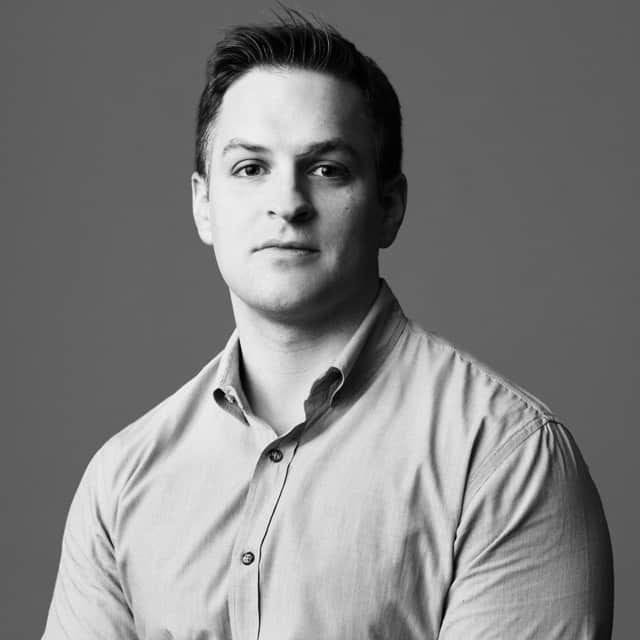
ALG: Welcome everyone to the latest episode of Flux. I’m excited to have Eric Marcotulli here today. He is the co-founder and CEO of Elysium Health a company that is rethinking healthcare whose first product is a science based supplement that promotes cellular health. Welcome.

EM: Thank you.

ALG: Appreciate it. I’ve been excited about your company for a long time. It’s nice to meet in person.

EM: Likewise.

ALG: As a New York based VC it’s also great to meet New York based companies, especially science focused companies. I’d love to start by hearing the beginnings of Elysium. You started the company in 2014. I talked to one of your investors last summer, he said to ask you the story of how you met your co-founder at Equinox? — ?is that true?

EM: So there’s two co-founders and they both have their own stories. I’ll start with my scientific co-founder, Leonard Guarente. Leonard’s run the biology of aging Lab at MIT for the last 25 to 30 years. I didn’t set out to become an entrepreneur. It was a confluence of events.

If you go back to 2011, 2012 I was in business school and in one of my classes we were studying a company that in the field of aging is well known but outside is not. It’s called Sirtris Pharmaceuticals and it was a Boston based biotech company going back to the mid 2000s. What’s interesting about this company is they were studying processes of aging and they identified one in particular. It was a class of genes that we now affectionately refer to as longevity genes. They’re called sirtuins. What they identified was that these genes are found in every living thing and that the activity level of these genes decreases through the normal course of aging. And when they reactivated these genes they saw amazing benefits, regardless of which model or organism you were looking at. They would live to the human equivalent of 120 years old. They don’t get cancer. They don’t gain weight.

ALG: You mean the mice?

EM: That’s right. Life is pretty good at this point if you’re a mouse. It was a monumental discovery in terms of aging research and it got the researchers nominated for the Nobel Prize. One of the researchers involved in that series of discoveries in the late 90s early 2000s went off to Harvard to open his own lab. And being more risk-seeking he was screening for natural molecules that could potentially activate these genes. The hypothesis there, which has since carried over to Elysium, is that aging itself isn’t a disease. It’s about the interconnected degradation or failure of our own biological processes and metabolisms. There is a prevailing hypothesis we are seeing develop that natural compounds will be the most effective interventions. That was the approach taken there, and the researcher’s name is David Sinclair. He screened natural product libraries for potential hits that could activate these genes.
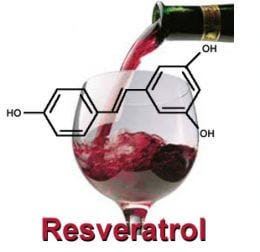
And he found one, a derivative of red wine called resveratrol. Some people have heard of this. If you look back at the ‘04 ‘05 time frame there was a massive spike in red wine sales due to all the media coverage around it. So they started a company, Sirtris. So they make you the protagonist in this case study, and you have to make a decision as the management of the company. What was interesting was that you have a natural product and that aging isn’t a disease. To try and create a traditional pharmaceutical company and go after diseases you’d be trying to fit a square peg in a round hole. You’d likely have to modify the molecule, you would have to start looking at disease models. On the other hand, you could build a direct to consumer company, where you don’t have to modify the molecule, and aging isn’t a disease so you don’t have to go through a laborious long-term and huge cost effort from an approval standpoint. We debated the merits of both of these business models. I was firmly in the camp of the consumer facing effort, because I was reading this research and saying, how could anybody sitting in this room not want this for themselves or their parents or their friends?

ALG: Right.

EM: It ends up not mattering which position you take. [In 2008] GlaxoSmithKline stepped in and bought the company for almost three quarters of a billion in cash, before they read any human data. I was fascinated at this point with the research. If you had played word association with me going into that class and you said “anti-aging” and “longevity” I would have just rattled off “late-night infomercials” and “snake oil.”

ALG: So that class awakened you to the industry and got you interested?

EM: That’s right. I didn’t know this was something you could study. Aging? — ?most people think it’s an unstoppable ambiguous force. But it’s not. It’s something that we can now quantify and measure and potentially intervene. That was new to me, the fact that people at MIT and Harvard were studying this and making progress. So I left that fascinated. Shortly thereafter I reached out directly to the the the MIT professor who was the original discoverer of these genes, the sirtuins. I reached out to the scientific co-founder at Harvard. The question I had was, whatever happened to this? Because now it’s almost a decade since the acquisition. There had been little news on it. If you fast forward to today the MIT professor, the one where they made the original discoveries of the longevity genes, is now the co-founder of Elysium.
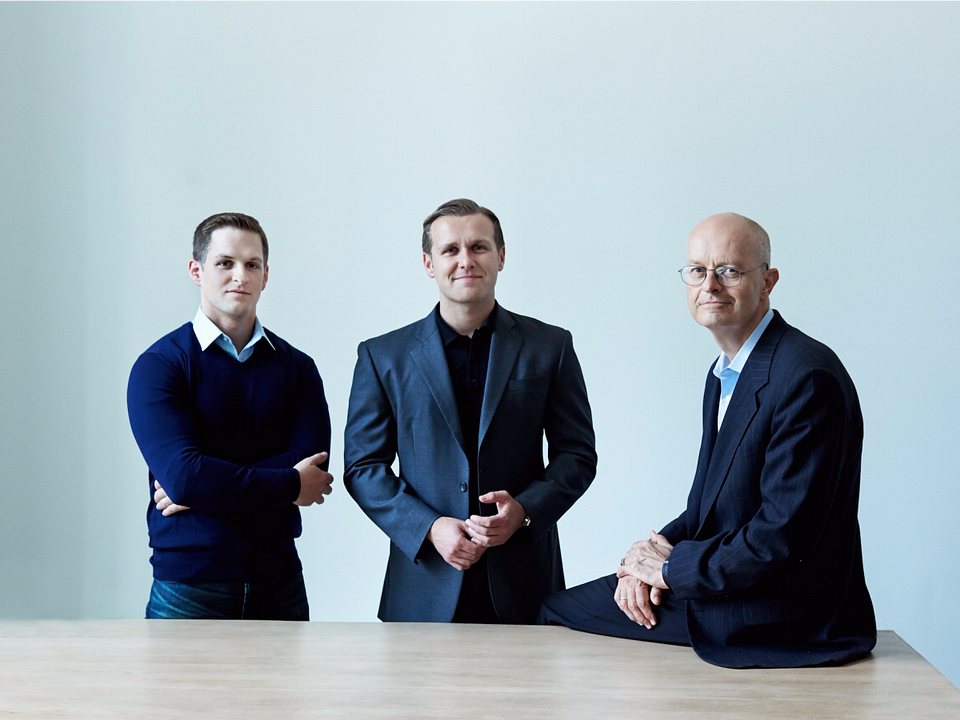
Elysium Health co-founders Eric Marcotulli, Dan Alminana, Leonard Guarente.

ALG: Leonard?

EM: Yes. Dr. Guarente. Or Lenny as we call him. Lenny and I just started off with conversations around how the research had progressed. At one point Lenny called me and said, “I’ve been approached by a Japanese venture capitalist who has invested in a company in Taiwan. They believe they have a potent sirtuin activating compound that’s very different from the resveratrol molecule.” He said, “I know nothing about the business side of things. We’re dealing with a venture capitalist and you’re a venture capitalist.” I was at the time?—?before business school I was at Bain Capital Ventures, after I was at Sequoia. He said, “would you want to go with me to look at this potential molecule?”

I said, “I don’t know how much help I can be but I’m happy to go with you.” So Lenny and I met for the first time six months after our first phone call. This was late 2012. We met in San Francisco International Airport and went to Taiwan for a few days. It was a fascinating experience. We ultimately passed on that molecule despite some interesting research. But it was through that that Lenny and I came up with this idea that you could build a direct to consumer facing effort and that there would be more of these types of products, that it wasn’t limited to a single product idea. So this was the vision for creating a platform-based company.

ALG: So that’s how you met him. And it sounds like you explored a couple of different routes in terms of what molecules could stimulate sirtuins right?

EM: That’s right.

ALG: And the one you ultimately went for first is NAD?

EM: So there’s two components to the product we have today, which is called Basis. One of the things that Lenny and his constituencies in the research community had identified was that sirtuins are dependent on a coenzyme called NAD. We didn’t know that at the time that Sirtris was founded. It’s the production of NAD? — ?a coenzyme, a fuel that’s used in a variety of reactions at the metabolic level? —? it was actually the production of this coenzyme that was decreasing in all of these living things. So NAD itself is not new. We’ve known about it for a hundred years. Two Nobel prizes have been awarded for elucidating its function. It’s important for things like DNA maintenance and repair, the creation of energy, the way the cells communicate both internally and with one another. Without NAD you’d be dead in under a minute. It’s very important. So this idea that it was decreasing, which we didn’t know until 2012, was a monumental discovery.

ALG: Decreasing over a mouse or human lifespan?

EM: Universally. Whether you’re a plant, animal, bacteria ?—? doesn’t matter. You have NAD, you use it for these critical functions and it declines in its production in everything that ages. But not every living thing ages. Jellyfish don’t age for example.

ALG: Oh wow. What’s going on with their NAD?

EM: Well we don’t know yet. But it’s a small number [of organisms]. In everything else you see this decrease [in NAD] when the organism ages. Since we didn’t know this, Lenny said trying to activate these sirtuins would have been a failure regardless. So what we first need to do is restore levels of NAD. Then we need to activate these sirtuins. And we know that resveratrol does not work in humans. So that was another discovery that happened in the subsequent time period after the acquisition.

ALG: So all the red wine articles are baloney?

EM: Well interestingly if you drink red wine you do get the benefit of sirtuin activation. You just have to drink quite a bit of it.

ALG: I can do that.

EM: Ha most people say that. So that’s just an example of removing a high purity molecule from its natural carrier state in the wine to a pill as an example, which was a failure in humans. So we identified a cousin of resveratrol called pterostilbene [an antioxidant], which from a structural standpoint, at the molecular level, is more stable.

ALG: The stuff found in blueberries?

EM: That’s right. If you could choose one food for the rest of your life my recommendation would be blueberries. Some people would disagree with me. Maybe it’s wine. But that was the idea behind Basis. First we need to restore levels of NAD. Secondly we can then go in and activate these longevity genes. And that there would be a synergy associated with that. The best way to think about it would be sports cars. If you’re activating sirtuins it’s like putting a turbo in the engine, but the car still requires some energy source. So if there’s no gasoline, or if you own a Tesla and there’s no battery power, it’s not going to work. But once you have the two of them together there’s a supercar.

ALG: It’s actually an analogy a lot of people use for aging. I don’t know if you know Aubrey de Grey and the SENS foundation, but he talks about aging as a disease. That it’s just like a car and we need to figure out how to repair the car and the many different things that go into that. I also want to ask you more about this reframing of how we think about living longer, and how the healthcare system doesn’t consider aging a problem so far or something to tackle. How does the shift happen?

EM: Part of it is, we are going to have to deal with it regardless. Everything we’re seeing now given the advancements in medicine is somehow related to aging. If you survive cancer you are unfortunately going to die from Alzheimer’s or cardiovascular disease or Type 2 diabetes. I won’t get the number exactly right, but if you cured every single form of cancer it would only add about three years of lifespan collectively, on average.

ALG: Because there’s going to be another disease that kills you.

EM: Correct. So for example, one of the areas we’re interested in is something called acute kidney injury. Thirty percent of people who go in for cardiovascular surgery will develop acute kidney injury, and with too much of it you’ll get kidney failure and dialysis. In 2004 there were just shy of a million cases in the United States of acute kidney injury. In 2014 just 10 years later there were four million cases. It’s not that our surgical techniques changed, it’s that older people are going in for these surgeries more often because our healthcare system is actually getting better. So we’re going to have to deal with these things. Two, from a diagnostic standpoint we are moving? —? out of necessity, at the research level? — ?into an area where we’re now able to quantify aging. As an example there is an epigenetic test, a cheek swab or a spit tube type test, developed at UCLA in conjunction with the National Institutes of Health. It can basically tell you your biological age. The age on your passport or your driver’s license is your chronological age. But there’s something that the gene activity expression data we collect can tell you about how you are aging.

ALG: Is that a hard test to do? I’m sure everyone would want to do that if they could.

EM: So we are commercializing this test. Think of it as rings of a tree. Over time you can get a pretty accurate understanding of a single tree. How old is it. Did it go through a bountiful spring or a terrible winter. Was there a forest fire. That’s at the individual level. Then when you look at the macro level, at the forest, you can learn a lot about that particular ecosystem. It’s an oversimplification of the idea but it’s the same thing every time, looking at something called methylation. Every time one of these sites is methylated it leaves a mark. So we can quantify that and say does this intervention or product reverse, slow, or stop the aging process.

ALG: That’s a game changer for you right. Because everyone thinks it’s a good idea to take [the product], why not. But without being able to measure a result, it is hard to say. People do report feeling better in the short term? —? less hangovers etc. I saw one of your advisers say something about his elbows getting softer—

EM: Oh Rich.

ALG: Yeah. A lot of great side effects that sound like they are worth having anyway. Like great energy peaks.

EM: Right. As we move towards aging, we would argue that it should be classified as a disease. But today it’s difficult because it’s not a moment in time diagnosis. It’s not like one day you wake up feeling symptoms and you go to the doctor and he says, “yes we ran the tests and you have aging.” It’s a decades long accumulation of mutations and failures and other things. So these types of diagnostics have been developed by the research community out of necessity. They need to understand does this intervention actually slow, stop, or reverse aging. That’s just one measure. We’re going to see other diagnostics that take shape and form over the next several years. So to your point, that’s important for us. Because one, the conversation today has been around, OK if you can reverse this fundamental process of aging what does it mean for me? It’s one thing to say, the models that exist today could show efficacy in cancer or neurodegenerative diseases et cetera. But there’s been nothing between showing the reversal of that process and the outcome of it from a disease standpoint. So this idea that there’s a middle ground, something where you can say, well the speed at which you’re aging has changed for the better. That is an important step in the entire process.

ALG: That’s super exciting. So what does the roadmap look like? Lets get into the product so that listeners who haven’t seen it know. Out the gate, your first product was Basis, the daily supplement which is $50 a month for a subscription, or $480 for the year. And it’s recommended that you take two pills in the morning. So that’s product one. It sounds like there’s a lot of other things in the works? How do the diagnostics fit in?

EM: Sure. Going back to the hypothesis for the company? — ?we sought early on to commercialize these technologies on a platform basis. We knew the diagnostics were coming. We knew that there would be other interventions. The third leg of the stool would be things on the digital front or the wearable front. We’re still a bit aways away from seeing the commensurate rigor in that camp. One is? — ?as you mentioned earlier? —? the diagnostics are important to show the efficacy broadly speaking for these products. The other thing that’s exciting is this idea of N of 1. We’re finally going to be able to move into the realm of personalization. First, is this product working for me? Second, what is it doing for me? Third, how would I have to modify my lifestyle or administration of the product?

That’s how we think about the world from a product development standpoint, through these systems. Apple is an exaggerated example but they’ve done a fantastic job from a platform basis? — ?of providing the app store and cloud services to integrate all the devices you have. What’s interesting about these diagnostics that we’re developing is that they are very much a subscription in nature. What you’re doing today is going to be different to what you’re doing tomorrow. Your health status may change for a whole host of reasons, genetic or otherwise. Since these aren’t just genetic tests looking at your ancestry, our hope is that 5 or 10 years in the future this is part of your annual checkup.

ALG: And there’s no negative side effects that we know?

EM: No. By and large this is one of the safest products we’ve ever seen, with all of the data that we have and millions and millions of data points in ongoing safety testing. Moving beyond that requires us to prove more digestible and accessible points of understanding. This idea of rate of aging is a step in that direction. We’re also, as an example, doing a study on photo aging of the skin based on both the existing body of literature that’s out there as well as feedback we’ve had from customers. The conversation changes a lot if I can put you under a special camera that shows the UV damage to your skin and then shows you the before and after of someone who has taken the product for six months and how it changed them. Even just showing wrinkles and things like that. Things that people are used to, from a marketing standpoint, but they might not actually see the science in it today. So there is that evolution. The evolution from, yes we can reverse this fundamental process of aging to, well what does that mean for me? Well it means it’s actually going to change the rate at which you age, which is tied to your health and all these diseases. Well OK, now I can actually tell you that it’s going to do XYZ for your skin, brain or whatever it might be.

ALG: You say upfront that this is about improving cellular function, but there’s no guarantee of longevity, though of course the name has connotations there. I’d like to ask your thoughts on longevity. There’s now things like cryo and people are signing up for places like Alcor. Do you think if we all had the ability to live forever, that that would be a good thing?

EM: So you skipped over the easier question. We’re focused on healthspan first and foremost. If you go into a room of people, and we do this all the time, and you say to the audience, “We’re going to take a quick poll. How many of you want to live forever? How many of you want to live to 120 or 150? How many of you want to live to 80?” It’s interesting to see the distribution. If you then say, “you are going to live to that age but you’re going to be as healthy as you are today, would you change your answer?” Most people do. So we are first and foremost focused on quality of life and healthspan. The belief is, ultimately if you improve every day, that you’ll have more days on the back end.

ALG: So it would be fine to go to 90 with a 20 year old’s full health, then kick the bucket. That’s more the goal.

EM: That’s exactly it. We’ve all dealt with it ourselves with loved ones. No one wants to live for another 10 or 20 years in a certain state. Usually the conversation is, what are the implications of that. From our standpoint, every time humanity has had an order of magnitude improvement in health? —? the introduction of antibiotics for example? — ?I don’t think we’ve ever seen humanity broadly say, we don’t need this or we don’t want it. I do think the question changes with the singularity. Which is living forever.

ALG: We should probably do another 40 minutes on the singularity, it’s an important topic.

EM: It is. I always say without question in our lifetime we will see a merging with something digital. Musk has announced his Neurolink technology recently and is claiming to make progress on it, so it may happen. We’re not going to be able to predict when it happens. And when it happens it’s going to happen quickly. That’s dangerous for a whole host of reasons. But I’m not sure we have a good answer for, “should we?”

ALG: I guess the answer is in splitting the question into healthspan and lifespan. People are generally in agreement on healthspan. Lifespan is more of a question mark.

EM: Without question. If you talk to anybody in the aging community at the research level, we would be surprised to hear them say, let’s focus on longevity first. Everybody is actually focused on understanding its implications and its role in human health more broadly and how interventions might change that. Then of course the idea is, well if we can get rid of all these diseases of aging, you would think that you’re going to live longer too. In a higher quality state.

ALG: It does amaze me. From a personal perspective I am signed up at Alcor. Do I think it’s going to work? Not really. But I did it for other reasons—

EM: Yes. I think we as a group need to hold companies in this space to a higher standard than we have in the last 10 years in terms of these types of things. I always say when someone brings me a product ?— ?even the products that I’m interested in ?— ?What is the research behind it? Where are the studies published? What do they find? How are they designed? If you just look at the supplement portion of our business, the consumer facing interventions, it’s a $35 billion dollar market in the United States.

ALG: And that’s with the current low standards and general snake oil perceptions [in supplements.]

EM: Of course. The other thing is, if you stop someone on the street and ask, “what’s your favorite supplement company?” you’re going to get a puzzled look back. No one walks around with a hat or a bag that has one of these companies on it. That’s because they lack legitimacy. That’s a huge part of Elysium’s mission. Hiring with the rigor that you would see in life sciences on the pharma side, into the consumer market. This is part of the shift. We will see legitimate companies not just Elysium, but others in the consumer sphere, changing this conversation. The market will look like a lot of other markets as opposed to this fragmented, untrustworthy one that we see today. That evolution might take a little longer. But ultimately we’re going to end up in a place where people feel good about the products they’re buying, because only the products that work are going to survive.

The global supplements market was estimated at USD $115.06 billion in 2018. It is expected to grow at a CAGR of 7.8% in coming years. [Source]

ALG: It’s interesting because you’re a pioneer in this area of supplements. There are other supplements startups, such as prenatal which is also taking off. But there’s less controversy ?— ?people say, prenatal vitamins? Of course, why wouldn’t you take that. With yours there’s more questions. My point on Alcor and backlash was that people have strong opinions on human longevity.

EM: It’s interesting. Our category is hot right now. In a lot of these established categories? — ?take prenatal —  there’s great literature supporting the use of folic acid. There’s companies that sell products around that. But they’ll make unique claims or link to literature that’s been done by other companies on other formulations or other delivery methodologies. Those can be dangerous. The data might appear to be good but in fact their own product hasn’t been tested. We have to do it by virtue of what you highlighted, the fact that we are new. But the buyer should beware of whether this exact formulation or exact product was tested for what it’s claiming to accomplish for you.

ALG: So you’re trying to do as much as you can in-house, which includes all R&D at the moment?

EM: Yes. We have a very open source model. One of the things we did, going back two or three years, was we did a randomized, placebo-controlled, double blind study on Basis to show that it could actually restore levels of NAD. We had to show that it actually did what it did. Now that’s mechanism of action in terms of what we’re showing. We didn’t show any tangible health benefits in that particular study, it was just the reversal—

ALG: That was the 2017 study?

EM: That’s right. It was an important first step to show that.
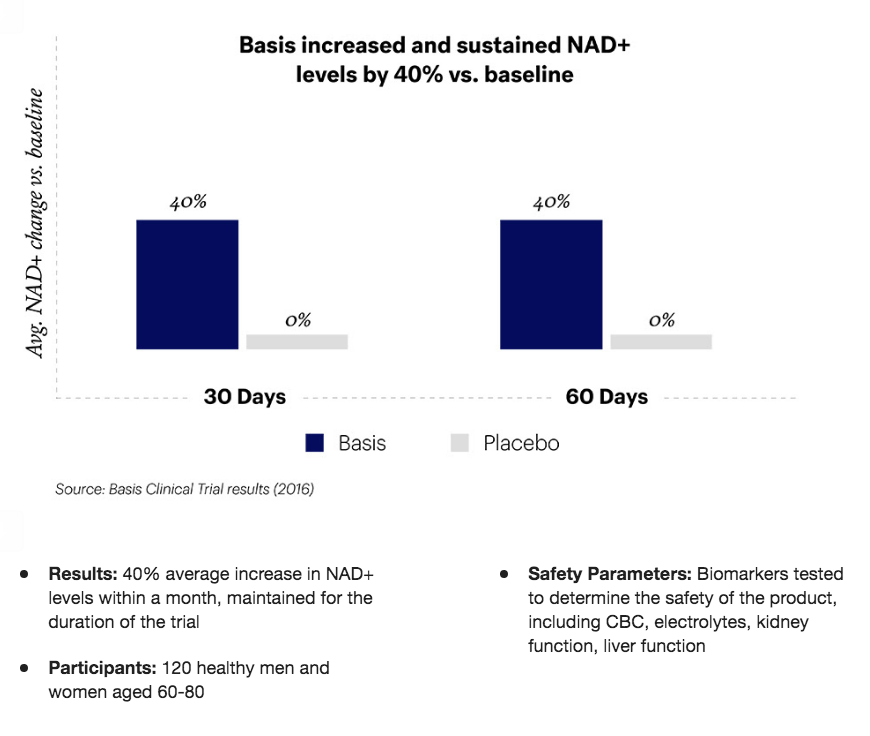
ALG: NAD levels increased by an average of 40 percent in your users?

EM: Yes. In a one month span. Then that was sustained over a period of time after that. And it was done safely. But if a traditional pharmaceutical company had done that study they would have just internally validated that the product works, then continued their research. We chose to publish and announce it. What we found was an influx of research interest from MDs and PHDs all around the world who said, “I’m interested in NAD repletion or sirtuin activation, and I now know that your product can safely and sustainably reverse this decline. Would you be willing to work on this particular health problem with me?” So a lot of it we do internally. And a lot of it is also driven by the scientific advisory board or collaborators that approach us and say we’d love to do something with you. This idea of open source is something that’s important to us and we encourage others to pursue it as well.

ALG: A lot of exciting stuff going on there. To wrap up is there anything else you want to share about the company or what we should expect in the next six to eight months?

EM: In terms of 2019, it is our plan to launch new products in both of the categories we talked about. You’ll see new diagnostics and you’ll see new interventions from us.

ALG: Exciting. I can’t wait to see. Thanks Eric for coming on. It’s great to meet and I look forward to seeing the products when they come out.

EM: Great. Thank you.

ALG: Thank you.

Traces AI is building a less invasive alternative to facial recognition tracking

With all of the progress we’ve seen in deep learning tech in the past few years, it seems pretty inevitable that security cameras become smarter and more capable in regards to tracking, but there are more options than we think in how we choose to pull this off.

Traces AI is a new computer vision startup, in Y Combinator’s latest batch of bets, that’s focused on helping cameras track people without relying on facial recognition data, something the founders believe is too invasive of the public’s privacy. The startup’s technology actually blurs out all human faces in frame, only relying on the other physical attributes of a person.

“It’s a combination of different parameters from the visuals. We can use your hair style, whether you have a backpack, your type of shoes and the combination of your clothing,” co-founder Veronika Yurchuk tells TechCrunch.

Tech like this obviously doesn’t scale too well for a multi-day city-wide manhunt, and leaves room for some Jason Bourne-esque criminals to turn their jackets inside out and toss on a baseball cap to evade detection. As a potential customer, why forego a sophisticated technology just to stave off dystopia? Well, Traces AI isn’t so convinced that facial recognition tech is always the best solution; they believe that facial tracking isn’t something every customer wants or needs and there should be more variety in terms of solutions.

“The biggest concern [detractors] have is, ‘Okay, you want to ban the technology that is actually protecting people today, and will be protecting this country tomorrow?’ And, that’s hard to argue with, but what we are actually trying to do is propose an alternative that will be very effective but less invasive of privacy,” co-founder Kostya Shysh tells me.

Earlier this year, San Francisco banned government agencies from the use of facial recognition software, and it’s unlikely that they will be the only city to make that choice. In our conversation, Shysh also highlighted some of the backlash to Detroit’s Project Green Light, which brought facial recognition surveillance tech city-wide.

Traces AI’s solution can also be a better option for closed venues that have limited data on the people on their premises in the first place. One use case Shysh highlighted was being able to find a lost child in an amusement park with just a little data.

“You can actually give them a verbal description, so if you say, ‘it’s a missing 10-year-old boy, and he had blue shorts and a white t shirt,’ that will be enough information for us to start a search,” Shysh says.

In addition to being a better way to promote privacy, Shysh also sees the technology as a more effective way to reduce the racial bias of these computer vision systems that have proven less adept at distinguishing non-white faces, and are thus often more prone to false positives.

“The way our technology works, we actually blur faces of the people before sending it to the cloud. We’re doing it intentionally as one of the safety mechanisms to protect from racial and gender biases as well,” Shysh says.

The co-founders say that the U.S. and Great Britain are likely going to be their biggest markets due to the high quantity of CCTV cameras, but they’re also pursuing customers in Asian countries like Japan and Singapore, where face-obscuring facial masks are often worn and can leave facial tracking software much less effective.

Microsoft Azure CTO Mark Russinovich will join us for TC Sessions: Enterprise on September 5

Being the CTO for one of the three major hypercloud providers may seem like enough of a job for most people, but Mark Russinovich, the CTO of Microsoft Azure, has a few other talents in his back pocket. Russinovich, who will join us for a fireside chat at our TechCrunch Sessions: Enterprise event in San Francisco on September 5 (p.s. early-bird sale ends Friday), is also an accomplished novelist who has published four novels, all of which center around tech and cybersecurity.

At our event, though, we won’t focus on his literary accomplishments (except for maybe his books about Windows Server) as much as on the trends he’s seeing in enterprise cloud adoption. Microsoft, maybe more so than its competitors, always made enterprise customers and their needs the focus of its cloud initiatives from the outset. Today, as the majority of enterprises is looking to move at least some of their legacy workloads into the cloud, they are often stumped by the sheer complexity of that undertaking.

In our fireside chat, we’ll talk about what Microsoft is doing to reduce this complexity and how enterprises can maximize their current investments into the cloud, both for running new cloud-native applications and for bringing legacy applications into the future. We’ll also talk about new technologies that can make the move to the cloud more attractive to enterprises, including the current buzz around edge computing, IoT, AI and more.

Before joining Microsoft, Russinovich, who has a Ph.D. in computer engineering from Carnegie Mellon, was the co-founder and chief architect of Winternals Software, which Microsoft acquired in 2006. During his time at Winternals, Russinovich discovered the infamous Sony rootkit. Over his 13 years at Microsoft, he moved from Technical Fellow up to the CTO position for Azure, which continues to grow at a rapid clip as it looks to challenge AWS’s leadership in total cloud revenue.

Tomorrow, Friday, August 16 is your last day to save $100 on tickets before prices go up. Book your early-bird tickets now and keep that Benjamin in your pocket.

If you’re an early-stage startup, we only have three demo table packages left! Each demo package comes with four tickets and a great location for your company to get in front of attendees. Book your demo package today before we sell out!