Second docking adapter for commercial crew vehicles installed on International Space Station

The International Space Station is now more than ready for crew-carrying spacecraft flown by commercial companies to pay it a visit: The second planned International Dock Adapter (IDA) was installed on the Space Station during a spacewalk by NASA astronauts Nick Hague and Andrew Morgan earlier today.

The dock adapter is actually IDA-3, as the first IDA was lost during the SpaceX launch failure of its CRS-7 mission on June 28, 2015. IDA-2, which was intended to be the second installed on ISS, instead became the first and was delivered in July 2016 during the SpaceX CRS-9 resupply mission.

IDA-2 has already proven effective, too: It received its first docking vehicle on March 3 of this year, when SpaceX’s Crew Dragon Demo-1 test vehicle used the automated docking procedure designed for this adapter to demonstrate how it will work eventually when crew are on board.

IDA-3 is the second working dock adapter that uses this automated procedure, which makes it so that vehicles arriving at the ISS don’t have to be caught and guided in manually by astronauts with the help of the station’s Canadarm2 robotic arm. The automated procedure is designed as an industry standard of sorts, and should mean that any commercial crew craft, from SpaceX’s Crew Dragon, to Boeing’s CST-100, and any other potential future craft, can easily and automatically dock with the ISS to transfer over passengers and cargo.

Boeing is the company that was contracted to design and build these docking adapters. Each weigh about 1,150 pounds, and they’re about 42 inches high and 63 inches wide, which means it’s a bit of a tight squeeze for crew to come through (these aren’t big step-through passageways like you sometimes see in movies).

Having both the IDAs installed on the Space Station is key milestone in the commercial crew program, but there are still plenty of hurdles left to clear — including the first test flights of commercial Crew vehicles with astronauts on board.

Google updates to a cleaner, simpler Play Store design [Updated]

[Update: the Music tab has been relocated] Google’s Play Store has gotten a big visual makeover, the company announced today, with changes that include a cleaner look-and-feel, new navigation, an easier way to to see app information and more. Most notably, however, is that Google has taken a page from Apple’s playbook with the priority given to its two distinct sections for apps and games. It has also removed the “Music” tab from the top-level navigation, likely ahead of planned changes to Google Play Music and YouTube Music.

Though the redesign is in keeping with Google’s Material Design philosophy, it’s hard to miss Apple’s influence here — from the brighter, whiter and cleaner layout to the new navigation and updated app detail page layouts, among other things.

With Apple’s huge App Store revamp in 2017, the company made several changes to refocus user attention away from top charts and rankings to editorial content, stories and tips, recommendations and curated collections. As a part of this redesign, it created two separate tabs for Apps and Games in the App Store app’s main navigation to better direct users to the type of app content they wanted to browse.

The Play Store had already broken out Apps and Games before today, but they had been part of a much larger navigational element at the top of the home page.

The new design now relocates the Play Store’s main navigation to the bottom of the screen, just like on the iOS App Store. It also distills navigation to just four tabs: Games, Apps, Movies & TV and Books. (Music is gone).

Google says its decision to create two main tabs for apps and games will help it to “better serve users the right kind of content.”

Within the Games and Apps sections, users can browse into other sections, including Google’s personalized “For You” suggestions and Top Charts, and more. Here, you’ll find the same sections the Play Store had before (like “New,” “Events,” “Premium,” etc.) — they’ve just been relocated within the new tabs instead of existing as a second-level navigation bar on the Play Store homepage.

When the user finds an app or game they’re interested in, the updated store listing page layout will now surface richer app information at the top of the page and a bigger call-to-action button (e.g. “Install”).

This, too, is similar to iOS, where key details about the app or game — like its rating or age range — are at the top of this app detail page.

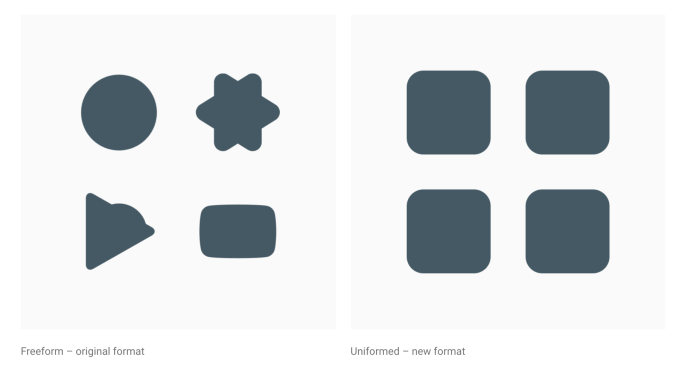
The store also features Google’s new icon system, where apps have a uniform rounded square shape. Apple has always enforced standardized app icons.

Screen Shot 2019 08 21 at 2.25.18 PM

The Play Store makeover had already leaked earlier this year, thanks to enterprising developers who got their hands on Google’s tests and published screenshots.

Some more screenshots of the new Google Play UI, this time with working reviews and music store. Only UI bug is the toolbar disappearing (that I can see), and it's *fairly* stable (but still crashes a fair amount), might be something at I/O next week? pic.twitter.com/7TmTH2TYMb

— Kieron Quinn (@Quinny898) May 2, 2019

As for the Music tab’s relocation, Google already confirmed it was planning to replace Google Play Music with YouTube Music, and shut down Google Play’s artist hub this April in preparation for that. With the removal of the Music tab from the new Play Store, the completion of this merger appears to be imminent.

Update: The Music tab has been relocated, says Google… it’s a bit buried now

Attention ? fans: The music section has moved, but don’t fret, it should only make your jam sesh easier. pic.twitter.com/9x7WpHAp6k
— Google Play (@GooglePlay) August 21, 2019

In Google’s announcement today about the redesign, it showed off the new look with a photo (see top photo above).

It’s pretty odd that the app being showcased in Google’s photo, Alto’s Odyssey, is an Apple Design Winner that launched on iOS first — as did its precursor, Alto’s Adventure. When coming to Android, the game development company worked with Android publisher Noodlecake on its Android ports.

In other words, not only is this a non-exclusive game, it comes from an iOS-first shop. Sure, it’s a great game. But that’s also a pretty weird pick on Google’s part.

The Google Play Store has more than two billion monthly active users, Google said in its announcement. The new version of the Play Store is rolling out now.

Our 12 favorite startups from Y Combinator’s S19 Demo Day 2

After two days of founders tirelessly pitching, we’ve reached the end of YC’s Summer 2019 Demo Days. TechCrunch witnessed more than 160 on-the-record startup pitches coming out of Y Combinator, spanning healthcare, B2B services, augmented reality and life-extending.

The full list is worth a gander, you can read about the 84 startups from Day 1 and the 82 companies from Day 2 in the linked posts. You can also check out our votes for the best of the best from day 1.

After conferring on the dozens of startups we saw yesterday, here are our favorites from the second day of Y Combinator pitches.

Twitter picks up team from narrative app Lightwell in its latest effort to improve conversations

Twitter’s ongoing, long-term efforts to make conversations easier to follow and engage with on its platform is getting a boost with the company’s latest acquihire. The company has picked up the team behind Lightwell, a startup that had built a set of developer tools to build interactive, narrative apps, for an undisclosed sum. Lightwell’s founder and CEO, Suzanne Xie, is becoming a director of product leading Twitter’s Conversations initiative, with the rest of her small four-person team joining her on the conversations project.

(Sidenote: Sara Haider, who had been leading the charge on rethinking the design of Conversations on Twitter, most recently through the release of twttr, Twitter’s newish prototyping app, announced that she would be moving on to a new project at the company after a short break. I understand twttr will continue to be used to openly test conversation tweaks and other potential changes to how the app works. )

The Lightwell/Twitter news was announced late yesterday both by Lightwell itself and Twitter’s VP of product Keith Coleman. A Twitter spokesperson also confirmed the deal to TechCrunch in a short statement today: “We are excited to welcome Suzanne and her team to Twitter to help drive forward the important work we are doing to serve the public conversation,” he said. Interestingly, Twitter is on a product hiring push it seems. Other recent hires Coleman noted were Other recent product hires include Angela Wise and Tom Hauburger. Coincidentally, both joined from autonomous companies, respectively Waymo and Voyage.

To be clear, this is more acqui-hire than hire: only the Lightwell team (of what looks like three people) is joining Twitter. The Lightwell product will no longer be developed, but it is not going away, either. Xie noted in a separate Medium post that apps that have already been built (or plan to be built) on the platform will continue to work. It will also now be free to use.

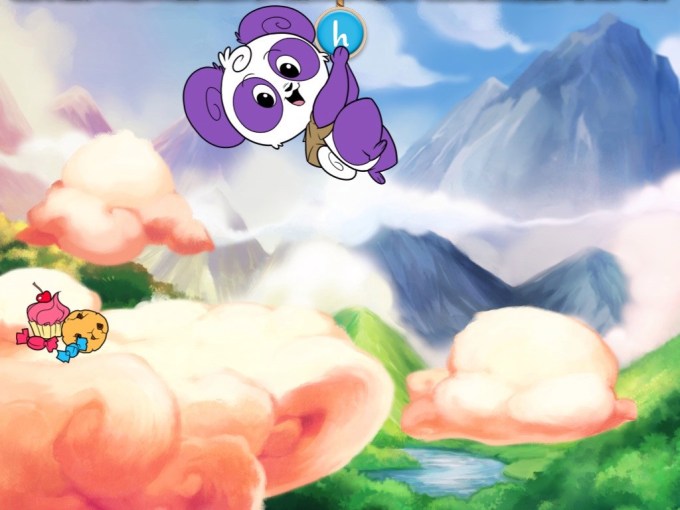
Lightwell originally started life in 2012 as Hullabalu, as one of the many companies producing original-content interactive children’s stories for smartphones and tablets. In a sea of children-focused storybook apps, Hullabalu’s stories stood out not just because of the distinctive cast of characters that the startup had created, but for how the narratives were presented: part book, part interactive game, the stories engaged children and moved narratives along by getting the users to touch and drag elements across the screen.

hullabalu lightwell

After some years, Hullabalu saw an opportunity to package its technology and make it available as a platform for all developers, to be used not just by other creators of children’s content, but advertisers and more. It seems the company shifted at that time to make Lightwell its main focus.

The Hullabalu apps remained live on the App Store, even when the company moved on to focus on Lightwell. However, they hadn’t been updated in two years’ time. Xie says they will remain as is.

In its startup life, the company went through YCombinator, TechStars, and picked up some $6.5 million in funding (per Crunchbase), from investors that included Joanne Wilson, SV Angel, Vayner, Spark Labs, Great Oak, Scout Ventures and more.

If turning Hullabalu into Lightwell was a pivot, then the exit to Twitter can be considered yet another interesting shift in how talent and expertise optimized for one end can be repurposed to meet another.

One of Twitter’s biggest challenges over the years has been trying to create a way to make conversations (also narratives of a kind) easy to follow — both for those who are power users, and for those who are not and might otherwise easily be put off from using the product.

The crux of the problem has been that Twitter’s DNA is about real-time rivers of chatter that flow in one single feed, while conversations by their nature linger around a specific topic and become hard to follow when there are too many people talking. Trying to build a way to fit the two concepts together has foxed the company for a long time now.

At its best, bringing in a new team from the outside will potentially give Twitter a fresh perspective on how to approach conversations on the platform, and the fact that Lightwell has been thinking about creative ways to present narratives gives them some cred as a group that might come up completely new concepts for presenting conversations.

At a time when it seems that the conversation around Conversations had somewhat stagnated, it’s good to see a new chapter opening up.

Classic Hangouts will hang in there a bit longer

Earlier this year, Google said it would transition all Hangouts users on G Suite to Hangouts Chat and Meet by October 2019 and then retire the classic version of Hangouts. But a lot of G Suite users love their classic Hangouts, so Google has now revised Hangouts’ retirement date to “no sooner than June 2020.” That leaves the door open for a later date, too, and the company says it will provide a “more definitive date” at some point in the future.

It’s worth stressing that this new timeline is about Hangouts for paying G Suite users, but it will also influence the consumer timeline. What exactly is happening to Hangouts for consumers remains a bit unclear, though, given that Google’s original consumer messaging strategy failed after the disappointment that was Allo.

But here is what we know: Earlier this year, Google said that it wanted to transition consumers over to a free version of Hangouts Chat and Meet after the G Suite transition. A Google spokesperson told me this plan remains in place and it will start after the G Suite transition.

As for G Suite users, Google plans to make the transition for G Suite users easier as it looks to move them over to the new platform. Admins can already jump on an accelerated timeline and disable classic Hangouts right now (but they still need an invitation from Google to do so).

Daily Crunch: DoorDash acquires Scotty Labs

The Daily Crunch is TechCrunch’s roundup of our biggest and most important stories. If you’d like to get this delivered to your inbox every day at around 9am Pacific, you can subscribe here.

1. DoorDash acquires autonomous driving startup Scotty Labs

DoorDash seems to be very interested in self-driving technology — not only did it acquire Scotty Labs (a startup enabling people to remotely control self-driving cars), it also brought on the two co-founders of Lvl5, which was creating high-resolution maps for autonomous driving.

“We’ll share more updates in the near future but for now, we’re really excited to be part of the amazing DoorDash family and looking forward to building something magical together,” Scotty Labs co-founder Tobenna Arodiogbu wrote on in a blog post.

2. Apple, Google and Mozilla block Kazakhstan’s browser spying tactics

Apple, Google and Mozilla have taken the rare step of blocking an untrusted certificate issued by the Kazakhstan government, which critics say it forced its citizens to install as part of an effort to monitor their internet traffic.

3. The 11 best startups from Y Combinator’s S19 Demo Day 1

We already rounded up all the startups that presented at the accelerator’s Demo Day 1, but now the team has selected their favorites. (Extra Crunch membership required.)

4. MoviePass exposed thousands of unencrypted customer card numbers

An unprotected MoviePass database included both customer cards (those are the debit cards used to purchase movie tickets) and personal credit card numbers.

5. Waymo releases a self-driving open data set for free use by the research community

The data set isn’t for commercial use, but Waymo’s definition of “research” is fairly broad, and includes researchers at other companies as well as academics.

6. PayPal-backed money lender Tala raises $110M to enter India

Tala looks at behavioral data gathered through an Android app to build a customer’s credit profile. The new round values the company at $750 million.

7. Join The New Stack for Pancake & Podcast with Q&A at TC Sessions: Enterprise

Popular enterprise news and research site The New Stack is coming to TechCrunch Sessions: Enterprise on September 5 for a special Pancake & Podcast session with live Q&A. (And we’re dead serious about the pancakes.)

Google denies reports of unannounced changes to Android app review process

Multiple reports this week claimed Google had quietly rolled out a more in-depth app review process to all developers — changes designed to keep the Play Store safer from spam, malware and copycat apps. Those reports are inaccurate, Google tells TechCrunch. Instead, the company is giving itself more time to review apps from new, unestablished developers on the Play Store, as previously announced, but this hasn’t been extended to all developers.

Concerns about these so-called “unannounced changes” stemmed from a blog post by Choice of Games, which wrote that “all new apps” would be getting an additional review, slowing down app approvals. It claimed new apps would require at least three days for review, and this now included existing developers.

The post cited a conversation with Google Support as the source for its claims.

This led to a ton of confusion, as the development shop behind the post was well-established, having been on the Play Store since 2010 and would have been exempt from Google’s policy of increased reviews for new developers.

As it turns out, it appears there was miscommunication between Google Play Store developer support and the developer, according to the chat transcript that was published. The support person, “Liz,” was alerting the developer to the new policy Google announced in April, which detailed increased review times for Play Store newcomers. She didn’t appear to understand that she was speaking with a developer who had published on Google Play for nearly a decade.

Android Police also picked up the news, writing that Google had “quietly instigated a more involved review process that impacts every app and update.”

Reddit and Hacker News also weighed in. In addition to the reported changes, developers were concerned there was now no way to schedule new app releases through the Timed Publishing feature. (That’s also not true — developers can publish to a closed testing track, then use Timed Publishing to go live to the public.)

A Google Developer Relations team member stepped in to clear things up on Reddit, and we’ve confirmed with Google that his responses were accurate.

Google’s updated app review process, first announced in April, hasn’t changed.

At the time, Google said:

“We will soon be taking more time (days, not weeks) to review apps by developers that don’t yet have a track record with us. This will allow us to do more thorough checks before approving apps to go live in the store and will help us make even fewer inaccurate decisions on developer accounts.”

Google began notifying developers directly in the Play Console in June that new apps by developers without a track record will take a couple of days longer to review. Google says that, since this change, it’s already seen a meaningful increase in the number of harmful apps blocked by Play even before they are published.

It’s not clear why the developer relations support person miscommunicated this information to the developer in question, but it points to a training issue on Google’s part.

It’s also unclear why the established developer’s app was held up in app review, beyond it just being a mistake on Google’s part.

Unfortunately for Google, Play Store developers have come to expect a speedy review process, so any delays feel like unnecessary friction.

Unlike Apple, which employs a large team to carefully review app submissions and make hard calls on controversial apps, Google has more heavily relied on automation over the years. The company disclosed in the past how it uses software to pre-analyze apps for viruses, malware and other content and copyright violations.

That process doesn’t always work, though. Only days ago, dozens of Android apps disguised as harmless photo editors and games were discovered to actually be adware. This follows similar news from January, when 85 apps were found to contain adware… and in May, when adware was discovered in some 200 apps totaling 150+ million installs… and, news from last November, when malware was found across more than a dozen apps with half a million installs… and so on.

While it would make sense for Google to increase its review of all apps, given its inability to address this problem, that was not the case here.

Bring your posse to Disrupt SF 2019 with group discounts

Disrupt San Francisco 2019, our flagship event on October 2-4, features three full days of programming, more than 10,000 attendees, over 1,200 exhibiting startups and sponsors — and that’s just for starters. That’s a lot of ground to cover. Here’s a hot tip: take advantage of group discounts, saddle up and bring your whole posse to the show and squeeze out every bit of information, inspiration and opportunity possible.

Spread your crew across Disrupt and get more done. Network til you drop in Startup Alley — using CrunchMatch, our free business match-making platform, to find and schedule meetings with only the best connections for your business. Bear witness to our epic pitch competition, Startup Battlefield — a great place to spot investment-worthy companies.

Attend the many Main Stage panel discussions and interviews with tech titans, up-and-coming founders and startup investors. Check out the conference agenda hereLooking for actionable tips and advice? Head for the Extra Crunch Stage. Yeah, you’ll learn a thing or two.

We offer group discounts for every pass level, to make your posse possible. Here’s what you need to know.

Group Innovator Pass: Buy five or more passes and get a 20% discount. Need 10 or more passes? Email us for a price quote at [email protected]. An Innovator Pass grants access to the Main Stage, Extra Crunch Stage, Q&As, workshops, CrunchMatch, networking receptions and the TechCrunch Events App, which lets you communicate with other attendees.

Group Founder Pass: Buy two or more passes and you’ll get a 10% discount. Your Founder Pass gets you the same benefits as an Innovator Pass but at an already discounted rate — but you must be a (co)founder of a company (of any size).

Group Investor Pass: Purchase two or more passes to get a 10% discount. An Investor Pass provides the same benefits as an Innovator pass, PLUS access to the Investor Lounge, an invitation to the investor-only reception and two hours of private meeting space.

Group Expo Only Pass: If you want to buy Expo Only passes in bulk (10 or more), email [email protected] for a price quote. An Expo Only Pass provides access to the Startup Alley expo floor, workshops and a lite version of the TechCrunch Events App.

Group Startup Alley Exhibitor Packages: If you’re interested in purchasing more than one Startup Alley Exhibitor Package, email [email protected] for more information. This package includes exhibit space for one day, use of the Startup Alley Lounge, access to the media list and two or three Founder Passes, depending on when you book.

Disrupt San Francisco 2019 takes place on October 2-4. Bring your posse and cover more ground, find more opportunity and discover more ways to grow your business. Get your group discounts today. If you’re riding solo, no problemo. Get an early-bird ticket and, depending on the pass level you choose, you can save up to $1,300. Saddle up and ride!

Is your company interested in sponsoring or exhibiting at Disrupt San Francisco 2019? Contact our sponsorship sales team by filling out this form.

How Dropbox, Nike, Salesforce, MailChimp, Google and Pepsi welcome their new hires

Vladimir Polo
Contributor

Vladimir PoloVladimir Polo is the founder and CEO of AcademyOcean, a SaaS tool for interactive onboarding and training. Vladimir has 10 years of management experience (agency & product) and is passionate about SaaS and building strong corporate culture.

The first day of work at a new job can be very stressful. The unfamiliar surroundings and onslaught of new material can cause new hires some degree of discomfort. But sometimes the atmosphere at the new company can be welcoming and can help counteract the stress.

Different companies have their own traditions to help make this transition period more comfortable and memorable for new hires. Some of these traditions include:

  • Team-building day trips for new hires
  • Breakfast with the CEO
  • Tours of the best cafes, parks, and other spots in the neighborhood
  • Office “quests” (or some other gamification of onboarding)
  • Personalized onboarding programs or interactive company academies

Usually, only employees can experience these traditions. But there’s one new-hire tradition that has become extremely popular and often highly publicized: the “welcome kit”.

Welcome kits usually contain a hodgepodge of items that employees will need on the job (pens, notebooks, books, etc.) and things to make employees feel welcome (clothing, stickers, water bottles, or more unusual items — often with the company name or logo on them).

To get a sense of how different companies handle their kits, we talked to four successful startups about their welcome kits in the article below, followed by our look at a dozen more:

Table of Contents:

This article is based on the personal welcome kit collection of Vladimir Polo, founder of AcademyOcean. AcademyOcean is a tool for interactive onboarding and training (and Vladimir Polo is a fan of welcome kits).

Dropbox

Apple exec Susan Prescott is coming to TechCrunch Sessions: Enterprise

Susan Prescott, Apple’s vice president of markets, apps and services, has been at Apple since 2003. She worked with the company’s co-founder Steve Jobs, and has witnessed such milestones as the launch of the iPhone and the iPad. Prescott will be coming to TechCrunch Sessions: Enterprise in San Francisco on September 5 to discuss Apple’s enterprise strategy.

Prescott has been closely involved in that from the earliest days of the iPhone, and as she told TechCrunch in a 2018 article on Apple’s enterprise strategy, the company was thinking about the enterprise as a potential market from the start. “Early on we engaged with businesses and IT to understand their needs, and have added enterprise features with every major software release,” she said at the time.

When you think about it, it was in fact the iPhone and the iPad that led to the Consumerization of IT and Bring Your Own Device movements, two huge trends in enterprise IT that began in the 2011 timeframe. Later the company helped grow the business further by partnering with such enterprise stalwarts as IBM, SAP, Cisco, GE and most recently Salesforce along with systems integrators like Deloitte and Accenture. Today, the company offers a range of business tools including Apple Business Chat and Apple Business Manager, an IT management tool for managing Macs, iPhones and iPads and the apps that run on them.

All of that adds up to robust enterprise strategy, and Prescott will discuss all of that and more with TechCrunch editors. We’ll dive into Apple’s history in the enterprise and what it’s doing today to enhance that part of its business.

In all, Prescott has over 25 years of technology industry experience. Before joining Apple in 2003, she worked for Adobe where she had a range of engineering, marketing and management roles. Her last position before joining Apple in 2003 was Vice President of product management and marketing in Adobe’s Creative Professional Solutions group.

Grab your $349 tickets today to join the show and meet amazing enterprise leaders. Don’t wait! Ticket prices go up at the door! If you book 4+ tickets you’ll save 20% – book for your team here.

RedDoorz raises $70M to expand its budget hotel network in Southeast Asia

Singapore-based budget hotel booking startup RedDoorz is tiny in comparison to fast-growing giant Oyo. But it is holding its ground and winning the trust of an ever growing number of investors.

On Monday, the four-year-old startup announced it has raised $70 million in Series C financing round, less than five months after it closed its $45 million Series B. The new round, which is ongoing, was led by Asia Partners and saw participation from new investors Rakuten Capital and Mirae Asset-Naver Asia Growth Fund.

The startup, which has raised $140 million to date, has been seeing “tremendous interest from investors, so it is decided to do a back-to-back rounds,” said Amit Saberwal, founder and CEO of RedDoorz, in an interview with TechCrunch.

Regardless, the new funds will help RedDoorz fight SoftBank-backed Oyo, which is already aggressively expanding to new markets. Oyo currently operates in more than 80 nations.

Saberwal isn’t necessarily threatened by Oyo, on the contrary, he sees Oyo’s success as a testament that there is room for more players to be in the space. He is confident that RedDoorz is “on the right track to create the next tech unicorn in Southeast Asia,” and trade in public exchange in the next two to three years.

RedDoorz operates a marketplace of “two-star, three-star and below” budget hotels, selling access to rooms to people. Currently it has 1,400 hotels on its network, said Saberwal. By the end of the year, the startup aims to grow this number to 2,000.

The startup operates in 80 cities across Indonesia, Singapore, the Philippines and Vietnam, and plans to use the new capital to expand its network in its existing markets, said Saberwal. At least for the next one year, RedDoorz has no plans to expand beyond the four markets where it currently operates, he said.

“Anything in the accommodation is our playground. We have all kinds of properties. We have three-star hotels, some hostels, so we will continue to go deeper and wider moving forward,” Saberwal, a former top executive at India’s travel giant MakeMyTrip, said.

It’s a great combination: Making the ubiquity of typically unorganized local guesthouse-style rooms with the more organized and efficient — but pricier — hotel option.

Some of the new capital will also go into broadening RedDoorz’s tech infrastructure, building a second engineering hub in Vietnam. (RedDoorz’s current regional tech hub is based in India.)

The Bugatti Centodieci is a $8.9 million homage to the early 90s EB110 supercar

The Bugatti Centodieci is the French automaker’s most powerful supercar yet — coming in a skosh above the Chiron at 1,600 horsepower. But it’s not just the power — or the $8.9 million price tag — that makes the Centodieci stand out.

The angular supercar, still dotted with the signature Bugatti design elements, tips its hat to the mid-engine EB110 supercar that debuted in 1991 when the company was owned by Romano Artioli.

One look at the Bugatti Centodieci, which had its world debut at the Quail Gathering during Monterey Car Week, and it’s clear that the early 1990s supercar was an inspiration.

bugatti front

The Bugatti Centodieci

But the Centodieci isn’t a copycat of the wedge-shaped, seemingly two-dimensional EB110. Instead, Bugatti designers aimed to bring the EB110 into the modern era.

“Transporting this classic look into the new millennium without copying it was technically complex, to say the least,” Bugatti head designer Achim Anscheidt said in a statement. “We had to create a new way of combining the complex aerothermal requirements of the underlying Chiron technology with a completely different aesthetic appearance.” 

The Centodieci, which means 110 in Italian to commemorate the 110th anniversary of the company’s founding, has a newly developed, deep-seated front spoiler along with three-section air intakes. The iconic Bugatti horseshoe is smaller than its counterparts — a decision made to fit in with the car’s the low-dropping front. The Centodieci also has new, very narrow headlamps with integrated LED daytime running lights and five round air inserts to ensure sufficient air intake for its 16-cylinder engine.

bugatti centodieci

The nod to the 1990s ends inside the Centodieci. In here, it’s all modern-day engineering. The 8.0-liter W16 engine produces 1,600 horsepower and can accelerate from 0 to 62 miles per hour in 2.4 seconds. The top speed has been electronically limited to 236 mph.

Here’s a 360-degree view of the vehicle.

Bugatti will only produce 10 of the Centodieci and they’re already sold, Pierre Rommelfanger, Bugatti’s head of exterior and structure development confirmed to TechCrunch. Typically, supercars such as these can be highly customized to meet the desires of their owners.

And the Bugatti Centodieci will be no different — to a point. “There are limits in order to reduce complexity,” Rommelfanger said.

Deliveries to the first Centodieci customers will begin in 2022. Bugatti has other orders to fill besides the Centodieci. The company is also producing 40 of the Bugatti Divo and just one La Voiture Noire, which is the world’s most expensive new car ever sold at $18.68 million. The company also plans to produce 500 Bugatti Chiron cars.

If president Stephan Winkelmann sticks to his plan to introduce two new products each year, more Bugatti models will soon join the Centodieci, Chiron, Divo and La Voiture Noire.

Tesla pitches a solar rental program to boost its renewable energy business

Tesla is pitching customers on a new rental offering for solar power as a way to revive the flagging fortunes of its renewable energy business.

Once among the largest installers of renewables in the country through SolarCity, Tesla has seen its share of the market decline significantly since its acquisition of SolarCity three years ago. In the second quarter Tesla deployed only 29 megawatts of new solar installations, while the number one and two providers of consumer solar, SunRun and Vivint Solar installed 103 megawatts and 56 megawatts respectively.

That’s likely one reason why Elon Musk took to Twitter early Sunday morning to pitch the new solar rental program.

One click to order solar & save ~$500/year in utility bills with no long-term contract (cancel anytime)

— Elon Musk (@elonmusk) August 18, 2019

According to Musk, the new program is “like having a money printer on your roof” for potential customers who live in states with high energy costs. “Still better to buy,” Musk exhorted, “but the rental option makes the economics obvious.”

Unlike SunRun and Vivint, which both used partnerships with homebuilders and retailers like Home Depot, BJ’s Wholesale, Costco and Sam’s Club to acquire customers, Tesla ended door-to-door marketing and abandoned its partnership with Home Depot. The company began relying almost entirely on direct sales to power its solar business and eschewed the no-money-down lease model, which SolarCity had used so effectively.

Under the new system, Telsa is offering customers the option to rent solar systems for anywhere from $65 for a small installation to $195 for its largest installation. Customers only need to pay a fully refundable $100 charge.

Tesla said the contract can be canceled any time, but it would charge users $1,500 to remove the system once it has been installed.

Tesla did not respond to a request for comment at the time of publication.


Original Content podcast: Netflix’s ‘Wu Assassins’ is a punching, kicking delight

When we reviewed “Another Life” last week, we described it as an old-fashioned space show, something that’s been absent from TV for the past decade or so. “Wu Assassins” is another new Netflix series, and it’s also a kind of throwback — this time to ’90s martial arts series like “Vanishing Son” and “Kung Fu: The Legend Continues.”

As we explain in the latest episode of the Original Content podcast, “Wu Assassins” — which tells the story of Kai, a San Francisco chef who receives mystical powers and must battle powerful nemeses known as the Wu Lords — has plenty of delightfully cheesy writing and special effects. But it’s set apart from those older shows in a couple key ways.

First, there’s the fact that Indonesian martial arts star Iko Uwais (who you might recognize from “The Raid” and “Star Wars: The Force Awakens”) plays Kai — he’s not a great dramatic actor, but once the action starts, he becomes a blur of punches and kicks.

The producers have surrounded Uwais with other accomplished martial artists, so the resulting fight scenes are extraordinary. “Wu Assassins” includes a couple big set pieces, but even more remarkably, every single fight (and there are plenty) feels like it’s been choreographed for the perfect mix of beauty and brutality.

Even better, there’s Byron Mann’s performance as Uncle Six, a ruthless triad boss who has a long history with Kai. Mann brings real charisma and humanity to his performance, and he turns his dramatic scenes with Uwais into a highlight of the show. Plus, he’s just as compelling when he’s called upon to beat the crap out of his enemies.

In addition to praising “Wu Assassins,” we also discuss the CBS-Viacom merger and listener response to our review of “Another Life.”

You can listen in the player below, subscribe using Apple Podcasts or find us in your podcast player of choice. If you like the show, please let us know by leaving a review on Apple. You can also send us feedback directly. (Or suggest shows and movies for us to review!)

And if you want to skip ahead, here’s how the episode breaks down:
0:00 Intro
0:40 “Another Life” listener response
11:51 CBS/Viacom merger
20:30 “Wu Assassins” review
33:52 “Wu Assassins” spoiler discussion

The mainstream media have still not learned the lessons of Gamergate

This week the New York Times published a five-years-later retrospective on Gamergate and its aftereffects, which is chilling and illuminating, and you should go read it. It makes an excellent case — several excellent written cases, actually — that “everything is Gamergate,” that it and its hate-screeching online mobs were the prototype for all the culture and media wars since and to come.

Sadly, the lesson expounded herein by the NYT is one which they — and other media — do not yet seem to have actually learned themselves.

Let’s look at another piece which called Gamergate a template for cultural warfare, using the media as a battleground. This one was written back in 2014, by one Kyle Walker, in Deadspin, and its scathing, take-no-prisoners real-time analysis was downright prophetic. A few of its most important passages:

Gamergate is […] a relatively small and very loud group of video game enthusiasts who claim that their goal is to audit ethics in the gaming-industrial complex and who are instead defined by the campaigns of criminal harassment that some of them have carried out against several women […] What’s made it effective, though, is that it’s exploited the same basic loophole in the system that generations of social reactionaries have: the press’s genuine and deep-seated belief that you gotta hear both sides … that anyone more respectable than, say, an avowed neo-Nazi is operating in something like good faith

It is now clear to us all that that last statement is no longer correct … in that it is far too optimistic. Two years ago, the NYT made it apparent that they are in fact willing to assume “an avowed neo-Nazi is operating in something like good faith,” when they published a piece about “the Nazi sympathizer next door,” one variously called “chummy” (Quartz), “sympathetic” (Business Insider), and “normalizing” (NYT readers themselves, among many others.)

Back to Wagner in Deadspin:

The demands for journalistic integrity coming from Gamergate have nothing at all to do with the systemic corruption of the gaming media … The claims from what we like to call the “bias journalisms” school of media criticism aren’t meant to express anything in particular, or even, perhaps, to be taken seriously; they’re meant to work the referees, to get them looking over their shoulders, to soften them up in the hopes that a particular grievance, whatever its merits, might get a better hearing next time around.

How does it play out? Like this: Earlier this month, the New York Times covered Intel’s capitulation in the face of a coordinated Gamergate campaign, called “Operation Disrespectful Nod.”

Here’s that NYT piece from five years ago. It, in turn, begins:

For a little more than a month, a firestorm over sexism and journalistic ethics has roiled the video game community, culminating in an orchestrated campaign to pressure companies into pulling their advertisements from game sites.

That campaign won a big victory in recent days with a decision by Intel, the chip maker, to pull ads from Gamasutra, a site for game developers.

Intel’s decision added to a controversy that has focused attention on the treatment of women in the games business and the power of online mobs. The debate intensified in August, partly because of the online posts of a spurned ex-boyfriend of a female game developer.

Wagner’s inescapable conclusion:

The story continued in this vein—cautious, assiduously neutral, lobotomized […] Both sides were heard. And thus did Leigh Alexander’s commentary on the pluralism of gaming today get equal time with a campaign bent on silencing her. …Make it a story about an oppressive and hypocritical media conspiracy, and all of a sudden you have a cause, a side in a “debate.”

Gamergate, like so many bad-faith movements since, followed a variant of the “motte and bailey” strategy, which is

when you make a bold, controversial statement. Then when somebody challenges you, you claim you were just making an obvious, uncontroversial statement, so you are clearly right and they are silly for challenging you. Then when the argument is over you go back to making the bold, controversial statement.

Here, the motte is an ugly or vile cause — in Gamergate’s case, vicious misogyny — and the bailey is an entirely different purported argument — for Gamergate, “it’s about ethics in games journalism.” They work the latter argument for credibility, but entirely in bad faith, because it is tacitly understood, both internally and externally, albeit in a quasi-deniable way, that what they actually care about is their ugly cause.

This has become the playbook for so many modern disputes, because it continues to be a thoroughly effective way to manipulate the mainstream media. Arguments about purported “grievance politics,” or “the decline of America sanctioned by the elites,” or a manufactured, fictionalimmigration crisis,” all continue to be treated by the media as legitimate grievances, and/or good-faith disputes, rather than a thin pretext for bald-faced racism and xenophobia.

Every so often the motte is accidentally revealed, as when the head of the USCIS said, just this week, that the famous poem which adorns the Statue of Liberty referred to “people coming from Europe.” But in general the pretense of the bailey is upheld.

Let me reiterate: the pretense. These are arguments knowingly made in bad faith. What’s more, the actual cause soon becomes apparent to those who investigate the subject with open and searching minds. Good journalists should not be willing accept such distorted pretenses at face value, nor assume good faith without evidence. The NYT clearly made that mistake, fell into that trap, with Gamergate five years ago. As Wagner put it then,

What we have in Gamergate is a glimpse of how these skirmishes will unfold in the future—all the rhetorical weaponry and siegecraft of an internet comment section brought to bear on our culture, not just at the fringes but at the center.

How right he was. And yet it is all too apparent that, in the heart and at the heights of the New York Times, nothing of significance has been learned. How else to explain how, five years after Gamergate, and two years after “readers accuse(d) us of normalizing a Nazi sympathizer,” the NYT continues to treat exactly the same kind of bad-faith arguments as if they are meaningful, important, and valid? Most visibly with its most recent headline debacle, but that is only the tip of the wilfuly ignorant iceberg.

In the aftermath of that headline incident, Dean Baquet, its executive editor, told CNN a remarkable thing: “Our role is not to be the leader of the resistance.” In other words, the publisher of this excellent recent Gamergate exegesis has learned nothing from it.

The NYT’s role should be to lead a resistance — not necessarily against any individual political party or figure, but a resistance of critical thinking, and searching analysis, against deceptive motte-and-bailey arguments. But they don’t seem willing to recognize that they are being manipulated by such bad-faith movements, much less accept that one of them has grown to occupy much of America’s political landscape. One wonders when the Gray Lady will finally open her eyes.