Chinese tariff retaliation, presidential tweets and market unease sends exchanges plummeting

After a week of modest gains, major stock indexes plummeted on Friday as China retaliated against U.S. tariffs by imposing $75 billion worth of tariffs on U.S. goods coming into the country.

China’s foreign ministry said that it would resume tariffs on U.S. imports of automobiles and auto parts and place an additional 5% or 10% tariff on agricultural and food products like soybeans, coffee, whiskey and seafood.

The trouble was exacerbated by statements on President Donald Trump’s Twitter account, which called for the U.S. to “immediately start looking for an alternative to China.” The president also accused China of stealing “our Intellectual Property at a rate of Hundreds of Billions of Dollars a year.”

Our Country has lost, stupidly, Trillions of Dollars with China over many years. They have stolen our Intellectual Property at a rate of Hundreds of Billions of Dollars a year, & they want to continue. I won’t let that happen! We don’t need China and, frankly, would be far….

— Donald J. Trump (@realDonaldTrump) August 23, 2019

The attacks sent markets into a tailspin. The Dow Jones Industrial Average fell by as much as 700 points before closing the day slightly down only 623 points at 25,628.60. Meanwhile the S&P 500 Index fell 75.84 points to end the day at 2,847.11 and the Nasdaq dropped 239.62 points to close at 7,751.77.

The declines come on top of a dismal week of economic reports for the U.S. Earlier, the number of jobs the country had added over the past year was revised downward by 500,000. Meanwhile, the national debt is ballooning at a faster rate than expected, with the U.S. deficit expected to hit $1.2 trillion by 2020.

Walmart and Tesla are going to try and work things out

Walmart came out swinging earlier this week in a lawsuit that accused Tesla of breach of contract and gross negligence over problems with rooftop solar panel systems installed at the retail giant’s stores.

Now, just days later, the lawsuit has been placed on hold while the two companies try to reach an agreement that would keep the solar installations in place and put them back in service, according to a joint statement issued late Thursday night.

“Walmart and Tesla look forward to addressing all issues and re-energizing Tesla solar installations at Walmart stores, once all parties are certain that all concerns have been addressed,” the statement read. “Together, we look forward to pursuing our mutual goal of a sustainable energy future. Above all else, both companies want each and every system to operate reliably, efficiently, and safely.”

Walmart hasn’t dropped the lawsuit. The complaint is still on file with New York state court. But the two parties are going to try to reach an agreement that would avoid a lawsuit.

The lawsuit, which is aimed at Tesla’s energy unit that was formerly known as SolarCity, alleges that seven fires on Walmart rooftops were caused by the solar panel systems. Walmart asked Tesla to remove the solar panel systems on all 244 stores where they are currently installed and to pay for damages related to fires that the retailer alleges stem from the panels.

Now, a Walmart spokesperson said it is “actively working towards a resolution” with Tesla.

Neither Tesla or Walmart would explain the details of the negotiations.

The stakes are high for Tesla. Earlier this month, Tesla CEO Elon Musk announced a new rental offering for solar power in a bid to reboot the flagging renewable energy business.

Tesla’s share of the solar market has declined since its merger with SolarCity in 2016. In the second quarter Tesla deployed only 29 megawatts of new solar installations, while the number one and two providers of consumer solar, SunRun and Vivint Solar, installed 103 megawatts and 56 megawatts, respectively.

Tesla’s renewable energy business includes residential and commercial solar and energy storage products. The company also has a utility-scale energy product called Megapack. While Tesla still produces solar panels for residential use, much of its focus has been on developing its solar roof, which is comprised of tiles. It still operates a commercial business, which targets municipalities, schools, affordable housing, enterprise and agriculture and water districts as customers.

The company doesn’t provide a breakdown of its solar installations, making it difficult to determine if the commercial business is flat, falling or on the rise. Language in its latest 10-Q suggests Tesla is putting a renewed effort into its solar business.

Tesla said it’s working on revamping the customer service experience for solar products, according to the 10-Q. The company said while its retrofit solar system deployments have decreased it expects they “will stabilize and grow in the second half of the year.”

How Pivotal got bailed out by fellow Dell family member, VMware

When Dell acquired EMC in 2016 for $67 billion, it created a complicated consortium of interconnected organizations. Some, like VMware and Pivotal, operate as completely separate companies. They have their own boards of directors, can acquire companies and are publicly traded on the stock market. Yet they work closely within Dell, partnering where it makes sense. When Pivotal’s stock price plunged recently, VMware saved the day when it bought the faltering company for $2.7 billion yesterday.

Pivotal went public last year, and sometimes struggled, but in June the wheels started to come off after a poor quarterly earnings report. The company had what MarketWatch aptly called “a train wreck of a quarter.”

How bad was it? So bad that its stock price was down 42% the day after it reported its earnings. While the quarter itself wasn’t so bad, with revenue up year over year, the guidance was another story. The company cut its 2020 revenue guidance by $40-$50 million and the guidance it gave for the upcoming 2Q 19 was also considerably lower than consensus Wall Street estimates.

The stock price plunged from a high of $21.44 on May 30th to a low of $8.30 on August 14th. The company’s market cap plunged in that same time period falling from $5.828 billion on May 30th to $2.257 billion on August 14th. That’s when VMware admitted it was thinking about buying the struggling company.

Waxed canvas messengers from Trakke, Waterfield and Mission Workshop are spacious and rugged

It’s nearing the end of Bag Week 2019, where we highlight the best receptacles for the tech we cover daily, and we’ve got a few more winners for you. Earlier this week I collected a few excellent waxed canvas laptop bags, a sequel to last year’s round-up, but these messenger-style bags stood out. So I’ve collected them here separately.

As I’ve written before, waxed canvas is a wonderful material. The natural fibers infused with wax provide water resistance, structure, protection and a great look that only gets better with time as you use it. It’s my favorite material and it should be yours too. Only trouble is, it can be expensive. But keep in mind that these bags are the kind that you take with you for a decade or two.

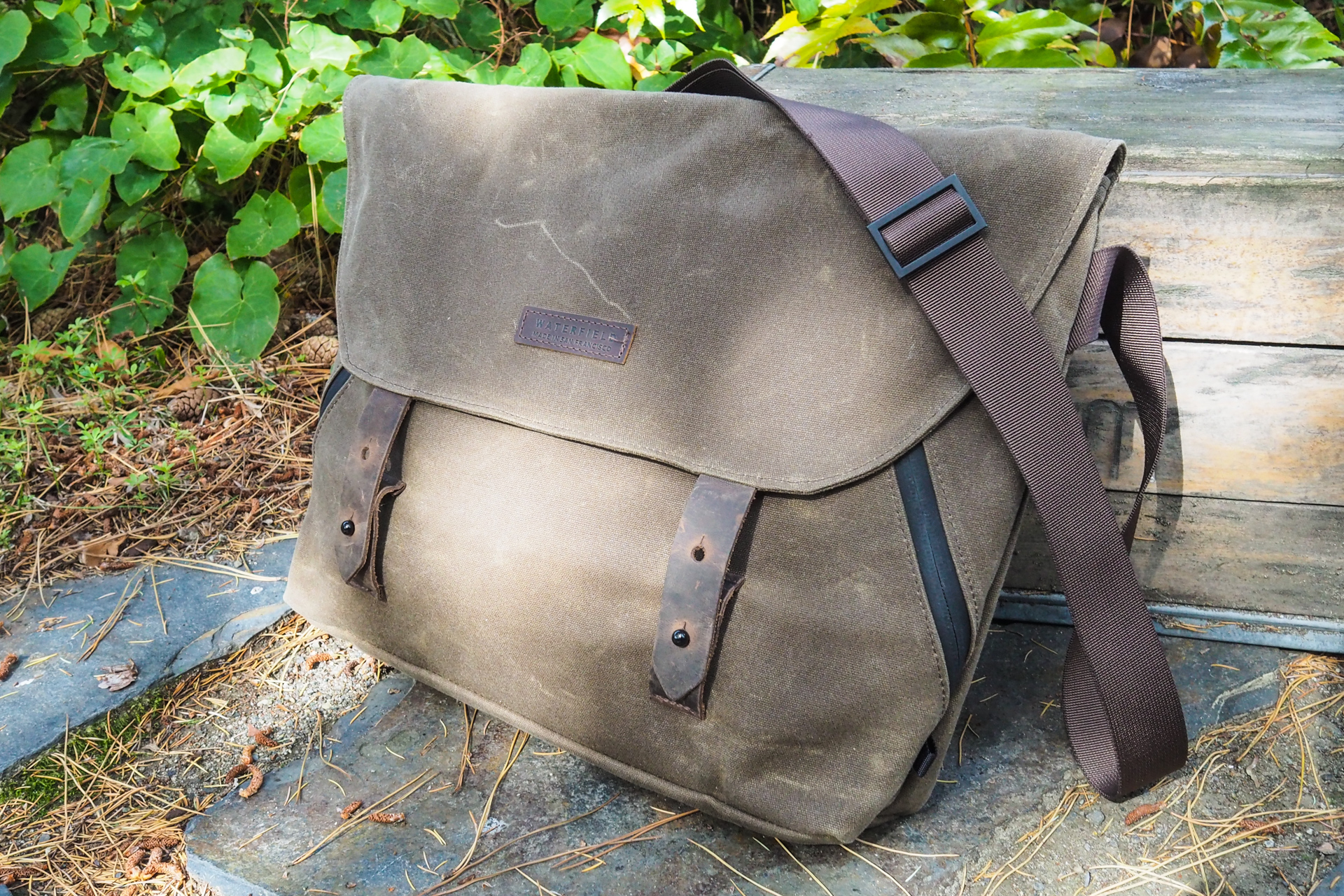
Waterfield Vitesse – $159
waxed messengers 01

Pros:

  • Extremely handsome material and color
  • Great closure mechanism
  • Interior laptop sleeve is lovely

Cons:

  • Permanently attached nylon straps
  • Exterior pocket style not for everyone
  • Prominent badge

Store link

Waterfield’s canvas material was my favorite, with the possible exception, accounting for taste, of the heavy-duty Saddleback bag. While the latter is raw and rugged, this one is more refined and flexible. The canvas is much softer and more pliable than the other bags, but still thick and protective. It isn’t very stiff, though.

The Vitesse is a simple, useful bag. It has plenty of space inside for a day out or even an overnight if you’re careful. There are three simple pockets on the inside for stowing smaller items, and a large laptop compartment that closes with a Velcro strap.

Waterfield recommends a sleeve for your laptop, and I support that, especially considering how nice their sleeves are. The padded waxed canvas sleeve that they sent along has a leather base and magnetic closure that made me feel quite confident in throwing the bag around. I also used it in other bags, like the Joshu+Vela one, which lacked their own padding. There are of course cheaper and thinner sleeves than this, but I felt this one deserved a shout-out.

On the outside, under the flap, is a single large pocket space that can be accessed through zippers on either side of the bag. These are weather-sealed, as well, so if they’re exposed a bit they won’t leak. There’s a leather handle up top that feels well balanced and won’t get in your way. On the front of the flap is a (to me) over-prominent leather logo badge. Maybe I’m over-sensitive to this kind of thing.

The closure method is unique: studs that fit into holes in leather straps attached to the flap. I thought it was weird at first but it’s grown on me: it’s easy to undo in a hurry, and not hard to attach even with one hand.

My main issue is the strap. For a messenger bag the strap is really important, and the truth is Waterfield kind of blew it here. The Vitesse basically just has a plain nylon strap, sewn on at an angle to the corners of the bag. Unlike many laptop bags, the straps can’t swivel, so they’ll get twisted. And unlike the other messengers here, there’s no big obvious pad or quick-adjust capability.

I’m a little sad I can’t recommend the Vitesse more, given its strengths, but this strap really is hard to get over.

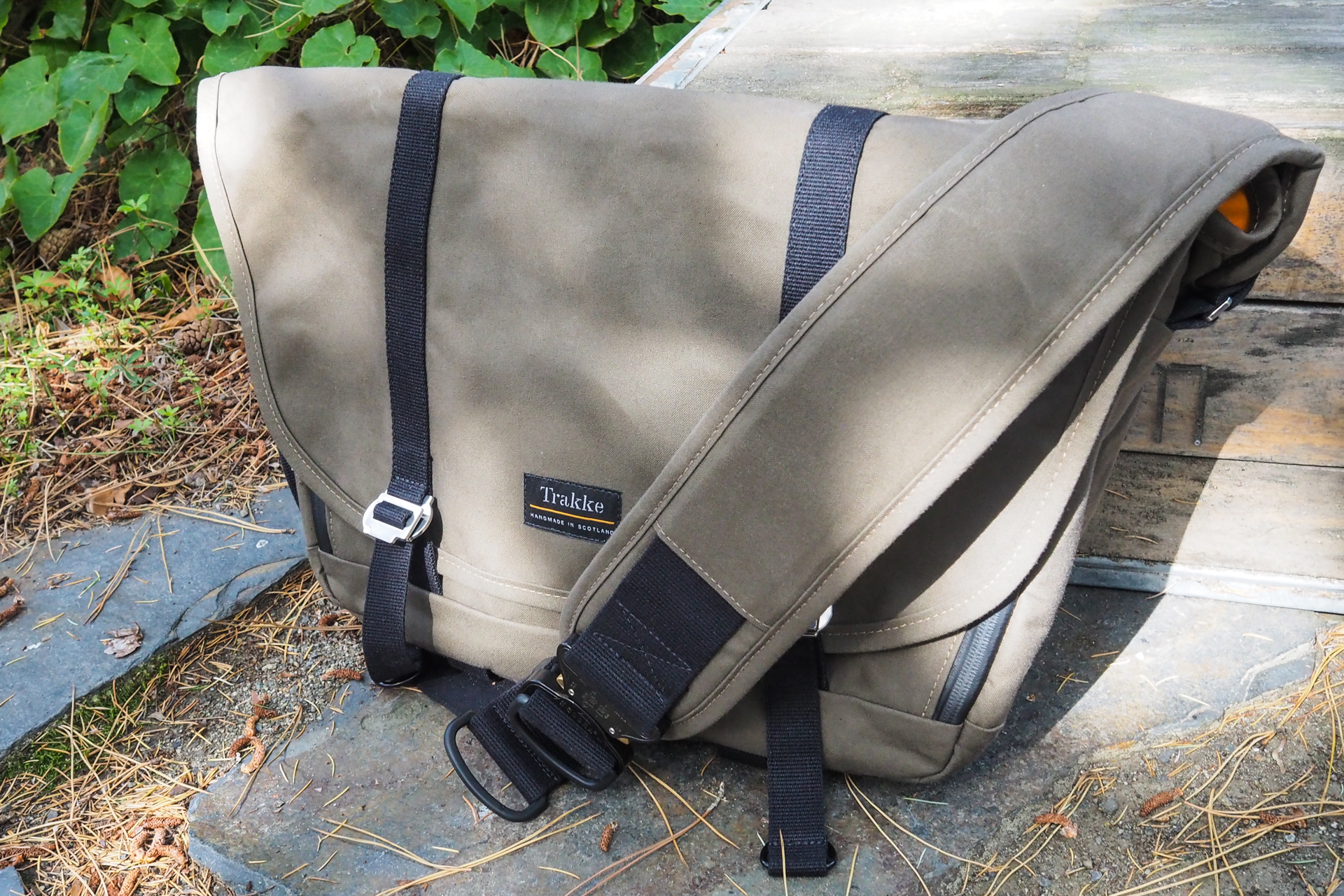
Trakke Wee Lug (Mk2) – £225 (around $270)
waxed messengers 12

Pros:

  • Refined, well thought-out design and components
  • Comfortable strap setup
  • Low-key waxing and color

Cons:

  • Closure can take some getting used to
  • Switching strap side could be easier
  • Low-key waxing and color

Store link

This Scottish maker of waxed canvas items has a long history over there, and sources its cloth from one of the original purveyors of waxed canvas in the world. We’re talking 19th century here.

But the design and in fact the cloth itself are distinctly modern. A “dry wax” finish gives the Wee Lug very little of a waxy feel, but it’s definitely in there, you can tell. It’ll just take longer to develop the kind of wear marks you get in a hurry on the more wax-forward bags like the Vitesse above. It’s also a lighter, smoother color in person, compared with the caramel Rummy and more textured Vitesse.

The truth is this finish isn’t for everyone, in that if you really want that old-fashioned waxed look, this isn’t it. But keep in mind that you can (and should) wax or rewax the material on this kind of bag, and you’re free to do so.

Whether the material is to your liking or not, the design is excellent. The exterior has two zip-access side pockets a bit like the Vitesse, but larger and a bit easier to access. The interior has a zipping padded laptop area, smaller zipped pocket, two simple side pockets and a large general-use space. It’s also a bright, citrusy not-quite-safety orange that complements the tan exterior well.

The zippers all have loops, a more practical alternative to ordinary pulls and, in my opinion, more attractive than leather thongs, which seem to me like they’re just a way to use up scraps. There’s a carry handle near the top of the back that feels very strong and despite sticking out a bit hasn’t bothered me while using the bag.

Closure is achieved by slipping a metal clip below through a gap in another metal clip above; it takes a little bit to get used to, but ultimately it’s both simple and robust, and very unlikely to wear out.

The shoulder strap is thick black canvas, with a generous (20-inch) shoulder pad. In the middle is a Cobra buckle for quick donning and removing. The Wee Lug is definitely intended to be worn high across the back, as the padded portion of the strap goes all the way to the edge of the bag. I should say the D-rings and hardware other than the buckle are the weakest parts of the whole bag — just ordinary plastic.

Those straps can be removed and reattached on the opposite sides so it goes from a right- to left-shouldered bag, but this process is a bit cumbersome. If it were too easy it might happen on accident, but slipping the thick canvas strap through the gap in its clip takes a lot of strength — something you might not have when you’re tired from riding and want to switch shoulders.

If I had to recommend one bag out of these three, I think the Trakke would be it.

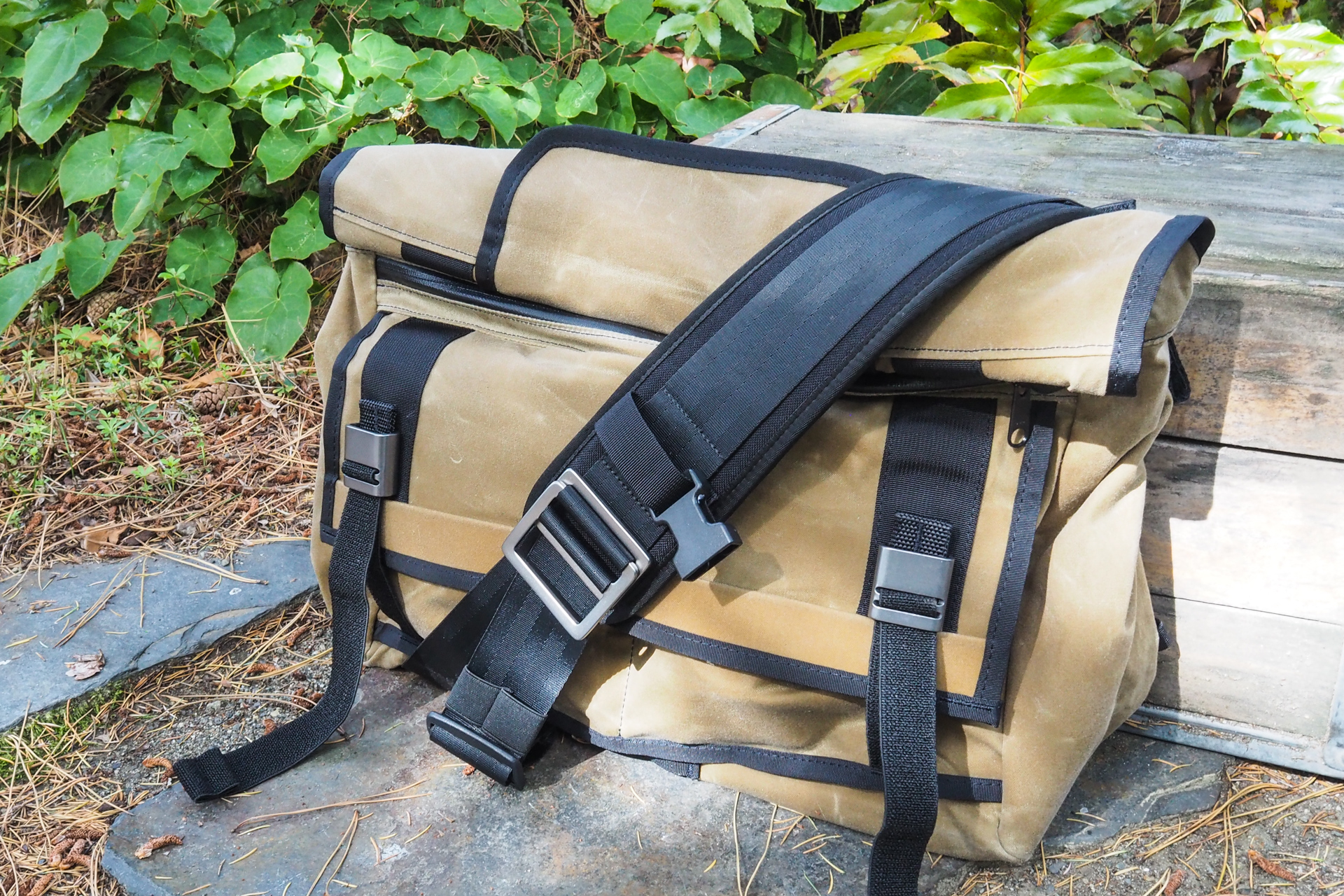
Mission Workshop Monty – $255
 

waxed messengers 19

Pros:

  • Nice marky waxed finish
  • Truly waterproof
  • Very spacious

Cons:

  • Feels a little overengineered
  • No padded laptop space
  • No handle and strap again could be easier to switch

Store link

Mission Workshop puts together bags of obviously high quality, but they tend to have an aspect of cleverness to them that I don’t always find warranted. In the case of the Monty (and its big siblings the Rummy and Shed) they have a great basic setup that feels like there’s just a bit too much going on.

What they get right is the materials and feeling of ruggedness. If I was going into seriously inclement weather, the Monty is the bag I’d take, no question. Waxed canvas is naturally water resistant and it’ll keep your gear safe from spray or limited rain, but torrential downpour or immersion breaks the spell. If you’re going to be riding in the rain regularly and for long periods of time, you need a synthetic, waterproof layer if you don’t want anything getting damp.

That’s what’s inside the Monty: a strong tarp layer lining every pocket and space that pretty much guarantees your gear stays dry. The exterior is a lovely caramel-colored waxed canvas that was extremely eager to pick up marks and impressions (and, as is often the case with wet finishes, dirt and fuzz — Filson’s do this too).

The other thing they get right is the amount of structured and unstructured space. The Monty has a very large main compartment in the back, big enough it’s difficult to photograph (I tried… for some reason this thing is not photogenic, though it looks good in real life). Then there’s a zippered area with two sub-compartments in the front, and two open pockets that close with a single flap in front of that. There’s no shortage of places to put your things, but you’re never at a loss where something should go.

I personally think the front pocket closure is a little much, since you can hardly reach inside them without removing the main flap and undoing this huge Velcro piece, but better too secure than not secure enough. And I would have liked a bit of padding around the larger zip pocket, or a padded sub-area where a laptop could go.

But the main issue I have with the Monty is that it tries to accommodate two styles when really there’s only one. You can close the bag in two ways: by folding the flap over and securing it with the company’s excellent Arkiv closures, or by rolling it down and Velcroing it shut with a different flap.

Rolltop stuff is in MW’s DNA, but it simply doesn’t fit here. If you roll it up, the straps have nothing to do but hang onto the front of the pockets. Meanwhile if you fold it over, you have unused Velcro all over the outside, and a flap on the inside doing nothing. You can’t roll it a little and then fold it over, since it would hide the closure rails.

I feel like MW could have made a strong decision one way or the other here and made the bag either rolltop or flap closure, but instead they did both, and whichever you choose, you still sort of run into the other. And the thing is it doesn’t matter which you choose, since your stuff will be protected fine either way and neither opens up or obscures any extra space.

So the Monty, despite being a very practical bag in some ways, feels like a weird hybrid in others. Whereas the Wee Lug knows exactly what it is and pursues that design exclusively.


These are all three great bags, but they serve very different purposes. The Waterfield is a great all-round casual bag, but the strap really makes it impractical for cycling or long wear. The Trakke is much more suited for athletic activities and has more room and organization, making it something of a perfect weekender or day bag. And the MW is sort of a prepper bag, ready for anything and a bit off-kilter.

If I had to buy a single one of these right now, I’d go with the Trakke — the attention to detail appeals to me. If, on the other hand, I knew I’d be facing lots of rain or the possibility of dropping my bag in the surf, I’d go MW. And if Waterfield gets its strap game together I’d find their bag easy to recommend as a flexible, unfussy hybrid. You can’t go wrong with any of them.

Netflix tests human-driven curation with launch of ‘Collections’

Netflix is testing a new way to help users find TV shows and movies they’ll want to watch with the launch of a “Collections” feature, currently in testing on iOS devices. While Netflix today already offers thematic suggestions of things to watch, based on your Netflix viewing history, Collections aren’t only based on themes. According to Netflix, the titles are curated by experts on the company’s creative teams, and are organized into these collections based on similar factors — like genre, tone, story line and character traits.

This human-led curation is different from how Netflix typically makes its recommendations. The streaming service is famous for its advanced categorization system, where there are hundreds of niche categories that go beyond broad groupings like “Action,” “Drama,” “Sci-Fi,” “Romance” and the like. These narrower subcategories allow the streamer to make more specific and targeted recommendations.

Netflix also tracks titles that are popular and trending across its service, so you can check in on what everyone else is watching, as well.

The new Collections feature was first spotted by Jeff Higgins, who tweeted some screenshots of the addition.

If you’ve been opted in to the test, the Collections option is available at the top right of the app’s homepage — where My List would have been otherwise.

Netflix Collections is your new way of finding what you want to watch, fast. pic.twitter.com/kKfciBWCg4

— Jeff Higgins Likes Umbrella Beach Drinks (@ItsJeffHiggins) August 23, 2019

The suggestions are organized into editorial groups, with titles like “Let’s Keep It Light,” “Dark & Devious TV Shows,” “Prizewinning Movie Picks,” “Watch, Gasp, Repeat,” “Women Who Rule the Screen” and many more.

You can follow the Collection from the main screen, or you can tap into it to further explore its titles.

ECp6oEOXsAAgddU

If you tap a collection that interests you, it smoothly expands to show the thumbnails of the suggested titles below a header that explains what the collection is about. You can choose to follow the suggestion from here too, which presumably ties into Netflix’s notification system.

Here's a look at the smooth transitions in the new Netflix Collections ? pic.twitter.com/5xPYRheCqn

— Jeff Higgins Likes Umbrella Beach Drinks (@ItsJeffHiggins) August 23, 2019

Collections are also found on the app’s Home page, for those who have access to the new feature.

“We’re always looking for new ways to connect our fans with titles we think they’ll love, so we’re testing out a new way to curate Netflix titles into collections on the Netflix iOS app,” a Netflix spokesperson confirmed to TechCrunch. “Our tests generally vary in how long they run for and in which countries they run in, and they may or may not become permanent features on our service.”

UQ4dOkhZ

This isn’t the first time Netflix has toyed with organizing content suggestions into Collections. The company’s DVD service (yes, it still exists), had rolled out a similar Collections feature in its own mobile app.

This test comes at a time when Netflix is working on features to better retain existing subscribers amid increased competition, including that from upcoming rivals like Disney+ and Apple TV+, among others. On this front, it also recently launched a feature allowing users to track new and soon-to-launch releases, as a means of keeping subscribers anticipating what comes next.

Netflix said Collections is only available on iOS. As a test, it won’t show to all users.

Backup service IDrive launches a face recognition API for developers

I did a bit of a double take when I first saw this announcement. IDrive, an online cloud storage and backup service, is launching a face recognition API today that goes up against the likes of AWS Rekognition and others. That seems like a bit of an odd move for a backup company, but it turns out that IDrive has actually been in the face recognition game for a while. Last year, the company launched IDrive People to help its users find faces in photos they’ve backed up on its service. With its API, IDrive is targeting a very different market, though, and entering into the API business for the first time.

IDrive Face, as the service is called, includes the standard tools for detecting and analyzing multiple faces within a still image that are at the core of every face detection API. For this, the API provides the usual bounding boxes and metadata for all faces. There are also face comparison and verification features to identify people by their face, and a gender, age and emotion detection option. All requests to the API are encrypted, and using the API looks to be pretty straightforward.

IDrive promises that its tool’s accuracy and performance is comparable to AWS Rekognition, but at a lower price. The company offers a developer plan for $49.50/month plus $0.0001 per transaction, at up to 75 transactions per minute, with unlimited storage included. There’s also a business plan for $124.50/month, $0.0001 per transaction and up to 500 transactions per minute, as well as custom enterprise plans and free trials for those who want to give the service a try.

AWS’ pricing is, as usual, a bit more complicated, and while there’s no monthly cost, most serious users will end up paying more for Rekognition than IDrive Face, though Rekognition offers a number of features (like text, object, scene and celebrity recognition) that aren’t available in the competing product, which only focuses on faces.

GenderAge Detection

Daily Crunch: Overstock CEO resigns

The Daily Crunch is TechCrunch’s roundup of our biggest and most important stories. If you’d like to get this delivered to your inbox every day at around 9am Pacific, you can subscribe here.

1. Overstock CEO resigns after ‘deep state’ comments

This comes after CEO Patrick Byrne released a statement declaring that he cooperated with federal investigators back in 2015 and was in fact “the notorious ‘missing chapter 1’ of the Russia investigation.” He subsequently gave interviews that also touched on his relationship Maria Butina, who’s been accused of working as a Russian agent.

The ensuing controversy sent Overstock’s share price tumbling, and Byrne said yesterday that he would have to “sever ties with Overstock, both as CEO and board member.”

2. Sphero has acquired littleBits

Founded in 2010 and 2011 respectively, Sphero and littleBits took separate approaches to creating STEM toys, but ultimately ended up in similar spaces.

3. Google says China used YouTube to meddle in Hong Kong protests

The search giant, which owns YouTube, followed in the footsteps of Twitter and Facebook, which earlier this week said China had used their social media sites to spread misinformation and discord among the protesters.

GettyImages 528179450

4. VMware acquires Carbon Black for $2.1B and Pivotal for $2.7B

Although these are two very different companies, both Carbon Black and Pivotal focus on modern workloads.

5. Oracle directors give blessing to shareholder lawsuit against Larry Ellison and Safra Catz

Three years after closing a $9.3 billion deal to acquire NetSuite, several Oracle board members have written a letter to the Delaware Court, approving a shareholder lawsuit against company executives Larry Ellison and Safra Catz over the deal.

6. Tumblr’s next step forward with Automattic CEO Matt Mullenweg

In an interview, Automattic founder and CEO Matt Mullenweg discussed Tumblr’s history and the impact of the poorly received adult content restrictions. He also shed some light on where Tumblr goes under its new owners. (Extra Crunch membership required.)

7. Apple exec Susan Prescott is coming to TechCrunch Sessions: Enterprise

Prescott has been at Apple since 2003, and she’ll be joining us to discuss the company’s enterprise strategy.

Watch a Waymo self-driving car test its sensors in a haboob

Waymo, the self-driving car company under Alphabet, has been testing in the suburbs of Phoenix for several years now. And while the sunny metropolis might seem like the ideal and easiest location to test autonomous vehicle technology, there are times when the desert becomes a dangerous place for any driver — human or computer.

The two big safety concerns in this desert region are sudden downpours that cause flash floods and haboobs, giant walls of dust between 1,500 and 3,000 feet high that can cover up to 100 square miles. One record-breaking haboob in July 2011 covered the entire Phoenix valley, an area of more than 517 square miles.

Waymo released Friday a blog post that included two videos showing how the sensors on its self-driving vehicles detect and recognize objects while navigating through a haboob in Phoenix and fog in San Francisco. The vehicle in Phoenix was manually driven, while the one in the fog video was in autonomous mode.

The point of the videos, Waymo says, is to show how, and if, the vehicles recognize objects during these extreme low visibility moments. And they do. The haboob video shows how its sensors work to identify a pedestrian crossing a street with little to no visibility.

Waymo uses a combination of lidar, radar and cameras to detect and identify objects. Fog, rain or dust can limit visibility in all or some of these sensors.

Waymo doesn’t silo the sensors affected by a particular weather event. Instead, it continues to take in data from all the sensors, even those that don’t function as well in fog or dust, and uses that collective information to better identify objects.

The potential is for autonomous vehicles to improve on visibility, one of the greatest performance limitations of humans, Debbie Hersman, Waymo’s chief safety officer wrote in the blog post. If Waymo or other AV companies are successful, they could help reduce one of the leading contributors to crashes. The Department of Transportation estimates that weather contributes to 21% of the annual U.S. crashes.

Still, there are times when even an autonomous vehicle doesn’t belong on the road. It’s critical for any company planning to deploy AVs to have a system that can not only identify, but also take the safest action if conditions worsen.

Waymo vehicles are designed to automatically detect sudden extreme weather changes, such as a snowstorm, that could impact the ability of a human or an AV to drive safely, according to Hersman.

The question is what happens next. Humans are supposed to pull over off the road during a haboob and turn off the vehicle, a similar action when one encounters heavy fog.  Waymo’s self-driving vehicles will do the same if weather conditions deteriorate to the point that the company believes it would affect the safe operation of its cars, Hersman wrote.

The videos and blog post are the latest effort by Waymo to showcase how and where it’s testing. The company announced August 20 that it has started testing how its sensors handle heavy rain in Florida. The move to Florida will focus on data collection and testing sensors; the vehicles will be manually driven for now.

Waymo also tests (or has tested) its technology in and around Mountain View, Calif., Novi, Mich., Kirkland, Wash. and San Francisco. The bulk of the company’s activities have been in suburbs of Phoenix  and around Mountain View.