Kitty Hawk CEO Sebastian Thrun is coming to Disrupt SF

Sebastian Thrun can’t be described easily.

He’s a serial entrepreneur and educator, a computer scientist and inventor. He helped bring self-driving cars out of academia through X, the Google moonshot factory he founded. (That little project is now known as Waymo.) Thrun went on to co-found Udacity, the $1 billion online education startup where he is executive chairman.

Now, Thrun is pushing the “future of transportation” idea beyond self-driving cars. As CEO of Kitty Hawk Corporation, Thrun is working on bringing two aircraft to market — the one-person Flyer and a two-person autonomous taxi called Cora. Kitty Hawk recently formed a strategic partnership with Boeing on Cora and more broadly on urban air mobility, particularly around safety and how autonomous and piloted vehicles will co-exist.

We’re excited to announce that Thrun will be joining us onstage at TechCrunch Disrupt SF to give a behind the scenes look at Kitty Hawk and what the future of flight might look like.

Disrupt SF runs October 2 to October 4 at the Moscone Center in San Francisco. Tickets are available here.

Thrun’s visits to Disrupt SF always deliver something new. Who can forget the puppy? This year, we’re focused on flying cars, what they’ll look like and how Kitty Hawk, which is backed by Google’s Larry Page, will deliver on this promise of the future. 

Did you know Extra Crunch annual members get 20% off all TechCrunch event tickets? Head over here to get your annual pass, and then email [email protected] to get your 20% off discount. Please note that it can take up to 24 hours to issue the discount code.

How to move from VP of Sales to CRO with leading exec recruiter David Ives

It wasn’t so long ago that sales meant just showing up with a deck and a smile. These days, it seems that sales leaders almost need a PhD in statistics just to get through the typical day managing a sales funnel. From SQLs and MQLs to NDRR and managing overall retention, the roles of VP of Sales and Chief Revenue Officers (CROs) are evolving rapidly in tandem with the best practices of SaaS startups.

Few people know this world better than David Ives, who is a partner at True Search, one of the top executive recruiting firms in the country where he co-leads the go-to-market practice. David has led countless CRO and VP of Sales searches, and in the process, has learned not just what CEOs and boards are looking for, but also the kinds of skills that candidates need to shine in these important career inflection points.

In our conversation, we talk about the evolving nature of the sales org, how leaders can best position themselves for future advancement, what companies are looking for today in new executive sales hires, and compensation changes in the industry.

This interview has been extensively edited and condensed for clarity

Introduction and background

Danny: Why don’t we start with your background — how did you get into recruiting?

David: So my background was definitely unique. I started as an enterprise sales rep of the truest form selling subscription-based data analytics and systems into capital markets, so into investment banks, trading desks, hedge funds, asset managers, portfolio managers — you name it. Then I drifted purposely, intentionally away from capital markets and did about four different growth technology companies. I landed at NewsCred, and it was a neat time — it was really the birth of the startup landscape with the whole Flatiron district in New York.

Later, I was looking for my next CRO opportunity and was networking with some of the investor folks that I knew. I had a friend of mine who was a talent partner at a private equity firm who said to me, “I’ve always thought that you’d be really good at this and we’re starting to push for our search firms to have operators.” I went and met with Brad and Joe [founders of True], and three weeks later I was in the seat.

Danny: That’s great. And what do you do at True?

David: Well, we moved to a specialization model right when I got here. I don’t know if I was the test case or not, but I didn’t know search, so my skillset was that I knew the role. I run our go-to-market practice with another partner, and we have probably 40, 45 people in that group. We focus exclusively on sales, marketing, customer success, we’ll do biz dev. I probably skew more to CRO than anything else, but I do CMO and VP of marketing as well, and then I do a handful of business development, chief client officers, and VPs of customer success a year. That’s my mix basically.

What is the skillset of a modern CRO?

Danny: You’ve been in the sales leadership space for a long time, and you’ve been in the recruiting space for a couple of years. What are some of the changes that you’re seeing today in terms of candidates, skills, and experiences?

David: I think a big change has been from what I call a backend pipeline manager to what I would call a full funnel manager.

Apple releases first beta of iOS 13.1, indicating iOS 13 is nearly done

Surprise, Apple didn’t release yet another beta version of iOS 13. The company released the first developer beta of iOS and iPadOS 13.1 instead.

This is a curious move, as Apple doesn’t usually share beta versions of .1 updates before the release of major updates. What’s even more surprising is that Apple released new beta versions for watchOS 6.0 and tvOS 13.0 today.

So Apple just posted the first beta for iOS 13.1…? pic.twitter.com/MH0PUOAZiQ

— Federico Viticci (@viticci) August 27, 2019

Chances are that iOS 13.0 is pretty much done by this point. Usually, Apple releases major versions of iOS a few days after announcing the new iPhone — the press event will likely take place at some point in early September. The company might release iOS 13.0 a bit earlier than expected this year.

Apple removed some minor features in iOS 13 in early beta versions of iOS 13. As MacRumors spotted, many of those features are now back in the beta version of iOS 13.1. Those features include Shortcuts automations and the ability to share your ETA in Apple Maps.

It’s clear that Apple is trying to make iOS 13.0 as stable as possible, even if it means releasing some features a bit later this fall.

We need to really get used to the fact that WWDC's "What's coming in iOS 13!" is about what is in *13*, not *13.0*.

And, honestly, I'm a fan of that. Show me what's coming for the next year, but don't rush shipping because of some arbitrary X.0 marketing need. https://t.co/Rj3l2XKB7U

— Curtis Herbert (@parrots) August 27, 2019

Lucid’s drone is built to clean the outside of your house or office

Building exteriors tend to get gross. Dirt clings to the walls. Windows get filmy. Spiderwebs amass. If you live in a particularly humid area, mold and mildew can start to make exterior walls look like a science experiment.

On taller buildings, scrubbing it all off generally means bringing a bucket truck, scaffolding or suspension gear and having a crew hang from the side of the building. It’s a lot of prep work, with a lot of potential for falls and injuries. Lucid, a new company out of North Carolina, has a different approach: drones.

Rather than pressure washing, their drone “soft washes” the building — be it a house, an office or the campus library — by spraying a cleaning solution that the company says is biodegradable and works on surfaces like brick and limestone. The operator rolls up to a site, unfolds the drone, powers it up, then plugs it into a tank sitting in the back of their work truck. A hose tether runs from the tank to the drone at all times, feeding the low-pressure sprayer while keeping the bulk of the weight down on the ground. The operator handles the drone via remote control.

The drone is currently battery-powered; in the future, Lucid plans to work tethered power into the design. The company tells me the drone is currently designed/tested to clean buildings up to 120 feet tall. That’s around 10-12 stories tall, depending on the building’s design.

While their early tests were done with off-the-shelf drones, Lucid tells me it’s now custom-building its own; they need to be able to carry the weight of the tether, fly slowly for finer controls and easier operation and stay light enough (under 55 lbs) that it fits within the FAA’s small unmanned aircraft guidelines. The company tells me their drone weighs around 25-30 lbs, depending on payload requirements.

Lucid co-founder Andrew Ashur says they originally set out to be the service provider, hiring operators and cleaning the buildings themselves. When they began testing the concept and other companies started reaching out, the team realized they might be better off selling the drone itself. They’re now starting to rent the drones to companies for $3,000 per month, which includes support, training and maintenance (because, as any hobbyist drone pilot could tell you, things break).

Lucid is part of Y Combinator’s Summer 2019 batch. As of YC Demo Day last week, the company noted that it had signed contracts worth around $33,000 per month in recurring revenue.

Ashur tells me that while they’re considering a nationwide rollout, their focus right now is on the southeastern United States — it’s where they started, and where mold and mildew issues are common.

Daily Crunch: Smartphone sales decline again

The Daily Crunch is TechCrunch’s roundup of our biggest and most important stories. If you’d like to get this delivered to your inbox every day at around 9am Pacific, you can subscribe here.

1. Smartphone sales declined again in Q2, surprising no one

After years of growth, the smartphone market’s recent slide has continued in the second quarter of 2019, according to Gartner.

It’s not a huge decline — 1.7% year over year — but this could turn into an ongoing problem for manufacturers. And the biggest hit is coming at the high end of the market, as higher prices combine with longer refresh cycles and fewer compelling features.

2. Yelp will let users personalize their homepage and search results

If you’re a vegetarian, or if you’re a parent who’s usually looking for kid-friendly restaurants, you no longer have to reenter that information every time you do a search. Instead, you can enter it once and Yelp will prioritize those results moving forward.

3. Ron Johnson’s e-commerce startup Enjoy raises $150M, expands in U.K.

Through partnerships with other companies, including AT&T, Sonos, Google and now EE, Enjoy creates an online mobile store where customers can shop for devices and receive same-day delivery. They can also opt to have an Enjoy expert deliver the item and help them get set up, free of charge.

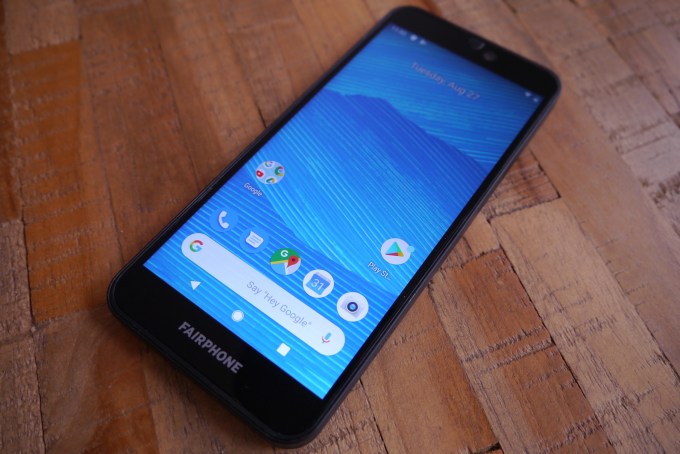
Fairphone main Google

Fairphone 3 running Android 9 out of the box

4. Can Fairphone 3 scale ethical consumer electronics?

Fairphone, the Dutch social enterprise that’s on a mission to rethink the waste and exploitation that underpins the business of consumer electronics, announced its third smartphone today.

5. Facebook is working with HackerOne on a bug bounty program for its Libra cryptocurrency

Facebook is moving ahead with its cryptocurrency project, even as government regulators have called for the company to suspend it while they assess its legality.

6. The BBC is developing a voice assistant, code named ‘Beeb’

Why is a publicly funded broadcaster ploughing money into developing a voice assistant? A BBC spokesperson said the intent is to “experiment with new programmes, features and experiences without someone else’s permission to build it in a certain way.”

7. How to use Amazon and advertising to build a D2C startup

In-depth tips from VMG Ignite, a consultancy that’s worked with dozens of direct-to-consumer startups trying to both find product-market fit and achieve scale through Amazon and online advertising. (Extra Crunch membership required.)

Through crowdsourcing, Cerberus Interactive wants to take location-based gaming to the masses

Sami Khan began his work in the startup world by marketing mobile-based investment services like Acorns.

Now the marketer who helped grow that business to a nearly $1 billion valuation is turning his attention to location-based gaming in the hopes that he can take on leading contender Niantic with a faster, more flexible and fan-driven approach to game development with his new startup, Cerberus Interactive.

Khan’s pitch is that he’s taking the skills he honed building up services like Acorns or the browser extension for bargain hunters, Honey, to game development to make games more viral from their inception.

The biggest thing is how do you de-risk what is perceived as a hit-driven industry?,” Khan asks. “Games are closer to digital apps than back in the days of the console and companies should ship it like an e-commerce concept… If adoption of the game is going to be the decision factor of whether a game fails or succeeds… why isn’t the adoption of the game tested before the title is built or while the game is being conceived?”

So for his first foray into gaming, Khan is combining a crowdsourced approach to the development of the game and applying it to what many people think is gaming’s next big frontier — the location-based game phenomenon that hit its stride with Niantic’s Pokémon GO.

Right now in location-based games you have the behemoth which is Niantic,” says Khan. “Right now the gaming industry looks at location-based games as its own sub genre. But when we look at location-based games, we believe that location-based games have an aspect that it is a game mechanic within other games.” 

The first game that Cerberus is developing is a base-building simulator akin to a title like “Age of Empires,” but based on real-world locations. “Simulation games or casual games with location built in will have a bonus or an advantage over the stationary games that we play today,” says Khan.

The “Atlas Empires” title that Cerberus is currently developing is being made in concert with the gamers who might want to play it. So far, an undisclosed number of customers are already paying to have a say in certain aspects of the game’s development — kind of like a premier tier within a crowdfunding campaign.

Khan, a New Orleans native who splits his time between Los Angeles and Austin, has enlisted some marquee investors in his bid to challenge both the traditional ways in which games have been developed and the current industry leader.

Strategic investor MobilityWare has signed on to back the company along with individual investors like Steve Huffman, the co-founder and chief executive of Reddit, and Blake Chandler, the chief business officer of the runaway social network hit, TikTok.

Khan traces his love of games to his time visiting his cousins in Bangladesh and playing “Prince of Persia” on an early Toshiba laptop. “I remember sitting around the computer, watching my oldest cousin play because my dad didn’t want any of the kids touching the laptop,” Khan says.

So far the beta version of “Atlas Empires” has had 50,000 downloads and has about 1,000 daily players, Khan says. The commercial version of the game is expected to go live in the first quarter of 2020, says Khan.

Anthony Levandowski, former Google engineer at center of Waymo-Uber case, charged with stealing trade secrets

Anthony Levandowski, the former Google engineer and serial entrepreneur who was at the center of a trade secrets lawsuit between Uber and Waymo, has been indicted by a federal grand jury on theft of trade secrets.

The indictment, which is posted below, charges Levandowski with 33 counts of theft and attempted theft of trade secrets while working at Google, where he was an engineer and one of the founding members of the group that worked on Google’s self-driving car project. He is scheduled to be arraigned on the charges at 1:30 p.m. Tuesday before U.S. Magistrate Judge Nathanael M. Cousins.

If convicted, Levandowski faces a maximum sentence of 10 years and a fine of $250,000, plus restitution, for each violation, according to the U.S. Attorney’s office.

Levandowski’s attorneys issued a statement on his behalf stating he is innocent of the charges.

“He didn’t steal anything, from anyone,” the statement reads. “This case rehashes claims already discredited in a civil case that settled more than a year and a half ago. The downloads at issue occurred while Anthony was still working at Google—when he and his team were authorized to use the information. None of these supposedly secret files ever went to Uber or to any other company.”

As a result of the charges, Levandowski has stepped down as CEO of his latest startup called Pronto AI, which is developing an advanced driver assistance system product for trucks called Copilot. Pronto AI was originally called Kache.ai, according to paperwork discovered at the time by TechCrunch, and was registered as a corporation with the California Secretary of State.

Robbie Miller, Pronto’s chief safety officer, will take over as CEO, the company told TechCrunch.

“The criminal charges filed against Anthony relate exclusively to lidar and do not in any way involve Pronto’s ground-breaking technology,” the company said in a statement. “Of course, we are fully supportive of Anthony and his family during this period.”

The charges stem from Levandowski’s time at Google’s self-driving project, where he led its light detecting and ranging (lidar) engineering team, according to the indictment. The indictment alleges that in the months before his departure, Levandowski downloaded from secure Google repositories numerous engineering, manufacturing and business files related to Google’s custom lidar and self-driving car technology. Levandowski worked on the project from 2009 until he resigned from Google without notice on January 27, 2016.

Levandowski left Google and started Otto, a self-driving trucking company that was then bought by Uber. Waymo later sued Uber for trade secret theft.

Waymo alleged in the suit, which went to trial, that Levandowski stole trade secrets, which were then used by Uber. The case went to trial, but was settled in February 2018. Under the settlement, Uber has agreed to not incorporate Waymo’s confidential information into their hardware and software. Uber also agreed to pay a financial settlement that included 0.34% of Uber equity, per its Series G-1 round $72 billion valuation. That calculated at the time to about $244.8 million in Uber equity.

“We have always believed competition should be fueled by innovation, and we appreciate the work of the U.S. Attorney’s Office and the FBI on this case,” a Waymo spokesperson said in a statement provided to TechCrunch.

An Uber spokesperson said the company has cooperated with the government throughout their investigation and will continue to do so.

The prosecution is being handled by the Office of the U.S. Attorney, Northern District of California’s new Corporate Fraud Strike Force and is the result of an investigation by the FBI.

“All of us have the right to change jobs,” said U.S. Attorney David L. Anderson, “none of us has the right to fill our pockets on the way out the door. Theft is not innovation.”

Levandowski Indictment by TechCrunch on Scribd

Hulu redesigns its mobile app for better discovery

At this year’s CES event, Hulu announced plans to trial an updated version of its user interface that would do away with the confusing landing page called “Lineup.” At the time, the company said it was considering both a “Hulu Picks” option or an “Unwatched in My Stuff” screen as a replacement for “Lineup.” Today, Hulu’s new interface is rolling out across iOS and Android devices, the company says, and “Lineup” is gone.

The Hulu interface launched in 2017 was not always well-liked — something Hulu had acknowledged after a complaint became the most upvoted item on Hulu’s customer feedback forums a couple of years ago. Users felt the interface was too difficult to navigate and the layout was confusing, among other things.

Some of Hulu’s challenges were around the fact that it was trying to merge an on-demand library with a live TV service, while also finding room to promote its original content.

But some of its other design choices were just odd — like its decision to make a single piece of content the main focus for many of its screens, for example. Meanwhile, its landing page “Lineup” never really made sense, either. Its name hinted at some form of personalization, but instead, it was more often filled with suggestions of what Hulu was promoting, like “The Handmaid’s Tale.”

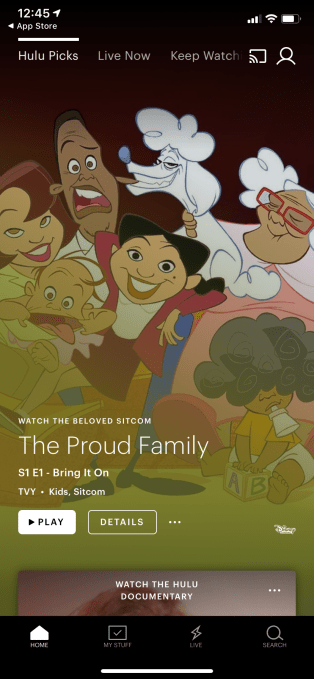
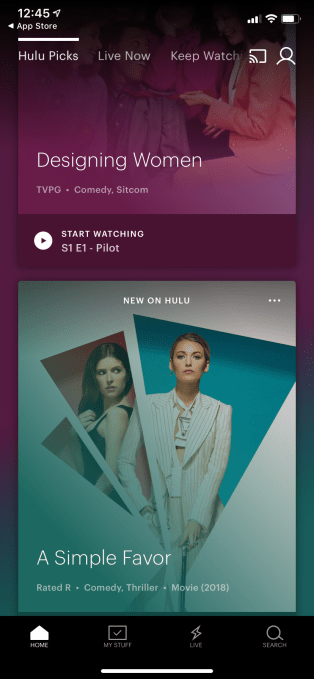
The updated iOS interface ditches “Lineup,” and replaces it with “Hulu Picks.”

This is more clearly a collection of things to watch that’s curated by Hulu staff, rather than algorithmically derived by user viewing behavior.

Image from iOS 7

However, the other landing page Hulu had been considering, “Unwatched in My Stuff,” is still available just a few swipes over.

While Hulu still gives a single piece of content the focus on its main screens on the iPhone, it’s now easier to see there’s more content available if you swipe down, as the top of the next item’s card is peeking up from the bottom of the screen.

On the smartphone, this means you can see two items at a time. On iPad, you can see two rows totaling six cards on the app’s main screen when in landscape mode.

Image from iOS 8

This same format applies not only to “Hulu Picks,” but also to neighboring screens like “Live Now,” “Unwatched in My Stuff,” “My Channels” and the genre-based sections like “Sports,” “News,” “TV,” “Movies,” “Kids,” “Hulu Originals” and others.

Only the “Keep Watching” screen retains the more traditional thumbnails.

This seems like a small change, but it goes a long way to increase the discoverability of Hulu content, as it reduces how many times you have to swipe to see more suggestions.

Image from iOS 6

Other changes touted at CES, like adding expanded metadata next to content (genre, rating, year) or the ability to mark content as “unwatched,” haven’t made an appearance. (Plenty of items still lack a rating). The 14-day live TV guide mentioned at CES isn’t available on iOS, either.

Hulu didn’t publicly announce the launch of the iOS redesign, but did confirm it’s rolling out now, only to mobile devices. They said other devices will get the update “soon.”

Update: Hulu says the update is coming to Android as well now, but it’s only in A/B testing at present. The post has been updated since publication. 

SAP & Pricefx cover hot topics at TechCrunch’s Sept. 5 Enterprise show in SF

You can’t talk enterprise software without talking SAP, one of the giants in a $500 billion industry. And not only will SAP’s CEO Bill McDermott share insights at TC Sessions: Enterprise 2019 on September 5, but the company will also sponsor two breakout sessions.

The editors will sit down with McDermott and talk about SAP’s quick growth due, in part, to several $1 billion-plus acquisitions. We’re also curious to hear about his approach to acquisitions and his strategy for growing the company in a quickly changing market. No doubt he’ll weigh in on the state of enterprise software in general, too.

Now about those breakout sessions. They run in parallel to our Main Stage set and we have a total of two do-not-miss presentations for you to enjoy. On September 5, you’ll enjoy three breakout sessions –two from SAP and one from Pricefx. You can check out the agenda for TC Sessions: Enterprise, but we want to shine the light on the sponsored sessions to give you a sense of the quality content you can expect:

  • Innovating for a Super-Human Future 
    Martin Wezowski (SAP)
    We talk about change, but what are the mechanics and the dynamics behind it? And how fast is it? The noted futurist will discuss what it means to be an innovator is transforming faster than before, and this transformation is deeply rooted in the challenges and promises between cutting-edge tech and humanism. The symbiosis between human creativity & empathy and machine intelligence opens new worlds for our imagination in a time when “now” has never been so temporary, and helps us answer the question: “What is human, and what is work in a superhuman future?” (Sponsored by SAP)
  • Pricing from Day One
    Madhavan Ramanujam (Simon-Kucher & Partners, Gabriel Smith) and Darius Jakubik (Pricefx) A key ingredient distinguishing top performing companies is clear focus on price. To maximize revenue and profits, pricing should be a C-level / boardroom consideration. To optimize pricing, you should think about price when determining which products and features to bring to market; put the people, process and technology in place to optimize it; and maintain flexibility to adjust strategy and tactics to respond to changing markets. By doing so, companies unlock the single greatest profit lever that exists. (Sponsored by Pricefx)
  • Cracking the Code: From Startup to Scaleup in Enterprise Software 
    Ram Jambunathan (SAP.iO), Lonnie Rae Kurlander (Medal), Caitlin MacGregor (Plum) and Dimitri Sirota (BigID) The startup journey is hard. Data shows that 70% of upstart tech companies fail, while only 1% of these startups will go on to gain unicorn status. Success in enterprise software often requires deep industry experience, strong networks, brutally efficient execution and a bit of luck. This panel brings together three successful SAP.iO Fund-backed enterprise startups for an open discussion on lessons learned, challenges of scaling and why the right strategic investors or partners can be beneficial even at early stages. (Sponsored by SAP)

TC Sessions: Enterprise 2019 takes place in San Francisco on September 5. It’s a jam-packed day (agenda here) filled with interviews, panel discussions and breakouts — from some of the top minds in enterprise software. Buy your ticket today and remember: You receive a free Expo-only pass to TechCrunch Disrupt SF 2019 for every ticket you buy.

Only 4 days left until prices go up on passes to Disrupt SF 2019

Calling all budget-conscious, bargain-loving members of the early-stage startup community. Here’s a real quick way for you to save up to $1,300 on your pass to Disrupt San Francisco 2019 (October 2-4). Buy your passes before early-bird pricing flies the coop. You have until 11:59 p.m. (PST) on August 30. That just four days left to reap serious savings.

TechCrunch’s flagship event is an epic, three-day startup adventure spanning the tech spectrum. Join more than 10,000 attendees, 1,200 exhibiting early-stage startups and sponsors, take in the world-famous Startup Battlefield pitch competition, the TC Hackathon, the workshops and the Q&A sessions — and so much more.

Disrupt events are famous for incredible speakers across four unique stages, and Disrupt SF will not disappoint. Let’s take a look at just some of the presentations you’ll enjoy:

  • Getting to IPO: PagerDuty CEO Jennifer Tejada led the company to a successful IPO earlier this year. She’ll join Box CEO Aaron Levie to talk about how these two companies charted their path to an IPO, the pros and cons of doing so and life after ringing the bell on Wall Street.
  • How to Raise My First Dollars: Venture funding may have boomed over the last decade, but the decisions around your initial funding are as tricky as ever. Hear how to take advantage of the current landscape from top Silicon Valley early-stage thinkers, including pre-seed investor Charles Hudson of Precursor Ventures, early-stage investor Annie Kadavy of Redpoint Ventures and Russ Heddleston, CEO of DocSend.
  • When Spies Meet Startups: Since leaving the world of intelligence, former NSA director Adm. Mike Rogers and ex-Israeli cyber-intelligence chief Nadav Zafrir talk shop about what startups need learn about security.
  • The Business and Ethics of Real Tech Diversity: There’s both a moral and a business imperative to building and fostering a diverse and inclusive workforce. Hear from Project Include’s Ellen Pao and Tracy Chou about what it takes to get there, and from Harry Glaser, general manager and CMO of Sisense, on how focusing on diversity has positively impacted his bottom line.

That’s merely a taste of greatness, and we’ll be adding even more content in the coming weeks. You can check out the full agenda here.

Disrupt San Francisco 2019 runs from October 2-4. Early-bird pricing ends in just four days — 11:59 p.m. on August 30. Don’t miss out — buy your pass and save up to $1,300.

Is your company interested in sponsoring or exhibiting at Disrupt San Francisco 2019? Contact our sponsorship sales team by filling out this form.

Uber tries to reassure customers that it takes safety seriously, following NYTimes book excerpt

It’s hard at times not to feel sorry for Uber CEO Dara Khosrowshahi, given all that he inherited when he became the ride-share giant’s top boss back in April 2017.

Among his many to-do items: take public a money-losing company whose private-market valuation had already soared past what many thought it was worth, clean-up the organization’s win-at-all-costs image, and win over employees who clearly remained loyal to Uber cofounder Travis Kalanick, an inimitable figure who Khosrowshahi was hired to replace.

Things are undoubtedly about to get worse, given the fast-upcoming publication of a tell-all book about Uber authored by New York Times reporter Mike Isaac. In just one excerpt published yesterday by the newspaper, Isaac outlines how Uber misled customers into paying $1 more per ride by telling them Uber would use the proceeds to fund an “industry-leading background check process, regular motor vehicle checks, driver safety education, development of safety features in the app, and insurance.”

The campaign was hugely successful, according to Isaac, who reports that it brought in nearly half a billion dollars for Uber. Alas, according to employees who worked on the project, the fee was devised primarily to add $1 of pure margin to each trip.

Om Malik, a former tech journalist turned venture capitalist, published a tongue-in-cheek tweet yesterday after reading the excerpt, writing, “Apology from @dkhos coming any minute — we are different now.”

Malik was close. Instead of an apology, Uber today sent some of its riders an email titled, somewhat ominously, “Your phone number stays hidden in the app.” The friendly reminder continues on to tell customers that their “phone number stays hidden when you call or text your driver through the app,” that “pickup and dropoff locations are not visible in a driver’s trip history,” and that “for additional privacy, if you don’t want to share your exact address, request a ride to or from the nearest cross streets instead.”

The email was clearly meant to reassure riders, some of whom might be absorbing negative press about Uber and wondering if it cares about them at all. But not everyone follows Uber as closely as industry watchers in Silicon Valley, and either way, what the email mostly accomplishes is to remind customers that riding in an Uber involves life-and-death risk.

Stressing that the company is “committed to safety” is the debating equivalent of a so-called negative pregnant, wherein a denial implies its affirmative opposite. It’s Uber shooting itself in the foot.

Uber

It would have been more effective for Uber to email riders that when it talks about safety, it really does mean business — and not the kind where it swindles its own customers for pure monetary gain.

Either way, the affair underscores the tricky terrain Uber is left to navigate right now. Though campaigns like Uber’s so-called “safe rides fee” was orchestrated under the leadership of Kalanick — who did whatever it took to scale the company — it’s Khosrowshahi’s problem now.

So is the fact that the company’s shares have been sinking since its IPO in early May; that Uber’s cost-cutting measures will be scrutinized at every turn (outsiders particularly relished the company’s decision to save on employees’ work anniversaries by cutting out helium balloons in favor of stickers); and that Uber appears to be losing the battle, city by city, against labor activists who want to push up the minimum wage paid to drivers.

And those are just three of many daunting challenges that Khosrowshahi has been tasked with figuring out  (think food delivery, self-driving technologies, foreign and domestic opponents). No doubt Isaac’s book will highlight plenty of others.

How Uber handles the inevitable wave of bad publicity that comes with it remains to be seen. We don’t expect Khosrowshahi to come out swinging; that’s not his style. But we also hope the company doesn’t take to emailing riders directly, without any context. It’s great if Uber is taking customer safety more seriously than it might have under Kalanick’s leadership, but reaching out to tell riders how to remain safe from their Uber drivers isn’t the way to do it, especially without acknowledging in any way why it’s suddenly so eager to have the conversation.

Y Combinator Demo Day, revenue-based VC funding, Pivotal, Dell, Tumblr, WeWork, and more

Editor’s note

Due to bad travel logistics (thanks SFO), I wasn’t able to get the mid-week edition of the Extra Crunch roundup newsletter out. Sorry about that. Instead, here is everything we published this week on Extra Crunch in one fell swoop — and my, we covered a lot of ground. Hope you enjoy some great weekend reading.

Y Combinator Demo Day Coverage-a-palooza

Much like the equinoxes that synchronize Earth’s calendar, Y Combinator’s biannual demo days are a key fixture of the Silicon Valley calendar. This year was no different, with 166 companies presenting from the summer batch (and occasionally from previous batches if they chose to delay their presentation).

We had a full squad on site not only covering the 84 companies from day one and 82 companies from day two, but our team also put their collective heads together to identify the top companies from each set exclusively for Extra Crunch members.

The 11 best startups from Y Combinator’s S19 Demo Day 1

Read our favorite 11 startups from day one, which included:

PopSQL provides collaborative SQL query editing. You can store SQL queries you run regularly, grouping them into folders that can be kept private or shared amongst your team. Version history tracks changes so it can be reverted if/when something breaks. It currently has more than 100 paying companies, and is making $13K per month. It plans to build a marketplace for apps that run on top of your company’s database.

Why it’s one of our favorites: SQL database queries can be a nightmare, especially if they’re not something you’re used to dealing with every day. PopSQL lets you hammer on queries collaboratively until they’re working exactly as you want — then you can save them for future use and share them amongst your team members. And when you’ve spent the last 45 minutes trying to figure out why your query isn’t working only for a team mate to fix it in thirty seconds, you can use version control to see exactly what they changed. PopSQL says its product has already found customers in companies like Instacart, Redfin, and DoorDash.

Our 12 favorite startups from Y Combinator’s S19 Demo Day 2

Read our favorite 12 startups from day two, which included:

Business Score is helping companies automate background checks on other businesses. The startup is looking to stamp out tired manual processes that largely mean picking up the phone and scouring documents. The single API taps data sources across the web to build out real-time profiles that can help customers scan businesses in an effort to prevent fraud, qualify leads and onboard new clients.

Why it’s one of our favorites: Though it’s yet another startup in the batch catering to other startups, we thought Business Score stood out. The company integrates with thousands of data providers to help companies verify other startups and enterprises they are considering doing business with, using a system they’ve dubbed “the business passport.” There’s an opportunity here to create a tool essential to company-building across industry.

YC is doubling down on these investment theses in its most recent batch

Finally, amidst all the zany craziness of watching 166 companies present over two days (there should be a YC company for unmelting your brain), our venture capital reporter Kate Clark stepped back to assess what all the various companies in the batch indicated about the accelerator’s strategy these days.

YC knows its sweet spot: enterprise SaaS. One might go as far as to say it’s transitioning into a full-on SaaS incubator. Why? Because one of the greatest advantages of going through YC is the network of alumni companies you can tap into. Many successful B2B companies have emerged from the program, raised boat loads of venture capital funding and rocketed to the moon (hello Stripe, Brex, Gusto and Atrium). With that in mind, YC is doubling down on its resources for startups that sell products to other startups, which brings us to our first piece of news.

YC chief executive officer Michael Seibel and president Geoff Ralston announced this week that the accelerator has implemented something called CTO and HR demo days. In short, CTO and HR demo days are an opportunity for B2B startups to pitch their products to YC alum companies’ CTO and/or head of HR. Seibel and Ralston said 60 CTOs attended the event, as well as 30 HR heads. In total, 42 startups presented and we’re guessing a bunch of those companies booked a few customers.

The new Disney+ streaming service is oriented around fans and families

You can tell a lot about a service by what it prioritizes on its home screen. With the new Disney + service the focus is initially organized by fan base, with different silos for the company’s various studios and the fans that follow them.

As the company gets the service off the ground — and casts about for content to stuff it with — curation is increasingly important. Over the course of my conversation with the Michael Paull, who’s overseeing Disney’s streaming service, “quality over quantity” was the mantra.

I spent some time reviewing the app and its features at the D23 expo and it seems the emphasis of quality over quantity in content didn’t necessarily extend to the app itself. The user interface and controls — at least on the AppleTV version that was used in my demonstration — were a little clunky.

While there’s going to be a rich content library of old and new titles — Disney, Pixar, Marvel and Star Wars classics and a mix of Fox content (chiefly “The Simpsons”) featured prominently on the home screen — other content is going to be a little bit more difficult to find.

Navigation over to the sidebar is required to find the new Disney+ original series (including the acquisitions like the “Diary of a Female President” series that Disney ordered earlier in the year. And don’t even bother trying to find any media from Hulu — or Hulu itself.  There are no plans to integrate any Hulu content or Fox properties that now fall under the auspices of Disney or its underlying studios (that includes the mutant corner of the Marvel Comics world that now fall under Disney’s purview after the Fox deal).

Family friendly fare for Disney means that the service (as previously reported) won’t have any media that would warrant a rating above PG-13. There won’t be a whiff of anything remotely as bloody or graphic as “Deadpool” on Disney’s streams.

While there aren’t a number of robust parental controls (since the content is designed to be more family friendly than the average streaming service) there is a kids’ mode designed for ages seven and below.

In the kids mode shows are organized by character, because that’s the way children (many of whom are pre-literate) relate to the medium. The screen for kids is also brighter and in kids accounts, the autoplay feature is turned off (the default for the streaming services is that autoplay is on for adults).

Initially the service will be available in several languages at launch through subtitles and dubbing with plans to be as inclusive as possible when the service rolls out in each of the countries it will be operating in. And eventually Disney wants the streaming service to be available everywhere.

The $7-a-month price tag will enable families to get four simultaneous streams, all the videos will be available in up to 4K HDR video playback and Dolby Atmos audio with an ability for a family to set up seven different user profiles. As CNet noted, this is in sharp contrast to Netflix, which only allows for five profiles and enables simultaneous streaming only at a higher price point.

Given the broader functionality, it’d be more apt to compare Disney+ to Netflix’s premium $15.99 per month service, rather than its basic $8.99 price point. Disney+’s content library and family friendly pitch also make it a compelling offering for families with young children.

Each profile can be designated with the Disney avatar of your choice. The service also won’t be dropping its original episodes all at once, preferring to serialize the entertainment — more like a traditional network.

For Disney, which owns Marvel, LucasFilm, as well as its own catalog of live action and animated shows through the now 36-year-old Disney Channel, and the film libraries of Pixar and the Walt Disney Co. the successful launch of Disney+ is nothing less than the future of the company.

At D23, the company’s fan service expo, that was incredibly apparent.

Driving Volkswagen’s all-electric ID Buggy concept

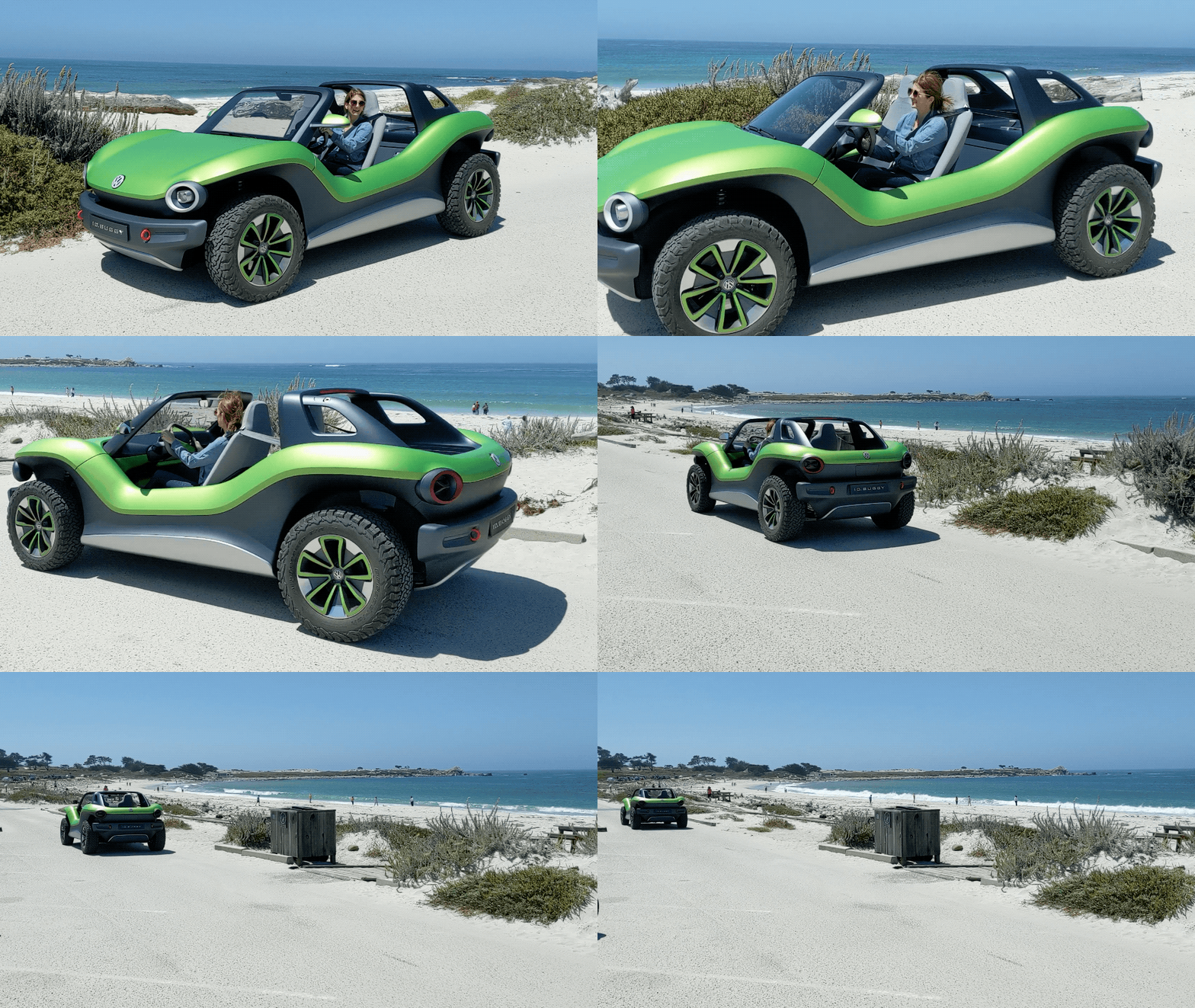
The VW electric ID Buggy concept is delightful and bright, stout and smiling. It’s a vehicle fit for the sunshine and sand dunes, or perhaps a less committing slow roll along the beach.

And so my first drive in a prototype of the all-electric buggy — along the coast near Spanish Bay in Monterey, Calif., — was tinged with sadness. After all, the ID Buggy is just a concept. It’s not meant for this world. At least not right now.

There is still a chance that the ID Buggy will make it to production. VW is already in talks with “at least one company” to bring the buggy into production, TechCrunch confirmed.

The global debut of the ID Buggy concept at the 89th Geneva International Motor Show in March was meant to showcase VW’s electric future and demonstrate the versatility of its modular electric drive toolkit chassis, or MEB. The MEB, which was introduced in 2016, is a flexible modular system — really a matrix of common parts — for producing electric vehicles that VW says make it more efficient and cost-effective.

The first vehicles to use this MEB platform will be under the ID brand, although this platform can and will be used for electric vehicles under other VW Group brands such as Skoda and Seat. (The MEB won’t be used by VW brands Audi or Porsche, which are developing their own platform for electric vehicles.)

VW has shown off several ID concepts. Some of these, like the ID Crozz and ID Buzz are going into production. A production version of the Crozz is coming to the U.S. at the end of 2020. Others, like this buggy, are not currently on the production track.
kirstenbuggy

Driving the ID Buggy Drive

The ID Buggy is simple, and that’s exactly what it should be. No clutter or whiz-bang creature comforts. Instead, this leisure vehicle inspired by the 1960s era Meyers Manx has no roof or doors — although a tarpaulin can be stretched between the windscreen frame and the Targa bar as a sun sail or light weather protection. Without doors, the driver climbs in, and with relative ease, depending on one’s general fitness and flexibility.

The ID Buggy towers over its inspiration — the iconic Meyers Manx buggy that became popular among the California beach-and-surf culture of the 1960s.

The ID Buggy was also a quieter, smoother ride than the Meyers Manx. I also spent some time in a classic bright red buggy with a four-speed manual transmission and gas engine that might have been a touch carbureted. While the Manx roared as I shifted into first and peeled away, the electric ID Buggy was silent and smooth as it rolled out of the sandy parking lot.
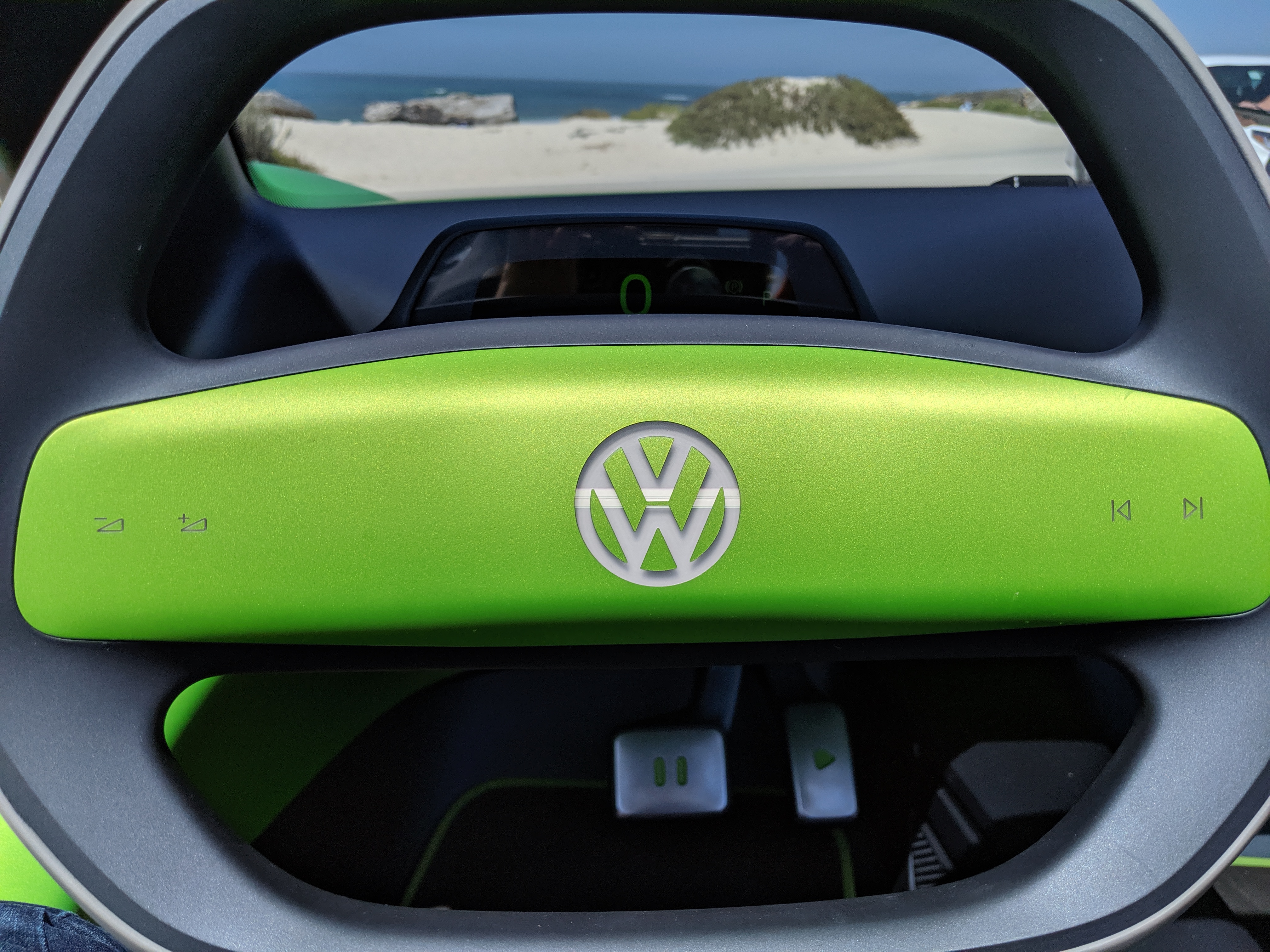
vw id buggy wheel

The main detail inside the ID Buggy is the lack of features and do-dads. The hexagonal steering wheel, shown above, isn’t littered with toggles; there are just a couple of controls on the crossbar. A small integrated stock to the right side of the steering wheel allows the driver to move the vehicle into drive, reverse and park. A digital instrument cluster provides the basic information like speed.

Even the brake and accelerator pedals continue this stripped-down design story. 

The dashboard and the passenger area are just as void of features. This lack of “stuff” is more about function than form, although the matte green and textured grey blue at the bottom does make a visual statement. The ID Buggy is meant to be driven in the elements, rain or shine. And so designers made the interior waterproof.
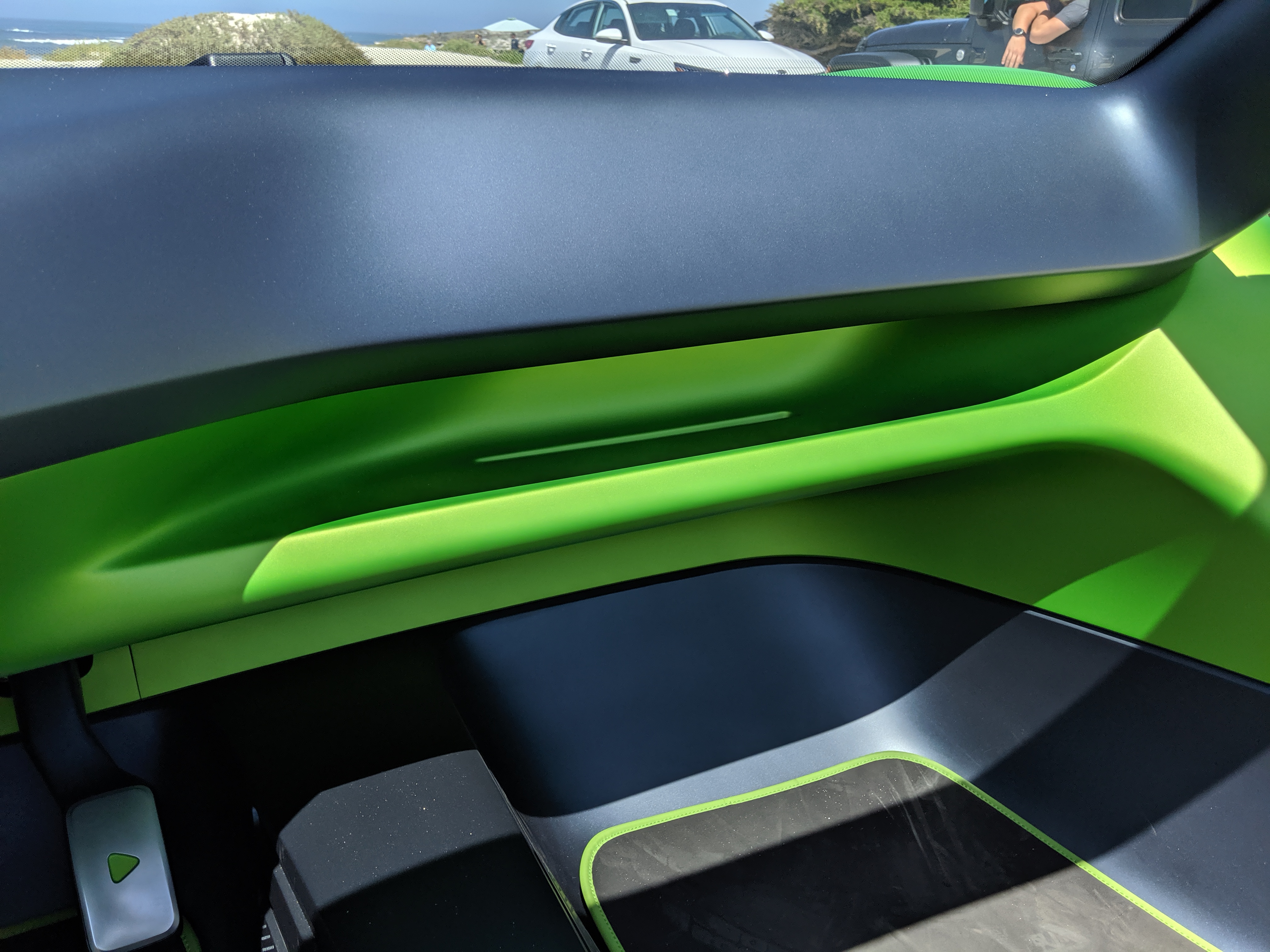
vw buggy dash

Under the ID Buggy’s body is where the good stuff lives.

The rear-wheel drive buggy is outfitted with an electric motor that produces 201 horsepower and a maximum torque of 228 pound-feet. It has a 62-kilowatt-hour battery that can travel 155 miles (under the WLTP standard) on a single charge. There is not an EPA estimate for the range. It can accelerate from a standstill to 62 miles per hour in 7.2 seconds.

Unfortunately, this prototype had a kill-the-thrill speed limiter on it, scuttling my plans for a zippy ride along the coast.

Still, the ID Buggy offered a fun and easy, breezy ride. It handled the curves of the roads with ease and its wide body and higher rear end provided a sense of security even while driving amid other much larger passenger cars.
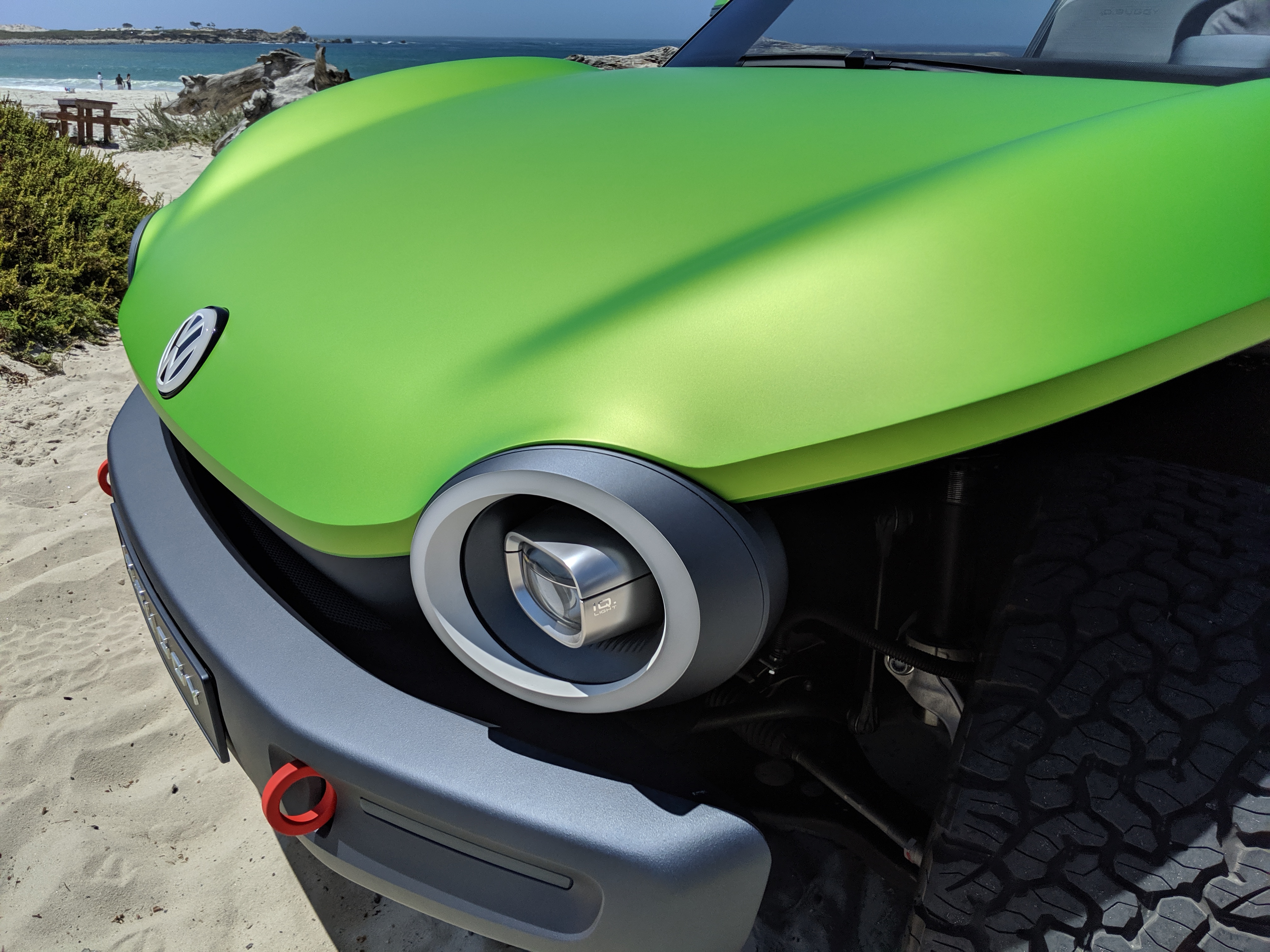
vw buggy id front

Building the ID Buggy

It’s unclear what company, or companies, are in talks to produce the buggy. VW wouldn’t give names; not even the ocean breeze and cloudless sky or the endless supercar eye candy were enough to loosen the lips of VW employees during Monterey Car Week.

It’s possible that this unnamed company is e.Go Mobile. VW announced in March that e.Go Mobile would be its first external partner to use its MEB electric platform to launch other EVs in addition to Volkswagen’s model range. A dedicated vehicle project is already being planned, VW said at the time.

A VW spokesperson told TechCrunch there’s no decision about which car will be produced under this partnership with e.Go Mobile. It could be the buggy; it could also be some other vehicle.

And then there’s Ford. Earlier this year, the two automakers announced a partnership that includes Ford producing electric cars based on the MEB developed by Volkswagen.

The VW folks on the ground in Monterey did express hope that a third party does build the buggy, or a modified version of it. As one spokesperson later told TechCrunch, “As the drive in Monterey showed, the Buggy is a great ambassador for Volkswagen and for e-mobility. I am sure it would find a lot of customers.”

In the end, the ID Buggy is a sleek cruiser rather than a beach bomber like the 1960s original. It successfully demonstrates the versatility around VW’s electric platform. After all, Volkswagen foresees critical parts in the ID Buggy used to power multiple consumer electric vehicles in the near future. And it’s a fair assumption the ID Buggy’s production cousins will have a bit more gadgets, including silly things like doors.