For two years, a handful of websites have indiscriminately hacked thousands of iPhones.
Category: Tech news
hacking,system security,protection against hackers,tech-news,gadgets,gaming
Depth of Field: Visual Poetry in the Chicken Sandwich War
This one paradoxical photo captures the essence of unmet fried-food desires.
A New Kind of Wi-Fi, a Streaming Piracy Bust, and More News
Catch up on the most important news from today in two minutes or less.
‘Control’ Is a Paranoiac’s Dream Turned Into a Videogame
On the surface, the game feels cold and brutal. But beneath all that, it’s disturbingly alive.
Apple Will Give Indie Repair Shops the Tools to Fix iPhones
Your options for repairing a broken Apple device just got a lot better as the company loosens its policies on third-party fixes.
Google will shut down Google Hire in 2020
Add another one to the Google Cemetery.
Google has disclosed that it will shut down Google Hire, the job application tracking system it launched just two years ago.
Google built Hire in an effort to simplify the hiring process, with a workflow that integrated things like searching for applicants, scheduling interviews, and providing feedback about potential hires into Google’s G Suite (Search/Gmail/Calendar/Docs etc.)
It was built mostly for small to medium sized businesses, with a price that ranged from $200 to $400 a month depending on how many G Suite licenses you needed.
Hire came into existence after Google acquired Bebop — a company started by VMWare founder Diane Greene — for a reported $380 million in 2015. Greene went on to act as the CEO of Google’s Cloud division, but left the role in early 2019.
In an email to customers, Google says:
While Hire has been successful, we’re focusing our resources on other products in the Google Cloud portfolio. We are deeply grateful to our customers, as well as the champions and advocates who have joined and supported us along the way.
On the upside: it’s not getting the axe immediately. In fact, you can keep using it for over a full year; Google says it won’t actually be shutdown until September 1st of 2020. Just don’t expect any new features to be added.
Google also notes that it intends to stop taking payment for the product in the meantime, saying in a support FAQ that customers will see no additional charges for Google Hire after their next billing cycle.
SpaceX Starhopper ‘hops’ to around 500 feet and flies for just under a minute in new test flight
SpaceX has completed a second low-altitude test flight of its “Starhopper” demonstration prototype, which is being used to test technologies that will be used to build the full-scale next-generation SpaceX “Starship” spacecraft. This test involved “hopping” the Starhopper (hence the name, get it?) to a height of around 150 meters (or a little less than 500 feet), the highest it’s flown so far, at a SpaceX test facility in Texas. After the hop, which lasted around 50 seconds (the GIF above is sped up 2X), it successfully navigated itself to a target landing pad a short distance away.
This is the second untethered test trip for the Starhopper, and is intended to be its last, as SpaceX moves forward with construction of its Starship Mk I and Mk II prototypes, which is taking place currently and simultaneously at sites in Florida and Texas. Today’s attempt was the second try after a planned test yesterday was aborted at the last second, with SpaceX resetting and ensuring everything was in place for this longer hop, which lasted just less than a minute.
In July, SpaceX ran its first untethered hop, which is designed to test the operation of the Raptor engine SpaceX is developing for Starship, along with other subsystems for use in the production Starship. That flew only for around 22 seconds, and attained a height of just 20 meters (a little over 65 feet).
Construction is currently in progress at both SpaceX’s Texas and Florida facilities on its full-scale Starship prototypes, which SpaceX CEO Elon Musk is ambitious will begin their own flight testing later this year, in perhaps as little as a few months. The larger prototypes, which should be closer to what will actually launch, will test more Raptor engines working together and aim to fly to higher altitudes, another key step as the company works toward a true first orbital test flight.
Ultimately, SpaceX is hoping to replace both Falcon 9 and Falcon Heavy entirely with different configurations of Starship, which will help the company in terms of cost efficiency thanks to its fully reusable nature and streamlining all of its rocket construction efforts around one type of vehicle.
Why ‘one app to rule them all’ is not the future of digital health
Chris Hogg
Contributor
Contributor
Chris Hogg is a digital health advocate interested in how new forms of health data are changing the relationship between physician and patient. As CCO of Propeller Health, he leads the company’s San Francisco office and oversees the pharma BD, health system and payer sales, clinical and medical affairs and data science teams.
More posts by this contributor
“One app to rule them all” is a compelling idea if you’re a healthcare giant.
In this imagined model, patients flock to one comprehensive user experience for all their healthcare needs, from insurance and scheduling to lab results and disease management. And the healthcare giant, which has developed or acquired its way to market dominance, now has the ability to guide patients to their preferred providers, treatments and services.
But “one app to rule them all” is flawed. Not only does it ignore the way people use technology, it puts the patient experience second. Forcing patients to use one app for every healthcare interaction disregards the complexity and specificity of individual diseases and patient profiles.
Until now, we haven’t had to reckon with the “one app” problem, because most healthcare experiences have been relatively disparate. But as payers, providers, pharmacies, pharma and digital health all race to create digital experiences and solidify their offerings, we will soon have to confront this question: Will we end up with separate disease management apps that work together in a best-of-breed ecosystem model, or will several large players dominate with one app to rule them all?
How we got here
Up until now, the question of who would control the user experience wasn’t a material issue in the market. Most apps didn’t have a large enough user base to impinge on their competitors, and organizations created “single function” experiences for a specific problem space.
Payers created tools to let you look up coverage and find providers, health systems allowed you to book appointments and see your EMR and lab data, pharmacies allowed you to refill prescriptions, pharmaceutical companies made apps to support their specific medicines and most successful digital health companies have focused on individual diseases and specific use cases.
But now that digital health has taken root and patient adoption is expanding, these “single function” experiences are starting to bump into each other. And organizations are reacting to this change in different ways.
Many health systems and payers recognize this as an opportunity to create an ecosystem model, taking best-of-breed solutions for each core patient need and connecting them through identity and data linking so they work seamlessly together.
But alarmingly, some large organizations see this as an opportunity to assert more control over the patient experience.
They’re attempting to develop “one app to rule them all” solutions, with one user experience covering all patients with all possible diseases.
At Propeller, we recently “broke up” with a customer who couldn’t see past their vision for a single dominant app to rule the marketplace.
It was a tough decision, but one I felt we had to make. Here’s why.
Why “one app to rule them all” results in a worse patient experience
The advantage to “one app to rule them all” is obvious on its face. Patients would have fewer apps to download and engage with, advantages that seem more pronounced in more complex and comorbid patients. Organizations would also be able to guide patients to their preferred providers, treatments and services via a single app.
But there’s a significant problem with this approach.
When one platform tries to excel in a vast number of areas, it usually ends up doing them all badly. If you’ve used a leading marketing software platform that I won’t name, you know this to be true. And healthcare is even more difficult, because it’s at once more complex and more personal. It turns out it is pretty easy to build a complex and complicated product, but it is very hard to build a simple one, especially with a multitude of inputs and use cases.
Healthcare isn’t fast food.
All my experience in digital health has told me this: It’s very difficult to build an engaging and useful user experience in one disease state, let alone across multiple disease states within one experience.
Enrolling users is hard. Keeping them engaged is hard. Improving specific clinical outcomes — and proving it continuously — is especially hard. Making a great product requires an obsessive focus on a specific user and problem space, as well as relentless experimentation and iteration. When you don’t have that singular focus, the needs of the patient are deprioritized compared to the needs of the organization, and the user suffers.
To make this approach worthwhile, you’d have to believe that the convenience of one app would make up for a worse user experience by driving higher enrollment or retention rates. You’d have to believe that user experience simply doesn’t matter as much as the convenience of an all-in-one platform.
I don’t believe that. Healthcare isn’t fast food. People’s humanity, dignity and lives are at stake, and they deserve our obsessive focus on an experience built specifically for them.
Why a “best of breed” ecosystem approach is best
We’ve learned a lot in the last 20 years about how people prefer to use technology. If you want evidence that “best of breed” is the future, you only need to look to the other industries experiencing digital transformation.
For example, look at Software-as-a-Service (SaaS). It’s dominated by a large number of specific solutions that work together through identity (OAuth) and data integrations (APIs).
It’s a similar story in consumer apps. There is no single fitness app, travel app or communication app. In entertainment many tried to become the “one app,” but instead we have witnessed a proliferation of vertical content providers with individual subscriptions, such a Netflix, HBO, Disney and ESPN, all of which work together seamlessly on your Apple TV. Even when a major company acquires or develops new solutions, they often keep the solutions separate in terms of user experience. For example, Facebook has unbundled Messenger, Instagram and WhatsApp instead of bundling them all as Facebook.
We as consumers are comfortable using specific solutions to solve specific problems, and want them all to work together with ease. Often, we find that when a major player branches into more and more solutions because they want our total business, each solution becomes more shoddily made, less intuitive and more poorly supported.
Now, this situation is not necessarily universal. In China, products like Tencent’s WeChat have expanded across multiple healthcare verticals, backed by very different market dynamics (both in healthcare and in technology). Yet even WeChat looks to third parties with best of breed solutions to grow their ecosystem, in addition to building multiple solutions themselves.
What the future looks like
The future I envision may not feature a single app, but neither is it complicated.
In this future, patients use a core clinical app, likely provided by their health system or primary care provider, that takes care of clinical interactions like scheduling, clinical data, reminders and follow-ups.
Beyond that, patients use a set of specific apps that specialize in particular health issues — for example, respiratory disease, diabetes, mental health, increasing activity or improving sleep. Those apps will rise to the top because they’re the best on the market at managing those issues. The experience of managing your mental health will feel different than managing your diabetes, just as using Instagram feels different than using Facebook.
In this ecosystem model, the patient’s core clinical app will link out to and connect to the problem-specific solutions. Health systems and physicians will adopt a small number of specialized platforms and products to focus on large clinical domains like cardiovascular, diabetes, respiratory and mental health. Data from these solutions will integrate back to the provider’s organization and will be available in the EMR and for population health management.
We’ll end up with a diverse ecosystem of solutions, each the best in their vertical, delivering a tailored user experience based on the needs of the specific patient and provider type.
And patients will be better off for it.
Netflix’s ‘The Irishman’ is coming to theaters on Nov. 1
“The Irishman,” the much-anticipated Martin Scorsese film produced by Netflix, will get a theatrical release on November 1, starting in Los Angeles and New York. It will then debut on the streaming service about four weeks later, on November 27.
This follows a similar pattern to the release of Alfonso Cuarón’s “Roma” last year, which saw Netflix (which had previously insisted that any theatrical run happen simultaneously with a film’s streaming debut) debuting the film in theaters three weeks before it came to streaming.
Netflix doesn’t report box office numbers, so it’s not clear how much money it’s making from these theatrical rollouts.
Regardless, committing to a real theatrical release helps Netflix attract big-name filmmakers like Scorsese and Cuarón, and it also gives them a better chance at winning awards. (“Roma” won three Oscars earlier this year, including Best Director, prompting a broader debate about whether streaming films should be eligible for Oscars.)
Would you like to be a part of this history?
The Irishman, in theaters beginning November 1st and on Netflix November 27th. pic.twitter.com/896Y3rMay1
— The Irishman (@TheIrishmanFilm) August 27, 2019
Deadline reports that the roughly four-week theatrical window was not enough to convince the major theater chains to sign up — apparently they’re concerned that if they give in to Netflix, the Hollywood studios will start demanding shorter theatrical windows too.
“The Irishman” stars Robert De Niro as Frank Sheeran (a union official with ties to organized crime) and Al Pacino as Jimmy Hoffa (ditto). It will premiere at The New York Film Festival on September 27.
In addition to reuniting De Niro and Scorsese for the first time in two decades, and bringing Pacino and Scorsese together for the first time ever, the film is also noteworthy for its use of extensive special effects, so the actors are able to play younger versions of their characters.
Ready, Set, Raise — the Y Combinator for female founders — announces second cohort
About one-fourth of the startups in Y Combinator’s summer batch had a female founder. Not the most disappointing statistic if you consider this: Companies with at least one female founder have raised only about 11% of venture capital funding in the U.S. in 2019, according to PitchBook. Companies with female founders exclusively have raised just 3%.
There is so much room for improvement.
To close the funding gap, programs tailored to female entrepreneurs are working tirelessly to mentor and incubate upstarts in hopes of impressing venture capitalists. Ready, Set, Raise, an accelerator program built for women, by women, is amongst the new efforts to help female and non-binary founders raise more dollars, or, at the very least, build relationships with investors.
The accelerator program, created by the Seattle-based network of startup founders and investors called the Female Founders Alliance, is today announcing its second batch of companies, a group that includes a sextech business, an AI-powered tool for podcasters and a line of workwear created for women who work on farms, construction sites and factory floors.
Ready, Set, Raise has partnered with Microsoft for Startups to provide entrepreneurs $120,000 in Azure credits, as well as technical and business mentoring from executives of the Redmond-based software giant. Other new partners include Brex and Carta, two well-funded companies that plan to lend the support of their executives to teach entrepreneurs about startup finance, valuation and fundraising terms.
“Both FFA and Microsoft recognize a major lapse in opportunities given to women and non-binary founders,” writes Ian Bergman, a managing director of Microsoft for Startups, in a statement. “We look forward to our continued work together to promote this necessary shift in the VC landscape.”
FFA’s founder and chief executive officer Leslie Feinzaig, who launched the organization in 2017, has been an outspoken advocate of diversity in entrepreneurship and venture capital, and well as providing awareness and resources for founders who are also parents.
“My experience fundraising was undeniably shaped by the fact that I am a woman, and at the time was a new mom,” Feinzaig, who previously founded an edtech startup, told Seattle Business Magazine earlier this year. “A year later, I was about to give up. Instead, I started a Facebook group, including all of the founders and tech startup leaders I knew. It was the group that I needed, made up of people who knew exactly what I was going through. That’s how the Female Founders Alliance was born.”

FFA’s Ready, Set, Raise provides its companies childcare throughout the six-week program, in which companies work one-on-one with experienced coaches ahead of a demo day that will take place on October 16th.
Here’s a look at Ready, Set, Raise’s sophomore class of startups:
- Echo Echo: AI-powered tools for podcasters.
- Give InKind: Coordinates support through major life events.
- Honistly: A provider of extended auto warranties to help with short-term cash needs.
- Juicebox It: Modernizes erotica with a chatbot that is arousing and educational.
- Panty Drop: A personalized intimates shopping experience for women sizes XS-6XL.
- The Labz: A platform that protects and memorializes creative content development in real time.
- Tougher: Functional, well-fitted workwear for women in the skilled trades.
Airship acquires A/B testing company Apptimize
Airship announced today that it has acquired Apptimize, an A/B testing company whose customers include Glassdoor, HotelTonight and The Wall Street Journal.
Formerly known as Urban Airship, the more concisely named Airship has built a platform for companies to manage their customer communication across SMS, push notifications, email, mobile wallets and more.
It says that by acquiring Apptimize, it can help customers test the impact of their messages. That means integrating Apptimize’s testing capabilities into the Airship platform, but the company says it will also continue to support Apptimize as a standalone platform.
“By combining Apptimize mobile app and web testing with Airship’s deep insight into customer engagement across channels, marketers and developers can focus innovation on the most critical areas while creating the seamless end-to-end experiences customers really want,” said Airship president and CEO Brett Caine in a statement.
The financial terms of the acquisition were not disclosed. Apptimize had raised a total of $18.6 million from US Venture Partners, Costanoa Ventures and others, according to Crunchbase.
Airship says it will be bringing over 19 Apptimize team members (a little less than two-thirds of the startup’s total workforce) across engineering, customer service and sales.
Peloton files publicly for IPO
Peloton, the well-funded maker of internet-connected stationary bikes and treadmills, has finally revealed documents for its upcoming initial public offering. The business previously submitted a confidential draft submission of its S-1 statement to the U.S. Securities and Exchange Commission in June.
The New York-based company, which plans to raise $500 million in its Nasdaq offering, will trade under the ticker symbol PTON.
Peloton reported $915 million in total revenue for the year ending June 30, 2019, an increase of 110% from $435 million in fiscal 2018 and $218.6 million in 2017. Its losses, meanwhile, hit $245.7 million in 2019, up significantly from a reported net loss of $47.9 million last year.
The company has reached 1.4 million total community members, defined as any individual who has a Peloton account.
Peloton customers subscribe to the company’s digital library of fitness content, streamed live and on-demand, for $39 per month, in addition to purchasing its hardware, which costs $2,200 to $4,295 apiece. The company says 58 million workouts were completed by Peloton users in fiscal 2019, while its paying subscriber base reached an all-time high of 511,202.
As for subscription revenue, Peloton reports $181 million for fiscal 2019, up from $80 million last year.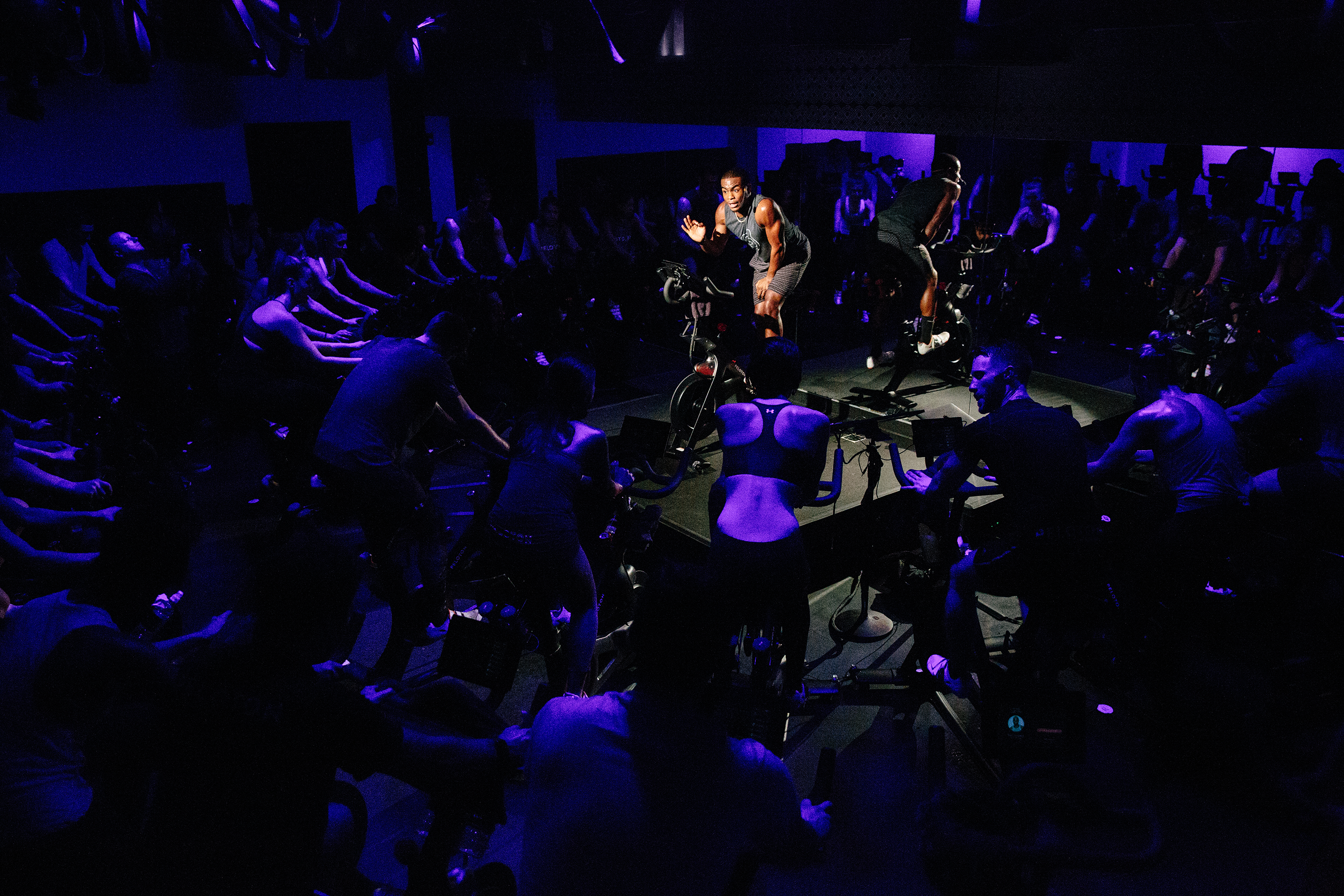
Envisioning a world in which 67 million households own connected fitness equipment, Peloton co-founder and chief executive officer John Foley writes in the S-1 that “Peloton sells happiness.”
“Peloton is so much more than a Bike — we believe we have the opportunity to create one of the most innovative global technology platforms of our time,” writes Foley. “It is an opportunity to create one of the most important and influential interactive media companies in the world; a media company that changes lives, inspires greatness, and unites people.”
Peloton, founded in 2012, raised $550 million in venture capital funding last year at a valuation of $4.15 billion. The startup, which initially struggled greatly to convince venture capitalists of its vision, has since inspired a new wave of fitness tech companies to launch, including a smart mirror company appropriately named “Mirror.”
In total, Peloton has raised $994 million in venture capital funding, according to PitchBook. Its S-1 filing lists CP Interactive Fitness (5.4% pre-IPO stake) — an entity connected to the private equity firm Catterton — TCV (6.7%), Tiger Global (19.8%), True Ventures (12%) and Fidelity Investments (6.8%) as principal stakeholders, or investors with at least a 5% stake in the company.
Goldman Sachs & Co. and J.P. Morgan Securities are managing the IPO as lead underwriters.
AR mapping startup 6D.ai expands platform as it exits beta
World-mapping computer vision startup 6D.ai is expanding support to new devices as its augmented reality platform exits beta.
The SF startup launched its beta in October and is now ready to let developers ship apps as it launches pricing for its services. The pay-as-you-go subscription rates for 6D move from a free tier to $20-$50 per app based on the number of map download calls that users prompt. 6D will have custom-pricing for customers ushering in more than 50,000 map downloads.
The startup boasts Autodesk, Nexus Studios and Accenture among its customers.
The company’s platform has previously been confined to iOS devices, but today, 6D announced that it is launching private beta support for Android phones and lightweight headsets.
Moving to the fractured Android platform presents more challenges than iOS, but 6D is beginning the rollout with recent ARCore-supported Samsung devices. The company plans to support all ARCore devices running Snapdragon 845 chips and newer.
The company is also announcing a partnership with Qualcomm, which is integrating the company’s tech into what basically seems to be a reference design for AR headset manufacturers. Headsets are a ways from being a central use case for the company’s technology, but 6D is pursuing early partnerships to ensure that future hardware plays nicely with their platform. They have also partnered with Chinese headset-maker Nreal.
US border officials are increasingly denying entry to travelers over others’ social media
Travelers are increasingly being denied entry to the United States as border officials hold them accountable for messages, images and video on their devices sent by other people.
It’s a bizarre set of circumstances that has seen countless number of foreign nationals rejected from the U.S. after friends, family or even strangers send messages, images or videos over social media sites like Facebook and Twitter, and encrypted messaging apps like WhatsApp, which are then downloaded to the traveler’s phone.
The latest case saw a Palestinian national living in Lebanon and would-be Harvard freshman denied entry to the U.S. just before the start of the school year.
Immigration officers at Boston Logan International Airport are said to have questioned Ismail Ajjawi, 17, for his religion and religious practices, he told the school newspaper The Harvard Crimson. The officers who searched his phone and computer reportedly took issue with his friends’ social media activity.
Ajjawi’s visa was canceled and he was summarily deported — for someone else’s views.
The United States border is a bizarre space where U.S. law exists largely to benefit the immigration officials who decide whether or not to admit or deny entry to travelers, and few protect the travelers themselves. Both U.S. citizens and foreign nationals alike are subject to unwarranted searches and few rights to free speech, and many have limited access to legal counsel.
That has given U.S. border officials a far wider surface area to deny entry to travelers — sometimes for arbitrary reasons.
On a typical day, U.S. Customs & Border Protection processes 1.13 million passengers by plane, sea and land and deny entry to more than 760 people. Sometimes a denial is clear, such as a past criminal conviction or the wrong documentation. But all too often, no specific reasons are given, and there are no grounds to appeal.

A U.S. immigration form describing why a traveler was denied entry to the U.S. (Image: Abed Ayoub/Twitter)
CBP also claims to have what critics say is broadly unconstitutional powers to search travelers’ phones — including those of U.S. citizens — at the border without needing a warrant. Last year, CBP searched 30,000 travelers’ devices — a four-times increase since 2015 — without any need for reasonable suspicion.
Complicating matters, the Trump administration in June began to demand that foreigners who apply for U.S. visas disclose their social media handles and profiles. Some 15 million are expected to fall under the new rule.
A spokesperson for Customs & Border Protection did not comment.
Summer Lopez, senior director of free expression programs at PEN America, a human rights nonprofit, said in a statement that the immigration policy on social media “demonstrates all too well the damage these ill-conceived policies can do.”
“That should not be the price of entrance to the U.S., let alone that one’s friends should have to censor themselves as well,” said Lopez.
But Ajjawi’s denied entry is not an isolated case.
Abed Ayoub, legal and policy director at the American-Arab Anti-Discrimination Committee, said device searches and subsequent denials of entry had become the “new normal” over the past year.
“We hear about this happening to Arab students and Muslim students coming into the U.S. today,” he told TechCrunch. Although all travelers are subject to having their devices searched, Ayoub said the government was “holding [the Arab and Muslim] community to a different level” than other backgrounds.
Ayoub said he’s had clients that have been turned away at the border for content found in their WhatsApp messages.
“It’s probably the most popular app in the Middle East,” he said. Because WhatsApp automatically downloads received images and videos to a user’s phone, any questionable content — even sent unsolicitedly — under a border official’s search could be enough to deny the traveler entry.
In one tweet, Ayoub posted a photo of an expedited removal form from one of his clients — also a student with U.S. visa — who was denied entry for an image he received in a WhatsApp group. The student strenuously denied any personal connection to the images and argued it had been automatically saved to his phone. The border official wrote that as a result of the device search the student was “inadmissible” to the U.S. The student was only a couple of semesters away from graduating, but a rejection meant the student can no longer return to the U.S.
“This is part of the backdoor ‘Muslim ban,’ ” Ayoub said, referring to a controversial executive order signed by President Trump in January 2017, which barred citizens from seven predominantly Muslim countries entry to the U.S.
“We don’t hear of other other individuals being denied because of WhatsApp or because of what’s on the social media,” he said.
Correction: an earlier version of this report said the Harvard student was Lebanese. He is a Palestinian national living in Lebanon.
Uber and Lyft drivers are not letting up on the fight for AB-5 and a union
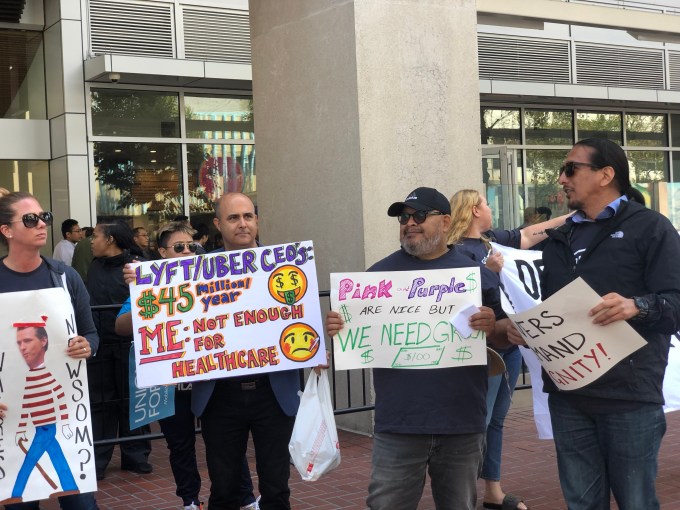
A number of Uber and Lyft drivers are protesting outside Uber’s San Francisco headquarters today to demand the passage of Assembly Bill 5 and the right to unionize.
“What do we want? AB-5! When do we want it? Now!” That was one of the phrases drivers chanted outside Uber’s HQ this afternoon.
This was part of a three-day caravan across California organized by Gig Workers Rising and Mobile Workers Alliance. As part of the protest, hundreds of drivers circled the blocks around Uber’s HQ honking their horns and sporting signs that say “AB5 + a union.”
Adan, an Uber and Lyft driver, took the microphone to remind the companies and the California state legislature that people matter, they are not machines and should not be “chained to an app,” he said at the protest.
“People deserve to be treated with dignity by their employer,” Adan said. “People deserve fair pay for the time and effort they put into their work. People deserve from their employer basic protections such as retirement and healthcare.”
Presidential candidate Pete Buttigieg joined the protest, saying drivers deserve protections like overtime and a union.
“They say that these technology companies are the future of the American workforce,” Buttigieg said. “I think that might be right.” So do we want a future where there are no protections, no unions and workers are not treated as workers or do we want a future with justice?”
The aim of the caravan is to rally drivers throughout California to advocate for their collective rights and make it clear to legislators they want AB-5 to pass. AB-5 seeks to codify the ruling established in Dynamex Operations West, Inc. v Superior Court of Los Angeles. In that case, the court applied the ABC test and decided Dynamex wrongfully classified its workers as independent contractors based on the presumption that “a worker who performs services for a hirer is an employee for purposes of claims for wages and benefits…”
Those who work as 1099 contractors can set their own schedules, and decide when, where and how much they want to work. For employers, bringing on 1099 contractors means they can avoid paying payroll taxes, overtime pay, benefits and workers’ compensation.
According to the ABC test, in order for a hiring entity to legally classify a worker as an independent contractor, it must prove the worker is free from the control and direction of the hiring entity, performs work outside the scope of the entity’s business and is regularly engaged in an “independently established trade, occupation, or business of the same nature as the work performed.”
In short, AB-5, which has already passed in the California State Assembly, would ensure gig economy workers are entitled to minimum wage, workers’ compensation and other benefits.

Today represents the third protest at Uber’s HQ since May, when drivers protested ahead of Uber’s IPO. Their demands have remained consistent, asking for better wages, benefits, transparent policies, a voice and the right to form a union. The protest also comes shortly after Jalopnik found discrepancies between how much Uber and Lyft say they pay their drivers versus how much they actually do.
But neither Lyft nor Uber wants AB-5 pass. Uber says drivers tell the company what they value most is the flexibility to work whenever, wherever and for whomever they want.
“We believe that independent, on-demand workers should not have to sacrifice security to enjoy that flexibility,” an Uber spokesperson told TechCrunch. “That’s why we’ve been working with stakeholders to find a path forward that provides a minimum earnings guarantee for drivers; a robust package of portable benefits they can access no matter which rideshare company they drive for; and meaningful representation that gives them a say on matters affecting their lives and livelihood.”
Similarly, Lyft says it’s advocating for an approach that is in line with the interests of its drivers, which would entail flexibility and benefits.
“That’s why we’ve been working with lawmakers and labor leaders on a different solution, so drivers can continue to control where, when, and how long they drive, while also having some basic protections like a minimum earnings floor, a system of worker-directed portable benefits, and representation,” the spokesperson said.
It’s worth noting that Gig Workers Rising and Mobile Workers Alliance do not represent all drivers. Lyft has shared thousands of messages it says drivers have sent to legislators demanding they protect their flexibility. However, as driver and protest organizer Annette Rivero previously told TechCrunch’s Greg Epstein, “AB5 doesn’t take away anybody’s flexibility, it’s the companies that take away the flexibility. Because I know that that’s something that everyone’s stuck on right now, and it’s a lie. There’s no truth to it.”