Like so many Twitter attacks lately, it was a SIM swap.
Category: Tech news
hacking,system security,protection against hackers,tech-news,gadgets,gaming
An Unprecedented iPhone Hack, a Wi-Fi Leg Implant, and More News
Catch up on the most important news from today in two minutes or less.
Senators on Protecting Kids’ Privacy: ‘It’s Complicated’
Even conservative lawmakers say they’re open to more regulation when it comes to tech companies and children online. So where is it?
The EPA Says Methane Rules Are Bad for Industry—It’s Wrong
Drones and satellites make it easy to detect and plug methane leaks, benefitting oil and gas companies and the environment alike.
A hacker has compromised Jack Dorsey’s Twitter account
A hacker has compromised Jack Dorsey’s Twitter account.
A stream of rogue tweets — including racial slurs — were posted to the Twitter chief executive’s own Twitter account just after 3:30pm ET. One of the tweets posted a Twitter handle for someone who purported to take credit for the account takeover. That account was quickly suspended.
Dorsey has more than 4.21 million followers.
Twitter spokesperson Ebony Turner said the company was investigating. The company also tweeted about the incident:
We're aware that @jack was compromised and investigating what happened.
— Twitter Comms (@TwitterComms) August 30, 2019
It’s not immediately known how the account was compromised. However, the rogue tweets were sent via Cloudhopper, a service Twitter bought in 2010 to improve its SMS service, suggesting Dorsey’s account may have been compromised by an authorized third-party app rather than obtaining Dorsey’s account password.
It’s not the first time Twitter had to clean up after a high-profile account was hacked. Facebook boss Mark Zuckerberg once had his Twitter account hacked because his account didn’t use two-factor authentication. He also had a ridiculously easy-to-guess password.
Twitter later said it secured Dorsey’s account.
“The phone number associated with the account was compromised due to a security oversight by the mobile provider,” said Twitter in a follow-up statement. “This allowed an unauthorized person to compose and send tweets via text message from the phone number.”
In other words, Dorsey was likely a victim of SIM swapping. Twitter did not name the mobile provider.
Updated with statements from Twitter.
…or you can always buy a $40 wood case for your Apple Card
Apple really unleashed the spoofs and goofs when the care instructions were spotted online for its new credit card. Of particular note were warnings against contact with denim and leather— common materials for people who own wallets and/or wear pants.
In the intervening week and change, I’m sure more than one entrepreneur had the thought of targeting those very specific parameters. Take Pittsburgh-based KerfCase, which is offering this $39 wooden card case with a pop up feature for the card. It looks nice, I suppose. I mean, it’s the nicest wooden Apple Card case I’ve seen all afternoon (though I’m bound to get 50 more in my inbox after posting this).
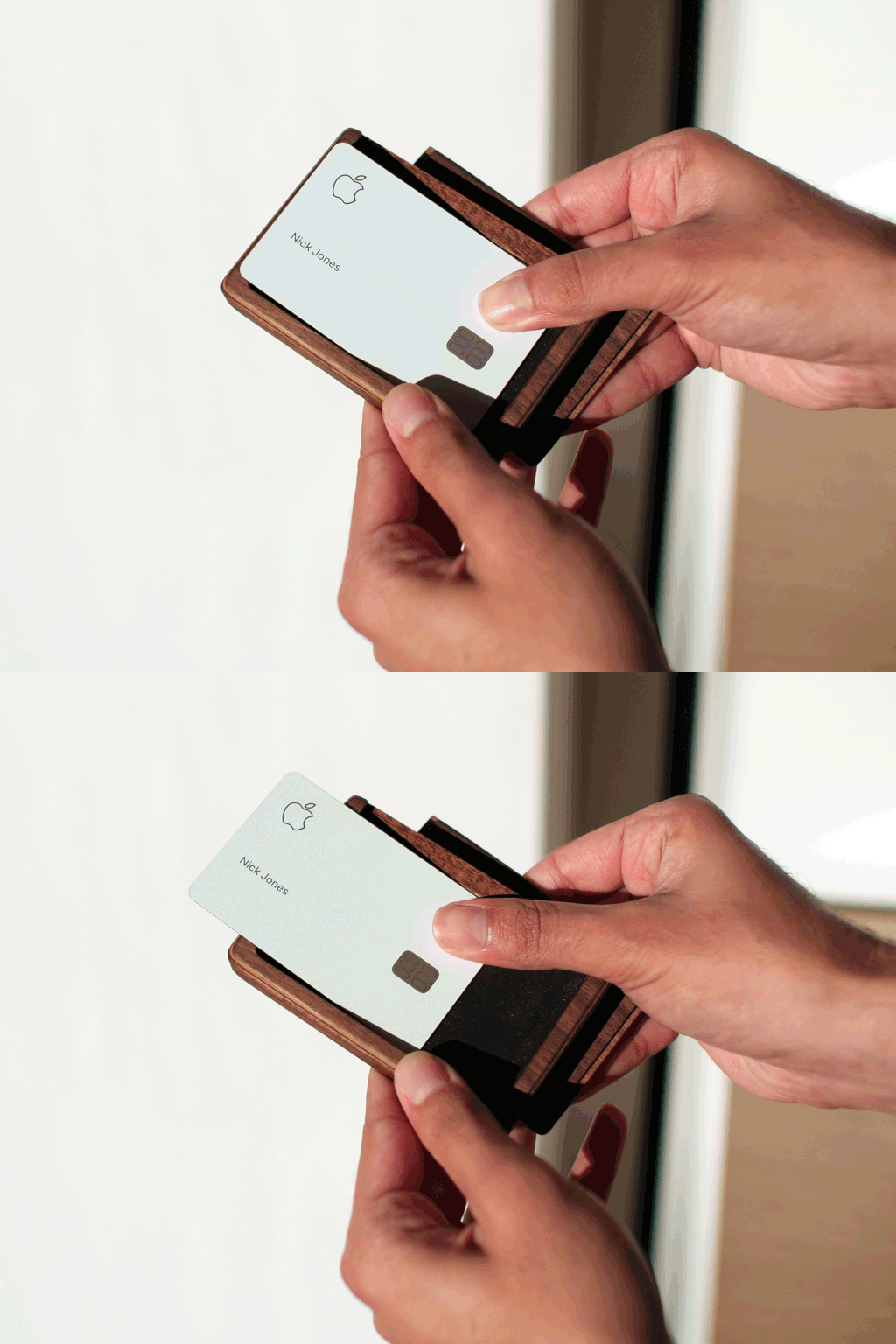
Founder Benjamin Saks notes that the project started out a bit tongue-in-cheek, but eventually it became a real project and turned out pretty well. I understand penicillin was discovered in similar fashion.
Telltale Games Seems to Be Rising From the Dead
Also, ‘Destiny 2’ is getting something that looks like a Battle Pass and there might be new ‘Witcher’ games on the way.
Xbox Live is down for many (Update: It’s back up)
If you were trying to sneak in a quick game on Xbox Live during your Friday afternoon lunch break and found that you can’t get online: don’t worry, you’re not alone.
While Microsoft’s Xbox Live Status page still says all things are good to go (Update: Microsoft’s status page has now caught up with the outage, and says that it’s impacting sign-ins, account creations and searches), reports are pouring in of an outage keeping many users from logging in.
Microsoft acknowledged the problem on Twitter, saying that they’re “looking into it now.”
Update, 2:30 PM: It’s back up! The status page shows all lights as green again, and a Microsoft spokesperson says that services have been fully restored.
We're aware that some users are unable to sign in currently & our teams are looking into it now. We'll update when we have more info to share. Thanks for all the reports!
— Xbox Support (@XboxSupport) August 30, 2019
Skype upgrades its messaging feature with drafts, bookmarks and more
Skype is best known for being a video calling app and, to some extent, that’s because its messaging feature set has been a bit underdeveloped. Today, the company is working to change that image with a series of improvements to Skype’s chatting features aimed at further differentiating it from rival apps.
One of the most useful of the new features is support for Message Drafts.
Similar to email, any message you type up in Skype but don’t yet send is saved within the conversation with a “draft” tag attached. That way you can return to the message to finish it and send it later.
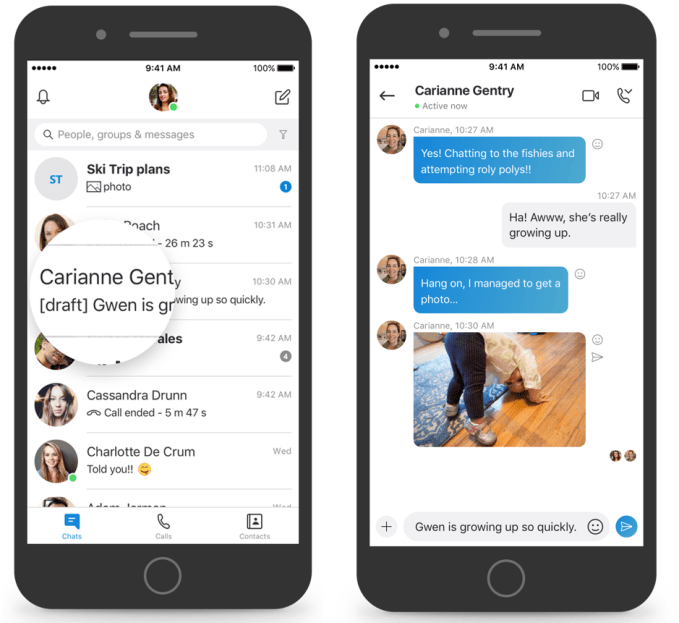
It’s a feature that would be great to see other messaging clients adopt, as well, given how much of modern business and personal communication takes place outside of email.
People have wanted the ability to draft and schedule iMessage texts for years — so much so that clever developers invented app-based workarounds to meet consumers’ needs. Some people even type up their texts in Notepad, waiting for the right time to send them.
In another email-inspired addition, Skype is also introducing the ability to bookmark important messages. To access this option, you just have to long-press a message (on mobile) or right-click (on desktop), then tap or click “Add Bookmark.” This will add the message to your Bookmarks screen for easy retrieval.
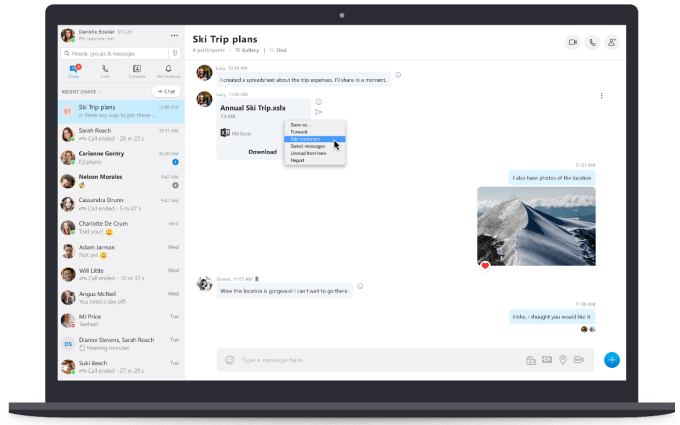
You’ll also now be able to preview photos, videos and files before you send them through messages — a worthwhile improvement, but one that’s more about playing catch-up to other communication apps than being particularly innovative.
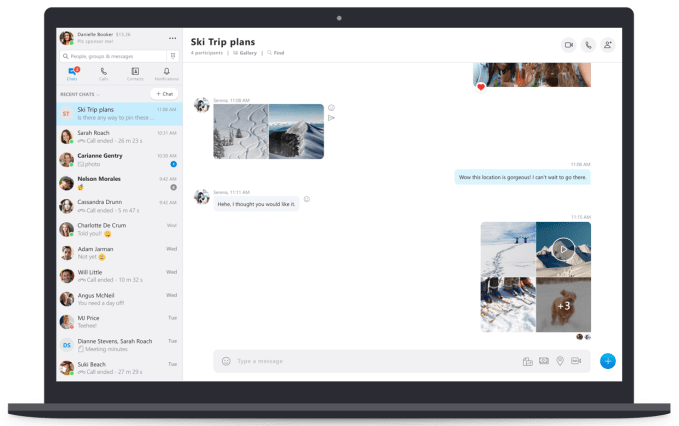
And if you’re sharing a bunch of photos or videos all at once, Skype will now organize them neatly. Instead of overwhelming recipients with a large set of photos, the photos are grouped in a way that’s more common to what you’d see on social media. That is, only a few are displayed while the rest hide behind a “+” button you have to click in order to see more.
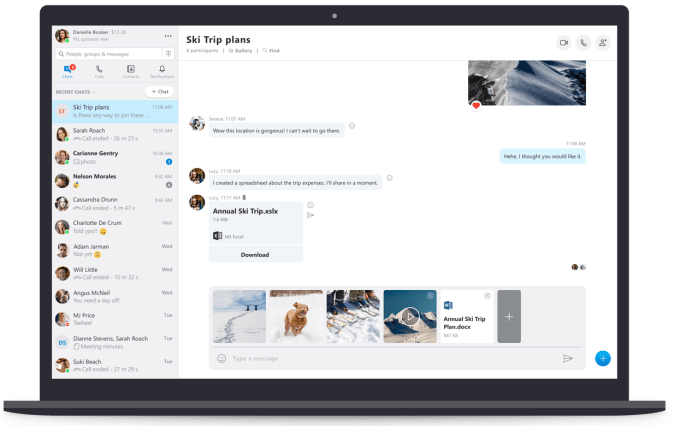
Unrelated to the messaging improvements, Skype also rolled out split window support for all versions of Windows, Mac and Linux. (Windows 10 support was already available.)
As one of the older messaging apps still in use, Skype is no longer the largest or most popular, claiming only 300 million monthly active users compared to WhatsApp’s 1.5 billion, for example.
However, it’s good to see its team getting back to solving real consumer pain points rather than trying to clone Snapchat as it mistakenly tried to do not too long ago. (Thankfully, those changes were rolled back.) What Skype’s remaining users appreciate is the app’s ease-of-use and its productivity focus, and these changes are focused on that direction.
Outside of the expanded access to split view, noted above, all the other new features are rolling out across all Skype platforms, the company says.
Credit Sesame, a platform for managing loans and credit scores, picks up $43M en route to IPO
Household debt in the U.S. continues to rise and as of this year now stands at nearly $14 billion. Now, one of the startups that’s building tools to help consumers better cope with that is announcing a round of funding and plans for an IPO — signs of the demand for its services, and its success to date.
Credit Sesame — which lets consumers check their credit scores and evaluate options to rebalance existing debts and loans to improve that score and thus their overall “financial health,” in the words of CEO and founder Adrian Nazari — has raised $43 million. With the company already profitable and growing revenues 90% each year for the last five, Nazari said that this round is likely to be the last round the company raises before it goes public.
Credit Sesame is not disclosing its valuation, in part because this round is likely to have some more money added to it. But Nazari noted that it’s on track to be valued at over $1 billion when it does close in the coming months. It has now raised $110 million in total.
The round is a mixture of equity and debt, and includes both strategic and financial investors. Led by growth-stage investors ATW Partners, it also includes participation from previous investors. Past backers of Credit Sesame include Menlo Ventures, Inventus Capital, Globespan Capital, IA Capital Groups, Symantec, Capital One Ventures and Stanford University. There also will likely be new investors coming to the company when the round does expand.
The reason the startup is raising both equity and debt is worth a note: Nazari said Credit Sesame is profitable and has been “for some time,” so when it raises money now, it would prefer to do so with less dilution. The funding will be going toward continuing to work on Credit Sesame’s artificial intelligence algorithms, and to continue expanding this business, but not likely acquisitions: there are a lot of companies in the fintech arena that are working on products adjacent to what Credit Sesame does, but Nazari said that it would likely only start to work on some M&A and consolidation plays after it IPOs, using the proceeds from that to fuel that.
In addition to a number of companies building tools and products to help people manage their money better, there are direct competitors to Credit Sesame, too, including Credit Karma, NerdWallet, Experian, ClearScore, Equifax and many more. Nazari’s view is that while Credit Sesame may be targeting a similar initial function, its approach and how it helps you manage your credit score is what differentiates it.
The company has coined the term “Personal Credit Management” (as opposed to personal financial management), and has built an algorithm it calls RoboCredit, which is based on a basic score provided by TransUnion (one of the big agencies that calculates scores, alongside Equifax and Experian), but also includes other factors that it calculates to show consumers which actions they can take to improve their scores. Checking initial scores is free on Credit Sesame, as are evaluating options for how to rebalance loans and other debts to help improve the score. But users that take products referred through the engine — such as refinancing a mortgage or taking a new credit and/or transferring your existing balance — or other premium services (such as an advanced level of identity theft protection), pay fees to do so.
The credit rating industry has seen some big setbacks in the last several years — first the big breach at Equifax, and then the Consumer Financial Protection Bureau fining both Equifax and TransUnion for misrepresenting what kind of data it was providing to consumers, and for not being transparent enough in its charges. But Nazari said that in fact, this has had a positive impact on the company.
“The impact from Equifax has been net positive,” he explained. “Incidents like these create awareness and the need for consumers to watch their credit and be on top of that,” he noted. “Identity theft from breaches could happen any time.”
Indeed, online security has become a bit of an unknown variable for many of us: We can try to prepare as much as possible, but we never know what news of a new breach might come around the corner, or when one fragment of our disclosed information might be the missing piece to someone using it to steal something from us. On the other hand, the startup is giving more transparency at least to how some of the other aspects of our online financial identity work, and how it can be used by others to evaluate us as consumers.
“Credit Sesame is revolutionizing how consumers manage their credit. What once was a mystery and black box is now distilled by Credit Sesame’s PCM platform into easy to digest actionable insights that can effortlessly and meaningfully change a consumer’s credit and financial health,” said Kerry Propper, co-founder and managing partner at ATW Partners, in a statement. “We’re thrilled to open the gates to a new age of Personal Credit Management with the Credit Sesame team leading the space.”
Gmail can now tell your co-workers you’re on vacation BEFORE they email you
Emailing a co-worker without realizing they’re on vacation is a bummer for everyone involved. The second you get that “out of office” auto-reply, you suddenly remember the 20-minute conversation you had about their upcoming trip to Hawaii and feel like a goober. Meanwhile, they come back to a thousand “Hey, can you help with this? OH NEVERMIND SORRY ENJOY YOUR TRIP!” email threads.
Google is trying to make this happen a little less often with a feature it’ll soon roll out for its G Suite (read: paid Gmail/Docs/Hangouts/Calendar/etc. plans for businesses) users. If you’ve marked yourself as out of office on your calendar, your co-workers will get a heads up before they email you.
The heads up comes in the form of a little yellow banner that hovers right above the Send button, alerting the sender that you’re currently out of the office, and when you’re set to return.
A similar message will pop up if they try to message you in Hangouts, too.
It all ties into the out-of-office functionality the company introduced into Google Calendar last year, which automatically declines all meeting requests for the window in which you’ll be gone.
You probably don’t want every rando/spammer who tries to email you to know your travel plans, so Google says that the Gmail/Hangouts heads-up functionality will only work with G Suite users that have already been granted access to your calendar. So it’s information they already had — now they just don’t have to go looking for it.
If you don’t like the concept or the banner screws with your workflow for some reason, each user can disable it — go into the “Access permissions” section of your Google Calendar settings, and turn off “Show calendar info in other Google apps.”
Google says the feature should roll out to all G Suite users by September 16th.
Unlicensed Signal Boosters Get a Boost From Amazon
Cell phone signal boosters can disrupt entire networks, which is why they’re tightly regulated by the FCC. But it’s all too easy to find unauthorized devices online.
This DIY Implant Lets You Stream Movies From Inside Your Leg
Biohackers inserted a device—a hard drive plus router—into their legs. They say it could improve data security, but it also raises knotty legal issues.
Fitbit, Andela, AfricaTech, startups and Brexit, plus content moderation
Programming note: Happy Labor Day!
To our U.S.-based readers, happy Labor Day weekend. Extra Crunch will be off on Monday and will resume publishing next Tuesday.

Reminder: EC ticket discounts for Enterprise Sessions and Disrupt SF
Next week, we will be hosting our Enterprise Sessions event at Yerba Buena Center in San Francisco. It’s a killer lineup, and directly follows up on Ron and Frederic’s Extra Crunch coverage around quantum computing, next-generation cloud services, artificial intelligence, and data center orchestration. I just checked in with the events team, and we are down to the last dozen or so tickets before the fire marshal gets angry — so if you want to join us, please snag a ticket soon.
I will be at Yerba Buena all day, so if you are a subscriber and you are attending next Thursday, feel free to reach out — would love to meet any of you in person.
Meanwhile, TechCrunch Disrupt SF is about a month away, and it also has a stellar lineup. This year, we have a dedicated “Extra Crunch” stage focused on helping founders build their companies, from how to fundraise without dilution, to massively growing a team at scale, to how to build a brand and reach out to media. In addition, we will have a special Extra Crunch members-only lounge space as just one of a couple of ways we are trying to make our premium readers feel special at our biggest event of the year.
Today is the last day before ticket prices rise, so if you’re interested in coming, be sure to get an order in.
For all TechCrunch events, EC annual subscribers get a 20% ticket discount. Just reach out to customer service at [email protected] and they will get you all squared away.
Fitbit’s CEO discusses the company’s subscription future
Our hardware editor Brian Heater got a chance to sit down with James Park, CEO of Fitbit, about a topic near and dear to my heart: consumer subscriptions. With the rise of consumer fitness subscription startups like Peloton, which recently filed its S-1, the business model of fitness is being upended, and now Fitbit is preparing to move even more in this direction. Be sure to also check out Brian’s earlier analysis of the state of the smartwatch.
Heater:The narrative around Apple’s last several quarters, as far as how they’re allocating, is a shift into content. Do you think that more and more of the revenue is going to be generated by content and services versus hardware?
Park: Yeah, I think more of our profits, because of the gross margin profile, will be generated by the software and services. But I think the good thing for our category in general is that unlike smartphones, the hardware portion is still rapidly growing in many countries around the world.
If you look at smartwatches, they’re growing 30% or higher per year. And for us, in the first half, trackers actually grew 51% year over year. So there’s still a lot of innovation and growth in the hardware portion of wearables. But where we do see things rapidly taking off is in software and services.
Daily Crunch: Apple will unveil the next iPhone on Sept 10
The Daily Crunch is TechCrunch’s roundup of our biggest and most important stories. If you’d like to get this delivered to your inbox every day at around 9am Pacific, you can subscribe here.
1. Apple will unveil the next iPhone September 10
Apple has sent out invites confirming rumors that its next major press event will happen on September 10. The event is expected to focus on the iPhone 11, unveiling three different models — the standard 11, as well as two Pro options.
If this happens, it would mark a subtle-but-significant shift in the way Apple structures its phone lineup. With a lower-priced flagship replacing the budget XR, the company could appeal to consumers who’ve been turned off by the rising prices for higher-end options.
2. Uber and Lyft are putting $60M toward keeping drivers independent contractors
In the event that California’s Assembly Bill 5 passes — forcing Uber and Lyft to make their drivers W-2 employees — each company is putting in $30 million to fund a 2020 ballot initiative that would enable them to keep their drivers as independent contractors.
3. Google lets David Drummond do the talking
Anyone wondering if Alphabet might reprimand its chief legal officer David Drummond for a long-ago extramarital affair with a former subordinate (which recently resurfaced in a much-discussed blog post), the answer seems to be . . . not right now.

Image via Getty Images / vladwel
Most new TVs come with a bunch of random junk turned on by default; things like motion smoothing that makes epic movies look like soap operas, or noise reduction that can wash out details and make an actor’s skin look cyborg-y. With Filmmaker Mode, you’ll be able to push a button and all that crap gets turned off.
5. Nike Huaraches get updated for the smartphone age
Slowly but surely, Nike has made its self-lacing motor technology more accessible. The next step: Bringing the tech to its Huarache line next month.
6. What is Andela, the Africa tech talent accelerator?
To put it succinctly, Andela is a startup — backed by $180 million in venture capital — that trains and connects African software developers to global companies for a fee. (Extra Crunch membership required.)
Benioff is coming to TechCrunch Disrupt in San Francisco to discuss how to build a highly successful business while giving back to the community.
