Daily Crunch: Apple Music comes to the web

The Daily Crunch is TechCrunch’s roundup of our biggest and most important stories. If you’d like to get this delivered to your inbox every day at around 9am Pacific, you can subscribe here.

1. Apple Music launches a public beta on the web

While this is the first time Apple has made its music service available on the web, the recent popularity of an unofficial website suggested that there’s some pent-up demand here.

The beta website includes most of Apple Music’s core features, but if you’re a new user looking to sign up, you’ll have to do that elsewhere, through the mobile or desktop app, for now.

2. NY attorney general will lead antitrust investigation into Facebook

In a statement, New York Attorney General Letitia James said her team “will use every investigative tool at our disposal to determine whether Facebook’s actions may have endangered consumer data, reduced the quality of consumers’ choices, or increased the price of advertising.”

3. Alibaba acquires NetEase Kaola in deal worth $2 billion

Alibaba-owned Tmall Global and Kaola are China’s largest and second-largest cross-border e-commerce platforms, respectively, and as a result of the deal, Kaola will be integrated into Tmall.

xiaomi india

4. Xiaomi has shipped 100 million smartphones in India

The Chinese giant, which has held the top smartphone vendor position in India for eight straight quarters, said budget smartphone series Redmi and Redmi Note have been its top selling lineups in the nation.

5. Facebook is making its own deepfakes and offering prizes for detecting them

Facebook, Microsoft and many others are banding together to help make machine learning capable of detecting deepfakes — and they want you to help.

6. YouTube launches a dedicated Fashion vertical

The new vertical, YouTube.com/Fashion, will attempt to better organize some of the video platform’s fashion content, including style videos from top creators, industry collaborations, live streams from the runway, inside looks into the fashion industry, behind-the-scenes video and vlogs from fashion icons.

7. How early-stage startups can use data effectively

Koen Bok outlines what he’s learned from his experience using data to take design software company Framer from seed round to Series B. (Extra Crunch membership required.)

Agave wants to fill the need Google Hire’s impending shutdown will create

With the scheduled 2020 shutdown of Google Hire, the tech giant’s applicant tracking system, there’s more room for startups to emerge as the go-to tool for hiring managers. Agave, which has $1 million in funding from SV Angel, Box Group and others, is aiming to serve that need.

Agave is a free hiring platform that offers job postings, hosted career pages, customer relationship management tools and full API read and write access. Agave also offers two paid tiers, ranging from $2 per user a month to $6 per user a month, which offer features like automated e-mail follow-up services, interview scheduling or pre-formulated offer letters. It’s available today, but it’s still early days in invite-only mode.

Similar to Google Hire, Agave is focused on small- to medium-sized businesses — anywhere from 20 to 500 employees.

“That’s the sweet spot,” Agave founder Jared Tame told TechCrunch. “After 20 people, companies tap out their referral networks and need to get more active about sourcing talent. After a certain point, it makes sense to use an ATS because the processes start to break down.”

Tame started the company because of his own experience working as a hiring manager and feeling frustrated with some of the products out there, he said.

Despite Google Hire’s impending shutdown, Agave still faces other competitors in the space, including Lever, which has $72.8 million in funding and Greenhouse, which has $110.1 million in funding. Right now, Agave has a handful of startups using its platform but is hoping to entice additional customers with its 48-hour guarantee for migrations from Google Hire to Agave.

Apple doesn’t want Google ‘stoking fear’ about serious iOS security exploits

Apple has issued a tart response to an extensive report by Google of a serious security flaw in iOS. The flaw, which let an attacker gain root access to a device visiting a malicious website, was reported last week. Apple wants to “make sure all of our customers have the facts,” which is funny, because it’s likely we wouldn’t have any of the facts if Google had not so rigorously documented this issue.

In a brief news post, Apple says that it has heard concerns from its customers and wants to make sure they know they are not at risk.

The attack, Apple says, was “narrowly focused” and not an exploit “en masse.” “The attack affected fewer than a dozen websites that focus on content related to the Uighur community,” Apple wrote. TechCrunch was the first to report that Uighurs, an ethnic Muslim group in China currently receiving a great deal of oppression and abuse there, were the intended target of this attack. Apple’s letter confirms that report.

While it’s true that only a small number of websites were affected, Google said that those websites were visited thousands of times per week — and the attacks were active for about two months. Even a conservative estimate based on these numbers suggests more than a hundred thousand devices could easily have been probed and, if vulnerable, infected. If only 1 in 100 were iPhones, that would be root access to a thousand of the target population. That rock-bottom estimate already sounds pretty “en masse” to me.

Furthermore, while it may make the non-Uighurs among us feel better that we were not the targets of this campaign, it’s cold comfort as the targeted demographic could just as easily have been a political or religious institution we do take part in.

It is worth mentioning that campaigns targeting Android devices were not discussed and may very well have also been another side of the attack in question. No doubt researchers are looking into this possibility as well, since Android is more popular than iOS in these regions and it would make sense to target that platform as well.

Apple takes issue with Google’s suggestion that this offered “the capability to target and monitor the private activities of entire populations in real time.” This was, according to Apple, “stoking fear among all iPhone users that their devices had been compromised.”

Yet Google’s warning in this case seems relevant. An undetectable root exploit for current iPhones deployed via a website popular among a targeted population? That should stoke fear among all iPhone users, as it seems clear that they very well could have been compromised before now. After all, there’s no evidence this Uighur-targeted attack was the only one.

Apple points out that “when Google approached us, we were already in the process of fixing the exploited bugs.” That’s great. But who then wrote up a long technical discussion of the issue so that other security researchers, along with consumers, will be aware?

It’s a bit troubling for Apple to say that “iOS security is unmatched” during the discussion of an incredibly dangerous and powerful exploit that was apparently deployed successfully against an ethnic minority by, almost certainly, the only nation-state that has any interest in doing so. Has Apple explained to the Uighurs whose phones were invisibly and completely taken over by malicious software that it’s okay because “security is a never-ending journey”?

Had Google’s Project Zero researchers not documented this problem, we probably would never have heard about it except as an anonymous “security fixes” decimal point in our mobile operating systems.

“We stand by our in-depth research which was written to focus on the technical aspects of these vulnerabilities,” Google said in a statement to TechCrunch. “We will continue to work with Apple and other leading companies to help keep people safe online.”

Journey or no journey, this was a serious security failure that appears to have been successfully and maliciously exploited in the wild. Apple’s sour grapes and defensive language are out of place here, and a mea culpa would have behooved the company better.

APIs are the next big SaaS wave

Daniel Levine
Contributor

Daniel Levine is a partner at Accel. He joined the firm in 2010 and focuses on product-first startups aimed at consumers, developers, and bottoms-up business users.

While the software revolution started out slowly, over the past few years it’s exploded and the fastest-growing segment to-date has been the shift towards software as a service or SaaS.

SaaS has dramatically lowered the intrinsic total cost of ownership for adopting software, solved scaling challenges and taken away the burden of issues with local hardware. In short, it has allowed a business to focus primarily on just that — its business — while simultaneously reducing the burden of IT operations.

Today, SaaS adoption is increasingly ubiquitous. According to IDG’s 2018 Cloud Computing Survey, 73% of organizations have at least one application or a portion of their computing infrastructure already in the cloud. While this software explosion has created a whole range of downstream impacts, it has also caused software developers to become more and more valuable.

The increasing value of developers has meant that, like traditional SaaS buyers before them, they also better intuit the value of their time and increasingly prefer businesses that can help alleviate the hassles of procurement, integration, management, and operations. Developer needs to address those hassles are specialized.

They are looking to deeply integrate products into their own applications and to do so, they need access to an Application Programming Interface, or API. Best practices for API onboarding include technical documentation, examples, and sandbox environments to test.

APIs tend to also offer metered billing upfront. For these and other reasons, APIs are a distinct subset of SaaS.

For fast-moving developers building on a global-scale, APIs are no longer a stop-gap to the future—they’re a critical part of their strategy. Why would you dedicate precious resources to recreating something in-house that’s done better elsewhere when you can instead focus your efforts on creating a differentiated product?

Thanks to this mindset shift, APIs are on track to create another SaaS-sized impact across all industries and at a much faster pace. By exposing often complex services as simplified code, API-first products are far more extensible, easier for customers to integrate into, and have the ability to foster a greater community around potential use cases.
Screen Shot 2019 09 06 at 10.40.51 AM

Graphics courtesy of Accel

Billion-dollar businesses building APIs

Whether you realize it or not, chances are that your favorite consumer and enterprise apps—Uber, Airbnb, PayPal, and countless more—have a number of third-party APIs and developer services running in the background. Just like most modern enterprises have invested in SaaS technologies for all the above reasons, many of today’s multi-billion dollar companies have built their businesses on the backs of these scalable developer services that let them abstract everything from SMS and email to payments, location-based data, search and more.

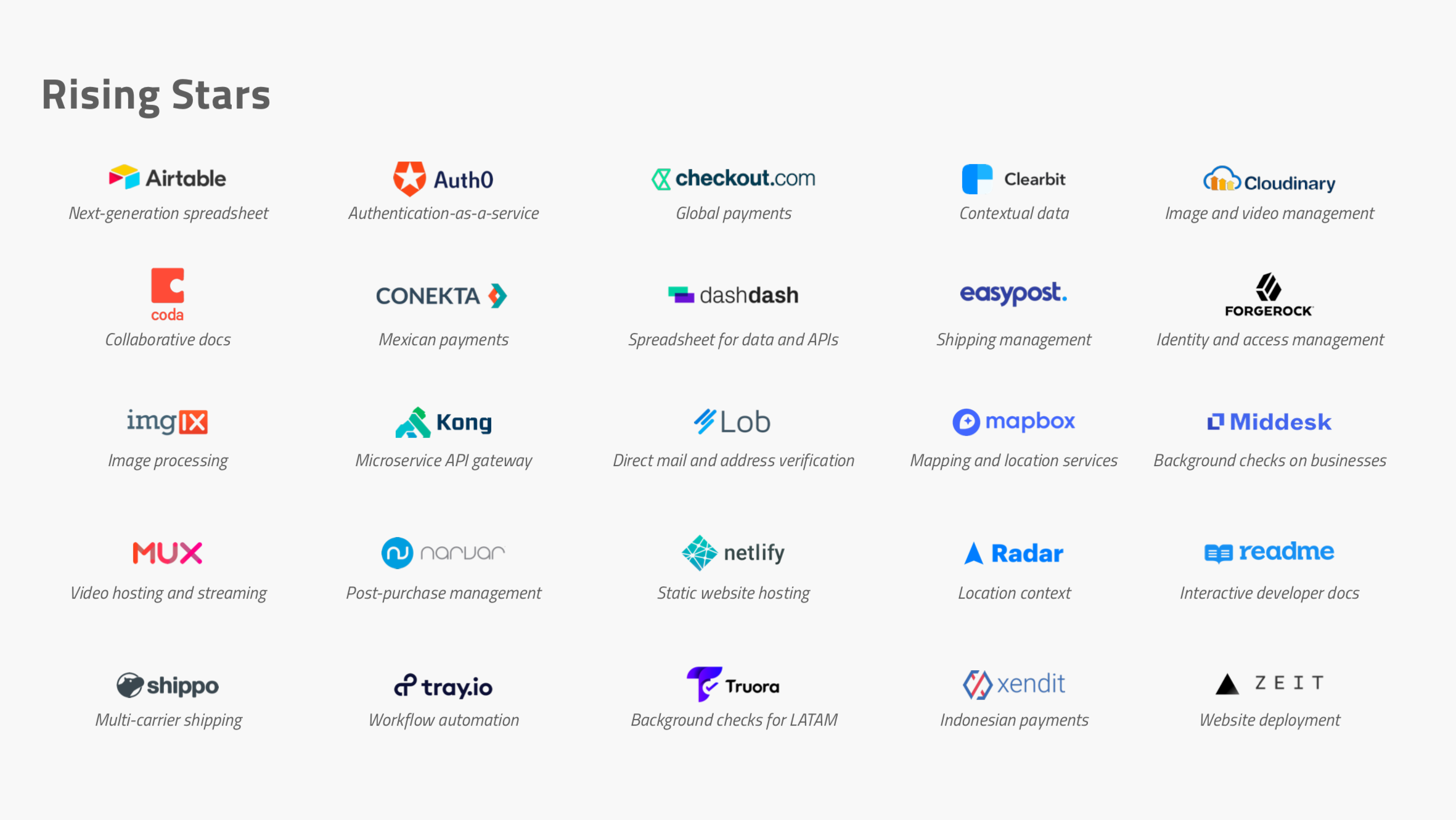
Simultaneously, the entrepreneurs behind these API-first companies like Twilio, Segment, Scale and many others are building sustainable, independent—and big—businesses.

Valued today at over $22 billion, Stripe is the biggest independent API-first company. Stripe took off because of its initial laser-focus on the developer experience setting up and taking payments. It was even initially known as /dev/payments!

Stripe spent extra time building the right, idiomatic SDKs for each language platform and beautiful documentation. But it wasn’t just those things, they rebuilt an entire business process around being API-first.

Companies using Stripe didn’t need to fill out a PDF and set up a separate merchant account before getting started. Once sign-up was complete, users could immediately test the API with a sandbox and integrate it directly into their application. Even pricing was different.

Stripe chose to simplify pricing dramatically by starting with a single, simple price for all cards and not breaking out cards by type even though the costs for AmEx cards versus Visa can differ. Stripe also did away with a monthly minimum fee that competitors had.

Many competitors used the monthly minimum to offset the high cost of support for new customers who weren’t necessarily processing payments yet. Stripe flipped that on its head. Developers integrate Stripe earlier than they integrated payments before, and while it costs Stripe a lot in setup and support costs, it pays off in brand and loyalty.

Checkr is another excellent example of an API-first company vastly simplifying a massive yet slow-moving industry. Very little had changed over the last few decades in how businesses ran background checks on their employees and contractors, involving manual paperwork and the help of 3rd party services that spent days verifying an individual.

Checkr’s API gives companies immediate access to a variety of disparate verification sources and allows these companies to plug Checkr into their existing on-boarding and HR workflows. It’s used today by more than 10,000 businesses including Uber, Instacart, Zenefits and more.

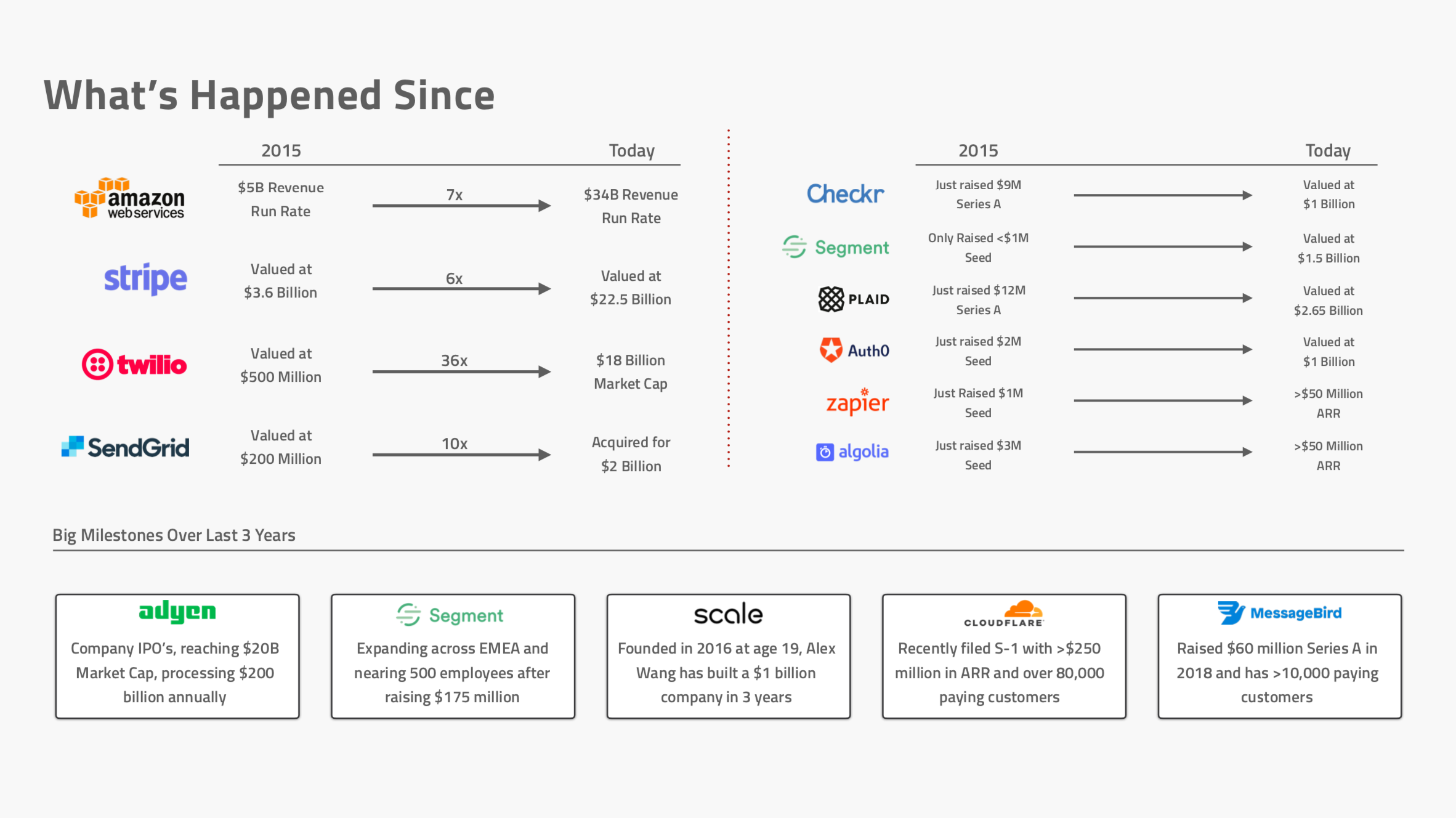
Like Checkr and Stripe, Plaid provides a similar value prop to applications in need of banking data and connections, abstracting away banking relationships and complexities brought upon by a lack of tech in a category dominated by hundred-year-old banks. Plaid has shown an incredible ramp these past three years, from closing a $12 million Series A in 2015 to reaching a valuation over $2.5 billion this year.

Today the company is fueling an entire generation of financial applications, all on the back of their well-built API.
Screen Shot 2019 09 06 at 10.41.02 AM

Graphics courtesy of Accel

Then and now

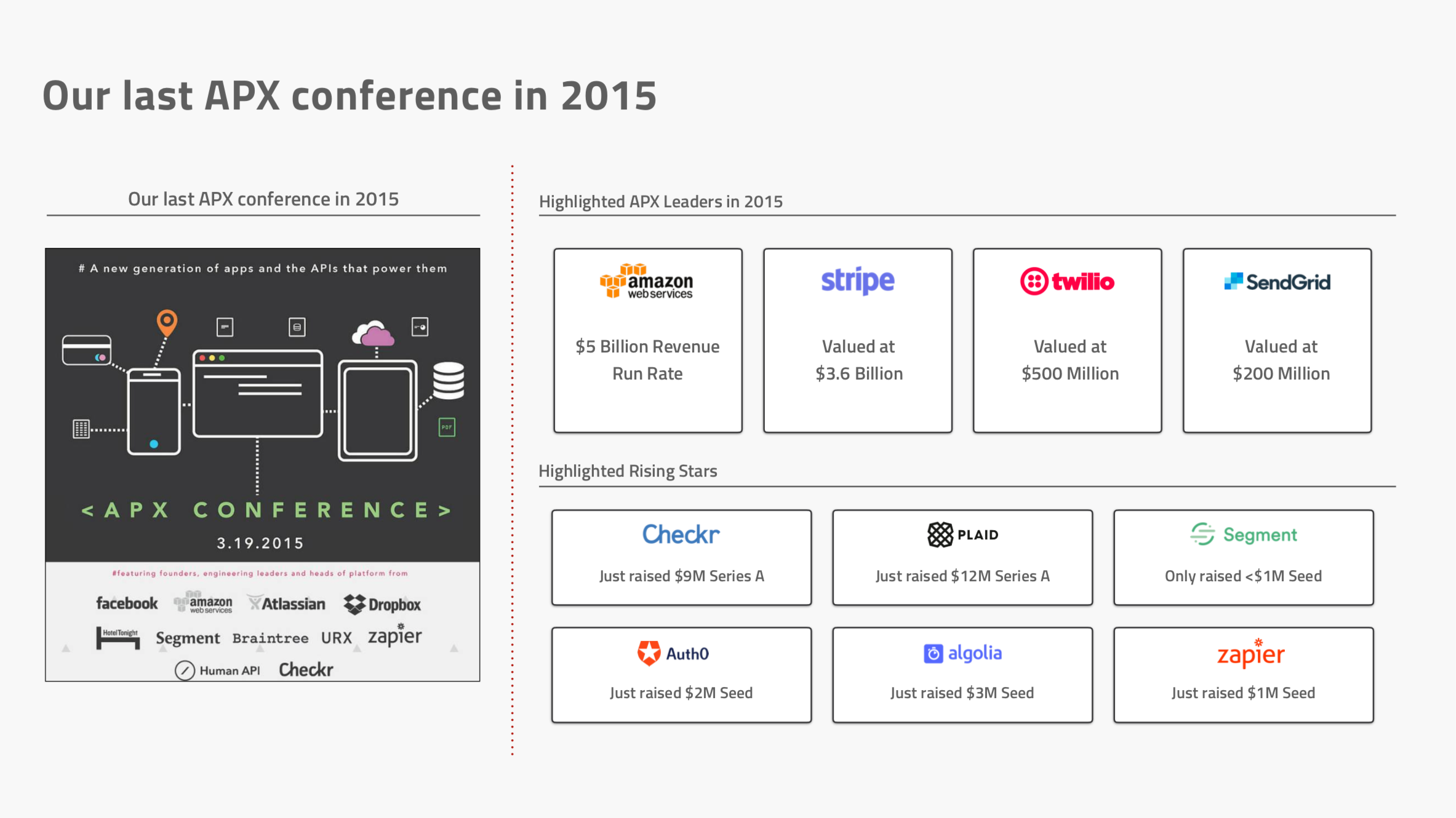
Accel’s first API investment was in Braintree, a mobile and web payment systems for e-commerce companies, in 2011. Braintree eventually sold to, and became an integral part of, PayPal as it spun out from eBay and grew to be worth more than $100 billion. Unsurprisingly, it was shortly thereafter that our team decided to it was time to go big on the category. By the end of 2014 we had led the Series As in Segment and Checkr and followed those investments with our first APX conference in 2015.

Plaid, Segment, Auth0, and Checkr had only raised Seed or Series A financings! And we are even more excited and bullish on the space. To convey just how much API-first businesses have grown in such a short period of time, we thought it would be useful perspective to share some metrics over the past five years, which we’ve broken out in the two visuals included above in this article.

While SaaS may have pioneered the idea that the best way to do business isn’t to actually build everything in-house, today we’re seeing APIs amplify this theme. At Accel, we firmly believe that APIs are the next big SaaS wave — having as much if not more impact as its predecessor thanks to developers at today’s fastest-growing startups and their preference for API-first products. We’ve actively continued to invest in the space (in companies like, Scale, mentioned above).

And much like how a robust ecosystem developed around SaaS, we believe that one will continue to develop around APIs. Given the amount of progress that has happened in just a few short years, Accel is hosting our second APX conference to once again bring together this remarkable community and continue to facilitate discussion and innovation.
Screen Shot 2019 09 06 at 10.41.10 AM

Graphics courtesy of Accel

Anti-utopian type design with Monotype’s Charles Nix

Monotype recently introduced a new typeface called Ambiguity, created by its Type Director, Charles Nix. Its unusual proportions deliberately challenge typographical conventions, going wide where a letter was once narrow and vice versa. I had a chance to talk to Nix about the genesis of Ambiguity and the state of type design; The conversation was interesting enough that I felt I should publish it more or less intact.

The interview has been slightly edited for clarity and conciseness. I started by asking for a little background on Monotype and what Nix does.

Charles Nix: Monotype is a very old company. It’s at least 125 years old, if not hundreds of years, just based on the number of foundries that have consolidated over the last 200 years. The current iteration of Monotype is the largest purveyor of digital fonts in the world.

The Monotype Studio is a discrete section within it that creates and manages type collections. There are around 60 of us, a dozen or so of which are type designers.

We help customers navigate the library, because it’s vast. We make do typeface recommendation, identification, pairing; we also help customers by modifying existing typefaces slightly in order to make them perform more uniquely.

And lastly the studio does custom design work, so we work with customers in order to identify their type needs, then create custom type solutions from the ground up.

Devin Coldewey: You mentioned the company is an amalgamation of foundries and studios from a century and more. The digital era seems like an exciting and weird one to be in type because the tools are so strong and distribution is so straightforward. Is this a good time to be in type versus 10, 20, 50 years ago?

Nix: I mean, you’re talking to a type designer, so any time working on type is a good time. But I agree with what you said, this time and this company, I want to say it’s all been leading up to this moment.

The tools and communication regarding typography, the typographic plenty, the awareness of typographic history, all these things are so amazing and focused at this point, there’s no more exciting time in the history of type to be involved.

Coldewey: What do you think is the biggest change in the last decade or so? Digitally the adoption of high-DPI screens has probably made type look a lot better, but I don’t know whether it’s actually changed what people do, or how it’s designed or approached.

Tools, distribution, and awareness — those three things are coming together to create the greatest typographic plenty in the history of the world.

Nix: There’s a triangulation of factors that are affecting type design at this point. One is the tools — and I always make this distinction, popular tools versus democratic tools. The tools aren’t democratic, but they’re popular enough, and they’re available enough, not freely obviously, but much much more freely and more accessible than any time in the 500 years of type founding, right?

As you pointed out, type is and has been for the last 30 years software. And slightly longer actually, if you look back to the early, early digital type, but now and in the public consciousness, it’s software. So distribution is crazy fast, and widespread.

My mother, she’s a special case because she helped my dad, who was a printer, so she knows more about type than most mothers. But in 1985 she could probably name five or six typefaces off the top of her head. And now she and everybody else’s mother has a favorite typeface, right?

That’s a huge change in the way that the world views type. What will come into sharper focus in the coming years is how those people harness the ability of typefaces to help modulate their own language, to help tell the story of what they say in print.

So tools, distribution, and awareness — those three things are coming together to create the greatest typographic plenty in the history of the world.

Looking to become the video-based social network of the gaming world, Medal.tv raises $9 million

When Medal.tv first launched on the scene, the company was an upstart trying to be the social network for the gaming generation.

Since its debut in February, the clipping and messaging service for gamers has amassed 5 million total users with hundreds of thousands of daily active users. And now it has a $9 million new investment from firms, led by Horizons Ventures, the venture capital fund established by Hong Kong multi-billionaire Li Ka-shing.

“We’re seeing sharing of short-form video emerge as a means of self-expression and entertainment for the current generation. We believe Medal’s platform will be a foundation for interactive social experiences beyond what you can find in a game,” says Jonathan Tam, an investor with Horizons Ventures .

Medal sees potential both in its social network and in the ability for game developers to use the platform as a marketing and discovery tool for the gaming audience.

“Friends are the main driver of game discovery, and game developers benefit from shareable games as a result. Medal.tv is trying to enable that without the complexity of streaming,” says Matteo Vallone, the former head of Google Play games in Europe and an angel investor in Medal.

Assets Web 1

It’s a platform that saw investors willing to fork over as much as $20 million for the company, according to chief executive Pim de Witte. “There are still too many risks involved to take capital like that,” de Witte says.

Instead, the $9 million from Horizons, and previous investors like Makers Fund, will be used to steadily grow the business.

“At Medal, we believe the next big social platform will emerge in gaming, perhaps built on top of short-form content, partially as a result of gaming publishers trying to build their own isolated gaming stores and systems,” said de Witte, in a statement. “That drives social fragmentation in the market and brings out the need for platforms such as Medal and Discord, which unite gamers across games and platforms in a meaningful way.”

As digital gaming becomes the social medium of choice for a generation, new tools that allow consumers to share their virtual experiences will become increasingly common. This phenomenon will only accelerate as more events like the Marshmello concert in Fortnite become the norm.

“Medal has the exciting potential to enable a seamless social exchange of virtual experiences,” says Ryann Lai, an investor from Makers Fund.

US senator demands answers from Amazon’s Ring over its police partnerships

Senator Edward J. Markey (D-Mass.) is looking for answers from Amazon about its doorbell camera Ring and the company’s relationships with law enforcement agencies around the U.S. In a letter published on Thursday, he writes to the technology giant how partnerships like Ring’s raise “serious privacy and civil liberties concerns,” and asks Amazon to further detail the size and scope of its numerous deals with police.

The senator’s attention was drawn to the issue following a recent report by The Washington Post. The report revealed that Ring had entered into some 400 video-sharing partnerships with U.S. police forces, which granted the police access to the footage from the homeowners’ internet-connected video cameras.

The police cannot tap into live or ongoing footage, and the homeowners can choose to decline police requests, the report also said.

However, the partnerships raised concerns from privacy advocates who believe the program could threaten civil liberties, turn residents into informants and subject innocent people to greater surveillance and risk, The Washington Post noted.

The same kind of network of surveillance cameras would draw more scrutiny if the police or the government had installed it themselves, but by working with Ring they’re not directly involved.

In a letter (see below) dated Thursday, September 5, 2019, Sen. Markey questions the use-targeted language that encourages Ring owners to opt in to the video-sharing program with police, as well as the way Amazon actively courts law enforcement to increase its use of the Ring system. Sen. Markey additionally points out that Amazon seems to be increasingly working with U.S. police forces, like it did when marketing its facial recognition product, Rekognition.

“The scope and nature of Ring’s partnership with police forces raise additional civil liberties concerns. The integration of Ring’s network of cameras with law enforcement offices could easily create a surveillance network that places dangerous burdens on people of color and feeds racial anxieties in local communities,” Sen. Markey wrote. “I am particularly alarmed to learn that Ring is pursuing facial recognition technology with the potential to flag certain individuals as suspicious based on their biometric information,” he continued, referencing a patent Ring applied for last year that would catch “suspicious” people on camera.

“In light of evidence that existing facial recognition technology disproportionately misidentifies African Americans and Latinos, a product like this has the potential to catalyze racial profiling and harm people of color,” Sen. Markey said.

The senator asks Amazon to detail how long it’s been asking users to share video footage with police, how those policies have changed and which police departments it’s working with. He also asked for information about how this data was being stored, what safeguards are in place, whether the police are sharing that footage with other entities, whether Rekognition capabilities were coming to Ring and more.

Sen. Markey also wants Ring to review its consent prompts for video-sharing with experts to make sure it’s not manipulating consumers into these agreements with police.

And he wants to know if Ring has worked with any experts in civil liberties, criminal justice or other relevant fields to review its doorbells and social network (Neighbors) to ensure they don’t present unique threats to people of color or other populations.

Ring would not be the first to create a home for racial profiling among neighbors, though its connection to cameras makes it more of an actionable threat than other networks, like Nextdoor or Facebook Groups.

Nextdoor, for example, became well-known for issues around racial profiling, and eventually rolled out tools to try to stem the problem in its app. Crime-tracking app Citizen also faced controversies for creating a state of paranoid hypervigilance among its users — something that has long-term effects on how people perceive their world and those they share it with. And anyone in a Facebook Group for their neighborhood knows there will at some point be a post about a “suspicious” person with little evidence of any wrongdoing.

Sen. Markey gave Amazon until September 26, 2019 to respond to his questions.

Top VCs say the landscape for enterprise startups is changing

Yesterday at TechCrunch’s Enterprise event in San Francisco, we sat down with three venture capitalists who spend a lot of their time thinking about enterprise startups. We wanted to ask what trends they are seeing, what concerns they might have about the state of the market and, of course, how startups might persuade them to write out a check.

We covered a lot of ground with the investors — Jason Green of Emergence Capital, Rebecca Lynn of Canvas Ventures and Maha Ibrahim of Canaan Partners — who told us, among other things, that startups shouldn’t expect a big M&A event right now, that there’s no first-mover advantage in the enterprise realm and why grit may be the quality that ends up keeping a startup afloat.

On the growth of enterprise startups:

Jason Green: When we started Emergence 15 years ago, we saw maybe a few hundred startups a year, and we funded about five or six. Today, we see over 1,000 a year; we probably do deep diligence on 25.

Only a few hours left for early-bird passes to Disrupt SF 2019

We’re in a price-hike homestretch, startup fans. Early-bird savings head south, and ticket prices head north in just a few short hours. Want to save up to $1,300 on passes to Disrupt San Francisco 2019? Buy your passes by 11:59 p.m. (PST) tonight, September 6 — avoid the costly stroke of midnight.

Wring even more savings out of the waning early-bird hours. How? Buy in bulk and score a group discount. Bring your entire squad and/or impress valued clients.

Here’s the 411 on group discounts:

  • Group Innovator Pass: Buy five or more passes and get a 20% discount. Need 10 or more passes? Email us for a price quote at [email protected].
  • Group Founder Pass: Buy two or more passes and you’ll get a 10% discount. Note: You must be a (co)founder of a company (of any size).
  • Group Investor Pass: Purchase two or more passes to get a 10% discount.
  • Group Expo Only Pass: If you want to buy Expo Only passes in bulk (10 or more), email [email protected] for a price quote.
  • Group Startup Alley Exhibitor Packages: If you’re interested in purchasing more than one Startup Alley Exhibitor Package, email [email protected] for more information.

Whether you bring your team or arrive solo, you’ll find incomparable networking opportunities at Disrupt SF. Head for Startup Alley to meet and greet our TC Top Picks. TechCrunch editors selected 45 companies they felt represented the best early-stage startups in these categories: AI/Machine Learning, Biotech/Healthtech, Blockchain, Fintech, Mobility, Privacy/Security, Retail/E-commerce, Robotics/IoT/Hardware, SaaS and Social Impact & Education.

You’ll find hundreds of other stellar startups exhibiting their tech and talent, and we’re here to help you make networking as painless as possible. First, get a jump on your research by reviewing our directory of exhibiting startups. Once you get a vetted handle on who you’d like to meet, take advantage of CrunchMatch, our free business match-making platform.

Available to attendees with Innovator, Founder or Investor passes, CrunchMatch automatically suggests suitable prospects based on profiles each user submits. Use it to send, accept or decline meeting requests. And you can use the service to reserve dedicated meeting spaces.

There’s so much more: Don’t miss Startup Battlefield as a group of standout startups compete for $100,000 on a world stage. And look at our conference agenda to see which of the many, many presentations, interviews, workshops and panel discussions we have on tap. So many choices and so little time.

So little time — just a few hours left to save up to $1,300 on passes to Disrupt San Francisco 2019. Avoid the price hike. Beat the deadline and buy your early-bird passes before 11:59 p.m. (PST) tonight, September 6.

Is your company interested in sponsoring or exhibiting at Disrupt San Francisco 2019? Contact our sponsorship sales team by filling out this form.

Tile teams up with Google to bring its lost item finding technology to Google Assistant

As rumors swirl about Apple’s plans to launch a Tile competitor, Tile today announced it’s teaming up with Google to make it easier for users to locate their lost items using their Android devices and others using Google Assistant. For the uninitiated, Tile is a small hardware accessory that you can attach to items like keys, purses, bags, wallets and more, which can then be tracked using a combination of Bluetooth technology and the wider network of Tile users running the companion app on their phone.

The newly announced Google Assistant integration will make it possible for Google Assistant users to use voice commands to ring the Tile attached to the missing item. This is supported by way of Tile’s “direct ring” technology, which allows the platform to directly connect with, then ring, the lost item.

The Google Assistant integration will be similar to using any other smart home Action through the Assistant, Tile says, and will launch later this year.

“This is big news for Tile customers,” said CJ Prober, CEO of Tile, in a statement. “If you were to lose or misplace your wallet, remote, backpack – anything, Google will soon join your personal search party with a simple voice command.”

Tile’s announcement of Google Assistant integration comes at an interesting time.

Apple, which is hosting its iPhone event next week, has been found to be developing its own Tile competitor. Recently, code referencing a new tab labeled “Items” in iOS 13’s “Find My” app was also discovered, hinting at a forthcoming launch.

It’s unclear, of course, when Apple plans to actually unveil this hardware. But Tile, apparently, is looking to get ahead of any such announcement with its news for Android and Google Assistant users.

Tile has grown to become one of the top makers of Bluetooth-powered lost-item trackers on the market, with 22 million sold in 2018 and a user base that’s locating more than 5 million items daily using its platform across 230 countries and territories around the world.

The company has since expanded beyond its consumer devices to provide location tracking to more products by way of partnerships with BLE chipmakers and other manufacturers.

As of today, that list also includes Sennheiser, which launched its new Momentum Wireless around-ear headphones (339 EUR) at the IFA consumer electronics show in Berlin today. The headphones will ship with Tile’s Community Fine technology built-in, so users can locate them if they become misplaced, lost or stolen.

Tile now has more than 20 partnerships with the addition of Sennheiser, the company says.

NY attorney general will lead antitrust investigation into Facebook

New York Attorney General Letitia James announced this morning that she’s leading an investigation into Facebook over antitrust issues — in other words, whether Facebook used its social media dominance to engage in anti-competitive behavior.

In a statement, James said:

Even the largest social media platform in the world must follow the law and respect consumers. I am proud to be leading a bipartisan coalition of attorneys general in investigating whether Facebook has stifled competition and put users at risk. We will use every investigative tool at our disposal to determine whether Facebook’s actions may have endangered consumer data, reduced the quality of consumers’ choices, or increased the price of advertising.

According to the announcement, that coalition includes the attorneys general of Colorado, Florida, Iowa, Nebraska, North Carolina, Ohio, Tennessee and the District of Columbia.

Facebook already announced in June that it was facing an antitrust investigation from the Federal Trade Commission (separate from the privacy-related settlement with the FTC that it announced on the same day). It seems that most of the tech giants are facing antitrust scrutiny from the FTC and Department of Justice.

“People have multiple choices for every one of the services we provide,” Facebook’s vice president of state and local policy Will Castleberry said in a statement after the new investigation was announced. “We understand that if we stop innovating, people can easily leave our platform. This underscores the competition we face, not only in the US but around the globe. We will of course work constructively with state attorneys general and we welcome a conversation with policymakers about the competitive environment in which we operate.”

Huboo raises £1M to take the pain out of e-commerce fulfilment

Huboo, a U.K. startup that operates a multi-channel fulfillment service for e-commerce businesses of varying sizes, has raised £1 million in seed funding. Backing the majority of the round is London venture capital firm Episode 1, alongside a number of unnamed private individual investors.

Launched in November 2017 by Martin Bysh and Paul Dodd after the pair had run a number e-commerce experiments, Huboo aims to solve the fulfillment pain point that most online stores face. The service promises to store your stock, and then “pick, pack and deliver it” automatically as customer orders are placed.

The idea is that by outsourcing fulfillment, online shops can focus on the parts of the business where most value is added, such as customer service and choosing which products to develop and/or sell.

However, according to Huboo’s founders, except for larger e-commerce stores, the market is woefully underserved, with most fulfillment providers too expensive and uninterested in servicing smaller businesses. The only other option, they claim, is Amazon’s “Fulfillment by Amazon” (FBA), which they say is viable only for goods sold on Amazon because of discounts the e-commerce giant offers.

“Packing boxes and queuing in the post office were a horrible side effect of our [e-commerce] experimentation, and we needed to offload this if we weren’t to waste hours each day or abandon the whole e-commerce research project,” says Bysh.

“Luckily this is a solved problem, or so we thought… but we called around some fulfillment companies and discovered that they had no interest in our business, our items were too cheap and our volumes too low. And they weren’t very tech savvy, often basing their business on third-party warehouse management software, and limited marketplace integrations.”

The pair decided to change tack. Instead of attempting to find the next pure e-commerce opportunity, as their e-commerce experiments had intended, they began trying to figure out a way to “shatter the traditional economics of fulfillment.” The potential prize is a “huge chunk” of what Bysh frames as a “multi-billion, largely uncontested” market.

“We did some research on the market opportunity and determined that in the U.K. alone the opportunity was around £1 billion of more or less uncontested fulfillment business,” he says.

The key was to build systems that are flexible enough for Huboo to work with sellers, regardless of what they sell, how much they sell and whether or not the goods are sold new or “re-commerced.” “We have clients that ship a couple of items a day and other that ship thousands. Items range in price for a few pounds to hundreds,” explains Bysh.

Products fulfilled by Huboo already span items such as vitamins, CBD oils, headphones, bingo tickets, electronic bagpipes, antiques, coffee, electronics, clothes (new and used) and beauty products. Clients include startups, subscription businesses and individuals selling niche or boutique products.

Bysh says that serving this part of the fulfillment market is made possible via a combination of bespoke technology and algorithms, leading to “massive process optimisation” and reducing client management costs through SaaS sign-ups, on-boarding and support.

But it’s not just about tech-driven optimised processes. Part of Huboo’s proposition is achieved through something as simple as a modular approach the company has designed to organise its warehouses. This sees every client given a designated space within a hub and a hub manager who understands their business.

From a revenue model perspective, Huboo is attempting to align its own interests with that of sellers. The startup provides two months of free storage to all clients for every new inventory shipment, so if sellers manage and maintain turnover they won’t need to pay for storage again.

“When a seller sells, we fulfill, which means they pay us primarily when they are earning. That’s where 80% of the revenue comes from,” explains Bysh.

Meanwhile, Huboo generates additional revenue from a small administrative subscription and optional services, such as packaging. The latter will grow when “Hubstore” is launched later this year, offering upgrades and customisations in a single click. This will include related services, such as tech to help expand to additional channels and increase sales.

Why Box is one of the most underappreciated companies

Hello and welcome back to Equity, TechCrunch’s venture capital-focused podcast, where we unpack the numbers behind the headlines.

This week, we recorded on location at TechCrunch Sessions: Enterprise in San Francisco, a show that saw talks from Box’s Aaron Levie, Atlassian CEO Scott Farquhar and venture capitalists Maha Ibrahim, Rebecca Lynn and Jason Green. The latter, the founder of Emergence Capital, joined us before his panel for a special episode of Equity focused almost entirely on enterprise tech. Danny Crichton, the esteemed leader of TechCrunch’s Extra Crunch, was on hand to co-lead the episode with Kate.

Before we jumped too deep into the enterprise pool, we had to review some news from one of the most-talked about companies. The co-working giant, legally known as The We Company, is said to have halved its IPO exceptions to a minuscule $20 billion! OK, that’s not really that small, but compared to its most recent valuation of $47 billion, we’re a bit shocked.

Next, we ran through the IPO pipeline. Cloudflare is expected to go public next Friday. Datadog will come after that. WeWork is reportedly kicking off its roadshow next week, but given this week’s reports, that could be delayed.

After that, Green gave us his take on Box, the file sharing business in which he was an early investor. If you haven’t heard, activist investor Starboard Value took a 7.5% stake in the business this week. Green explains what that means and what he think is next for the company. Levie, of course, spoke onstage at the enterprise event. In short, the executive said his goal is to continue building a sustainable business.

Finally, we dove into the latest trends in startups. Enterprise still isn’t sexy, but it’s much sexier than it has been in the past. Why? Because all the enterprise startups want to build consumer-friendly tools. Tune in to hear what Green thinks of the consumerization of the enterprise and all the startup madness.

Equity drops every Friday at 6:00 am PT, so subscribe to us on Apple PodcastsOvercastSpotify, Pocket Casts, Downcast and all the casts.

Alibaba’s UCWeb to launch an e-commerce service in India

UCWeb, a subsidiary of Chinese giant Alibaba Group, plans to launch an e-commerce service in India in the coming months.

In a statement to TechCrunch, a UCWeb spokesperson said the firm plans to build an e-commerce service around content platforms in India. It has no intention to compete with existing e-commerce businesses in the country, and Alibaba Group is not overseeing the development of the service, the spokesperson added.

UCWeb, which is best known for its popular mobile browser UC Browser, would leverage its “extensive user communities in India,” to build the e-commerce business, the spokesperson said. “The new service is in line with our strategy to enrich the experience for users and clients alike.”

UC Browser, used by more than 430 million users worldwide, counts India as one of its key markets where it has over 130 million users. According to third-party analytics firm StatCounter, UC Browser commanded over 23% of the mobile browser market share in India, lagging only behind Google Chrome, whose market share has ballooned in recent years to 63%.

UC Browser remains among the top 15 apps in India based on number of downloads through Google Play Store, according to app research firm SensorTower.

In recent years, UCWeb has bulked up UC Browser to expand its offering beyond mobile browsing. Today it works with over 120,000 bloggers and more than 700 media outlets to produce content that it then serves to UC Browser users.

UCWeb has launched a number of apps in recent quarters that are aimed at users who are trying to download videos from the web. Vmate, a UCWeb-owned app that offers similar functionalities, recently secured $100 million commitment from parent firm Alibaba.

On the sidelines of a company event on Thursday, Huaiyuan Yang, vice president of UCWeb Global Business, told news agency PTI that the firm would partner with existing players for its upcoming e-commerce service. Alibaba owns about 30% of payments and e-commerce firm Paytm.

“We have Alibaba’s e-commerce gene in us. We are actually trying to start an innovative business model related to e-commerce,” he told PTI.

Super early-bird pricing for Disrupt Berlin 2019 ends tonight

The last few hours of serious euro-savings are upon us, startuppers. In the States, we’d say it’s time to fish or cut bait. What we’re trying to tell you is that super early-bird pricing for Disrupt Berlin 2019 ends tonight at 11:59 p.m. (CEST). Buy your passes now and save up to €600 or pay more tomorrow. Note that staying home is not an option.

Come to Berlin and join more than 3,000 of your kindred startup spirits from more than 50 countries. You’ll benefit from the words and wisdom of tech’s most influential leaders, investors, makers and shakers. Folks like these…and lots more phenomenal speakers.

Enjoy a fireside chat with Oscar Pierre, the CEO and co-founder of Glovo. Pierre’s bona fides are fascinating — he got his start as an aerodynamics engineer for Airbus. We can’t wait to hear how he transitioned to lead a major on-demand delivery platform with more than 1,000 employees and service in 124 cities across 21 countries.

?Quick, what company single-handedly changed the tech startup investment game? If you said SoftBank Vision Fund, well good on ya, mate. Fund partner David Thevenon will join us onstage, and we can’t wait to hear his take on ride-hailing and mobile transportation platforms. We also want to know if SoftBank board members are hands-on or hands-off when it comes to letting executive teams make decisions.

There are plenty more reasons and ways to attend Disrupt Berlin. Why not take a shot at startup glory? One application form is all it takes to apply to both Startup Battlefield and the TC Top Picks program.

Think you have what it takes to compete in Startup Battlefield and launch your company on the world’s most famous startup stage? It won’t cost you anything to apply or to participate. If you’re chosen, you’ll receive rigorous pitch coaching, so you’ll be ready to go head-to-head against some of the best early-stage startups. Who will win the $50,000 prize?

Not ready for a pitch competition quite yet? No worries. Apply to be a TC Top Pick. If you make the cut, you’ll get a free Startup Alley Exhibitor Package, a VIP experience and loads of investor and media attention.

Disrupt Berlin 2019 takes place on 11-12 December, but the super early-bird ticket pricing disappears in just a few hours. Buy your passes now before the deadline strikes tonight at 11:59 p.m. (CEST). Remember, staying home  is not an option.

Is your company interested in sponsoring or exhibiting at Disrupt Berlin 2019? Contact our sponsorship sales team by filling out this form.