Pinduoduo draws shoppers outside China’s big cities with low-priced goods. It trails only Alibaba in number of users, and has a larger market cap than eBay.
Category: Tech news
hacking,system security,protection against hackers,tech-news,gadgets,gaming
Unusual Fluids Flip, Twirl, and Redefine How Liquids Work
New shape-shifting liquids can move or morph on command. One scientist even used them to make liquid cables for his headphones.
The Lovability of Malcolm Gladwell: A Gladwellian Analysis
In which the journalist’s podcast and new book, *Talking to Strangers*, are reviewed on his own terms.
Let’s All Just Chill About Processed Foods
Processed foods are bad for you, right? So super-processed, plant-based meat must be terrible, right? Not so fast on either count.
Imagine the Views From This Italian-Designed Swiss Train
Italian design firm Pininfarina has designed the new rail cars with nearly floor-to-ceiling windows for a line in the Swiss Alps.
The Boston Straight Pride Parade Tops This Week’s Internet News Roundup
Also, British Prime Minister Boris Johnson had a very bad week and Walmart took a stand to curb gun violence.
An Electric Porsche, a Tesla Probe, and More Car News This Week
Porsche’s battery-powered Taycan can go 0 to 60 in 2.6 seconds and features a two-speed gearbox that’s the first of its kind.
8 Best Electric Bikes for Every Kind of Ride (2019)
We’ve tested ebikes for commuting, mountain biking, gravel, and even a few that can fold up. These are our favorites.
Are We All Wrong About Black Holes?
A philosopher of science worries that the analogy between black holes and thermodynamics has been stretched too far.
Concerning Consent, Chappelle, and Canceling Cancel Culture
Dave Chappelle hates cancel culture. Some people have canceled him. Should we just cancel cancel culture already?
CDC says stop vaping as mystery lung condition spreads
Vape lung is spreading and the CDC is warning people not to use vaping products while they are investigating the cause. In a media briefing, the public health agency said that some 450 people are now thought to be affected, and as many as five have died.
The CDC’s incident manager for this issue, Dana Meaney Delman, summed up the situation as follows:
CDC, states, and other partners are actively investigating, but so far, no definitive cause has been established. No specific e-cigarette device or substance has been linked to all cases, and e-cigarette include a variety of chemical and additives; consumers may not know what these products contain.
Based on the clinical and laboratory evidence to date, we believe that a chemical exposure is likely associated with these illnesses. However, and I really want to stress this, more information is needed to determine which specific products or substances are involved
Reports earlier this week suggested that Vitamin E acetate, a byproduct of the vitamin complex formed during the vaporization process, may be to blame. Delman downplayed this, saying that although they are working with the labs that made that connection, nothing has been established as yet.
One trend worth noting, however, is that very few of the cases involve only nicotine products; most of the afflicted users reported using THC exclusively or as well as nicotine. This could be the result of many factors, however, so take it with a grain of salt.
The first death was reported in late August in Indiana, but other suspected cases have turned fatal in Illinois, Minnesota, California and Oregon — as reported by The Washington Post, though the CDC said three are confirmed and one is under investigation. The number of reported cases has skyrocketed, though this is likely a consequence of better information coming from state health authorities and hospitals, rather than a sudden epidemic.
In the meantime, the only advice they have is to avoid e-cigarette and vape device usage, especially modified devices or homebrew material. The fact is no one really knows what chemicals are formed in the conditions created by these devices, and some of them could be toxic.
While the investigation is ongoing, CDC has advised that individuals consider not using e-cigarettes because as of now, this is the primary means of preventing this type of severe lung disease. And of course e-cigarette use is never safe for youth, young adults, or pregnant women.
People who do use e-cigarette products should monitor themselves for symptoms (e.g., cough, shortness of breath, chest pain, nausea, vomiting, or others) and promptly seek medical attention for any health concerns. Regardless of the ongoing investigation, people who use e-cigarette products should not buy these products off the street and should not modify e-cigarette products or add any substances that are not intended by the manufacturer.
The CDC is working with numerous state authorities and the FDA to identify the cause of this malady, and will soon publish a report in The New England Journal of Medicine detailing the first 53 cases identified. This should help doctors and other health workers tell if they are dealing with a case of vape lung or something else.
Daniel Fox from WakeMed Hospitals in North Carolina characterized the condition as they had encountered it, with a preliminary diagnosis of “lipoid pneumonia”:
What we wanted to report and what we have seen has been a cluster of five cases that will be reported later today. Each of these cases featured a pulmonary illness in a relatively young person. Ranging in age from 18-35 from what we saw here in North Carolina. The symptoms that these patients were experiencing were being short of breath, having some GI or gastrointestinal symptoms of nausea and vomiting and fevers.
One of the things that was found in common with all of these cases is that all patients were using vaped substances in e-cigarettes. They all had abnormal chest x-rays and developed a need for a lot of oxygen.
All of our patients underwent evaluation, and after the clinical evaluation we found a certain type of pneumonia that was noninfectious. It’s called lipoid pneumonia. Basically, can be, it can occur when either oils or lipid-containing substances enter the lungs.
That is consistent with the Vitamin E acetate hypothesis, as that substance is oily and could enter the lungs mixed with the vapor and then stay there. But none of the doctors or experts on the call made that connection officially.
Some patients are being misdiagnosed as having bronchitis or a viral infection. If you are or anyone you know is getting sick and uses vaping products a lot, it’s worth mentioning this if you get checked out.
Delman concluded her briefing with an assurance that everything that can be done is being done:
Please know that CDC, FDA, state, and clinical partners are working hard to understand why people are getting sick. We will continue to share what we know and what we don’t know to help health departments, clinicians, and the public respond to this outbreak.
If you are concerned about your health or the health of a loved one who is using an e-cigarette product, contact your healthcare provider, or your local poison control center at 1-800-222-1222.
Paid streaming music subscriptions in US top 60M, says RIAA
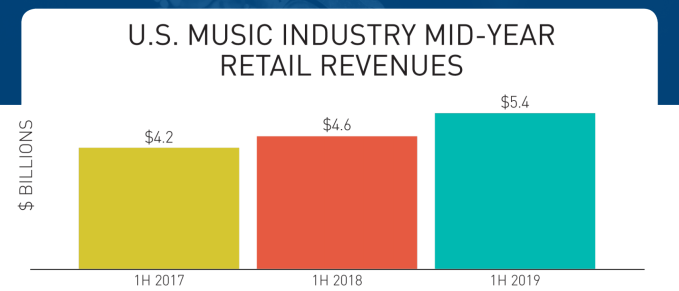
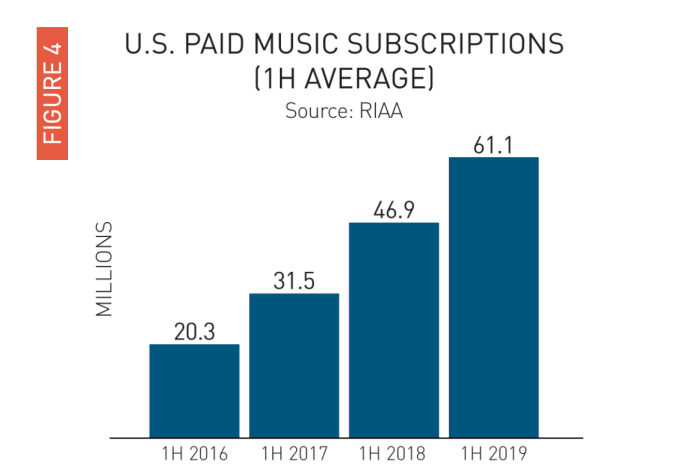
Streaming music subscriptions continue to drive the U.S. music industry’s growth and revenues, according to a new report from the Recording Industry Association of America (RIAA) released this week. The organization said total music revenue grew 18% to $5.4 billion in the first half of 2019, with streaming music accounting for 80% of industry revenues. The report also noted the number of paid subscriptions topped 60 million in the U.S. for the first time.
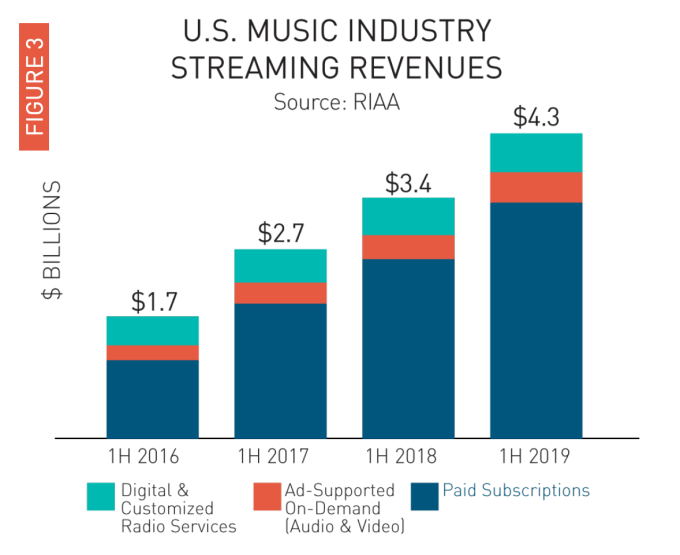
Streaming revenues grew 26% to $4.3 billion in the first half of the year.
This broad figure includes paid versions of Spotify, Apple Music, Amazon Music and others, as well as digital radio service revenues like those from Pandora, Sirius XM and other internet radio, plus ad-supported streaming like YouTube, Vevo and the ad-supported version of Spotify. 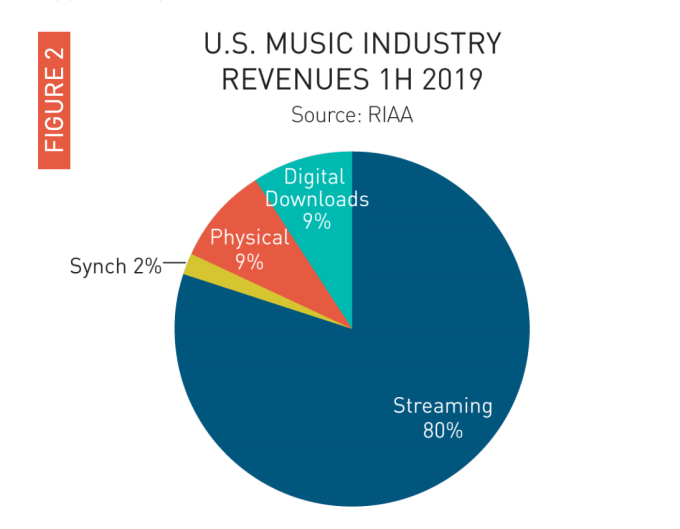
Meanwhile, paid subscription streaming is continuing to grow, too, said the RIAA. Year-over-year, paid subscriptions grew 31% to reach $3.3 billion and remain the biggest growth driver for industry revenues.
In the first half of 2019, paid subscriptions made up 62% of all U.S. industry revenues and 77% of U.S. streaming music revenues.
The number of paid subscriptions to full on-demand streaming services grew 30% to 61.1 million in the first half of the year, at an average pace of more than 1 million new subscriptions per month.
This doesn’t include the “Limited Tier” subscriptions like Pandora Plus or that Echo-only subscription to Amazon Music, for example, where various factors limit access to a full catalog across devices or restrict some on-demand features. This category saw $482 million in revenues, up 39% from the year prior.
“Thanks to that breakneck growth, plus continued modest drops in digital downloads and new physical sales, streaming now generates 80% of music business revenues and has fundamentally reshaped how fans find, share, and listen to the songs and artists they love,” wrote RIAA chairman & CEO Mitch Glazier, about the new figures.
Ad-supported on-demand services grew 25% year-over-year to $427 million, while digital radio service grew 5% to $552 million in the first half of 2019.
However, the gains made by streaming were somewhat offset by declines in digital downloads, as Glazier noted.
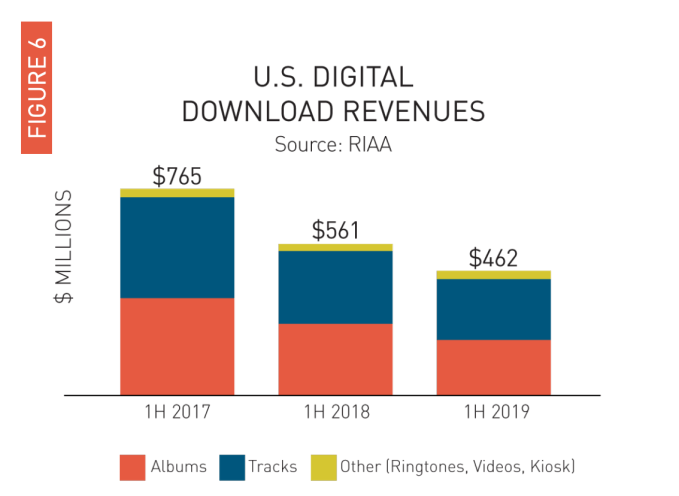
Revenues in this category fell 18% to $462 million in the first half of the year, with digital track sales down 16% year-over-year and digital album revenues down 23%. Overall, digital download only accounted for 8.6% of total industry revenues.
Physical product revenues grew 5% to $485 million in the first half of 2019, but the RIAA attributed this to a reduction in returns.
Watch India’s Chandrayaan-2 make its historic Moon landing attempt right here
It’s a big day for India’s highly audacious Chandrayaan-2 mission. The nation will attempt to land on the moon’s surface shortly as it inches closer to becoming the fourth in the world to complete a successful lunar landing. ISRO, India’s equivalent of NASA, is live streaming the landing on its website, and YouTube channel (embedded below).
Additionally, if you are tuning in from India, dozens of channels, including Doordarshan (DD1), Disney India, Colors Infinity, National Geographic, Star Plus, Star Bharat and DD News are live telecasting India’s mission to the Moon. The landing is scheduled for between 1pm and 2pm Pacific Time (4pm to 5pm Eastern Time; 8pm to 9pm GMT).
ISRO launched its 142-foot tall spacecraft from the the Satish Dhawan Space Centre, Sriharikota in Andhra Pradesh on July 15. The spacecraft consists of an orbiter, a lander named Vikram (named after Vikram Sarabhai, the father of India’s space program) and a six-wheeled rover named Pragyaan (Sanskrit for “wisdom”). Earlier this week, the lander that carried the rover detached from the orbiter.
The mission’s budget is just $141 million, significantly lower than those of the U.S., Russia and China, and less than half of the recently released blockbuster “Avengers: Endgame.”
Commenting on the landing, India’s Prime Minister Narendra Modi, who will be watching the nation’s attempt at the Moon landing from ISRO’s office, said earlier today that, “India, and the rest of the world will yet again see the exemplary prowess of our space scientists.”
Chandrayaan-2 aims to land on a plain surface that covers the ground between two of the Moon’s craters, Simpelius N and Manzinus C — that is about 375 miles from the South Pole. It’s an understudied region that no one has seen closely yet.
NASA astronaut Jerry Linenger said in a televised program today, “I just want everyone to know that the whole world is following this and it is not just Indians. This is the first time any country is going to the South Pole of the Moon! India is leading this and as a representative of the U.S., we are nervous and we are hoping for success. This increases the knowledge base of the Moon.”
Update 1.50pm PT: About 2.1 kilometers (1.3 miles) above the surface, the mission control lost connection with the lander. ISRO is trying to reestablish the connection. In the meantime, India’s Prime Minister said in a televised appearance, “we are proud of what ISRO has achieved. Be courageous. I hope for the best. My faith in ISRO remains intact.”
India is proud of our scientists! They’ve given their best and have always made India proud. These are moments to be courageous, and courageous we will be!
Chairman @isro gave updates on Chandrayaan-2. We remain hopeful and will continue working hard on our space programme.
— Narendra Modi (@narendramodi) September 6, 2019
Porsche increases stake in electric car maker Rimac Automobili to 15.5%
Porsche AG is increasing its stake in Croatian electric vehicle components and hypercar company Rimac Automobili . The increased stake is the latest effort by Porsche to invest more into electric mobility, particularly in battery technology.
It was just 14 months ago that Porsche took a 10% stake in Rimac. Now, the German automaker is pushing that to 15.5%, according to an announcement Friday.
Porsche intends to intensify its collaboration in the field of battery technology, said Lutz Meschke, deputy chairman of Porsche’s executive board. Porsche, which just introduced its all-electric Taycan sports car, has said it will invest more than $6 billion into electric mobility through 2025. The automaker spent more than $1 billion developing the Taycan, a cost that included expanding its factory.
For the unfamiliar, Rimac was founded by Mate Rimac in 2009 and is perhaps best known for its electric hypercars, such as the two-seater C Two that it debuted in 2018 at the Geneva International Motor Show.
The vehicle produces an extraordinary 1,914 horsepower, has a top speed of 256 miles per hour and can accelerate from 0 to 60 mph in 1.85 seconds. That’s faster than Tesla’s next-generation Roadster prototype that CEO Elon Musk unveiled in November 2017. The Rimac’s battery is no slouch either, and gets 404 miles to a single charge under the more generous NEDC estimates. Still, that blows away other EVs on the market.
But Rimac, which is based in Zagreb and employs around 550 people, does more than produce hypercars. The company focuses on battery technology within the high-voltage segment, engineers and manufactures electric powertrains and develops digital interfaces between humans and machines. The company also develops and produces electric bikes. This strand of the business was established in 2013 in the form of the sister company Greyp Bikes.
“Gaining Porsche as a stakeholder was one of the most important milestones in our history. The fact that Porsche is now increasing its stake is the best form of confirmation for our collaboration and represents the foundation for an even closer relationship,” Mate Rimac, the company’s founder said in a statement. “We are only at the start of our partnership – yet we have already met our high expectations. We have many collaborative ideas that we aim to bring to life in the future. The fundamental focus is creating a win-win situation for both partners and offering our end customers added value by developing exciting, electrified models.”
Porsche isn’t the only automaker interested in Rimac. The company has already worked with Renault, Jaguar and Aston Martin. And in May 2019, Hyundai Motor Company and Kia Motors jointly invested €80 million, or around $90 million, into Rimac. Under that deal, the three parties agreed to collaborate on the development of high-performance electric vehicles.
Pagerduty’s Jennifer Tejada and Box’s Aaron Levie will talk IPOs at TC Disrupt SF
Pagerduty‘s CEO Jennifer Tejada and Box co-founder and CEO Aaron Levie both guided their companies to successful IPOs, with Box going public in 2015 and Pagerduty listing its stocks only a few months ago. Both of them will join us on the first day of TechCrunch Disrupt SF (October 2) to talk about their experiences in getting their companies to this point and managing the changes that come with being a public company.
It took both companies about 10 years to get to their IPOs. Levie co-founded the content management and file sharing service Box in 2005 and Pagerduty first launched as a basic notification tool for on-call developers in 2009, with Tejada joining as CEO in 2016. Box has already experienced its share of ups and downs in the stock market and Pagerduty’s IPO in April launched its stock right into one of the more volatile markets in recent years.
At Disrupt, though, we’ll focus on what these two CEOs did to get their companies ready to go public and the process of listing a company — and what, in hindsight, they would’ve done differently.
Box’s road, especially, was rather long and winding. It took the company nine months from filing its S-1 to actually IPOing — in part because the reaction to the numbers it disclosed in its S-1 was pretty negative at the time.
Pagerduty, on the other hand, had a more straightforward path, in part thanks to its strong financial position before it filed.
Disrupt SF runs October 2 to October 4 at the Moscone Center in the heart of San Francisco. Tickets are available here.