Annual Extra Crunch members get 100,000 Brex Rewards points upon credit card signup

We’re excited to announce an addition to the Extra Crunch community perks. Starting today, annual Extra Crunch members can get 100,000 Brex Rewards points after signing up for a Brex corporate credit card. This offer is worth about $1,000 in credit card points.

Brex’s corporate credit card is designed for startups, and Extra Crunch was built for the startup ecosystem. We understand that startups are trying to be as frugal as possible with spending, and we felt that the Brex corporate credit card was the perfect way to stretch those valuable dollars.

Brex gives startup founders and finance teams higher credit limits than what they would get with any other business credit card option, and it does so without requiring a personal credit check or security deposit during the application. There are some impressive reward multipliers across categories like rideshare, travel, and restaurants. It also comes with $50,000 worth of partner offers from AWS, Salesforce and many more.

Full benefits with the Brex for Startups credit card include:

  • 100,000 Brex Rewards points upon signup (equal to about $1,000)
  • 7x points on ridesharing app charges
  • 4x points on travel charges, including Airbnb
  • Miles transfer program to six airlines (including Singapore Airlines, Qantas, Air France and more) and their loyalty programs
  • 3x points on restaurant charges
  • 2x points on recurring software charges like Salesforce, Slack and GitHub
  • 1x points on all other charges
  • Discounts on the top services for startups, including Zendesk, Google Ads, SendGrid, AWS, WeWork and more
  • Automated receipt-capture and expense matching with the Brex mobile app, or via text and email
  • Built-in integrations with QuickBooks and Xero
  • And more

In order to qualify for the Brex credit card, companies need at least $100,000 in the bank and must meet Brex’s other qualification requirements. This offer is only available to annual Extra Crunch members in the United States. You can sign up for annual Extra Crunch membership here.

Extra Crunch membership offers exclusive access to analysis of successful startups, original research and reporting, resources on company building, lists of verified experts in key services, no banner ads on TechCrunch.com, conference calls with our writers and more. You can take a look at the types of articles we produce for Extra Crunch by heading here.

After signing up for an annual Extra Crunch membership, you’ll receive a welcome email with a link to the Brex offer. If you are already an annual Extra Crunch member, you will receive an email with the offer at some point today. If you are currently a monthly Extra Crunch subscriber and want to upgrade to annual in order to claim this deal, head over to the “my account” section on TechCrunch.com and click the “upgrade” button.

Once you receive the link, you’ll have the opportunity to sign up for the credit card. As a reminder, companies must have at least $100K in the bank to qualify, be based in the U.S., and meet Brex’s other qualification requirements. 

This is one of several new community perks we’ve been working on for Extra Crunch members. In addition to the Brex offer, Extra Crunch members also get 20% off all TechCrunch event tickets (email [email protected] with the event name to receive a discount code for event tickets). You can learn more about our events lineup here.

Expect to see more perks and deals like this in the near future. If there are other community perks you want to see us add, please let us know by emailing [email protected].

Sign up for an annual Extra Crunch membership today to claim this community perk. You can purchase an annual Extra Crunch membership here.

Forty-nine states and the District of Columbia are pushing an antitrust investigation against Google

Fifty attorneys general are pushing forward with an antitrust investigation against Google, led by the Texas state attorney general, Ken Paxton.

In an announcement on the steps of the U.S. Supreme Court building, Paxton and a gathering of attorneys general said that the focus of the investigation would be on Google’s advertising practices, but that other points of inquiry could be included in the investigation.

The investigation into Google comes as big technology companies find themselves increasingly under the regulatory microscope for everything from anticompetitive business practices to violations of users’ privacy and security to accusations of political bias.

Last week, the New York state attorney general launched an investigation into Facebook.

“Google’s control over nearly every aspect of our lives has placed the company at the center of our digital economy. But it doesn’t take a search engine to understand that unchecked corporate power shouldn’t eclipse consumers’ rights,” said New York Attorney General Letitia James, in a statement. “That is why New York has joined this bipartisan investigation of Google to determine whether the company has achieved or maintained its dominance through anticompetitive conduct. As with the Facebook investigation we are leading, we will use every investigative tool at our disposal in the Google investigation to ensure the truth is exposed.”

Action from the states follows movement from the federal government, which is investigating just about every major technology company, including Google, Apple, Amazon and Facebook.

For those trying to keep score on antitrust:

The FTC is investigating Facebook.

The Department of Justice is investigating Apple, Google and Amazon.

The DoJ is also investigating ALL of Big Tech.

State attorneys general set to announce inquiry expected to focus on Google

— Jeremy C. Owens (@jowens510) September 9, 2019

The CEO of Naspers — one of the world’s most powerful and lowest-flying investment firms — is coming to Disrupt

In 2001, Naspers, a media company that launched in 1915 and later evolved into a media holding company with pay TV interests, agreed to invest $32 million for a 46.5% stake in Tencent. The China-based company had been founded just three years earlier, and, as Quartz notes in a 2014 story about the deal, Tencent wasn’t a brand that many aside from users of its instant messaging platform, QQ, knew at the time.

Of course, given Tencent’s wild growth, it has largely come to define Naspers . Consider that today, Tencent is a roughly $410 billion company, and though Naspers has sold off some of its holdings in the company over the years, it still owns a little more than 30% of Tencent, for a stake currently worth roughly $120 billion.

The story is not so unlike that of SoftBank, which made an early $20 million bet on a nascent China-based company called Alibaba in 2000. Though SoftBank has sold some of its ownership in the company, including to fund an acquisition of the British chip designer ARM in 2016, it maintains a 26% stake worth roughly $100 billion.

The bets have proved a blessing, but also a challenge, for both companies as they work to create valuable portfolios that correlate less closely with these home runs.

For its part, Naspers is finding a number of ways to buffer itself, including, most notably, carving out a new holding company called Prosus NV that’s due to list in Amsterdam this week and that features Nasper’s stakes in the online classifieds business OLX, the Craigslist competitor Letgo, as well as Nasper’s massive piece of Tencent.

Prosus also holds stakes in numerous social networking, food delivery, payments, online travel bookings and other companies, packaging together its shares in roughly 20 different companies altogether.

It’s a huge deal for Naspers, which is spinning off Prosus to lessen its own dominance of Johannesburg’s stock exchange where it trades, and to minimize the valuation gap between itself and its stake in Tencent. It’s also a highly unusual listing, including because the value of the shares is largely established already (given that they currently trade within Naspers).

Luckily, CEO Bob van Dijk is joining us at TechCrunch Disrupt in early October to talk about Naspers and Prosus and to help us understand this fairly novel and important effort for the company.

Yet that’s not all we want to know. We want to better understand how the company thinks about new investments, including how it views different sectors and different geographies.

We want to hear what Naspers thinks of SoftBank’s investing strategy. (Among other things, the two coinvested in Flipkart, which proved a lucrative bet for both. Naspers sold an 11% stake in the company last year for $2.2 billion after investing $616 million. SoftBank sold its 20% stake for roughly $4 billion after investing $2.5 billion into the company.)

We also want to learn more about Phuthi Mahanyele-Dabengwa, the recently appointed CEO of Nasper’s South African unit — and the company’s first female and first black chief executive.

For these reasons, and many others, we can’t wait to sit down with van Dijk during our upcoming show. If you’re curious about where the big money is moving around the world, this is one conversation you won’t want to miss. Disrupt SF runs October 2-4 at the Moscone Center in San Francisco. Tickets are available here.

Workout app Fitplan adds Alex Rodriguez as a trainer… and an investor

Former New York Yankees all-star Alex Rodriguez is racking up quite an impressive batting average in his new career as an investor and has added Fitplan to his roster of portfolio companies.

The Los Angeles-based workout app launched by Landon Hamilton and Cam Speck has closed on $4.5 million led by A-Rod and Corazon Capital, and has added new celebrity athlete trainers — including Rodriguez — to cover the needs of would-be sports stars and interested amateurs alike.

“One of the things we’re doing as a company is moving into sports-specific training,” says Speck. It’s an initiative that Rodriguez helped to lead as the company recruited a number of marquee players, including Carolina Panthers running back Christian McCaffrey; the controversial swimming superstar Ryan Lochte; fitness model Hattie Boydl; celebrity trainer Corey Calliet; legal scholar and trainer Danni Bell; and fitness model Sommer Ray. 

“The thing that differentiates us [from other fitness apps] is the talent,” says Speck. “We have diverse training plans that fulfill and serve people who are just getting to the gym to people who are college students playing football helping them get to the next level.”

Much of the cash coming from Rodriguez will help recruit new trainers.

DSC 6997

Fitplan co-founders Cam Speck and Landon Hamilton (Image courtesy of Fitplan)

The Fitplan workout app costs $15.99 per month, or $83.99 per year, and includes step-by-step exercise demonstrations and training programs tailored to different sports. “Within those training programs we have everything laid out for a member. We’re defining what a workout plan is from the data we have on over 5 million workouts completed.”

An average Fitplan member is doing 2.7 workouts per week and the average workout time is 58 minutes per workout. Most of the company’s users are in the 18 to 35-year-old range and skews about 70% women, but Hamilton says they’re hoping the focused training regimens will help balance some of the gender disparity among the user base.

For the founders of Fitplan, bringing Rodriguez on board will allow them to move deeper into the tailored fitness vertical. The two men actually reached out to Rodriguez about the investment because they noticed him following fitness influencers specifically.

A bit of research into the portfolio of investments Rodriguez had amassed revealed that he hadn’t made a specific bet on a fitness app yet, so Hamilton reached out to a mutual friend and asked for a meeting.

The founders then spent the next two months in intermittent meetings with Rodriguez while the former Yankee dug into their app.

“He came into the platform and became a user himself,” says Speck.

Since its launch in 2016, Fitplan hadn’t taken any outside investment, relying on the money that Hamilton and Speck had accrued as nightlife entrepreneurs in Canada.

“You’re looking at an explosive media company, when you collectively have over a billion followers on social media,” between all of the trainers on the app, Rodriguez says.

“We are invested heavily in health and wellness brick and mortar companies,” he says. “It just drills in perfectly to our portfolio.”

Root Insurance valuation hits $3.65 billion in latest round led by DST Global and Coatue

Root Insurance, <span lang=”EN”>an Ohio-based car insurance startup that uses smartphone technology to understand individual driver behavior, said Monday it has raised $350 million on a $3.65 billion valuation in a Series E funding round. 

The amount of the round was reported last month by Axios, citing anonymous sources. This official announcement fills in the remaining details, including that DST Global and Coatue Management led the funding round. Existing investors Drive Capital, Redpoint Ventures, Ribbit Capital, Scale Venture Partners and Tiger Global Management all participated in this round, along with several new investors, according to the company.

The car insurance company, founded in 2015, has now raised $523 million with an additional $100 million in debt financing. The funding will be used to scale up in the 29 U.S. states where it currently operates and expand into new markets. The additional capital will also be used to develop new product lines, Root said.

The company said last year it planned to be in all 50 states and Washington, D.C. by the end of 2019. 

“Root is transforming auto insurance, the largest property and casualty insurance market in the U.S., by leveraging technology and data to offer consumers lower prices, transparency, and fairness,” Tom Stafford, managing partner of DST Global, said in a statement.

Root provides car insurance to drivers. The company has differentiated itself by using individual driver behavior along with other factors to determine the premium customers pay.

Drivers download the Rootmobile app and take a test drive that typically lasts two or three weeks. Root provides a quote that rewards good driving behavior and allows customers to switch their insurance policy. Customers can purchase and manage their policy through the app.

Root has said its approach allows good drivers to save more than 50% on their policies compared to traditional insurance carriers. The company uses AI algorithms to adjust risk and sometimes provide discounts. For example, a vehicle with an advanced driver assistance system that it deems improves safety might receive further discounts.

The company’s business model has attracted customers. Root wrote more than $187 million in insurance premiums in the first six months of 2019, 824% growth over the same period in 2018.

Why am I seeing this ad? AI, ML & human error in advertising

Adam Zelcer
Contributor

Adam Zelcer founded the advertising company Adboy.com.
More posts by this contributor

Ad platforms create equal opportunities for businesses but not equal outcomes.

They’re mostly marketed as self-service and easy to use, however, there are new features added regularly and open-ended ways to set, structure and target. Meaning, countless ways to spend—creating winners and losers in advertising.

This is where machines and digital advertisers are needed, to provide a profitable outcome.

Enter AI, ML and experts as freelancers, via agencies or housed in some of the world’s biggest companies, equipped with ample data, tech and educational resources to match people with companies via ads on search, social, and elsewhere on the web.

But, are the machines still in infancy or too heavily relied upon and do the experts always get it right?

Well, how often are you seeing ads that are irrelevant to what you wanted or where you were or who you are?

An irrelevant ad is an ad paid for by the company advertising but can return zero value as it’s of no use to the person receiving the ad.

As a digital advertiser via my company Adboy.com, I’m always curious as to why I was served an ad and if the company paying makes or loses money from it.

Something I’ve noticed is that in easily avoidable errors, ads can be served to existing customers, people with irrelevant needs and people that can’t be or are far less likely to become customers.

With this article, I’m going to give you the lenses of a fastidious digital advertiser. You’ll spot errors like these for yourself and know how they could occur, what the negative impact could be and how they can be avoided.

Advertising to existing customers

Daily Crunch: Joi Ito resigns from MIT Media Lab

The Daily Crunch is TechCrunch’s roundup of our biggest and most important stories. If you’d like to get this delivered to your inbox every day at around 9am Pacific, you can subscribe here.

1. Joi Ito resigns as MIT Media Lab head in wake of Jeffrey Epstein reporting

Joi Ito and the MIT Media Lab were already facing criticism for the funding they’d received from disgraced financier Jeffrey Epstein, and the criticism intensified after a New Yorker piece reported that Ito and others at the media lab worked to conceal Epstein’s contributions.

In an email to the university administration, Ito wrote, “After giving the matter a great deal of thought over the past several days and weeks, I think that it is best that I resign as director of the media lab and as a professor and employee of the Institute, effective immediately.”

2. Fitbit Versa 2 review

The Versa gave Fitbit a way forward beyond simple fitness trackers, and Brian Heater says the new smartwatch is a worthy update.

3. The Vivaldi browser lands on Android

Vivaldi for Android retains the desktop browser’s look, feel and speed without getting bogged down trying to bring all of its features to mobile.

Jason Green Emergence Capital Maha Ibrahim Canaan Partners and Rebecca Lynn Canvas Ventures 1

4. Top VCs say the landscape for enterprise startups is changing

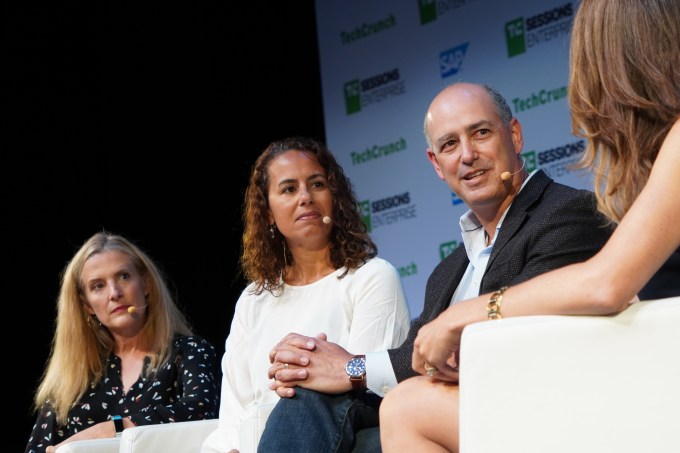
We sat down with Jason Green of Emergence Capital, Rebecca Lynn of Canvas Ventures and Maha Ibrahim of Canaan Partners, who said that startups shouldn’t expect a big M&A event right now. (Extra Crunch membership required.)

5. AppZen nabs $50M to build AI tools for expenses and other finance team work

To date, AppZen’s biggest product has been a service that automatically audits expenses — comparing, for example, an employee’s charges with the travel they’ve undertaken.

6. Pagerduty’s Jennifer Tejada and Box’s Aaron Levie will talk IPOs at TC Disrupt SF

Tejada and Levie both guided their companies to successful IPOs, with Box going public in 2015 and Pagerduty listing its stocks only a few months ago.

7. This week’s TechCrunch podcasts

Speaking of Box, the latest edition of Equity includes a discussion of why the content management company is underappreciated, while the Original Content team reviews the Amazon series “Carnival Row.”

Microsoft debuts a new version of its To Do app as Wunderlist founder expresses remorse

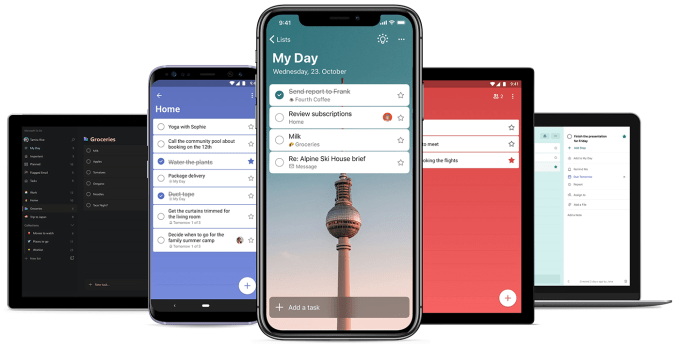
Microsoft several years ago acquired the popular iOS app Wunderlist with the intention of building out its own list-making productivity app that brings the best of Wunderlist’s feature set to a larger group of mobile consumers. This is a similar path as Microsoft took with email app Accompli, which later became Microsoft Outlook for mobile devices. In the case of Wunderlist, Microsoft didn’t just rebrand the app — it built a new one called Microsoft To Do. With Wunderlist up and running for years alongside To Do, its founder wants to know if he can just have it back.

The founder of Wunderlist maker 6Wunderkinder, Christian Reber, recently tweeted a desire to buy his app back from Microsoft just as the company is launching a new version of To Do. 

According to the tweets, Reber says he’s serious about reacquiring Wunderlist and wants to make it open-source and free. He even tweeted a list of upgrades he’d like to build, including features like shared folders and cross-team collaboration, among other things.

Still sad @Microsoft wants to shut down @Wunderlist, even though people still love and use it. I’m serious @satyanadella @marcusash, please let me buy it back. Keep the team and focus on @MicrosoftToDo, and no one will be angry for not shutting down @Wunderlist. pic.twitter.com/27mIABncLF

— Christian Reber (@christianreber) September 6, 2019

What I would do with @Wunderlist if I would get it back: pic.twitter.com/DYslu8mhOp

— Christian Reber (@christianreber) September 8, 2019

The founder doesn’t come across as having sour grapes exactly. He just says he’s sad that his plans for Wunderlist didn’t work out, but he’s grateful for the Microsoft exit.

If anything, it seems to be just remorse over the fact that Wunderlist itself will be shut down.

Want to make one thing clear: I feel nothing but gratitude for @Microsoft and everyone involved in the @Wunderlist acquisition in 2015. It made perfect sense, definitely the best thing that ever happened to us. The team there is amazing, I’m friends with many of them. 1/2

— Christian Reber (@christianreber) September 8, 2019

Microsoft had said years ago this was its intention, but also that it would hold off until it felt it has a competitive product that Wunderlist’s users would love.

On Monday, Microsoft unveiled another upgrade for Microsoft To Do, which hints that the Wunderlist shut down could be nearing.

The upgrade delivers a more polished look-and-feel with a wider range of backgrounds, including the Berlin TV tower theme that was popular in Wunderlist.

To Do 2b

The app also includes smart lists and a personalized daily planner that offers smart suggestions of tasks that need to be accomplished, Microsoft reminded its users, and it’s supported across a variety of platforms, including iOS, Android, Windows and Mac.

The app is now also integrated with other Microsoft apps like Outlook, Microsoft Planner, Cortana and Microsoft Launcher on Android, among others. And it works with Alexa, if you prefer.

With the release, Microsoft is again pushing users to migrate from Wunderlist to To Do to gain access to these features.

It did not, however, give an end-of-life date for Wunderlist, which is remarkably still a top 100 Productivity app in the U.S. App Store, according to data from App Annie, over four years after its acquisition.

We’ve asked Microsoft if it will share more details around its plans for Wunderlist and if it has any response to Reber’s request.

“Once we have incorporated the best of Wunderlist into Microsoft To Do, we will retire Wunderlist. We look forward to making Microsoft To Do even more useful, intuitive and personal,” a Microsoft spokesperson replied. The company declined to comment on Reber’s tweets.

Microsoft To Do has been installed approximately 5.8 million times worldwide since launch, according to data from Sensor Tower. During that same time frame, Wunderlist was installed about 10 million times.

As for Reber, he says he’s written to Microsoft many times before and now tried to make it more official via Twitter. The offer, he tells TechCrunch, is indeed serious, and the price would be based on the negotiation. “Chances are low, but I’m trying,” he says.

Uber commits $200 million to Uber Freight expansion in bet on trucking and Chicago

Uber Freight is establishing its headquarters in Chicago as part of Uber’s broader plan to invest more than $200 million annually in the region, including hiring hundreds of workers.

Uber said Monday it will hire 2,000 new employees in the region over the next three years; most will be dedicated to Uber Freight .

Uber Freight, which helps truck drivers connect with shipping companies, has become an important piece to Uber’s larger business strategy to generate revenue from all forms of transportation, including logistics for packages. The announcement comes on the heels of a disappointing quarter for Uber that included a stunning $5.2 billion loss.

Since launching in May 2017, Uber Freight has grown from from limited regional operations in Texas to the rest of the continental U.S. and to Europe.

Uber made Uber Freight a separate business unit in August 2018. Since then, the company has redesigned the app, adding new navigation features that make searching for and filtering loads easier to customize and more intuitive, as well as other features, including an updated map view and a search bar across the top of the screen.

It has also made some key hires, one of which intimated the company’s global ambitions. The company hired Andrew Smith, one of Box’s early employees, to head up global sales at Uber Freight, and Bar Ifrach, formerly of Airbnb, to lead its marketplace team.

With signs of some success, Uber is doubling down on the trucking business.

Uber Freight has more than 400,000 drivers in its carrier network and 1,000-plus shippers as customers, including AB Inbev, Niagara Bottling and Land O’Lakes, according to the company. Uber Freight also has more than 50,000 carriers on the platform.

“I believe this makes Uber Freight  the biggest virtual fleet in the United States,” Lior Ron, head of Uber Freight, told TechCrunch in a recent interview.

The company has been relatively quiet as it has scaled up, Ron said, noting that this announcement marks a turning point for Uber Freight.

“This is really a graduation moment for us and where we can share that because the business is doing so well we are doubling down on our investment,” he said.

The new Uber office located in The Old Main Post Office in the historic Chicago River area will serve as Uber Freight headquarters and its first engineering hub outside of San Francisco.

“Trucking represents an enormous opportunity for Uber, and this milestone is a testament to our long-term commitment to our Freight business,” Uber CEO Dara Khosrowshahi said in a statement. “Chicago is the heart of America’s transportation and logistics industry, and there is no better place to open our dedicated Freight HQ. Uber has long recognized the incredible history, innovation, and talent that Chicago has to offer, and we’re excited about the thousands of new jobs our Freight business will help bring as we become one of the city’s largest technology employers.”

As part of its new investments in the region, Uber is collaborating with the Chicago Cook Workforce Partnership (CCWP) to help with workplace diversity. Uber will start onboarding new employees in 2020 and will work with CCWP to develop a process for identifying potential candidates through their system.

Apple tweaks its App Store algorithm as antitrust investigations loom

That Apple has used its App Store to offer itself a competitive advantage is nothing new. TechCrunch and others have been reporting on this problem for years, including those times when Apple chose to display its apps in the No. 1 position on the Top Charts, for example, or when it stole some of the App Store’s best ideas for its own, banned apps that competed with iOS features or positioned its apps higher than competitors in search. Now, in the wake of antitrust investigations in the U.S. and abroad, as well as various anti-competitive lawsuits, Apple has adjusted the App Store’s algorithm so fewer of its own apps would appear at the top of the search results.

The change was reported by The New York Times on Monday, which presented Apple with a lengthy analysis of app rankings.

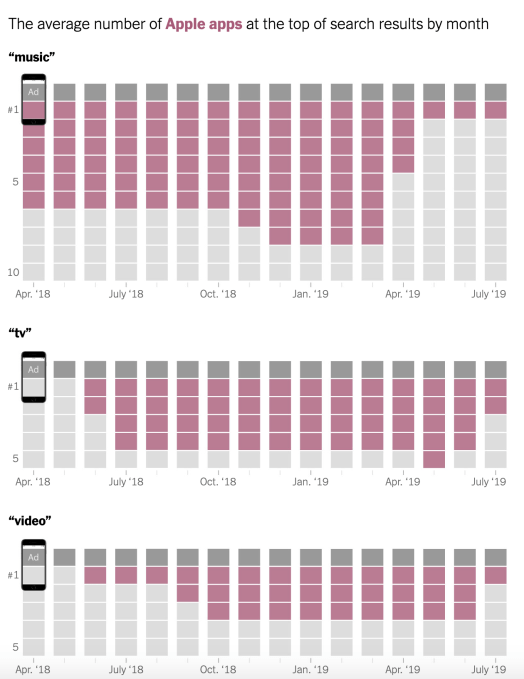
It even found that some searches for various terms would display as many as 14 Apple-owned apps before showing any results from rivals. Competitors could only rank higher if they paid for an App Store search ad, the report noted.

That’s a bad look for Apple, which has recently been trying to distance itself and its App Store from any anti-competitive accusations.

In May, for example, Apple launched a new App Store website designed to demonstrate how it welcomes competition from third-party apps. The site showed that for every Apple built-in app, there were competitors available throughout the App Store.

But availability in the store and discoverability by consumers are two different things.

Apple admitted to the NYT that for over a year many common searches on the App Store would return Apple’s own apps, even when the Apple apps were less popular or relevant at times. The company explained the algorithm wasn’t manipulated to do so. For the most part, Apple said its own apps ranked higher because they’re more popular and because they come up in search results for many common terms. The company additionally said that one feature of the app’s algorithm would sometimes group apps by their maker, which gave Apple’s own apps better rankings than expected.

Screen Shot 2019 09 09 at 11.29.20 AM

Above: via the NYT, the average number of Apple apps that returned at the top of the search results by month

Apple said it adjusted the algorithm in July to make it seem like Apple’s own apps weren’t receiving special treatment. According to the NYT, both Apple VP Philip Schiller, who oversees the App Store, and SVP Eddy Cue, who oversees many of Apple’s apps, confirmed that these changes have not fully fixed the problem.

The issue, as Apple explains it, is that its own apps are so popular that it had to tweak its algorithm to pretend they are not. Whether or not this is true can’t be independently verified, however, as Apple doesn’t allow any visibility into metrics like searches, downloads or active users.

Maybe it’s time for Apple’s apps to exit the App Store?

The report, along with the supposed ineffectiveness of the algorithm’s changes, begs the question as to whether Apple’s apps should show up in the App Store’s charts and search results at all, and if so, how.

To be fair, this is a question that’s not limited to Apple. Google today is facing the same problem. Recently, the CEO of a popular software program, Basecamp, called Google’s paid search ads a “shakedown,” arguing that the only way his otherwise No. 1 search result can rank at the top of the search results page is to buy an ad. Meanwhile, his competitors can do so — even using his brand name as the keyword to bid against.

The same holds true for the App Store, but on a smaller scale than the entirety of the web. That also makes Apple’s problem easier to solve.

For example, Apple could simply choose to offer a dedicated section for its own software downloads, and leave the App Store as the home for third-party software alone.

This sort of change could help to eliminate concerns over Apple’s anti-competitive behavior in the search results and chart rankings. Apple might balk against this solution, saying that users should have an easy way to locate and download its own apps, and the App Store is the place to do that. But the actual marketplace itself could be left to the third-party software while the larger App Store app — which today includes a variety of app-related content, including app reviews, interviews with developers, app tips and a subscription gaming service, Apple Arcade — could still be used to showcase Apple-produced software.

It could just do so outside the actual marketplace.

Here’s how this could work. If users wanted to re-install an Apple app they had deleted or download one that didn’t come pre-installed on their device, they could be directed to a special Apple software download page. Pointers to this page could be in the App Store app itself as well as in the iOS Settings.

An ideal spot for this section could even be on the existing Search page of the App Store.

With a redesign, Apple could offer a modified search screen where users could optionally check a box to return a list of apps results that would come only from Apple. This would indicate intentional behavior on the consumer’s part. That is, they are directly seeking an Apple software download — as opposed to the current situation where a user searches for “Music” and sees Apple’s own music app appear above all the others from rivals like Spotify and Pandora.

Alternately, Apple could just list its own apps on this page or offer a link to this dedicated page from the search screen.

And these are just a few variations on a single idea. There are plenty of other ways the App Store could be adjusted to be less anti-competitive, too.

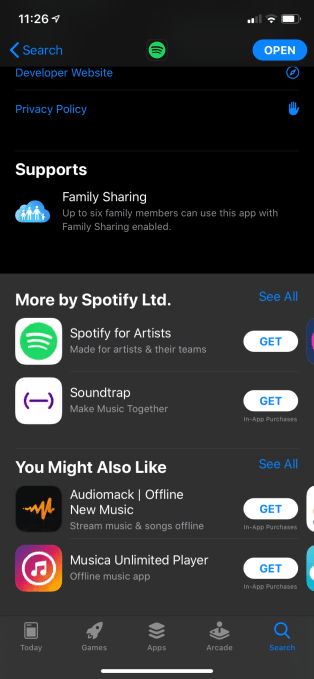
As another example, Apple could also include the “You Might Also Like” section in its own apps’ App Store listings, as it does for all third-party apps.

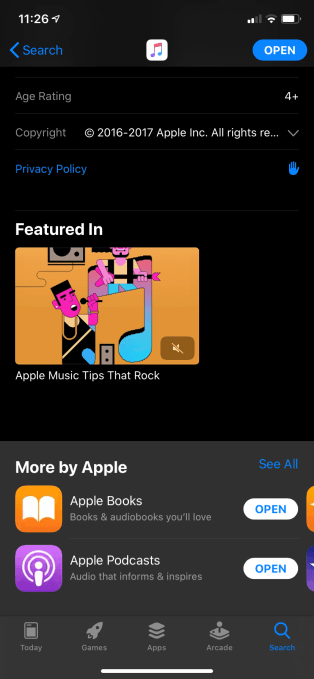
Image from iOS 1Above: Apple Music’s App Store Listing

This section directs users to other apps that match the same search query right within the app’s detail page. Apple’s own apps, however, only include a “More by Apple” section. That means it’s keeping all the search traffic and consumer interest for itself.

Image from iOS

Above: Spotify’s App Store Listing

Or it could reduce the screen space dedicated to its own apps in the search results — even if they rank higher — in order to give more attention to apps from competitors while still being able to cater to users who were truly in search of Apple’s software.

But ultimately, how Apple will have to behave with regard to its App Store may be left to the regulators to decide, given Apple’s failure to bake this sort of anti-competitive thinking into its App Store design.