Paytm’s annual loss doubles to $549M

Running a payments business in India is not cheap. Just ask Paytm . One of India’s largest payment companies reported a net loss of Rs 3959 crore ($549 million) for the financial year that ended in March, up 165% over 1490 crore ($206 million) in the same period last year.

During the same period, the company’s revenue rose to Rs 3232 crore ($448 million), compared to Rs 3052 crore ($423 million) in the year before. The firm’s debt also surged to Rs 695 crore ($96 million), One97 Communications, the parent firm of Paytm, told investors in its annual report.

One97 Communications also runs an e-commerce business, which recently raised money from eBay, and Paytm Money, that runs mutual funds business. On a consolidated basis, the 9-year-old firm reported an annual loss of Rs 4217.20 crore ($584 million), up from Rs 1604.34 crore ($222 million) from the year before.

Indian news outlet BloombergQuint first reported (paywalled) the financial performance of Paytm.

The loss should worry Paytm, whose CEO Vijay Shekhar Sharma said in a conference last week that the firm would begin to work on going public in the next 22 to 24 months. The level of competition that Paytm faces today is only about to increase in the coming future, and unlike earlier, the Indian firm is not facing off financially weaker local rivals.

Paytm, which has raised over $2 billion to date from a range of investors including SoftBank, Alibaba, and Berkshire Hathaway, continues to be the largest mobile wallet app provider in India, but increasingly users are moving to government-backed UPI payments infrastructure. In UPI land, Paytm competes with Flipkart’s PhonePe and Google Pay, both of which are heavily-backed.

As of July, both PhonePe and Google Pay commanded a bigger market share across UPI apps than Paytm.

Also in UPI land, you don’t make money on each transaction. So lately, every payments firm in India, including Paytm, has expanded it offering to include financial services such as a credit card, or loan, or insurance.

In many ways, this has created a level playing field for payment firms that did not dominate the wallet business.

In a statement, Paytm said it has been investing $1 billion per year for the last two years to “expand payments ecosystem in our country.” The company plans to invest a further $3 billion in the next two years.

“We believe India is at the inflection point of digital payments and Paytm’s sole focus is towards solving the merchant payments and offering them financial services. We will invest Rs 20,000 crore ($2.7 billion) in the next two years towards achieving this,” a company spokesperson said.

The biggest challenge for Paytm and other UPI payment apps has yet to emerge. Before the end of this year, WhatsApp, which has over 400 million users in India, plans to offer UPI payment option to all its years in the coming month.

SoftBank mints QuintoAndar a new unicorn in Latin American real estate tech

QuintoAndar, the Brazilian real estate technology developer, has secured a massive $250 million Series D led by SoftBank, as the Japanese conglomerate continues to deploy its $5 billion commitment to the Latin American region. The round is the latest sign that startups in Latin America can get money if they’re developing technologies in specific areas that are massive painpoints for the geography’s nascent middle class.

QuintoAndar invented a marketplace that lets users search, book, rent and advertise rental properties in Brazil. The site manages listings and visits, transaction processing between tenants and landlords, and houses the digital contracts that bind these agreements together. QuintoAndar also developed a credit analysis system that negates the need for co-signers, deposits and rental insurance – barriers that have historically blocked deal flow in this industry.

Co-founder and CEO Gabriel Braga says QuintoAndar has now entered unicorn territory thanks to the SoftBank-led round. Dragoneer also participated, as well as return investors General Atlantic and Kaszek (which recently announced a fresh $600 million fund of its own). 

QuintoAndar, which literally translates from Portuguese to English as “fifth floor,” is an example of a Brazilian startup solving Brazilian problems. Those seeking long-term rentals in big cities like São Paulo and Rio de Janeiro are throttled by bureaucratic policies that enforce expensive deposits, co-signer requirements and skyscraper-high insurance fees. On the supply side, amateur landlords are tunnel visioned on making money from transactions, creating a terrible customer service experience for tenants, along with wasted hours of apartment hunting. QuintoAndar is billing itself as a modernized fix that lets users search, book, rent and advertise rental properties in Brazil. 

The startup, which has grown into a 1,000 person São Paulo-based operation has now amassed a total of $345 million to date, including a $64 million Series C led by General Atlantic that closed just nine months ago. Braga declined to confirm the exact valuation of QuintoAndar, but says that it has crossed the threshold of billion dollar status. The company was founded in 2013. 

Why is this long term rentals startup accumulating so much capital? Brazilians are seeing home ownership as less of a long-term goal and are opting to rent, meaning more money in the bank and freedom to relocate. This, the founder believes, creates a big opportunity to make renting more efficient in a country where 62% of Brazilians are aged 29 or under, according to this review. Brazil’s population of 211,000,000 people has proven a hungry enough market for a startup like QuintoAndar to turn profitable, and to attract foreign investors like SoftBank. Co-founders André Penha and Braga were able to leverage these massive foreign investment checks to create a specific product to help generate liquidity for users in its home market. 

Braga says the company doesn’t measure success by volume of users or its newly minted unicorn status, but by number of property visits carried out on QuintoAndar. The company is projecting over 2 million visits scheduled through its platform in 2019, and is seeing 4,500 contracts signed per month. The CEO attributes QuintoAndar’s popularity to its ease of use, and the fact that the renting service is generating liquidity for brokers and sellers in the Brazilian long term rentals market. 

With the new funding, Braga intends to strengthen QuintoAndar’s userbase by acquiring new customers in more cities across Brazil. The company also intends to attract new talent and build out broker partnerships. In the long term, QuintoAndar envisions launching more financial products for its customers, and eventually using its suite of data to make recommendations for services like home renovations. 

QuintoAndar now joins Nubank, Loggi, Gympass and Stone in the growing club of billion dollar Brazilian tech companies, but its founder is more interested in keeping the momentum going than celebrating entrance into the Latin American unicorn club. “I’m more focused on the long term mission that we have, and not overly excited about being a unicorn. Tomorrow’s another day, we have to keep working,” says Braga. 

Troubles keep mounting for the We Company as Softbank reportedly calls for shelving the IPO

The troubles for We Company and its main business WeWork are mounting as the Financial Times is reporting that the company’s main backer, Softbank, is pushing for the company to put its troubled public offering on hold.

Citing sources familiar with the company and its main investor, the Financial Times said that the cool reception We Company has received from public market investors.

The company needs to raise at least $3 billion in the public offering to trigger a $6 billion in debt financing from the very bankers architecting its IPO. If it fails to cross that $3 billion threshold and not have access to that debt, it would be a significant roadblock to the We Company’s global expansion plans. And those plans are vital to the company’s success, since it’s the growth story that the company is selling to public market investors.

Over the weekend, the Wall Street Journal reported that the company was thinking about reducing the amount it would seek in a public offering below the $20 billion figure that had been previously reported.

The We Company had last raised money at a valuation of over $47 billion and the constant reductions in the company’s value may create a self-fulfilling prophecy that pushes the share price down even further should the company go ahead with a public offering.

The company has even taken steps to roll back some of the more egregious financial arrangements that made investors look at the company askance. It added a woman to its board of directors after much public outcry over the board composition and unwound a nearly $6 million agreement the company had made with its chief executive Adam Neumann over the licensing rights to the brand “We”.

Still, Neumann’s control over the company and the mounting losses of the core business sub-leasing long term commercial rental space to short term tenants have made public investors balky on the We Company’s longterm prospects.

Target’s personalized loyalty program launches nationwide next month

Target today announced its new data-driven loyalty program, Target Circle, will launch nationwide on October 6th, following a year and a half of beta testing in select markets. The program combines a variety of features, including 1% savings on purchases, birthday rewards and personalized offers and savings designed to make the program more attractive to consumers.

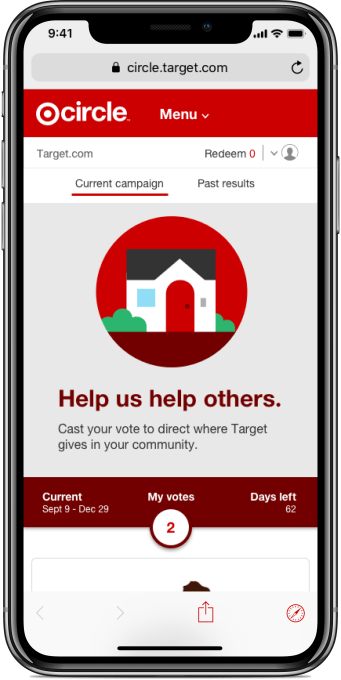
It also includes a way for customers to vote on Target’s community giving initiatives, which helps direct Target’s giving to around 800 nonprofits in the U.S.

Voting

The new program is designed to lure customers who have yet to adopt Target’s store card, REDcard. While REDcard penetration today is around 23%, that number has remained fairly consistent over time — in fact, it’s down about one percentage point from a year ago.

With Target Circle, however, the retailer has another means of generating loyalty and establishing a connection with its customers on a more individualized basis.

A big part of that is the personalized aspect of the Target Circle program. In addition to the “birthday perks” (an easy way to grab some demographic data), customers will also get special discounts on the categories they “shop most often” — meaning, Target will be tapping into its treasure trove of customer purchase history to make recommendations from both in-store and online purchases along with other signals.

“As guests shop, Target leverages information about their shopping behaviors and purchases to share relevant offers that create an even more personalized, seamless shopping experience,” a company spokesperson explained, when asked for details about the data being used. “For example, a guest who frequently shops Target for baby products may receive a special offer on their next purchase of baby items.”

TargetCircle NonBeta 19 Brand RGB Logo Red

According to a recent retail study from Avionos, 78% of consumers are more likely to purchase from retailers that better personalize their experiences and 63% are more open to sharing personal information if retailers can better anticipate needs.

And as some may recall, Target is already scary good at personalization.

In one notable case, the retailer figured out a teen girl was pregnant before her father did, and sent her coupons for baby items. The dad, understandably, was angry — until he found out that Target was right.

That story was a high-profile example of the data collection and analysis big retailers are doing all the time, though. Target Circle simply formalizes this into an opt-in program instead of an opt-out experienceAs part of the changes, Target’s Cartwheel savings are rolling into Target Circle where they’ll be rebranded as Target Circle offers. 

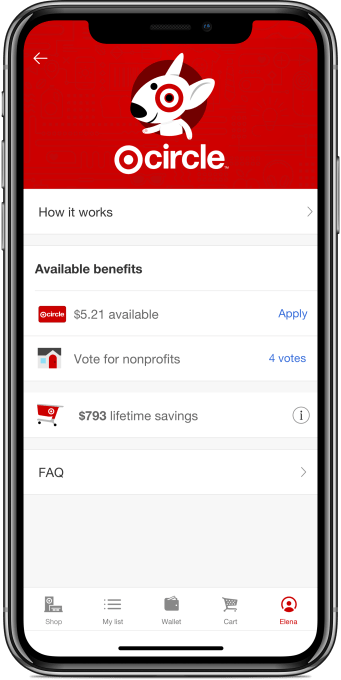
TargetCircle inApp

Circle members will also get early access to special sales throughout the year — that is, the events people line up for, like they did for the Lilly Pulitzer’s fashion line or, more recently, the quickly sold-out Vineyard Vines collection.

Target says, in time, it will come up with “even more personalized, relevant ways” to make shopping easier for its customers.

The new program is meant to complement the REDcard, which will increase the savings to 5% when used. But REDcard holders can still join Circle to take advantage of the other perks.

WalletRedeeming
“Our guests are at the center of everything we do, and we’re always looking for ways to create even easier, more rewarding shopping experiences that give them another reason to choose Target,” said Rick Gomez, Target executive vice president and chief marketing and digital officer, in a statement. “We worked directly with guests to develop Target Circle, and the program includes the benefits and perks they told us were most important to them, from earning on every trip to having the opportunity to help Target make a positive impact in their local communities,” he said.
The loyalty program had been in testing in Dallas-Ft. Worth, Charlotte, Denver, Indianapolis, Kansas City and Phoenix over the past 18 months.

Though not having Amazon’s scale, Target has done well at quickly innovating to keep up with today’s pace of e-commerce. In short order, it has made over its stores to make more room for order pickups and online grocery, and has launched and expanded new services like Target Restock (next-day), Shipt (same day delivery) and Drive Up (same day pickup). The changes have been paying off, with Target beating on its latest earnings with $18.42 billion in revenue and profits of $938 million.

FDA says Juul ‘ignored the law’ and warns it may take action

The Food and Drug Administration has put vaping giant Juul on notice with a pair of letters calling out the company for misleading statements about its products and ongoing targeting of teens. It is demanding written answers to a boatload of pertinent questions and expects Juul to respond within two weeks or risk “even more aggressive action” by regulators.

The specific claims being disputed by the FDA have to do with Juul positioning itself as a smoking cessation product. Now, it may be obvious anecdotally that vaping is a good way to wean yourself off smoking. But unlike nicotine patches and other products, there isn’t a lot of documentation on the complete risk associated with vaping — and with several people dead of vape lung, there would seem to be some worth considering.

“Companies must demonstrate with scientific evidence that their specific product does in fact pose less risk or is less harmful,” said Acting FDA Commissioner Ned Sharpless in a news release. “Juul has ignored the law, and very concerningly, has made some of these statements in school to our nation’s youth.”

Juul was reportedly directly targeting social media channels frequented by young people and, “despite commitments JUUL has made to address this epidemic, JUUL products continue to represent a significant proportion of the overall use of ENDS products by children. Some of this youth use appears to have been a direct result of JUUL’s product design and promotional activities and outreach efforts.”

In a recent congressional hearing about the risk of “electronic nicotine delivery systems,” or ENDS, evidence was presented that a Juul representative told students that the company’s products were “much safer than cigarettes,” “totally safe,” and that the “FDA was about to come out and say it was 99% safer than cigarettes… very soon.”

Representations like these were apparently made far and wide, among students certainly and also among Native American communities. They aren’t the kind of statements you can just say — tobacco cessation products are regulated, essentially medical products, and the FDA looks at them closely. Claims have to be documented and evaluated.

Juul seems to have been walking very close to the line in its public statements, and it’s likely that the company very carefully crafted these messages to convince people that its devices are good alternatives to smoking while not making any claims that would expose it to FDA attention. But they appear to have stepped over that line now and again and provoked exactly the kind of scrutiny they’d rather avoid.

“We request that you provide any and all scientific evidence and data, including consumer perception studies, if any, related to whether or not each statement and representation explicitly or implicitly conveys that JUUL products pose less risk, are less harmful, present reduced exposure, or are safer than other tobacco products,” the FDA told Juul.

Furthermore it asked Juul to explain why it uses a 5% nicotine concentration in its products, which could increase the likelihood of addiction, and why the company uses nicotine salts, a substance that reduces harshness and allows greater nicotine concentrations.

Likely independent of the ongoing investigation into lung problems seemingly caused by vaping, the FDA also requested “Aerosol particle size analysis of aerosol formed from your device,” “experimental design and data on pK studies from your device, your e-liquid, and combusted cigarettes,” comparisons between free nicotine and nicotine salt delivery, and “How the design and performance of your device and/or e-liquid, including the level, formulation, and delivery specifications of nicotine, affect lung deposition as related to the use and addictive potential of the product.”

In other words, tell us why you designed your product to be extra addictive and attractive to non-smokers, and whether this was in spite of knowing the substances created caused lung damage.

In a statement, Juul said that it was “reviewing the letters and will fully cooperate.”

Shopify buys warehouse automation tech developer 6 River Systems for $450 million

Shopify, the shopping technology developer that’s quickly becoming the anti-Amazon, has taken another step up the sales supply chain with its $450 million acquisition of the warehouse automation and management technology developer, 6 River Systems.

The acquisition will serve to boost efficiencies among Shopify’s Fulfillment Network service, which launched in June.

The acquisition gives Shopify access to the robotics experts who helped develop Amazon’s own robotics business when they were at Kiva Systems (before Amazon acquired that company).

“Shopify is taking on fulfillment the same way we’ve approached other commerce challenges, by bringing together the best technology to help everyone compete,” said Tobi Lütke, CEO of Shopify, in a statement. “With 6 River Systems, we will bring technology and operational efficiencies to companies of all sizes around the world.”

The deal, which was approved by 6 Rivers’ investors, including Menlo Ventures, Norwest Venture Partners and Eclipse Partners, was a mix of cash and stock totaling $450 million, with around $69 million worth of Shopify Class A shares set aside for 6 River Systems’ employees and founders that will vest subject to certain conditions.

Shopify said in a statement that the transaction would have no material effect on the company’s revenue in 2018. It’s expected to increase the company’s expenses by $25 million — including $10 million in operating expenses, $8 million in amortization of intangible assets, and $7 million in stock-based compensation.

Shopify estimated that 6 River Systems will have annual revenues of roughly $30 million in 2020.

Foundation Capital, now 24 years old, just closed its ninth fund with $350 million in capital commitments

Not all venture firms are long for this world. Though they tend to shut down exceedingly quietly, it sometimes happens when the returns just aren’t compelling or a firm grows too fast or there’s infighting or there’s not a solid succession plan.

Foundation Capital, founded in 1995, had its own kind of reckoning in the aftermath of the 2008 financial crisis, owing to a little bit of all of these things.

Like a lot of firms that had begun to raise ever-bigger funds with ever-bigger teams, the once-small firm closed its sixth fund with $750 million in capital commitments in 2008 before it was forced to scale back dramatically, closing its seventh fund with $282 million in 2013 with a whopping eight general partners (then parting ways with half of those individuals), closing its eighth fund with $325 million in late 2015 and doing what it could to right the ship.

It plainly pulled it off. Today, the firm is announcing that it has closed its ninth fund with $350 million in capital commitments and the smallest pool of active general partners it has had in years: Ashu Garg, who joined Foundation in 2008 after spending the previous four years at Microsoft; Charles Moldow, who joined the firm in 2005, after spending the previous five years as a senior vice president at TellMe Networks (later acquired by Microsoft); and Steve Vassallo, who joined the outfit in 2007 after spending a couple of years as a VP of product and engineering at a social network co-founded by Marc Andreessen, called Ning.

A fourth general partner with Foundation’s previous funds, Paul Holland, who joined Foundation in 2001, continues to manage out his investments.

Some notable exits were surely helpful for the trio, including the IPOs of Sunrun (2015), LendingClub (2014), TubeMogul (2014) and Chegg (2013). But we’re guessing Foundation’s newer bets intrigued limited partners even more.

Among some of the firm’s most interesting deals: the biomaterials company Bolt Threads, which is growing artificial spider silk and closed its Series D round last year; Fair, the fast-growing car subscription app that has already locked down at least $1.6 billion in equity and debt funding; and Cerebras, a next-generation silicon chip company that launched publicly last month after almost three years of quiet development, surprising many with its very large and very fast processor, which houses 1.2 trillion transistors, 18 gigabytes of on-chip memory and 400,000 processing cores across its 46,225 square millimeters.

In fact, the last was incubated at Foundation’s office, and it isn’t the only company to get its start with the help of the firm. Another example of a de novo investment is States Title, an insure-tech platform that was founded in 2016 and has gone on to raise $106.6 million, according to Crunchbase.

Starting from scratch is a “more repeatable and sustainable way of building ownership in a company,” explains Moldow. By “putting teams together with a bunch of ideas,” Foundation can “build companies from whole cloth” rather than “play the auction game where prices keep getting crazier and crazier.”

Foundation’s broader staff includes partner Joanne Chen, who joined Foundation in 2014 and focuses on enterprise and AI; partner Rodolfo Gonzalez, who joined the firm in 2013 and focuses on fintech, Latin America, and crypto; and the firm’s newest partner, Li Sun, who is helping to spearhead the firm’s frontier tech practice.

The firm tends to make between 10 and 12 new investments each year, writing checks from $6 million to $10 million typically as part of a Series A deal, though it will invest as little as a few thousand dollars in the right opportunity.

As for later-stage investments, the firm does not have an opportunity fund currently, nor does it assemble special purpose vehicles, which are basically pop-up funds that come together to make an investment in a single company. Instead, says Vassallo, it facilitates direct investments into companies for its limited partners.

We get the impression that could change at some point. Indeed, the new, smaller Foundation Capital seems very focused on trying out a lot of new things.

As Moldow says, “At one point, we had nine GPs and $750 million [in fresh capital to invest]. The evolution [to the firm’s current iteration] took a lot of work. At first it was, how do you fix this? In the last five to seven years, it has been, how do we excel at this?”

Pictured above, from left to right: Charles Moldow, Steve Vassallo and Ashu Garg.

International students face immigration hurdles under Trump

Xiao Wang
Contributor

Xiao Wang is CEO at Boundless, a technology startup that has helped thousands of immigrant families apply for marriage green cards and U.S. citizenship while providing affordable access to independent immigration attorneys.

This fall, nearly half a million international students will begin or return to STEM degree programs at U.S. colleges and universities. If you’re among them, congratulations — look forward to being wooed by talent-hungry U.S. tech firms when you graduate. But there’s bad news, too: Under current immigration rules, switching from a student visa to an employment visa can be tricky, so it’s important to understand what’s required and how the latest policy upheavals could impact your journey.

In theory, it’s a great time to be a STEM graduate. U.S. STEM jobs are expected to grow by nearly 11% — or about 10.3 million positions — between 2016 and 2026, faster than all U.S. occupations. In practice, however, it can be tough for international students to secure permanent residence in the United States. The H-1B skilled-worker visa system is badly clogged; a federal lawsuit could slam the door on many STEM graduates, and the White House is shaking up both the skilled-worker and student visa systems.

But don’t despair: There’s still a pathway to a future in the United States — you just might face a bumpy ride. Whether you’re starting your studies or preparing to graduate, it’s crucial to understand your options.

Getting an employment-based visa

An employment-based green card requires an executive-level job, a truly extraordinary résumé, or an employer willing to pony up thousands of dollars in fees and labor-certification costs. Because it’s hard to get a green card, most international STEM students aim for an H-1B visa, which lets you work for a specified U.S. employer for up to six years. It’s not a permanent solution, but it can be a useful launchpad for your career.

Even getting an H-1B isn’t easy, though. There’s a hard cap on H-1Bs: This year, there were more than 200,000 applicants vying for just 85,000 visas. Recipients are selected via lottery, and while you could land an H-1B on your first attempt, many tech workers have to try again — and again, and again — before they finally get lucky.

In the meantime, international students typically start out using the temporary work authorization through their student visa until they transfer to an H-1B. 

Let’s dig into the details of what’s allowed under your student visa: 

If you’re on an F-1 visa

GettyImages 961623304

Image via Getty Images / South_agency

The F-1 student visa is one of the main on-ramps to the U.S. tech sector for foreign-born workers. That’s largely thanks to Bush- and Obama-era changes that expanded the Optional Practical Training (OPT) program, which allows F-1 holders to work at American companies after graduating, from 12 to 36 months. 

Graduates with multiple STEM degrees (such as a bachelor’s and master’s degrees) can also chain together their OPT periods, working for up to six years in total before switching to another visa. That’s great news because each year of OPT is another chance to play the H-1B lottery, increasing your odds of winning a visa. 

To use OPT, you’ll need to get a work permit (“Employment Authorization Document,” or EAD) as you near graduation. You’ll also need to file for visa extensions in order to make the most of your OPT entitlement. 

If you’re on a J-1 visa

Similar to the F-1, the J-1 visa is designed for students involved in cultural exchange programs or who receive substantial funding from governments or institutions. 

As a J-1 student, you won’t get OPT but 18 months of Academic Training (AT). Any internships or jobs you take during your studies will count toward your AT allotment, so it’s possible to finish your degree with less than 18 months of work authorization remaining. And while a second 18-month AT period is available for postdoctoral research, there’s no automatic extension for STEM degree holders: Once your 18 months are up, you’ll need to leave the United States.

There’s another catch: Many J-1 visas come with a home residency requirement (HRR), requiring holders to return to their home country for two years before seeking a work-based or family-sponsored U.S. visa — that or apply for an HRR waiver

If you’re on an M-1 visa

The M-1 visa is used by students at technical and vocational schools, not academic programs. As student visas go, it’s very restrictive: You won’t be able to work off-campus and can’t work for more than six months. You also won’t be able to switch to an F-1 visa and won’t find it easy to transition to an H-1B. If you hope to stay in the United States long-term, think carefully about whether an M-1 is right for you.

No job lined up?

If you don’t have a job offer, there are other ways to stay in the United States after finishing your studies. One popular option is to enter a graduate program: Getting a master’s degree could extend your student visa by a year or two, while upgrading to a PhD program could get you several additional years. In fact, an advanced U.S. degree under your belt effectively doubles your chances of getting an H-1B in the same lottery. 

If you can’t find work and don’t want to keep studying, you’ll need existing family ties to a U.S. citizen or lawful permanent resident (green card holder). If you’re the direct relative of one (for example, a spouse or child), then things are relatively easier: You have a clear path toward a family-based green card, allowing you to live and work permanently in the United States. That’s true even if you’ve become a family member through marriage: You’ll be able to obtain a marriage-based green card more quickly and easily than an H-1B or other employment-based green cards.

If you’re the spouse or child of someone on a temporary visa, such as an H-1B or O-1 visa holder, you can usually obtain a dependent’s visa. Such visas often allow you to study, but you won’t qualify for OPT after graduating. It’s also getting harder for H4 visa holders to obtain work permits, so don’t count on using a dependent’s visa to launch your career in Silicon Valley. In many cases, OPT is still a better springboard to an H-1B or green card.

If the person who claims you as a dependent applies for permanent residence, you may be able to get a green card through “derivative” benefits, meaning their green card eligibility trickles down to you.  

Next step: Mark your calendar

GettyImages 1132448431

Image via Getty Images / normaals

Whatever immigration status you currently have or want to get, you’ll need to plan ahead. In some cases, you might need to start planning your next step almost as soon as you begin your studies, in order to make sure you aren’t left without a valid visa.

  • For graduate study: Update your existing student visa before the end of the 60-day grace period (for F-1 visas) or 30-day grace period (for J-1 visas) following the program completion date listed on your Student and Exchange Visitor Information System (SEVIS) record and I-20 or DS-2019 form. 
  • For F-1 OPT: Apply no sooner than 90 days before and no later than 60 days after completing your studies. If your official completion date is June 1, 2020, for instance, you can apply for OPT between March 3 and July 31 of that year.
  • For J-1 AT: Apply shortly before your program ends. Your school will facilitate your AT application and will set its own deadline to process your paperwork before the end of your studies, but your AT must begin no later than 30 days after completing your program.
  • For H-1B visas: Play the annual visa lottery held in early April. You’ll need a job offer lined up well in advance from an employer who’s willing to sponsor you. You can’t begin working until your H-1B is approved, unless you have separate work authorization through OPT, AT, or some other means.
  • For employment-based green cards: The timeline depends on your specific green card category, but you’ll generally wait months or years
  • For green cards through marriage to a U.S. citizen: You’ll typically wait 10–13 months, but you’ll be able to stay in the United States while in the meantime, even if your student visa expires.
  • For green cards through marriage to a permanent resident: You’ll typically wait 29–38 months, but you’ll need another valid visa, such as an unexpired F-1, for the first 11–15 months.
  • For family-based green cards (other than for spouses and children of U.S. citizens): You might face a lengthy wait depending on your relationship to your sponsoring relative and home country

Whatever your plans, remember that immigration rules are constantly changing — and seldom in ways that benefit new immigrants. If you can, file your visa or green card application right away to avoid nasty surprises.

Trouble coming down the line

It’s important not only to understand your current visa but also to recognize that the U.S. immigration system is in flux — and many of the planned changes spell bad news even for immigrants with advanced degrees and vitally needed skills. 

The new public charge rule, for instance, will make it harder to get a green card if you’ve used public benefits and allows the U.S. government to deny your application if they suspect you’ll fall on hard times in the future. For STEM grads with solid job offers, that might not seem like a major concern, but the new rule will apply even to those on temporary visas, including H-1Bs, who wish to extend or change their immigration status. At the least, it’s a sign of how much harder the immigration process is getting.

The Trump administration is also targeting students with a new “unlawful presence” rule that imposes tough punishments for minor violations of student visa terms. Fortunately, the rule is tied up in court, but if it goes through, it could lead to lengthy bans on future work visas if you overstay on your student visa, work in ways that aren’t authorized, or otherwise fail to play by the rules.

Such changes underscore the importance of doing your own due diligence and not simply relying on your college or employer to steer you right. Figuring out your immigration options can feel overwhelming — but as the many thousands of foreign-born STEM graduates who’ve successfully built careers in the United States can tell you, it’s well worth the effort.

Get your pressing immigration questions answered

Have a question about the complex and shifting immigration process? Boundless can help. Please send your immigration-related questions to our resident immigration expert, Anjana Prasad, at [email protected]. We will consider your question for a future column on the Boundless blog.

Volkswagen reveals its mass-market ID.3, an electric car with up to 341 miles of range

Volkswagen introduced Monday the ID.3, the first model in its new all-electric ID brand and the beginning of the automaker’s ambitious plan to sell 1 million EVs annually by 2025.

The ID.3 debut, which is ahead of the IAA International Motor Show in Frankfurt, is an important milestone for Volkswagen. The company upended its entire business strategy in the wake of the diesel emissions cheating scandal that erupted in September 2015. Now, four years later, VW is starting to show more than just concept vehicles for its newly imagined electric, connected and carbon-neutral brand.

Information about the ID.3, which was unveiled alongside a new VW logo and brand design, has trickled out for months now. Monday’s reveal finally fills in some much-needed details on the interior, battery, infotainment and driver assistance systems.

Screen Shot 2019 09 09 at 11.35.06 AM

The upshot: Everything about the ID.3, from its size and styling to its battery range and pricing, is aiming for the mass-market category.

The electric hatchback is similar in size to the VW Golf. But this is no VW Golf. The aim here, and one Volkswagen just might have achieved, was to signal the beginning of a new brand.

Numerous details in the special edition version of the ID.3, including a panorama tilting glass roof edged in black and interactive LED headlights that have “eyelids” that flutter when the driver approaches the parked vehicle, help drive the future-is-here point home.

The ID.3 will only be sold in Europe and have a starting price under €30,000 (about $33,000). North America’s first chance at an all-electric VW will be the ID Crozz, which is coming to the U.S. at the end of 2020.

ID.3 details

The four-door, five-seater hatchback is as long as a Golf, but thanks to its shorter overhangs, its wheelbase is larger than that of any other vehicle in its category, according to the company. This gives the ID.3 a roomier interior.

The company is starting with the ID.3 1ST, a special edition version that will come with a 58 kWh-battery pack with a range of up to 420 kilometers, or about 260 miles, and come with three equipment variants. The ID.3 1ST will start under €40,000 ($44,200).

Screen Shot 2019 09 09 at 11.32.00 AM

The ID.3 1ST will have fast-charging capability that will allow it (when using a DC fast charger) to add 180 miles to its battery in 30 minutes, a longer range than had previously been possible in the compact vehicle segment, VW said Monday.

Buyers of the special edition will be offered free charging for one year up to 2,000 kWh. This free-charging deal only applies to stations linked to WeCharge, which includes the Ionity network of more than 100,000 charging points throughout Europe.

Volkswagen, which owns a stake in the joint venture Ionity, aims by 2020 to install along main European routes 400 ultra-fast charging stations that use 100% renewable energy.

All 30,000 special edition ID.3 vehicles have been reserved. The first ID.3 vehicles will be delivered to customers in Germany in spring 2020.

Series production

The series production version of the ID.3 will have two additional battery options, including a 45 kWh-pack that has a range of 205 miles and a 77 kWh-pack that can travel 341 miles on a single charge, in accordance with WLTP. The WLTP, or Worldwide Harmonised Light Vehicle Test Procedure, is the European standard to measure energy consumption and emissions, and tends to be more generous than the U.S. EPA estimates.

The ID.3 will come with an advanced driver assistance system-supported multifunction camera mounted on the windshield. This camera will be able to identify road signs.

Volkswagen ID.3 Large 10139

The ADAS will include an emergency braking system, pedestrian monitoring, multi-collision brake feature, lane-keeping and lane change systems, and a parking assist that uses a rearview camera. There also will be a keyless access system featuring illuminated door handles.

A park distance control feature is designed to prevent impending collisions or to reduce the severity of collisions by triggering an emergency braking maneuver at the latest possible point.

Inside the ID.3, customers will find a 10-inch touch display. A feature called ID. Light will display an LED strip during navigation that can signal drivers to take actions, such as prompting them to brake.

VW is also offering an optional augmented reality head-up display that will project relevant information directly onto the windshield. All controls are operated using touch functions featuring touch-sensitive buttons. Only the electric windows and hazard warning lights are still operated using tactile switches, the company said.

The ID.3 comes equipped with intelligent natural voice control. Drivers or front passengers can speak to the ID.3, simply by saying “hello ID.” Visually, ID. Light signals to whom the ID.3 is currently responding.

More to come

The ID.3 along with others that will join its eventual portfolio of more than 20 full-electric models are built on VW’s flexible MEB platform.

The MEB, which was introduced in 2016, is a flexible modular system — really a matrix of common parts — for producing electric vehicles that VW says make it more efficient and cost-effective.

The first vehicles to use this MEB platform will be under the ID brand, although this platform can and will be used for electric vehicles under other VW Group brands such as Skoda and Seat. (The MEB won’t be used by VW brands Audi or Porsche, which are developing their own platform for electric vehicles.)

With its Kubernetes bet paying off, Cloud Foundry doubles down on developer experience

More than 50% of the Fortune 500 companies are now using the open-source Cloud Foundry Platform-as-a-Service project — either directly or through vendors like Pivotal — to build, test and deploy their applications. Like so many other projects, including the likes of OpenStack, Cloud Foundry went through a bit of a transition in recent years as more and more developers started looking to containers — and especially the Kubernetes project — as a platform on which to develop. Now, however, the project is ready to focus on what always differentiated it from its closed- and open-source competitors: the developer experience.

Long before Docker popularized containers for application deployment, though, Cloud Foundry had already bet on containers and written its own orchestration service, for example. With all of the momentum behind Kubernetes, though, it’s no surprise that many in the Cloud Foundry started to look at this new project to replace the existing container technology.