MoviePass will shut down on September 14th

MoviePass’ all-you-can-watch movie theater membership always seemed too good to be true. After multiple price hikes, business model changes, temporary shutdowns and raising a mountain of money less than a year ago, the company seems to be calling it quits.

MoviePass has issued an announcement letting customers know that the service will stop working as of September 14th — so, tomorrow — because “its efforts to recapitalize MoviePass™ have not been successful to date.”

For the past few months, MoviePass had existed in a weird sort of zombie state; some customers in some regions were still able to use it, but no new subscribers were being accepted. Not helping the matter any, a database with “tens of thousands” of MoviePass customer card numbers was found unsecured at the end of August.

The company says it’s exploring “all strategic and financial alternatives,” from a massive “reorganization” to a sale of the company and all of its assets. In the meantime, though, it sounds like the service is dead, effective pretty much immediately.

Story developing…

How to work with top influencers and avoid ad blockers

Julian Shapiro
Contributor

Julian Shapiro is the founder of BellCurve.com, a growth marketing agency that trains you to become a marketing professional. He also writes at Julian.com.

We’ve aggregated the world’s best growth marketers into one community. Twice a month, we ask them to share their most effective growth tactics, and we compile them into this Growth Report.

This is how you’re going stay up-to-date on growth marketing tactics — with advice you can’t get elsewhere.

Our community consists of 600 startup founders paired with VP’s of growth from later-stage companies. We have 300 YC founders plus senior marketers from companies including Medium, Docker, Invision, Intuit, Pinterest, Discord, Webflow, Lambda School, Perfect Keto, Typeform, Modern Fertility, Segment, Udemy, Puma, Cameo, and Ritual.

You can participate in our community by joining Demand Curve’s marketing webinars, Slack group, or marketing training program.

Without further ado, onto the advice.

Editor’s note: This is the first of a new series of articles on startup growth tactics in 2019 for Extra Crunch. This first article has been unlocked for all TechCrunch readers.


Don’t abandon email unsubscribers. They’re still useful.

Based on insights from Matt Sornson of Clearbit.

You’ve launched a new feature and want to tell your audience about it. You can send an email to your newsletter subscribers, but how do you reach the 20%+ who unsubscribed? Most people mistakenly consider this audience to be a lost cause.

  • Create a custom audience of all newsletter unsubscribers on Facebook.
  • Run ads announcing the new feature to that audience.
  • Now you’ve reactivated people who at one point had an interest in your product — instead of forever ignoring them.

Tips for effectively working with influencers

Based on insights from Barron Caster of Rev.

  • Create a referral system for influencers: Influencers who sign up others get a % of their sales or signups. This makes a mini-pyramid structure and turns your influencers into a salesforce. Why is this important? Some influencers don’t actually sell products, but just sign up tons of other influencers. Find these people.
  • Get everything you can out of an engagement (e.g. permission to use them as a testimonial for emails, social proof, etc.).
  • Working with influencers is a relationship-building game:
    • Actually go to conferences to meet influencers.
    • Treat influencers like royalty. Surprise them with gifts like flowers/donuts. $100 to send a gift can pay hefty dividends if they like your brand more and share that with their followers.
    • Give influencers a tangible benefit to share with their followers. They care about their followers and want to beneficially incentivize them to click on their link and buy with them.

More tips for working with influencers

Based on insights from Cezar Grigore of Tremo Books.

  • Geo rollouts: Your ROI increases when a bunch of influencers in the same category / region share your product within an interval of 2-4 weeks. It gives the impression that everyone is talking about your product.
  • Initially focus on influencers with 10-150k audiences. They’re smaller and more willing to accept bartered deals. There are enough influencers in this range willing to work in exchange for a free product. Most may not be producing results, but some work well, bringing in 50-200 customers within 24 hours. As you build up your following and reputation for your brand, it becomes much easier to work with more influential people.
  • It’s harder to cut deals with bigger influencers (100k-2M). Only about 5-10% of bigger influencers are willing to work on an affiliate basis (e.g. $10/customer).

Overcoming ad blockers that screw up your conversion data

  • Ad blockers can block FB’s tracking libraries and underreport ad conversions (even by 50%). The trick? Consider using the static IMG FB pixel — not the JavaScript one — which ad blockers don’t appear to block. — C.
  • Here’s another ad block workaround: You can extract UTM tags from the URL then save them into LocalStorage using JavaScript. Next, send that stored data plus the user’s on-site conversion behavior to a custom backend that, inherently, will circumvent ad blockers. Just be diligent about ensuring your marketing links all have UTM tags. —Neal O’Grady of Demand Curve
  • Remember that the use of ad blockers varies heavily by audience and device type. Depending on who your audience is, ad blockers can either be a huge problem or a non-problem. —Neal O’Grady of Demand Curve
    • So, for example, few people on mobile have ad blockers. Not much of a problem there.
    • However, on desktop, up to ~75% of millennial gamers and techies may have it installed.
    • In contrast, on desktop, maybe only 25% of middle-aged Americans outside of tech hub cities may have it installed.
    • These are hand-wavy numbers. Google for specifics.

This prosthetic arm combines manual control with machine learning

Prosthetic limbs are getting better every year, but the strength and precision they gain doesn’t always translate to easier or more effective use, as amputees have only a basic level of control over them. One promising avenue being investigated by Swiss researchers is having an AI take over where manual control leaves off.

To visualize the problem, imagine a person with their arm amputated above the elbow controlling a smart prosthetic limb. With sensors placed on their remaining muscles and other signals, they may fairly easily be able to lift their arm and direct it to a position where they can grab an object on a table.

But what happens next? The many muscles and tendons that would have controlled the fingers are gone, and with them the ability to sense exactly how the user wants to flex or extend their artificial digits. If all the user can do is signal a generic “grip” or “release,” that loses a huge amount of what a hand is actually good for.

Here’s where researchers from École polytechnique fédérale de Lausanne (EPFL) take over. Being limited to telling the hand to grip or release isn’t a problem if the hand knows what to do next — sort of like how our natural hands “automatically” find the best grip for an object without our needing to think about it. Robotics researchers have been working on automatic detection of grip methods for a long time, and it’s a perfect match for this situation.

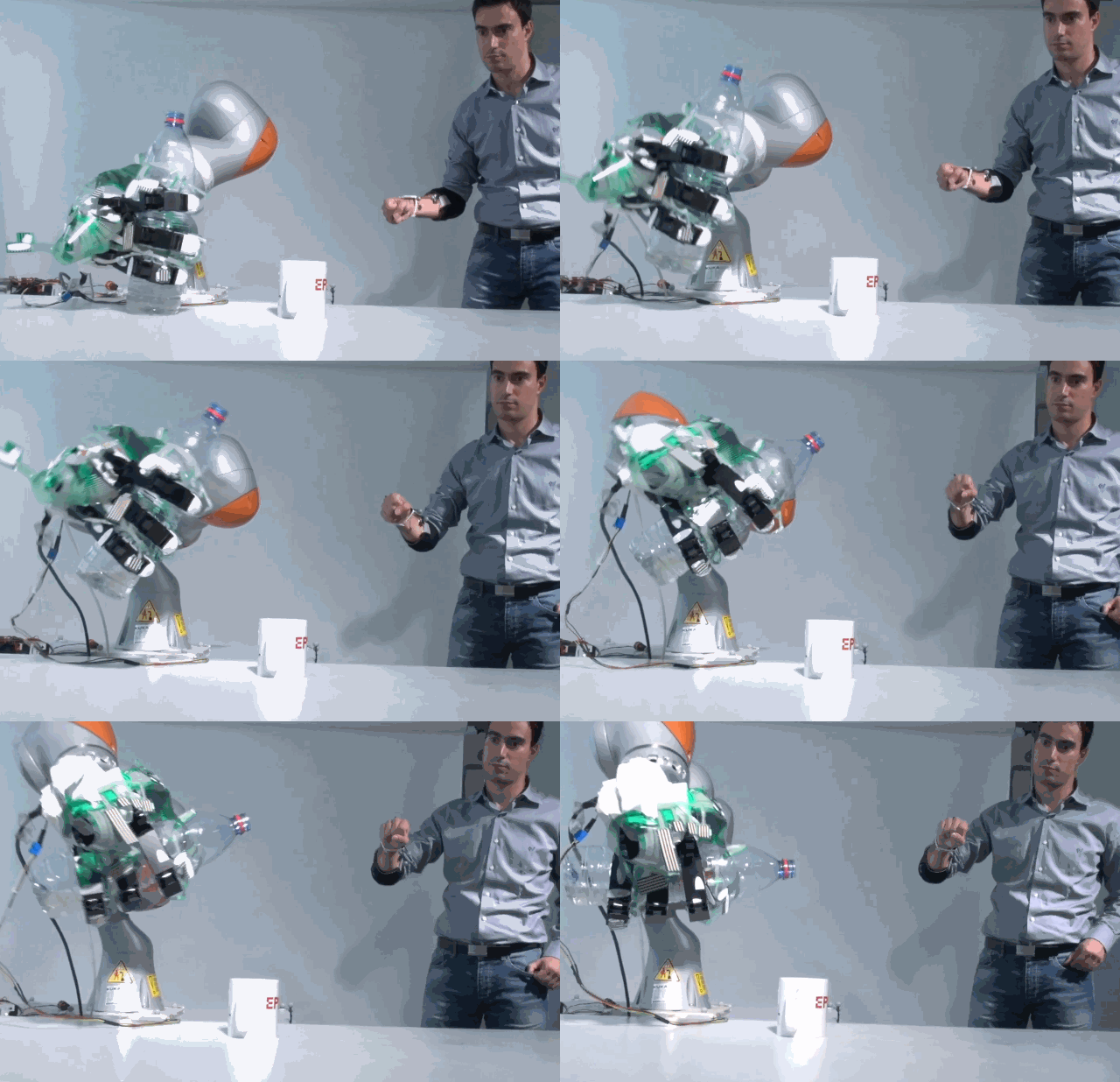
epfl roboarm

Prosthesis users train a machine learning model by having it observe their muscle signals while attempting various motions and grips as best they can without the actual hand to do it with. With that basic information the robotic hand knows what type of grasp it should be attempting, and by monitoring and maximizing the area of contact with the target object, the hand improvises the best grip for it in real time. It also provides drop resistance, being able to adjust its grip in less than half a second should it start to slip.

The result is that the object is grasped strongly but gently for as long as the user continues gripping it with, essentially, their will. When they’re done with the object, having taken a sip of coffee or moved a piece of fruit from a bowl to a plate, they “release” the object and the system senses this change in their muscles’ signals and does the same.

It’s reminiscent of another approach, by students in Microsoft’s Imagine Cup, in which the arm is equipped with a camera in the palm that gives it feedback on the object and how it ought to grip it.

It’s all still very experimental, and done with a third-party robotic arm and not particularly optimized software. But this “shared control” technique is promising and could very well be foundational to the next generation of smart prostheses. The team’s paper is published in the journal Nature Machine Intelligence.

Amazon tests a one-tap review system for product feedback

Amazon is testing an easier way for people to leave product feedback with the launch of one-tap ratings. The change is meant to encourage those who don’t have the time, energy or interest in writing reviews to still share their opinion about the product, which benefits the larger Amazon community of shoppers who are reliant on ratings and reviews to make better purchasing decisions.

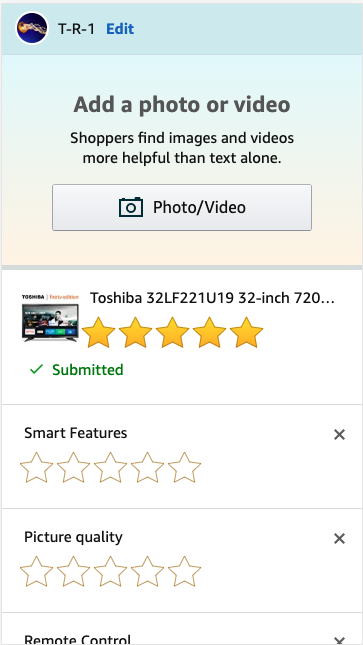
If you have access to the new experiment, you’ll be able to just tap once to leave your star rating on any item, without having to fill out additional fields like a review title and written review, as previously required.

You’ll also be able to access these one-tap ratings from a number of places, including the “Your Orders” page on Amazon where you can tap the “Write a Review” button; by going to a product page directly; or by responding to solicitations sent to you from Amazon or those that appear on the homepage when you log in.

The process of leaving a one-tap review is extremely simple — you just select the star rating and you’ll then see a green checkmark confirming the submission.

Only those one-tap ratings from Verified Purchases will contribute to the product’s overall star rating. You’re also able to expand on your feedback later on, if you choose, by adding a review, photos or video.

amazon ratings test

The new feature could go a long way toward being able to collect feedback from a larger number of online consumers, as many don’t bother with writing reviews. It also could help balance out the ratings with feedback from real shoppers, as opposed to those who may have been incentivized or paid to leave reviews.

That’s against Amazon policy, of course, and is a practice the retailer has been cracking down on for years — including by outright banning incentivized reviews, by way of multiple lawsuits, fines and through suspensions of seller accounts. But there are still services out there offering to boost a product’s Amazon reviews through less-than-official tactics. And there are products on Amazon that continue to have suspiciously positive reviews, ranging from weight loss pills to Bluetooth headphones.

Flooding those products with legit reviews from real customers could bring about a more accurate rating, even if Amazon isn’t able to fully flush the scammers from its review community.

The new ratings test is showing both online and in the mobile app worldwide. Not everyone will see the feature at this time, as some customers will be in a control group.

Amazon confirmed the new feature is an experiment, not a public launch.

“We are testing a feature that allows customers to leave feedback easily while also helping shoppers get authentic customer ratings on products from a broader set of shoppers,” an Amazon spokesperson said.

Despite tipping policy changes, DoorDash says back pay is not ‘at issue here’

When DoorDash announced changes in its tipping model last month, it was certainly a step in the right direction. Some workers, however, have said it’s not enough. In addition to wanting fair wages, they want back pay.

In light of DoorDash’s announcement, labor group Working Washington said a key question remained: “Will they pay workers backpay for the customer tips the company has been misappropriating since 2017?”

“There’s no ‘back pay’ at issue here because every cent of every tip on DoorDash has always gone and will always go to Dashers,” a DoorDash spokesperson told TechCrunch via email in response to a question about whether or not DoorDash would back pay its delivery workers.

When Instacart changed its tipping practices earlier this year, it also retroactively compensated shoppers when tips were included in the payment minimums. DoorDash, however, does not see the need for back pay.

“An independent third-party research firm has confirmed that Dashers were paid as was explained on our website and in our app: Dashers received a minimum base bay from DoorDash, plus 100% of customer tips, plus additional pay for some orders to reach the guaranteed minimum,” the spokesperson said. “A reminder that under our old model, DoorDash would boost pay if a customer left little or no tip. Although boost pay was intended to help Dashers, we recognize that it also had the unintended effect of making some customers feel like their tips didn’t matter. Under our new model, every dollar a customer tips will be an extra dollar in their Dasher’s pocket.”

Additionally, DoorDash says it will increase the amount it pays on average through base pay and bonuses. Ideally, that will increase overall earnings for Dashers.

“This commitment is incredibly important to us, which is why we’ll be working with that same independent third party to ensure that Dasher earnings under this new model increase,” the spokesperson said.

As DoorDash previously announced, the new payment policies will go into effect this month following feedback from its tests. Since the announcement, however, DoorDash has put $30 million toward a campaign committee to establish a 2020 ballot initiative that would enable companies to provide workers benefits, establish wage commitments and guarantees, offer flexibility and establish that drivers are not employees. Lyft and Uber have also each put $30 million into the initiative. Meanwhile, gig worker protections bill AB-5 passed.

AB-5 would help to ensure gig economy workers are entitled to minimum wage, workers’ compensation and other benefits by requiring employers to apply the ABC test. The bill, first introduced in December 2018, aims to codify the ruling established in Dynamex Operations West, Inc. v Superior Court of Los Angeles. In that case, the court applied the ABC test and decided Dynamex wrongfully classified its workers as independent contractors.

According to the ABC test, in order for a hiring entity to legally classify a worker as an independent contractor, it must prove the worker is free from the control and direction of the hiring entity, performs work outside the scope of the entity’s business and is regularly engaged in an “independently established trade, occupation, or business of the same nature as the work performed.”

The bill has yet to be signed into law, but Governor Gavin Newsom is expected to do so. Moving forward, we can surely expect DoorDash to continue advocating for its independent worker model. We also can expect organizers from Working Washington to keep advocating for better wages and protections.

Daily Crunch: AR startup Daqri is shutting down

The Daily Crunch is TechCrunch’s roundup of our biggest and most important stories. If you’d like to get this delivered to your inbox every day at around 9am Pacific, you can subscribe here.

1. Another high-flying, heavily funded AR headset startup is shutting down

In an email obtained by TechCrunch, Daqri — which built enterprise-grade AR headsets — told its customers that it’s pursuing an asset sale and will be shutting down its cloud and smart-glasses hardware platforms by the end of September.

Daqri is the latest heavily funded, enterprise-focused augmented reality startup to struggle or shut down recently, with Osterhout Design Group unloading its AR glasses patents earlier this year and Meta selling its assets after it ran out of cash.

2. Apple introduces a ‘grace period’ for lapsed App Store subscriptions

Previously, any lapse in payment could cut off the customer from an app’s subscription-based features. Now, Apple says developers will have the option to offer a “grace period,” giving Apple more time to collect payment.

3. SmileDirectClub makes its debut on the public market

Teeth-straightening company SmileDirectClub rang the opening bell at Nasdaq yesterday, marking its first day of trading as a public company.

4. Element AI raises $151M on a $600-700M valuation to help companies build and run AI solutions

Element AI has built an artificial intelligence systems integrator of sorts, designed to help other companies develop and implement AI solutions.

5. Walmart’s Vudu adds Family Play feature so viewers can skip sex, violence and substance abuse

Vudu viewers can turn filters on and off for sex/nudity, violence, substance abuse and language. In the first three instances, Vudu will skip the relevant scenes, and in the case of strong language, it will mute the dialog.

6. Sidewalk Labs spins out urban data-gathering tool Replica into a company

The Replica tool grew out of Model Lab, a project started two years ago to investigate modeling as a way to address urban problems — specifically the fact that public agencies don’t have all the information needed to understand the connections between transportation and land use.

7. How the Valley can get philanthropy right with former Hewlett Foundation president Paul Brest

When he was named president of the William & Flora Hewlett Foundation, Brest applied the rigor of a legal scholar, not just to his own institution’s practices, but to those of the philanthropy field at large. (Extra Crunch membership required.)

JUMP pulled its bikes from a number of markets in the last few months

Uber -owned JUMP pulled its bikes and scooters from a handful of markets over the last few months. The latest city affected is San Diego, where JUMP’s bikes and scooters will no longer be available as of September 19, with the exception of two naval bases in the city.

“We understand this may have a huge impact on your day-to-day commuting and we regret the fact that we can no longer provide this service to you,” JUMP wrote in an email to its San Diego customers.

The decision was in light of San Diego councilperson Barbara Bry calling for a moratorium on scooters in the city until it could figure out a fiscally responsible and thoughtful plan.

“We agree with local elected officials in San Diego who’ve said current micromobility regulations foster an unsustainable operating environment, which is why we’re ending our operations as of today,” an Uber spokesperson told TechCrunch. “We look forward to working with the city to develop more sensible regulations.”

Earlier this week, JUMP removed its bikes from Providence following acts of vandalism and misuse. This month, JUMP is also removing its bikes from Atlanta after operating in the city for just nine months. Its scooters, however, will remain.

“We are winding down our current JUMP e-bike operations in Atlanta,” an Uber spokesperson told TechCrunch. “We will continue to offer JUMP scooters and look forward to continuing conversations with city leaders on how we can work together to expand transportation options.”

That decision came after Atlanta halted its permitting process for dockless vehicles and implemented a nighttime curfew for them. Meanwhile, JUMP also pulled its bikes from Dallas and San Antonio, with no real explanation. In Staten Island, regulatory hurdles forced JUMP to remove its bikes. Since June, JUMP has pulled its bikes from at least six markets.

“Our goal is to make JUMP electric bikes and scooters a sustainable part of the transportation ecosystem,” an Uber spokesperson told TechCrunch. “We currently have JUMP products in over 25 cities worldwide and we make operational decisions on a case by case basis.”

It’s likely those case-by-case decisions are at least partially fueled by unit economics — looking at everything from ridership to vandalism to theft.

Meanwhile, San Francisco seems to remain a solid market for JUMP bikes. In August, JUMP hit one million rides in San Francisco since launching in January 2018 with a total fleet size of 500 bikes. Earlier this year, JUMP touted its high utilization rates in the city compared to docked bike providers. Though, that may soon change given the courts recently approved Lyft’s preliminary injunction to prevent other bike-share providers from deploying in the city.

Uber’s JUMP, of course, is not the only company facing issues with its micromobility operations. In July, Lyft had to pull its e-bikes from San Francisco following apparent battery fires. Then, in August, a Lime bike caught on fire in Seattle. On the positive side for Uber, at least there have not been any reports of its bikes or scooters catching on fire.

This is all to say micromobility is not an easy business. Between regulatory hurdles, potential vandalism and faulty batteries, there are a number of factors that can stand in the way of success.

Another high-flying, heavily funded AR headset startup is shutting down

While Apple and Microsoft strain to sell augmented reality as the next major computing platform, many of the startups aiming to beat them to the punch are crashing and burning.

Daqri, which built enterprise-grade AR headsets, has shuttered its HQ, laid off many of its employees and is selling off assets ahead of a shutdown, former employees and sources close to the company tell TechCrunch.

In an email obtained by TechCrunch, the nearly 10-year-old company told its customers that it was pursuing an asset sale and was shutting down its cloud and smart-glasses hardware platforms by the end of September.

“I think the large majority of people who worked [at Daqri] are sad to see it closing down,” a former employee told TechCrunch. “[I] wish the end result was different.”

image

The company’s 18,000+ square foot Los Angeles headquarters (above) is currently listed as “available” by real estate firm Newmark Knight Frank. The company’s Sunnyvale offices appear to have been shuttered sometime prior to 2019.

Daqri’s shutdown is only the latest among heavily funded augmented reality startups seeking to court enterprise customers.

Earlier this year, Osterhout Design Group unloaded its AR glasses patents after acquisition talks with Magic Leap, Facebook and others stalled. Meta, an AR headset startup that raised $73 million from VCs including Tencent, also sold its assets earlier this year after the company ran out of cash.

Daqri faced substantial challenges from competing headset makers, including Magic Leap and Microsoft, who were backed by more expansive war chests and institutional partnerships. While the headset company struggled to compete for enterprise customers, Daqri benefitted from investor excitement surrounding the broader space. That is, until the investment climate for AR startups cooled.

Daqri was, at one point, speaking with a large private-equity firm about financing ahead of a potential IPO, but as the technical realities facing other AR companies came to light, the firm backed out and the deal crumbled, we are told.

As of mid-2017, a Wall Street Journal report detailed that Daqri had raised $275 million in funding. You won’t find many details on the sources of that funding, other than references to Tarsadia Investments, a private-equity firm in Los Angeles that took part in the company’s sole disclosed funding round. We’re told Tarsadia had taken controlling ownership of the firm after subsequent investments.

In early 2016, Daqri acquired Two Trees Photonics, a small UK startup that was building holographic display technologies for automotive customers. The UK division soon comprised a substantial portion of the entire company’s revenues, sources tell us. By early 2018, the division was spun out from Daqri as a separate company called Envisics, leaving the Daqri team to focus wholly on bringing augmented reality to enterprise customers.

The remaining head-worn AR division failed to gain momentum after prolonged setbacks in adoption of its AR smart glasses, including difficulties in training workers to use the futuristic hardware, a source told TechCrunch.

All the while, the company’s leadership put on a brave face as the startup sputtered. In an interview this year with Cornell Enterprise Magazine, Daqri CEO Roy Ashok told the publication that the startup was forecasting shipments of “tens of thousands” of pairs of its AR glasses in 2020.

Daqri, its founder and several executives did not respond to requests for comment.

Scientists propose ‘Spaceline’ elevator to the Moon

Fans of sci-fi and fringe tech may already be familiar with the idea of the “space elevator,” which is pretty much exactly what it sounds like — and totally impossible with today’s technology. But a pair of scientists think they’ve found an alternative: a Moon elevator. And it’s slightly less insane… technically.

The idea of the space elevator, first explored in detail by Arthur C. Clarke in his novel “The Fountains of Paradise,” is essentially a tower so tall it reaches space. Instead of launching ships and materials from the surface of the Earth to orbit, you just put them in the elevator of this tower and when they reach the top, somewhere about 26,000 miles up in geosynchronous orbit, they’re already beyond gravity’s pull, for all intents and purposes.

It’s a fun idea, but the simple fact is that this tower would need to be so strong to support its own weight, and that of the counterweight at the far end, that no known material or even reasonably hypothetical one will do it. Not by a long shot. So the space elevator has remained well on the “fiction” side of science fiction since its first proposal. Hasn’t stopped people from patenting it, though.

But what if I told you that we could make a space elevator even bigger, with materials available today? You’d say I am completely unqualified to engineer such a structure — and you’d be right. But two astronomers from Cambridge and Columbia Universities think they’ve got an alternative. They call it the Spaceline.

The secret is in abandoning the entire concept of anchoring the space elevator to the surface of the Earth. Instead they propose a tower or cable extending the other direction: From the surface of the Moon to geosynchronous orbit around the planet.

Unsurprisingly, this idea has been put out there before, as early as the ’70s. But as Zephyr Penoyre and Emily Sandford put it in their paper:

We present the derivations herein as a full standalone mathematical and physical description of the concept, one that we and authors before us have been surprised to find is eminently plausible and may have been overlooked as a major step in the development of our capacity as a species to move within our solar system.

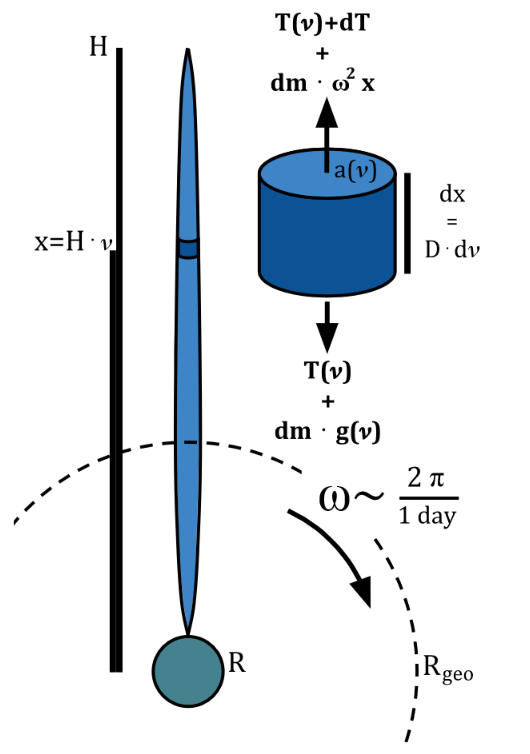
diagram

Math by Cambridge and Columbia. Diagram by MS Paint.

In other words, others have suggested it before, but they did the math. And it actually works out. And it might only cost a few billion dollars.

The Spaceline would be more like a skyhook than a tower. A thin, strong piece of material (think the width of a pencil lead) that extends about 225,000 miles from the surface of the Moon to a safe distance above the planet, where it won’t interfere with satellites or encounter our pesky atmosphere.

Anyone interested in going to the Moon would simply launch to the correct orbit height and sync up with the tip of the Spaceline, where there would no doubt be a station of some kind. From there they could use solar-powered propulsion to zip along the line, no fuel required. At the other end, they simply slow down and have a soft landing at lunar orbit or whatever surface facility we put on the regolith there.

Importantly, the Spaceline would pass through the Earth-Moon Lagrange point, where there is effectively zero gravity and no other physical interference, making construction and storage a snap.

Having only a small team of scientists and engineers at such a base camp would allow hand construction and maintenance of a new generation of space based experiments – one could imagine telescopes, particle accelerators, gravitational wave detectors, vivariums, power generation and launch points for missions to the rest of the solar system.

Sounds nicer than the tiny Lunar Gateway NASA has planned.

While the researchers say this is “not idle theorycrafting,” it most certainly is, with the caveat that the theory is more realistic than a famously unrealistic one no one takes seriously. Still, the possibility is tantalizing now that someone has crunched the numbers. Perhaps one of these space-bound billionaires will make a Moon elevator their next passion project.

With the 2020 Cadillac CT4, GM begins to expand its hands-free Super Cruise driving system

GM’s high-end brand unveiled Thursday the 2020 Cadillac CT4, a sporty and small sedan that is designed and priced to attract younger buyers looking to enter the luxury car market.

The vehicle’s debut also marks an important expansion for GM’s hands-free driver assistance system, Super Cruise. The hands-free driving system has been lauded for its capabilities; it’s also been criticized because of its severe limitations. Today, Super Cruise is available in just one Cadillac model, the full-size CT6 sedan. And even in the CT6, the system is restricted to certain highways.

Super Cruise uses a combination of lidar map data, high-precision GPS, cameras and radar sensors, as well as a driver attention system, which monitors the person behind the wheel to ensure they’re paying attention. Unlike Tesla’s Autopilot driver assistance system, users of Super Cruise do not need to have their hands on the wheel. However, their eyes must remain directed straight ahead.

GM is finally starting to expand where the system can be used and bringing it to more models. Earlier this year, the company said it will add another 70,000 miles of compatible divided highways in the United States and Canada to the existing system via a software update. By the end of the year, Super Cruise will be available on more than 200,000 miles of highways.

The automaker plans to bring Super Cruise to other GM brands, such as Chevrolet, GMC and Buick, after 2020.

The expansion follows other improvements rolled out in 2018, including adding a dynamic lane offset so that a CT6 with Super Cruise activated can adjust slightly over in its lane for driver comfort when passing large vehicles. Gauge cluster messages were also added, to inform drivers why Super Cruise may not be available in certain instances.

Super Cruise isn’t the only feature of note in the 2020 Cadillac CT4 model. Cadillac is offering the CT4 in a few trim levels, all of which will have turbo engines. The standard version will have an eight-speed transmission and a 2.0 turbo-4 engine that generates 237 horsepower and 258 pound-feet of torque.

The CT4-V, the premium luxury version of the CT4, will have a 2.7-liter turbo-4 engine with a 10-speed automatic transmission.

The CT4 will come with unique grilles and bright exterior accents to distinguish the CT4 luxury and premium luxury models. The Sport and V-Series models are differentiated by darker accents and “performance-inspired” details, including unique grilles, fascias, rocker extensions, rear spoiler and exclusive performance design wheels, Cadillac said.

Every version of the CT4 will have LED exterior lighting, including headlamps, tail lamps and signature vertical lights at all four corners.

Cadillac 2020 CT4 Sport 023

The interior of the 2020 Cadillac CT4.

Inside the car, drivers will find an eight-inch touchscreen that is mounted prominently in the center of the instrument panel. GM’s new digital platform, which can handle over-the-air software updates, is integrated into the CT4, as well.

“We developed CT4 to appeal to youthful buyers in the luxury market who may be new to the Cadillac brand,” said Andrew Smith, executive director of global Cadillac design. “The vehicle was intended to draw attention, using a combination of great proportions, taught surfacing and Cadillac family details that hint at the athletic driving experience this vehicle offers.”

The youngest new partner at the venture firm Felicis Ventures, Niki Pezeshki, on how he wins deals

Felicis Ventures has, in its roughly 13 years of existence, established a reputation in venture circles as a smart early-stage investment firm that’s willing to make bets almost anywhere in the world. Founded by ex-Googler Aydin Senkut, the San Francisco-based firm has also demonstrated a knack for attracting talented investors into the fold, including another former Google executive, Wesley Chan; Sundeep Peechu, who held various product roles at Intel before joining the firm in 2010; and Renata Quintini, an investor who Felicis eventually lost to Lux Capital (which more recently lost her to her own firm, Renegade Partners, which is reportedly raising a $300 million debut fund).

We talked this morning with yet another member of Felicis, Niki Pezeshki, who, following several promotions, has just became the youngest partner in the firm’s history. For aspiring VCs out there, we wondered how Pezeshki landed the role — and how he’s managing to win deals. Following is part of that conversation, edited lightly for length.

TC: Everyone wants to work in VC. How did you land this gig?

NP: Out of undergrad [at the University of Southern California], I went to work for [private equity firm] Vista Equity Partners.They hire, like, four people out of undergrad every year at USC. I was in Austin [where the firm is based] for three years. It was amazing. I didn’t know what I was getting into at the time — Vista has blossomed into this incredible fund — but it grounded me in the fundamentals of business and what is a good software investment. I think it made me more numbers-focused than a lot of other venture capitalists. I may get flamed for saying this, but I come to the world of venture with a much more numbers-driven and formulaic approach to understanding business that I think helps me pick good investments.

TC: How did you wind up in the Bay Area?

NP: My family is from LA so I came to California to work for Climate Corp. for a year; I worked in sales strategy and operations. I wanted a bit of operating experience. But I love investing so much; I wanted to go back to it. So I got a job with [PE firm] Summit Partners, where you’re doing hardcore outbound sourcing and learning how to reach out to people and get conversations started and figuring out [who you should be learning more about] out of hundreds of founders.

While there, Felicis randomly reached out to me through a friend of a friend, who said, ‘You should meet Sundeep,’ and they told Sundeep, ‘Sundeep, you should meet Niki,’ and though I hadn’t thought about venture, a lot of what they were doing really resonated with me. In many ways, I’m doing what I was doing at Summit, but with a much wider aperture.

TC: You were just promoted to partner from principal, up from senior associate, where you started in 2016. What does that mean on a practical level?

NP: A lot of the role won’t be much different than in the past year. I think from an external-facing perspective, it gives me more credibility with founders and investors. It’s one more thing that I can use to win great deals.

TC: What’s one competitive deal that you’ve won already?

NP: Modus in Seattle. It’s a [tech-driven] escrow startup that is to the title and brokerage industry what Compass is to real estate. I led the Series A deal for that company and I’m on the board and I got lot of credibility internally for that. I think they were thinking of promoting me next year or the year after, but they were like, ‘Dang, Niki just led a competitive Series A round. Let’s give him ammunition.’ [Laughs.]

TC: How did the deal come together, and what do you think won them over?

NP: I think three things: bonding with the founders, conviction about their company and speed. I’d heard that they were going to be in town for two weeks, fundraising, and I knew their goal was to leave the area with a term sheet. A lot of firms are fairly bureaucratic and it’s hard for them to spin up their team and do due diligence that quickly, but Felicis has a small team and I had conviction about the space already, so when they came through, I told them how excited I was to do something on their timeline.

We also bonded over [an up-and-coming] DJ. It’s also about creating that human connection with founders. I have a bunch of friends who are founders who say it often feels very transactional, their relationship with investors. You want to support these people.

TC: You don’t have tons of operating experience. You aren’t alone in this, but plenty of VCs will argue that to founders that it’s crucial. How do you counter this?

NP: Some founders do want more operational expertise, others don’t care that much unless the VC once ran a multibillion-dollar company. If you’re Martin Casado [of Andreessen Horowitz] and someone really loves Nicira, I’m probably not going to win against him.

But I’m relatively young compared with other partners, and I’m really passionate, and I think that comes across in the fundraising process. I think founders know that I will take a call any time, and help them build an amazing model for their business, and really help them prep for their next fundraising process, and help them with any VP recruits.

I’m still building my track record, so founders know that I care and that my incentives are aligned with theirs. If a founding team is successful, I’ll be successful versus someone who is already sitting on 15 boards and will show up once a quarter and try to own the room and who is less invested in whether or not the company does well because [that investor] has already been successful. I want every single portfolio company to do incredibly well. I want that to come across. And I think it does.

The MIT Media Lab controversy and getting back to ‘radical courage’, with Media Lab student Arwa Mboya

People win prestigious prizes in tech all the time, but there is something different about The Bold Prize. Unless you’ve been living under a literal or proverbial rock, you’ve probably heard something about the late Jeffrey Epstein, a notorious child molester and human trafficker who also happened to be a billionaire philanthropist and managed to become a ubiquitous figure in certain elite science and tech circles.

And if you’re involved in tech, the rock you’ve been living under would have had to be fully insulated from the internet to avoid reading about Epstein’s connections with MIT’s Media Lab, a leading destination for the world’s most brilliant technological minds, also known as “the future factory.” 

This past week, conversations around the Media Lab were hotter than the fuel rods at Fukushima, as The New Yorker’s Ronan Farrow, perhaps the most feared and famous investigative journalist in America today, blasted out what for some were new revelations that Bill Gates, among others, had given millions of dollars to the Media Lab at Jeffrey (no fucking relation, thank you very much!) Epstein’s behest. Hours after Farrow’s piece was published, Joi Ito, the legendary but now embattled Media Lab director, resigned.

But well before before Farrow weighed in or Ito stepped away, students, faculty, and other leaders at MIT and far beyond were already on full alert about this story, thanks in large part to Arwa Michelle Mboya, a graduate student at the Media Lab, from Kenya by way of college at Yale, where she studied economics and filmmaking and learned to create virtual reality. Mboya, 25, was among the first public voices (arguably the very first) to forcefully and thoughtfully call on Ito to step down from his position.

Imagine: you’re heading into the second year of your first graduate degree, and you find yourself taking on a man who, when Barack Obama took over Wired magazine for an issue as guest editor, was one of just a couple of people the then sitting President of the United States asked to personally interview. And imagine that man was the director of your graduate program, and the reason you decided to study in it in the first place.

Imagine the pressure involved, the courage required. And imagine, soon thereafter, being completely vindicated and celebrated for your actions. 

000f0341 828e 4453 882d 26986fe42a9e

Arwa Mboya. Image via MIT Media Lab

That is precisely the journey that Arwa Mboya has been on these past few weeks, including when human rights technologist Sabrina Hersi Issa decided to crowd-fund the Bold Prize to honor Mboya’s courage, which has now brought in over $10,000 to support her ongoing work (full disclosure: I am among the over 120 contributors to the prize).

Mboya’s advocacy was never about Joi Ito personally. If you get to know her through the interview below, in fact, you’ll see she doesn’t wish him ill.

As she wrote in MIT’s The Tech nine days before Farrow’s essay and ten before Ito’s resignation, “This is not an MIT issue, and this is not a Joi Ito issue. This is an international issue where a global network of powerful individuals have used their influence to secure their privilege at the expense of women’s bodies and lives. The MIT Media Lab was nicknamed “The Future Factory” on CBS’s 60 Minutes. We are supposed to reflect the future, not just of technology but of society. When I call for Ito’s resignation, I’m fighting for the future of women.”

From the moment I read it, I thought this was a beautiful and truly bold statement by a student leader who is an inspiring example of the extraordinary caliber of student that the Media Lab draws.

But in getting to know her a bit since reading it, I’ve learned that her message is also about even more. It’s about the fact that the women and men who called for a new direction in light of Jeffrey Epstein’s abuses and other leaders’ complicity did so in pursuit of their own inspiring dreams for a better world.

Arwa, as you’ll see below, spoke out at MIT because of her passion to use tech to inspire radical imagination among potentially millions of African youth. As she discusses both the Media Lab and her broader vision, I believe she’s already beginning to provide that inspiration. 

Greg Epstein: You have had a few of the most dramatic weeks of any student I’ve met in 15 years as a chaplain at two universities. How are you doing right now?

Arwa Mboya: I’m actually pretty good. I’m not saying that for the sake of saying. I have a great support network. I’m in a lab where everyone is amazing. I’m very tired, I’ll say that. I’ve been traveling a lot and dealing with this while still trying to focus on writing a thesis. If anything, it’s more like overwhelmed and exhausted as opposed to not doing well in and of itself.

Epstein: Looking at your writing — you’ve got a great Medium blog that you started long before MIT and maintained while you’ve been here — it struck me that in speaking your mind and heart about this Media Lab issue, you’ve done exactly what you set out to do when you came here. You set out to be brave, to live life, as the Helen Keller quote on your website says, as either a great adventure or nothing. 

Also, when you came to the Media Lab, you were the best-case scenario for anyone who works on publicizing this place. You spoke and wrote about the Lab as your absolute dream. When you were in Africa, or Australia, or at Yale, how did you come to see this as the best place in the world for you to express the creative and civic dreams that you had?

Mboya: That’s a good question — what drew me here? The Media Lab is amazing. I read Whiplash, which is Joi Ito’s book about the nine principles of the Media Lab, and it really resonated with me. It was a place for misfits. It was a place for people who are curious and who just want to explore and experiment and mix different fields, which is exactly what I’ve been doing before.

From high school, I was very narrow in my focus; at Yale I did Econ and film, so that had a little more edge. After I graduated I insisted on not taking a more conventional path many students from Yale take, so [I] moved back to Kenya and worked on many different projects, got into adventure sports, got into travel more.

Epstein: Your website is full of pictures of you flipping over, skydiving, gymnastics — things that require both strength and courage. 

Mboya: I’d always been an athlete, loved the outdoors.

I remember being in Vietnam; I’d never done a backflip. I was like, “Okay, I’m going to learn how to do this.” But it’s really scary jumping backwards; the fear. Is, you can’t see where you’re going. I remember telling myself, ” Okay, just jump over the fear. Just shut it off and do it. Your body will follow.” I did and I was like, “Oh, that was easy.” It’s not complicated. Most people could do it if they just said, “Okay, I’ll jump.”

It really stuck with me. A lot of decisions I’ve [since] made, that I’m scared of, I think, “Okay, just jump, and your body will follow.” The Media Lab was like that as well.

I really wanted to go there, I just didn’t think there was a place for me. It was like, I’m not techie enough, I’m not anything enough. Applying was, ’just jump,’ you never know what will happen.

image 4

Image from Arwa Mboya

Epstein: Back when you were applying, you wrote about experiencing what applicants to elite schools often call “imposter syndrome.” This is where I want to be, but will they want me?

Mboya: Exactly.