Tinder’s interactive series ‘Swipe Night’ could bring a needed boost to user engagement

On Sundays in October, Tinder is launching in its dating app an “interactive adventure” called “Swipe Night” that will present a narrative where users make a series of choices in order to proceed. This sort of choose-your-own-adventure format has been more recently popularized by Netflix and others as a new way to engage with digital media. In Tinder’s case, its larger goal may not be a dramatic entry into scripted, streaming video, as has been reported, but rather a creative way to juice some lagging user engagement metrics.

For example, based on analysis of Android data in the U.S. from SimilarWeb, Tinder’s sessions per user, meaning the number of times the average user opens the app per day, have declined. From the period of January – August 2018 to the same period in 2019 (January – August 2019), sessions declined 10.8%, from 4.5 to 4.1.

The open rate, meaning the percentage of the Tinder install base that opens the app on a daily basis, also declined 5.9% during this time, going from 28% to 22.1%.

These sort of metrics are hidden behind what would otherwise appear to be steady growth. Tinder’s daily active users, for example, grew 3.1% year-over-year, from 1.114 million to 1.149 million. And its install penetration on Android devices grew by 1%, the firm found (see below).
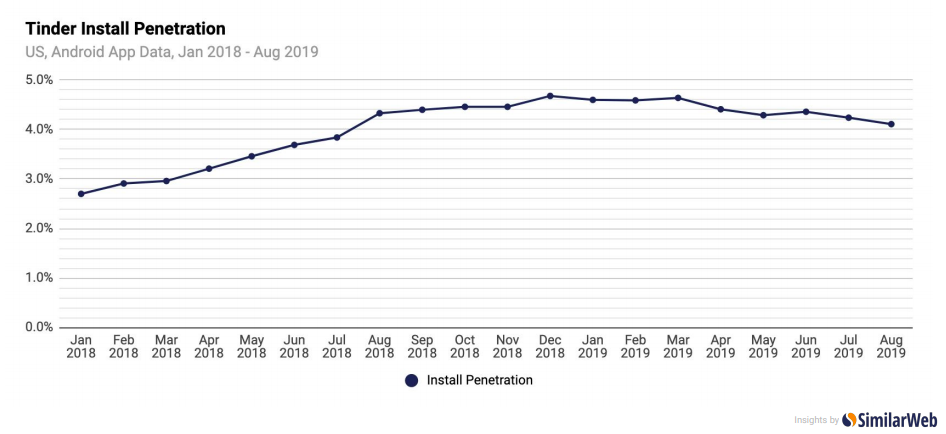
Tinder Install Penetration

Drops in user engagement are worth tracking, given the potential revenue impact.

App store intelligence firm Sensor Tower found Tinder experienced its first-ever quarter-over-quarter decline in combined revenue from both the App Store and Google Play in Q2 2019.

Spending was down 8.8%, from $260 million in Q1 to $237 million in Q2, the firm says. This was largely before Tinder shifted in-app spending out of Google Play, which was in late Q2 to early Q3. Tinder revenue was still solidly up 46% year-over-year, the company itself reported in Q2, due to things like pricing changes, product optimizations, better “Tinder Gold” merchandising and more.

There are many reasons as to why users could be less engaged with Tinder’s app. Maybe they’re just not having as much fun — something “Swipe Night” could help to address. Sensor Tower also noted that negative sentiment in Tinder’s user ratings on the U.S. App Store was at 79% last quarter, up from 68% in Q2 2018. That’s a number you don’t want to see climbing.

Of course, all these figures are estimates from third-parties, not directly reported — so take them with the proverbial grain of salt. But they help paint a picture as to why Tinder may want to try some weird, experimental “mini-series”-styled event like this.

It wouldn’t be the first gimmick that Tinder used to boost engagement, either. It also recently launched engagement boosters like Spring Break mode and Festival mode, for example. But this would be the most expensive to produce and far more demanding, from a technical standpoint.Swipe Night IntroIn “Swipe Night,” Tinder users will participate by launching the app on Sundays in October, anytime from 6 PM to midnight. The five-minute story will follow a group of friends in an “apocalyptic adventure,” where users will face both moral dilemmas and practical choices.
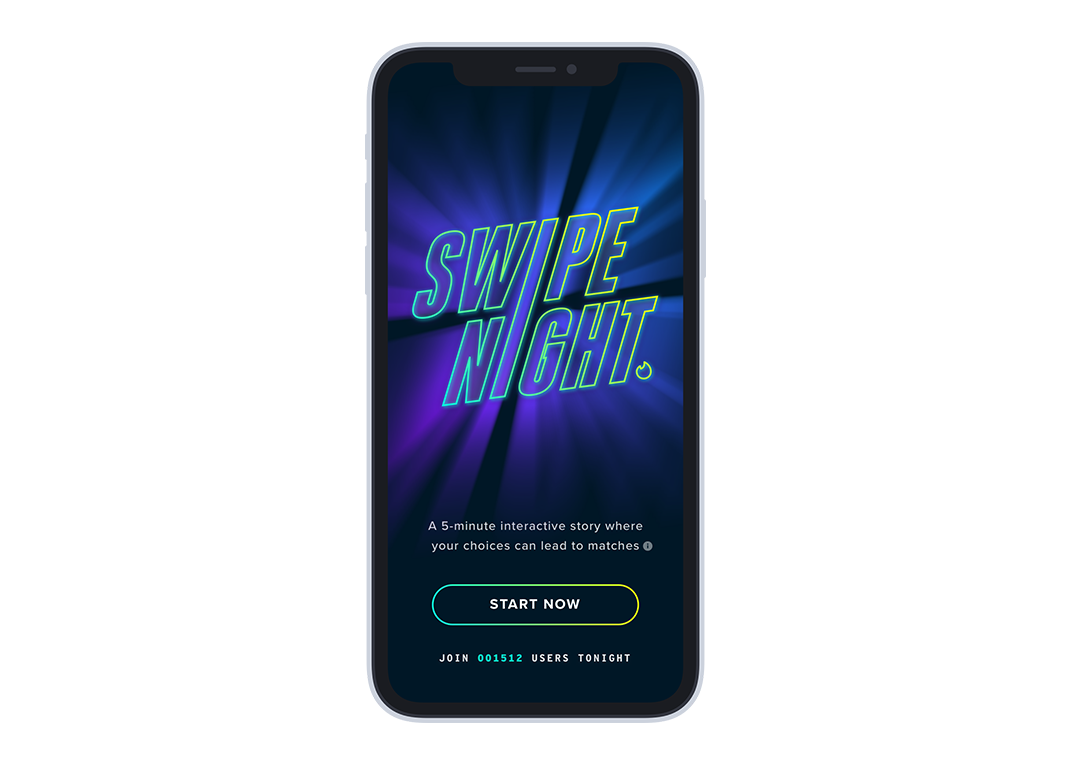
You’ll have seven seconds to make a decision and proceed with the narrative, Tinder says. These decisions will then be added to your user profile, so people can see what decisions others made at those same points. You’ll make your choice using the swipe mechanism, hence the series’ name.

Every Sunday, a new part of the series will arrive. Tinder shot more than two hours’ worth of video for the effort, but you’ll only see the portions relevant to your own choices.

The series stars Angela Wong Carbone (“Chinatown Horror Story”), Jordan Christian Hearn (“Inherent Vice”) and Shea Gabor, and was directed by Karena Evans, a music director used by Drake. Writers include Nicole Delaney (Netflix’s “Big Mouth”) and Brandon Zuck (HBO’s “Insecure”).Swipe Night ChoiceTinder touts the event as a new way to match users and encourage conversations.

“More than half of Tinder members are Gen Z, and we want to meet the needs of our ever-evolving community. We know Gen Z speaks in content, so we intentionally built an experience that is native to how they interact,” said Ravi Mehta, Tinder’s chief product officer. “Dating is all about connection and conversation, and Swipe Night felt like a way to take that to the next level. Our hope is that it will encourage new, organic conversations based on a shared content experience,” he said.

How someone chooses to play through a game doesn’t necessarily translate into some sort of criteria as to whether they’d be a good match, however. Which is why it’s concerning that Tinder plans to feed this data to its algorithm, according to Variety.

At best, a series like this could give you something to talk about — but it’s probably not as much fun as chatting about a shared interest in a popular TV show or movie.

Variety also said the company is considering whether to air the series on another streaming platform in the future.

Tinder declined to say if it plans to launch more of these experiences over time.

Despite the user engagement drop, which crazy stunts like “Swipe Night” could quickly — if temporarily — correct, the dating app doesn’t have much to worry about at this time. Tinder still accounts for the majority of spending (59%) in the top 10 dating apps globally as of last quarter, Sensor Tower noted. This has not changed significantly from Q2 2018, when Tinder accounted for 60% of spending in the top 10 dating apps, it said.

Ten questions for 2020 presidential candidate Tom Steyer

In November 2020, America will go to the polls to vote in perhaps the most consequential election in a generation. The winner will lead the country amid great social, economic and ecological unrest. The 2020 election will be a referendum on both the current White House and the direction of the country at large.

Nearly 20 years into the young century, technology has become a pervasive element in all of our lives, and will continue to only grow more important. Whoever takes the oath of office in January 2021 will have to answer some difficult questions, ranging from an impending climate disaster to concerns about job loss at the hands of robotics and automation.

Many of these questions are overlooked in day to day coverage of candidates and during debates. To better address the issues, TechCrunch staff has compiled a 10-part questionnaire across a wide range of tech-centric topics. The questions have been sent to national candidates, regardless of party. We will be publishing the answers as we receive them. Candidates are not required to answer all 10 in order for us to publish, but we will be noting which answers have been left blank.

Previously: John Delaney

This time out, we’re speaking to Tom Steyer. The California-based billionaire hedge fund manager spent time at Morgan Stanley and Goldman Sachs before founding and heading up Farallon Capital Management. The investment firm managed $21 billion in investments with Steyer at the helm. In recent years, he has become an outspoken opponent of climate change, giving a speech at the 2012 Democratic National Convention. In 2017, he rose to national political prominence starring in a self-funded $10 million TV ad campaign calling for the Donald Trump’s impeachment.

1. Which initiatives will you prioritize to limit humankind’s impact on climate and avoid potential climate catastrophe?

Climate change is a crisis as big and urgent as any other that this country and our planet has faced. It demands our immediate attention on all levels of government and society. Our country needs a strong president who will make this a top priority. On my first day in office, I will declare the climate crisis a national emergency and use the emergency powers of the presidency to implement a plan to build a safer, more sustainable world, with or without Congress. This is truly a global crisis, and it is long past time for the United States to take the lead in solving it. I have been on the ground working with local groups to take on polluters and save the planet. One campaign I successfully led was the No on Prop 23: a coalition that defeated a ballot initiative sponsored by out of state oil interests that would have rolled back California’s nation-leading climate laws.

2. What is your plan to increase black and Latinx startup founders’ access to funding?

Finance and banking were built around a pretty basic idea — some people have money, while others need it to buy homes, build a business and improve their lives. Moving that money around efficiently was the key to success. The free flow of capital fuels the private sector. But not everyone has equal access to that capital, particularly for the innovative new products that could redefine society. In particular, we know that women, black and Latinx founders have been held back by racists and misogynists and do not have the same access to funding that their white, male counterparts enjoy.

So here’s what I have done: my wife and I created Beneficial State Bank as an alternative to the big financial institutions that have treated customers, communities and the planet so badly and that have left so many Americans out of shared prosperity. The profits from the bank don’t go to line our pockets, but are reinvested into the community and used to promote the public good. We now have 17 local branches throughout California, Oregon and Washington, which have been used to build affordable homes for low-income families; create clean, renewable energy; provide spaces for art; educate our youth; help nonprofit organizations and support minority businesses and businesses owned by workers. As president, I will apply this approach to government programs supporting entrepreneurship to ensure that the best ideas have the chance to succeed, no matter the sex, race or creed of the founder. I will also restore the integrity of the Consumer Financial Protection Bureau to ensure that financial institutions and others are putting the interests of consumers and borrowers first.

3. Why do you think low-income students are underrepresented in STEM fields and how do you think the government can help fix that problem?

Science, technology, engineering and math — and I would add the arts, STEAM — are the fields at the core of our innovation economy. Yet so far, low-income students have been left out. We have to tackle this from cradle to career, but there are a few simple things we can do to get started. Our campaign has proposed The 5 Rights, and one of these is the right to education. This includes a strong math foundation, a fundamental need for kids wanting to progress in STEM/STEAM fields. It also includes resourcing schools in all ZIP codes to offer hands-on learning, like place-based environmental education, and to teach new life skills like coding. For kids who are already starting out behind, we are going to have to devote the necessary resources to get them up to speed. Once they graduate, we also want the door to college to be open for any student who dreams of building a better future for themselves. That’s why I have been working to reduce student debt, ensure that kids are properly nourished at school and have other social services available to them, making it possible for students from all family backgrounds to afford quality higher education.

4. Do you plan on backing and rolling out paper-only ballots or paper-verified election machines? With many stakeholders in the private sector and the government, how do you aim to coordinate and achieve that?

One person, one vote is the principle underpinning our system of government. As we have seen, the very machines where we cast our votes are under attack, and states need help to secure the integrity of our elections. My administration will work closely with all 50 states to implement paper ballots and risk-based auditing to secure our election systems from fraud and malicious attack.

5. What, if any, federal regulation should be enacted for autonomous vehicles?

My hometown is where these cars are first hitting the roads and from that experience, we know that autonomous vehicles are well on their way, but aren’t quite ready for mainstream. As this new technology develops, we will need to update our federal regulations to ensure the safety of the American people.

6. How do you plan to achieve and maintain U.S. superiority in space, both in government programs and private industry?

Space has captured our imaginations as the next frontier, a place of striving, exploration and excellence, and is also the sphere where the infrastructure of our future is being built in the satellites that now connect people around the planet almost seamlessly. Space, like any domain in which we compete with adversaries and collaborate with allies, demands our attention and a commitment to research and development so we stay a step ahead. Our security interests are always a top priority — but the best way to ensure our safety is to make sure the American people are writing the rules for the defense industry, not lobbyists and corporate interests. I’d ensure that the U.S. Air Force is equipped to handle the risks while making sure every branch and entity involved in space has a centralized hub for communication and action. And we should continue to look at American-led international cooperation — including public and private sector collaboration — in space as a perfect example of soft power, which we should work to maintain and expand. Finally, we should ensure that America’s space program, NASA, is properly resourced.

7. Increased capital in startups founded by American entrepreneurs is a net positive, but should the U.S. allow its businesses to be part-owned by foreign governments, particularly the government of Saudi Arabia?

As president, I will commit to protecting and fostering American interests, both at home and abroad. And that is why I will support investments in our businesses from sources outside of the U.S. as long as the ownership does not risk our national security and those countries — and companies from those countries — obey and respect our laws from intellectual property to labor and environmental standards. We can only advance our interests if our values are respected.

8. Will U.S.-China technology decoupling harm or benefit U.S. innovation and why?

Like it or not, we are going to have to engage with China both economically and politically. It’s impossible for us to completely divorce these relationships. The real challenge facing our country is how we promote and protect American economic and national security interests. I believe we should stand up strongly to protect the interests of American intellectual property and punish those that don’t obey the laws. We are also going to have to protect American consumers and workers, ensure our cybersecurity and work with China to address pressing global issues like the climate crisis and regional security. The devil is in the details of how we compete with China, and when we engage with them as a strategic partner.

9. How large a threat does automation represent to American jobs? Do you have a plan to help train low-skilled workers and otherwise offset job loss?

From the impacts of Climate Change to the threat of automation, working people have gotten the short end of the stick for the past 40 years. As an investor, I know that if we invest in our people and the technologies needed to save our planet, we can give workers the skills they need for the new economy. These investments need to be done now, not when a million truck drivers lose their jobs. My Justice Centered Climate Plan includes investments in Civilian Climate Corps, which will create one million jobs over 10 years.

10. What steps will you take to restore net neutrality and assure internet users that their traffic and data are safe from manipulation by broadband providers?

The Trump administration’s decision to rescind federal net neutrality rules put the internet into the hands of powerful corporations without protecting consumers. Internet service providers should not be able to charge websites to reach their subscribers. I would reinstate the net neutrality rules written during the Obama administration. In California, I was proud to help pass SB 822, the net neutrality bill that was signed into law — it not only restored the Obama-era standards but went steps further to advance the ball in this policy area.

Update: Walmart is pulling electronic cigarettes from store shelves

Walmart is planning to pull electronic cigarettes from its stores.

“Given the growing federal, state and local regulatory complexity and uncertainty regarding e-cigarettes, we plan to discontinue the sale of electronic nicotine delivery products at all Walmart and Sam’s Club U.S. locations,” a company spokesman said in an email. “We will complete our exit after selling through current inventory.”

The news was first reported by CNBC citing internal company documents.

The move comes as federal regulators are putting mounting pressure on the industry in the face of illnesses that have swept across the country and have been tied to vaping (although the culprit seems to be gray-market products used for THC consumption — rather than tobacco).

However, regulators and private sector health advocates are both alarmed by the dramatic increase in teen vaping rates, and have made moves to ban flavored e-cigarettes. Some countries where smoking is rampant are taking a preliminary step of banning electronic cigarettes altogether.

“Given the growing federal, state and local regulatory complexity and uncertainty regarding e-cigarettes, we plan to discontinue the sale of electronic nicotine delivery products at all Walmart and Sam’s Club U.S. locations,” the company said in a memo, according to CNBC reporting.

Earlier this month the philanthropic organization affiliated with billionaire former mayor Mike Bloomberg said that it would commit $160 million to get kids to stop vaping. Just a day later, the White House said that it would take steps to ban the sale of flavored e-cigarette cartridges.

Meanwhile, the health officials are scrambling to find a cause for the vaping-related lung illness that has sickened at least 530 people in the U.S., according to new reports. So far, seven people have died from the illness, according to a statement yesterday from the Centers for Disease Control and Prevention, and no single substance or product has been connected to the cases, yet.

So far, the illness has cropped up in 38 states.

Walmart has already taken steps to limit teens’ access to tobacco products. The company raised the buying age for tobacco goods to 21 earlier this year. It was a response to what regulators have called an “epidemic” of teen vaping with at least 25% of students claiming to use e-cigarettes.

This all spells bad news for Juul, the leading e-cigarette supplier, which raised $12.8 billion from the tobacco giant, Altria Group in a December 2018 investment.

As the dominant e-cigarette brand, with something like a 70% market share, the company has become the focus of regulatory scrutiny. Earlier this month,  the FDA threatened the company with regulatory action as a result of its marketing practices.

So far, Juul has said it will comply with all regulations imposed by the government. When the latest suggestion of a federal ban on flavored products went out, the company said, “We strongly agree with the need for aggressive category-wide action on flavored products. We will fully comply with the final FDA policy when effective.”

Walmart did not respond to a request for comment at the time of publication.

Amazon Prime adds free mobile game content to its perks, starting with PUBG Mobile

Amazon today is introducing a new perk for Prime members: free mobile game content. The company, which already offers Twitch Prime benefits through its subsidiary, will now give its Prime members various in-game items for PUBG Mobile, the popular battle royale title from Tencent.

The items launching today include an exclusive Infiltrator Mask, Infiltrator Jacket, Infiltrator Pants, and Infiltrator Shoes to complete a Prime-exclusive set, plus the brand-new Blood Oath – Karabiner 98K and Black Magma Parachute.

These exclusive game items aren’t just a one-off as part of a special deal between the retailer and Tencent, however.

Amazon says it will roll out new mobile gaming content on an ongoing basis, going forward, as part of the Prime membership program.

Upcoming partners will include the likes of EA, Moonton, Netmarble, Wargaming Mobile, and others, Amazon tells us.

“Now, no matter what platform you play on—whether console, PC, or mobile—there are Prime game benefits for you,” said Ethan Evans, VP, Twitch Prime, in a statement. “We’re starting with exclusive content for PUBG Mobile, one of the biggest mobile games in the world, and in the coming months, we’ll roll out benefits for some of the most popular mobile games across many favorite genres.”

Amazon’s Twitch already offers a Prime benefit called Twitch Prime which offers a range of perks, like bonuses like channel subscriptions, access to select games and in-game loot, exclusive emoticons, Prime chat badges and more. And as of yesterday, it now includes the option to share select Twitch Prime loot with other non-Prime members on Twitch. However, its focus is more on PC and console gaming, not mobile.

This isn’t the first time Amazon has pitched gaming perks to its Prime members. Several years ago, it ran a program called “Underground Actually Free” which offered customers free versions of Android apps that would typically cost money. That program, however, was more about luring Prime members to Amazon’s Fire tablets. It shut down in 2017.

Today’s mobile gaming perks instead seem to be just a better way for Amazon to leverage the relationships Twitch already has with PC and console game makers who have cross-platform titles that extend to mobile.

To claim the new perks, Prime members can visit www.amazon.com/pubgm.

Facebook has suspended ‘tens of thousands’ of apps suspected of hoarding data

Facebook has suspended “tens of thousands” of apps connected to its platform which it suspects may be collecting large amounts of user profile data.

That’s a sharp rise from the 400 apps flagged a year ago by the company’s investigation in the wake of Cambridge Analytica, a scandal that saw tens of millions of Facebook profiles scraped to help swing undecided voters in favor of the Trump campaign during the U.S. presidential election in 2016.

Facebook did not provide a more specific number in its blog post but said the apps were built by 400 developers.

Many of the apps had been banned for a number of reasons, like siphoning off Facebook user profile data or making data public without protecting their identities, or other violations of the company’s policies.

Despite the bans, the social media giant said it has “not confirmed” other instances of misusing user data beyond those about which it has already notified the public. Among those previously disclosed include South Korean analytics firm Rankwave, accused of abusing the developer platform and refusing an audit; and myPersonality, a personality quiz that collected data on more than four million users.

The action comes in the wake of the since-defunct Cambridge Analytica and other serious privacy and security breaches. Federal authorities and lawmakers have launched investigations and issued fines from everything from its Libra cryptocurrency project to how the company handles users’ privacy.

Sen. Ron Wyden, a Democratic senator from Oregon, said this was not an “accident” as Facebook has claimed.

“Facebook put up a neon sign that said ‘Free Private Data,’ and let app developers have their fill of Americans’ personal info,” he said. “The FTC needs to hold Mark Zuckerberg personally responsible.”

Facebook said its investigation will continue.

Fujifilm’s upcoming X-Pro3 camera has a unique design sure to appeal to film photographers

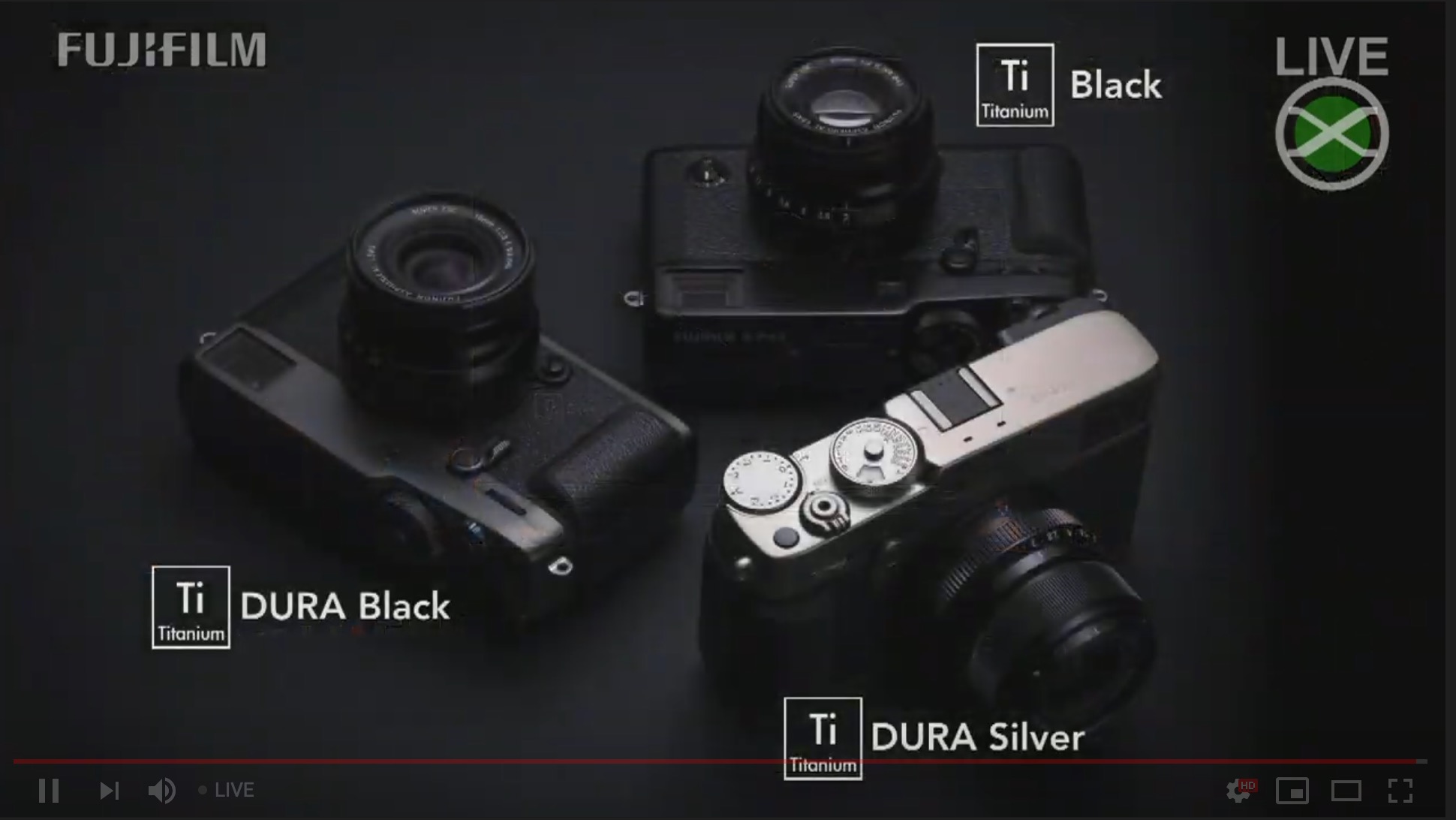
Fujifilm is teasing its forthcoming X-Pro3, the successor to its popular digital rangefinder mirrorless camera, ahead of its official full introduction on October 23. During its X Summit event going on today, the company showed off the X-Pro3 in detailed images (via Fujirumors), revealing for the first time its innovative new rear-display design.

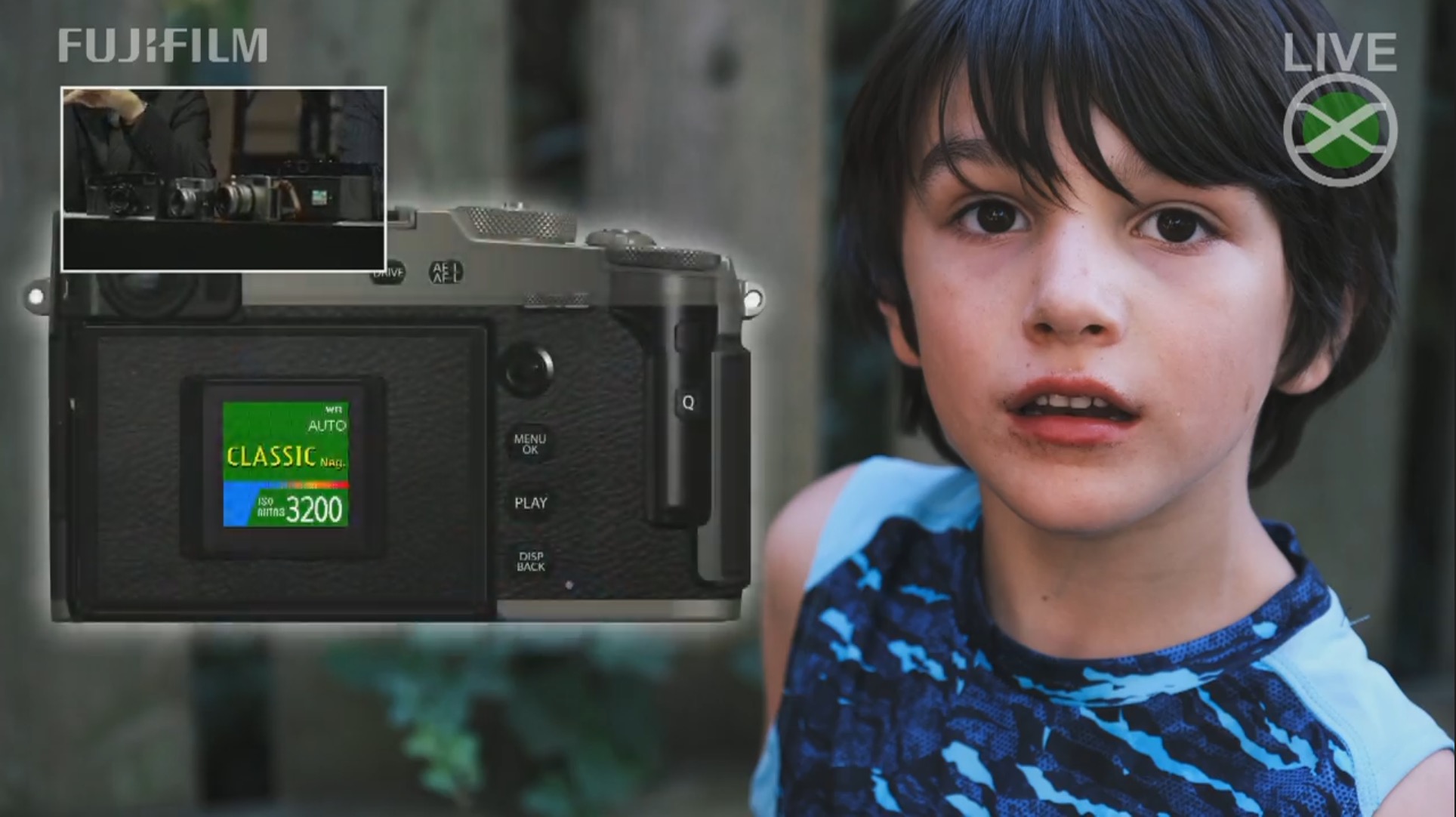
The X-Pro3 has an LCD on the back, as do most modern digital interchangeable-lens cameras, but it’s definitely unique: The screen is hidden in normal use, facing inward toward the camera back while the outward side of the rear door instead offers the photographer a small OLED “mini screen” that contains only basic info about shooting settings.

The rear display will show details like shutter speed, f-stop, ISO and film simulation and file size settings, and if you want to actually see a preview of the virtual viewfinder image, you’ll need to flip down the screen to reveal the color LCD. The downward flipping display is therefore ideal for doing things like shooting from a low angle, with the photographer looking down to check framing — just like you could do on classic film cameras with waist-level viewfinders.

The X-Pro3 still offers an electronic viewfinder, but that’s also more akin to film photography versus digital, since photographers using the camera will be much more likely to either use the viewfinder or shoot waist-level with the flip down screen — while also being able to check their various settings at a glance by quickly pulling the camera away from their eye and looking at the back.

Fujifilm’s lineup of APS-C digital interchangeable-lens cameras have already won many fans thanks to their film simulations, which mimic types of film the company offered previously. The X-Pro3 will focus even more on replicating a film-inspired experience backed by modern digital photographic technology, and will also include a new film simulation called “Classic Negative.”

Classic Negative

Other details about the camera include titanium construction, which is going to make it a super durable but lightweight camera, and three different color options.

New X Pro3 colorsNo pricing or availability info is out yet, but we’ll find that out, along with full details, on October 23.

As it readies a test for vaping additives, cannabis testing company Cannalysis raises $22.6 million

Cannalysis, a testing company for cannabis, has raised $22.6 million in a new round of financing as it prepares to bring a new test for vaping additives to the market.

The test, which the company is preparing to unveil later this week, will test for the presence and amount of Vitamin E acetate, a chemical compound that may be linked to the vaping related illness that has swept through the U.S. in the past month.

Cannalysis chief executive Brian Lannon said the new product was developed in response to the current crisis in the cannabis industry over illnesses related to vaping cannabis products.

“The big story that’s been going out over the last week isn’t the product that’s going out in cannabis, but an additive called Vitamin E acetate. We have  developed a test for that,” Lannon says. “As part of the different compliance testing that’s required, it’s not mandated to test for any of these additives… What I’m anticipating based on the phone calls we’ve been getting is that a lot of our customers want to get the test to show that they’re not using the stuff.”

The Santa Ana, Calif.-based company tracks cannabis products across its companies supply chain and provides data management and integration services for its customers so they can immediately update their own tracking systems with the results of Cannalysis’ tests. It also integrates directly with consumer services like Weedmaps, so consumers can get third party verification of the strength of the dosage.

Quality assurance for cannabis products isn’t just a matter of legal compliance. The percentage of THC that’s available in different strains can impact the price producers can charge for their product, Lannon says.

“The price of a cannabis product can vary greatly based on its potency,” he says. “Right now the number in the market is 20 percent. If your product tests at 18 percent instead of twenty percent, that can mean a huge difference in cost.”

While testing variance is a problem for the industry, Cannalysis says its highly automated lab, which relies on robotics and machine learning to increase the speed and accuracy of its testing, along with the integrated software services it offers to customers, exceeds the standards for ISO accreditation.

Certainly that’s what attracted CanLab, the nation’s largest testing service to commit $22 million to the company as a strategic investor.

Lannon says the new cash will be used to expand into new markets including Oregon, where the company has already made an initial hiring push, and other highly regulated cannabis markets.

A serial entrepreneur who previously founded an action sports apparel company called HK Army and MetaThreads, an esports clothing company, Lannon came to the cannabis industry initially as a user of the substance. As the market matured his interest was piqued in developing technologies that could ascertain the quality of various cannabis products.

His timing was exceptional. Investors have spent nearly $16 billion on North American cannabis companies in 2018, double the amount invested just three years ago,  according to data from the analytics company New Frontier Data cited by the Associated Press. And the Marijuana Business Factbook projects that the economic impact of the legal industry was somewhere between $20 billion and $23 billion in 2017. Its a number that could grow to $77 billion by 2022.

Netflix cofounder Marc Randolph on the company’s earliest days, the streaming wars, and moving on

Netflix is today a company whose valuation hovers around $130 billion, but it was, of course, once a little startup, and in his new book “That Will Never Work,” Netflix’s cofounder and its first CEO Marc Randolph takes readers on a fun and surprisingly vivid journey through the streaming giant’s earliest days.

It’s also instructive, though this is more memoir than business book, and Randolph, who is the great nephew of Edward Bernays — a  public relations pioneer — turns out to be a very compelling writer, explaining in sometimes humbling detail how and why the company eventually outgrew him, and the reason he doesn’t regret stepping away when he did.

In fact, rather than lament past decisions, Randolph seems to relish his longtime work as a startup advisor, one who often has no financial ties to the companies he helps. As he explains it, there is a “role for someone in a founder’s life who isn’t a board member or an investor or an employee. The role of a founder-CEO is extremely lonely. You can’t always be fully forthcoming with your board or investors or employees. And if you go to your peers and you bring them an issue, they don’t really understand. So it’s very valuable for a founder who doesn’t have an ulterior motive but also understands a problem well enough that they can give really good advice.”

We had a chance to catch up with Randolph earlier today to discuss the book and his current relationship with his Netflix cofounder Reed Hastings, who he met when the company that Hastings began running in 1991, Pure Atria, acquired Randolph’s company, Integrity QA Software, (They both found themselves searching out the next big thing when Pure Atria was itself acquired.)

Randolph also shared why it took him 16 years to tell his story about what has become one of the most impactful companies in the history of television.

TC: We’re still zipping through the book but there is a lot of great storytelling here, from scenes with you and Reed carpooling to the office together, to some of earlier startup ideas you ran past him and he didn’t think much of, including customized baseball bats. Did you write this alone?

MR: Of course, I had help, you can’t write about something as important as Netflix by yourself. Over the course of one-and-a-half years, I spent tons of time on the phone and [engaged in] email correspondence and in meetings with everyone I could track down, because I wanted to hear all those stories again. But this isn’t a ghostwritten book and it’s not a as-told-to book. I did write it with the help of a great editor. In fact, the book was originally conceived as more of a self-help book, but my editor came back and said, “You shouldn’t do this as a ‘you’ book. Make it a ‘me’ book. Make the lessons you’ve learn over your career implicit instead of explicit.”

But I’ve been writing all my life. I was a direct marketing guy [before founding Netflix]. I had to restrain myself from writing things like, “Frankly, I’m puzzled,” and “But wait! There’s more!”

TC: You left Netflix in 2003. Why not write a book sooner?

MR: I needed to wait all that time. Even though I needed to tell the story, I didn’t really understand the lessons. It has taken me working with other early-stage companies and mentoring them and investing in them to make these connections. Why did Netflix work? What were my failings? What could I have done better?

TC: You’re pretty candid in the book about not being punctual and not having great attention to detail, but these are minor offenses. 

Get your Startup Alley Exhibitor package plus bonus hotel stay

It’s getting down to the wire for your opportunity to show off your early-stage startup in Startup Alley at TechCrunch Disrupt SF this October 2-4. There’s simply no better way to place your ideas and technology in front of influential change agents that can help you propel your business forward and set the stage for future success. Here are just four of the many reasons you should exhibit in Startup Alley.

1. Awesome exposure to the media 

Along with 10,000+ attendees, Disrupt SF will have more than 400 members of the media. We’re talking the big guns — CNBC, Bloomberg, Forbes, Financial Times — alongside TechCrunch writers, scouring the floor looking for stories about fascinating founders, emerging tech trends or maybe even a future unicorn. Scoring media coverage can work wonders for your bottom line — as Luke Heron, CEO of TestCard, learned when he exhibited in Startup Alley:

We got a fantastic writeup in Engadget, which was really valuable. Cash at the beginning of the start-up journey is difficult to come by, and an article from a credible organization can help push things in the right direction.

Last year, TestCard closed a $1.7 million funding round.

2. Beaucoup investor attention

Journalists aren’t the only influencers perusing the tech and talent on display in Startup Alley. Investors are just as eager to find up-and-coming prospects to add to their portfolios. It’s the perfect place to start conversations and develop relationships that lead to big changes. And we’ve got a plethora of investors (both traditional VCs and corporate folk) in the Valley: Sequoia, Verizon Ventures, GV, SoftBank, Naspers, AT&T, Honda Innovations and more. Here’s what David Hall, co-founder of Park & Diamond, had to say about his experience:

Exhibiting in Startup Alley was a game-changer. The chance to have discussions and potentially form relationships with investors was invaluable. It completely changed our trajectory and made it easier to raise funds and jump to the next stage.

Last year, Park & Diamond closed its first round of funding, allowing the company to relocate to New York and make its first key hires.

3. Wild Card shot at the Startup Battlefield competition

Missed out on the Startup Battlefield applications? All exhibitors in Startup Alley get a chance to win one of TWO Wild Card entries to the Startup Battlefield pitch competition. TechCrunch editors will select two standout startups as Wild Card teams that will go on the Main Stage to compete head-to-head in Startup Battlefield for $100,000 equity-free cash, the Disrupt Cup and even more glorious investor and media attention. 

4. Free hotel stay for Startup Alley companies who book now

With all of those reasons, it’s hard to top all the value you’ll get from a Startup Alley Exhibitor Package, but we’ll even sweeten the deal and throw in a complimentary 3-night stay at a SF hotel if you book by Wednesday, September 25. All of this opportunity for $1,995 sounds like it’s too good to be true, but if you act now, this can become your reality.

There you have it. What are you waiting for? Buy your Startup Alley Exhibitor Package and strut your stuff at Disrupt San Francisco 2019.

How to profit from valuable peer referrals hiding in Slack

Colin Bendell
Contributor

Colin is Senior Director of Analytics and Strategy for Cloudinary, the co co-author of High Performance Images, and passionate about data, web performance and user experience.

Brands are often left to act like the person who searches for their keys under the streetlight simply because that is where the light is better. However, when brand marketers focus only on engaging with the customers they can more easily see — where online activity is visible — they risk overlooking the valuable opportunities hiding in darker spaces.

One of the most valuable of those dark web spaces is in the realm of what we call “microbrowsers” — the messaging apps like Slack, WhatsApp and WeChat. We call them microbrowsers because they display miniature previews of web pages inside private message discussions. These previews, also known as ‘unfurled links’, create your brand’s first impression and play a big role in whether or not the person on the receiving end will click through to buy, or read or engage.

Google Analytics lumps all microbrowser-generated web traffic into the ‘Direct’ bucket, which we often just ignore. This means we look for customers where we know how to create campaigns easily — on Facebook, Twitter and Instagram, and buying Google Ad Words.

And as more people rely more heavily on messaging apps for primary communication, these link previews from microbrowsers are becoming the leading segment of your direct traffic visitors. In Cloudinary’s 2019 State of Visual Media Report, which drew on data from more than 700 customers and 200 billion transactions, we found that 77% of link sharing in Slack occurs during working hours and that the vast majority of the click-throughs are reported as ‘direct’ traffic. The rise of microbrowsers gives us an opportunity to engage and attract customers through word of mouth discussions.

The good news is that the ‘leads’ that microbrowsers send to your brand site are usually highly qualified and close to the bottom of the traditional sales pipeline funnel. When consumers arrive on your site they are often ready and eager to buy (or read, view and listen to your content).

Whether it be for sneakers, tickets to a concert, a birthday gift idea, or an article to read — a trusted peer recommendation typically happens in that fleeting moment when the appetite to buy is right now. That isn’t just valuable, it’s the holy freaking grail!

Top tips for creating links that engage

GettyImages 952111924

Image via Getty Images / drogatnev

The way to get the most value from microbrowser traffic is by helping along this peer influencing that happens in the dark. By creating compelling, informative links with images, video and text information specifically for microbrowsers, you increase the likelihood that peer-to-peer recommendations in groups convert into sales and reads.

What follows are some top tips to ensure that the links unfurling within microbrowsers have the greatest impact.

First, remember the golden rule: your audience is human. When creating content for microbrowsers, design it for humans, not machines.

Lunchclub raises $4M from a16z for its AI warm intro service

There are apps out there that help you find friends, find dates and find your distant family histories, but when it comes to “growing your professional network,” the options are shockingly bad, we’re talking LinkedIn here.

Lunchclub is a startup that’s looking to help users navigate finding new connections inside specific industries. The company has recently closed a $4 million seed round led by Andreessen Horowitz with other investments coming in from Quora’s co-founder, the Robinhood cofounders, and Flexport’s cofounders.

The app follows in the footsteps of others that aimed to be dating app-like marketplaces for growing out your professional network via 1:1 lunch and coffee meetings. Lunchclub is more focused on setting up a handful of meetings for users that have a specific goal in mind. Lunchclub is aiming to be your warm intro and connect you with other users via email that can assist you in your professional goals.

When you’re on-boarded to the service, you are asked to highlight some “objectives” that you might have and this is where the app really makes its goals clear. Options include, “raise funding,” “find a co-founder or parter,” “explore other companies,” and “brainstorm with peers.” These objectives are pretty explicit and complementary, i.e. for every “raise funding” objective, there’s an “invest” option.

There isn’t a ton being asked for on the part of the user when it comes to building up the data on their profile, Lunchclub is hoping to get most of the data that they need from the rest of the web.

“Our view is that there’s tons of data already out there,” Lunchclub CEO Vlad Novakovski told TechCrunch in an interview. “Anything that comes from the existing social networks, be in things like Twitter, be it things that are more specific to what people might be working on, like Github or Dribble or AngelList — all of those data sources are in the public domain and are fair game.”

Lunchclub’s sell is that they can learn from what matches are successful via user feedback and use that to hone further matches. Novakovski most previously was the CTO of Euclid Analytics which WeWork acquired in 2017. Previous to that, he led the machine learning team at Quora.

The web app, which currently has a lengthy-waitlist, is available for users in seven cities including the SF Bay Area, Los Angeles, New York, Boston, Austin, Seattle and London.

Lunchclub

Co-founders Vlad Novakovski, Scott Wu and Hayley Leibson