BlaBlaCar to acquire online bus ticketing platform Busfor

BlaBlaCar, the marketplace that matches people for long-distance ridesharing between cities, has announced plans to acquire Busfor, the leading bus ticketing platform in Russia and Ukraine.

“This is the biggest acquisition in BlaBlaCar’s history and Busfor is the region’s leading bus distribution company, with over 150 employees. Connecting our significant online demand with Busfor’s supply will help travelers and bus operators alike, so we’re incredibly excited to be joining forces,” BlaBlaCar co-founder and CEO Nicolas Brusson told me.

BlaBlaCar isn’t disclosing terms of the deal.

This is yet another move in buses for BlaBlaCar. But this is a different move when you compare it to the acquisition of Ouibus in France. BlaBlaBus, BlaBlaCar’s bus service, currently operates in France, Belgium, the Netherlands, Germany and Italy.

This time, the company is buying a ticketing platform that partners with 7,000 bus carriers and generates $4 billion in ticket sales per year. It doesn’t plan to operate as a bus carrier in Russia, Ukraine and Poland directly. Blablacar says that it has 25 million members in the region out of 80 million registered users in total.

“Busfor will retain its own brand, product offering and consumer app, but we will be integrating its supply of bus journeys into the BlaBlaCar platform to help bus carriers and stations grow their customer bases while also creating the best user experience for travelers,” Brusson said.

But buses are still an offline industry in those countries. BlaBlaCar says that online booking currently represents 10% of all tickets. There’s still a lot of room for growth.

Eventually, BlaBlaCar wants to become a carpooling and bus company, with buses for trips from one main city to another main city, and carpooling rides for trips between smaller cities.

Pan-European VC fund Target Global is opening an office in Barcelona

Hola Barcelona. Target Global, a pan-European VC firm with €700 million under management and a broad investment canvas spanning SaaS, marketplaces, fintech, insurtech and mobility, is opening an office in the Catalan capital.

Investor director, Lina Chong, will lead the expansion into Spain, having relocated to Barcelona from the fund’s Berlin headquarters. They’re setting up in a co-working space on Avenue Diagonal in the center of the city. 

Target Global backs early and growth stages startups, as well as doing some seed investing. The firms tells us it’s expecting to do between one and three deals per year out of the Barcelona office, envisaging the same mix of investments in terms of early and growth stage.

“We’ve been seeing decent deals in both stages. Definitely. Across Spain,” says Chong. “There is just more — by numbers — way more early stage seed than A. I think that’s just the maturity of the ecosystem here.”

Dialling up a local presence across Europe means Target Global can pitch founders on being able to connect talent and expertise across key regional startup hubs, while also plugging into a wider international network. (It also has offices in London, Tel Aviv and Moscow.)

From a VC perspective opening local offices is of course about deal flow. Being on the ground to take more meetings widens the pipe, increasing the chance of an early shot at the next high growth business.

That’s important because Europe’s startups have many more options for early stage funding than in years past, and founders are getting smarter about choosing their investors. Boots on the ground means more time for all important relationship building.

Target Global describes itself as something of a startup — it was founded in 2012 — which means it’s competing for deals with VCs that have more established brands and networks. Becoming a familiar face in the room looks like a solid strategy to growth hack its own network.

We are a global or a pan-European fund but for an entrepreneur here we want them to feel that we’re local; we understand the ecosystem; that we have deep rooted connections; that we’re committed; that we show up,” general partner Shmuel Chafets tells TechCrunch.

“It’s all a function of time and effort. Just being here and having breakfast with people, lunch with people and helping out even the people we don’t invest. You get more connected and then you start to see more deal flow.”

This is the second local office it’s opened in Europe this year, after adding a London base in April — making it a flattering pick for Barcelona. Plenty of other European hubs are being passed over in the city’s favor this time, be it Madrid, Lisbon, Paris or Stockholm. 

Chafets says the firm looked at five or six other cities but settled on Barcelona for now, though he won’t rule out opening more offices in future. “Never say never,” he quips. 

Having been a regular visitor to Barcelona for a number of years he talks enthusiastically about the creative energy motivating entrepreneurs — saying the city’s ecosystem reminds him of how Berlin felt a few years ago. “It looks like it’s just about to happen,” he reckons. 

“From what I’ve seen Barcelona is sort of strong in creative. It’s a very creative city. It’s always pretty strong in mobile, historically. It had more mobile successes… SaaS, particular smb SaaS, is pretty good here. I think it would be harder to find enterprise sales companies and companies building these very deep tech stuff right now. But definitely in the marketplace, smb SaaS space, mobile space you see great stuff here. 

“That ties into the creativity, because it’s a product driven environment — not a tech driven environment. I think Berlin is a very operationally driven environment, Tel Aviv is a very tech driven environment, this is a very product driven environment — which actually complements well our other hubs.”

“There’s some pent-up energy here,” agrees Chong, who says they’ve already come across a “surprising” amount of deal flow. “Again it’s very similar to Berlin where there’s a lot of willingness and there’s a lot of dreaming but there’s not a lot going on. So I think the younger people here they’re creating that.”

Target Global has been testing the water prior to formalizing its commitment to Barcelona, and has four local portfolio companies which it’s ploughed around €20M into over the past 12 months.

Its biggest regional investment to date is in business trip booking SaaS, TravelPerk. It’s also backed flatmate matching platform Badi; online doctor booking platform, Doc Planner (which relocated from Warsaw, Poland after merging with local startup Doctoralia); and medical chat app MediQuo.

From a wider perspective, Barcelona’s tech ecosystem has been gathering momentum for years, helped by the annual presence of the world’s biggest mobile tradeshow (MWC) — as well as more specific pull factors for startups such as a relatively low cost of living and an attractive Mediterranean location. 

“It’s a great place to live and you can’t ignore that,” says Chafets. “In Europe if you’re a team and you’re an international team there are very few places you can live.”

This combination means Barcelona is now home to a growing number of high growth startups, including Target Global’s portfolio firm TravelPerk — as well as the likes of on-demand delivery platform Glovo; and RedPoints, which sells a SaaS to brands for detecting and acting against the sale of fake goods online, to name two other notable examples.

Other local startups grabbing attention and investment in recent years include 21Buttons, Holded, Housfy, Typeform and Verse. While hyper local mobile marketplace startup Wallapop — which was on a growth tear in an earlier wave of ecoystem growth — remains the go-to classified app on every local’s phone (though it merged with a US rival back in 2015).

The city even has its own youthful scooter startup (Reby) which has refused to be put off by some tough regulations controlling rentals — and has recently been applying AI to try to make like a good citizen by automatically detect poor parking.  

Mobility is a major area of focus for Target Global — which last year announced a dedicated fund (with an initial raise of $100M) for startups working to disrupt transportation. Although, when it comes to stand-up e-scooters the firm is already invested in Berlin-based Circ so will presumably be looking to spend elsewhere on that front.

“Barcelona is the perfect city for scooters,” says Chafets. “Scooters can really change the way the city works. It’s also small and has relatively good public transportation from outwards in — but they need to be regulated. You need to really make sure that [they aren’t a misused nuisance].”

He notes that European regulators have been relatively quick to spot the risks of shared mobility, and close off the antisocial expansionist playbook that played out in some US cities during the first wave of scooter startups — when people trolled Bird by hanging scooters in trees (or, well, worse) — but he sees that as good news for building a sustainable future for alternative mobility. 

“It’s a great challenge and it will be a huge money maker — that’s where we want to be right, multiple trillion dollar businesses!”

Away from disruptive developments on the ground in Barcelona and the other local tech hubs that Target Global is intending to explore from its new base in Catalonia, it also views Spain as a low risk gateway to opportunities on the other side of the Atlantic. 

“There’s a decent local domestic market and there is a natural second market in South America,” says Chafets. “Actually in the US too — because Spanish is the second most commonly spoken language in America so when you start a company here you have that second market built in. Which is very important — you can scale it.”

“Latin America is a fascinating market right now, it’s a fascinating time,” he adds. “So in a way it’s a way for us to make a side bet on Latin America without going out of Europe and investing far.”

We’ll share a full interview with Chafets and Chong on Extra Crunch.

U.S. security experts admit China’s 5G dominance, push for public investment

U.S. security experts are conceding that China has won the race to develop and deploy the 5G telecommunications infrastructure seen as underpinning the next generation of technological advancement and warn that the country and its allies must develop a response — and quickly.

The challenge we have in the development of the 5G network, at least in the early stage, is the dominance of the Huawei firm,” said Tom Ridge, the former US Secretary of Homeland Security and governor of Pennsylvania on a conference call organized recently by Global Cyber Policy Watch. “To embed that technology into a critical piece of infrastructure which is telecom is a huge national security risk.” 

Already some $500 million is being allocated to the development of end-to-end encryption software and other technologies through the latest budget for the U.S. Department of Defense, but these officials warn that the money is too little and potentially too late, unless more drastic moves are made.

(You can also hear more about this at TechCrunch Disrupt in SF next week, where we’ll be interviewing startup founders and investors who build businesses by working with governments.)

The problems posed by China’s dominance in this critical component of new telecommunications technologies cut across public and private sector security concerns. They range from intellectual property theft to theft of state secrets and could curtail the ways the U.S. government shares critical intelligence information with its allies, along with opening up the U.S. to direct foreign espionage by the Chinese government, Ridge and other security experts warned.

In Latin America, the business of trolling threatens Twitter’s disruptive power

In 2012, the emblematic podcast This American Life did a special on politics in Afghanistan. They noted that in order to be a politician in Afghanistan, one needs to command a personal armed militia. That’s how politics is practiced in a fragmented country with a long history of violence, and without a stable, credible centralized authority.

In the quaint and relatively peaceful Andean nation of Ecuador, snuggled between Colombia and Peru, a similar phenomenon takes place: politicians don’t require armed guards, but they do require their digital equivalent: Twitter troll centers, or businesses that sell online harassment as a service.

Indeed, much of the country’s public debate, or lack thereof, is now defined by the anonymous accounts that threaten, cajole and, ultimately, aim to silence voices of dissent. Though Ecuador may be too small to register on the Twitter executive team’s radar, under their noses the lucrative business of weaponizing the platform is already being exported to other countries in the region. The abuse of Twitter through troll centers not only threatens the company’s vision to become the world’s agora, it may also be putting lives at risk.


Imagine a populist president raging against his country’s elites, including the news media, as corrupt enemies of the people. Because of his innate distrust of journalists, he uses Twitter to speak divisive rhetoric directly to his digital faithful. At his disposal is an army of hardcore supporters ready to do his bidding, echo his message and attack anyone who dares disagree. If you recognize the character in this story, it’s probably because you’re familiar with Rafael Correa (56), the populist former president of Ecuador (January 2007- May 2017).

Correa now lives in Belgium and cannot return to Ecuador without facing trial for having ordered the kidnapping of a political opponent. The opponent in question fled Ecuador to neighboring Colombia in 2012, where he was trailed by members of Ecuador’s secret police and briefly kidnapped. Witnesses from the state security apparatus have since come forward to point the finger at Correa as the intellectual author of the crime.

The staunchest defenders of concentrated power are those who hold that power.

Correa denies the charges and claims they are merely politically motivated theater orchestrated by his former mentee and now sworn enemy, current Ecuadorian president, Lenín Moreno. But even if that were the case, Correa still has a number of other uncomfortable questions to answer to the Ecuadorian people. Since 2013, Latin America has been rocked by a corruption scandal called Lava Jato (the car wash) in which the Brazilian construction company Odebrecht paid bribes to politicians across the region to win public works projects (the Netflix series O Mecanismo, or The Mechanism in English, dramatizes the unfolding of the case in Brazil). In total, Odebrecht is said to have paid $788 million U.S. dollars in bribes in 12 countries in exchange for government contracts.

As a result of Lava Jato, former presidents in Brazil and Panama are in jail. In Peru, two former presidents are incarcerated, one is being held prior to an extradition hearing in California and, in April of this year, one dramatically committed suicide when police came to escort him to prison.

Ecuador’s government was no exception to the Brazil construction firm’s corruption: Rafael Correa’s former vice president and preferred successor, Jorge Glas, was convicted in December of 2017 of having directed multi-million-dollar contracts to the Brazilian firm in exchange for massive payoffs hidden through a series of offshore accounts. Indeed, Glas’s poor approval rating was the cause for Correa asking Moreno to come out of retirement and run for president.

Were Lava Jato not enough to spark wide-scale public outrage, a new scandal called Arroz Verde (green rice), revealed in May of 2019, exposed how the Correa election campaigns had government contractors cover expenses in order to flaunt spending restrictions. Numerous former ministers from the Correa government are currently either in jail or awaiting trial, under house arrest or have fled the country. Correa’s legacy as a tough yet modernizing progressive president is currently threatened by corruption scandals of previously unimaginable proportions.

It wasn’t supposed to be that way. When Rafael Correa was elected in 2007, Ecuador was emerging from a period of political, social and economic instability. In 2000, the country’s banks failed and the following economic collapse lead to Ecuador adopting the U.S. dollar as its official currency. Two years prior, a war with neighboring Peru resulted in the loss of a significant portion of Ecuador’s claim to the Amazon rain forest. In the early 2000s, close to 10% of the population, more than a million Ecuadorians, migrated to Spain and the United States in search of work. Three democratically elected presidents in a row were overthrown by street protests, including one colorful actor who was disposed after only six months in office. He was officially declared to have abandoned his role due to mental incapacity.

A relatively obscure leftist economics professor, Correa had a short stint as the country’s finance minister in 2005 during a transitional government. He left his post after a public spat with the International Monetary Fund. The IMF demanded Ecuador use its oil revenues to pay off its staggering external debt. Correa insisted that the country’s first priority should be its social debt and that the monies should be invested in health and education.

The fight vaulted Correa into the public eye and he was able to ride the momentum all the way to the presidency, defeating the country’s richest man in a run-off vote. Through his bombastic rhetoric, Correa took aim at the country’s business, political and media elites and fingered them as the origin of the country’s problems. He captured the populations’ unrest through the campaign slogan Dale Correa, which means both “Go Correa” and “Give ‘Em the Belt!”

Once in office, Rafael Correa set about an aggressive reform agenda. He rewrote the Constitution, the country’s 20th, and re-organized the state apparatus. Fueled by record high oil prices, Correa invested massively in highways, schools, hospitals and much-needed infrastructure like hydroelectric dams.

Shunning the country’s traditional alliance with the United States, Correa turned instead to China, a decision that, as The New York Times has documented, ended in billions of dollars being misspent on Chinese-built hydroelectric dams that don’t actually work at full capacity. In addition, China sold Ecuador technology which, though promoted as a 911 public safety tool, was used by the Correa government to keep tabs on and harass political opponents.

When Americans talk about Donald Trump’s latest scandals, Latin Americans mostly roll their eyes. After all, Latin Americans have seen the Donald Trump character interpreted by numerous strongmen, or caudillos, throughout the region’s history. They have even seen how it plays out on Twitter. Both Venezuela’s late President Hugo Chávez and Rafael Correa saw in Twitter an opportunity to go around their countries’ respective traditional media and speak directly to the citizens, a benefit of social media President Trump has also touted.

Correa would regularly engage in banter with citizens and do the work of government through tweets. His famous expression Favor Atender (please see to this) followed by a mention of a high-level minister or official was his calling card to government to get directly involved in resolving citizen complaints brought to his attention through Twitter. Correa went so far as to host lunches in the presidential palace for the Twitter users who most supported and defended him. The novelty of the hands-on approach soon revealed its dark side.

What happened next is the stuff of Benghazi-like conspiracy theories.

Many historians point to the 30th of September 2010 as the date when Rafael Correa started breaking bad. The day began as any other in the perpetually sunny capital of Quito. As mountain climbers will note, people at high altitudes sometimes make bad decisions due to the thin air, and Ecuador’s capital Quito stands at 9,350 feet. On this day, the National Police declared to the news media they were going on strike to protest a restructuring of their compensation packages. A group of police officers took a regiment and Rafael Correa decided that the best course of action was to go in person and confront them. Surrounded by his handlers and sustaining himself with a cane after a recent knee operation, Correa berated  the police officers, ripped his shirt open like a tropical hulk and dared the officers to shoot him in the chest. “Here I am and if you want to kill me, go ahead and kill me!” he cried.

What happened next is the stuff of Benghazi-like conspiracy theories. Depending on who you believe, Correa was either kidnapped and taken to a police hospital or went there voluntarily. The army eventually responded and a shoot-out ensued between the police and the army in the streets of Quito. Five people were killed, including three police officers, a soldier and a citizen. The president was eventually rescued by the military and restored to his functions about 12 hours after the debacle began. In a country used to coups and presidential turnover, democracy seemed to have won.

From the beginning of his time in office, Rafael Correa was determined not to suffer the fate of his overthrown predecessors. Having experienced the potential for that fate up-close, Rafael Correa reacted by removing his tyrannical constraints. Correa became increasingly belligerent on and off Twitter. Notoriously thin-skinned, Correa made a habit of throwing people in jail for flipping him off. He even stopped his motorcade to personally stick his finger in the nose of an irreverent teenager who Correa later had thrown in jail (the young man was eventually freed after apologizing).

Correa continued his crusade against journalists who wrote things about him with which he didn’t agree. Sometimes he insulted and threatened them; other times he hit them with multi-million-dollar lawsuits, which friendly judges were more than willing to oblige with speedy trials and favorable outcomes for the president.

The Ecuadorian government, it was leaked, spent millions on the Italian firm Hacking Team to spy on its citizens. On his weekly traveling Saturday Show, broadcast across radio, television and the internet, Correa would read tweets from people who insulted him and then reveal their true identities and addresses and call for retaliation. Whilst on the world stage, Correa portrayed himself as a defender of free speech by famously receiving Julian Assange in the Ecuadorian embassy in London; on the homefront, Correa hunted down dissenters and used the entire state apparatus to punish whistleblowers.

The Correa government’s harassment wasn’t only digital: as Gimlet’s Reply All podcast documented in their story Favor Atender, one of Correa’s most fervent Twitter adversaries, Gabriel González, received death threats in February 2015 after making memes that poked fun at things like the government’s sometimes absurdly inefficient healthcare system. Worried for his safety, Gabriel left Quito. Then, at his hideout hundreds of miles away, he received a Sopranos-like wreath of flowers along with pictures of his wife and child (Disclosure: Gabriel briefly freelanced for me as a contractor before the aforementioned events took place), stating it would be a shame if anything were to happen to them. When the price of oil started to decline and Correa’s spending power was curtailed, his popularity began to waver. After this, the president’s digital antics only worsened.

Whenever anyone tweeted something unpleasant to the president, they immediately faced a barrage of incoming attacks and insults.

Carlos Andrés Vera is one journalist for whom online harassment become offline harassment. A documentary filmmaker, publicist and former editor of the Ecuadorian edition of Soho Magazine, Carlos Andrés drew the ire of the Correa government by being highly critical of the administration, including its management of the Ecuadorian Amazon and its mishandling of the safety of the uncontacted tribes that are currently threatened by oil exploitation in and around the Yasuní National Park.

A prolific tweeter, Carlos Andrés frequently engaged his trolls, as well as numerous government ministers and operators. He first felt threatened when a troll account published a photo of his son that was on his phone but that he hadn’t published anywhere. The troll account suggested making a pornographic movie with Carlos Andres’s underaged son.

On more than one occasion he was threatened on the street by individuals who made reference to his digital activism. Then, in 2015, Carlos Andrés was the victim of a secuestro express, or express kidnapping. Usually victims of secuestro express are roughed up and then driven from bank machine to bank machine to empty their account, and then set free. In his case, Carlos Andrés was held and beaten for a number of hours, but the perpetrators never drove him to a bank machine nor did they even take his wallet. The event occurred at a time when Carlos Andrés was involved in fierce and aggressive Twitter debates with high-level government authorities. Carlos Andrés is convinced the incident was coordinated by the government and meant to intimidate him into digital silence. According to Carlos Andrés, “no government, not even Russia or Venezuela, was as advanced as the Correa government in weaponizing Twitter against its citizens.”


Out for a run on a recent Saturday, I noticed a particularly dirty street close to an official billboard declaring that “Quito is once again great.” In May of this year a new mayor had taken office after a surprise victory, slipping his way through a crowded group of 18 candidates and crowning himself mayor despite winning less than 30% of the popular vote (in Ecuador voting is mandatory, and though run-off elections are held at the presidential level, they are not used for municipal elections).

The new mayor, Jorge Yunda, was a former Correa collaborator who had since distanced himself from the now out of favor ex-president. The owner of a number of radio stations whose frequencies were granted in a process many consider to be less than transparent and fair, Yunda shamelessly copied Donald Trump’s “Make America Great Again” slogan and adopted it to Quito. Unlike Trump, Yunda resisted the temptation to name and shame a public enemy.

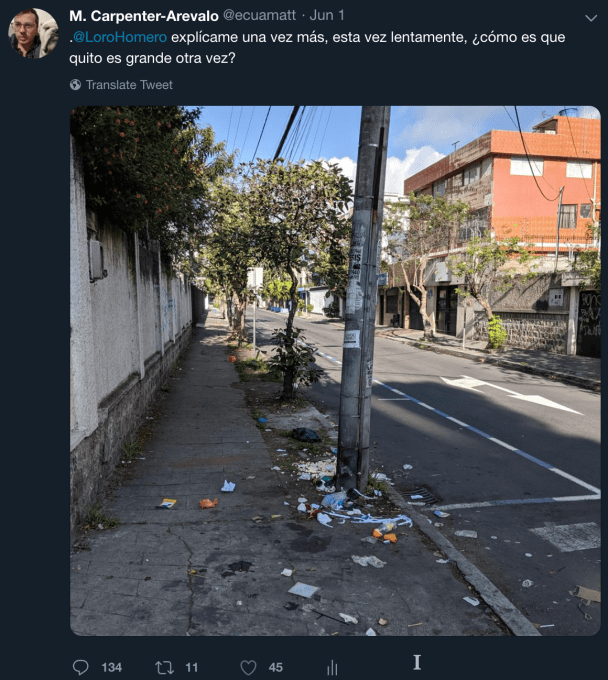
Despite the candidate’s poor showing in the popular vote, Yunda’s team brazenly plastered Quito with “Quito is now great again” billboards, despite having yet to accomplish anything. Angry with the juxtaposition of a government declaring victory whilst having a major garbage management crisis on its hands, I took a picture and trolled the mayor.
Screen Shot 2019 06 16 at 4.52.42 PM

.@lorohomero, explain to me once again, this time slowly, how is it that Quito is great again?

By the time I finished my run I had regretted my tweet. The tweet wasn’t going to accomplish anything and Twitter doesn’t need more angry voices shouting into deep internet space. I thought about deleting it, and when I arrived home and I opened my phone it took me by surprise to see that in 10 minutes the tweet had received 134 responses, including one from the mayor asking me for more time to get his house in order.

The volume of responses was surprising because it was early on a Saturday morning, so I dug a little further and quickly picked up on a familiar pattern: many of the accounts of the respondents had less than 50 followers and they only followed a handful of people. Their usernames were often combinations of names plus a string of numbers. Most were saying more or less the same thing in response to my tweet. Soon thereafter, Twitter began automatically deleting some of the responses as if in recognition that the pattern of behavior was malicious.

Screen Shot 2019 06 16 at 4.55.53 PM

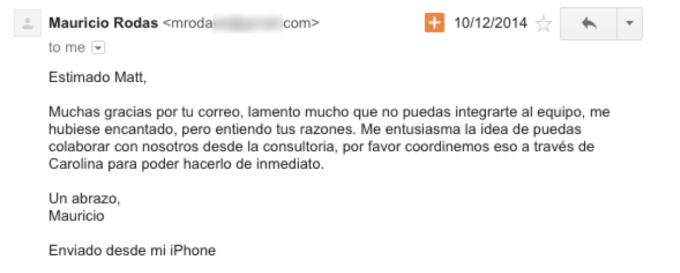
I say the behavior was familiar because I had seen it before. I was a vocal critic of the outgoing municipal administration (May 2014-May 2019) lead by Mauricio Rodas (44). The mayor then reached out through a mutual friend and offered me a job, which I turned down.
Screen Shot 2019 06 16 at 5.05.59 PM

Dear Matt, Thank you for your email. I’m sorry you won’t be able to join the team. I would have liked you to but I understand your reasons. I’m really enthusiastic about the idea that you might be able to collaborate with us through a consulting gig. Let’s please set this up through Carolina so we can do this immediately. A hug, Mauricio.

Though my relationship with the mayor was cordial, I continued to offer my critique of his administration’s work. After some time I began to receive messages that attacked me and used personal information, including a number of tweets that attacked my and my wife’s fertility.

Screen Shot 2019 06 16 at 5.05.27 PM

@ecuamatt poor guy, by the way is your wife (Michelle) pregnant yet? Can you not yet get it up? Hahaha

Aside from its crudeness, what was surprising was that the then-mayor (2014-2019), Mauricio Rodas, had been elected to counter the increasingly overbearing influence of Rafael Correa. Promising to stand up to the president, Rodas declared that it was time for a new form of politics without the tricks and dirty games popularized by the Correa government. Yet here was Mauricio Rodas using the same means by which Correa attacked and silenced his critics.

A company close to Rafael Correa was the first in Ecuador to begin to monetize the practice of Twitter trolling.

I researched my trolls and noticed a number of patterns between their accounts and a number of accounts of certain high-level municipal officials who appeared to be outsourcing the management of their twitter profiles, including who they followed and which images they used in their profiles and their posts. I then prepared a dossier that pointed to the intellectual authors behind the fake accounts and, in good faith, asked the mayor and two of his advisors to look into the kind of behavior that was being undertaken on his administration’s behalf. I asked them to consider the impact on democratic culture and public debate should politicians like him replicate the behavior of silencing critics through intimidation tactics. I received no reply, though the tweets and most of the accounts that attacked me were deleted. The trolling of the mayor’s critics, however, continued. One of the recipients of my dossier, Rodas’ communication secretary, later became a communications advisor to the incoming Yunda  administration.


A company close to Rafael Correa was the first in Ecuador to begin to monetize the practice of Twitter trolling, and Twitter itself was uncomfortably close to this company. Ximah Digital was started by young businessmen from the port city of Guayaquil whose main asset was their close connections to the government. When Twitter began selling ads in Latin America in 2012, it hired the region-wide firm Internet Media Services (IMS) to re-sell its advertising products in the region. Twitter then hired me in 2013 to manage its relationship with IMS (because I worked from a country in which Twitter had no office and am not an American citizen, I was technically hired as a foreign contractor). IMS, an accomplished digital re-seller with operations in much of Latin America, did not have an office of its own Ecuador and thus used Ximah Digital as its official national re-seller.

IMS choosing Ximah as its re-seller was a strange decision, as the small digital agency did not have established relationships amongst the country’s largest brands. Ximah did, however, have high-level government connections, and the government quickly became Twitter’s largest client in Ecuador.

During my time managing the relationship between Twitter and IMS, numerous individuals came to me with accusations that Ximah was managing troll centers whilst acting as the country’s exclusive Twitter sales channel, but I initially didn’t take the threats seriously. The accusations mostly came from individuals aligned with the opposition and, in that moment, I naively thought they were politically motivated. I went so far as to unwittingly take Ximah representatives to meetings with political actors Ximah was allegedly trolling and I defended Ximah publicly. I also don’t recall raising the issue with IMS before I left Twitter in May of 2014.

Ximah then lost plausible deniability on the 5th of September 2014 when a video circulated on social media showing that a number of well-known troll accounts were controlled by Ximah Digital employees. IMS responded to the controversy by firing Ximah Digital and opening its own office. Afterwards, Ximah went quiet for some time, then re-launched itself as a digital consultancy focused on political marketing.

When it worked defending Rafael Correa, the troll centers were easy to detect. Usually the troll accounts tweeted the exact same message as every other troll account in an attempt to control trending topics. The government also used its large number of verified accounts, which hold an extra weight in Twitter’s trending topic algorithm, to control the day’s conversation. The troll accounts could be brutal: Whenever anyone tweeted something unpleasant to the president, they immediately faced a barrage of incoming attacks and insults.

So how does one pay for trolling services? According to past reporting and confirmed by past and current employees, the government would often disguise contracts as general social media management RFPs (request-for-projects), then ensure their provider won the contract. In other instances companies were overpaid to provide legitimate services and there would be an agreement beforehand to provide trolling services in addition to the legitimate services.

Tracking the contracts can be tricky: As the investigative journalists at the leak-publishing site Milhojas have reported, a network of over 16 agencies, some of whom listed unaware farm-workers as their general managers on official documents, earned hundreds of thousands of dollars in government contracts. Many of these agencies shared a single official address, the same address as Ximah Digital.

According to company insiders, Ximah has since sophisticated its operation and now exports its services to other countries in Latin America. Whereas reverse image searches used to reveal the origin of their fake profile pictures, Ximah now scours the Ecuadorian coastal provinces and takes pictures of digital exiles to use their unique pictures as profile images. Ximah has also invested in technology, including AI, to enable automatic responses that are no longer copy-paste and therefore harder to detect. Ximah also trains other digital agencies to be trolls: Former employees from Ximah and employees from other local agencies, including agencies that manage major international clients in industries such as telecommunications, confirmed that Ximah trained their staff how to troll.

If companies like Ximah were founded because of an ideological conviction and affinity with Rafael Correa, they no longer have any qualms about who they work for. One morning I received a WhatsApp message alerting me to a corruption scandal involving a politician that used to be aligned with Rafael Correa and who was running for mayor of Guayaquil, Ecuador’s largest city. The sender’s number came from Cambodia, which was strange. The language and the aesthetics of the “leaks” page was reminiscent of past work I knew to be from Ximah: an anonymous source then confirmed that Ximah had been hired to manage the slanderous campaign on behalf of Cynthia Viteri, the eventual winning candidate of Guayaquil’s municipal elections. That fact was also confirmed by a political operative close to the Viteri campaign. Viteri’s political party was meant to be the sworn enemy of Rafael Correa. Viteri herself was the victim of Ximah trolling. In numerous campaigns throughout the years, Viteri promised a break from the Correa-era demagoguery… and yet.

Rafael Correa eventually made a career defining miscalculation. Though prior to leaving office Correa reformed the constitution he authored in order to remove the term limits he once insisted upon, he left power temporarily in the hands of his first vice president, the one not in jail for corruption charges, Lenín Moreno.

Tensions between the out-going and in-coming presidents started to show in the campaign, but no-one anticipated the complete 180 that would happen when the wheelchair bound Moreno would assume office. Throwing his predecessor and former mentor under the bus, Moreno promised to investigate and prosecute corruption “caiga quién caiga,” or regardless of who falls. Correa went berserk. Moreno, true to his promise, lost his first and second vice presidents to corruption charges. Moreno also held a referendum to reinstate term limits.

Correa spends his days tweeting hate from an attic in Belgium to his weakened but still dangerous troll army. He, the man who once wielded the power of a state against his enemies, now wallows in his own victimhood. So belligerent were his posts that Facebook closed his account. Twitter hasn’t censored him. Correa talks about returning to Ecuador as a vice-presidential candidate in two years. Ecuador’s weak institutions and strong journalists tremble at the thought.


In his drawn-out interview with Joe Rogan, Twitter CEO Jack Dorsey speaks sincerely about the desire to have Twitter become the world’s discussion form. When Twitter works well it can foster debate and generate otherwise impossible interactions between people from all walks of life. It is clear that Jack firmly believes in this mission.

At the same time, Jack is notoriously tone-deaf, as was put on display when he tweeted about the benefits of vacationing in Myanmar without so much as a thought for the victims of the Mynmar government’s ongoing genocidal campaign against its Muslim population. As a former insider and as a close watcher of Twitter’s growth and evolution, I am not convinced Twitter really feels the urgency to make its platform a safer space for healthy debate and accurate information.

Twitter’s indifference is Latin America’s loss. For much of the history of Latin America, media ownership has been concentrated in the hands of a few who generally held sway over public opinion. Media outlets often belonged to prominent businessmen from important industries. The concentration of power in the hands of a few brokers from business, media and politics represented a Petri dish for corruption.

Twitter is raw, open and immediate, allowing the crowd to determine relevance.

Twitter blew up in Latin America because it represented a true opportunity to break from the aforementioned traditional power structure. Unlike Facebook, which tries to curate the world’s information to increase our engagement, Twitter is raw, open and immediate, allowing the crowd to determine relevance. All of a sudden voices that were excluded from national conversations can now be heard, and they can determine and influence debates, much like the #BlackLivesMatter (2013) and #MeToo (2017) movements in the United States.

Information that used to be suppressed now achieves its goal of being free. It is no coincidence that the rise of Twitter coincides with the unraveling of a corruption scandal that compares in size and scope only to the corruption inherent in the European colonization of the Americas. In the digital age it is harder to hide information. Corruption, the region’s chief operating system, leaves an Exxon Valdez-sized oil-slick of a paper trail. Those who benefit from corruption are, for the first time, vulnerable.

If information is power, that means that when information is democratized, power is democratized. But the expression of that power, meaning the systems through which that power is exercised, do not necessarily democratize. Indeed, maybe our greatest democratic gap of the modern era is found in the fact that humans can produce a big bang of information every day, but our democracy, as the Argentine democratic hacktivist Santiago Siri has stated, can only process one bit of information per citizen roughly every four years. We have sophisticated users trying to stuff their sophisticated thoughts, expressions and identities into a system with wildly outdated hardware and software that appears to be infected with a powerful firmware virus called corruption.

And not everyone has an interest in upgrading the software. In the same way that a small number  of powerful Bitcoin miners can prevent Bitcoin from increasing the block size, there are powerful actors who benefit from preventing an upgrade to democracy. Principally, those actors who have figured out how to hack and monopolize the old system will seek to ensure the new system does not threaten their concentrated hold on power. Even if they started out as rebels in the old system, as Rafael Correa once did, the rebels eventually learn how to be successful in the old model and hence become its strongest defenders.

Indeed, the staunchest defenders of concentrated power are those who hold that power. Increasingly desperate to stay at the helm, the holders-on employ mafia-like tactics to defend their mafia-like organizations, all in the name of their good intentions and sacred causes wrapped in a bow of “for the people.”  In this world, however, there is only one truth, and that truth weaves a thread between all Latin American governments, be they dictatorial or democratic, left or right, loved or despaired: that idea is that the ends always justifies the means.

Twitter threatens the concentration of power of the old system, which is why Twitter becomes the battleground between tyranny and democracy. The winners in the old system, as discussed here, are fighting back, and that fight is coming to a democracy near you. By not taking sides, Twitter is ultimately taking a side. By siding with the trolls in the name of free speech, Twitter is standing against everyone else’s free speech. Twitter’s troll centers in Latin America aren’t an unfortunate minor externality or a regional nuance: they’re a business model that threatens to take away any value that the platform might create. The stakes are unimaginably high.


Amazon launches Amazon Care, a virtual and in-person healthcare offering for employees

Amazon has gone live with Amazon Care, a new pilot healthcare service offering that is initially available to its employees in and around the Seattle area. The Amazon Care offering includes both virtual and in-person care, with telemedicine via app, chat and remote video, as well as follow-up visits and prescription drug delivery in person directly at an employee’s home or office.

First reported by CNBC, Amazon Care grew out of an initiative announced in 2018 with J.P. Morgan and Berkshire Hathaway to make a big change in how they all collectively handle their employee healthcare needs. The companies announced at the time that they were eager to put together a solution that was “free from profit-making incentives and constraints,” which are of course at the heart of private insurance companies that serve corporate clients currently.

Other large companies, like Apple, offer their own on-premise and remotely accessible healthcare services as part of their employee compensation and benefits packages, so Amazon is hardly unique in seeking to scratch this itch. The difference, however, is that Amazon Care is much more external-facing than those offered by its peers in Silicon Valley, with a brand identity and presentation that strongly suggests the company is thinking about more than its own workforce when it comes to a future potential addressable market for Care.

Screen Shot 2019 09 24 at 4.02.46 PM

The Amazon Care logo.

Care’s website also provides a look at the app that Amazon developed for the telemedicine component, which shows the flow for choosing between text chat and video, as well as a summary of care provided through the service, with invoices, diagnosis and treatment plans all available for patient review.

Amazon lists Care as an option for a “first stop,” with the ability to handle things like colds, infections, minor injuries, preventative consultations, lab work, vaccinations, contraceptives and STI testing and general questions. Basically, it sounds like they cover a lot of what you’d handle at your general practitioner, before being recommended on for any more specialist or advanced medical treatment or expertise.

photo devicerendering.4x 9a453f4c420db36a6d32e73e7e344dec

Rendered screenshots of the Amazon Care app for Amazon employees.

Current eligibility is limited to Amazon’s employees who are enrolled in the company’s health insurance plan and who are located in the pilot service geographical area. The service is currently available between 8 AM and 9 PM local time, Monday through Friday, and between 8 AM and 6 PM Saturday and Sunday.

Amazon acquired PillPack last year, an online pharmacy startup, for around $753 million, and that appears to be part of their core value proposition with Amazon Care, too, which features couriered prescribed medications and remotely communicated treatment plans.

Amazon may be limiting this pilot to employees at launch, but the highly publicized nature of their approach, and the amount of product development that clearly went into developing the initial app, user experience and brand all indicate that it has the broader U.S. market in mind as a potential expansion opportunity down the line. Recent reports also suggest that it’s going to make a play in consumer health with new wearable fitness tracking devices, which could very nicely complement insurance and healthcare services offered at the enterprise and individual level. Perhaps not coincidentally, Walgreens, CVS and McKesson stock were all trading down today.

Facebook promises not to stop politicians’ lies & hate

Facebook confirms it won’t fact check politicians’ speech or block their content if it’s newsworthy even if it violates the site’s hate-speech rules or other policies. This cementing of its policy comes from Facebook’s head of global policy and communication Nick Clegg, who gave a speech today about Facebook’s plans to prevent interference in the 2020 presidential election.

But by seeking neutrality, Facebook may become complicit in the misinformation and malevolence some politicians will use it to spread. It leaves users to fend for themselves as they try to discern fact from fiction and opinion from reality. Clegg claims the idea is for users to “judge what politicians say themselves.”

Isn’t that disgorgement of responsibility already what Facebook was doing by merely routing false news links to fact checkers and affixing their verdicts to shares of the content while still leaving it up on the site? To now say politicians can’t be fact-checked directly at all sets a critical and questionable precedent.

Nick Clegg

Facebook’s head of global policy and communications, Nick Clegg

“We don’t believe, however, that it’s an appropriate role for us to referee political debates and prevent a politician’s speech from reaching its audience and being subject to public debate and scrutiny,” writes Clegg, the former deputy Prime Minister of the U.K. “That’s why Facebook exempts politicians from our third-party fact-checking program . . .This means that we will not send organic content or ads from politicians to our third-party fact-checking partners for review.”

Yes, it prevents direct censorship of politicians and leaves critique to the media. Yet it also ignores how Facebook turns any voice into a publication, amplified by engagement-seeking algorithms distributed to billions of people. Users often treat Facebook as the internet and what they see on the internet as true.

Facebook doesn’t want false news distorting voters’ decisions ahead of the 2020 elections. However, the year-old “no fact-checks” rule and three-year-old “protected newsworthy speech” rule effectively elevate whatever comes out of a politicians mouth as above consequence.

If they share a debunked link, that can be labeled as wrong and demoted, but what they say is free to proliferate and confuse people. Not even a politician’s ads are subject to fact check, so you can spread whatever lies you want on Facebook as long as you’re rich enough and running for office. Facebook only draws the line at allowing content from politicians that would cause real-world harm, or running politicians’ ads that violate its policies.

This is certainly easier operationally for Facebook. It doesn’t have to be responsible for paying in-house staff or outside fact checkers to assess politicians’ diatribes. And it won’t as often end up in the cross-hairs of elected officials claiming Facebook is biased against them.

Some could see the benefit of these rules being that Facebook could never directly censor a politician unless they directly threatened people. If speaking for themselves from their own accounts, they get what’s close to free speech.

But it ignores how politics has evolved in the post-truth era. Rather than win with facts, it’s easier just to shout lies or insults loud and frequently enough that they’re accepted at face value, rebroadcast and culturally ingrained. Sensationalism spreads further than what’s level-headed. The fact check never gets as many shares as the incendiary claim. And those with a bully pulpit can keep an iron grip on their megaphone.

Facebook may not want to be the arbiter of truth, or even be considered “media,” but it transmits falsity without question; it’s not a platform, it’s a pawn.

Media metrics giant Comscore pays SEC $5 million in fraud settlement

Comscore, a company that’s performance metrics are widely touted in the media world, has settled with the SEC following charges of inflating its own metrics.

The company and its former CEO Serge Matta have been charged with fraud by the SEC and have agreed to pay $5 million and $700,000 respectively, in a settlement. Matta has also agreed to reimburse Comscore $2.1 million, representing profits from the sale of his Comscore stock, a post on the agency’s website reveals.

The orders state that Matta and the company engaged in fraudulent behavior that overstated the company’s revenues by $50 million and made other false statements about the company’s performance.

“As the SEC orders find, Comscore and its former CEO manipulated the accounting for non-monetary and other transactions in an effort to chase revenue targets and deceive investors about the performance of Comscore’s business,” said Melissa R. Hodgman, associate director in the SEC’s Enforcement Division, in a statement.

More from the SEC’s announcement:

The SEC’s orders find, among other things, that from February 2014 through February 2016, Comscore, at the direction of its former CEO Serge Matta, entered into non-monetary transactions for the purpose of improperly increasing its reported revenue. Through these transactions, Comscore and a counterparty would negotiate and agree to exchange sets of data without any cash consideration. Comscore recognized revenue on these transactions based on the fair value of the data it delivered, which had been improperly increased in order to inflate revenue. The SEC’s orders also find that Comscore and Matta made false and misleading public disclosures regarding the company’s customer base and flagship product and that Matta lied to Comscore’s internal accountants and external audit firm. This scheme enabled Comscore to artificially exceed its analysts’ consensus revenue target in seven consecutive quarters and create the illusion of smooth and steady growth in Comscore’s business.

The company’s share price has been in free-fall since some of its actions came to light earlier this year. It was trading above $20 back in April; the company’s stock now sits just above $2 per share. The stock was down nearly 5% on the day as trading neared its close.

In a lengthy statement, Comscore says that the company “neither admits nor denies the Commission’s allegations,” while further noting that “a separate proceeding against Mr. Matta was announced by the SEC today.”

Matta resigned from Comscore in 2016.

The company’s slogan is “Comscore is the trusted currency for planning, transacting, and evaluating media across platforms.”

Boston Dynamics puts its robotic quadruped Spot up for sale

Since the days of BigDog, the quadrupedal robots of Boston Dynamics have impressed and repelled us. But while the early, bulky robots never felt like something we’d see in real life, the company’s latest and greatest creation, Spot, is not only quite real, but now for sale — in fact, some people have had them for months already.

Boston Dynamics announced on our stage at TC Sessions: Robotics last year that Spot, previously known as SpotMini, would be its first commercial product — and we got the first peek at the production version at this year’s conference in May. It’s an incredibly impressive and flexible robotics platform capable of navigating a variety of environments and interacting with many everyday objects and obstacles. And while today is the first day of official sales, there are already robots out there in use.

“We’re putting Spots out into the wild as we speak,” Boston Dynamics VP of business development Michael Perry told TechCrunch. “Last month we started delivering robots to customers, as part of an early adopter program. The question we’re posing to these early customers is ‘what do you think spot can do for you that’s valuable?’ We had some initial ideas, but it’s all our thinking and the hope is that this program will enable a whole new set of use cases.”

The early adopter program is lease-based rather than a straight purchase, but there’s no shortage of customers who want to own their Spot outright. The cost of one of the robots varies, but think tens of thousands of dollars — this isn’t a hobby bot.

“The general guidance is that the entire early adopter program is going to be about the price of a car, but how nice of a car depends on a lot,” said Perry.

Some people might want a bare-bones platform onto which they can integrate their own sensing and interaction tech. Others might want a fully functional robot they can plug into their existing automation workflow.

But either way, it will take some work on the part of the customer. Spot isn’t going to inspect that oil pipeline or patrol a facility with the push of a button. It’s a powerful, flexible legged robot platform, but Boston Dynamics isn’t running a turn-key service.

“We’re now at a phase where we don’t have to send out 12 engineers with the robot,” said Perry. “Say a customer wants to operate it close to people — it needs to detect people and change its behavior. That’s totally possible. We can actually leave it with them, give them access to our GitHub repo, and say ‘have at it.’ But if someone says they just want it built into the robot… We want people to have realistic expectations about what it can do.”

That said, you don’t need to present a whole whitepaper on your intentions. A lot of companies just want to buy a couple of these guys to play around with and test. If you’re one of those, or perhaps a smaller operation with more specific goals in mind, get in touch with Boston Dynamics and its sales team via the link here.

“We have a deluge of people emailing us,” he lamented. “Some are legitimate applications, but some just want Spot as a pet, or to get them a beer from the fridge. It would be thrilling to accommodate them, but we’re not quite there yet.”

No word on when you’ll be able to buy an Atlas.

Apple says a bug may grant ‘full access’ to third-party keyboards by mistake

Apple is warning users of a bug in iOS 13 and iPadOS involving third-party keyboards.

In a brief advisory posted Tuesday, the tech giant said the bug impacts third-party keyboards which have the ability to request “full access” permissions.

iOS 13 was released last week. Both iOS 13.1 and iPadOS 13.1, the new software version for iPads, are out today.

Third-party keyboards can either run as standalone, or with “full access” they can talk to other apps or get internet access for additional features, like spell check. But “full access” also allows the keyboard maker to capture to its servers keystroke data or anything you type — like emails, messages or passwords.

This bug, however, may allow third-party keyboards to gain full access permissions — even if it was not approved.

Apple didn’t say much more about the problem. A spokesperson did not comment beyond the advisory. But the advisory said that the bug doesn’t affect iOS’ in-built keyboard.

The bug will be fixed in an upcoming software update.

Lyft revamps app to focus on multimodal transportation

Lyft is rolling out an update that makes it possible to access bikes, scooters, transit and car rentals within the app. Uber, however, did something similar more than one year ago. With Lyft’s update, customers can more easily see all of the transportation modes available to them.

“At Lyft, we’re working toward a future where cities are centered around people, not cars,” Lyft co-founder and president John Zimmer said in a statement. “The changes we’re making today will unlock better transportation solutions — whether that’s a trip on public transit, a bike ride or a shared Lyft — for people in cities around the country. ”

Lyft began testing car rentals in San Francisco earlier this year. As part of the offering, Lyft will give renters a free ride to and from the car rental location. Currently, there are just three car rental locations in California, including one in San Francisco, Oakland and Los Angeles. Uber launched a rental program in 2018, but it shut down after just seven months.

While app updates are nice and all, I’d be remiss not to mention California gig worker bill AB-5, which Governor Gavin Newsom recently signed into law. The bill effectively makes it harder for the likes of Lyft and Uber to classify their drivers as independent contractors.

Before the bill even passed, Lyft and Uber announced they were both putting $30 million toward a 2020 campaign initiative that would enable them to continue classifying their drivers as independent contractors.

The cynical view on Lyft’s update is that it’s looking to move people away from its ride-hail business, which is now under more threat than it has been in the past, and into other modes of transportation that rely less on working humans. A more neutral take is that this update is simply a way for Lyft to increase profits and better compete against Uber.

CrunchMatch is open: Ready, set, vet and network at Disrupt SF 2019

Attention all current and future pass holders to Disrupt SF 2019! Our CrunchMatch platform is up, operational and ready for you to create your profile and get down to the business of connecting with the people who can move your business to new heights.

Hold up a sec’. If you don’t already have one, stop what you’re doing and buy your pass to Disrupt SF right now.

Okay, back to networking. More than 10,000 people will attend Disrupt SF and CruntchMatch is the most efficient way for you to zero in on the connections you want to make. Whether you’re a founder looking for developers, an investor looking to fatten your portfolio, technology service providers trolling for new customers or founders looking for marketing help, CrunchMatch will make connecting so much easier.

Now’s the time to create a CrunchMatch profile listing your specific criteria, goals and interests. For example, you’ll identify your role (developer, service provider, founder, etc.) and the type of people you want to connect with at Disrupt.

CrunchMatch kicks into high, algorithmic gear to find and suggest suitable matches and, subject to your approval, proposes meeting times and sends meeting requests. You can even use it to reserve meeting spaces. How well does it work? Here’s what Michael Kocan, managing partner at Trend Discovery, said about CrunchMatch.

“I scheduled more than 35 meetings with startups that I pre-vetted using CrunchMatch, and we made a significant investment in one, who came to our attention through Startup Battlefield. It’s an extremely efficient way to vet deals.”

Last year alone, the program facilitated more than 3,000 meetings. And Yoolox — makers of a portable wireless charger — says the connections it made through CrunchMatch helped Yoolox increase its distribution.

Make the most of your limited time at Disrupt San Francisco 2019 on October 2-4. CrunchMatch relieves you of the hassle and the guesswork associated with traditional conference networking. Buy your pass, go create your profile and get ready to meet the right movers and shakers for your business.

Is your company interested in sponsoring or exhibiting at Disrupt San Francisco 2019? Contact our sponsorship sales team by filling out this form.

Google veteran Tony Wang joins 500 Startups as managing partner

San Francisco-based accelerator 500 Startups is expanding its executive team with the hiring of Tony Wang.

Wang is joining the early-stage firm from Color Genomics, a venture-backed developer of genetic testing kits where he had served as chief operating officer since 2014. Prior to Color, Wang was the vice president of global partnerships and development at Twitter and managing counsel for Google’s international operations.

“The venture capital world is undergoing a dramatic shift towards globalization where 500 Startups has been the leader and investing for the past decade,” Wang said in a statement. “There’s no question there are talented founders around the world, as proven by the number of unicorn companies in the 500 family.”

500 Startups, led by chief executive officer Christine Tsai, is an early investor in TalkDesk, Twilio, GitLab, Canva and several others.

Through its four-month seed program, the 500 Startups seed fund invests $150,000 in participating companies in exchange for 6% equity. Here’s a closer look at all the startups to finish 500 Startups’ latest program.

Daily Crunch: Facebook acquires a neural monitoring startup

The Daily Crunch is TechCrunch’s roundup of our biggest and most important stories. If you’d like to get this delivered to your inbox every day at around 9am Pacific, you can subscribe here.

1. Facebook buys startup building neural monitoring armband

Facebook has talked a lot about working on a non-invasive brain input device that can make things like text entry possible just by thinking.

So far, most of the company’s progress on that project appears to be taking the form of university research, but with the acquisition of CTRL-labs (which we’ve confirmed was worth between $500 million and $1 billion), Facebook appears to be moving closer to turning this idea into a commercial product.

2. Messaging app Kik shuts down as company focuses on Kin, its cryptocurrency

The company’s team will be reduced to 19 people, a reduction that will affect over 100 employees, as it focuses on converting more Kin users into buyers. Kin still faces a lawsuit from the SEC, claiming the company’s ICO was illegal.

3. Europe’s top court rules that ‘right to be forgotten’ only applies in Europe

Google and other search engines started implementing the right to be forgotten in 2014, allowing European citizens to ask search engines to delist results with sensitive personal information. Now the Court of Justice of the European Union has ruled that Google doesn’t have to de-reference those results on a global scale.

Samsung Galaxy Fold

4. Samsung Galaxy Fold, take two

This week, the Fold finally debuts on North American store shelves, about five months later than initially planned.

5. ClimateTech is the new hot space for investors in a warming planet

Whereas CleanTech has traditionally been known in the field of energy generation, such as solar, battery and hydro, ClimateTech could perhaps be defined as data-driven products aimed at addressing the risk and exposure to the effects of climate change. (Extra Crunch membership required.)

6. Honestbee owes almost $1 million in unpaid salary to employees, according to affidavit filed by its CEO

Honestbee, the Singapore-based grocery delivery startup that has been struggling with financial issues, owes 217 employees a total of almost USD $1 million in unpaid salary.

7. Hear about investing in African tech at Disrupt SF with Marième Diop, Wale Ayeni and Sheel Mohnot

We’ll be hosting a Q&A session with Orange Digital Ventures’ Marième Diop, International Finance Organization‘s Wale Ayeni and 500 Startups’ Sheel Mohnot, three Africa-based investors who bring plenty of experience screening startups across its top tech hubs.

Stealth startup Manticore Games raises $30M to launch a game-making platform for novices

Investors are betting on gaming platforms as an area of consumer tech with plenty of room left to grow.

Today, Manticore Games, a stealth gaming startup announced that it has raised $30 million in Series B funding from Benchmark, Correlation Ventures, BITKRAFT Esports Ventures, M Ventures, Arrive, Sapphire Sport, Tuesday Capital, and SV Angel. The gaming startup has now disclosed that they’re raised at least $45 million in financing, all before they’ve shipped a product.

They are announcing the name and some limited details of what it is that they’re building.

Their upcoming product is called CORE and it’s a way for gamers to build new, custom experiences. Users can build and monetize experiences that they create on the platform and it appears that they won’t need much of a technical background to be order to do so.

“The traditional game development pipeline is very rigid and very complex,” CEO Frederic Descamps told TechCrunch in an interview. “We’re really focused on bringing a new generation of game-makers to game-making.”

The startup is still in stealth so there’s a good deal about CORE that they say they’re not ready to talk about quite yet. It’s built on the Unreal Engine and doesn’t appear to be a game engine in itself and Manticore’s founders are comparing it more to a Twitch or YouTube in terms of how users will engage with creators’ game content, there’s all a good deal up in the air. They haven’t given a timeline for launch, but it sounds like something will be available soon.

In press materials, the company calls itself a “collaborative social ecosystem that supports a wide variety of shared online experiences.”

Manticore appears to be injecting itself into an arena that’s mostly represented by massively popular online games with “creator modes” like Fortnite, Roblox and Minecraft. Moving to the platform side before establishing a strong base via a popular title is obviously risky. The company declined to comment on whether they would be launching the platform alongside some of its own first-party experiences.

Descamps and his co-founder Jordan Maynard previously ran a game studio called “A Bit Lucky” that was acquired by Zynga in 2012. The co-founders both stayed on as executives at Zynga until launching Manticore.


WeWork CEO Adam Neumann steps down

WeWork’s co-founder and chief executive officer Adam Neumann has stepped down as CEO and will serve as non-executive chairman of the board, the company confirmed in a press release Tuesday following a report from The Wall Street Journal. WeWork’s vice chairman Sebastian Gunningham and the company’s president and chief operating officer Artie Minson will serve as co-CEOs.

The eclectic executive has faced increasing pressure to relinquish his throne after another report from the WSJ highlighted his drug use and desires to become Israel’s prime minister, among other strange behaviors.

“As co-founder of WeWork, I am so proud of this team and the incredible company that we have built over the last decade,” Neumann said in a statement. “Our global platform now spans 111 cities in 29 countries, serving more than 527,000 members each day. While our business has never been stronger, in recent weeks, the scrutiny directed toward me has become a significant distraction, and I have decided that it is in the best interest of the company to step down as chief executive. Thank you to my colleagues, our members, our landlord partners, and our investors for continuing to believe in this great business.”

Neumann’s wife and WeWork co-founder Rebekah Neumann is said to have stepped down from her role as well. Rebekah has had several titles over the years, including chief impact officer, chief brand officer and most recently, co-founder and CEO of WeGrow, WeWork’s “conscious entrepreneurial school.”

SoftBank, the Japanese investor that has funneled billions into the star co-working business, is said to have encouraged — rather, enforced — Neumann’s reported transition out of the CEO role ahead of the company’s anticipated initial public offering. Per the WSJ, moving to the chairman seat would “allow [Neumann] to stay at the company he built into one of the country’s most valuable startups, but inject fresh leadership to pursue an IPO that would bring We the cash it needs to keep up its torrid growth.”

WeWork revealed its unusual IPO prospectus last month after raising more than $8 billion in equity and debt funding. The New York-based company had been valued at a whopping $47 billion, thanks largely to SoftBank’s repeated investments despite financials that show losses of nearly $1 billion in the six months ending June 30.

Wall Street investors were skeptical of the eye-popping valuation, leading to reports WeWork would seek a valuation of as low as $15 billion instead, a magnificent defeat for one of the most valuable private companies in the world. Ultimately, WeWork delayed its float altogether, claiming it planned to go public “by the end of the year.”

In additional efforts to appease Wall Street, WeWork amended its S-1 filing to include the appointment of an independent lead director and its first female board member, Frances Frei. On top of that, the company decreased the strength of Class B and Class C shares so Neumann would not have 20 times the voting power of other shareholders, and removed Neumann’s wife from succession planning at the company.

According to the latest news, Neumann’s voting shares will be reduced from 10:1 to 3:1.

Meanwhile, WeWork is working with bankers to reduce the cost of its money-losing operation, with a new report from The Information stating the business may cut as many as 5,000 roles, or one-third of its entire workforce.

The WeWork IPO saga draws many parallels to Uber’s pre-IPO struggles. Both companies were led, for years, by outspoken executives, Neumann and Travis Kalanick, respectively. Both men were ousted, in essence, by frustrated board members who were concerned at the potential outcome of multi-billion-dollar IPOs.

Given WeWork’s struggle to complete a public listing and Uber’s disappointing performance on the public markets, perhaps private market investors will realize Silicon Valley’s pixie dust doesn’t carry the same weight on Wall Street.