Librarian Jean Armour Polly along with African pioneer Adiel Akplogan are among this year’s 11 inductees to the Internet Hall of Fame.
Category: Tech news
hacking,system security,protection against hackers,tech-news,gadgets,gaming
Three Simple Tests Might Help Prevent Athletes’ Injuries
Coaches in the NFL and elsewhere are using software that claims to identify a player’s weak spots. All it takes is a force plate—and a leap of faith.
This Week’s Cartoons: VR Pets, Gamma Rays, and Emotions
Pictographs walked so emojis could run.
NASA Wants to Send Nuclear Rockets to the Moon and Mars
It’s baaaack: Nuclear propulsion, first floated in the ’60s, is hot again. President Trump’s Mars ambitions might even hinge on it.
Feds Say Boeing 737s Need to Be Better Designed for Humans
A National Transportation Safety Board review of two fatal crashes suggests pilots may have been overwhelmed by multiple alerts and warnings.
Uber’s New Features Put a Focus on Rider Safety
Passengers will be able to text 911 from inside the app. Uber also is offering new ways to confirm a driver’s identity.
Congress Grills the Spy Chief, Google’s Quantum ‘Victory,’ and More News
Catch up on the most important news from today in two minutes or less.
‘The Legend of Zelda: Link’s Awakening’ Is Ahead of Its Time
The game’s original version came out in 1993. The remake for Nintendo Switch shows how revolutionary it was.
At Oculus Connect, VR Is Still Living in ‘the Good Old Days’
Facebook is racing toward an AR/VR future, but at this week’s developer conference, the company asked for patience.
Depth of Field: Jennifer Lopez Once Again Enchants in a Viral Versace Dress
J.Lo in a sea-green cut was one of the internet’s original image obsessions. It still is.
Canoo takes the covers off of its debut electric vehicle
The Los Angeles-based startup Canoo has finally unveiled its first model, the eponymously named canoo.
The Canoo designers have departed pretty radically from the traditional designs that other electric vehicle manufacturers have favored going with something that looks more like a VW Microbus than the sport utility vehicle that Byton is aiming for, or Tesla and Fisker’s sportscars and sedans or Rivian’s electric trucks.
Remarkably, Canoo has completed the design and engineering of its first model in just 19 months and is preparing its vehicles for production through a contract manufacturer. The first cars are slated to appear on the road by 2021, according to the company’s current leader, Ulrich Kranz.
Kranz, who initially came on board as the company’s chief technology officer, took over the day-to-day operations of Canoo after Stefan Krause, Canoo’s co-founder and chief executive, stepped away from the company in August for personal reasons, as The Verge previously reported.
The two key features that Canoo was designing for were space and value, according to a statement from Kranz, and the first car from the company has plenty of both.
Canoo has beta cars on site at its Los Angeles headquarters where prospective partners and customers can test out the vehicles, which were made by an undisclosed contract manufacturer based in Michigan. “We will crank out a couple of cars which will be used to verify and confirm the simulations we have done so far,” says Kranz.
Canoo has spent the past year discussing the development of its prototype vehicle with the manufacturer so the company could provide advice on how to design and develop the car.
Canoo will launch its first vehicles in the Los Angeles market and expects to not only provide its “skateboard” platform for its own vehicles, but potentially work with other customers that would put their own cabin on top of the Canoo platform, Kranz says.
The company intends to go to market with an entirely new business model by providing customers with its cars for a monthly subscription fee. That service will likely include perks like automatic vehicle registration, maintenance, insurance management and charging through a single app on a customer’s phone. The idea, the company says, is to bring convenience and afforability of a Netflix movie service to the auto industry.
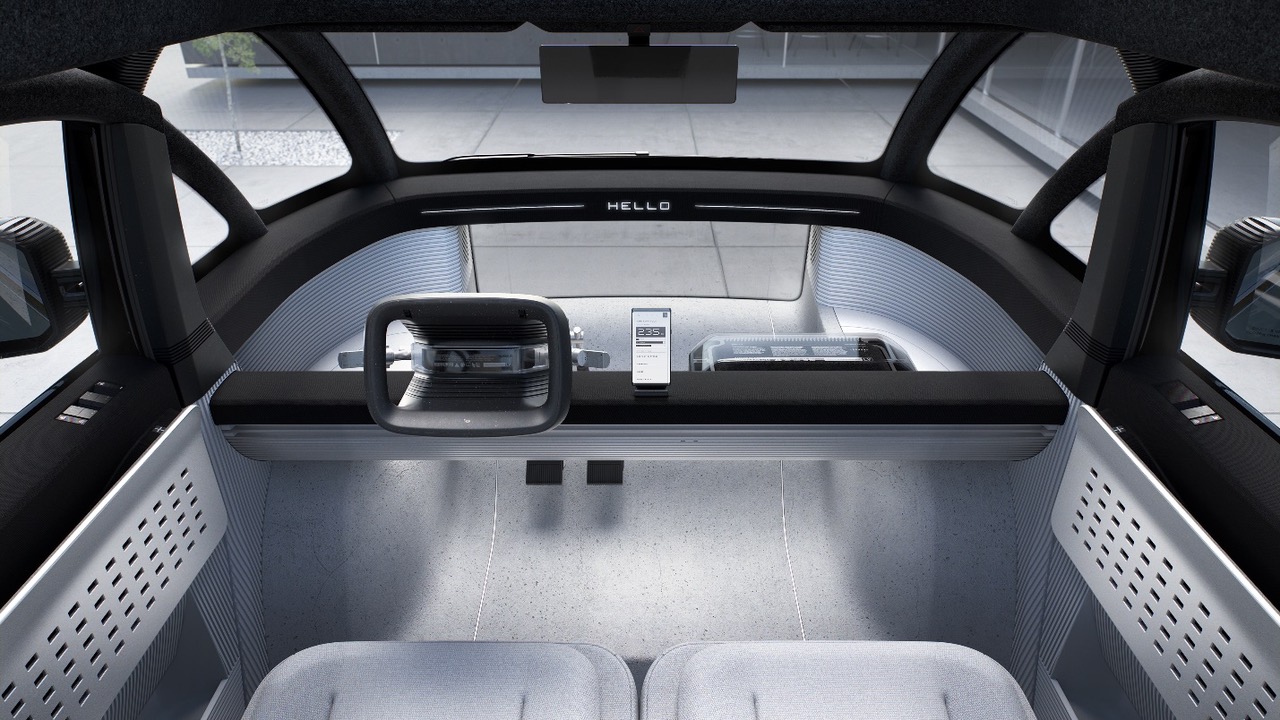
The first vehicle will have enough room for seven people, with the interior space of a large sport utility vehicle in a car with the footprint of a small compact car, the company says. In the back, seats are positioned in a semicircular formation against the sides and rear of the vehicle, while the front cabin is arranged like a sofa, according to Kranz.
“Cars always have been designed to convey a certain image and emotion; however, we chose to completely rethink car design and focus on what future users will actually need. Thus, we came up with this loft-inspired vehicle,” says Richard Kim, in Charge of Design at Canoo. “When you subscribe, you think differently about a car – now the value is defined by the user benefit. We implemented the Bauhaus philosophy, which is centered around minimalism and functionality, and started with the reduction to the absolute minimal need. Next, we applied that approach to the seamless connectivity with the personal devices customers care most about – their phones.”

Entertainment systems are dependent on customers’ own devices and the canoo is compatible with both iOS and Android operating systems. Rather than having a central display, the company expects that drivers and passengers will want to use their own navigation and apps in the vehicle.
Kranz says it was also made with autonomy in mind, and while the current system is arrayed with seven cameras, five radars and 12 ultra sonic sensors to provide level two autonomy. Kranz is especially proud of a new feature which has a video camera focused on the driver to monitor their actions and avoid unnecessary alerts when they’re operating a vehicle safely.
“We watch the face and the meaning of the driver with the camera” Kranz says. “When the camera recognizes that the driver pays attention… like looking to the right side and checking blind spots, we don’t warn them with an alert… Because people sometimes turn off the warning systems.”
The heart of the Canoo system though, is its “skateboard” architecture, which houses the batteries and the electric drivetrain in a chassis underneath the vehicle’s cabin. All of the companies vehicles will have the same base and different cabins to create all sorts of vehicles for different applications, the company says.
The first vehicle has a five-star safety rating and includes driver and passenger airbags throughout the canoo. The skateboard platform can also support dual, front, or rear motor configurations the company said.
Finally, the company says it will have the first truly steer-by-wire vehicle on the market without a hardware connection between the steering wheel and the wheels.
Steering is conducted by electric signals only, with a fully redundant control system that the company says has some long-term benefits for future designs. Steer-by-wire offers both weight savings and gives Canoo flexibility on where to locate the steering wheel to accommodate different designs and . driver positions.
As for range, the company’s first car has a range of 250 miles and can reach an 80% charge in less than 30 minutes. Its battery pack is fastened directly to the skateboard structure and saves more space since there’s no separate structure. The battery also is able to provide torsional rigidity and support for the vehicle since its resting directly on the chassis.
Kranz wouldn’t say how much Canoo will charge for its subscription service, but said that the company can reduce its cost because it can depreciate the vehicle’s value over a seven-to-ten year timeframe. “These savings we will be able to give back to the customer,” he said. And even with the low price, Kranz expects to make a mint with his new company. “We want to be the first EV company that makes a profit with an EV,” he says.
The rental model will help as will the company’s conservative rollout plan. Kranz says that Canoo will start offering its subscription vehicles in one geography and scale slowly from there.
“We will roll out city-by-city,” he says. “Eight to ten cities represent more than 70% of all the electric vehicle population [so] there is no need to provide our EV nationwide.”
The plan for 2021 is to launch in Los Angeles and have another eight cities account for the company’s U.S. market. That means four on the West Coast and four on the East Coast, according to Kranz.
“After the launch in the U.S. we are considering launching the vehicle in China… There are 18 cities that represent 75% of the EV population in China,” he said.
The controlled expansion plans and modest goals for geographical reach should be a big benefit for the company, according to Kranz.
“It gives us the big advantage that we can easily control our fleet and we are ramping up in a more conservative way and we are not bragging that we can churn out hundred thousand of cars,” he says. “We know how difficult it is to manufacture a good quality car at a high pace.”
CEO ouster, looming layoffs and devaluation turn WeWork into cautionary tale
Major layoffs are all but inevitable at high-flying real estate startup WeWork after Adam Neumann succumbed to pressure today to step down as CEO and take the role instead of non-executive chairman of the company he cofounded nine years ago.
Two well-placed sources tell us that the scope is likely to be massive, and includes some of of its newest business divisions, which these same sources anticipate will be jettisoned to get the company’s focus back on its core business. One of these sources speculates that over time, up to half of WeWork’s 15,000 employees — 9,000 of whom have been brought on in the last two years — could be laid off to shore up the unprofitable company’s expenses. The sentiment echoes a new piece in The Information that reports a “group of executives from WeWork’s parent company and bankers” have discussed laying off as many as 5,000 employees—a third of its workforce.
Neumann won’t have as much say in the matter, either way. As part of his departure from the role, he has agreed to further reduce the power of his supervoting shares from an original 20 votes for every one vote that a regular investor in WeWork would receive to just three, reports Bloomberg. His wife, Rebekah, a cofounder who is thought by insiders to have played a heavy role in the company’s original — and highly atypical — IPO prospectus, is also leaving the business.
It’s rather breathtaking, the speed with which the couple was just elbowed aside. Still, some others involved in the company look poised to get a far worse deal. The Japanese conglomerate SoftBank currently stands to lose billions of dollars on its investment in the company — if it doesn’t wind up writing down nearly the entire investment. Even an aggressive ratchet clause won’t do much to protect SoftBank if WeWork’s shares eventually sink on the public market.
It would seem an extreme correction to a culture that had become, well, anything but restrained. It’s also far from clear that it would have the intended effect of attracting public shareholders to the company, whose wheels began to come off when SoftBank first plugged $4.4 billion into WeWork roughly two years ago, according to our sources. (Roughly $6 billion more would follow.) As says one of these individuals, who has known Neumann for many years, “Adam already had a healthy ego. What the f_ck do you think is going to happen when he’s given billions of dollars?”
Trump impeachment could derail administration’s maneuvers in tech
Speaker of the House Nancy Pelosi announced official impeachment proceedings against President Trump today, and while the approaching political fracas may not be directly tech-related, it could have serious effects on several efforts at the federal level to rein in or otherwise influence the tech industry.
Impeachment does not mean the government stops doing what it needs to do, of course. But it does immediately become one of the highest priority items on the White House’s already crowded to-do list. It’s more than possible that with impeachment work, the smoldering conflict in Saudi Arabia, immigration and ICE issues, and innumerable other issues and legal challenges, something like social media regulation may simply not be important enough to actively pursue.
The Trump administration has a complicated relationship with the tech industry. Many would say that it was the savvy leveraging of social media that helped the man get elected. And Trump has embraced Twitter so closely as to make it effectively the main instrument of his office. But he has also repeatedly lashed out against companies like Facebook and Google for a variety of reasons, often having to do with a perceived bias against him or conservatives in general.
This summer, for example: In July the president said there “may or may not be National Security concerns with regard to Google and their relationship with China.” Then the next week he suggested Google had taken “very illegal” actions, specifically that they “suppressed negative stories on Hillary Clinton, and boosted negative stories on Donald Ttump [sic].” Shortly after that, he accused Google of having “manipulated from 2.6 million to 16 million votes” in favor of Clinton in the 2016 election, saying “Google should be sued.”
This is only a handful of examples, from a period of weeks. While these events individually appear to have occurred spontaneously in response to what the president was watching or being told at the time (for instance in the last case, Fox News had mentioned the report minutes earlier), they amount to a semi-organized collection of actions that in aggregate may have eventually been called policy.
The multi-state investigation of potential antitrust violations by Google does not seem to in fact have been instigated by the White House, though the FTC and Department of Justice investigations were likely spurred by the Executive in some form or another.
But Trump has also found himself at least notionally on the side of Big Tech elsewhere; for instance, on the question of privacy and user protection laws. States like Illinois have had highly robust laws in place for years that have proven a thorn in many a company’s side. With California enacting its own, the industry decided that enough was enough, and has been calling loudly for federal intervention. The logic is that a federal law on the matter of, say, selling personally identifiable information to advertisers, would be more lenient and preempt state laws. And they are right not to expect anything of the scale or rigor of GDPR.
While some of these machines are already in motion, the White House has yet to set others on their way — for example a puzzling rumored order that would have put the FCC in charge of regulating social media. Tech companies are likely breathing a sigh of relief at the thought that Trump’s attention will be elsewhere as impeachment proceedings begin and blend into the 2020 election.
Tech will remain at the center of many national debates and actions, but impeachment may very well have pushed these troublesome but ultimately not urgent efforts from the back burner and onto the floor.
NBCU launches LX, a local news network aimed at younger cord cutters
NBCU is again going after Gen Z and millennials with the launch of a new digital news brand and soon-to-arrive streaming network, called LX — short for “Local X.” Local, because the focus is on local news and “X” because…well, it sounds cool? (NBCU says it’s for LX’s “exponential abilities,” if you want the official reasoning.)
The service will be run by NBCU’s 42-station group, NBCUniversal Owned Television Stations, which will next year begin delivering LX’s programming as both an over-the-air and streaming network.
The company says the news programming on LX will feature “visually rich,” longer-form content — which is a switch from NBC’s other, earlier efforts in targeting the younger demographic.
For instance, NBC’s new streaming news network, NBC News Now, launched in May, delivers hourly live updates called “Briefly’s” as one of its key features. NBC also invested in a Snapchat news show, “Stay Tuned,” where it delivers a selection of top stories in just a few minutes.
LX is a different sort of news-telling experience — one that’s more akin to a news magazine, rather than a traditional local newscast.
Its “Visual Storytellers,” as the reporters are called, will work within their own communities — including LA, Boston, Dallas, Miami and New York — to offer local stories and background on complex issues, says NBCU.
Among the group of storytellers are LA’s Chase Cain, formerly of Hulu, who will use 360-degree videos as part of his storytelling efforts; Ngozi Ekeledo, previously a reporter for the Big Ten Network in Chicago, now in Boston; a two-time Emmy winner whose background is in local TV news, Clark Fouraker, in Dallas; plus Bianca Graula, a bilingual journalist who will focus on Miami stories; and former Vice News Tonight reporter Alexa Liautaud, in New York.
The programming launched on Monday with stories about climate change, urban farming, a surfing program for black women in California and a young female Asian chef and James Beard nominee who launched a successful restaurant without experience or training.
Currently, the content is airing on YouTube at NBCLX, on LX.com and across social media platforms (@NBCLX.)
In April 2020, LX will debut as an over-the-air streaming network with live programming included, too. That means local newscasts will be added into the mix of coverage.
And the network will feature fewer and shorter ad breaks at that time, the company says.
More broadly, the service aims to attract an audience of younger people who no longer watch television in the traditional sense. Today’s cord cutters and “cord nevers” often get their news from social media, podcasts, apps and other digital-first sources.
That’s a challenge for a news division focused on local TV.
“Our younger audiences want stories that are relatable. They want to feel a connection with the people delivering the news to them. They want more context about what’s happening in their neighborhoods. LX will deliver this and more,” said Valari Staab, president, NBCUniversal Owned Television Stations, in a statement. “Our team has been working hard to create a place that younger audiences can go to watch stories that are about them, and get the background about complex issues happening in their own backyard but still walk away feeling inspired about the power we all have to affect positive changes for our communities,” she added.
Target Global is firming up its bet on Barcelona’s entrepreneurs
VC firm Target Global has just announced it’s expanding its European network by adding a local office in Barcelona, Spain — building on its existing presence in Berlin and London, plus Tel Aviv and Moscow.
The firm has €700 million under management and a broad investment range that covers SaaS, marketplaces, fintech and insurtech, as well as a big focus on mobility.
TechCrunch sat down with general partner Shmuel Chafets and investor director Lina Chong, who will be heading the firm’s push into Spain, to talk about its decision to set up shop in Barcelona — discussing how they see the local and national ecosystem, as well as picking their brains on wider investments trends and regulation in Europe.
Want to know what it takes to get a meeting with Target Global and factors they weigh when they’re deciding whether to cut a check or not? Read on…
The interview has been lightly edited for clarity.
TechCrunch: Why choose Barcelona and why now? Why not Spain’s capital, Madrid — or even a city like Paris?
Shmuel Chafets: First of all have you been outside!?
I started coming to Barcelona four or five years ago just to see things and we had some angel investments here and it feels to me today — or when Lina and I started getting more serious about Barcelona it seemed to us that Barcelona has the attributes of Berlin eight or nine years ago. When I at least started coming to Berlin and Lina moved to Berlin, it has the same attributes. It looks like it’s just about to happen
I think it has a few factors. The first one is that it’s a great place to live and you can’t ignore that. In Europe, if you’re a team and you’re an international team there are very few places that you can live in. So London is the original ex-pat city of Europe and it still is amazing but very, very expensive. Berlin is the second one. And I think a lot of Berlin’s early success was fuelled by people who were not necessary German and definitely not Berliners coming and starting a company there.
It’s a good place to live, it’s also a cheap place to live, and it’s a cheap place to do business. Salaries here are quite low but the quality of living is quite high and that makes it very good for startups. Particularly when you need young people, developers, creative people to move. It’s an easy place to convince people to move to.
It doesn’t have a dominant industry. And that is very similar to Berlin — Berlin is not where Germany economically is, and that means that the smartest people around want to go in for startups. That’s the best employment option. There is no banking industry sucking people in with high salaries. And also driving costs up. It is in its culture a very creative city, a very open, very creative city and that I think is also very important.
And lastly, there are these early success stories that fuel the idea of entrepreneurship and also fuel financial entrepreneurship. So one of the interesting things about entrepreneurship is that people who start need to know where it ends or where it’s going to. And the early success stories — first of all they make the smartest kid graduating — who has a McKinsey job offer and a Goldman Sachs job offer and a startup idea — he needs to know that the startup idea has a future. That there’s a future in being an entrepreneur and he needs to look up to people around him. It’s not enough to know that Mark Zuckerberg dropped out — that’s fine but that’s very far and very large.

Image via Getty Images / Pol Albarrán
But to look at Carlos [Pierre, founder and CEO] from Badi and say okay there’s a guy, he’s a few years older than me, he started a company, he’s doing very well — this is the path that I want to take.
Also, there are more and more mentors. People who’ve done it before. And they can help you figure things out. You have to be able to call someone up and say hey let’s have breakfast and explain how they do it.
And there’s more money — for seed. Because you look at a lot of people starting funds, and we were just talking on the way about the Ticketbis guys. They’re starting a fund. And that’s a great example of one of these early success stories and now they’re putting it back into the ecosystem and helping it grow.
Rocket Internet did a lot of that in Germany. They had early exits and then they went and plowed it all back into the ecosystem in their own particular way. People like [serial entrepreneur] Lukasz Gadowski — who we work with a lot. He built Spreadshirts… [then later] he founded Delivery Hero. So through Team Europe. So people who were early, early entrepreneurs — and then in the second wave helped build an ecosystem. So I think there are more and more people like that that we see here.
That usually fuels the ecosystem. Also as companies here start to scale and as more of these European startups start to build hubs here there’s more experience. You can find people who’ve been through a couple of rounds.
And the last thing which is not about Barcelona it’s about Spain in general. There’s a decent local domestic market and there is a natural second market in South America. And actually in the US too — because Spanish is the second most commonly spoken language in America so when you start a company here you have that second market built-in. Which is very important — you can scale it.
Latin America is a fascinating market right now, a fascinating time. So in a way, it’s a way for us to make a side bet on Latin America in a way without going out of Europe and insetting far. My first boss told me never to do business in a place where there’s no direct flight from where I live and I adhere to that. If things go belly up you don’t want to be stuck in transfer in some airport sitting there waiting for a transfer.
TechCrunch: So in a way being in a second city — this isn’t Madrid, Spain’s capital — is a more interesting proposition for startups because there’s less competition for talent?
Chong: It’s a bit of an underdog here. There are not these big dominant industries. It’s not cosmopolitan like how Madrid is perceived. There’s a lot of creativity, a lot of people who are more entrepreneurial in spirit.