Opinion: Transgender employees live in fear even in the most progressive workplaces. Clearer and more dedicated support is needed.
Category: Tech news
hacking,system security,protection against hackers,tech-news,gadgets,gaming
Want to Find the Best Parking Spot? Do the Math
Here’s how to strike the optimal balance of parking close to the entrance without wasting too much time circling.
Stumbles at Uber and WeWork Don’t Mean the End of Tech
Opinion: Venture capitalists can be subject to the same bubbles and group think as ordinary investors.
Alberto Salazar, World Records, and Athletics’ Greatest ‘Hug’
Do negative splits actually matter? Did Salazar deserve a 4-year doping ban? WIRED editor Nicholas Thompson and elite runner Knox Robinson hash it out.
GoPro Hero 8 Black Review: A Better GoPro
The Hero 8 Black’s new body design and attachable accessories may attract a whole new crowd to GoPro. WIRED’s full review.
Today’s Cartoon: Deepfake Awards
It’s an honor just to be nominated.
Welcome to the Age of ‘Airbnb for Everything’
In the sublet economy, you can turn anything into extra cash: your house, your car, your boat, or your backyard.
7 Trillion Microplastic Particles Pollute the San Francisco Bay Each Year
A new report shows an astounding amount of microplastics, largely from car tires, are tainting the watershed.
On TikTok, There Is No Time
The popular app doesn’t tell users when a video was posted. Creators say that makes it easier to steal content—but there are also upsides to forgetting what day it is.
Twitter’s Speech Policies Shouldn’t Be a Campaign Issue
Senator Kamala Harris wants President Trump banned, but that could give Twitter—and Trump’s tweets—more weight.
In the dual-class shares debate, the big exchanges should get off the sidelines
Adam Neumann’s fall from grace was astonishingly swift once his company, WeWork, filed to go public in August. Even while his spending was fairly well-documented across time (as were his apparent conflicts of interest), he was humiliated for enriching himself, then ultimately kicked out of the corner office before the company, in the least surprising turn of events in recent weeks, today yanked its S-1 registration.
Neumann never exactly hid who he is or how he operates, so what suddenly sparked the ire of reporters — and investors — around the world? What, exactly, in an ultimately unsurprising IPO filing had people coughing up their morning coffee? Boiled down to the worst offense (including selling his own company the trademark “We” for $5.9 million in stock) was very likely the lock on control that Neumann had set up through a multi-class voting structure that aimed to cement his control. And by ‘cement,’ we mean he would enjoy overwhelming control for not just for 5 or 10 years after the company went public but, unless Neumann sold a bunch of of his shares, until his death or “permanent incapacity.”
Given that Neumann is just 40 years old and (mostly) abstains from meat, that could have been an awfully long time. Yet this wasn’t some madcap idea of his. There are plenty of founders who have or who plan to go public with dual or multi-class shares designed to keep them in control until they kick the bucket. In some cases, it’s even more extreme that that.
Consider at Lyft, for example, Logan Green and John Zimmer hold high-voting shares entitling them to twenty votes per share not until each is dead but both of them. If one of them dies or becomes incapacitated, Lyft’s so-called sunset clause enables the remaining cofounder to control the votes of the deceased cofounder. Even more, after the lone survivor bites the dust, those votes still aren’t up for grabs. Instead, a trustee will retain that person’s full voting powers for a transition period of 9 to 18 months.
The same is true over at Snap, where cofounders Evan Spiegel and Bobby Murphy have designated the other as their respective proxies. Accordingly, when one dies, the other could individually control nearly all of the voting power of Snap’s outstanding capital stock.
Unbelievably, that’s not the worst of it. Many dual class shares are written in such a way that founders can pass along control to their heirs. As SEC Commissioner Robert Jackson, a longtime legal scholar and law professor, told an audience last year, it’s no academic exercise.
You see, nearly half of the companies who went public with dual-class over the last 15 years gave corporate insiders outsized voting rights in perpetuity. Those companies are asking shareholders to trust management’s business judgment—not just for five years, or 10 years, or even 50 years. Forever.
So perpetual dual-class ownership—forever shares—don’t just ask investors to trust a visionary founder. It asks them to trust that founder’s kids. And their kids’ kids. And their grandkid’s kids. (Some of whom may, or may not, be visionaries.) It raises the prospect that control over our public companies, and ultimately of Main Street’s retirement savings, will be forever held by a small, elite group of corporate insiders—who will pass that power down to their heirs.
Why public market investors haven’t pushed back on such extremes isn’t clear, though they’re far from an homogenous group, of course. Surely, some aren’t aware of what they’re agreeing to when they’re buying shares, given that dual-class structures are far more prevalent than they once were. Other investors may plan to churn out of the shares so quickly that they’re uninterested in a company’s potential governance issues later in time.
A third possibility, suggests Jay Ritter, who is a professor of finance at the University of Florida and an I.P.O. expert, is that even with dual-class structures, shareholders have legal rights that limit that ability of an executive who has voting control to do anything he or she wants. Further, the board of directors, including the CEO, has a fiduciary duty to maximize shareholder value.
Says Ritter, “I don’t think it’s accidental that with the We Company, the board of directors let [Neumann] get away with various things, and as it was transitioning to a public company, a lot of [outside participants] pushed and said, ‘This is a company where we’re worried about corporate governance and we’re willing to apply a big discount to people with inferior voting rights.’”
Of course, some investors believe visionary founders should be left to control their companies as long as they wish because, in the case of Alphabet and Facebook specifically, their founders have produced asymmetric returns for many years. But we’re still fairly early into this experiment. Do we really want more situations like we saw with Sumner Redstone of Viacom, with trials over founders’ mental capacity playing out in the media?
For his part, Alan Patricof — the renowned venture capitalist who founded the private equity firm Apax Partners before cofounding the venture firm Greycroft — say he isn’t looking forward to that future. Instead, he think it’s time the exchanges that list these companies’ shares do something about it. “I”m not holier than thou in this industry,” says Patricof, “but if you want to be a publicly traded company, you should act like a public company.” To Patricof, that means one vote for one share — period.
There’s a precedent for intervention. Patricof notes that dual-class stock first emerged in 1895 and by that 1926, there were 183 companies with such stock. It became so widespread, that the New York Stock Exchange banned the use of non-voting stock until 1956, when it made changed its rules for the Ford Motor Company, which granted only partial voting rights to new shareholders. In the ensuing years, few companies took advantage of dual-class listings until Google bounded onto the scene and now, 15 years after its IPO, it’s like 1926 all again.
Indeed, while Patricof is sympathetic to the argument that founders might need protection for a few years after an IPO, things have gone way too far, in his estimation, and he thinks the best solution would be for the NYSE and Nasdaq to meet for lunch and decide to ban multi-class shares again.
There aren’t a lot of other options. VCs aren’t going to force the issue by turning away founders with whom they want to work. Neither are bankers or large institutional investors like mutual funds; they’ve also shown they’re more than happy to look the other way if it means money in their pockets. “I could be wrong,” says Patricof, “but I don’t think it would that tough for [the big exchanges] to impose a ban that keeps founders from wielding so much power at the expense of the company’s other shareholders.”
Given how fiercely competitive the exchanges are, it’s certainly hard to imagine, this meeting of the minds. But the only other plausible path back to a saner system would seemingly be the Securities & Exchange Commission, and it seems disinclined to do anything about the issue.
Indeed, while Commissioner Jackson has advocated for change, SEC Chairman Jay Clayton would clearly prefer to leave well enough alone. After the S&P Dow Jones Indices and another major index company, FTSE Russell, decided to ban all companies with multiple classes of stock a couple of years ago — they’re uncomfortable with forcing popular index funds to buy stakes in companies that give investors little say in corporate decisions — Clayton reportedly called the moves “governance by indexation” at a conference.
He’s worried that the indexes are being heavy-handed. On the other hand, something has to give, and a lot of market participants might rather see companies being forced to do abandon dual-class shares — or, at least, forced to dismantle their multi-class structures after a fixed period — to watching those with with unchecked power get broken into pieces afterward.
The reality is that neither WeWork, nor Neumann, are not the zany outliers they’ve been made to seem. They’re very much a product of their time, and if public market shareholders don’t want to see more of the same, something has to be done. It might be incumbent on the exchanges to do it.
Khatabook raises $25M to help small businesses in India record financial transactions digitally and accept online payments
Even as tens of millions of Indians have come online for the first time in recent years, most businesses in the nation remain offline. They continue to rely on long notebooks to keep a log of their financial transactions. A nine-month old startup that is helping them digitize their bookkeeping and accept online payments just raised a significant amount of capital to expand its operations.
Khatabook, a Bangalore-based startup, said on Tuesday it has raised $25 million in a new financing round. The Series A round for the startup was funded by GGV Capital, Partners of DST Global, RTP Ventures, Sequoia India (Khatabook was part of its Surge accelerator program), Tencent, and Y Combinator. The startup has raised $29 million to date.
A clutch of high-profile angel investors including Gokul Rajaram of Square, James Viraldi of TikTok, Aditya Agarwal of Dropbox, Sriram Krishnan of Twitter, Sriram Krishnan, formerly with Spotify and Tinder, Akshay Kothari of Notion, Amrish Rau of PayU, Anand Chandrasekharan, formerly with Facebook, Deep Nishar of SoftBank, Jitendra Gupta of LazyPay, Kunal Bahl of SnapDeal, and Kunal Shah of CRED also participated in the round.
Khatabook operates an eponymous Android app that allows micro, small and medium-sized businesses to keep a digital log of their financial transactions and accept payments online. The app, which was launched on Google Play Store in December last year, has amassed 5 million merchants from more than 3,000 cities, towns, and villages in India, Ravish Naresh, cofounder and CEO of Khatabook, told TechCrunch in an interview this week.
The app, which supports 11 languages, was used to process transactions worth more than $3 billion in the month of August, said Naresh. Most merchants in developing markets are currently not online. They continue to rely on logging their financial transactions — credit, for instance — on notebooks and pieces of paper. As you can imagine, this methodology is not structured.
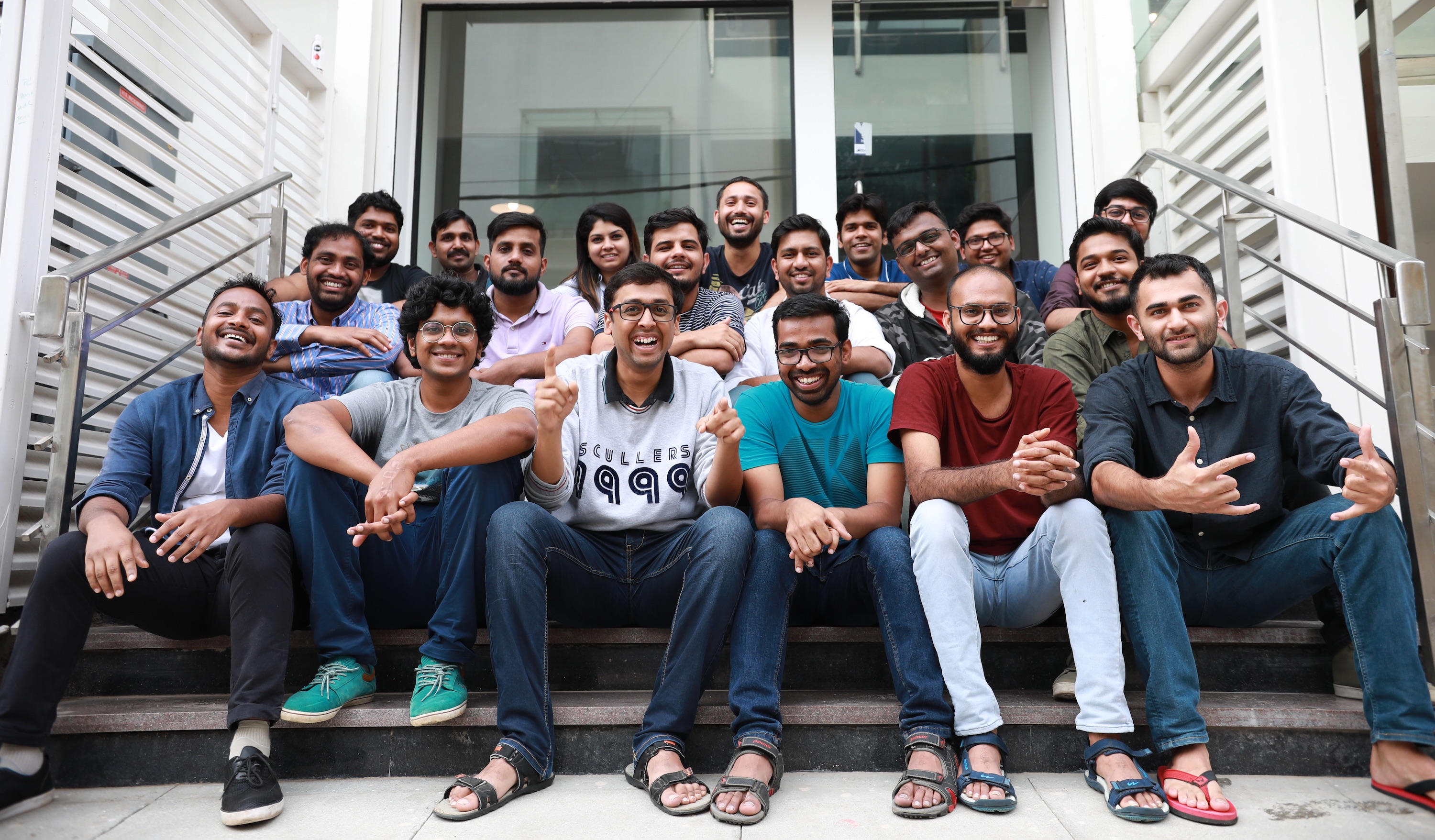
Even as Reliance Jio, a telecom operator launched by India’s richest man Mukesh Ambani, upended the Indian market and brought tens of millions of Indians online for the first time in last three years, most businesses in the country are still carrying out their operations without the use of any technology, said Naresh. “Could we build an app that makes it very easy for merchants to digitize their bookkeeping?” he said.
“As soon as we launched the app, we instantly started to go viral,” he said. “These shop keepers and roadside vendors have an internet-enabled smartphone, they are just not using it in their businesses. All they needed was a simple-to-use app.”
For several months now, the startup has been seeing 20% growth each week, he said. In six months, the app has helped businesses recover $5 billion in previously unpaid credits, Naresh claimed. Without any marketing, the app has also gained a significant number of users in Nepal, Pakistan, and Bangladesh, said Naresh.
“At Khatabook, we have taken early but significant steps towards leveraging this trend to digitize India’s shopkeepers. For most of our merchants, we are the first business software they’ve used in their entire life. And we will continue to build more India-first innovations to further enable the growth of what is still a largely untapped sector,” he said.
In a statement, Hans Tung, Managing Partner of GGV Capital, said, “as a global investor, we seek out founders who understand the local market and respond to growth opportunities with speed and agility – we certainly see this with the Khatabook team.”
Naresh, a cofounder of property startup Housing, said Khatabook will use the capital to build new features such as billing and invoicing to serve merchants. In next 12 months, Khatabook aims to add 25 million businesses, he said. The app currently does not charge merchants, but Naresh said the startup will introduce some additional features in the future that will enable monetization of its user base.
A growing number of startups and major giants in India are attempting to help businesses. OkCredit, which raised $67 million last month, serves 5 million merchants. IndiaMART, a 23-year-old B2B firm that went public this year, led a round in a startup called Vyapar last month that is addressing similar problems. New Delhi-based BharatPe raised $50 million in late August to help businesses accept digital payments.
Last month, Google unveiled a version of its payment service for businesses that will allow them to quickly establish some web presence and accept online payments.
“India has more than 60 million small and medium-sized businesses, however only a fraction of them support digital payments. Imagine the transformation that is possible if more of these merchants could access payments online,” said Ambarish Kenghe, director and product manager for Google Pay, at the event.
Monthly enlists experts and celebrities to teach 30-day online classes
You may know Max Deutsch from Month to Master, his yearlong self-improvement program where he tried to master one “expert-level” skill each month — such as solving a Rubik’s Cube in 20 seconds, holding a 30-minute conversation in a foreign language and even challenging world champion Magnus Carlsen to a game of chess (Deustch lost).
Now, Deustch and his co-founder Valentin Perez are launching Monthly, which Deustch told me is designed to “leverage technology to help scale this kind of learning to many more people.”
Specifically, Monthly offers 30-day classes taught by experts and celebrities — the instructors often have hundreds of thousands or millions of YouTube subscribers. For example, Andrew Huang is teaching a class on music production, Daria Callie is teaching a class on realistic portrait painting and Stevie Mackey is teaching a class on singing.
When you enroll in a class, you’ll be assigned a different task every day; you might watch an instructional video one day, and then do something more hands-on the next. While the classes are online, you have to enroll and take the class at set periods of time — currently, Huang’s class is the only one open for enrollment.
Deutsch acknowledged that this can seem “a bit antithetical to the benefit of online learning (that you can do it whenever you want),” but he noted that often, “‘whenever you want’ ends up offering most people too much flexibility and becomes ‘maybe some other time.’”
So by having explicit start and stop days for a class, he said, “the commitment you’re making to yourself is more significant and as a result you’re much more likely to stick with it and follow through on your aspirations.”
You’ll also be placed in peer groups with 20 other students, with whom you share work and give and receive feedback. And at the end of it, Deutsch said you’ll have produced “something tangible that you’ve made that you’re proud of and that you can share with the world” — a voice recording, a film, a painting, etc.
Pricing will vary from $179 to $279, depending on the class. Deutsch didn’t provide specific numbers on how the money is shared with instructors, but he noted that the split varies depending on whether students signed up via Monthly or via an instructor promotion. And either way, he said, “creators are getting a very compelling split.”
As for funding, Monthly has raised an undisclosed amount from Floodgate’s Ann Miura-Ko at Floodgate, Intuit founder Scott Cook (Deutsch worked as a product manager at Intuit), and OVO Fund’s Eric Chen.
Twitter launches its anti-abuse filter for Direct Messages
Twitter is rolling out its spam and abuse filter for Direct Messages, a month and a half after the company announced it had started testing the feature. The filter will be available on Twitter’s iOS, Android and Web apps.
The filter adds a new view to the Additional Messages inbox, where DMs from people you don’t follow go. If you click on it, messages that potentially contain offensive content also have their previews hidden, with an option to delete the message without opening it first.
We tested, and turns out filters help you cut through the noise to find gems. Who knew. So we’re rolling out this filter to everyone on iOS, Android, and web!
— Twitter Support (@TwitterSupport) September 30, 2019
The new DM filter is useful for people who want to keep their Twitter messages open, but (like most people) don’t want to see abusive content. The feature, however, feels long overdue considering that offensive messages are so common for users with open inboxes that third-party developers have launched their own filtering tools, including a recently-released plugin that detects and deletes dick pics.
Earlier this month, Twitter also released its Hide Replies feature in the U.S. and Canada after testing it in Canada. It gives users the option of picking replies to a tweet to hide, but does not delete them. Instead, they are still visible in a separate view that is linked to a button in the original tweet.
Upstart banking company Dave is now worth $1 billion, as Norwest puts in $50 million
Two years after the Los Angeles-based fintech startup Dave launched with a suite of money management tools to save consumers from overdraft fees, the company is now worth $1 billion thanks to a nascent banking practice that had investors lining up.
The company used its overdraft protection service and money management display to shift customers’ focus away from the total balance that their account would show by giving them a sense of how much was actually left in their accounts once debits were included in their statements.
“What was cool about our financial management product was that we were trying to use Dave as a replacement for their current bank,” says Jason Wilk, Dave’s co-founder and chief executive.
Dave now counts over 4 million users for its financial management app and has roughly 800,000 people on the waiting list to use its banking services, Wilk says.
The company has taken a methodical approach to opening its doors as a digital bank, in part because it wants to have the necessary support infrastructure in place to service the demand that Wilk expects to see for its service.
“It’s one thing to help people with budgeting. It’s another to actually manage their money,” says Wilk.
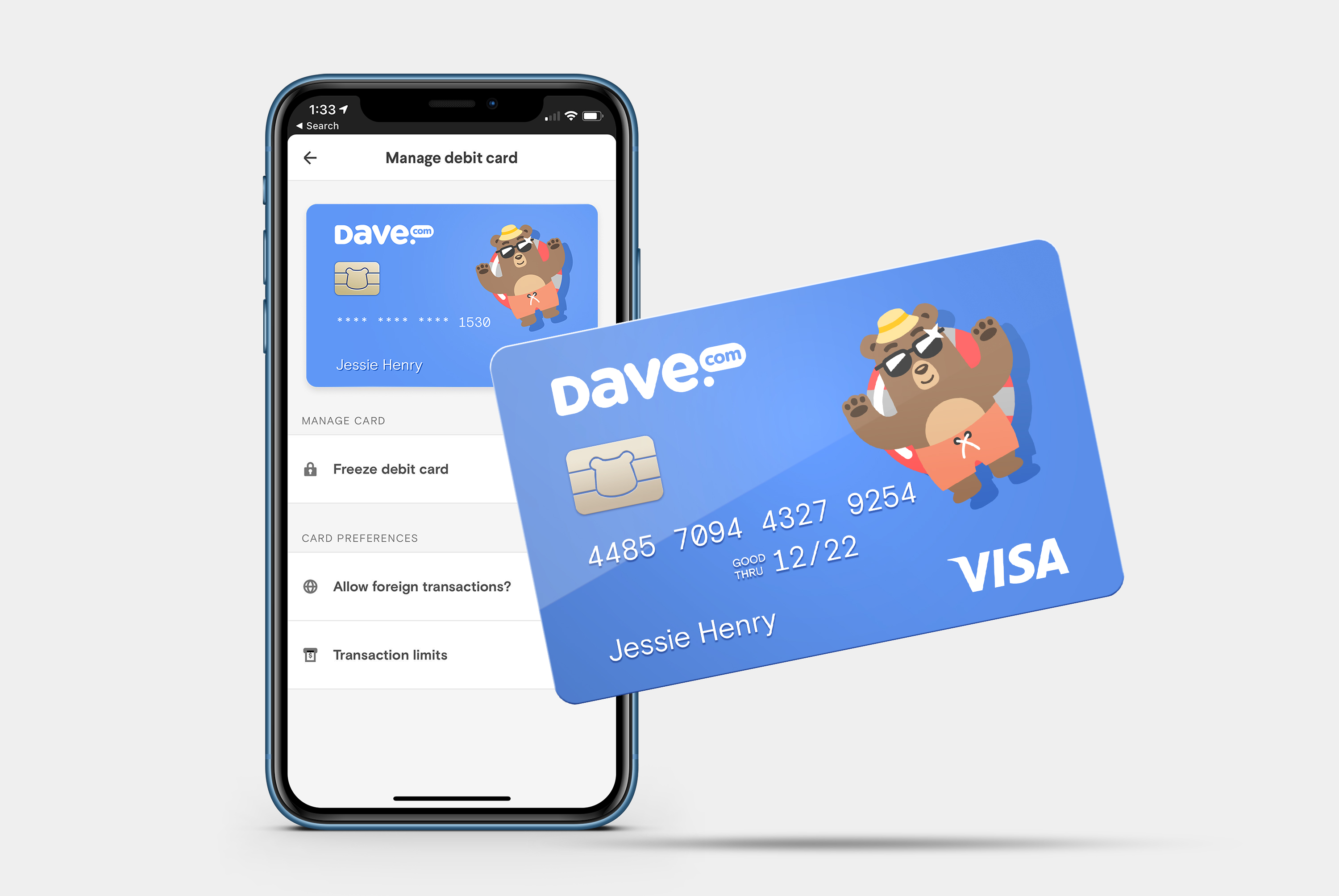
Dave will use the $50 million raised from Norwest to significantly expand its product and engineering team within the next 12 months, in order to double down on the core business and ensure the success of the banking product.
“We can prove that Dave can be helpful by showing how we can help you manage your current account, and then Dave banking is the marketing lever from there,” says Wilk.
For now, customers need to have the financial management app installed to be able to access the company’s banking service.
Dave charges $1 per month for access to its financial management tools and that also gives customers the ability to use a cushion of between $50 to $75 to avoid being hit with overdraft fees from their current bank account. Dave asks for a tip every time a customer uses that cushion to cover expenses — something that Wilk says is still cheaper than having to worry about overdraft fees.
And, to add a bit of environmental spin, for every tip that Dave receives, the company plants a tree. “We plant millions and millions of trees,” says Wilk.
The company is FDIC insured through a partner bank, the Memphis-based Evolve Bank and Trust, which acts as a backstop for the company’s financial management activities.
“We already had a relationship with them for some payment processing stuff,” says Wilk. “We liked the team and liked the terms and went with them.”
Terms between financial services firms can vary, and, Wilk says, Evolve Bank was willing to give the company a good deal on splitting the interchange fee, which is a big source of revenue for upstart banks.
It’s possible that Dave could have received a bigger check at a potentially higher valuation, but Wilk says the startup is trying to stay lean.
“The company is growing so quickly, we didn’t want to get too diluted on this round,” he says. “We think the company is quite a bit more valuable than [$1 billion]. You don’t want to raise too much money too quickly if you really think the valuation is going to climb… Since we signed the term sheet the company has already grown another 40%.”
It was only four months ago that Dave was announcing a $110 million credit financing with Victory Park Capital and the launch of its banking product.
Dave’s products and services have a few advantages for customers that are just getting started on the path to financial security. The company monitors everyday monthly payments and reports them to credit agencies to improve customers’ credit ratings. The company also provides up to $100, interest-free, overdraft protection.
“Banks have failed their customers by building products that put their own interests ahead of the humans who use them. People don’t need predatory fees, they need tools that actually solve their challenges around credit building, finding work and getting access to their own money to cover immediate expenses. Dave is the banking product that works with its customers, not against them,” said Wilk, in a June statement announcing the funding and banking product launch.
While Dave is getting some hefty firepower and a generous valuation from Norwest, it’s also operating in a market where its core services that were a point of differentiation are quickly becoming table stakes.
Earlier in September, the new startup banking company Chime announced that it had hit 5 million banking customers and was offering its own overdraft protection service.
The San Francisco-based bank has also raised a lot more capital for a potential piggy bank to raid if it needs to acquire or spend on engineering talent to build out new products and services. Earlier this year, the company announced a $200 million round and said it had hit roughly 3 million customers. Clearly Chime is adding new banking customers at a torrid pace.
And they’re facing global competition as well. N26, the European startup bank with a $3.6 billion valuation and hundreds of millions in financing launched in the U.S. a few months ago as well.
The company sees a global opportunity to create new digital banking services in a world where large amounts of capital and an elite set of consumers move easily between international markets.
“We have an opportunity that we build a bank that has more than 50 million users around the globe. Today, we only have 3.5 million users but we’re accelerating,” said N26 chief executive, Valentin Self, in an interview with TechCrunch. “From a country perspective, we have agreed already that we go to Brazil. There’s no plan after Brazil yet. Now let’s focus on the U.S., then on Brazil, then next year we’ll find out what’s the feedback from these two markets.”