Catch up on the most important news from today in two minutes or less.
Category: Tech news
hacking,system security,protection against hackers,tech-news,gadgets,gaming
WeWork expected to announce major layoffs
WeWork, the co-working business once valued at $47 billion, is expected to announce significant layoffs this month, Bloomberg reports. This follows reports the company was looking to slash as many as 5,000 roles, or one-third of its workforce.
Now expected to go public in 2020 at a valuation as low as $10 billion, WeWork is also in negotiations with JPMorgan for a last-minute cash infusion to replace the capital expected from the now-postponed IPO, per reports. The company, now a cautionary tale, has been working with bankers in recent weeks to reduce the sky-high costs of its money-losing operation.
News of potential layoffs come about two weeks after co-founder and chief executive officer Adam Neumann resigned from his post and the nine-year-old company postponed its highly anticipated initial public offering. Neumann is now serving as the company’s non-executive chairman, succeeded by WeWork’s former vice chairman Sebastian Gunningham and the company’s president and chief operating officer Artie Minson.
The embattled company has been struggling to satisfy Wall Street skeptics, who were floored by the company’s eye-popping valuation. Since Neumann’s resignation, WeWork has begun several cost-cutting initiatives and is reportedly looking to sell off several of its acquisitions, including Managed by Q, Conductor and Meetup.
Layoffs are a natural next step for the business as it aims to carve out a clear path to profitability, now a requisite for a 2020 IPO. To float at any point in the future, after all, WeWork must prove elevating “the world’s consciousness” will eventually lead to profits.
WeWork revealed an unusual IPO prospectus in August after raising more than $8 billion in equity and debt funding. Despite financials that showed losses of nearly $1 billion in the six months ending June 30, the company still managed to accumulate a valuation as high as $47 billion, largely as a result of Neumann’s fundraising abilities.
“As co-founder of WeWork, I am so proud of this team and the incredible company that we have built over the last decade,” Neumann said in a statement confirming his resignation. “Our global platform now spans 111 cities in 29 countries, serving more than 527,000 members each day. While our business has never been stronger, in recent weeks, the scrutiny directed toward me has become a significant distraction, and I have decided that it is in the best interest of the company to step down as chief executive. Thank you to my colleagues, our members, our landlord partners, and our investors for continuing to believe in this great business.”
WeWork declined to comment.
We’ll have self-flying cars before self-driving cars, Thrun says
Once you get up high enough, you don’t have to worry about a lot of the obstacles like pedestrians and traffic jams that plague autonomous cars. That’s why Sebastian Thrun, Google’s self-driving team founder turned CEO of flying vehicle startup Kitty Hawk, said onstage at TechCrunch Disrupt SF today that we should expect true autonomy to succeed in the air before the road.
“I believe we’re going to be done with self-flying vehicles before we’re done with self-driving cars,” Thrun told TechCrunch reporter Kirsten Korosec.
Why? “If you go a bit higher in the air then all the difficulties with not hitting stuff like children and bicycles and cars and so on just vanishes . . . Go above the buildings, go above the trees, like go where the helicopters are!” Thrun explained, but noted personal helicopters are so noisy they’re being banned in some places like Napa, Calif.
That proclamation has wide-reaching implications for how cities are planned and real estate is bought. We may need more vertical take-off helipads sooner than we needed autonomous car-only road lanes. More remote homes in the forest that have only a single winding road that reaches them like those in Big Sur, Calif. might suddenly become more accessible and thereby appealing to the affluent because they could just take a self-flying car to the city or office.
The concept could also have wide-reaching implications for the startup industry. Obviously Thrun’s own company, Kitty Hawk, would benefit from not being too early to market. Kitty Hawk announced its Heaviside vehicle today that’s designed to be ultra quiet. If the prophecy comes true, Uber, which is investing in vertical take-off vehicles, could also be in a better position than Lyft and other ride-hailing players focused on cars.
To make sure its vehicles don’t get banned and potentially pave the way for more aerial autonomy, Kitty Hawk recently recruited former FAA Administrator Mike Huerta as an advisor.
Eventually, Thrun says that because cars have to navigate indirect streets but in the air “we can go in a straight line, we believe we will be roughly a third of the energy cost per mile as Tesla.” And with shared UberPool-style flights, he sees the cost of energy getting down to just “$0.30 per mile.”
But in the meantime, Thrun is trying to get people, including me, to stop saying flying cars. “I personally don’t like the word ‘flying car,’ but it’s very catchy. The technical term is called eVTOL. These are typically electrically propelled vehicles, they can take off and land vertically, eVTOLs, vertical take-off landing, so that you don’t need an airport. And then they fly very much like a regular plane.” We’ll see if that mouthful catches on, and if the skies get more congested before the roads thin out.

Orbit Fab raises $3M to make orbital refueling easier, cheaper and more accessible
Orbit Fab, one of the companies competing in this year’s TechCrunch Disrupt Battlefield in San Francisco this week, has closed a seed round of $3 million. The funding comes from Type 1 Ventures, TechStars and others, and will help Orbit Fab continue to build on the great momentum it has already bootstrapped with its space-based robotic refueling technology.
You might remember the name Orbit Fab from a milestone accomplishment the young company achieved earlier this year: Becoming the first startup to supply water to the International Space Station, itself an achievement but also a key demonstration of the viability of its technology for use in orbital satellite refueling. Refueling satellites could have tremendous impact on the commercial satellite business, extending the operating life of expensive satellites considerably, which translates to better margins and more profitable businesses.
Thanks to co-founders Daniel Faber and Jeremy Schiel’s connections in the space industry, from more than 15 years working in space technology businesses in a leadership capacity, the company was able to demonstrate its technology working in space less than a year after Orbit Fab was actually founded. Faber, Orbit Fab’s CEO, and Schiel, the startup’s CMO, met when both were working at Deep Space Industries – Faber as CEO and Schiel as a contractor.
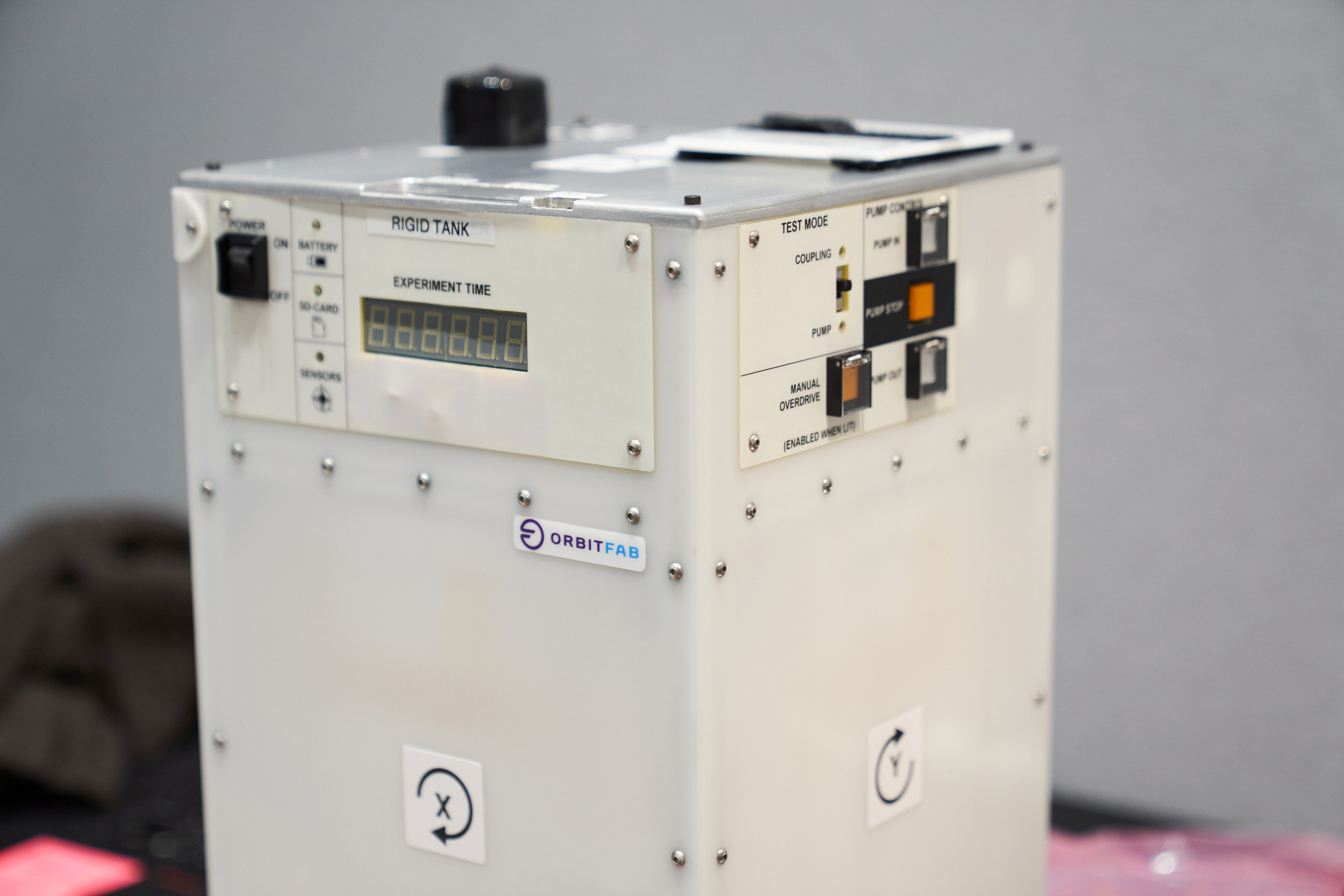
Orbit Fab’s first space payload, the ISS water resupply robot.
“We ended up reconnecting later on and really looking at a few different business models on how to push the industry forward,” Schiel said in an interview. “The one that really landed with customers, and the one that resonated with the industry was refueling satellites. Elon [Musk] has been making rockets reusable – we thought it’s time that we make satellites reusable as well.”
Starting from this realization, the pair founded the company in January 2018. They then secured their first round of pre-seed investment from Bolt in San Francisco in June that year, and also landed two contracts – including one with NASA, and one with the International Space Station National Laboratory.
“Basically in four-and-a-half months, we got flight-qualified and human-rated from NASA our two tanker test beds that we flew to the International Space Station in December 2018, and March of 2019,” Shield said.
How did they do it with that speed? Faber credits their rapid progress largely to lead engineer James Bultitude, an accomplished space engineer with five payloads on the International Space Station already.
“He took [the project] from a napkin through to flight hardware in four-and-a-half months,” Faber said. “All qualified to NASA human-rated safety standards, which was quite the feat. We really had to push hard on NASA.”
Faber said that the company’s ability to spur the U.S. space agency into action has been a key driver of its success. In fact, he relayed a story in which their National Lab demonstration payload was actually left off of its intended flight, but the team was able to get its cargo approved by top NASA decision-makers over the course of a weekend and just barely made the cut as a result.
As for working with NASA as a startup, Faber said that it’s become a very different affair, with the agency eager and adapting to working more with younger companies and startups bringing a different pace of innovation to the field.
“The change is almost palpable on the phone with NASA – you can almost hear them changing,” he said.
At Disrupt, Orbit Fab demonstrated their robotic connector for refueling on stage for the first time. The idea is that satellite makers will build their standard nozzles into their designs, and then a robotic refueler will be able to seek out the nozzle, open and then close on to the coupler, forming a solid connection to allow propellant transfer.
Already, Orbit Fab is talking to partners, including Northrop Grumman, and it’s a member of the Consortium for Execution of Rendezvous and Servicing Operations (CONFERS), an industry group that aims to make robotic service and maintenance of satellites a viable reality.
Lora DiCarlo founder says CES award snub did company ‘a pretty big favor’
CES parent the Consumer Technology Association created a public relations disaster in January when it unceremoniously revoked an award from sex tech startup, Lora DiCarlo and its product Osé.
“Vela [now Osé] does not fit into any of our existing product categories and should not have been accepted for the Innovation Awards Program,” the organization wrote at the time. “CTA has communicated this position to Lora DiCarlo. We have apologized to the company for our mistake.”
The CTA would go on to apologize and reinstate the award. During a panel today at TechCrunch Disrupt, founder and CEO Lora Haddock told the audience, that in hindsight, “I think they actually did us a pretty big favor.”
Back in May, we noted that the CTA’s apology serendipitously coincided with a $2 million funding raise for the company’s advanced sex toy. Haddock noted that, while the CTA’s initial move was understandably both “disheartening” and “devastating,” the startup’s decision to push back on historical biases, including booth babes and the underrepresentation of female speakers, ultimately became a win.
“We started to really look at some of their policies and recent procedures in the last few years,” Haddock said. “A lot of booth babes products that were on the floor are geared towards male sexuality, but apparently something geared towards a female gaze was frowned upon. So, we fought it, and eventually we ended up winning, we ended up on an international press circuit, we got a ton of ton of coverage.”
T4 wants to transform market research data with a combination of AI and humans
When T4 co-founder and CEO Maks Khurgin was working at Bain and Company, he ran into a common problem for analysts looking for market data. He spent way too much time searching for it and felt there had to be a better way. He decided to build a centralized market data platform himself, and T4 was born. This week the company competes in the TechCrunch Disrupt SF Startup Battlefield.
What he created with the help of his long-time friend and CTO, Yev Spektor, was built on a couple of key components. The first is an industry classification system, a taxonomy, that organizes markets by industries and sub-industries. Using search and aggregation tools powered by artificial intelligence, it scours the web looking for information sources that match their taxonomy labels.
As they researched the tool, the founders realized that the AI could only get them so far. There were always pieces that it missed. So they built a second part to provide a way for human indexers to fill in those missing parts to offer as comprehensive a list of sources as possible.
“AI alone cannot solve this problem. If we bring people into this and avoid the last mile delivery problem, then you can actually start organizing this information in a much better way than anyone else had ever done,” Khurgin explained.
It seems simple enough, but it’s a problem that well-heeled companies like Bain have been trying to solve for years, and there was a lot of skepticism when Khurgin told his superiors he was leaving to build a product to solve this problem. “I had a partner at Bain and Company actually tell me, “You know, every consulting firm has tried to do something like this — and they failed. Why do you think you can do this?””
He knew that figuring out the nature of the problem and why the other attempts had failed was the key to solving the puzzle. He decided to take the challenge, and on his 30th birthday, he quit his job at Bain and started T4 the next day — without a product yet, mind you.
This was not the first time he had left a high-paying job to try something unconventional. “Last time I left a high paying job, actually after undergrad, I was a commodities derivatives trader for a financial [services company]. I left that to pursue a lifelong dream of being in the Marine Corps,” Khurgin said.

T4 was probably a less risky proposition, but it still took a leap of faith that only a startup founder can understand, who believes in his idea. “I felt the problem first-hand, and the the big kind of realization that I had was that there is actually a finite amount of information out there. Market research is created by humans, and you don’t necessarily have to take a pure AI approach,” he said.
The product searches for all of the related information on a topic, finds all of the data related to a category and places it in an index. Users can search by topic and find all of the free and paid reports related to that search. The product shows which reports are free and which will cost you money, and like Google, you get a title and a brief summary.
The company is just getting started with five main market categories so far, including cloud computing, cybersecurity, networking, data centers and eSports. The founders plan to add additional categories over time, and have a bold goal for the future.
“Our long-term vision is that we become your one-stop shop to find market research in the same way that if you need to buy something, you go to Amazon, or you need financial data, you go on Bloomberg or Thomson. If you need market research, our vision is that T4 is the place that you go,” Khurgin said.
Civic Champs app gives nonprofits the tech tools to manage volunteers
Nonprofits employ 10% of the U.S. workforce and generate some $2 trillion in revenue each year and yet, many charitable organizations are still using pen and paper to track their volunteers.
Civic Champs, a startup that presented onstage at TechCrunch Disrupt SF, has developed a platform that aims to give non-profits the tech tools they need to better manage volunteers.
“The nonprofit market is underserved by technology companies,” co-founder and CTO Mike Jeffery told TechCrunch.
Civic Champs is initially focusing on volunteer management. However, the mobile app, which was built with React Native for Android and iOS, can be broadened over time.
For instance, the company recently launched a micro-donations feature that automatically converts volunteers to donors. The feature will integrate a number of payment options, including Stripe, Apple Pay, and Plaid/Dwolla for ACH donations.
The Civic Champs platform uses geolocation and geofences to automate volunteer-hour tracking. The seemingly simple task of checking volunteers into events and tracking their time can take a small nonprofit 10 hours per month to manage, according to the company. Civic Champs co-founder and CEO Geng Wang says their platform can slash that task down to an hour per month.
Civic Champs designed a mobile-first platform. However, the company’s co-founders say they understood that not all volunteers will have smartphones or want to use the app. So they developed three ways to use the platform.
Volunteers can use the Civic Champs mobile app to check in at events and track their hours. The platform has also been adapted to web-based kiosks, which nonprofits can use to make it easier for tech-averse volunteers to check in. A volunteer’s hours can also be tracked through a nonprofit’s administrative features on both the app and the web. All three tracking methods — mobile, web kiosk, or by administrator — synchronize volunteer tracking across platforms and between users and potentially multiple organizations.
With the launch of Civic Champs, Wang, who co-founded the startup with Jeffery and Ryan Underdahl, is now solidly in serial entrepreneur territory. Wang’s first startup, RentJungle, was an apartment search engine, which was acquired in 2014 by The Rainmaker Group. Wang’s second startup, a social media marketing firm called Community Elf that has since been rebranded as Cosmitto, was acquired in 2017 by private equity firm Topanga Partners.
For his third go around, Wang told TechCrunch he wanted to do something more mission-driven. The original idea was to create a mobile game for volunteering. This “Pokemon Go” of volunteering would let users contribute in small ways — like helping cities collect data on physical assets, such as traffic lights and fire hydrants using GPS and photo uploads.
But that idea quickly morphed into something larger when Geng started talking to volunteer organizations and learned the challenges were far more basic and widespread.
“Essentially, nine out of the 10 organizations we talked to still track their volunteers on pen and paper forms,” Geng said. “As a former consultant, I thought well that’s sort of crazy. That’s a lot of time that you’re spending on paperwork that you could direct back to the community and in certain, more impactful ways.”
The co-founders pivoted away from gamification and started developing a mobile platform that nonprofits can use to track volunteers. The company officially launched in January 2019.
Civic Champs has raised $312,000 in a pre-seed round and also received $29,000 in non-dilutive grants through the Indiana University CLAPP competition and the Indiana Technical Assistance Program.
The company is still figuring out its pricing structure. Civic Champs does have 34 customers, 24 of which are paid clients. The remaining 10 are pilots. The business model, which is set up like a Software-as-a-Service product, charges between $25 a month for its smallest customer up to $450 a month for its largest client.
The Rotary Club, Habitat for Humanity and The Audubon Society are among its customers.
‘Destiny 2: Shadowkeep’ Is Ready to Kill the Past
The new expansion is a haunted one that draws considerable dynamism and tension from making nostalgia horrific.
Meet Vise AI, the startup reimagining portfolio management
The founders of Vise AI met when they were 13, a couple of teenagers more interested in applied artificial intelligence than English class. Fast-forward several years and the pair has relocated from the Midwest to San Francisco to raise money for a financial technology business they’ve been self-funding since 2016.
As teenagers with an inordinate amount of AI knowledge, Samir Vasavada and Runik Mehrotra proved to be quite useful to large businesses, investment bankers and other financiers. Leveraging their AI know-how, they were paid $700 per hour by a consulting firm to teach financial “experts” about AI. Mehrotra, according to Vasavada, is a mathematical prodigy: “And that translates extremely well to AI, right, because what underlies AI is math,” Vasavada, co-founder and chief executive officer of Vise AI, tells TechCrunch. “We had the ability of articulating what AI is to investment bankers in a way that they would understand. Whereas most expert explanations would be really complex and very technical.”
Meanwhile, school was on autopilot. “I was taking phone calls in English class,” Vasavada said. “It wasn’t very good but we were making a lot of money.” Ultimately, that money funneled into the early makings of a real business, Vise AI, which automates portfolio management using AI and machine learning. Launching onstage at TechCrunch Disrupt San Francisco today, the SEC-registered investment advisor will begin customer on-boarding next week. In short, the platform analyzes clients’ investment needs and builds them a personalized portfolio of stocks, bonds and other assets, then provides investment manager tools to automate management.
“It’s an unsexy industry that makes all of the money in finance,” said Mehrotra, co-founder and chief technology officer of Vise AI.
For now, the team is going after independent advisory shops, those without a flock of analysts available at their beck and call and who need outsourced investment management. Ultimately, they plan to pursue the big wealth managers. The business has also been approved as a subadvisor by TD Ameritrade Institutional, which has thousands of independent RIAs on its platform.
“The icing on the cake is what we refer to as portfolio intelligence,” Vasavada explains. “We can provide unique insights, justifications and logic as to why specific investment decisions were made — talking points to make the advisor look smarter with the clients because it’s a relationship game with these advisors, so tools that will help build their relationships and help empower their relationships, while still delivering a better portfolio to the client is the type of solution that really needs to be built in this space.”
“We are literally giving them bite-sized portfolio intelligence,” adds Mehrotra. “Because most of them aren’t really doing the investment management themselves, right? So they’re either using some ETF allocation tool, like Betterment for Advisors, or something like that, where it’s just a standard set of ETFs and there really isn’t any personalization.”
We felt like we were turning away tons of money. Vise AI co-founder Samir Vasavada
Vasavada, hailing from Cleveland, and Mehrotra, raised just outside Detroit, met years ago at a Northwestern University summer research program. The two have since established themselves as AI experts, supporting high-profile clients (who they can’t name due to non-disclosure agreements) as consultants and completing the fintech conference circuit a few times over. But when it came to raising venture capital to exit the era of self-funding and launch their AI-enabled portfolio manager, they were clueless.
Their first infusion of outside capital came in the form of a $20,000 uncapped note from Dorm Room Fund. A little something to help them through the daunting fundraising process. But their first real pitch meeting was with none other than Vinod Khosla, the billionaire founder of Sun Microsystems and Khosla Ventures. Khosla’s son, Neal Khosla, had worked on the investment team at Dorm Room Fund and made the introduction.
Khosla passed and the Vise team realized they had no idea what they were doing. They began refining their pitch. After reaching out to roughly 1,000 different investors (Vasavada created a detailed CRM to track all their cold pitches) they raised $2 million from co-leads Keith Rabois, a co-founder at PayPal and a partner at Founders Fund, and Ben Ling of Bling Capital, two investors who were, ironically, former general partners at Khosla Ventures. Great Oaks Ventures, Flatiron Health co-founders Nat Turner and Zach Weinberg, Future Advisor founder John Xu, NFX’s Pete Flint and Contrary Capital also participated. Vasavada and Mehrotra said that once they had tapped two high-profile leads, offers came flooding in, including from VCs who had rejected them just weeks before.
“This was our first round of fundraising ever,” says Mehrotra. “So in the beginning, a lot of it was just like, figuring out how things worked and learning how to best pitch the company because it is a niche market. I think once we got the momentum … We felt like we were turning away tons of money.”
We want to empower advisors to be better at their jobs. Vise AI co-founder Runik Mehrotra
Once they reach $50 million in assets under management, Vise plans to raise a much larger round of funding to help the team expand and open an office in New York.
Vise is targeting a market worth trillions in one of the most valuable industries in the world. To succeed in the long term, the startup will have to infiltrate a decades-old network relying on legacy technology, as well as battle Silicon Valley’s narrative that robo-advisors will soon make the financial advisory space obsolete. According to their thesis, companies like Betterment and Wealthfront are successful with tech-rich millennials, but once one accumulates “real wealth,” it’s a conversation with a human being they’re looking for, not an easy-to-use app.
“We want to empower advisors to be better at their jobs, so they can focus on actually building better relationships and holding their clients’ hand,” said Mehrotra.
The Ukraine Whistle-Blower Did Everything Right
The Trump administration’s attacks on the whistle-blower aren’t just baseless—they could have a corrosive long-term effect.
Instagram’s New App, Threads, Is Just for Your Inner Circle
The new offering expands on Instagram’s “Close Friends” list, providing a completely separate space for sharing photos and messages with your besties.
Will Smith Is on TikTok Now
Also, ICYMI, here’s the first ‘Birds of Prey’ trailer.
Reclaiming South Africa’s Townships Through Queer Culture
The settlements can be dangerous places for queer people. The subjects of photographer Lee-Ann Olwage’s #BlackDragMagic want to change that.
If Each of Us Planted a Tree, Would It Slow Global Warming?
Ask a physicist: Just how much carbon could 7.5 billion new trees pull out of the atmosphere?
The Internet’s Horrifying Way to Get Google Apps on Huawei Phones
Just make a Chinese website your device’s remote administrator. It’ll be fine\!