Silicon Valley’s competing philosophies on tech ethics with The New Yorker’s Andrew Marantz

“If Silicon Valley is going to keep telling itself the story that the only uses of their technology will be the most optimistic, the most hopeful, the most salubrious, the most prosocial,” New Yorker staff writer Andrew Marantz told me in Part 1 of this recent conversation for Extra Crunch, “you can try to rebut that logically, or you can just disprove it by showing a very glaring counterexample. If somebody is going around and saying, ‘all swans are white,’ you can argue against that logically, or you can just show them a black swan.”

Author Photo Andrew Marantz credit Luke Marantz fix

Image via Penguin Random House

Marantz, a brilliant and eclectic writer, has in recent years trained his attention on the tech world and its contribution to social unrest in the United States and beyond. He has just published a new book, “Antisocial: Online Extremists, Techno-Utopians, and the Hijacking of the American Conversation“, which, along with recent New Yorker essays expanding on the book’s themes, is sure to provoke debate.

In part 2 of our conversation below, we discuss the Alt-Right and White Nationalists in tech and politics; Silicon Valley spirituality today; competing philosophies of tech ethics; and more.

Greg Epstein: If you look at the alt-right later that year and in 2017, I myself spent a lot of time poring over these figures like Richard Spencer and Gavin McInnes, and their videos, and their writings, and whatever thinking, ‘These guys are really taking over our society right now.

Daily Crunch: China pressures Apple

The Daily Crunch is TechCrunch’s roundup of our biggest and most important stories. If you’d like to get this delivered to your inbox every day at around 9am Pacific, you can subscribe here.

1. China attacks Apple for allowing Hong Kong crowdsourced police activity app

Apple’s decision to greenlight an app called HKmaps, which is being used by pro-democracy protestors in Hong Kong to crowdsource information about street closures and police presence, is attracting the ire of the Chinese government.

Specifically, an article in Chinese state mouthpiece China Daily attacks the iPhone maker for reversing an earlier decision not to allow the app to be listed on the iOS App Store.

2. What the hell is up with this Essential device?

Essential CEO Andy Rubin tweeted photos of what he called a “radically different formfactor” — basically, it’s a long, skinny phone.

3. Uber’s newest feature alerts drivers that pets will be joining the ride

With Uber Pet, riders will pay a “small surcharge” for the privilege of taking their pets with them. And drivers will have the option of avoiding trips with non-service animals by opting out of Uber Pet trips.

4. Twitter admits it used two-factor phone numbers and emails for serving targeted ads

Twitter finds itself in the same boat as Facebook, which last year was caught using phone numbers and email addresses — given to Facebook to secure users’ accounts — for targeted advertising.

5. Google’s Grasshopper coding class for beginners comes to the desktop

A larger screen and access to a keyboard makes learning to code on the desktop significantly easier than on mobile. For example, in the desktop app Google is able to put columns for the instructions, the code editor and the results next to each other.

6. Amazon, Walmart confront India’s slowing economy as holiday season growth stalls

Even India’s biggest festive season, featuring blinding marketing blitzkrieg and heavy discounts from Amazon India and Walmart’s Flipkart, has failed to escape the pains of a slowing economy.

7. With $15M round and 100K tablets sold, reMarkable CEO wants to make tech ‘more human’

The reMarkable tablet is a strange device in this era of ultra-smart gadgets, with a black and white screen meant for reading, writing and sketching — and nothing more. (Extra Crunch membership required.)

Social Club, a ‘censorship free’ Instagram clone for pot, gets booted from the App Store

Apple has booted from the App Store cannabis-promoting app Social Club after it devolved into a place where users were openly posting drugs for sale, and it became filled with photos of various drugs, guns and weaponry, racist content, memes, gore videos and adult and child pornography, according to its users. The app is inexplicably still live on Google Play.

Social Club first launched on July 15, 2019, and during its life saw 455,000 downloads across both iOS and Android devices, according to data from Apptopia.

The app was part of a larger collaboration between Joshua Otten, the co-founder of cannabis lifestyle brand PRØHBTD and CEO of content services agency RONIN, and rapper and Cookies dispensaries owner, Berner. The founders announced in an August press release their plans for “Social Club TV,” an over-the-top cannabis network featuring series about marijuana like “Marijuana Mania,” “HighTech,” “Pot Pie” and others.

The Social Club mobile app, meanwhile, was designed to offer a home for cannabis content and, most importantly, marijuana-related advertising, to flourish outside of Instagram, where such content is currently banned.

SC2

However, the Social Club app promoted itself not just as a place for sharing photos of cannabis, but rather a “zero-censorship community,” which clearly invited abuse.

According to a tweet from Berner, who was responding to NYT Styles reporter Taylor Lorenz’s comments about the chaos raging in Social Club, the app had been “attacked.”

I feel like we were attacked . I don’t see how overnight the app completely changed , sad , scary and wack . Cleaning it up now

— Berner (@berner415) October 9, 2019

“I don’t see how overnight the app completely changed, sad, scary and wack,” he said. “Cleaning it up now.”

But the app wasn’t so much attacked as it was poorly designed. There was seemingly no moderation or image recognition technology in place on Social Club, giving users a rare look at what it would be like if social media had no limitations or rules.

As designed, the app was also very much an Instagram clone, offering the ability to post photos, comment and browse a “Discover” page to find interesting content.

There, you’d come across a large number of marijuana photos, as intended, as well as pictures of cash, guns and other modified weapons, a wide range of other drugs (particularly pills), porn, memes and spam. Some of its content, like the child pornography, is illegal. And some of its users were openly selling drugs in the app, as well.

How is @AppleSupport allowing this social network (currently no.1) for selling drugs to be on @AppStore ?

cc @tim_cook @pschiller @pbsIdentity

Social Club 😉 https://t.co/Dd7XfvDnOH pic.twitter.com/6hfGjcagnZ

— Apps Exposed ????? (@AppsExposed) October 7, 2019

https://twitter.com/faneta/status/1181205250021187585

things on social club
1. porn
2. weed
3. sex
4. marijuana
5. sexual memes
6. cannabis
7. horny niggas expressing that they're horny
8. drug dealers
9. did i mention niggas are horny a lot
10. potheads

— im black but not proud (@wokeshart) October 7, 2019

Everyone else: OMG EW CHILD PORN IN SOCIAL CLUB OMG WEED THIS APP IS DISGUSTING #BANSOCIALUB
The shit i find in social club: pic.twitter.com/rdI6qepoGT

— .78cm gang (@ceoofhorny) October 8, 2019

Social Club just Instagram with Porn

— IG: @duragcarti (@DuragCarti) October 6, 2019

if social club is just insta without censors im gonna post so much fucking porn there

— ELEPHANT BONES (@hullowaan) October 5, 2019

When the servers are back up for Social Club and you can get back to looking at porn and memes pic.twitter.com/JdaNjoYFxC

— hoodniggademiks (@hoodniggademiks) October 6, 2019

Social Club is literally the shittest Instagram clone that’s filled with porn, weed and shit memes and I love it

— Awkwerd is fat (@ImAwkwerd) October 7, 2019

i love social club its just drugs porn gore and anime

— pee (@doorheaded) October 8, 2019

Since its launch, Social Club soared up the charts on the App Store, becoming the No. 12 top-ranked app on the U.S. App Store across both apps and games, and the No. 5 top-ranked app. Social Club isn’t as popular on Google Play, where it’s the No. 70 top app and No. 132 overall.

According to an Instagram story post by Berner, Social Club is now “temporarily” off the App Store because “a weirdass porn community attacked the app.” He said the app is adding an image recognition system to help it identify and remove the problematic content, including the numerous photos of pills being posted for sale.

He also shot down rumors that Social Club “was working with the feds” and warned people (using a lot of expletives) that it was really stupid to be posting drugs for sale on social media using your phone in the first place. That being said, he promised Social Club wouldn’t look at its users DMs.

Apple and Google haven’t commented.

Toys ‘R’ Us relaunches its website, where online sales are powered by Target

Toys “R” Us is back online, thanks to a new deal with Target. Tru Kids, the parent company that acquired the defunct toy chain following its bankruptcy, has announced the relaunch of the ToysRUs.com website as it begins the process of opening its retail stores across the U.S. As a part of its comeback strategy, the Toys “R” Us website’s product pages will redirect to Target.com when consumers click the “buy” button to make an online purchase.

The retailers didn’t discuss the terms of the deal, but a revenue-sharing agreement is clearly involved in a scenario like this, given the mutual benefits. Toys “R” Us would be able to quickly establish cash flow from the still top-ranked, well-established domain name toysrus.com, while Target could get an influx of new sales from shoppers who visited ToysRUs.com, unaware of the toy chain’s bankruptcy and relaunch.

In addition to redirecting online shoppers to Target, the new website also features articles and videos about the latest toy trends and hot brands, plus in-depth product reviews, hot toy lists and other brand experiences. These will be available on the Toys “R” Us website itself. Only when a customer is ready to make a purchase will they be sent over to Target for checkout.

The site’s “Buy” button is also clearly labeled so there’s no confusion at checkout. In Target’s red-and-white brand colors, it reads “buy now at [target].com” where the word “Target” is replaced with the Target logo icon.

Target shoppers sent to Toys “R” Us get the same benefits they would if shopping directly — meaning, they can place orders for delivery, curbside or store order pickup, and can earn loyalty points with Target Circle, or get 5% by paying with a Target REDcard.

Screen Shot 2019 10 09 at 10.51.19 AM

The new partnership between the retailers isn’t only focused on redirecting consumers’ traditional e-commerce product sales, however.

Target says it will also fulfill online sales when Toys “R” Us opens its first experiential retail stores later this fall in Houston, Texas and Paramus, N.J.

Tru Kids had previously announced a deal with tech startup b8ta to create a modernized toy store experience featuring things like STEAM workshops, a treehouse for kids to play in, theaters for movies and games, and a way for brands to showcase their products in a more interactive environment.

At these stores, guests who want to purchase items that aren’t available in the store itself will be able to place their order with a store associate that gets fulfilled through Target.com.

“Target’s leadership in toys, digital and fulfillment are an unbeatable platform for ToysRUs to reconnect with their fans while we introduce them to the ease and convenience of shopping at Target,” said Nikhil Nayar, senior vice president of merchandising at Target, in a statement. “By applying our capabilities in a new way with ToysRUs, we can serve even more toy shoppers, drive new growth, and build on our toy leadership,” Nayar added.

The new deal with Toys “R” Us isn’t the only significant toy-related partnership Target has made in recent weeks. At the end of August, the retailer announced an agreement with Disney that sees it opening mini Disney stores within its retail stores, where shoppers can buy toys, apparel, collectibles, home items and more. Twenty-five Disney “shop-in-shops” are open now and dozens more are planned for 2020.

“Our U.S. strategy is to bring back the ToysRUs brand in a modern way through a strong experiential and content-rich omnichannel concept,” Tru Kids CEO Richard Barry, a former Toys “R” Us exec, said in a statement about the Target partnership.

“The foundation of that strategy requires the help of a retail industry leader and Target is the ideal retailer to support a new ToysRUs shopping experience, which is designed to provide families with endless ways to discover, play and enjoy toys. Target will help us deliver on that experience with its toy assortment, digital strength and ability to deliver orders to shoppers in a matter of hours,” he said.

Gnarbox 2.0 backup SSD is a photographer’s best friend in the field and at home

Working photographers, and enthusiasts who just love taking plenty of pictures, know that even the biggest SD cards can sometimes fill up, especially when you’re working with large file sizes, shooting both JPG and RAW, and shooting 4K video. The solution? A good mobile backup drive. There are a number of options out there that fit the bill, but the newly released Gnarbox 2.0 might be the best of them all, because it works like a miniature independent photo computer in addition to packing speedy SSD storage on board.

This is the second generation of Gnarbox’s backup solution, and while I used the original HDD-based version to great effect for a long time, the 2.0 version adds a ton of useful features, including super-fast SSD storage ranging from 256GB to 1TB in capacity, a new OLED display that makes it even easier to use in the field, and a removable battery that means you can pack spares to stay powered up and ready.

Simple, no fuss backup

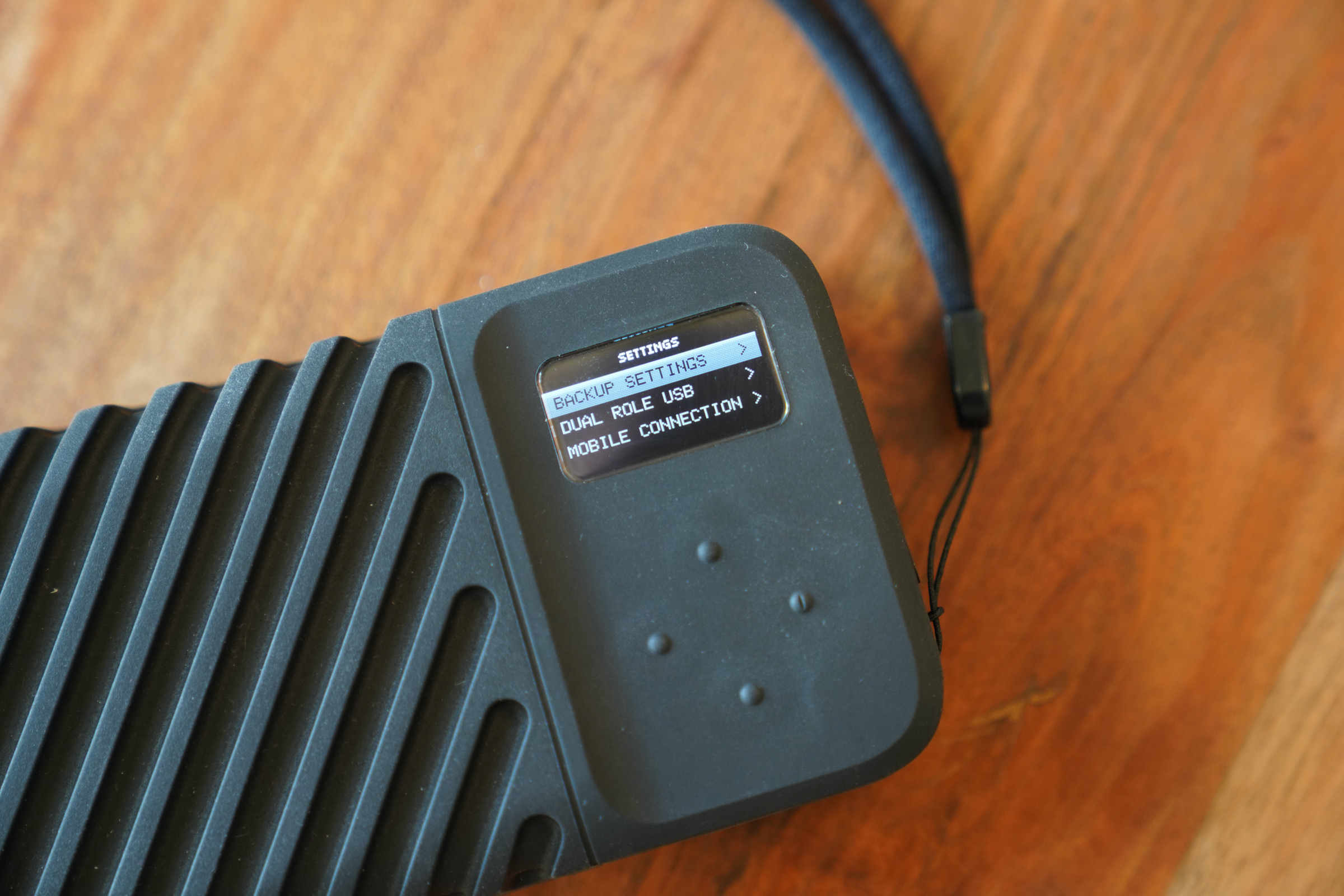
It’s not the fanciest feature that the Gnarbox 2.0 offers, but it might be the one you use most: Quick and painless backup of SD cards. There’s an SD port on the device itself that can transfer at speeds up to 75MB/s, and it has USB-C ports that can transfer direct from cameras or from card readers at up to 350MB/s, depending on their transfer capabilities. When you plug in an SD card or camera, you get an option on the screen to totally back up the contents of the attached drive with one click, which makes it incredibly easy to dump and delete and clear space to keep shooting.
Gnarbox 2.0 6

During a nine-day trip that included two events and a vacation to shoot, I made frequent use of this feature. Shooting with the new Sony A7R IV in both RAW and JPG, even my 128GB SD + 64GB SD backup cards filled up pretty quickly, but I would just slide one of the cards into the Gnarbox’s slot and hit the backup button before changing venues and it’d be fully backed up within a few minutes.

In my experience, this process has been rock-solid reliable, and gives me effectively 10x the space for a shoot versus just relying on my cards alone (I don’t typically have a similar-sized backup SD card on the road, let alone 10). By default, the Gnarbox 2.0 stores all your media in backup folders organized by capture date, too, which makes them super easy to sort through once you get back to base.

A mobile review and rating machine

Once all that great capture content is on your Gnarbox 2.0, you can also very easily connect to the drive using Gnarbox’s mobile apps to either review what you’ve got or go through and rate your photos quickly to make easier the process of working through them once you’re installed at your workstation.

There are two apps from Gnarbox available right now, including Gnarbox Safekeep and Gnarbox Selects. Safekeep gives you access to all your device’s settings and can act as a file browser for shuttling photos between apps. But Selects is probably what you’re going to be using most — it not only offers fast RAW previews (compatible with every major camera’s RAW formats) but also lets you quickly add ratings, keyboard tags and more to make sure your collection is primed for edit when you get back to your desktop.

With Selects, you can review either files on the Gnarbox SSD itself, or on attached memory cards or storage media (so yes, you can use this with something like a Samsung T5 if you’re already using that as a backup solution). All this info will then show up in applications like Adobe Lightroom to expedite your workflow.

This can shave hours off the process of organizing your photos, as it means you can do the rating and reviewing upfront without having to wait for everything to import and then trying to recall what you were going for with the shoot in the field after the fact.

Easy sharing from the field

Speaking of saving time, the Gnarbox 2.0 also helps you move more quickly from capture to sharing, which is incredibly useful if you’re working on a live event or doing photojournalism of something happening in the moment. The device supports Lightroom mobile out of the box, meaning you can navigate to it as a source for a new collection and move files over directly when connected to your phone or tablet. This makes it awesome for adding quick edits to RAW files, exporting finished JPGs and sharing directly to social apps and websites.

With Apple’s new iOS 13 file system changes, the Gnarbox 2.0 can also be addressed as a mass storage device, so you should be pretty wide open in terms of options for working with various editing software. This is also great for mobile video workflows, as Gnarbox 2.0 works just as well for storing video capture as well as photos.

Home workstation companion
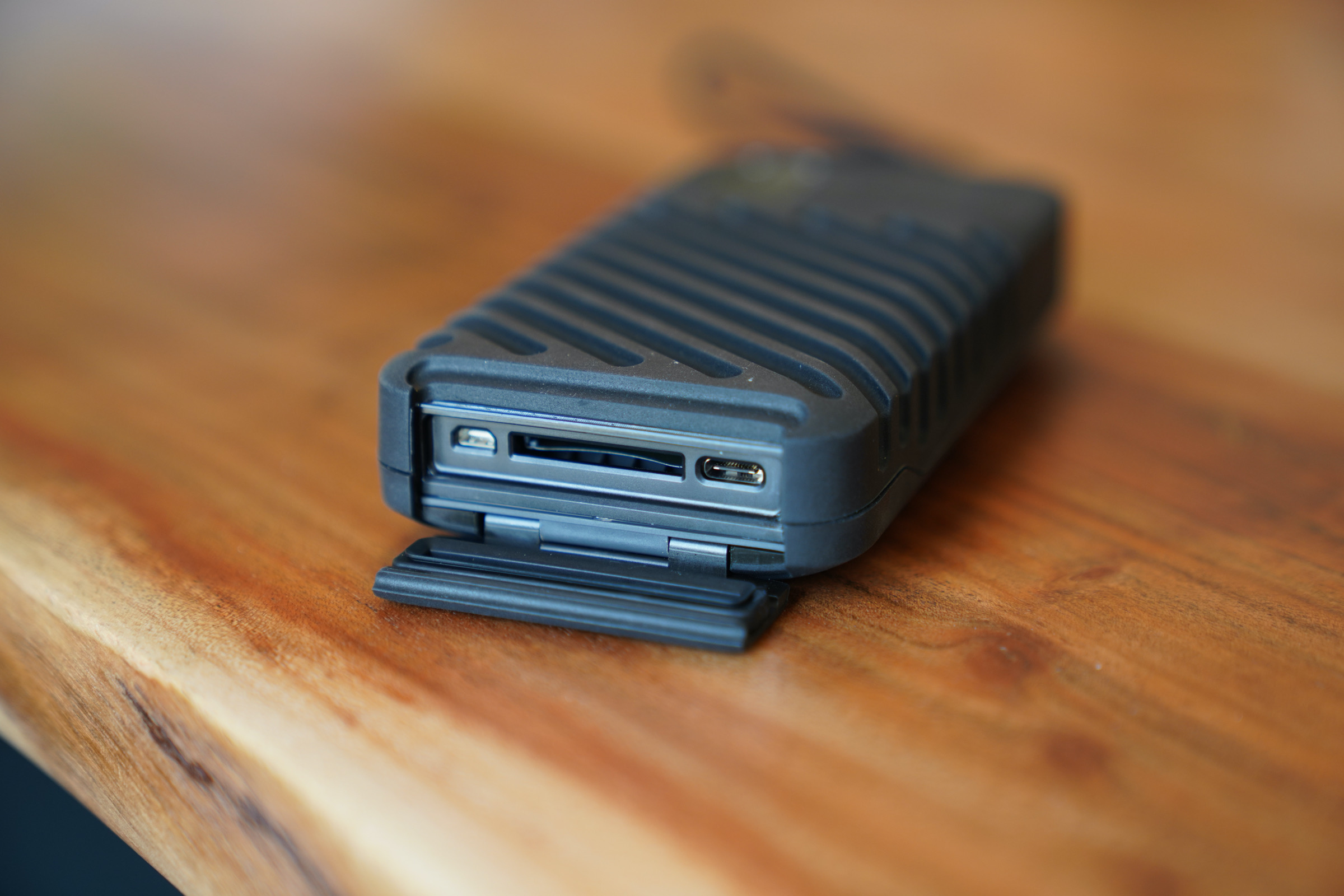
Gnarbox 2.0 3The Gnarbox 2.0 is great on the go, but it’s also perfect for plugging in as a home work drive once you’re back from the shoot. I’m reviewing the 1TB version, so the amount of available on-board storage is a big advantage here, because it can essentially provide all the space you need to give you all of your working files in one place.

As mentioned, it supports high-speed USB-C transfer, which makes working with the files directly from the drive on your main workstation much more pleasant. That also means you don’t necessarily have to move things over local to get to work, which saves you a step and spares your computer’s disk space.

Gnarbox 2.0 switches to USB Mass Storage mode pretty easily, using the on-board OLED menu system. You do need to make this switch manually however, because by default the USB-C port that it uses to make the computer connection is used for charging the Gnarbox’s battery. Once you’re in that mode, however, it’s as easy as connecting Gnarbox 2.0 to your computer and navigating to it as you would any other connected mass storage device.

Photos on the drive are organized by capture date, as mentioned (you can customize how it creates its folder structure if you want) and you can select it as an import target in any photo-editing software, like Lightroom or Capture One.

Bottom line
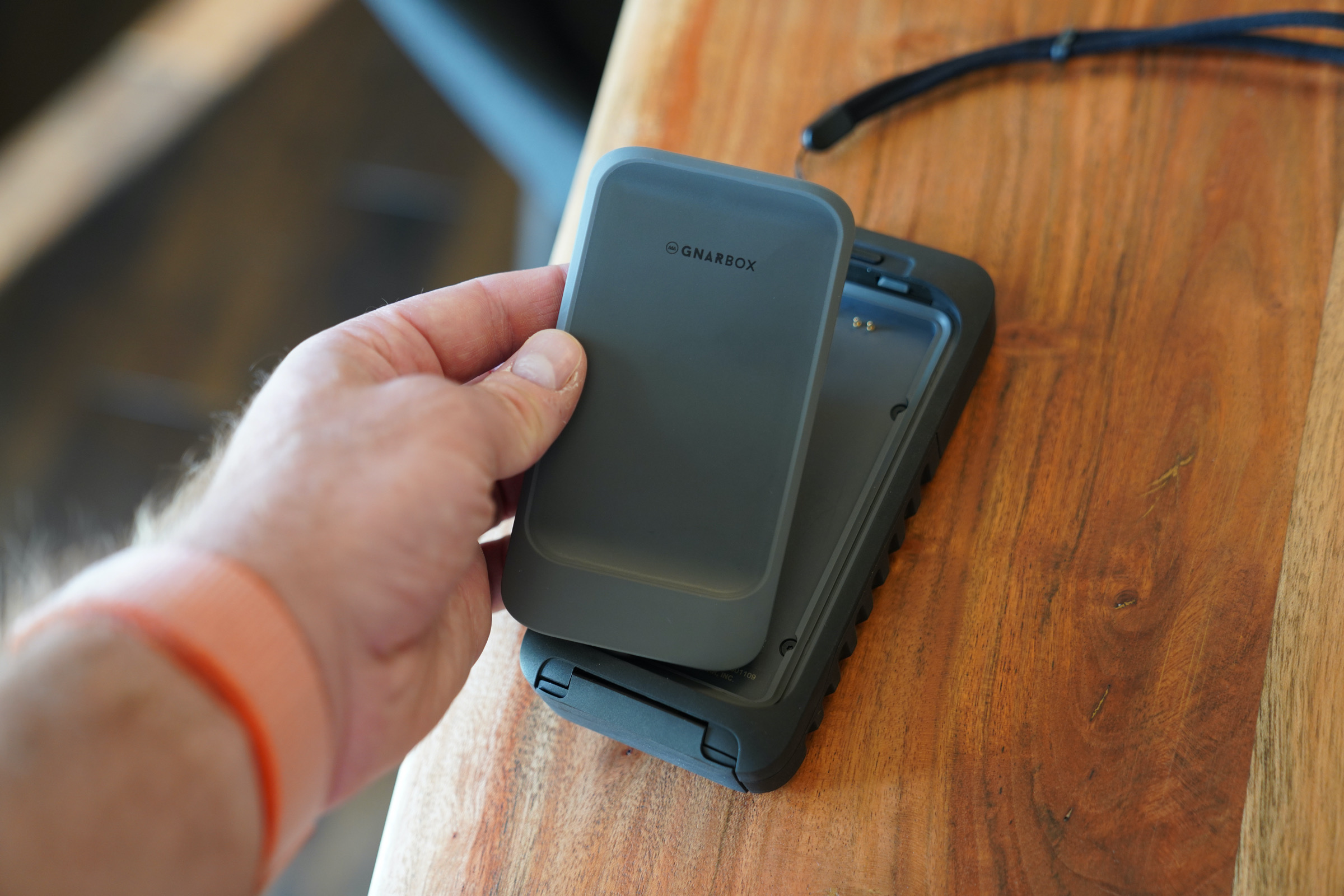
Gnarbox 2.0 5Gnarbox has taken their time to create a thoughtful and thorough successor to their original product with the Gnarbox 2.0. It’s a unique blend of field photo server and mini computer, made more versatile with clever touches like the removable battery packs and dust/splash resistance. Ultimately, there really isn’t anything in the market that can compete with the Gnarbox 2.0 on everything it provides, though devices like WD’s My Passport Wireless Pro and the LaCie Rugged Boss SSD can offer some key parts at lower prices, depending on your needs.

At $899 for the 1TB version I reviewed, ($499 and $599 for the 256 and 512GB versions, respectively), the Gnarbox 2.0 clearly isn’t for everyone. It’s a professional tool for a professional workflow, and it’s priced as such. That said, the value it provides for busy photographers who need a companion storage solution with utmost flexibility for working both at home and on the road is definitely going to make it worth the cost of admission for some.


European risk report flags 5G security challenges

European Union Member States have published a joint risk assessment report into 5G technology which highlights increased security risks that will require a new approach to securing telecoms infrastructure.

The EU has so far resisted pressure from the U.S. to boycott Chinese tech giant Huawei as a 5G supplier on national security grounds, with individual Member States such as the UK also taking their time to chew over the issue.

But the report flags risks to 5G from what it couches as “non-EU state or state-backed actors” — which can be read as diplomatic code for Huawei. Though, as some industry watchers have been quick to point out, the label could be applied rather closer to home in the near future, should Brexit comes to pass…

Some parts of the 5G report on risk of non-EU cyberattacks may accidentally gain a new unexpected meaning after #Brexit (https://t.co/o7gyV0hqCv) https://t.co/VgU30kRz4p

— Lukasz Olejnik (@lukOlejnik) October 9, 2019

Back in March, as European telecom industry concern swirled about how to respond to US pressure to block Huawei, the Commission stepped in to issue a series of recommendations — urging Member States to step up individual and collective attention to mitigate potential security risks as they roll out 5G networks.

Today’s risk assessment report follows on from that.

It identifies a number of “security challenges” that the report suggests are “likely to appear or become more prominent in 5G networks” vs current mobile networks — linked to the expanded use of software to run 5G networks; and software and apps that will be enabled by and run on the next-gen networks.

The role of suppliers in building and operating 5G networks is also noted as a security challenge, with the report warning of a “degree of dependency on individual suppliers”, and also of too many eggs being placed in the basket of a single 5G supplier.

Summing up the effects expected to follow 5G rollouts, per the report, it predicts:

  • An increased exposure to attacks and more potential entry points for attackers: With 5G networks increasingly based on software, risks related to major security flaws, such as those deriving from poor software development processes within suppliers are gaining in importance. They could also make it easier for threat actors to maliciously insert backdoors into products and make them harder to detect.
  • Due to new characteristics of the 5G network architecture and new functionalities, certain pieces of network equipment or functions are becoming more sensitive, such as base stations or key technical management functions of the networks.
  • An increased exposure to risks related to the reliance of mobile network operators on suppliers. This will also lead to a higher number of attacks paths that might be exploited by threat actors and increase the potential severity of the impact of such attacks. Among the various potential actors, non-EU States or State-backed are considered as the most serious ones and the most likely to target 5G networks.
  • In this context of increased exposure to attacks facilitated by suppliers, the risk profile of individual suppliers will become particularly important, including the likelihood of the supplier being subject to interference from a non-EU country.
  • Increased risks from major dependencies on suppliers: a major dependency on a single supplier increases the exposure to a potential supply interruption, resulting for instance from a commercial failure, and its consequences. It also aggravates the potential impact of weaknesses or vulnerabilities, and of their possible exploitation by threat actors, in particular where the dependency concerns a supplier presenting a high degree of risk.
  • Threats to availability and integrity of networks will become major security concerns: in addition to confidentiality and privacy threats, with 5G networks expected to become the backbone of many critical IT applications, the integrity and availability of those networks will become major national security concerns and a major security challenge from an EU perspective.

The high level report is a compilation of Member States’ national risk assessments, working with the Commission and the European Agency for Cybersecurity. It’s couched as just a first step in developing a European response to securing 5G networks.

“It highlights the elements that are of particular strategic relevance for the EU,” the report says in self-summary. “As such, it does not aim at presenting an exhaustive analysis of all relevant aspects or types of individual cybersecurity risks related to 5G networks.”

The next step will be the development, by December 31, of a toolbox of mitigating measures, agreed by the Network and Information Systems Cooperation Group, which will be aimed at addressing identified risks at national and Union level.

“By 1 October 2020, Member States – in cooperation with the Commission – should assess the effects of the Recommendation in order to determine whether there is a need for further action. This assessment should take into account the outcome of the coordinated European risk assessment and of the effectiveness of the measures,” the Commission adds.

For the toolbox a variety of measures are likely to be considered, per the report — consisting of existing security requirements for previous generations of mobile networks with “contingency approaches” that have been defined through standardisation by the mobile telephony standards body, 3GPP, especially for core and access levels of 5G networks.

But it also warns that “fundamental differences in how 5G operates also means that the current security measures as deployed on 4G networks might not be wholly effective or sufficiently comprehensive to mitigate the identified security risks”, adding that: “Furthermore, the nature and characteristics of some of these risks makes it necessary to determine if they may be addressed through technical measures alone.

“The assessment of these measures will be undertaken in the subsequent phase of the implementation of the Commission Recommendation. This will lead to the identification of a toolbox of appropriate, effective and proportionate possible risk management measures to mitigate cybersecurity risks identified by Member States within this process.”

The report concludes with a final line saying that “consideration should also be given to the development of the European industrial capacity in terms of software development, equipment manufacturing, laboratory testing, conformity evaluation, etc” — packing an awful lot into a single sentence.

The implication is that the business of 5G security will need to get commensurately large to scale to meet the multi-dimensional security challenge that goes hand in glove with the next-gen tech. Just banning a single supplier isn’t going to cut it.

Eureka Robotics’ new robotic arm is designed for optical lenses and mirrors

Last year, Nanyang Technological University, Singapore had a small viral sensation on its hands with the release of Ikea Bot. The robot did laps around its inept human counterparts by autonomously assembling an Ikea chair in less than nine minutes.

That same team is behind NTU spin-off Eureka Robotics, which this morning debuted Archimedes, a six-axis robotic arm designed to pick up and manipulate optical lenses and mirrors. The functionality is decidedly less YouTube video-friendly than its furniture-assembling predecessor, but there’s probably a lot more money to be made in optics.

ezgif 3 f71208050ec1

Archmides is capable of handling multiple-sized lenses and mirrors and loading them into a tray in order to be coated. Introducing a robotic arm into the process can help eliminate defects introduced by human interactions. The challenge, of course, is to create a robotic arm that can handle such delicate objects without damaging them in the process.

“With Archimedes, we have taken accuracy to the tens-of-micron level,” company co-founder and NTU Associate Professor Pham Quang Cuon said in a release tied to the news. “Its accuracy of placing objects is within a tenth of a millimetre, yet it does so with the gentleness of a human touch, made possible by our control algorithms.”

The robot debuts this week at a robotics trade event in Southeast Asia.

Walgreens partners with FedEx to accept online returns, print labels

FedEx and Walgreens are partnering to make online returns more convenient, in a move that’s part of a growing trend where brick-and-mortar retailers cater to the needs of e-commerce shoppers in order to increase foot traffic at their stores. Under the new agreement, consumers will be able to drop off their online returns at thousands of Walgreens locations nationwide. They’ll also be able to print their return shipping label in the store, if need be.

The partnership involves the use of the FedEx Returns Technology platform, which allows online vendors and retailers to send customers a return code via email. The customer can then take that code to the participating Walgreens location to get their label printed for them.

FedEx says it’s providing the printing equipment, related technology and training materials to the Walgreens locations. However existing Walgreens store staff will be the ones who actually do the printing — not FedEx employees.

The new partnership is an expansion of an existing relationship between the two companies. In 2017, Walgreens announced a long-term alliance with FedEx to offer drop-off and pickup services at its U.S. stores. However, it did not actually assist with label printing — the packages would need to be ready to ship.

The new partnership addresses what remains one of the biggest challenges associated with shopping online. Many customers don’t have access to a working printer, or are out of ink or paper, which makes printing a return label a hassle. And studies have shown that consumers prefer to take their online returns to a store, rather than shipping them back themselves. In fact, as many as 75% of U.S. internet users said they would prefer that course of action, according to a study cited by eMarketer.

Brick-and-mortar retailers have been quick to capitalize on this trend to meet their own needs in terms of boosting foot traffic at a time when more of their customers are shopping from home.

Kohl’s, for example, recently expanded its partnership with Amazon, which allows customers to bring their returns to its retail stores across the U.S., after the program boosted revenue from the increased customer visits. Stein Mart also this year embraced the enemy with the installation of Amazon Lockers in nearly 200 stores. And, of course, major retailers accept their own online returns in their stores. Walmart also rolled out in-store returns for marketplace items last year.

“Our service offering with FedEx has been very well received by our customers, and implementing this latest technology in our stores will deliver even greater convenience to meet the needs of today’s customer,” said Richard Ashworth, president of operations at Walgreens, in a statement. “This is especially meaningful heading into the holiday season as more customers shop for gifts online and we’re able to offer safe, secure package pickup and drop-off services.”

Deal terms were not disclosed.

The move comes shortly after FedEx exited its ground and express delivery contracts with Amazon in order to focus on the wide range of e-commerce opportunities outside of the dominant online retailer, as well as the opportunity to serve international e-commerce retailers, it said at the time.

The new offering will begin rolling out in early November, ahead of the peak holiday shopping season.

Toyota, GM, Nvidia, Bosch and others form new autonomous driving tech consortium

We’re still very much in the collaboration phase of autonomous driving, since it’s looking still quite a ways off from being anything consumers can use on the regular. That means there’s plenty of opportunity for things like the new “Autonomous Vehicle Computing Consortium” (AVCC) announced today. This industry group includes Arm, Bosch, Continental, GM, Toyota, Nvidia, NXP and Denso, collecting top automakers along with some of the leading chipmakers and tier 1 suppliers in automotive today.

The group’s goal is to work together in order to “solve some of the most significant challenges to deploy self-driving vehicles at scale,” which pretty clearly translates into putting together the collective efforts of some of those who stand to gain most from autonomy becoming a commercially viable technology, in order to speed up said commercialization. While self-driving has been an area of intense investment and focus in the past few years, it still has a ways to go before these companies can start really reaping the rewards of their investments in terms of revenue-driving businesses.

So what will they actually do to achieve this goal? Step one will be setting up a set of recommended specs, essentially, outlining what size, temperature, power consumption and safety standards AV system architectures and computers should adhere to. The idea is that by arriving at some baseline standards, the group will be better able to move from prototyping, which is expensive and low-volume in terms of output, to manufacturing and deploying AVs at the scale where they’ll truly become a viable commercial enterprise.

There’s more to this industry collaboration than just figuring out the specs range for systems, however: Participating companies will “study common technical challenges,” as well, meaning they’ll be putting their heads together to overcome the major, fundamental tech challenges that still act as hurdles to be overcome in getting self-driving vehicles on the roads.

And, of course, though the initial founding group includes only those companies listed above, this new group is also open to new members.

Uber’s newest feature alerts drivers that pets will be joining the ride

Uber is piloting a new feature that lets U.S. riders alert drivers that a pet will be coming along, the latest effort from the company to appeal to a broader audience and become the one-stop shop for transportation, meals and other services.

The feature, called Uber Pet, will be available beginning October 16 in Austin, Denver, Nashville, Minneapolis-St. Paul, Philadelphia, Phoenix and Tampa Bay. Riders will pay for the privilege of taking their pets with them through what Uber describes as a “small surcharge.” And drivers will have the option of avoiding trips with non-service animals by opting out of Uber Pet trips in the driver preferences menu in the app.

Uber says it will pay drivers “a significant portion of that surcharge,” on top of their standard trip earnings.

The company emphasized that Uber Pet does not replace their service animal policy. Riders with service animals are not expected or required to use Uber Pet, and can select from any number of ride options without paying the surcharge.

Instead, Uber Pet was designed for riders who are pet or non-service animal owners. Uber expects cats and dogs will be the most common animals on Uber Pet trips.

Uber Pet is another example of the company making efforts to become the app behind every aspect of its users’ lives, namely through transportation and meal delivery. Uber unveiled last month a number of changes across its products designed to achieve that very goal.

“We want to be the operating system for your everyday life,” CEO Dara Khosrowshahi at the time. “A one-click gateway to everything that Uber can offer you.”