California’s power outages might have some residents looking for backups. But that juicy Tesla battery pack isn’t it—at least not yet.
Category: Tech news
hacking,system security,protection against hackers,tech-news,gadgets,gaming
Why the PG&E Blackouts Spared California’s Big Tech HQs
Silicon Valley companies are served by safer, robust transmission lines. Regular homes? Not so much.
Creators of modern rechargeable batteries share Nobel prize
If you had to slip a couple AAs into your smartphone every morning to check your email, browse Instagram, and text your friends, chances are the mobile revolution would not have been quite so revolutionary. Fortunately the rechargeable lithium-ion battery was invented — a decades-long task for which three men have just been awarded the Nobel Prize in Chemistry.
The prize this year honors M. Stanley Whittingham, John Goodenough, and Akira Yoshino, all of whom contributed to the development of what is today the most common form of portable power. Without them (and of course those they worked with, and those who came before) we would be tied to even more wasteful and/or stationary sources of energy.
Lead-acid batteries had been in use for nearly a century by the time people really got to thinking about taking things to the next level with lithium, a lightweight metal with desirable electrical properties. But lithium is also highly reactive with air and water, making finding suitable substances to pair it with difficult.
Experiments in the ’50s and ’60s laid the groundwork for more targeted investigations, in particular Whittingham’s. He and partner Fred Gamble showed in 1976 that lithium ions, after donating electrons to produce a charge, fit perfectly into a lattice of titanium disulfide — where they sit patiently (in their “van der Waals gaps”) until an electron is provided during recharging. Unfortunately this design also used a lithium anode that could be highly reactive (think fire) if bent or crushed.
John Goodenough and his team soon developed a better cathode material (where the lithium ions rested) with a much higher potential — more power could be drawn, opening new possibilities for applications. This, combined with the fact that the metallic lithium anodes could be highly reactive (think fire) if bent or crushed, led to increased research on making batteries safe as well as useful.
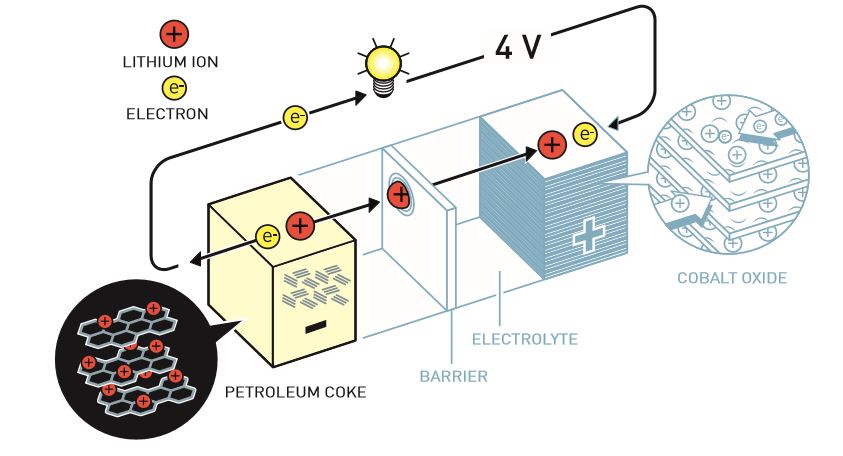
In 1985 research by Akira Yoshino led to the discovery of several materials (whose names won’t mean anything to anyone without domain knowledge) that could perform as well while also being able to be physically damaged and not cause any major trouble.
Many, many improvements have been made since then, but the essentials of the technology were laid out by these teams. And soon after lithium-ion batteries were shown to be safe, capacious, and able to be recharged hundreds of times, they were found in laptops, medical devices, and eventually mobile phones. Today, after three more decades of enhancements, lithium batteries are now taking on gasoline as the energy storage medium of choice for human transportation.
The three scholars whose work most powerfully advanced this technology from theory to commercial reality were awarded equal shares of this year’s Nobel Prize in Chemistry, each taking home a third of the million and, more importantly, the distinction of being recognized in historic fashion.
Waymo to customers: “Completely driverless Waymo cars are on the way”
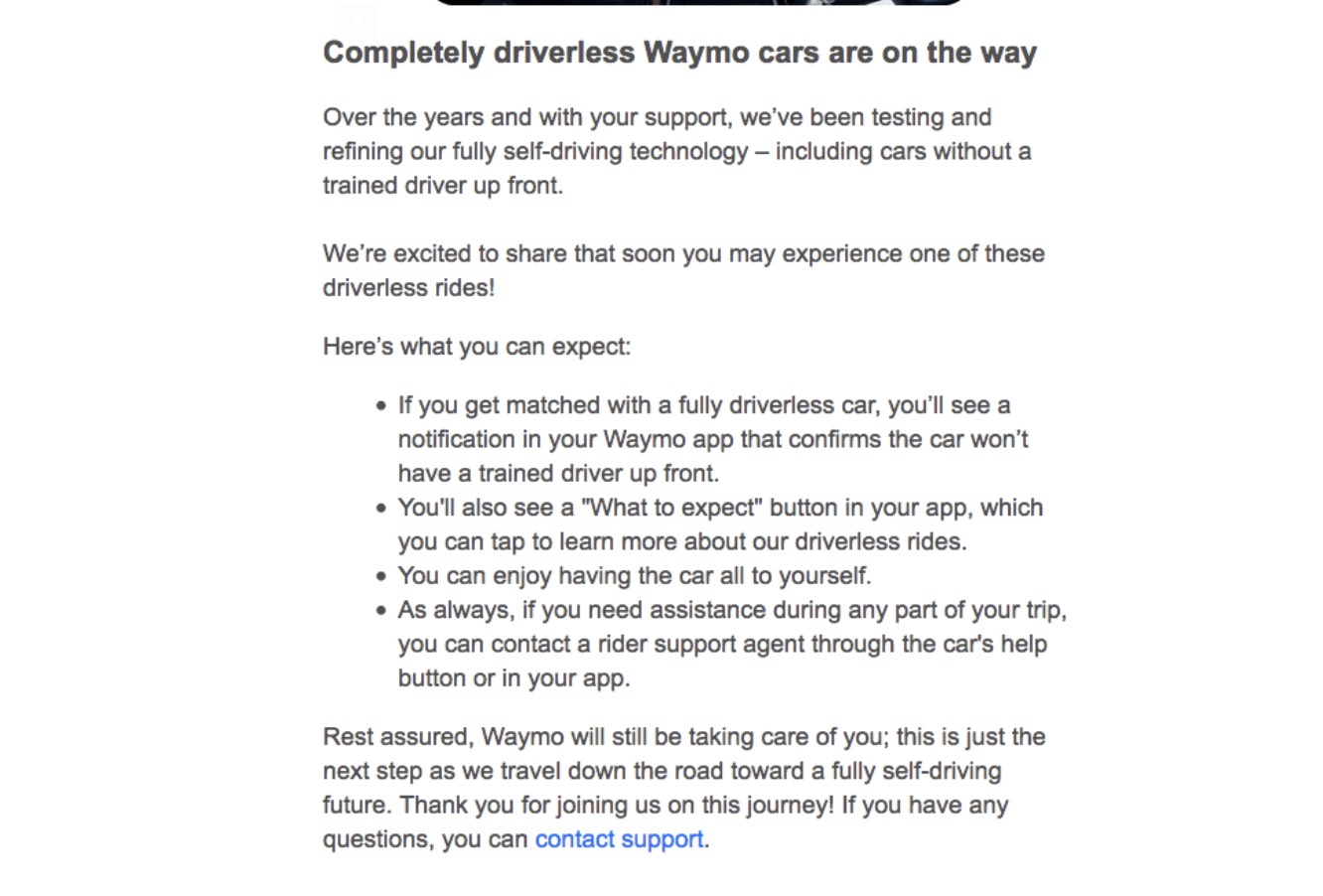
Waymo, the autonomous vehicle business under Alphabet, sent an email to customers of its ride-hailing app that their next trip might not have a human safety driver behind the wheel, according to a copy of the email that was posted on Reddit.
The email entitled “Completely driverless Waymo cars are on the way” was sent to customers that use its ride-hailing app in the suburbs of Phoenix.
Both the early rider program and Waymo One service use self-driving Chrysler Pacifica minivans to shuttle Phoenix residents in a geofenced area that covers several suburbs including Chandler and Tempe. All of these “self-driving rides” have a human safety driver behind the wheel.
A driverless ride is what it sounds like. No safety driver behind the wheel, although a Waymo employee would likely be present in the vehicle initially.
Waymo could not be reached for comment. TechCrunch was able to confirm that the email went out to members of Waymo’s early rider program. The email is posted below.
Waymo, formerly known as the Google self-driving project, first began testing its technology in 2009 in and around its Mountain View, Calif., headquarters. It’s been a slow and steady roll ever since. The company has expanded its test area to other cities, spun out into its own business and iterated the vehicle design and the sensors around it.
Waymo opened a testing and operations center in Chandler, Arizona in 2016. Since then, the company has ramped up its testing in Chandler and other Phoenix suburbs, launched an early rider program and slowly crept toward commercial deployment. The early rider program, which required vetted applicants to sign non-disclosure agreements to participate, launched in April 2017.
In December, the company launched Waymo One, a commercial self-driving car service and accompanying app. Waymo One signaled that the company was starting to open up its service. Members of the early rider program were transferred to the Waymo One, which allowed them to bring guests and even talk publicly about their rides. More recently, Waymo opened another technical service center in the Phoenix area in preparation to double its capacity and grow its commercial fleet.
While driverless Waymo vehicles have been spotted periodically, they have never been used to shuttle the general public. The introduction of driverless vehicles would be milestone for the company.
And yet, there remains a number of questions. It’s unclear how many of these driverless rides there will be or the what constraints Waymo will place on them. It’s likely that these will operate in more simple, controlled environments for months before it expands to more complex situations.
A Mass Power Outage, Twitter’s Data Misuse, and More News
Catch up on the most important news from today in two minutes or less.
How Two Nobel Laureates Spotted the First Exoplanet
Swiss scientists “started a revolution in astronomy” by noticing a tiny stutter in the starlight.
The first spacecraft that can service satellites to extend their life launched today
Up until now, commercial satellites have essentially been disposable. Even the massive, multi-ton ones that can have service lives spanning a decade or more eventually just become so much space trash once they’re out of fuel, or they experience some kind fo terminal mechanical failure. A new spacecraft built by Northrop Grumman and launched aboard a Russian Soyuz today (via Space.com) could change all that, however.
The MEV-1, as its known, is a satellite service spacecraft, which has the specific mission of meeting up with Intelsat 901 in orbit and lending it use of its orientation thrusters to put it back into an ideal target orbit – thus extending the useful life of the 18-year old satellite by as many as five years. Once it has succeeded in putting Intelsat 901 back on track, it’s very possible the MEV-1 could do the same thing for yet another orbital satellite running low on its own propellant supply.
In fact, Northrop Grumman says that the spacecraft is itself designed for a 15-year useful life, and can dock and undock multiple times, providing “well in excess of” 15-years of mission extension to geosynchronous satellites around 4,400 lbs in size while docked with said satellite.
That should mark a new era for commercial satellite operation, leading to further decreased operating costs, and therefore more access for startup and smaller companies to take part. Northrop’s MEV-1 is basically a space tug, but even that can as much as double the life of some geosynchronous satellites – which means a lot more potential revenue for not too much more cost, if the MEV-1 serves multiple customers who share the cost of its development and launch. Think of it as satellite servicing-as-a-service, or a SsaaS model for space tech companies.
Other satellite servicing projects are in the works, and could benefit companies like Orbit Fab, the so-called ‘gas stations in space’ startup that was a finalist in our Battlefield competition at TC Disrupt last week. Orbit Fab is working on a simple refuelling system for satellites to use in space, so that the servicing craft wouldn’t need to actually dock and propel the satellite it’s working with, just connect and transfer some fuel. Other potential business opportunities could lead from in-space commercial orbital spacecraft servicing, including upgrading satellites with new modules and sensors from different customers to maximize the return on the investment of their original design, build and launch.
Facebook sure does love free $peech
Ensuring politicians in the 2020 election stay truthful is hard work, so Facebook has decided it’s going to sit this one out.
Joe Biden’s campaign team sent a letter to CEO Mark Zuckerberg, COO Sheryl Sandberg and global elections policy chief Katie Harbath that essentially called on the company to take down a Trump campaign ad that made debunked claims regarding the Biden family’s relationship with Ukraine. Facebook responded to that letter today with their own letter to Biden saying that the company’s policies prevented it from making judgment calls on the veracity of speech in political advertisements. The New York Times has a full run-down of the situation.
Facebook isn’t alone in this manner; Fox News is remaining fair and balanced on the issue as well. CNN refused to run the ad.
Political campaigns are messy, so America’s largest content company — with more content moderators than any publication in the country — is leaving it to the free press to debunk what it’s getting paid to broadcast. But it’s not that Facebook wants to keep raking in stupid amounts of advertising dollars. It’s that the company is grounded in a “fundamental belief in free expression,” they say.
Here’s a quote from the company’s letter to Biden’s team: “Our approach is grounded in Facebook’s fundamental belief in free expression, respect for the democratic process, and the belief that, in mature democracies with a free press, political speech is already arguably the most scrutinized speech there is.”
I’m sorry, what? Facebook’s “respect for the democratic process” should raise eyebrows given how its products have been used in some highly publicized scenarios. But how does a platform that’s been abused so much to the detriment of democratic processes feel like it deserves to rattle that phrase off as another PR talking point?
Here’s the rest of the letter:
Here's the letter Facebook sent the @JoeBiden campaign explaining why it allowed Trump to run Facebook ads with false allegations about the VP and Ukraine — @sarahmucha reports. https://t.co/HFMdDqpzXH pic.twitter.com/VbUlW2C6qI
— Donie O'Sullivan (@donie) October 9, 2019
If Facebook just wants to allow politicians to spout mistruths and conspiracy theories without fact checks on its platforms as status updates from their personal pages, then some of these claims could be taken more seriously, but Facebook is getting paid to push these messages to its users. It’s algorithmically deciding where these messages go based on parameters set by the campaigns via a system it designed.
Before you sound off, yeah, political advertising isn’t anything new. I am well aware that TV channels and newspapers have carried messy attack ads and hauled in the advertising revenues for decades, but Facebook is a platform designed around scale. Scale has allowed the company to tap massive revenue streams, but it’s also opened up the company to critiques. The company has learned to respect this scale after sizable amounts of external pressure were applied, but they’ve always defaulted to dated comparisons when it’s profitable to them.
Newspaper and TV political ads are painted with a wider brush and are subject to more stringent laws, but there’s a responsibility in Facebook’s precise ad-targeting that the company still doesn’t seem to respect. The company has the tools to push out judgment calls on content, and it could still do so on a case-by-case basis. Some truths are buried in more nuance than others, but by painting all political claims in its same bath of indifference to truth, Facebook is abusing its scale and creating a platform where a politician’s speech is exempt, as if political leaders aren’t the ultimate primary sources on politically contentious matters.
Political advertising legislation is going to take far too long to catch up to the current landscape of technology platforms — it would be nice if we could trust Facebook to stay at a moral forefront that isn’t legally mandated. Twitter and YouTube aren’t immune to this same criticism either, but Facebook is operating in broad daylight, believing that they can reverse engineer a free expression mission statement to prevent responsibility-free revenues from leaking out.
Facebook hired me to head Elections Integrity ops for political ads. I asked if we could scan ads for misinfo. Engineers had great ideas. Higher ups were silent. Free speech is b.s. answer when FB takes $ for ads. Time to regulate ads same as tv and print.https://t.co/eKJmH7Sa7r
— Yael Eisenstat (@YaelEisenstat) October 9, 2019
Help Us Recognize Tech That Protects Our Values
Opinion: The Tech Spotlight will highlight products, initiatives, and policies that protect the public good and shape a more responsible future.
Virgin Orbit plans to launch first commercial small satellites to Mars
The Richard Branson-backed small satellite launch operation Virgin Orbit wants to be the first to dedicate a mission to bringing commercial CubeSats to the “Red Planet,” the company announced today. Working with Polish satellite company SatRevolution, Virgin Orbit has established a consortium along with a group of Polish academic institutions to jointly work on at least one, and as many as three, small satellite launches to Mars, with the first expected to happen as soon as three years from now.
The consortium is working to follow in the footsteps of the NASA Jet Propulsion Laboratory’s MarCO mission from 2018, which saw two smaller satellites successfully launched to Mars. The group’s early studies have suggested that even satellites as small as 50 kg (around 110 lbs), or potentially even smaller, can provide meaningful and useful research, including imagery collection, from both Mars and its orbiting body, Phobos. These satellites could provide key info about the atmospheric composition of Mars, or even scouting for underground water, Virgin Orbit says.
Warsaw-based SatRevolution has experience in the commercial space industry, and in April this year sent Poland’s first commercial nano satellite into orbit. The universities involved, which include the AGH University of Science and Technology, Wroclaw University of Science and Technology and many others, all have experience in space industry research, as well. The plan is to launch the spacecraft developed by the universities and SatRevolution aboard Virgin’s LauncherOne rocket, which takes off from a converted 747-400 Virgin has retrofitted for the process.
Virgin Orbit is aiming to have its first orbital rocket launch later this year, and is currently going through the final round of testing before that happens. The company ran a successful drop test earlier this year, during which it let a non-functional rocket fall from the wing of the 747 launcher aircraft in a key test, and it has been signing contracts to launch from the U.K. as early as next year.
Pinterest launches a new ‘Lite’ app for emerging markets
Pinterest is the latest tech company to introduce a “Lite” version of its mobile application to meet the needs of users in emerging markets. With Pinterest Lite, launched on Monday, users will benefit from a faster download and an app that takes up less storage space on their mobile device, the company says.
Pinterest previously offered a Pinterest Lite app on Google Play, but this app was pulled a year ago, according to data from App Annie.
The new Pinterest Lite app is actually Pinterest’s Progressive Web App (PWA) that’s been made available to Google Play users as a download, the company tells TechCrunch.
This is a project that’s been underway for some time, according to a post last year on Pinterest’s Engineering blog. There, the company acknowledged that its mobile web experience had been “terrible” and in need of an update.
In July 2017, Pinterest formed a team to rewrite the mobile web app from scratch as a PWA. It said this would offer a better experience for people in low-bandwidth environments and on limited data plans.
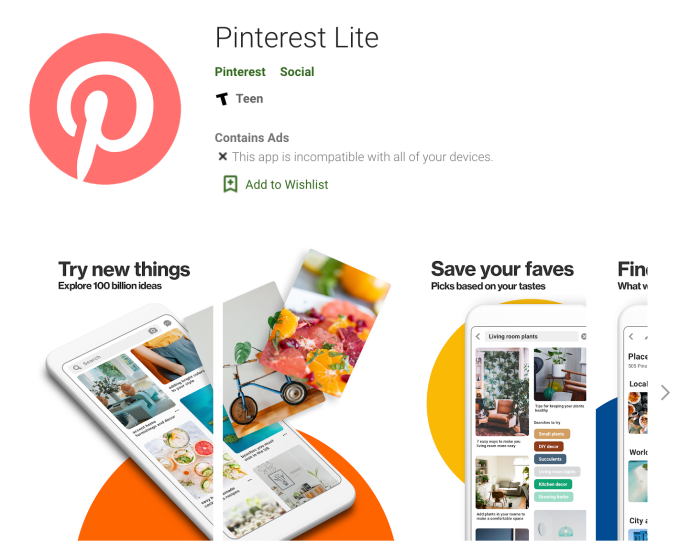
The Pinterest Lite mobile app is available today to Android users in Peru, Argentina, Colombia, Chile and Mexico, and clocks in at a tiny 1.4 MB. The main Pinterest app’s size varies by device on Android, but is significantly larger. On iOS, it’s 143.1 MB, for comparison’s sake.
“The goal is to bring Pinterest to everyone around the world so they can discover inspiration related to their interests wherever they might be,” a Pinterest spokesperson said, when reached for comment about the Pinterest Lite launch.
Pinterest is now one of many top publishers who offer a “Lite” version of their flagship apps.
Google has a full suite of lightweight “Go”-branded apps, like Google Go, Gmail Go, Files Go, YouTube Go, Google Maps Go and Google Assistant Go. There’s also Facebook Lite, Instagram Lite, Messenger Lite, Twitter Lite, Uber Lite, Spotify Lite, TikTok Lite, Skype Lite and LINE Lite, to name a few others. Tinder had also said earlier this year it was working on a Tinder Lite app to better serve the Indian market. That app quietly launched over the summer.
Offering a Lite app is a baseline requirement these days for competing in emerging markets.
Pinterest, in particular, has been working to expand its global footprint, and recently reported international revenue was up 199%, to $24 million in Q2, and international monthly users were up 38% to 215 million, out of a total of 300 million users. However, the U.S. continues to drive the majority of Pinterest’s revenue, contributing $153 million of the total $261 million reported in Q2.
Image credit: Pinterest
Twitter Puts Profit Ahead of User Privacy—Just Like Facebook Did Before
Twitter funneled two-factor authentication phone numbers into their ad targeting platform—but they weren’t the only ones.
DHS cyber unit wants to subpoena ISPs to identify vulnerable systems
Homeland Security’s cybersecurity division is pushing to change the law that would allow it to demand information from internet providers that would identify the owners of vulnerable systems, TechCrunch has learned.
Sources familiar with the proposal say the Cybersecurity and Infrastructure Security Agency (CISA), founded just less than a year ago, wants the new administrative subpoena powers to lawfully obtain the contact information of the owners of vulnerable devices or systems from internet providers.
CISA, which warns both government and private-sector businesses of security vulnerabilities, privately complained of being unable to warn businesses about security threats because it can’t always identify who owns a vulnerable system.
The new proposal would allow CISA to use its new powers to directly warn businesses of threats to critical devices, such as industrial control systems — typically used in critical infrastructure. These systems are highly sensitive and are increasingly the target of hackers to disrupt real-world infrastructure, like the power grid and water supply.
By law, internet providers are not allowed to share their subscriber data without first receiving a legal demand, such as a subpoena, that can be issued from a federal agency without requiring the approval of a court. Lacking those powers, CISA has to rely on its federal law enforcement partners to use their powers to identify owners of vulnerable systems. Law enforcement can only serve subpoenas during an investigation. But CISA says it is still obliged to warn owners of vulnerable systems, even if there is no investigative interest.
The move is likely to spark fresh debate over how much responsibility the federal government has to proactively warn private-sector businesses about possible vulnerabilities in their defenses.
Jake Williams, founder of Rendition Infosec and former NSA hacker, called the move a “huge power grab,” and warned that the proposed new powers are flawed and could be misused.
“I cannot fathom that this will not be used in a way that lawmakers who are drafting the legislation will not have intended,” he told TechCrunch.
Tarah Wheeler, cybersecurity policy fellow at New America, also said technical challenges of the proposals were flawed.
“When you have traffic originating from a botnet, those IP addresses can be made to appear to be coming from anywhere, which means it can be used as an incredibly thin pretext for the government to knock on someone’s door,” she said.
CISA’s request for administrative subpoena powers is not unusual in government. Many federal departments and divisions use these subpoena powers to obtain information from private businesses. But these powers remain controversial, not least because they can be used to obtain large amounts of information without any judicial oversight.
The FBI uses its own controversial administrative subpoena powers to secretly demand subscriber data from phone companies and tech giants. The courts continue to question the legality of these so-called national security letters (NSLs).
A CISA official speaking to TechCrunch on background said that the proposals, which have already been submitted to Congress, would ensure that businesses would be “more motivated” to take action if the advisory came directly from government. The official said the agency was working with lawmakers to prevent any overreach or potential abuse of the authority.
Adam Comis, a spokesperson for the House Committee on Homeland Security, which oversees CISA, did not return a request for comment.
Got a tip? You can send tips securely over Signal and WhatsApp to +1 646-755-8849. You can also send PGP email with the fingerprint: 4D0E 92F2 E36A EC51 DAAE 5D97 CB8C 15FA EB6C EEA5.
Wealthy Counties Benefited Most From a Flood Relief Program
When the government offered to buy up houses in flood zones, wealthier homeowners took advantage while poorer residents stayed put or fled.
Andreessen Horowitz hires Julie Yoo as general partner
Julie Yoo has joined Andreessen Horowitz as its newest general partner. She will make investments out of the venture capital firm’s bio fund, which closed on $450 million in 2017.
Yoo spent the last eight years as a co-founder and chief product officer of Kyruus, a venture-backed healthcare provider matching tool. She’s joins as a16z’s 17th GP; the firm hired David George, who focuses on late-stage deals, and Anish Acharya, who specializes in fintech deals, as GPs earlier this year.
More notably, Yoo becomes the fourth female general partner at a firm that for years had only men at the top of its ranks. The Slack investor hired its first-ever female GP, Katie Haun, in June 2018 to lead its crypto efforts alongside Chris Dixon. Longtime a16z investors Connie Chan and Angela Strange were later promoted to GP.
Yoo joins Vijay Pande and Jorge Conde on a16z’s biotech investment team. The trio will focus on life sciences, synthetic bio and broader health tech.
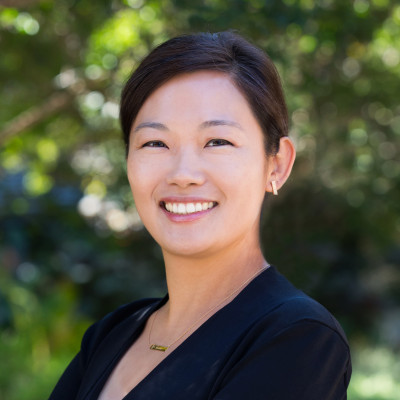
a16z’s newest general partner, Julie Yoo
“As we’ve focused on these three areas we’ve realized it’s a pretty broad opportunity,” Conde tells TechCrunch. “We wanted to find a GP that had the phenotype of what we look for in all of our GPs … and someone who has deep operating expertise that knows how to build companies.”
Before co-founding Kyruus, Yoo was the vice president of product at Generation Health, a CVS-acquired health management company. In her first role as a venture capitalist, Yoo says she will identify investments in companies transforming access to our healthcare system.
“We are an extension of the phrase ‘software is eating the world,’ ” Yoo tells TechCrunch. “We are focused on software eating care delivery and everything that flows from that.”
Among a16z’s health and bio investments is Devoted Health, which helps Medicare beneficiaries access care through its network of physicians and tech-enabled healthcare platform. Other investments in the space include Freenome, a liquid biopsy diagnostics platform; Apeel, which makes a kind of plant food-based barrier for fruit that aims to replace wax coatings; a care coordination network called PatientPing; and BioAge Labs, a company that’s trying to find drugs that extend humans’ health span through machine learning and biomarkers that speed up the discovery process.