Google Nest Mini hands-on

Two years after the release of the Home Mini, Google’s back with the sequel. Well, “sequel” might be a bit strong. The Nest Mini is more like one of those 1.5 movies they release on home video with a little extra footage than the theatrical release.

That’s not a compliant, exactly. The truth is there are some improvements here, but honestly, Google didn’t really need to do much. The $49 Home Mini sold like hot cakes and is a big part of the company’s rapid growth in the smart home space.

google nest mini

It was a low barrier of entry for those who were curious, but perhaps not fully on-board. And, like the Echo Dot before, it’s been an inexpensive way to outfit an entire home with smart speaker functionality.

Google has smartly kept the price the same with the Nest Mini. The device may not be a loss leader, exactly, but it’s the easiest and cheapest way of hooking users into the Assistant ecosystem — one that will theoretically lead to more smart home purchases, and, perhaps mobile device decisions.

The Nest is nearly identical to its predecessor. That, too, is fine. It’s simple and with a choice of four pastel colors (Chalk, Charcoal, Coral and Sky), it should fit most interior designs reasonably well. Bonus points for the new fabric covering, which is made entirely from recycled plastic bottles. Google says one half-liter bottle will cover two Minis. Interestingly the new cloth doesn’t negatively impact the sound.

google nest mini

Speaking of, that’s the biggest upgrade on-board. Sound has been improved over the original with a louder max volume and twice the bass. I’ve been listening to music at home on the new device, and while it gets pretty loud, I can’t recommend it as a standalone speaker. There are much better options for that. It serves Assistant and voice playback pretty well, but it gets a bit distorted at louder volumes.

I do quite like the music playback controls, however. Tap the center to play or pause music and either side to increase and decrease volume. When your hand approaches the speaker, two dots will illuminate on the edges to show you where to touch. Paired in stereo mode with another, better speaker (like, say, the Home Max) and it serves as a cool little touch control. The recent addition of stream transfer, meanwhile, makes it easier to keep listening to music as you change rooms.

Another interesting tidbit that didn’t get a lot of mention at today’s event is dynamic volume adjustment, which adjusts the sound based on background noise. It’s similar to the feature the company teased with today’s Pixel Buds reveal and could come in handy if you happen to live or work in a loud environment. Take that, neighbors.

google nest mini

The new Mini presents one of the more compelling use cases I’ve seen for Duo thus far (and honestly, I haven’t seen a ton). You can use the device as a kind of speakerphone with the app. I can certainly see this coming in handy for things like work calls at home. If you’ve got a big home, you can also use it as an intercom to communicate with other Home/Nest devices.

One other bit worth mentioning is the smart addition of a wall mount on the bottom of the device. It’s something small, but handy. Using a nail or thumbtack (well, probably just a nail, given the size/weight), you can now hang the Mini on a wall. Apparently this was a pretty heavily requested feature for those with limited shelf space. I could certainly imagine sticking it in my kitchen, where counter space is at an extreme premium — though dealing with the cord is another question entirely.

The Nest Mini arrives on retail shelves and walls October 22.

SpaceX files paperwork to launch up to 30,000 more Starlink global internet satellites

SpaceX has filed documents with the International Telecommunication Union, which governs international use of global bandwidth, to launch up to 30,000 more satellites for its Starlink global broadband constellation, SpaceNews reports. That’s on top of the 12,000 it already has permission to launch. Why so many? SpaceX says that it’s about ensuring its network can meet anticipated demand “responsibly.”

“As demand escalates for fast, reliable internet around the world, especially for those where connectivity is non-existent, too expensive or unreliable, SpaceX is taking steps to responsibly scale Starlink’s total network capacity and data density to meet the growth in users’ anticipated needs,” wrote a SpaceX spokesperson in an emailed statement to TechCrunch.

The ITU filing doesn’t mean SpaceX is launching 30,000 satellites tomorrow: In fact, the company is looking to launch likely only a few hundred in the coming year. But SpaceX is anticipating big increases in the demand for low-latency and high-capacity broadband globally, and its initial deployment plans only cover a fraction of that demand. Plus, given the increased interest in providing communications from orbit, there’s bound to be a growing rush on spectrum over the next few years.

Starlink will originally set out to provide service in the northern U.S., as well as parts of Canada, beginning as early as next year when the network goes live. The plan is to then scale the network to global coverage over the course of around 24 launches of Starlink satellites. It’s betting that it’ll need to scale by adding on nodes opportunistically to address demand, especially because most current coverage demand models don’t take into account regions that are getting broadband access for the first time.

SpaceX is also priming Starlink for high-traffic operation (though the total constellation won’t all be operating in the same orbital region, it’ll still be a considerable addition to the orbital population relative to the roughly 8,000 objects that have been launched to space to date — in total). The measures SpaceX is taking to deal with traffic include building in automated collision avoidance systems, structure de-orbiting plans, information sharing about orbital routes for their satellites and more, and the company says it’s meeting or exceeding the industry standards that have been established thus far around this.

To address the concerns of astronomers, SpaceX is also turning the base or Earth-facing portion of all future Starlink satellites back, which should help address concerns of space watchers who are concerned about the impact that large constellations will have on stellar observation and research. The company will also take steps to adjust satellite orbits where it’s shown that its constellation is impeding serious scientific pursuit.

Starlink launched its first 60 satellites back in May, and the plan is that each roughly 500-lb satellite will work in tandem with the others to communicate with ground stations that end users will then be able to connect to in order to get a broadband network signal.

LinkedIn gets physical, debuts Events hub for people to plan in-person networking events

LinkedIn, the Microsoft-owned social network for the working world with around 650 million users, is known best as a place where people connect with each other online either to build work connections, for recruitment, or for professional development. Now, the company is taking a step to bring its networking features into the physical world: the company is launching a new feature called Events, a (currently free) tool for people to plan, announce and invite people to meetups and other get-togethers, in the physical world.

The feature — which will appear as a menu item in LinkedIn’s website and mobile app — is rolling out first in English-speaking countries starting October 17, with the aim to expand it to further non-English markets soon after that.

Ajay Datta, the head of product for LinkedIn India (where the app was developed; more on that below), believes that there is a clear gap in the market for a feature like this, much like you could argue Facebook’s events feature has served a role in the out-of-work world to plan casual events.

“I think there is a massive whitespace for events today,” he said. “People don’t have a single place to organise [work-related] offline meetups specific to an industry or a neighborhood. People want to find other people.”

You may recall a limited trial of the Events feature about a year ago in New York and San Francisco: the kinds of events that LinkedIn said were created with the pilot included meetups, training sessions, offsites, sales events and happy hours, so expect to see these popping up in the live product, too.

Screenshot 2019 10 15 at 18.26.01

Events is also important because it is the first major, global feature to be built out of the company’s R&D office in Bangalore, India — a significant milestone for the team of engineers and others that are based there. Up to now, much of the work that they have done has been focused on regional tools or those specifically targeting emerging markets.

LinkedIn Lite, the company’s pared-down Android app for users in bandwidth-constrained markets, has probably been the  Bangalore office’s biggest win so far: it has now passed 10 million downloads in the 70+ countries where it is available.

To be clear, right now, Events is free to use and is fairly limited in its first iteration. You can create an announcement and invite first-person contacts, but you have no way to promote the event beyond your own organic reach on the platform (and wherever you might want to share the link outside it).

“Targeting is not the focus right now,” said Ajay Datta, the head of product at LinkedIn India. “Organic adoption is what we are looking for first before we look at anything else.”

You can lay out your plans, but there are no links to services to find and book out available spaces. You can’t create any ticketing or other limitations on attendance numbers, but you can include links to places where you might be able to manage such things, such as Eventbrite or any of its many competitors.

But if this starts to see traction — and I suspect that it will, because of its natural proximity to the social network to amplify an event, and the fact that most of the people who are hanging out on LinkedIn are likely to already be predisposed to engaging on it — you could imagine how LinkedIn might start to add on all of the above, and more. It says that other areas where it’s continuing to experiment to facilitate better in-person connections using include QR codes, business cards, and proximity-based beacons.

This could help LinkedIn create another revenue stream in its business — or at least provide another way to boost existing revenue streams such as premium memberships (access to a wider circle of people to invite), advertising and recruitment solutions. Potentially, this could help pave the way to positioning LinkedIn (and by association, Microsoft) as an Eventbrite competitor.

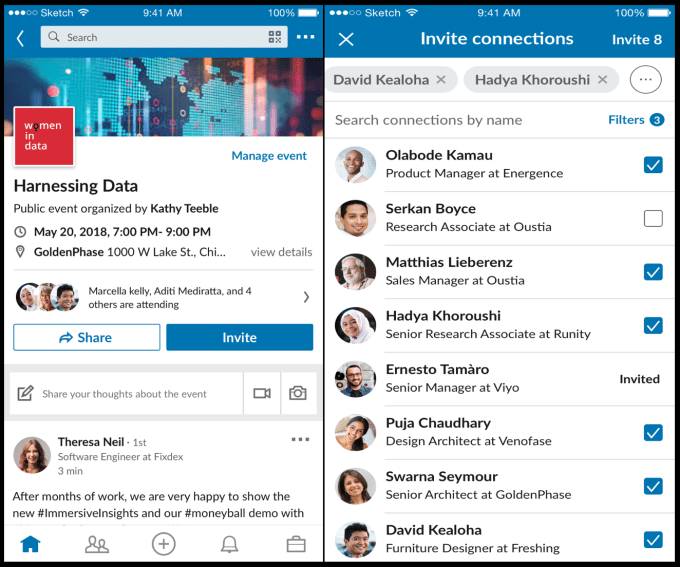
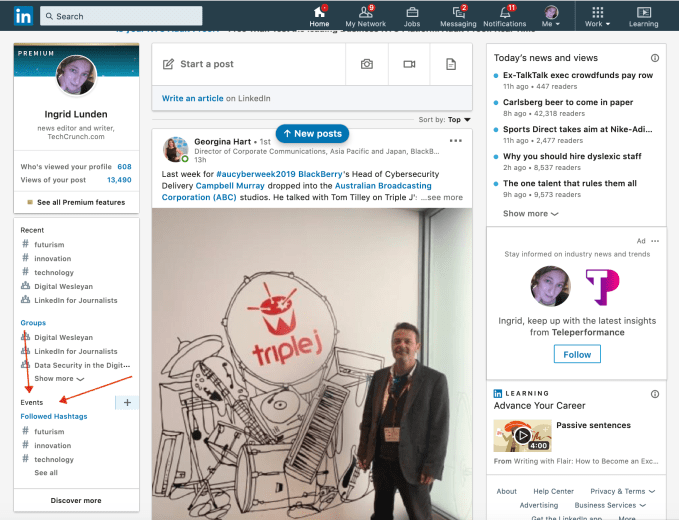
From the Events menu bar, you will be able to create events yourself and also invite others. It looks like it’s already live on my own account, so here is how it looks from there:

Screenshot 2019 10 15 at 18.43.00

And here’s how the event-creation window looks. As you can see, you post links through to other sites for ticketing, and potentially further details about agendas and more. Each box has a limit on

Screenshot 2019 10 15 at 18.42.15

LinkedIn is also being cognisant of its reputation for how the platform can be used for over-aggressive contacting, and so it’s also including security features for people to report and block suspicious events or conversations related to them. It’s also applying AI algorithms to the events that do get listed to screen them for bad actors and bogus content, which then get assessed by human reviewers for further action.

The move into Events is one of the bigger moves that LinkedIn has made over the last several years — another big one has been its efforts in educational content — to open itself up to a new area of business by leveraging how it uses the professional graph that it has built up over time. It sometimes feels to me that under Microsoft (which bought the company for $26 billion in 2016) the company has been less productive in terms of launching new services and generally making noise, so this move is interesting in that sense too.

Still, the synergy between online networking and physical networking is so close that it’s a surprise that the company hadn’t launched an Events feature before now. All the more because Linked has dabbled in building tools to help people make better connections with each other when they are in the same physical space before.

Years ago it launched a Connected app to help people maximise the kinds of connections they make in the physical world. It has since been sunset and integrated into the main LinkedIn app, which has a “find nearby” feature that you can use to see if people who are your connections are, say, at the same conference as you are, or if you’re meeting a contact for coffee and don’t know what the person looks like.

It’s also been over the last three months seeding the idea of associating actual events with LinkedIn the platform by encouraging the organising of “LinkedIn Local” events, which apparently have created more feedback from users to build an Events too, too.

It’s not clear why it’s taken so long — LinkedIn sometimes does take its time, as it did with video — but in this period when some of us are beginning to pause and ponder what being online too much does for our ability to relate to each other, collaborate and progress not just in the working world, but in the wider world, it’s an interesting moment to choose to launch Events. We’ll see if LinkedInners agree.

The Station: A new self-driving car startup, Inside Tesla’s V10 software, Lilium’s big round

If you haven’t heard, TechCrunch has officially launched a weekly newsletter dedicated to all the ways people and goods move from Point A to Point B — today and in the future — whether it’s by bike, bus, scooter, car, train, truck, flying car, robotaxi or rocket. Heck, maybe even via hyperloop.

Earlier this year, we piloted a weekly transportation newsletter. Now, we’re back with a new name and a format that will be delivered into your inbox every Saturday morning. We’re calling it The Station, your hub of all things transportation. I’m your host, senior transportation reporter Kirsten Korosec.

Portions of the newsletter will be published as an article on the main site after it has been emailed to subscribers (that’s what you’re reading now). To get everything, you have to sign up. And it’s free. To subscribe, go to our newsletters page and click on The Station.

This isn’t a solo effort. Expect analysis and insight from senior reporter Megan Rose Dickey, who has been covering micromobility. TechCrunch reporter Jake Bright will occasionally provide insight into electric motorcycles, racing and the startup scene in Africa. And then of course, there are other TechCrunch staffers who will weigh in from their stations in the U.S., Europe and Asia.

We love the reader feedback. Keep it coming. Email me at [email protected] to share thoughts, opinions or tips or send a direct message to @kirstenkorosec.

A new autonomous vehicle company on the scene

the station autonomous vehicles1

Deeproute.ai is the newest company to receive a permit from the California Department of Motor Vehicles to test autonomous vehicles on public roads.

Here is what we know so far. The Chinese startup just raised $50 million in a pre-Series A funding round led by Fozun RZ Capital, the Beijing-based venture capital arm of Chinese conglomerate Fosun International. The company has research centers in Shenzhen, Beijing and Silicon Valley and is aiming to build a full self-driving stack that can handle Level 4 automation, a designation by the SAE that means the vehicle can handle all aspects of driving in certain conditions without human intervention.

Deeproute.ai is also a supplier for China’s second-largest automaker Dongfeng Motor, according to TechNode. The startup plans to offer robotaxi services in partnership with Dongfeng Motor for the Military World Games in the city of Wuhan next month.

Snapshot: Tesla Smart Summon

the station electric vehicles1Remember way back in September when Tesla started rolling out its V10 software update? The software release was highly anticipated in large part because it included Smart Summon, an autonomous parking feature that allows owners to use their app to summon their vehicles from a parking space.

We have some insight into the rollout, courtesy of TezLab, a Brooklyn-based startup that developed a free app that’s like a Fitbit for a Tesla vehicle. Tesla owners who download the app can track their efficiency, total trip miles and use it to control certain functions of the vehicle, such as locking and unlocking the doors, and heating and air conditioning. TezLab, which has 20,000 active users and logs more than 1 million events a day, has become a massive repository of Tesla data.

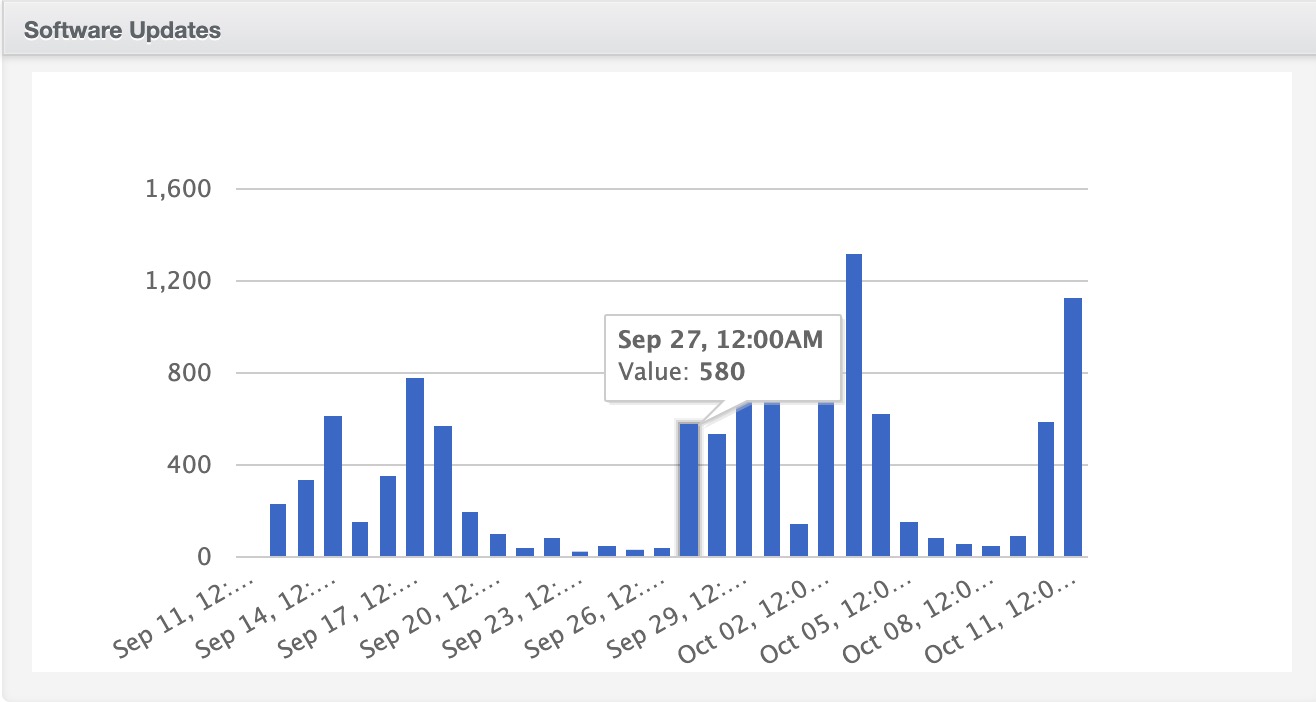
TezLab shared the data set below that shows the ebb and flow of Tesla’s software updates. The X axis shows the date (of every other bar) and a timestamp of midnight. (Because this is a screenshot, you can’t toggle over it to see the time.)

Screen Shot 2019 10 11 at 3.52.53 PM

This data shows when Tesla started pushing out the V10 software as well as when it held it back. The upshot? Notice the pop on September 27. That’s when the public rollout began in earnest, then dipped, then spiked again on October 3 and then dropped for almost a week. That lull followed a slew of social media postings demonstrating and complaining about the Smart Summon feature, suggesting that Tesla slowed the software release.

A geofencing bright spot

Speaking of Smart Summon, you might have seen the Consumer Reports review of the feature. In short, the consumer advocacy group called it “glitchy” and wondered if it offered any benefits to customers. I spoke to CR and learned a bit more. CR notes that Tesla is clear in its manual about the limitations of this beta product. The organization’s criticism is that people don’t have insight into these limitations when they buy the “Full Self-Driving” feature, which costs thousands of dollars. (CEO Elon Musk just announced the price will go up another $1,000 on November 1.)

One encouraging sign is that CR determined that the Smart Summon feature was able (most of the time) to recognize when it was on a public road. Smart Summon is only supposed to be used in private areas. “This is the first we’ve seen Tesla geofence this technology and that is a bright spot,” CR told me.

Deal of the week

money the station

There were plenty of deals in the past week, but the one that stood out — for a variety of reasons — involved German urban air mobility startup Lilium . Editor Ingrid Lunden had the scoop that Lilium has been talking to investors to raise between $400 million and $500 million. The size of this yet-to-be-closed round and who might be investing is what got our attention.

Lilium has already raised more than $100 million in financing from investors, including WeChat owner and Chinese internet giant Tencent, Atomico, which was founded by Skype co-founder Niklas Zennström, and Obvious Ventures, the early-stage VC fund co-founded by Twitter’s Ev Williams. International private banking and asset management group LGT and Freigeist (formerly called e42) are also investors.

TechCrunch is still hunting down details about who might be investing, as well as Lilium’s valuation. (You can always reach out with a tip.)

Lunden was able to ferret out a few important nuggets from sources, including that Tencent is apparently in this latest round and the startup has been pitching new investors since at least this spring. The round has yet to close. Lilium isn’t the only urban air mobility — aka flying cars — startup that been shaking the investor trees for money the past six months. Lilium’s challenge is attempting to raise a bigger round than others in an unproven market.

A little bird

blinky cat bird green

We hear a lot. But we’re not selfish. Let’s share. For the unfamiliar, a little bird is where we pass along insider tips and what we’re hearing or finding from reliable, informed sources in the industry. This isn’t a place for unfounded gossip. Sometimes, like this week, we’re just helping to connect the dots to determine where a company is headed.

Aurora, an autonomous vehicle startup backed by Sequoia Capital and Amazon, published a blog post that lay outs its plans to integrate its self-driving stack into multiple vehicle platforms. Those plans now include long-haul trucks.

Self-driving trucks are so very hot right now. Aurora is banking on its recent acquisition of lidar company Blackmore to give it an edge. Aurora has integrated into a Class 8 truck its self-driving stack known as “Aurora Driver.” We hear that Aurora isn’t announcing any partnerships — at least not now — but it’s signaling a plan to push into this market.

Got a tip or overheard something in the world of transportation? Email me at [email protected] to share thoughts, opinions or tips or send a direct message to @kirstenkorosec.

Keep (self) truckin’

the station semi truck

Ike, the autonomous trucking startup founded by veterans of Apple, Google and Uber Advanced Technologies Group’s self-driving truck program, has always cast itself as the cautious-we’ve-been-around-the-block-already company.

That hasn’t changed. Last week, Ike released a lengthy safety report and accompanying blog post. It’s beefy. But here are a few of the important takeaways. Ike is choosing not to test on public roads after a year of development, unlike most others in the space. Ike has a fleet of four Class 8 trucks outfitted with its self-driving stack as well as a Toyota Prius used for mapping and data collection. The trucks are driven manually, (a second engineer always in the passenger seat) on public roads. The automation system is then tested on a track.

There are strong incentives to demonstrate rapid progress with autonomous vehicle technology, and testing on public roads has been part of that playbook. And Ike’s founders are taking a different path; and we hear that the approach was embraced, not rejected, by investors. 

Screen Shot 2019 10 12 at 7.56.36 AM

In the next issue of the newsletter, check out snippets from an interview with Randol Aikin, the head of systems engineering at Ike. We dig into the company’s approach, which is based on a methodology developed at MIT called Systems Theoretic Process Analysis (STPA) as the foundation for Ike’s product development.

In other AV truck-related news, Kodiak Robotics just hired Jamie Hoffacker as its head of hardware. Hoffacker came from Lyft’s Level 5 self-driving vehicle initiative and also worked on Google’s Street View vehicles. The company tells me that Hoffacker is key to its aim of building a product that can be manufactured, not just a prototype. Check out Hoffacker’s blog post to get his perspective.

Nos vemos la próxima vez.

Flowhub raises $23 million for its retail management software for cannabis dispensaries

As cannabis dispensaries flourish across the country alongside the push to legalize medicinal and recreational marijuana use, demand for tools to manage the specificities of the weed retail business continues to increase.

Looking to address that need, Flowhub, a cannabis retail management software vendor, has raised $23 million from a consortium of investors including e.ventures, Evolv Ventures (the Kraft Heinz-backed venture capital fund) and Poseidon. 

The legal cannabis market is expected to top $66 billion over the next five years, according to estimates from Grand View Research, and entrepreneurs looking to get into the highly regulated industry are flocking to Flowhub’s suite of dispensary management services.

Not only does the company’s software address compliance concerns, according to chief executive officer Kyle Sherman, but it also integrates with companies like Dutchie for online ordering to facilitate in-store purchases and adds integrations with LeafBuyer and Leafly to provide more information to potential retailers.

The company also updated its software to include the “Stash” app, a mobile inventory management system, and a cashier app that integrates with iPads or other tablets to improve point-of-sale capabilities.

“What we are experiencing right now is an end to cannabis prohibition and Flowhub is on the front lines of this movement,” said Sherman, in a statement. “Every legal transaction completed with the Flowhub retail platform is a positive step forward, and we are committed to helping our customers build thriving cannabis businesses. With this investment, we will continue to automate the cannabis supply chain, retail and reporting processes and bring to market technology solutions that are not only shaping the cannabis retail business, but also driving forward the future of legalization and de-stigmatization.”

For investors like Emily Paxhia, a managing director at Poseidon, the opportunity to back a company helping to automate compliance in the regulated marijuana industry was too tempting to pass up.

“The compliance and regulation aspects make this a unique industry and Flowhub is one of the leading cannabis tech companies that is taking a meticulous and strategic approach,” Paxhia said in a statement. “We saw the potential for Flowhub’s technology and mission early on and we’re thrilled to continue to support them in delivering the cannabis retail experience of the future.”

Twitter says it will restrict users from retweeting world leaders who break its rules

Twitter said it will restrict how users can interact with tweets from world leaders who break its rules.

The social media giant said it will not allow users to like, reply, share or retweet the offending tweets, but instead will let users quote-tweet to allow ordinary users to express their opinions.

The company said the move will help its users stay informed about global affairs, but while balancing the need to keep the site’s rules in check.

We haven’t used this notice yet, but when we do, you will not be able to like, reply, share, or Retweet the Tweet in question. You will still be able to express your opinion with Retweet with Comment.

— Twitter Safety (@TwitterSafety) October 15, 2019

Twitter has been in a bind, amid allegations that the company has not taken action against world leaders who break its rules.

“When it comes to the actions of world leaders on Twitter, we recognize that this is largely new ground and unprecedented,” Twitter said in an unbylined blog post on Tuesday.

Last year, Twitter said it would not ban President Trump despite incendiary tweets, including allegations that he threatened to declare war on North Korea. However, in the case of Iran’s supreme leader Ayatollah Seyed Ali Khamenei, he had one of his tweets deleted from the site.

“We want to make it clear today that the accounts of world leaders are not above our policies entirely,” the company said. Any user who tweets content promoting terrorism, making “clear and direct” threats of violence, and posting private information are all subject to ban.

But Twitter said in cases involving a world leader, “we will err on the side of leaving the content up if there is a clear public interest in doing so.”

In such a case, “we may place it behind a notice that provides context about the violation and allows people to click through should they wish to see the content,” said Twitter, making good on a promise it made in June.

“Our goal is to enforce our rules judiciously and impartially,” Twitter added in a tweet. “In doing so, we aim to provide direct insight into our enforcement decision-making, to serve public conversation, and protect the public’s right to hear from their leaders and to hold them to account.”

David Sacks’s Craft Ventures just closed its second fund with $500 million

Craft Ventures, the venture firm launched in 2017 by serial entrepreneur David Sacks, has closed its second fund with $500 million in capital commitments, an amount the firm was said to begin targeting roughly a year ago.

Craft’s debut fund had closed with $350 million.

The outfit — which Sacks runs with other serial entrepreneurs Bill Lee (Remarq, Social Concepts), Jeff Fluhr (StubHub, Spreecast) and Sky Dayton (who has founded and co-founded a lot of companies) — invests in series seed, A and B rounds, in a wide range of companies that neatly fit into each investor’s wheelhouse.

For his part, Sacks, who was the COO of PayPal before founding the genealogy website Geni.com, then Yammer, is focused on both consumer and enterprise startups as long as they can go viral.

His signature bet at Craft is Bird, the e-scooter company whose Series A round Craft led. (Bird founder Travis VanderZanden announced the company’s Series D round of $275 million at a $2.5 billion valuation during our recent TechCrunch Disrupt event.)

Fluhr focuses on marketplaces and e-commerce startups, and the firm cites as one of his more prominent deals the Series A round of the nursing marketplace Trusted Health. Lee is focused on breakthrough technologies and counts among his investments the esports company Cloud9, a company that went on to raise $50 million in Series B funding last year (and is probably due to announce yet another round soon).

Meanwhile, Dayton — who is very notably a co-founder with Travis Kalanick in CloudKitchens, the dark kitchen company that’s literally trying to take over the world— focuses on so-called hard tech, drawing on his experience of launching the dial-up pioneer EarthLink, along with the Wi-Fi service provider Boingo Wireless.

All four have impressive portfolios as angel investors, including bets on Affirm, Airbnb, Facebook, Houzz and Slack, though naturally, they’ve also backed startups that haven’t proved winners. An investment in the HR payroll startup, Zenefits proved particularly trying for Sacks, who acquired a sizable stake in the company and — when its founding CEO, Parker Conrad, was ousted amid a regulatory scandal — stepped in to try to fix its errant ways. (He left after less than a year at the helm.)

It’s too soon if they’ll have as much success as a team, but some of Craft’s more recent bets include Terminal, a San Francisco-based startup that helps companies to source and manage remote engineers in international locations; it raised $17 million in funding just last month.

Another is Superplastic, a year-old, Burlington, Vt.-based maker of limited-edition art toys that’s trying to turn two of its characters into animated digital media stars. It raised $10 million in Series A funding led by Craft in the summer.

At the firm’s outset, blockchain was a major theme, though Craft appears to be fast-evolving into an outfit that invests far more broadly.

It may have been too early. At least, Harbor, a decentralized compliance protocol that aims to standardize the way crypto securities are issued, was a deal that Craft announced around the same time that it was itself launching publicly. But Harbor’s founders have since left the company to start Internal, a startup that wants to help companies better manage their internal consoles so they can ensure that not everyone on staff has access to sensitive data.

Internal closed on $5 million in seed funding led by Craft last month, a deal we wrote about here.

With Alibaba, Pivotal and Lightbend on board, Reactive flexes its ROI muscle in the microservices world

Mahendra Ramsinghani
Contributor

Mahendra Ramsinghani is the founder of Secure Octane, a Silicon Valley-based cybersecurity seed fund.

The Linux Foundation recently announced the launch of the Reactive Foundation. Its founding members are Alibaba, Lightbend, Pivotal and Netifi. So what exactly is this Reactive Kool-Aid, and why are all these companies guzzling it down so fast?

If you buy the premise that developers live in a cloud-native microservices world, then you also understand that most applications are distributed and elastic. The compute is spread across clusters, as is all the data. It could be a few users, or a spike of thousands. Systems need to be architected to handle these spikes. Yet the dark secret of microservices is complexity — the management of resources, costs, performance and latency remain a challenge.

If we break down any application into hundreds of moving parts (such as containers and microservices), then we better have an elegant way to manage those moving parts. These services need to talk to each other, exchange data and ensure that overall performance is reliable, at all times. Easier said than done.

The “big unsolved problem of the cloud”

According to Daniel Berg, Distinguished Engineer at IBM Cloud, “The network is the unsolved problem of the cloud…. We need the network to be a first-class citizen of a cloud system.” Why does the network remain a problem? Is it because we fall back on our old ways, when we need to rethink the new? We have designed the car with the big clunky wheels of a horse buggy. Conceptually, it sounds fine — but it can be a pretty rough ride.

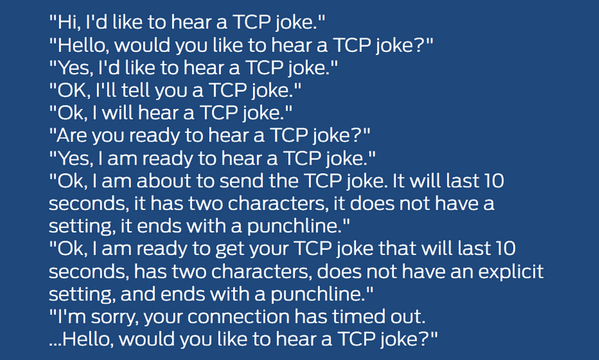
In the layered cake of network protocols, we have the middle layer of transportation (Transmission Control Protocol / Internet Protocol or TCP/IP), and right at the top, we have the application layer. We use a protocol called hypertext transfer protocol (or HTTP) to make sure the web applications can talk to each other. TCP was born in 1974 and is called a “chatty protocol” — it has to go back and forth many times just to do some basic stuff. A TCP joke circulating around proves this point.

HTTP Joke

HTTP came in 15 years later, in 1989, and was used to serve documents in a client-server era. This was when we all had desktops being cooled with whirring fans. We would use a Netscape browser to launch a web page (hypertext) and the web-server would say, “Wait a sec – let me fetch that for you.”

Three decades later, we are trying to make do with HTTP, when the compute layer has exploded. Does HTTP work in the world of millions of interactions with machine-to-machine communications? Our mobile, IoT and edge devices are not quite requesting pages and walls of text. And there is no client-server as much as peer-to-peer exchange. But the network layer is stuck with us and we are trying to make sure these microservices can stay put using some archaic methodologies. “As much as 89% of all microservices architecture is based on HTTP, says Stéphane Maldini, principal software engineer at Pivotal. Pivotal is one of the founding members of the Reactive Foundation. In the process, we are creating a big trade-off in efficiency. We are still using two cans and a piece of string to communicate, when we should use the next iPhone.

HTTP is unsuitable for microservices

If we use HTTP in the micro-services world, we have fundamental challenges. For one, there is no flow control — “which means that data flows from a fire hose,” says Robert Roeser, co-founder of Netifi. Because the data can be dumped at a rapid pace, and multiple threads are opened up, we end up building control features to ensure the application does not crash.

Reactive programming is a paradigm shift at the architectural level. It’s about speed and performance.

Stuff like circuit breakers, retry logic, thundering herd (where a large number of processes wake up, but only one wins, often leading to freezing up) needs to be managed effectively. In HTTP, everything is a request / response, but if we look at a simple notification for an app, we don’t need to keep polling all the time. The request is like a grumpy kid sitting in the backseat whimpering, “Are we there yet?,” when the journey has just begun.

Such inefficient mechanisms cause a huge waste of compute resources when we use the wrong protocol. IBM documented the inefficiency of microservices and concluded that the performance of the microservices is ~ 79% (s)lower than the monolithic model. “We identified that Node.js and Java EE runtime libraries for handling HTTP communication consumed significantly more CPU cycles in the microservice model than in the monolithic one,” conclude the researchers.

Goodbye HTTP, hullo Reactive

The Reactive Foundation sits under the Linux Foundation and aims to accelerate the next generation of networked technologies. It espouses the merits of Reactive Programming Frameworks and builds the community. Ryland Degnan, chair of the Reactive Foundation and co-founder of Netifi, lived the HTTPain while he was a member of the Netflix edge platform.

Ryland understands scale, latency and user experience better than most people. At Netflix, the platform would have billions of requests from over several hundred million members. He says, “We live in a multi-dimensional universe where user experience matters. Developers have to deal with three axes of (a) deployments (b) frameworks and (c) protocols. Spotty connections are unacceptable. Why can’t we pick the stream up from where you left off? If we do that alone, we reduce 90% of our infrastructure.”

Indeed, Facebook has adopted RSocket to reduce the dropped connections over mobile network hops and reduced its edge infrastructure significantly. Steve Gury, a software engineer at Facebook speaking at SpringOne Platform said, “The future is R-Socket.”

Reactive programming is a paradigm shift at the architectural level. It’s about speed and performance. One of the major strengths of Reactive is asynchronous I/O, which allows reduction of edge infrastructure by orders of magnitude.

Andy Shi, developer advocate at AliCloud (a unit of Alibaba), is one of the founding members of the Reactive Foundation. He says, “Alibaba has thousands of developers as we are one of the world’s biggest e-commerce platforms. As we adopt microservices and see that compute is utilized only around 10%, throwing more infrastructure at the service mesh is not the answer. Pods are talking to each other using REST API which is not the way to go.”

REST APIs require multiple endpoints and round trips to get the data. Another founding member of the Reactive Foundation, Viktor Klang, deputy CTO at Lightbend, has been evangelizing Reactive for well over a decade, and feels like the time has finally come. “Our systems need to produce results in the required time frame. Imagine if you could compute an answer to a grand question — like the meaning of life — but if the answer is delivered after you die, the system has failed,” he says.

Comparing service meshes and use cases

While Istio is the 18-wheeler truck best suited for lift and shift, RSocket is the Ferrari — speed and elegance. Experts foresee a world where the two may coexist. Yet there are applications, such as IoT use cases, where RSocket has a clear edge (pun intended). Istio offers load balancing, service discovery, logging and traffic management but with heavy overhead.

In studies, Netifi was able to process 16X more requests and delivered four times higher throughput in comparison while maintaining three times better latency — 372% faster throughput with 300% less latency. “Netifi has the potential to be like a Cisco — the router of the microservices,” says Creighton Hicks, investor at Dell Technology Capital.

Istio was launched by Google, IBM and Lyft, so it is a strong incumbent and with serious brand cachet. But when the likes of Alibaba and Facebook start to showcase the RSocket ROI, the fun has just begun. During a recent presentation in London, the Reactive mafia was in full swing. Ondrej Lehecka, a software engineer at Facebook, and Andy Shi talked about how RSocket is addressing real-world architectural challenges. Shi said, “RSocket is designed to shine in the era of microservice and IoT devices. Projects built on top of RSocket protocol and Reactive streams in general will disrupt the landscape of microservices architecture. The Reactive Foundation is the hub of these exciting projects.”

AMC Theatres launches its own on-demand streaming service

AMC Theatres announced a new service today called AMC Theatres On Demand — a marketplace where members of AMC’s Stubs loyalty program can buy or rent individual movies to watch at home.

The launch of an iTunes-style, à la carte movie marketplace seems almost quaint at a time when all the major media companies seem to be following Netflix’s lead and readying their own subscription streaming services. But it’s a noteworthy bet on a slightly old-fashioned model, and it’s also interesting as an effort by the world’s largest theatrical chain to diversify, particularly as box office numbers decline.

In the announcement, AMC Theatres President and CEO Adam Aron argued that AMC has a particular advantage, because it can use its data about the movie-going habits of Stubs members to deliver targeted offers.

“The addition of AMC Theatres On Demand, which extends our movie offerings for AMC Stubs members into their homes, makes perfect sense for AMC Theatres, for our studio partners and for our millions of movie-loving guests,” said Aron in a statement. “With more than 20 million AMC Stubs households, and with our web site and smartphone apps already being visited hundreds of millions of times annually by movie fans, AMC Theatres is in a unique position to promote specific movies with greater personalization than has ever been possible before.”

AMC Theatres On Demand has more than 2,000 films, drawn from all the major studios, available at launch. (As an extra incentive, if you buy or rent a movie distributed by Lionsgate or Paramount Pictures, you’ll get an extra three movies from the same studio.) The company says the service will be available via web, mobile apps and smart TV apps — though it doesn’t mention specific devices.

AMC has already been experimenting with new business models, responding to the popularity of the (now-defunct) MoviePass with its own theatrical subscription, Stubs A-List.

Will unreliable research bury your healthcare startup?

For healthtech founders and funders, scientific claims and conclusions are more than policy — business models depend upon the lucid appraisal of clinical problems, evaluating inadequacies in current standards of care, a clear understanding of disease pathways, and designing superior interventions. 

At each step along this value chain, founders stand on the shoulders of the scientists that preceded them to obtain reliable evidence. When they promote their own innovations, credibility is a critical prerequisite. But where does credibility come from?

A 2012 study selecting 50 common cookbook ingredients found that 80% had publications linking their consumption to cancer risk; according to some reports, tomatoes, lemons, and celery all cause cancer. The to-and-fro of nutrition science is emblematic of a larger dynamic related to fickle research findings across disciplines. Because investigators seeking to build upon seminal studies struggle to reproduce the original findings, researchers have deemed the problem a reproducibility crisis

Simulations have found that up to 85% of published findings could not be replicated. In turn, tens of billions of dollars are wasted and countless patient lives are adversely impacted annually due to unreliable research. 

Historically, academic research and healthcare VC have had considerable overlap, but in recent years, this co-dependence has increased as researchers are looking more and more for financial support. Government research funding has seen a steady decline, with private sources now supporting almost 60% of the spend. Biomedical VC has been portrayed as a critical source of risk capital for early-stage research and a key engine for its translation at later stages.

Hands-on with the new Pixel 4

After the onstage presentation at Made by Google 2019, we got our hands on a Pixel 4. In this video, you can watch us do a quick run-through of the major new features — like Motion Sense, which provides gesture controls that don’t require you to touch your phone, and improved Night Sight, which allows you to take high-quality photos in dark environments.


The Pixel 4 will start shipping on October 24, with a starting price of $799.


Product lessons from building our subscription service Extra Crunch

Subscription has been all the rage in media circles as the industry searches for new, sustainable business models. We’ve seen companies from infrastructure plays like Substack and Pico to brand verticals like Holloway and The Athletic receive venture funding, all with the goal of changing the economics of news, information and entertainment.

Every day, I get the fortune of talking with founders about their startups and writing about them on TechCrunch, but I’ve also been something of an intrapreneur myself, building out product in the form of TechCrunch’s membership service Extra Crunch as EC’s executive editor over the past two years.

This month, I am transitioning to work on new projects at TechCrunch, and my co-editor Eric Eldon is now going to lead the charge on Extra Crunch as executive editor working in tandem with our new EC senior editor Walter Thompson.

So given the changing of the editorial guard, I wanted to write down some thoughts about editorial product strategy as well as some of the hard-won lessons learned about what worked and what didn’t in building a subscription product in today’s media environment.

The art of building an editorial product strategy within constraints

Before we get into some lessons though, I want to talk about product strategy a little bit. Every startup needs a product strategy, and Extra Crunch was no exception. The difference is that we are fundamentally an editorial product, which means that instead of transforming lines of codes into functional software, we take ideas, interviews, research, and analysis and transform them into articles and other media that users (hopefully!) want to pay for.

Product strategy involves devising a plan within constraints, and TechCrunch was no exception.

The first constraint was that we were not starting from scratch. Unlike a startup, TechCrunch has been here for years and has a strong brand name in the startup community, millions of passionate readers, a successful advertising and events business, and an editorial org that knows how to be productive. We couldn’t just throw out the playbook that has worked for years in the pursuit of a new business model that was untested. And so from the beginning, we had to have an attitude of evolution rather than one of revolution.

Second, we had limited resources in terms of capital and talent. TechCrunch is not a venture-backed company with millions of dollars in funding waiting to be burned in our bank account. Instead, we are a successful, sustainable and sometimes ridiculously efficient media business owned by a telecom that rewards proven financial performance. So when we launched, I was the only dedicated editorial position for Extra Crunch, along with a smattering of freelancers. As we have proven our success since launch this past February, we have since expanded to three dedicated editorial positions for EC. Throughout, we’ve had to have a strategy that was careful about spending our resources.

Third, we had to design a strategy that encompassed the talents of our existing staff. TechCrunch has consistently avoided the “hire a bunch of people and then fire a bunch of people” waves that hit New York media companies again and again and again by relying on smart reporters who can adapt with the changing tides of media. Extra Crunch was no exception — we wanted to build a product that every one of our writers could contribute to.

Those were the constraints. On top of that, I had a couple of personal rules for the product.

First, I hate metered paywalls (i.e. any model that charges you after reading a set number of articles) with a fiery passion. It has never made sense to me that articles could be free for some people, paid for others, or that the article that tries to force a conversion could be a news brief and not one of the best articles a site has published. To optimize for conversions, you want to trigger a conversation around moving from free to paid at just the right time, and not because the article clock has ticked down to zero.

Second, I didn’t want any of our writers to be placed entirely behind the paywall. Everything in subscription (media or not) should be focused on guiding users through the conversion funnel. If a writer is entirely behind the paywall, how can anyone sample their work or start to engage with that voice?

Third and finally, we had to charge for the right kinds of content. People don’t pay for news. They don’t, they won’t, and every time we as an industry ask users to do so, we fail (minus maybe the NYT and WSJ). At TechCrunch, our startup news coverage drives a huge loyal following and is a major credibility point of pride for many early-stage founders. It’s not good business to put that core offering behind a paywall.

With all those constraints and rules in mind, what we ended up centering Extra Crunch on was solving the problems facing founders in building their startups. That included how to raise venture capital, recruit talent, grow, pay themselves, work with PR agencies, and much, much more. I was previously a VC, and so I essentially channeled all the questions my founders would ask me into articles that solved those problems. Since launch in February, we’ve published about 600 articles on these topics.

This approach has allowed us to maximize our existing audience, which already encompasses a large number of founders, designers, builders, and product managers, but also has allowed our writers to write to their strengths, building on their relationships to research and answer new questions.

The great news is that one of our core metrics — engaged reading time — has been very strong, averaging upwards of 5 to 10 minutes per piece depending on its length. Subscribers don’t just read, they read closely and deeply that is not typical of a web surfer stopping by the site for a few seconds.

Now, on to some lessons from this whole product launch and early-growth phase.

Mistake: setting the wrong expectations around content length

I really despise the terms “longform” and its diminutive cousin “shortform.” Articles should be exactly the right length — no longer and no shorter than what is necessary to communicate their ideas. Longform articles are not fundamentally better because they are longer, and in fact, can actually be a lot worse if they convey little with many words.

One of the biggest concerns I heard from TechCrunch writers early on was that they would have to leave their beats for weeks at a time in order to produce “in-depth” subscription content — code for really, really longform pieces.

This fear was exacerbated by a mistake I made right at our launch: we published the Patreon EC-1 package as the very first set of articles on Extra Crunch. Eric Peckham, our media columnist, wrote nearly 24,000 words on the company after conducting many interviews with the startup’s leadership and others in the music and maker industries. A lot of folks on our staff looked at the gargantuan work involved in that package and basically thought “I just don’t have the time to do that” on top of all of their other duties.

Over time, we learned through data that article length has almost no correlation with the number of conversions or the readership of an article. People pay for short articles, long articles and everything in between so long as it meets their needs. That’s a major reason why we don’t have word counts or reading times listed on our content.

Frankly, it took months to emphasize that EC was a change in tone and focus in reporting, rather than just a refuge for extremely long pieces of content. A big part of that was trying to make a splash from day one, rather than just diving right into our day-to-day editorial. I would not take that approach a second time through.

Do: be very mindful of the number of premium articles

Beyond just content length, there was a huge debate early on around how many articles we should publish on EC each day. The obvious argument is essentially “the more the merrier,” since more articles get more readership and therefore more chances to convert users. Of course, there are real constraints, and writing more articles for EC meant drawing resources away from our news coverage on TechCrunch.

The approach that we’ve taken is to keep EC frequent but not overpowering. I have always believed that our core users are extremely busy and overwhelmed by the amount of media they feel a need to consume. So I have pushed hard, in line with my thesis around brainjunk, to try to force us to write a very small number of high-quality articles and simply ask that people pay for them. We ended up targeting about 2-3 articles per weekday, or roughly 5% of TechCrunch’s total volume each day.

Do: Completely ignore users who compare you to Netflix

I have talked a lot about subscription hell, or the sheer number of subscriptions that consumers are being asked to sign up for these days (and that was back in 2018 — hello Disney+!). Hundreds of millions of consumers subscribe to Netflix, or Spotify, or Amazon Prime, or Apple Music, and so invariably, you start to see comparisons of different subscription offerings against each other.

Here’s the thing: Extra Crunch (and really any niche media subscription publication) is not Netflix. We aren’t a general video entertainment service. Instead, we are a service that tries to help founders, builders, and other tech leaders do better in their jobs every single day. That’s just a completely different value proposition.

So when users start to do the comparisons with us (“you’re priced the same as Netflix!!!1”), I flat out ignore them (well, I try to educate, but you get my drift). If a user doesn’t find value in the product, then move on and find the users who do.

Mistake: ‘misunderestimating’ the timeline of product launches

Editorial is our product, but of course, we still have software that drives EC.

Unlike a startup that can just build a stack from scratch, we have software — sometimes really legacy software — that powers our platform. The approach we took on product had to take these constraints into account.

Our product team always gives reasonable timelines, but I have been guilty of just assuming that things will work faster than expected (and yes, I have a technical background and should know better). Unfortunately, I massively underestimated engineering timelines, and that has made communicating with our editorial staff and our readers challenging.

Pocket watch silver swinging on a chain black background to hypnotize

I’ll give two choice examples. First, identity is just tough for us. We have multiple internal identity providers thanks to a legacy of mergers and acquisitions, plus on top of that, we have identity in the context of our content management system as well as our paywall provider. It is a sheer programmatic chore to keep identity information synced across all of these databases, not to mention that each of these identity layers incorporates new changes that break the existing flows. If I had a magic wand, I would create the ultimate “one true identity source of truth.” But I don’t have a magic wand, and instead have code that needs to continue to function.

Second, launching internationally is extremely challenging for us as well. Extra Crunch is available in a handful of countries, but launching elsewhere can require dozens of people to work together to handle tax, accounting, legal, policy, and security reviews across multiple corporate entities and regions. We have thousands of users requesting access from dozens of other countries, but it just takes a lot of work to launch any specific country, making promising a timeline very hard.

The lesson for me here is to work with the timelines you are given, and realize that the world around subscription law is getting ever more complicated.

Do: give your writers huge room to experiment

We are blessed at TechCrunch to have a great editorial team, but as with any new editorial product, there is always a healthy fear of change.

One of the biggest challenges of launching a subscription media product within an existing brand is convincing writers to write for you. On a site where a top-trafficked article can get a million reads, it is hard to convince anyone to put their work behind a wall where only a few thousand people might read it (even if those readers are heavily engaged). Plus, some of our writers have been successfully producing content for a decade or more — some of our staff have literally written thousands of articles on TechCrunch. Any change to that formula is going to take time to be accepted.

On top of that, TechCrunch’s newsroom is very decentralized and bottoms-up. The reason we catch the next startup wave in a space is because our writers don’t have to go up and down the editor stack to get permission to chase a story or a trend. Instead, they can keep their ears to the ground and hunt for the best stories.

So we built structures to ensure that EC can be part of every staffer’s work when they are ready to engage with us. Every writer at TC has their own Slack channel that connects them to the EC editorial team and functions as a place to circulate ideas and get rapid feedback. As good ideas have worked, we’ve then circulated them to other writers as possible models for them to consider.

This approach has afforded us much more experimentation in the early phase of the product than if we had simply set out three buckets of content and demanded that everything fit perfectly inside of them.

Do: Integrate paid with the rest of the editorial product

Extra Crunch is a special, members-only place, but we also wanted to make sure that the product was integrated into everything else that we do. We took a couple of approaches here.

First, we integrated our content into other parts of TechCrunch. For example, Kate Clark and Alex Wilhelm host our VC-focused podcast Equity, which discusses the venture rounds of the week and the startups behind them. When we have published our in-depth EC-1 business analyses, we have also tried to do a special episode of Equity called an Equity Dive where we discussed some of the takeaways of the EC-1 piece for the Equity audience (for instance, here is one on Patreon). Those episodes are packed with interesting tidbits, and also act as marketing for EC.

Danny Crichton, Mailchimp Co-founder & CEO Ben Chestnut and Kabbage Co-Founder & President Kathryn Petralia speak onstage during TechCrunch Disrupt San Francisco 2019 (Photo by Kimberly White/Getty Images for TechCrunch)

Second, we created a whole “Extra Crunch Stage” at our flagship conference Disrupt, again focused on solving the challenges that founders face every day. Among the panels we hosted were how to build a billion dollar subscription business, how to get into YC, how to build a startup culture, how to iterate a product, and how to exit your startup. What was great was the balance between our news-breaking Main Stage and the more skills-orinted EC stage. Plus, we also had a special members lounge for EC subscribers at the event, which proved even more popular that I would have predicted (yes, members want to feel exclusive!)

Finally, we also offer EC members a discount on our events, which has driven more attention to our Sessions events and to TechCrunch Disrupt Berlin, where we will have another EC stage this coming December. We love it when members show up in person, and so we wanted to incentivize that as much as we could could. It’s a nice way to say thanks to our most enthusiastic customers.

Do: have a free newsletter for your paid content

This is one we accidentally stumbled upon but has worked really, really well. We have a free newsletter called the Extra Crunch Roundup (example issue) that summarizes the pieces we’ve published on EC.

Here is something crazy: we have about a 4:1 ratio of free users to paid users subscribing to the newsletter. In other words, roughly 80% of the users reading the subscription-focused newsletter don’t subscribe to Extra Crunch.

I can’t stress enough how useful this is. In some cases, these users don’t have access to EC because we haven’t launched in their country, or they haven’t made a purchase decision about us yet. By allowing them to stay tapped into our community, we keep them engaged and hopefully in the long run, turn them into customers.

Mistake: failing to fully integrate real-time analytics into editorial decision-making

Extra Crunch faces a typical business intelligence problem: our core user and analytics data is scattered across a number of data silos, and we don’t have a data lake (a term that, if used in an email sent to me, automatically sends the email to spam by the way). Like many smaller media companies, we lack the data science team and data pipeline engineers required to build out a full BI function.

I code, and I have been able to cobble together some Python scripts to pipeline some of our data into an Airtable so that we have at least decent visibility on what our readers like and what they don’t (in some cases involving manually scraping our own sites since some of our tools don’t have API access). But it doesn’t allow us to make real-time decisions about our content, and that acts as friction to delivering the best possible experience.

While analytics is obviously important for our business leaders, it’s really editorial that needs the data the most. As I was building out the editorial strategy, I would have put even more time into thinking through our analytics strategy to ensure we had the right feedback mechanisms in place from day one to do quality data analysis.

Focused, steady progress against the media maelstrom

It’s been exhilarating watching a product start on a whiteboard and now being enjoyed by paying customers.

Media, and particularly New York media, loves the ambitious editor that wants to shake things up and shoot for the stars with massive budgets and a huge vision. But the reality is that the gyrations in the media industry in Manhattan are entirely avoidable by focusing on users, getting the basics right, using feedback properly, and being sure to walk before you run.

TechCrunch has watched as new publications have jumped into covering the tech industry, old publications have withered and faded away, and every format of media has come and gone. What has ultimately worked for us is to stay true to our founding mission: to fairly cover the startup world and all of its facets. That’s why we’ve always been here, and if the data we have is any proof, a heck of a lot of people are willing to pay to ensure that focus continues for us. So to our early Extra Crunch members — thank you. And of course, the best is yet to come.