The movie hits theaters December 20—and it promises to be intense.
Category: Tech news
hacking,system security,protection against hackers,tech-news,gadgets,gaming
Here’s the very last trailer for Star Wars: The Rise of Skywalker
And there we have it: the very last trailer for a Star Wars movie focusing on the Skywalkers.
After 42 long years of Jedi returning, clones attacking, and Force awakenings… the three pack of trilogies that is the “Skywalker saga” comes to an end this December with the release of Episode IX: The Rise of Skywalker. Disney will keep releasing Star Wars movies, of course — but the Skywalker Saga is done*.
As with the last few Star Wars movies, Rise of Skywalker’s final trailer dropped right in the middle of Monday Night Football. This comes roughly six months after the first teaser landed back in April.
Rise of Skywalker is set to open on December 20th according to the billboards… which means it’s actually opening the evening of December 19th in much of the US due to midnight screenings and timezone rules. If your goal is to see it as early as possible to avoid spoilers and whatnot, double check when your theater’s first screening actually is.
(* until the inevitable point down the road when another Skywalker trilogy is announced… because, well, people like the Skywalkers.)
Through partnerships and a new software toolkit, Nvidia looks to surf the 5G wave
Nvidia is making a hard pitch at this year’s Mobile World Congress Los Angeles that the future of software defined 5G networks should be powered by its chipsets.
Through the launch of a new software development toolkit and a series of partnerships announced today with Ericsson (for networking); Microsoft (for its cloud computing); and Red Hat (for its Kubernetes expertise), Nvidia is pitching telecommunications companies that its chipsets are the best base for managing the breadth of new services 5G networking will enable.
Getting in on the ground floor would be a huge win for the chip manufacturer, especially since 5G antennas will need to be fairly ubiquitous to be effective.
Helping to make that case is the launch of a new software development toolkit that will let telecommunications companies take more advantage of the “network slicing” abilities (allowing telecom companies to dial up and down capacity on a session-by-session basis) that 5G networking provides.
In a keynote speech from Nvidia’s chief executive, Jensen Huang, ahead of the convention, the company’s pitch is that embedding its chipsets and new software into those networks is the best way for telecom companies to add dynamically provisioned additional services.
The company has developed two software development kits: a CUDA Virtual Network Function, which provides optimized inputs and outputs and processing; and CUDA Baseband, which has a GPU-accelerated signal processing pipeline.
What’s more, the Aerial software development kits run on top of Nvidia’s previously announced EGX stack, which works with the new containerized software development paradigm dominated by Kubernetes.
The GPU-enabled off-the-shelf servers that telecoms can all be installed with NVIDIA software as containers that run on Kubernetes.
If the software is one new hook for telecommunications companies, Nvidia’s “collaboration” wth Ericsson could be another.
With Ericsson, Nvidia hopes to build out its abilities to virtualize radio area network architectures to make the networking technology lower-cost, more scalable, and more energy efficient.
“With NVIDIA we will jointly look at bringing alternatives to market for virtualizing the complete radio access network,” Fredrik Jejdling, executive vice president and head of Networks at Ericsson, said, in a statement.
Another partner that Nvidia is bringing to the table is Microsoft, whose Azure cloud services will be more tightly integrated with Nvidia’s EGX hardware and software like the Metropolis video analytics tools.
“In a world where computing is becoming embedded in every place and every thing, organizations require a distributed computing fabric that spans the cloud and edge,” said Satya Nadella, chief executive of Microsoft, in a statement. Nvidia represents the edge, and Microsoft is making a pitch to be the cloud service provider.
Tighter connectivity to cloud services is one way that Nvidia can ensure its stack of hardware and software tools makes an appealing choice for telecommunications companies casting around for the right hardware provider to complement their networking services. Another is to make sure that Nvidia’s chipsets are developer friendly.
To achieve that, the company also is expanding on its partnership with RedHat to speed up the adoption of Kubernetes in data centers and to telecom infrastructure through the newly announced Nvidia Aerial software development toolkit.
“The industry is ramping 5G and the ‘smart everything’ revolution is beginning. Billions of sensors and devices will be sprinkled all over the world enabling new applications and services,” said Huang. “We’re working with Red Hat to build a cloud-native, massively scalable, high-performance GPU computing infrastructure for this new 5G world. Powered by the NVIDIA EGX Edge Supercomputing Platform, a new wave of applications will emerge, just as with the smartphone revolution.”
IBM Says Google’s Quantum Leap Was a Quantum Flop
A paper from Google leaked last month claimed its researchers had achieved “quantum supremacy.” Now IBM says Google rigged the test.
New DNA Editing for Diseases, Dining Surveillance, and More
Catch up on the most important news from today in two minutes or less.
India moves closer to regulating internet services as it fears ‘unimaginable disruption to democracy’
India said on Monday that it is moving ahead with its plan to revise existing rules to regulate intermediaries — social media apps and others that rely on users to create their content — as they are causing “unimaginable disruption” to democracy.
In a legal document filed with the country’s apex Supreme Court, the Ministry of Electronics and Information Technology said it would formulate the rules to regulate intermediaries by January 15, 2020.
In the legal filing, the government department said the internet had “emerged as a potent tool to cause unimaginable disruption to the democratic polity.” Oversight of intermediaries, the ministry said, would help in addressing the “ever growing threats to individual rights and nation’s integrity, sovereignty and security.”
The Indian government published a draft of guidelines for consultation late last year. The proposed rules, which revise the 2011 laws, identified any service — social media or otherwise — that have more than 5 million users as intermediaries.
Government officials said at the time that modern rules were needed, otherwise circulation of false information and other misuse of internet platforms would continue to flourish.
The Monday filing comes as a response to an ongoing case in India filed by Facebook to prevent the government from forcing WhatsApp to introduce a system that would enable revealing the source of messages exchanged on the popular instant messaging platform, which counts India as its biggest market with more than 400 million users.
Some have suggested that social media platforms should require their users in India to link their accounts with Aadhaar — a government-issued, 12-digit biometric ID. More than 1.2 billion people in India have been enrolled in the system.
Facebook executives have argued that meeting such demands would require breaking the end-to-end encryption that WhatsApp users enjoy globally. The company executives have said that taking away the encryption would compromise the safety and privacy of its users. The Supreme Court will hear Facebook’s case on Tuesday.
India’s online population has ballooned in recent years. More than 600 million users in India are online today, according to industry estimates. The proliferation of low-cost Android handsets and access to low-cost mobile data in the nation have seen “more and more people in India become part of the internet and social media platforms.”
“On the one hand, technology has led to economic growth and societal development, on the other hand there has been an exponential rise in hate speech, fake news, public order, anti-national activities, defamatory postings, and other unlawful activities using Internet/social media platforms,” a lower court told the apex court earlier.
‘People fix things. Tech doesn’t fix things.’
Veena Dubal is an unlikely star in the tech world.
A scholar of labor practices regarding the taxi and ride-hailing industries and an Associate Professor at San Francisco’s U.C. Hastings College of the Law, her work on the ethics of the gig economy has been covered by the New York Times, NBC News, New York Magazine, and other publications. She’s been in public dialogue with Naomi Klein and other famous authors, and penned a prominent op-ed on facial recognition tech in San Francisco — all while winning awards for her contributions to legal scholarship in her area of specialization, labor and employment law.
At the annual symposium of the AI Now Institute, an interdisciplinary research center at New York University, Dubal was a featured speaker. The symposium is the largest annual public gathering of the NYU-affiliated research group that examines AI’s social implications. Held at NYU’s largest theater in the heart of Greenwich Village, Dubal’s event gathered a packed crowd of 800, with hundreds more on the waiting list and several viewing parties offsite. It brought together a relatively young and diverse crowd that, as my seatmate pointed out, contained basically zero of the VC vests ubiquitous at other tech gatherings.
AI Now’s symposium represented the emergence of a no-nonsense, women and people of color-led, charismatic, compassionate, and crazy knowledgeable stream of tech ethics. (As I discussed with New Yorker writer Andrew Marantz recently, not all approaches to tech ethics are created equal). AI Now co-founders Kate Crawford and Meredith Whittaker have built an institution capable of mobilizing significant resources alongside a large, passionate audience. Which may be bad news for companies that design and hawk AI as the all-purpose, all glamorous solution to seemingly every problem, despite the fact that it’s often not even AI doing the work they tout.
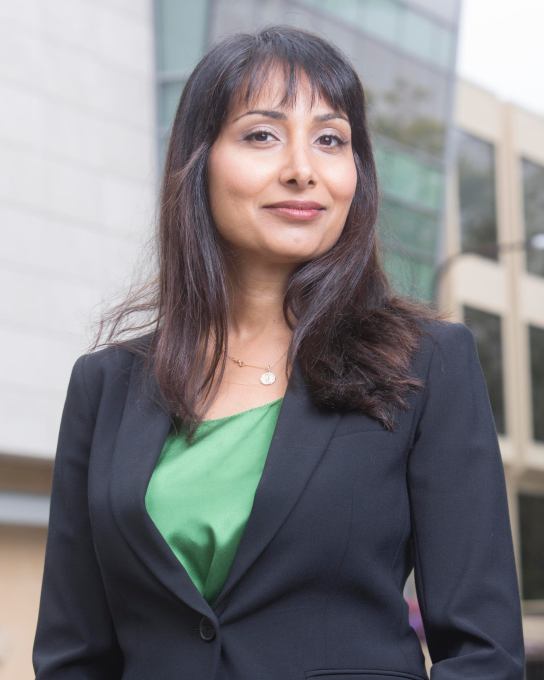
Legal scholar Veena Dubal.
As the institute’s work demonstrates, harmful AI can be found across many segments of society, such as policing, housing, the justice system, labor practices and the environmental impacts of some of our largest corporations. AI Now’s diverse and inspiring speaker lineup, however, was a testament to a growing constituency that’s starting to hold reckless tech businesses accountable. The banking class may panic at the thought of a Warren or Sanders presidency, but Big Tech’s irresponsible actors and utopian philosopher bros should be keeping a watchful eye on the ascendance of figures like Clark, Whittaker, and Dubal, along with their competence.
Here’s my free, evergreen solution advice for all tech companies: find unintended consequences of your products before journalists do, and think about how to address them even if you aren’t forced to by the law or public pressure, and then those problems won’t turn into scandals. https://t.co/IGymNWe2Q4
— Sarah Frier (@sarahfrier) October 16, 2019
I won’t attempt a more detailed review of AI Now’s conference here; the organization will put out an annual report summarizing and expanding on it later this year; and if you’re intrigued by this piece, get on their mailing list and go next year.
Below is my conversation with Dubal, where we discuss why the AI Now Institute is different from so many other tech ethics initiatives and how a scholar of taxis became a must-read name in tech. Our conversation ends with the story of one well-off white male software engineer who experienced surprising failure, only to realize his own disillusionment helped him connect to a much greater purpose than he’d ever envisioned.
Epstein: Let’s start by talking about the AI Now Symposium. What does it mean for you to be here as one of the featured speakers?
Dubal: It’s so awesome for a center like this to to say that what Uber drivers are doing to organize to better their conditions is actually related to tech. For the last half decade at least, I’ve been doing what is considered tech work, but very much at the periphery. Because we weren’t explicitly doing computer science-related work, I think people didn’t think of the research people like me do as being at all [related to tech]… it was “just” labor. It wasn’t tech, even though it is on [workers] backs that the whole tech industry exists. So it’s powerful to be included in this conversation.
And for this particular event, they’ve done such a good job of [inviting speakers] whose research is thought of as on the periphery, but should be at the center in terms of what is really important from an ethics perspective. Ruha Benjamin [a Professor of African American Studies at Princeton and founder of Princeton’s JustData Lab]’s work is amazing and then the two people that I’m on the panel with, Abdi Muse [Executive Director of the Awood Center in Minneapolis, a community organization focused on advocating for and educating Minnesota’s growing East African communities about their labor rights], organizes warehouse workers in Minnesota, who are the reason Amazon can facilitate the transcontinental flow of goods in the way that they do.
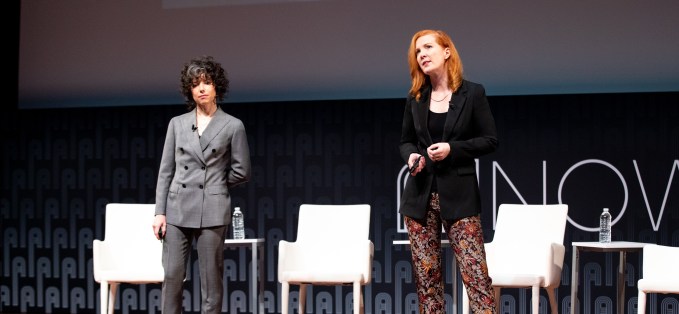
AI Now co-founders Meredith Whittaker and Kate Crawford. (Photo: Katherine Tyler)
And Bhairavi Desai [Executive Director of the New York Taxi Worker’s Alliance] — I’ve known her for 10 years and she has, from the very beginning, been fighting this gig nonsense. To have them in the room and centered, to have their voices centered instead of on periphery, is just so awesome for me.
Epstein: It’s very clear that AI Now is dedicated to doing that, maybe even moreso than any other peer organization I can identify. How do you see AI Now, as an organization, positioned among their various peers?
Dubal: It’s a great question. I’ve looked at a couple of other more nonprofity things that do tech and equality, and you are absolutely right; more so than any other organization, [AI Now] centers the people who are often at the periphery. Everything that they do is very deliberative.
They aren’t moving through things really quickly, onto the next project really quickly. Every decision they make is thoughtful, in terms of the people that they hire, for example, or how they do an event, or who they include in an event. It’s just very, very thoughtful, which is not how most things in tech, period, run.
Epstein: They’re not moving fast. They’re not breaking things.
Dubal: Exactly. They’re not breaking things. They’re fixing things. And the other thing is, even The TechEquity Collaborative, a nonprofit in San Francisco, there’s a tech utopian imaginary that guides their work. They really have a belief that the technology is going to fix things. AI now, based on all the interactions I’ve had with them, My sense is that their ethos is very much about how people fix things. Tech doesn’t fix things.
So they’re centering the people who can fix things. They’re in a powerful place, and I think because they’re so sophisticated in the work that they do, they have a powerful voice, which is unusual for people who are interested in the subaltern and in the issues that hurt the most marginalized.
Epstein: Yes. What made me want to come all the way here from Cambridge, MA, where we are not exactly suffering from a shortage of tech ethics initiatives, and what made me decide to miss a lot of the Disrupt conference even though I work for TechCrunch, is that it’s rare that you have an organization that is able to combine to things: genuinely fighting for the marginalized, or helping the subaltern speak; and actually achieving a very significant public voice. Usually it’s maybe one or the other but not both.
A Brief History of Russian Hackers’ Evolving False Flags
Most hackers know how to cover their tracks. But Russia’s elite groups are working at a whole other level.
Report: SoftBank is taking control of WeWork at an ~$8B valuation
WeWork, once valued at $47 billion, will be worth as little as $7.5 billion on paper as SoftBank takes control of the struggling co-working business, CNBC reports.
SoftBank, a long-time WeWork investor, plans to invest between $4 billion and $5 billion in exchange for new and existing shares, according to CNBC . The deal, expected to be announced as soon as tomorrow, represents a lifeline for WeWork, which is said to be mere weeks from running out of cash and has been shopping several of its assets as it attempts to lessen its cash burn.
WeWork declined to comment.
To be clear, it is reportedly the Vision Fund’s parent company, SoftBank Group Corp. that is taking control, with SoftBank International chief executive officer Marcelo Claure stepping in to support company management, per reports.
The Japanese telecom giant’s move comes precisely four weeks after co-founder and former CEO Adam Neumann relinquished control of the company and transitioned into a non-executive chairman role, and about three weeks after WeWork decided to delay its highly anticipated initial public offering. WeWork’s vice chairman Sebastian Gunningham and the company’s president and chief operating officer Artie Minson are currently serving as WeWork’s co-CEOs.
In addition to those personnel shake-ups, WeWork has lost its communications chief, Jimmy Asci, its chief marketing officer, Robin Daniels and several others. Meanwhile, the company has slashed hundreds of jobs, and opted to shut down its school, WeGrow, in 2020.
Now expected to go public in 2020, WeWork was also said to be in negotiations with JPMorgan for a last-minute cash infusion. The company, now a cautionary tale, will surely continue to reduce the sky-high costs of its money-losing operation in the upcoming months.
WeWork revealed an unusual IPO prospectus in August after raising more than $8 billion in equity and debt funding. Despite financials that showed losses of nearly $1 billion in the six months ending June 30, the company still managed to accumulate a valuation as high as $47 billion, largely as a result of Neumann’s fundraising abilities.
“As co-founder of WeWork, I am so proud of this team and the incredible company that we have built over the last decade,” Neumann said in a statement confirming his resignation last month. “Our global platform now spans 111 cities in 29 countries, serving more than 527,000 members each day. While our business has never been stronger, in recent weeks, the scrutiny directed toward me has become a significant distraction, and I have decided that it is in the best interest of the company to step down as chief executive. Thank you to my colleagues, our members, our landlord partners, and our investors for continuing to believe in this great business.”
6 tips founders need to know about securing their startup
If you’ve read anything of mine in the past year, you know just how complicated security can be.
Every day it seems there’s a new security lapse, a breach, a hack, or an inadvertent exposure, such as leaving a cloud storage server unprotected without a password. These things happen, but they don’t have to; aecurity isn’t as difficult as it sounds, but there’s no one-size-fits-all solution.
We sat down with three experts on the Extra Crunch stage at TechCrunch’s Disrupt SF earlier this month to help startups and founders understand what they need to do, when, and why.
We asked Google’s Heather Adkins, Duo’s Dug Song, and IOActive’s Jennifer Sunshine Steffens for their best advice. Here’s what they had to say.
Quotes have been edited and condensed for clarity.
1. Don’t put off the security conversation
The one resounding message from the panel: don’t put security off.
“There are basically three areas that folks should start considering how to bucket those risks,” said Duo’s Song. “The first is corporate risk in defending your users and applications they access. The second is application security and product risk. A third area is is around production, security and making sure that the operation of your security program is something that keeps up with that risk. And then a fourth — a new and emerging space — is trust, and not just privacy, but also safety.”
It’s better to be proactive about security than to be reactive to a data breach; not only will it help your company bolster its security posture, but it also serves as an important factor in future fundraising negotiations.
Song said founders have a “very direct obligation” to think about security as soon as they take someone else’s money, but especially when a company starts gathering user or customer data. “You have to put yourself in the shoes of those folks whose data you have to protect,” he said. “It’s not just your existential threats to your business, but you do have a responsibility, right to figure out how to do this well.”
IOActive’s Steffens said startups are already a target — simply because it’s assumed many won’t have thought much about security.
“A lot of attackers will go after startups who have high value data, because they know security is not a priority and it’s going to be a lot easier to get ahold of,” she said. “Data these days is extraordinarily valuable.”
2. Start with the security basics
Google’s Adkins, who runs the search giant’s internal information security team, joined the company almost two decades ago when it was just the size of a large startup. Her job is to keep the company’s network, assets, and employees safe.
“When I got there, they were so fanatical about security already, that half of the job was already done,” she said. “From the moment [Google] took its first search query, it was thinking about where those logs are stored, who has access to them, and what is its responsibility to its users,” she said.
“Startups who are successful with security are those where the chief executive and the founders are fanatical from day one and understand what threats exist to the business and what they need to do to protect it,” she said.
Song said many popular products and technologies these days come with strong security by default, such as iPhones, Chromebooks, security keys and Windows 10.
“You’re better off than the 90% of large companies out there,” he said. “That’s one of those few strategic advantages you have as a smaller, nimbler organization that doesn’t have a lot of legacy,” he added. “You can do things better from the start.”
“A lot of the basics are still key,” said Steffens. “Even as we come out with the new shiny technology, having things like firewalls and antivirus, and multi-factor authentication.”
“Security doesn’t always have to be a money thing,” she said. “There’s a lot of open source technology that’s really great.”
3. Start looking at security as an investment
“The sooner you start thinking about security, the less expensive it is in the end,” said Steffens.
That’s because, the experts said, proactive security gives companies an edge over competitors who tack on security solutions after a breach. It’s easier and more cost-effective to get it right the first time without having to fill in gaps years later.
It might be a hard sell to funnel money into something where you won’t actively see financial returns, which is why founders should think of security as investments for the future. The idea is that if you spend a little money at the start, it can save you down the line from the inevitable — a security incident that will cost you in bad headlines, lost customer trust, and potentially fines or other sanctions.
NASA’s Jim Bridenstine says 2035 is doable for human landing on Mars — provided budget is there
NASA Administrator Jim Bridenstine took part in a joint presentation by the chiefs of a number of international space agencies at the annual International Astronautical Conference on Monday. At the end of the event, a question was put to the entire group — when do we get to Mars?
After a joke answer of “Tuesday” by ESA Director General Jan Wörner, Bridenstine followed with a serious answer that he believes — provided everyone can get their governments to actually back them and provide the support needed — it’s possible that astronauts could land on Mars by as early as 2035.
“If we accelerate the Moon landing, we’re accelerating the Mars landing — that’s what we’re doing,” Bridenstine said, referring to the agency’s aggressive, accelerated timeline of aiming to land the first American woman and next American man on the Moon by 2024 with the Artemis program.
“If our budgets were sufficient,” Bridenstine said, turning to his colleagues from NASA’s international equivalents, “I would suggest that we could do it by 2035.”
“The goal is to land on the Moon within five years and be sustainable by 2028,” Bridenstine said during a press conference following the agency leadership panel, clarifying that sustainability means “people living and working on another world for long periods of time.”
The caveat Bridenstine offered, that budgets match ambition, is not an insignificant one. NASA just faced a congressional subcommittee budgetary hearing about its plan to get to the Moon by 2024, and faced some heavy skepticism. From NASA’s scientific and technical assessment of Mars mission feasibility for a 2035 target, however, the agency previously discussed this date as early as 2015.
The Station: Volvo evolves, Skip trips and touchscreen tech
The Station is back for another week of news and analysis on all the ways people and goods move from Point A to Point B — today and in the future. As always, I’m your host Kirsten Korosec, senior reporter at TechCrunch.
Portions of the newsletter will be published as an article on the main site after it has been emailed to subscribers (that’s what you’re reading now). To get everything, you have to sign up. And it’s free. To subscribe, go to our newsletters page and click on The Station.
This week, we’re looking at factories in China, scooters in San Francisco and touchscreens in cars, among other things.
Please reach out anytime with tips and feedback. Tell us what you love and don’t love so much. Email me at [email protected] to share thoughts, opinions or tips or send a direct message to @kirstenkorosec.
Micromobbin’

Welcome to micromobbin’ — a weekly dive into the tiny but mighty chaotic world of micromobility. This also happens to be a place where Megan Rose Dickey reigns. Follow her @meganrosedickey.
Uber, Lime and Spin each deployed 500 electric scooters in San Francisco as part of the city’s permitting program. This means residents in SF can now choose from Uber-owned JUMP, Lime, Spin or Scoot scooters. Unfortunately for Skip, the company did not receive a permit to continue operating in the city, which means layoffs at the local level are afoot, Skip CEO Sanjay Dastoor said earlier this week.
Meanwhile, former Uber executive Dmitry Shevelenko unveiled Tortoise, an autonomous repositioning software for micromobility operators. The idea is to help make it easier for these companies to more strategically deploy their respective vehicles and reposition them when needed.
Let’s close this section with the obligatory funding round. Wheels, a pedal-less electric bike-share startup, raised a $50 million round led by DBL Partners. That brought its total funding to $87 million.
Oh, but wait, TC reporter Romain Dillet reminded us that micromobbin’ happens outside of the U.S. too. Uber also announced this past week that it has integrated its app with French startup Cityscoot, which has a fleet of free-floating moped-style scooters.
This is the latest example of Uber’s plan to become a super mobility app that goes well beyond its own network of ride-hailing vehicles.
— Megan Rose Dickey
Snapshot: Touchscreen tech
We’ve seen a lot of different approaches when it comes to engaging with connected car services: head-up displays on the windshield, small screens perched on the dashboard, interactive voice and, of course, connections and mounts for smartphones.
But how about if your whole car becomes the touchscreen? A startup called Sentons is working on technology that could make that happen. The company uses a technique involving processors and AI that emit and read ultrasound to detect physical movement on a surface, such as touch, force or gestures, and users can create “virtual controls” on the fly that work on these surfaces.
This week, it released SurfaceWave, a software and hardware stack that works on glass, metal and plastic surfaces of smartphones.
CEO Jess Lee says the next iterations are going to be the kinds of materials that are used to make car dashboards and other interior surfaces you find inside the vehicle, including leather, thicker plastic and other materials. The company is already engaging with automotive companies, Lee told TechCrunch.
I can see a lot of possibilities for this in the human-driven vehicles of today. We’ve already seen how Tesla has changed how we think about infotainment systems in cars. And then there’s electric vehicle startup Byton, which plans to bring a vehicle to market with a touchscreen that extends along the entire dashboard.
The real opportunity for Sentons will be with autonomous vehicles, a product that will afford its passengers more leisure time.
— Ingrid Lunden
Made in China

Earlier this week, Tesla was given the OK to begin producing vehicles at its $2 billion factory in Shanghai. Tesla was added to the Ministry of Industry and Information Technology’s list of approved automotive manufacturers.
Now we’ll watch and wait to see if production starts this month. Expect the topic of China and this factory to come up during Tesla’s earnings call with analysts October 23.
In other China factory news, we hear that electric vehicle startup Byton plans to host a splashy opening ceremony in early November for its new plant. The event will include lots of Chinese officials, company executives and maybe a preview of a near-final production version of its M-Byte vehicle.
Byton’s factory in Nanjing covers some 800,000 square meters (8.6 million square feet) funded with a total investment of more than $1.5 billion. Over the summer, the walls and roof went up, equipment was installed and commissioning began in five major workshops: stamping, welding, paint, battery and assembly.
The plant will begin trial production in late 2019.
This all sounds great, but there have been challenges, and the constant requirement for capital is one of them. Byton has delayed the launch of the production version of the M-Byte by two quarters. It’s now looking like commercial production will begin by the end of the second quarter of 2020.
Here are a couple of interesting tidbits for those manufacturing geeks out there:
- The stamping shop completes one panel every 3 seconds on average. Byton claims it will be one of the fastest stamping production lines in China.
- The welding shop incorporates 335 welding robots supplied by KUKA and boosts the automation rate to 99%, according to Byton.
- The paint shop is equipped with a “3 Coating 2 Baking” system and thin film pre-treatment as well as the transverse “Eco-Incure” oven technology.
- The battery shop will produce and assemble battery packs, designed independently by Byton. Battery maker CATL provides the battery cells and modules and aluminum maker Constellium supplies the aluminum battery tray.
A little bird

We hear a lot. But we’re not selfish. Let’s share. A little bird is where we pass along insider tips and what we’re hearing or finding from reliable, informed sources in the industry. This isn’t a place for unfounded gossip.
To get a “little bird” and the rest of the newsletter, please subscribe. Just go to our newsletters page and click on The Station.
What does systems engineering in AVs mean?

I recently spoke to Randol Aikin, the head of systems engineering at self-driving trucks startup Ike Robotics, about the company’s approach, which is based on a methodology developed at MIT called Systems Theoretic Process Analysis. STPA is the foundation for Ike’s product development.
The company also released a wickedly long safety report (it’s halfway down that landing page in the link provided).
The complete interview was included in the emailed newsletter. Yet another reason to subscribe to this free newsletter. Here’s one quote from the interview with Aikin:
We asked the question, what do we have to prove to ourselves and demonstrate in order to be on a public road safely? It’s the same question that we’re going to have to answer for the product as well, which is, what do we need to prove to assure that we’re safe to operate without a human in the cab?
It’s one of the huge unproven hypotheses. Anybody in this space that doesn’t consider that to be a huge technical challenges is ignoring a really thorny and important question.
Who will own the future of transportation?
Our mobility coverage extends to Extra Crunch. Check out my latest article on who will own the future of transportation based on insights from Zoox CEO Aicha Evans and former Michigan Gov. Jennifer Granholm. The idea here is to explore some of the nuances of this loaded question.
Extra Crunch requires a paid subscription and you can sign up here.
Daily Crunch: We review the Pixel 4
The Daily Crunch is TechCrunch’s roundup of our biggest and most important stories. If you’d like to get this delivered to your inbox every day at around 9am Pacific, you can subscribe here.
1. Pixel 4 review: Google ups its camera game
Brian Heater was impressed by the improvements in Google’s latest smartphone, including camera upgrades and the Recorder app.
However, he also argued that the Pixel 4 doesn’t exactly address what Google wants the Pixel to be, moving forward, especially after the Pixel 3a it was confirmed that consumers were looking for something cheaper.
2. NordVPN confirms it was hacked
The admission comes after rumors that the company had been breached, and what first emerged was that NordVPN had left an expired internal private key exposed, potentially allowing anyone to spin out their own servers imitating NordVPN.
3. Netflix to raise $2 billion in debt to fund more content spending
Despite a relatively strong earnings report last week, Netflix isn’t out of the woods just yet. Disney+ and Apple+ launch next month, and there’s more competition on the way.
4. Commercetools raises $145M from Insight for Shopify-style e-commerce APIs for large enterprises
The funding comes at the same time as commercetools is getting spun out by REWE, a German retail and tourist services giant that acquired the startup in 2015.
The Pro 7, which is going on sale today, is a competent upgrade that gives Surface Pro users exactly what they want — even if it sticks to a tried and tested formula.
6. IPOs are the beginning, not the end
At Disrupt SF, PagerDuty’s Jennifer Tejada argued that an IPO “is part of the beginning of a long journey for a durable company that you want to build a legacy around.” (Extra Crunch membership required.)
7. This week’s TechCrunch podcasts
The Equity team talks to Greylock’s Sarah Guo about the future of software-as-a-service products, while Original Content has a review of “El Camino,” the new “Breaking Bad” movie on Netflix.

Is there room for a US equivalent to China’s No. 1 news app?
In China, Toutiao is literally big news.
Not only has its parent company ByteDance achieved a $75 billion valuation, two of its apps — Toutiao, a news aggregator, and Douyin (Tik Tok in China) — are chipping into WeChat’s user engagement numbers, no small feat considering the central role WeChat plays in the daily lives of the region’s smartphone users.
The success of Toutiao (its name means “headline”) prompts the question: why hasn’t one news aggregator app achieved similar success in the United States? There, users can pick from a roster of news apps, including Google News, Apple News (on iOS), Flipboard, Nuzzel and SmartNews, but no app is truly analogous to Toutiao, at least in terms of reach. Many readers still get news from Google Search (not the company’s news app) and when they do use an app for news, it’s Facebook.
The top social media platform continues to be a major source of news for many Americans, even as they express reservations about the reliability of the content they find there. According to research from Columbia Journalism Review, 43% of Americans use Facebook and other social media platforms to get news, but 57% said they “expect the news they see on those platforms to be largely inaccurate.” Regardless, they stick with Facebook because it’s timely, convenient and they can share content with friends and read other’s comments.
The social media platform is one of the main reasons why no single news aggregator app has won over American users the same way Toutiao has in China, but it’s not the only one. Other factors, including differences between how the Internet developed in each country, also play a role, says Ruiwan Xu, the founder and CEO of CareerTu, an online education platform that focuses on data analytics, digital marketing and research.
While Americans first encountered the Internet on PCs and then shifted to mobile devices, many people in China first went online through their smartphones and the majority of the country’s 800 million Internet users access it through mobile. This makes them much more open to consuming content — including news and streaming video — on mobile.
New Facebook features fight election lies everywhere but ads
Heaven forbid a political candidate’s Facebook account gets hacked. They might spread disinformation…like they’re already allowed to do in Facebook ads…
Today Facebook made a slew of announcements designed to stop 2020 election interference. “The bottom line here is that elections have changed significantly since 2016,” and so has Facebook in response, CEO Mark Zuckerberg said on a call with reporters. “We’ve gone from being on our back foot to proactively going after some of the biggest threats out there.”
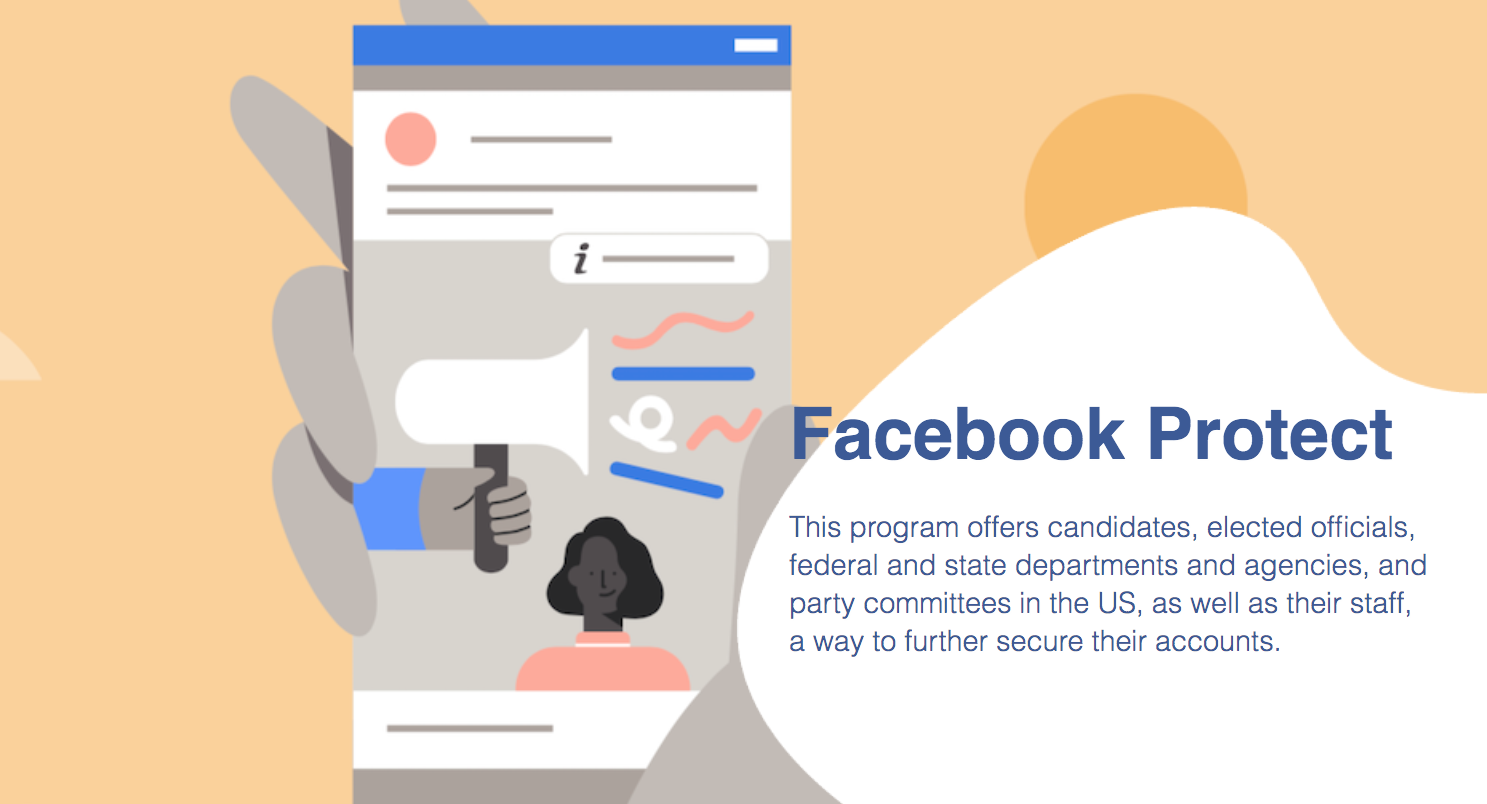
One new feature is called Facebook Protect. By hijacking accounts of political candidates or their campaign staff, bad actors can steal sensitive information, expose secrets and spread disinformation. So to safeguard these vulnerable users, Facebook is launching a new program with extra security they can opt into.
Facebook Protect entails requiring two-factor authentication, and having Facebook monitor for hacking attempts like suspicious logins. Facebook can then inform the rest of an organization and investigate if it sees one member under attack.
Today’s other announcements include:
- The takedown of foreign influence campaigns, three from Iran and one from Russia in order to protect users from deception.
- Labeling state-owned or controlled media organizations like Russia Today on their Facebook Pages and the Ad Library to help users identify potential propaganda.
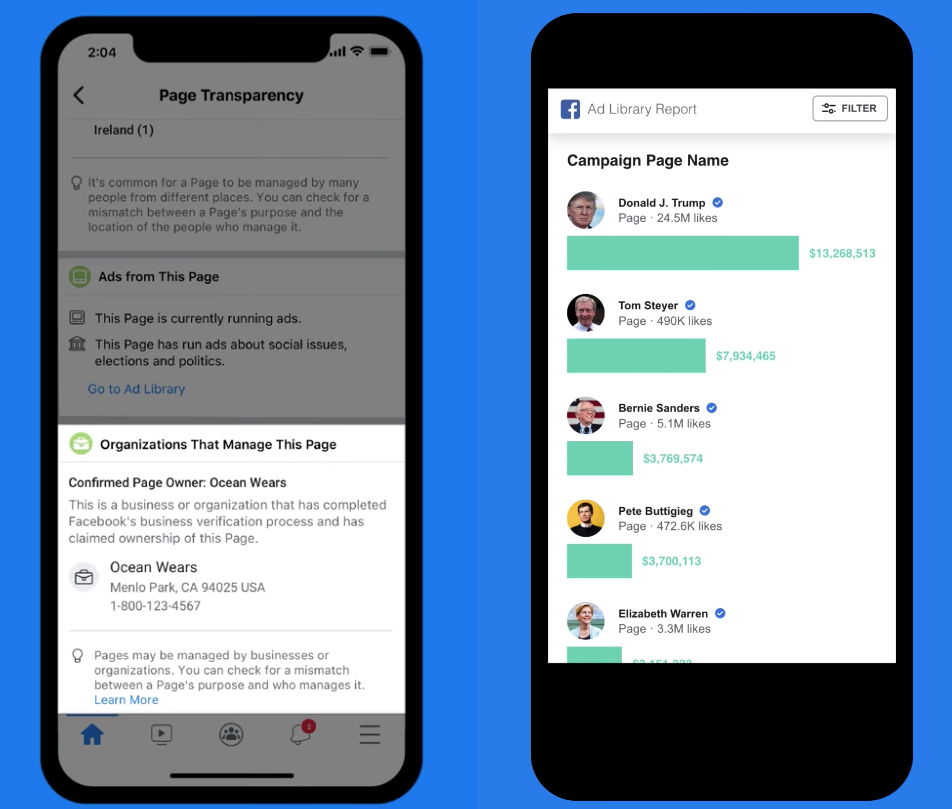
- Added Page ownership transparency for ePages with large U.S. audiences and those verified to run political ads, which will have to display their owner’s organization’s legal name, city and phone number or website so it’s clear where information comes from.
- New transparency features around political ad spend, including a U.S. presidential candidate spend tracker, more geographic spending details, info on which apps an ad appears on and programmatic access to downloads of political ad creative.
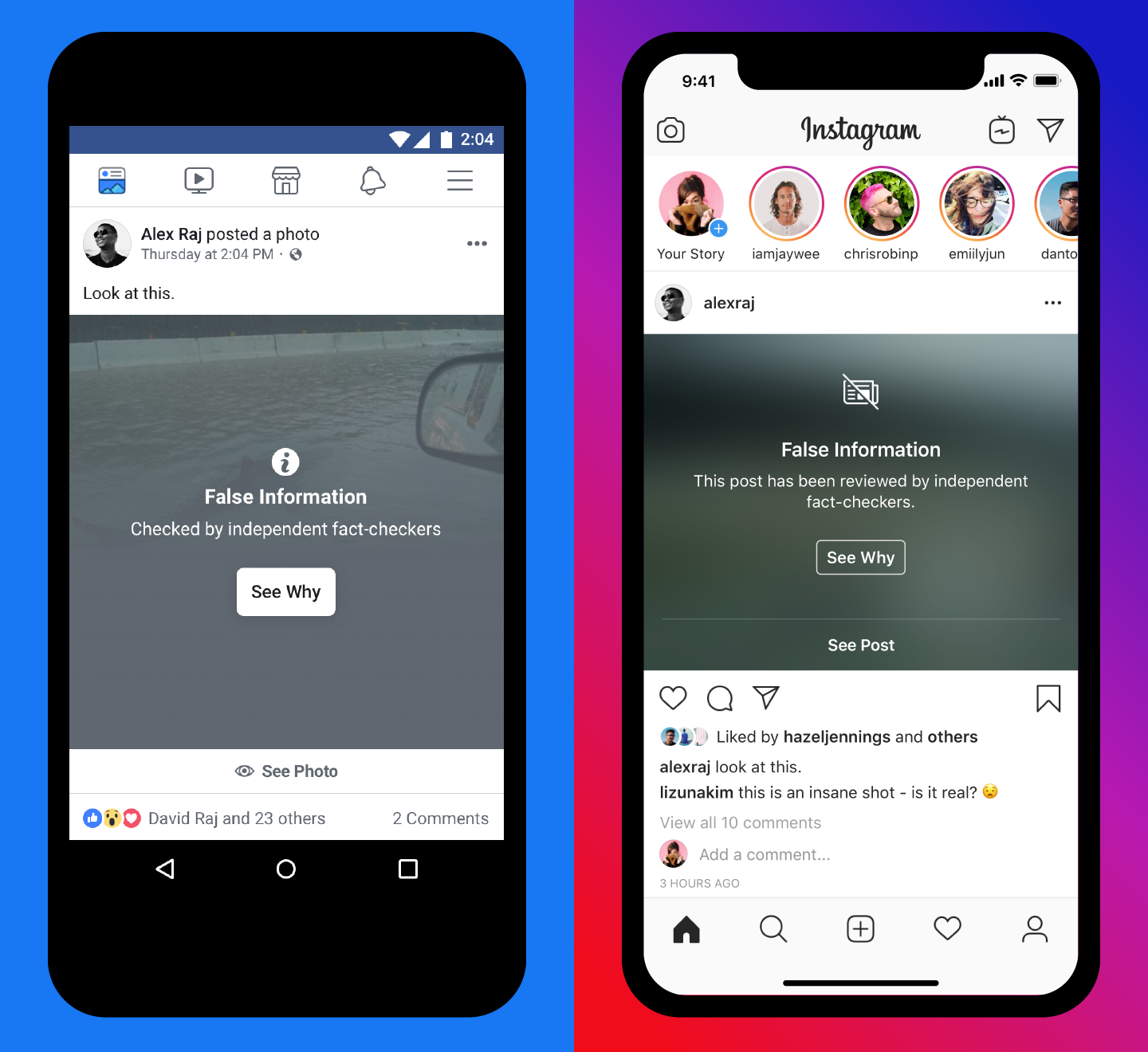
- Much more prominent fact-checking labels will now run as interstitials warnings atop photos and videos on Facebook and Instagram that were fact-checked as false, rather than smaller labels attached below the post to make sure users know information is false before consuming it. Users will also be warned before they share posts fact-checked as false to keep them from going viral.
- A wider ban on voter suppression ads that suggest it’s useless to vote, provide inaccurate polling or voter eligibility information or threaten people if they vote or based on the outcome of an election to prevent intimidation and confusion.
- A $2 million investment from Facebook into media literacy projects to develop new methods of educating people to understand political social media and ads.
- Facebook Protect offering hack monitoring services to elected officials, candidates’ political party committees, government agencies and departments surrounding elections and verified users involved in elections.
Combined, the efforts could protect both campaigns and constituents from misinformation while giving everyone more clarity about where content originates. Yet the approach highlights Facebook’s tightrope walk between policing its networks and overstepping into censorship.
In a speech last week, Zuckerberg tried to firmly plant Facebook as erring on the side of giving people a voice rather than stifling speech. He raised the threat of China’s influence over foreign businesses by dangling its giant market in exchange for adherence to its political values. And he tried to defend allowing lies in political ads, arguing that banning political ads on Facebook as I’ve recommended the company do would benefit incumbents and silence challengers who don’t have media attention.

A Trump ad spreads misinformation claiming Democrats want to repeal the second amendment
Yet throughout the call, Zuckerberg was hammered with questions about Facebook’s willingness to fact check what users share with friends, but not what politicians pay to show to millions of voters.
“People should make up their own minds about what candidates are credible. I don’t think those determinations should come from tech companies . . . People need to be able to see this content for themselves,” Zuckerberg insisted. Yet if Facebook is willing to cover photos containing misinformation with a warning label you have to click to see past, it’s strange that it’s unwilling to do the same for political ads.
Like farming out fact-checking to third-party news outlets as Facebook already does, banning political ads wouldn’t force Facebook to judge the truth of individual statements, and they’d still have the right to share what they want to their own followers.
When I asked why he believes banning political ads would favor incumbents, Zuckerberg admitted, “You’re right that incumbents can raise more money,” and he wasn’t sure there’d been a comprehensive study on the matter. His defense relied on anecdotal beliefs of unnamed sources:
I’ve talked to a lot of people. The general belief that they have, when they’re a challenger, is that they rely on different mechanisms like ads in order to get their voices into a debate more than incumbents do . . .
From all of the conversations that I’ve had, the general overwhelming consensus from people who are participating in these things and who work on them has been that removing political ads would favor incumbents.
While the rest of Facebook’s announcements today felt like sensible steps in the right direction, the company will need stronger arguments for why it polices misinformation shared by users but not political ad campaigns.
If it wants to find a better middle-ground, it could offer standardized ad units for political campaigns that endorse the candidate and ask for donations, but can’t make potentially untruthful assertions about them or their competitors. Alternatively it could apply fact-check labels to political ads without making calls of veracity itself. Facebook could also build other ways for challengers to grow their voice outside of ads so it could ban them without supposedly empowering incumbents.
Otherwise, it faces a political ad misinformation arms race in stern contrast to its other pro-truth efforts announced today. What will Facebook do if campaigns make increasingly malicious and inaccurate statements about their rivals via ads, claiming only donations to their candidate can save society? And what if they keep pouring all the money they unscrupulously raise into more ads? “My opponent eats babies. Donate to me by midnight. Only I can stop them from becoming America’s dictator.”
At least most of the time, users can try to avoid politics by ignoring campaign pages and unfollowing their crazy uncles. But untrue ads inject polarization and discord into people’s feeds. Facebook’s policies give the richest, most craven candidates the loudest voices. Can the social network and the democratic process survive a whole year of top spenders shouting lies?