London’s top consumer VCs share which trends they’re tracking

With 72 unicorns created since 2009 and $8.7 billion in venture funding last year, the UK is Europe’s leading startup hub.

Although it remains uncertain how Brexit will impact startups’ ease of recruiting and rapid scaling, initial pains are unlikely to displace London from its position as a global center for finance, media, retail, and technology.

As UK-based startups reach $1 billion (~£800 million) valuations at a rate of one per month, according to data from Dealroom, VC firms have raised $3.5 billion in new funds to fuel the next wave of investments.

Interested to learn where that capital could flow, I asked nine of London’s top consumer-focused VCs to find out which specific trends they’re using to identify startup investment opportunities:

  • Julia Hawkins, Partner at LocalGlobe
  • Lars Fjeldsoe-Nielsen, Partner at Balderton
  • Sonali De Rycker, Partner at Accel Partners
  • Christian Dorffer, Partner at Sweet Capital
  • Danny Rimer, Partner at Index Ventures
  • Reshma Sohoni, Managing Partner at Seedcamp
  • Niall Wass, Partner at Atomico
  • Paul Murphy, Partner at Northzone
  • Nic Brisbourne, Partner at Forward Partners

Their responses highlighted the diversify of funding interests in the ecosystem, but also show that banking, consumer health, transport, direct-to-consumer brands, and social entertainment remain hot areas.

Julia Hawkins, Partner at LocalGlobe

“I’m very focused on the healthtech sector and within consumer health, I’m particularly interested in the potential for digital therapeutics to enable people to gain control over habits and treat certain chronic conditions such as mental health. 

We’re thinking deeply about transportation, we’re already investors in Citymapper, Beryl and Voi and see the huge potential to improve how people move around cities and influence how urban centers are planned, all while reducing pollution.  

On that topic, we’re watching the climate change debate closely and I’m heartened by the fact that people everywhere are becoming wholly committed to reducing waste. Companies that can produce truly circular products for our families, homes and places of work I think will do well.

It’s an incredibly interesting time in media with titanic worlds of video, gaming and music are shifting and I believe in the transformative power of games, music and immersive experiences — TikTok and Fortnite show just how powerful these can be and I believe new platforms such as Playdeo will make consuming media and entertainment much more active experiences in the future.”

Lars Fjeldsoe-Nielsen, Partner at Balderton

“We are excited about the disruption within the European transportation sector, where we’ve seen new types of vehicles, like e-scooters from VOI, and amazing advances in autonomous mobility solutions. Time is up for car ownership in many city centers and competition is fierce for environmentally-friendly alternatives. This creates an exciting opportunity to use tech to improve public transport options and to leverage the sharing economy which Citymapper offers, as well as overhaul the car hire sector as new players like Virtuo are aiming to do.

We are also impressed by the continued innovation in the financial sector. We are long-time investors in fintech and have backed Revolut and GoCardless, amongst others. Traditional banks and financial incumbents are battling fragmented and outdated technology stacks to adapt to rapidly changing consumer demands, which creates a huge opportunity for startups.”

Sonali De Rycker, Partner at Accel Partners

“We’re excited about three key trends in consumer tech. The first is fintech, for which the UK has created a very supportive environment. A few large businesses are being built from London, like Monzo, buoyed by new rules written around retail banking and next generation financial services as well as huge, unmet customer demand.

The second is healthtech. Healthcare is a large and untapped opportunity plagued by rising costs for providers and deteriorating patient experience. We are seeing a few platform companies that are finding ways to successfully solve these problems by providing digital healthcare to consumers, like Kry out of Sweden.

Quantum computing’s ‘Hello World’ moment

Does quantum computing really exist? It’s fitting that for decades this field has been haunted by the fundamental uncertainty of whether it would, eventually, prove to be a wild goose chase. But Google has collapsed this nagging superposition with research not just demonstrating what’s called “quantum supremacy,” but more importantly showing that this also is only the very beginning of what quantum computers will eventually be capable of.

This is by all indications an important point in computing, but it is also very esoteric and technical in many ways. Consider, however, that in the 60s, the decision to build computers with electronic transistors must have seemed rather an esoteric point as well. Yet that was in a way the catalyst for the entire Information Age.

Most of us were not lucky enough to be involved with that decision or to understand why it was important at the time. We are lucky enough to be here now — but understanding takes a bit of explanation. The best place to start is perhaps with computing and physics pioneers Alan Turing and Richard Feynman.

‘Because nature isn’t classical, dammit’

The universal computing machine envisioned by Turing and others of his generation was brought to fruition during and after World War II, progressing from vacuum tubes to hand-built transistors to the densely packed chips we have today. With it evolved an idea of computing that essentially said: If it can be represented by numbers, we can simulate it.

That meant that cloud formation, object recognition, voice synthesis, 3D geometry, complex mathematics — all that and more could, with enough computing power, be accomplished on the standard processor-RAM-storage machines that had become the standard.

But there were exceptions. And although some were obscure things like mathematical paradoxes, it became clear as the field of quantum physics evolved that it may be one of them. It was Feynman who proposed in the early 80s that if you want to simulate a quantum system, you’ll need a quantum system to do it with.

“I’m not happy with all the analyses that go with just the classical theory, because nature isn’t classical, dammit, and if you want to make a simulation of nature, you’d better make it quantum mechanical,” he concluded, in his inimitable way. Classical computers, as he deemed what everyone else just called computers, were insufficient to the task.

GettyImages feynman

Richard Feynman made the right call, it turns out.

The problem? There was no such thing as a quantum computer, and no one had the slightest idea how to build one. But the gauntlet had been thrown, and it was like catnip to theorists and computer scientists, who since then have vied over the idea.

Could it be that with enough ordinary computing power, power on a scale Feynman could hardly imagine — data centers with yottabytes of storage and exaflops of processing — we can in fact simulate nature down to its smallest, spookiest levels?

Or could it be that with some types of problems you hit a wall, and that you can put every computer on Earth to a task and the progress bar will only tick forward a percentage point in a million years, if that?

And, if that’s the case, is it even possible to create a working computer that can solve that problem in a reasonable amount of time?

In order to prove Feynman correct, you would have to answer all of these questions. You’d have to show that there exists a problem that is not merely difficult for ordinary computers, but that is effectively impossible for them to solve even at incredible levels of power. And you would have to not just theorize but create a new computer that not just can but does solve that same problem.

By doing so you would not just prove a theory, you would open up an entirely new class of problem-solving, of theories that can be tested. It would be a moment when an entirely new field of computing first successfully printed “hello world” and was opened up for everyone in the world to use. And that is what the researchers at Google and NASA claim to have accomplished.

In which we skip over how it all actually works
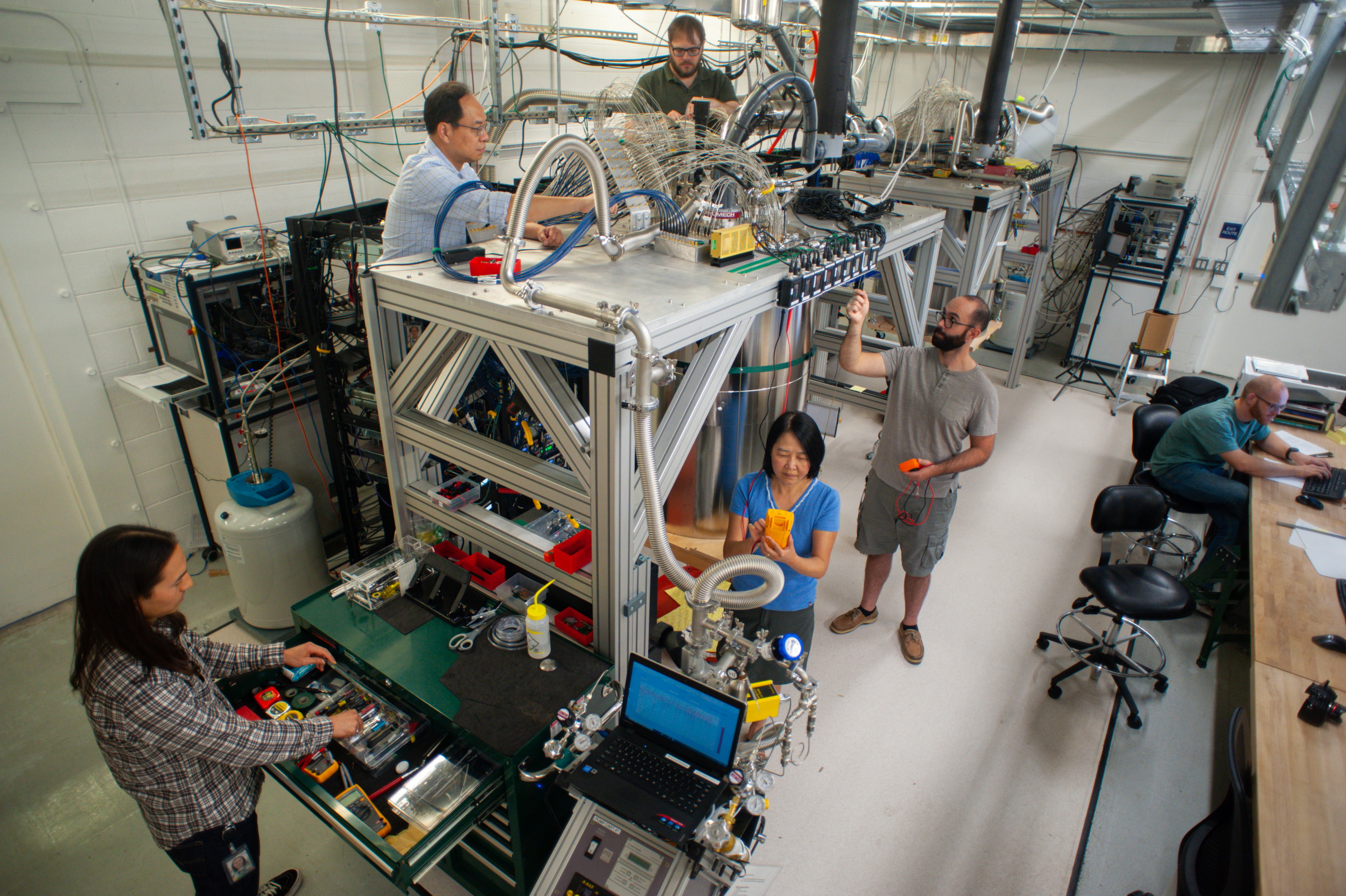
google quantum team

One of the quantum computers in question. I talked with that fellow in the shorts about microwave amps and attenuators for a while.

Much has already been written on how quantum computing differs from traditional computing, and I’ll be publishing another story soon detailing Google’s approach. But some basics bear mentioning here.

Classical computers are built around transistors that, by holding or vacating a charge, signify either a 1 or a 0. By linking these transistors together into more complex formations they can represent data, or transform and combine it through logic gates like AND and NOR. With a complex language specific to digital computers that has evolved for decades, we can make them do all kinds of interesting things.

Quantum computers are actually quite similar in that they have a base unit that they perform logic on to perform various tasks. The difference is that the unit is more complex: a qubit, which represents a much more complex mathematical space than simply 0 or 1. Instead you may think of their state may be thought of as a location on a sphere, a point in 3D space. The logic is also more complicated, but still relatively basic (and helpfully still called gates): That point can be adjusted, flipped, and so on. Yet the qubit when observed is also digital, providing what amounts to either a 0 or 1 value.

By virtue of representing a value in a richer mathematical space, these qubits and manipulations thereof can perform new and interesting tasks, including some which, as Google shows, we had no ability to do before.

A quantum of contrivance

In order to accomplish the tripartite task summarized above, first the team had to find a task that classical computers found difficult but that should be relatively easy for a quantum computer to do. The problem they settled on is in a way laughably contrived: Being a quantum computer.

In a way it makes you want to just stop reading, right? Of course a quantum computer is going to be better at being itself than an ordinary computer will be. But it’s not actually that simple.

Think of a cool old piece of electronics — an Atari 800. Sure, it’s very good at being itself and running its programs and so on. But any modern computer can simulate an Atari 800 so well that it could run those programs in orders of magnitude less time. For that matter, a modern computer can be simulated by a supercomputer in much the same way.

Furthermore, there are already ways of simulating quantum computers — they were developed in tandem with real quantum hardware so performance could be compared to theory. These simulators and the hardware they simulate differ widely, and have been greatly improved in recent years as quantum computing became more than a hobby for major companies and research institutions.
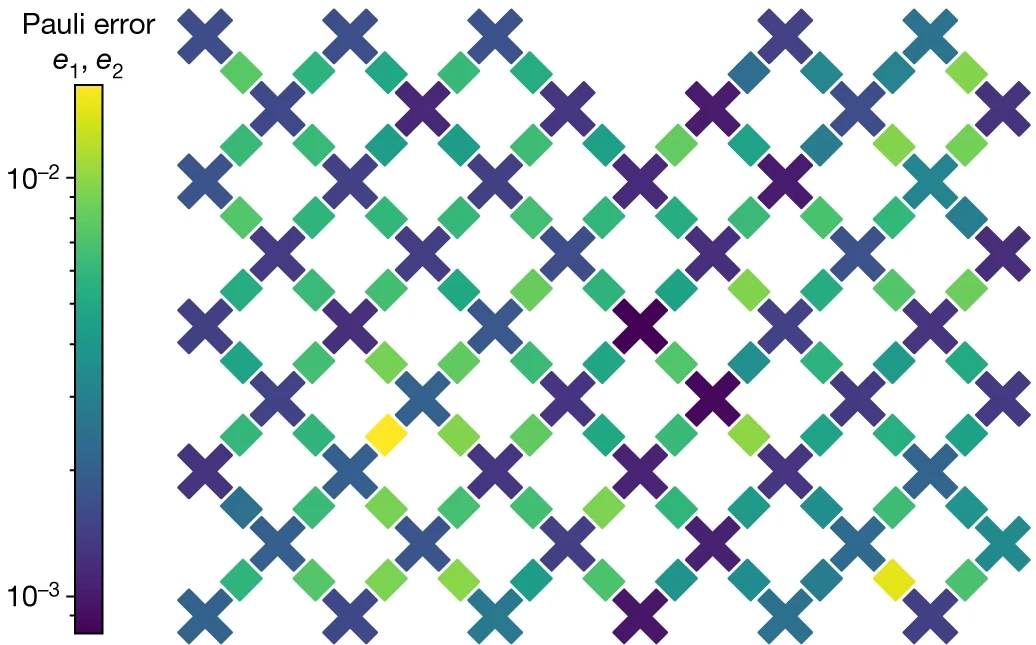
qubit lattice

This shows the “lattice” of qubits as they were connected during the experiment (colored by the amount of error they contributed, which you don’t need to know about.)

To be specific, the problem was simulating the output of a random sequence of gates and qubits in a quantum computer. Briefly stated, when a circuit of qubits does something, the result is, like other computers, a sequence of 0s and 1s. If it isn’t calculating something in particular, those numbers will be random — but crucially, they are “random” in a very specific, predictable way.

Think of a pachinko ball falling through its gauntlet of pins, holes and ramps. The path it takes is random in a way, but if you drop 10,000 balls from the exact same position into the exact same maze, there will be patterns in where they come out at the bottom — a spread of probabilities, perhaps more at the center and less at the edges. If you were to simulate that pachinko machine on a computer, you could test whether your simulation is accurate by comparing the output of 10,000 virtual drops with 10,000 real ones.

It’s the same with simulating a quantum computer, though of course rather more complex. Ultimately however the computer is doing the same thing: simulating a physical process and predicting the results. And like the pachinko simulator, its accuracy can be tested by running the real thing and comparing those results.

But just as it is easier to simulate a simple pachinko machine than a complex one, it’s easier to simulate a handful of qubits than a lot of them. After all, qubits are already complex. And when you get into questions of interference, slight errors and which direction they’d go, etc. — there are, in fact, so many factors that Feynman decided at some point you wouldn’t be able to account for them all. And at that point you would have entered the realm where only a quantum computer can do so — the realm of “quantum supremacy.”

Exponential please, and make it a double

After 1,400 words, there’s the phrase everyone else put right in the headline. Why? Because quantum supremacy may sound grand, but it’s only a small part of what was accomplished, and in fact this result in particular may not last forever as an example of having reached those lofty heights. But to continue.

Google’s setup, then, was simple. Set up randomly created circuits of qubits, both in its quantum computer and in the simulator. Start simple with a few qubits doing a handful of operational cycles and compare the time it takes to produce results.

Bear in mind that the simulator is not running on a laptop next to the fridge-sized quantum computer, but on Summit — a supercomputer at Oak Ridge National Lab currently rated as the most powerful single processing system in the world, and not by a little. It has 2.4 million processing cores, a little under 3 petabytes of memory, and hits about 150 petaflops.

At these early stages, the simulator and the quantum computer happily agreed — the numbers they spat out, the probability spreads, were the same, over and over.

But as more qubits and more complexity got added to the system, the time the simulator took to produce its prediction increased. That’s to be expected, just like a bigger pachinko machine. At first the times for actually executing the calculation and simulating it may have been comparable — a matter of seconds or minutes. But those numbers soon grew hour by hour as they worked their way up to 54 qubits.

When it got to the point where it took the simulator five hours to verify the quantum computer’s result, Google changed its tack. Because more qubits isn’t the only way quantum computing gets more complex (and besides, they couldn’t add any more to their current hardware). Instead, they started performing more rounds of operations with a given circuit, which adds all kinds of complexity to the simulation for a lot of reasons that I couldn’t possibly explain.

For the quantum computer, doing another round of calculations takes a fraction of a second, and even multiplied by thousands of times to get the required number of runs to produce usable probability numbers, it only ended up taking the machine several extra seconds.
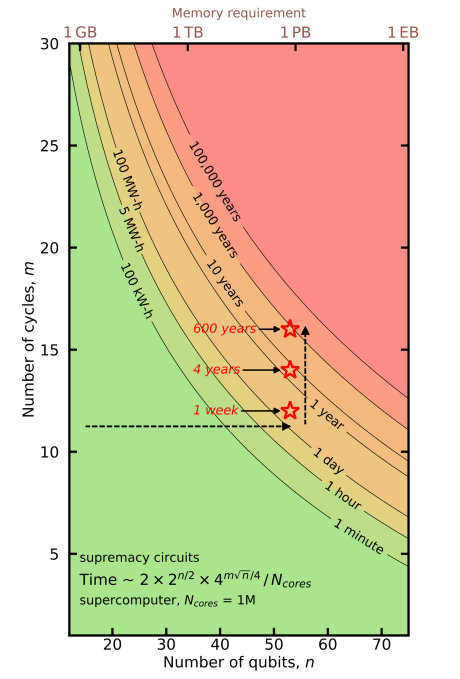
schroed feyn chart

You know it’s real because there’s a chart. The dotted line (added by me) is the approximate path the team took, first adding qubits (x-axis) and then complexity (y-axis).

For the simulator, verifying these results took a week — a week, on the most powerful computer in the world.

At that point the team had to stop doing the actual simulator testing, since it was so time-consuming and expensive. Yet even so, no one really claimed that they had achieved “quantum supremacy.” After all, it may have taken the biggest classical computer ever created thousands of times longer, but it was still getting done.

So they cranked the dial up another couple notches. 54 qubits, doing 25 cycles, took Google’s Sycamore system 200 seconds. Extrapolating from its earlier results, the team estimated that it would take Summit 10,000 years.

What happened is what the team called double exponential increase. It turns out that adding qubits and cycles to a quantum computer adds a few microseconds or seconds every time — a linear increase. But every qubit you add to a simulated system makes that simulation exponentially more costly to run, and it’s the same story with cycles.

Imagine if you had to do whatever number of push-ups I did, squared, then squared again. If I did 1, you would do 1. If I did 2, you’d do 16. So far no problem. But by the time I get to 10, I’d be waiting for weeks while you finish your 10,000 push-ups. It’s not exactly analogous to Sycamore and Summit, since adding qubits and cycles had different and varying exponential difficulty increases, but you get the idea. At some point you can have to call it. And Google called it when the most powerful computer in the world would still be working on something when in all likelihood this planet will be a smoking ruin.

It’s worth mentioning here that this result does in a way depend on the current state of supercomputers and simulation techniques, which could very well improve. In fact IBM published a paper just before Google’s announcement suggesting that theoretically it could reduce the time necessary for the task described significantly. But it seems unlikely that they’re going to improve by multiple orders of magnitude and threaten quantum supremacy again. After all, if you add a few more qubits or cycles, it gets multiple orders of magnitude harder again. Even so, advances on the classical front are both welcome and necessary for further quantum development.

‘Sputnik didn’t do much, either’

So the quantum computer beat the classical one soundly on the most contrived, lopsided task imaginable, like pitting an apple versus an orange in a “best citrus” competition. So what?

Well, as founder of Google’s Quantum AI lab Hartmut Neven pointed out, “Sputnik didn’t do much either. It just circled the Earth and beeped.” And yet we always talk about an industry having its “Sputnik moment” — because that was when something went from theory to reality, and began the long march from reality to banality.
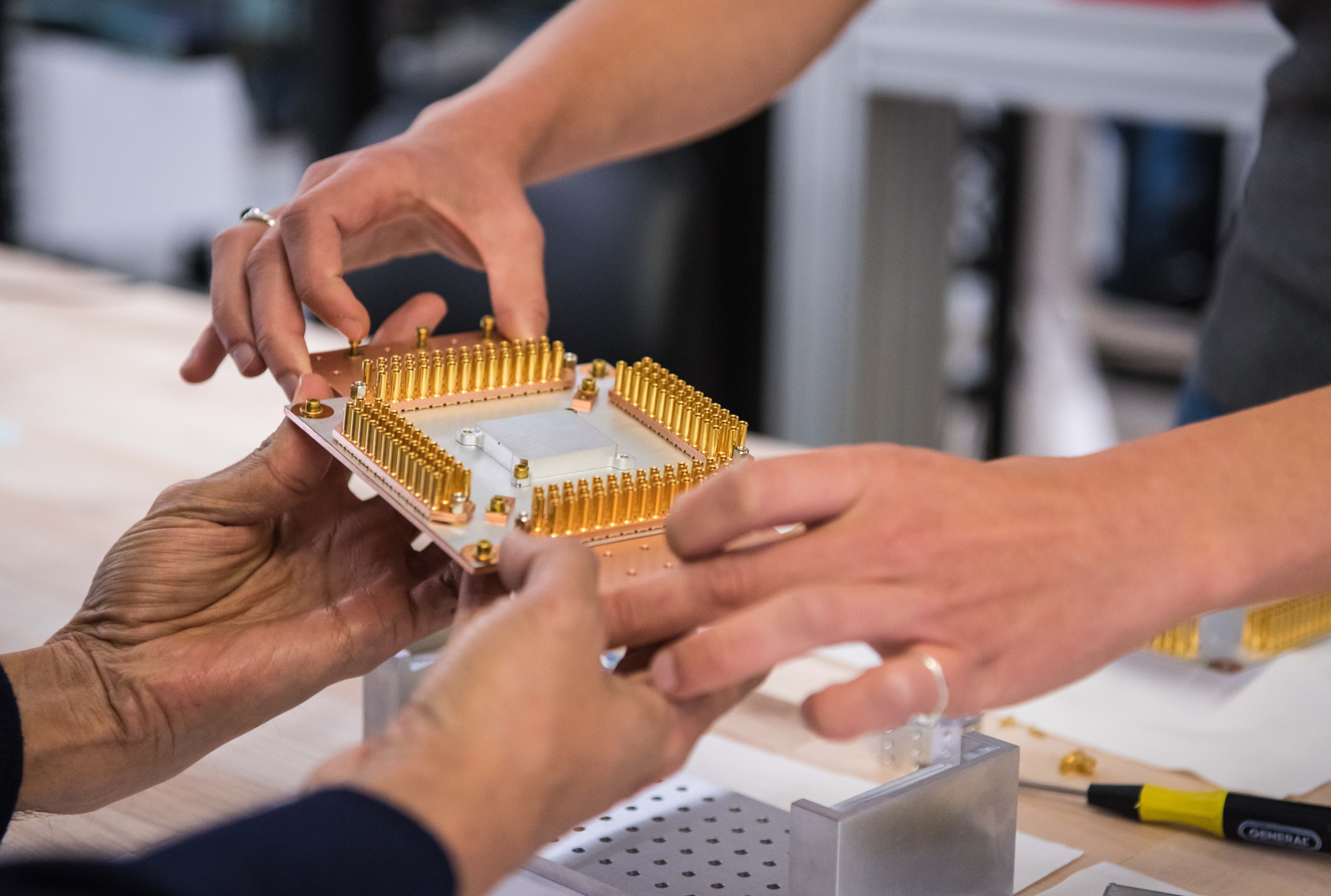
2019 SB Google 0781

The ritual passing of the quantum computing core.

That seemed to be the attitude of the others on the team I talked with at Google’s quantum computing ground zero near Santa Barbara. Quantum superiority is nice, they said, but it’s what they learned in the process that mattered, by confirming that what they were doing wasn’t pointless.

Basically it’s possible that a result like theirs could be achieved whether or not quantum computing really has a future. Pointing to one of the dozens of nearly incomprehensible graphs and diagrams I was treated to that day, hardware lead and longtime quantum theorist John Martines explained one crucial result: The quantum computer wasn’t doing anything weird and unexpected.

This is very important when doing something completely new. It was entirely possible that in the process of connecting dozens of qubits and forcing them to dance to the tune of the control systems, flipping, entangling, disengaging, and so on — well, something might happen.

Maybe it would turn out that systems with more than 14 entangled qubits in the circuit produce a large amount of interference that breaks the operation. Maybe some unknown force would cause sequential qubit photons to affect one another. Maybe sequential gates of certain types would cause the qubit to decohere and break the circuit. It’s these unknown unknowns that have caused so much doubt over whether, as asked at the beginning, quantum computing really exists as anything more than a parlor trick.

Imagine if they discovered that in digital computers, if you linked too many transistors together, they all spontaneously lost their charge and went to 0. That would put a huge limitation on what a transistor-based digital computer was capable of doing. Until now, no one knew if such a limitation existed for quantum computers.

“There’s no new physics out there that will cause this to fail. That’s a big takeaway,” said Martines. “We see the same errors whether we have a simple circuit or complex one, meaning the errors are not dependent on computational complexity or entanglement — which means the complex quantum computing going on doesn’t have fragility to it because you’re doing a complex computation.”

They operated a quantum computer at complexities higher than ever before, and nothing weird happens. And based on their observations and tests, they found that there’s no reason to believe they can’t take this same scheme up to, say, a thousand qubits and even greater complexity.

Hello world

That is the true accomplishment of the work the research team did. They found out, in the process of achieving the rather overhyped milestone of quantum superiority, that quantum computers are something that can continue to get better and to achieve more than simply an interesting experimental results.

This was by no means a given — like everything else in the world, quantum or classical, it’s all theoretical until you test it.

It means that sometime soonish, though no one can really say when, quantum computers will be something people will use to accomplish real tasks. From here on out, it’s a matter of getting better, not proving the possibility; of writing code, not theorizing whether code can be executed.

It’s going from Feynman’s proposal that a quantum computer will be needed to using a quantum computer for whatever you need it for. It’s the “hello world” moment for quantum computing.

Feynman, by the way, would probably not be surprised. He knew he was right.

Google’s paper describing their work was published in the journal Nature. You can read it here.

Startups Weekly: SoftBank is screwing up

Hello and welcome back to Startups Weekly, a weekend newsletter that dives into the week’s startups and venture capital news. Before I jump into today’s topic, let’s catch up a bit. Last week, I wrote about All Raise’s expansion, Uber the TV show and the unicorn from down under.

Remember, you can send me tips, suggestions and feedback to [email protected] or on Twitter @KateClarkTweets. If you don’t subscribe to Startups Weekly yet, you can do that here.


The SoftBank saga

According to a new report from The Wall Street Journal, SoftBank plans to take a more conservative approach as it begins deploying capital from Vision Fund II. Why? The Japanese mega-fund’s track record is less than stellar. Not only has it lost billions on WeWork, but several of its other portfolio companies are suffering through layoffs, mismanagement and more.

Fair.com, a startup building a flexible car ownership business that is valued at $1.2 billion — backed by some $500 million in equity from SoftBank and others, plus billions more dollars in debt funding — said this week that it will be laying off 40% of its staff. On top of this, it’s removing its CFO, Tyler Painter, the brother of the CEO and co-founder (and car business veteran) Scott Painter. He’s being replaced in the interim by Kirk Shryoc. Read more from TechCrunch’s Ingrid Lunden.

fair cars 1

WeWork, the co-working giant we’re all too familiar with at this point, has benefited from $18.5 billion from SoftBank, according to Marcelo Claure, a SoftBank executive who’s speech to WeWork employees was leaked to Recode this week. “We have guaranteed the future of WeWork, but more importantly is we’re putting the future back into our hands. There’s no more days needed to go fundraising …The size of the commitment that SoftBank has made to this company in the past and now is $18.5 billion. To put the things in context, that is bigger than the GDP of my country where I came from. That’s a country where there’s 11 million people.” Now nearly every single WeWork investor, particularly SoftBank, is entirely under water.

There’s more where that came from. Brandless, another … star of SoftBank’s portfolio, has struggled greatly with layoffs and a CEO shake-up, according to The Information. The dog-walking startup Wag raised $300 million from SoftBank, has also endured layoffs and management changes, and has failed to protect the safety of its pets, per this great report from CNN. And Compass, a real estate unicorn, has lost its CFO, CMO and CTO in what’s been labeled “Another SoftBank-Fueled Real Estate Exodus.”


BERLIN, GERMANY – DECEMBER 05: Clue Co-founder & CEO Ida Tin talks at TechCrunch Disrupt Berlin 2017 at Arena Berlin on December 4, 2017 in (Photo by Noam Galai/Getty Images for TechCrunch,)

Meet me in Berlin

The TechCrunch team is heading to Berlin again this year for our annual event, TechCrunch Disrupt Berlin, which brings together entrepreneurs and investors from across the globe. We announced the agenda this week, with leading founders including Away’s Jen Rubio and UiPath’s Daniel Dines on tap for great talks. Take a look at the full agenda.

I will be there to interview a bunch of venture capitalists, who will give tips on how to raise your first euros. Buy tickets to the event here.


VC deals


Equity

This week, Alex was remote and I was in studio to chat about a new angel fund, the WeWork saga and Lime’s losses. Listen to the latest episode here.

Equity drops every Friday at 6:00 am PT, so subscribe to us on iTunesOvercast and all the casts.


Startup Spotlight

Bespoke Financial wants to provide cannabis businesses with the same kind of financial services that other businesses get, but that dispensaries and growers can’t yet access.

The regulations around cannabis operations are so stringent at the local level — and so nebulous at the federal level — that national banks won’t give businesses in the cannabis industry the same basic services (like short-term loans).

That’s why one former Goldman Sachs banker has partnered with two entrepreneurs from the traditional agriculture industry to create Bespoke Financial. And it’s why the company has raised $7 million in financing led by Casa Verde Capital — the investment firm launched by legendary cannabis aficionado, Calvin Broadus (AKA Snoop Dogg). Read more by TechCrunch’s Jon Shieber here.

Uber is testing selling foodie experiences via Uber Eats

Uber is selling foodie experiences such as cooking classes and multi-course fine dining in its on-demand food delivery app, Uber Eats, under a new Moments tab, per Forbes, which reports on a small-scale test currently running in San Francisco.

It says Uber Eats users in the city have received an email saying they can book Uber Moments for the next month, until November 17, with initial bookable experiences being a $75 class on making Chinese dumplings and a $55 five-course Nigerian dinner.

“We’re always thinking about new ways to enhance the Eats experience,” an Uber spokesperson told Forbes when asked about the pilot.

The test sounds similar in concept to the experiences which Airbnb has baked into its on-demand accommodation platform over the past three years — with tens of thousands of experiences now being offered in its case, running the gamut from (similar) foodie offerings, to pretty much anything you can think of wanting to do; guided hiking tours, glamping, animal petting, performing arts classes and so on.

It might seem odd for Uber, a ride-hailing giant, to try to blend its on-demand food delivery arm — with its raison d’être of quickly filling a lunch-hole in your stomach — with aspiration culinary experiences like lessons on preparing elaborate dinner.

But the company has designs on building what CEO Dara Khosrowshahi described last month as the “operating system for your everyday life”.

In June we also reported that Uber had begun testing folding Eats into its main app, ahead of publicly laying out its plan to roll multiple services into a single app to rule users’ daily decisions. (Work is another area of current focus for Uber: Earlier this month it launched a shift-finder app in Chicago, partnering with local staffing agencies but saying it would expand the offering to more areas “soon”.)

So, ultimately, Uber Moments looks intended to sit alongside a range of Uber-powered services, from ride-hailing to micromobility, employment and on-demand delivery.

As well as — most likely — new services Uber hasn’t launched yet but needs to given its ongoing quest to hail a profitable business model.

It’s pretty easy to envisage Uber Moments rubbing shoulders with other branded tabs in Uber’s ‘uber app’ — say Uber Stays, Uber Trips and Uber Cover, for example, if the company were to pivot towards travel; or Uber Clean, Uber Care and Uber Fix, if it decided to get in on on-demand home services.

Last month it launched an incubator to develop new services to plug into its planned ‘everything app’. Khosrowshahi added the app would be “a one-click gateway to everything that Uber can offer you” — though what else it can offer which people will want to buy remains to be seen.

The company’s reputation has taken a battering in recent years. And whether Uber has traveled far enough down the road of reforming its culture and detoxifying its brand for consumers to want to lean in and deepen their relationship, after earlier years of scandals plus ongoing question marks over issues like passenger safety, is not yet clear.

If Uber’s ride-hailing business still can’t weed out problematic drivers then consumers will have little reason to trust it to delivery a wider range of everyday services.

Don Valentine, who founded Sequoia Capital, has died at age 87

Sequoia Capital founder Don Valentine passed way at his home in Woodside, Ca., today at age 87 of natural causes.

Sequoia posted a tribute to Valentine shortly afterward, calling him “one of a generation of leaders who forged Silicon Valley.”

A native of New York, Valentine majored in chemistry at Fordham University before joining Raytheon in South California, then moving north to the Bay Area to work at Fairchild Semiconductor, where over the years, Valentine began investing his own small checks into technology companies that he was meeting. According to Sequoia Capital, he soon attracted the attention of an early mutual fund group, Capital Group, which staked Valentine, allowing him to form a $3 million venture fund in 1974. Among his first bets from that pool of capital: Atari and Apple. He later led the firm into numerous other high-flyers, including Cisco Systems.

Valentine continue to lead Sequoia until handing over the reins well before retirement age to Doug Leone and Michael Moritz, though he continued attending partner meetings for another 10 years. The partners have said they were happy for his continued advice and guidance — not that they always agreed with him.

In 2017, in keeping with the firm’s focus on succession and ensuring smooth transitions, partner Roelof Botha was made U.S. head of the firm working under Leone, who oversees the firm’s global operations. (Other top execs include Neil Shen, the founder and managing partner of Sequoia Capital China, and Moritz, who stepped away for health reasons in 2012 but who remains actively involved in the firm.)

Leone issued a statement this afternoon about Valentine’s passing, writing: “We are deeply saddened to share that Don Valentine passed away on October 25, 2019. Don’s life is woven into the fabric of Silicon Valley. He shaped Sequoia and left his imprint not just on those of us who had the privilege to work with him or the many philanthropic institutions that invested with Sequoia, but also on the founders and leaders of some of the most significant technology companies of the later part of the twentieth century. Our thoughts are with Don’s wife, Rachel, with his family, and with all those inspired by his pioneering vision and indelible impact.”

Valentine chose the name Sequoia because it “conveyed the longevity and strength of the tallest of redwoods,” according to the firm’s tribute today to Valentine. The partners note, too, the “humility of someone who refrained from putting his own name on our business.”

Valentine is survived by his wife; three children; and seven grandchildren, according to Sequoia.

Valentine joined TechCrunch at a Disrupt event back in 2013. He appeared along with another pioneer of the venture industry, Kleiner Perkins Caufield & Byers cofounder Tom Perkins . Perkins passed away in June 2016 at age 84.

VC Ben Horowitz on WeWork, Uber, and one cultural value his employees can’t break

Ben Horowitz, the co-founder of the venture firm Andreessen Horowitz, has a new book coming out this coming Monday titled “What You Do is Who You Are,” that takes a look at how to create “culture” at a company.

It’s a word that’s thrown around a lot but that’s very hard to grasp, let alone implement in a sustainable way. Horowitz learned firsthand as a CEO how elusive it can be when he took stock of his company, only to discover it was made up of “screamers who intimidated their people,” others who “neglected to give any feedback,” and at least one compulsive liar who excelled at sucking up to Horowitz and also making up stories from whole cloth.

Horowitz says creating culture was a missing part of his education, and in this new book — a follow-up to his best-selling “The Hard Thing About Hard Things” — he does his best to fill that gap for other CEOs, using his own experience, as well as lessons gleaned from historical figures Toussaint Louverture and Genghis Khan, along with Shaka Senghor, a contemporary who served time for murder and today is a criminal justice reform advocate.

It’s an instructive and novel combination, and we suggest picking up the book, especially if you love history. In the meantime, we sat down recently with Horowitz to talk about its timing and whether some of the biggest cultural blow-ups in the startup industry — Uber and WeWork — could have been avoided. These excerpts have been edited for length and clarity. Note that we’ll have more of the conversation — including Horowitz’s thoughts about dual-class shares —  for readers of Extra Crunch on Monday.

TC: You’ve written a book about culture that’s coming out just as a lot of questions are being raised about culture because of WeWork. What happened there?

BH: [Cofounder Adam Neumann] had a certain kind of culture there. He had some holes — some great strengths and great holes. And sometimes that happens. When you’re really good at part of it, you can delude yourself into thinking that you’ve got everything you need when you have some massive incompleteness.

Adam is so amazing. Like, the way they got all the money and everything. And the vision was so spectacular. And everybody there believed it, and they recruited some phenomenal talent. But when you’re that optimistic, it does help to have something in the culture that says [allows] people to bring you the bad news, like, if the accounting is all over the place or what have you.

TC: As with Uber’s Travis Kalanick, whose culture also came under fire, Neumann operated in very plain sight. He wasn’t hiding who he was or what he was spending. 

BH: Right, everybody knew how Travis was running the company. Everyone in Silicon Valley knew, let alone everyone on the board. The culture was published. You can look up Uber’s values [from that period].

Travis designed, I think, a really compelling culture, and believed in it, and published it. And the consequences of what he was missing were also super well-known. It’s only when board members think people are coming after them that [they take an interest in these things].

TC: What are the biggest lessons in these two cases?

BH: I obviously know more about Uber [as a Lyft investor who follows the space]. In Uber’s case, it’s a very subtle thing. Travis had a really good code. But he had a bug in it.

I think it was reported that, like, Travis encouraged bad behavior. I don’t think he did at all. I just think he didn’t make it clear that legal and ethical [considerations] were more important than competitiveness. As a result, when left to their own devices, in a distributed organization where there was a lot of distributed power, that combination had people doing things that were out of bounds.

And he was making everybody so much money. And the company was growing so fast that, for the board members, I suspect they were like, ‘As long as it’s making money, I’m not going to worry about what happens next.’

To me, the unfair part is, like, they shouldn’t get any credit at the end. Whatever you’re blaming Travis for [you should blame them, too] because they didn’t see it, either. I think that’s a charitable way of putting it.

The reason I wanted to go through [how to create business culture] in the book is so if you’re a new CEO, you can see, look, this thing looks like a small thing, but it’s going to become a big thing. Ethics are a bit like security issues. They’re not a problem at all until they’re a problem. Then they’re existential.

TC: Why was this issue on your mind?

BH: A few things. First, it was the thing that I had the most difficult time with as a CEO. People would say, ‘Ben, pay attention to culture, it really is the key.’ But when you were like, ‘Okay, great, how do i do that?’ it was like, ‘Um, maybe you should have a meeting about it.’ Nobody could convey: what it was, how you dealt with it, how you designed it. So I felt like I was missing a piece of my own education.

Also, when I look at the work I do now, it’s the most important thing. What I say to people at the firm is that nobody 10 or 20 or 30 years from now is going to remember what deals we’ve won or lost or what the returns were on this or that. You’re going to remember what it felt like to work here and to do business with us and what kind of imprint we put on the world. And that’s our culture. That’s our behavior. We can’t have any drift from that. And I think that’s true for every company.

On top of that, the companies in Silicon Valley have grown so fast and become so powerful that they’re getting a lot of criticism about their culture now, which, some of it is fair enough. But the proposed solutions are wacky  . . . so it kind of felt like somebody had to make a positive contribution and not just a critique about, like, okay, here’s what you ought to do.

TC: These fast-growing companies are also distributed, as you noted with Uber, but I don’t think you talk about remote workforces in this book. Do you have thoughts about establishing a culture where individuals are scattered here and there? 

BH: I didn’t talk about remote workforces and that one is interesting because it’s evolving because the tool sets are changing. It used to be nearly impossible for an engineering organization to be distributed and to be effective, because the information flow wasn’t good enough and the build systems weren’t good enough. And so for years, Microsoft would only buy companies that they could move to Redmond.

Lately, due to things like Slack and Tandem, people are getting better results with it. And I think a lot of the cultural techniques intersect with the tools quite a bit. But then you have to set the culture through electronic media more than you would walking around, catching somebody doing thing in a meeting.

We just did a thing on email the other day. We have this cultural value, which is: we don’t like to criticize entrepreneurs. I don’t care if we think your idea is stupid or whatever. You’re trying to create something from nothing. You’re trying to chase your dream. We support that, period. So if you get on Twitter and do what Bill Gurley does and say, ‘That company is a stupid piece of shit. It’ll never made a $1 and blah blah blah,’ like, you get fired for that. [Similarly] on our podcast, we have a news segment and I didn’t want us to do a story on ‘WeWork, the cautionary tale.’ That’s not us. And it’s a cultural statement. There are a million people who are going to write that story; we were like, let them write that story.

So you don’t have to be in person to set the tone, but you do have to be thoughtful about the way you do it, and who all hears it.

More on Monday . . .