Latin America Roundup: Uber acquires Cornershop, SoftBank invests in Buser and Olist

Sophia Wood
Contributor

Sophia Wood is a principal at Magma Partners, a Latin America-focused seed-stage VC firm with offices in Latin America, Asia and the U.S. Sophia is also the co-founder of LatAm List, an English-language Latin American tech news source.

Brazil continued to churn out unicorns this month, with Curitiba-based Ebanx becoming the first startup from the southern part of the country to top a $1 billion valuation. U.S.-based FTV Capital provided the investment but did not disclose the amount invested nor the exact valuation of Ebanx after the investment.

Ebanx is an end-to-end payment processor that helps international companies receive payments in the Latin American market, similar to Stripe. Their clients include Airbnb, AliExpress, Pipedrive, Spotify, Uber and Wish, and more than 50 million Latin Americans have conducted transactions with more than 1,000 companies through the Ebanx platform. This investment comes on the heels of exciting partnerships with Uber Pay, Shopify, Spotify and Visa to expand cross-border payment processing across the region.

Ebanx has operations in Brazil, Mexico, Argentina, Colombia, Chile, Peru, Ecuador and Bolivia, and will expand their local payment solution, Ebanx Pay, into Colombia in 2020. The company has grown its user base by offering a full-service product that includes market research, 24/7 customer service and anti-fraud technology.

The Ebanx investment is part of a growing interest in Latin American payments startups. Brazil’s PagSeguro and StoneCo had successful IPOs last year, while Mexico’s Conekta and Ecuador’s Kushki have raised large rounds to try to unite the region under a single processor as Latin America rapidly adopts e-commerce.

Uber acquires Cornershop, takes off where Walmart left off

The acquisition of the Chilean-Mexican grocery delivery startup Cornershop has been an emotional roller coaster for Latin American entrepreneurs and investors throughout 2019. First Walmart announced a $225 million deal that would be one of the bigger exits of the region, then the acquisition was blocked by Mexican antitrust institution COFECE. This announcement dealt a blow to the ecosystem as entrepreneurs and VCs had eagerly awaited this boost in liquidity in the local market.

Last-mile delivery and logistics became a very competitive space in Latin America in 2018.

Then in mid-October 2019, Uber announced it would take a 51% stake in Cornershop for a reported $450 million, quadrupling the startup’s value in the four months since the COFECE decision. This deal will consist of cash, investment in Cornershop’s growth and stock in Uber, which IPO’d earlier this year.

However, this deal must also be approved by the Chilean and Mexican antitrust boards, which are expected to release their decisions within the next two weeks. In the meantime, Cornershop will continue its expansion into the Colombian market after it added Peru and Canada in 2019.

Last-mile delivery and logistics became a very competitive space in Latin America in 2018, and many of the players are sitting on enormous pools of capital. Colombia’s Rappi raised $1 billion from SoftBank in early 2019, breaking records for startup investment for the region. Brazil’s iFood raised $500 million from Naspers at the end of 2018. However, delivery continues to be a cash-intensive business, with many of these companies burning through capital quickly to gain market share. Cornershop was an exception and had raised less than $50 million before the acquisition.

Brazil’s Buser, Olist, raise funding from SoftBank

Despite the WeWork crash, SoftBank has continued investing consistently in Brazilian startups. In early October 2019, the Japanese investor led an undisclosed Series B round for Brazilian collaborative bus chartering startup Buser. Buser’s team will invest more than $73 million in growth over the next 12 months to create new alliances for their network of operating partners.

Buser helps coordinate groups of people to charter buses at convenient times and lower prices, disrupting the bureaucratic, anti-competitive and inefficient bus system. The company has grown 1,500% over the past nine months and serves more than 3,000 people per day. While Buser has been popular with locals, traditional bus drivers are calling for regulation to slow the company’s meteoric growth. Buser plans to add more than 100 direct jobs in 200 cities over the next 12 months, and SoftBank’s most recent investment will help power this growth.

Brazil’s e-commerce marketplace integrator Olist also received investment from SoftBank for its Series C, coming in around $46 million. Redpoint eVentures and Valor Capital also participated in the round. 

This investment signals the increased interest by traditional retailers in startups that are slowly chipping away at their market share across the region.

Olist connects small businesses to larger product marketplaces to help entrepreneurs sell their products to a larger customer base. They will reportedly use this investment to investigate the development of financial products and look for collaboration with SoftBank’s other companies, like Rappi and Loggi. Based in Curitiba, Olist was founded in 2015 to help small merchants gain market share across the country through a SaaS licensing model to small brick and mortar businesses.

Today, Olist has more than 7,000 customers and uses a drop-shipping model to send products directly from stores to clients around the country, allowing them to grow with a capital-light model. They will use the investment to add up to 100 new employees.

Carrefour Brazil acquires 49% of Ewally

Grocery chain Carrefour acquired a large stake in Brazil-based Ewally after it completed Village Capital’s first regional acceleration program.

Ewally improves financial inclusion in Brazil through a mobile wallet app that allows unbanked clients to pay bills and make purchases online through the blockchain. Carrefour will reportedly use the acquisition to accelerate digital transformation and improve online payment mechanisms throughout Brazil.

Carrefour did not disclose the amount invested and the deal is still subject to approval by Brazilian financial regulation authorities. However, this investment signals the increased interest by traditional retailers in startups that are slowly chipping away at their market share across the region.

News and Notes: Early-stage rounds are getting bigger

Startups in Brazil, Colombia and Argentina raised several rounds this month, ranging from $1.5 million to $13 million. Brazil’s Xerpa, Colombia’s Sempli, Brazil’s Gorilla and Argentina’s Bitso and Worcket were among those that raised capital from local and international investors in October 2019.

Brazilian human resource management platform Xerpa raised $13 million from Vostok Emerging Finance to continue to help companies like MercadoLibre, iFood and QuintoAndar provide benefits for their employees. Previous investors include Nubank’s David Velez, Kaszek Ventures and QED Investors.

Sempli, an online lending platform for small businesses in Colombia, raised an $8 million Series A from new investors Oikocredit and Incofin CVSO, as well as previous investors BID LAB, XTPI Fund, Generación Exponencial, and Impulsum Ventures. To date, Sempli has raised more than $24 million in equity funding. The founders will use this round to grow their portfolio and improve their risk assessment technology to provide more small business loans in Colombia.

Brazil’s Quicko, an alternative mobility startup that uses big data, raised $10 million in October from Brazilian transport company CCR. Quicko’s technology integrates all mobility options — from bicycles to Uber and 99 — to help people get where they need to go as quickly and inexpensively as possible.

Also in Brazil, startup Gorilla Invest raised $8.4 million from Ribbit Capital, Monashees and Iporanga. Gorilla aggregates financial assets so that investors can review all their commitments in one place, and currently manages more than $1.2 billion for 40,000 clients.

Mexican cryptocurrency exchange Bitso raised an undisclosed round from Argentine startup Ripple to expand into the Southern Cone, especially Argentina and Brazil. Other investors in the round included Pantera Capital, Digital Currency Group, Jump Capital and Coinbase.

Looking ahead to November, with unsettled politics in several countries across the region, tech startups are growing despite governmental changes. Some of these changes will likely have a positive effect on the regional ecosystem as people push for more sustainable and equal economic growth.

What to watch next? Last year, Q4 was marked by a wave of large investments as funds and startups look to end the year strong. IFood raised its record-breaking $500 million round in December 2018. We may well see a similar uptick this year as mega-funds like SoftBank have been consistently investing multi-million dollar rounds since June. There is no sign international investment in Latin America will slow through the end of the year, so we can likely look forward to several more growth-stage rounds before the year is out.
Facebook shares rise on strong Q3, users up 2% to 2.45B

Despite ongoing public relations crises, Facebook kept growing in Q3 2019, demonstrating that media backlash does not necessarily equate to poor business performance.

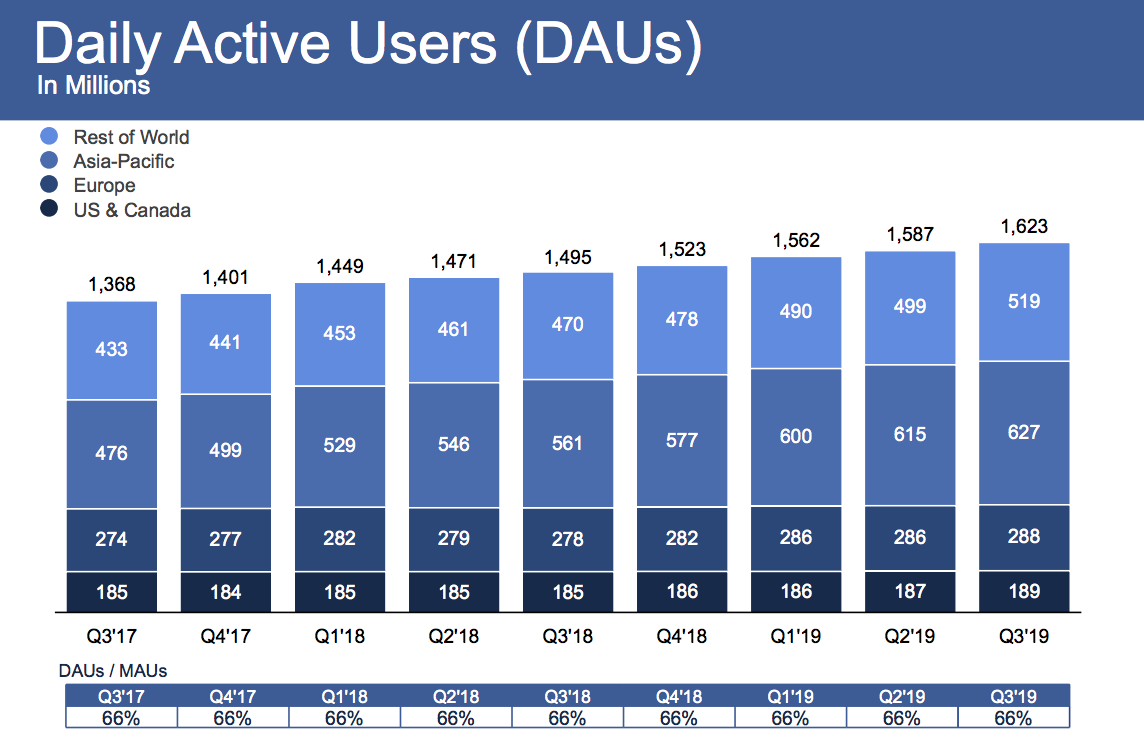
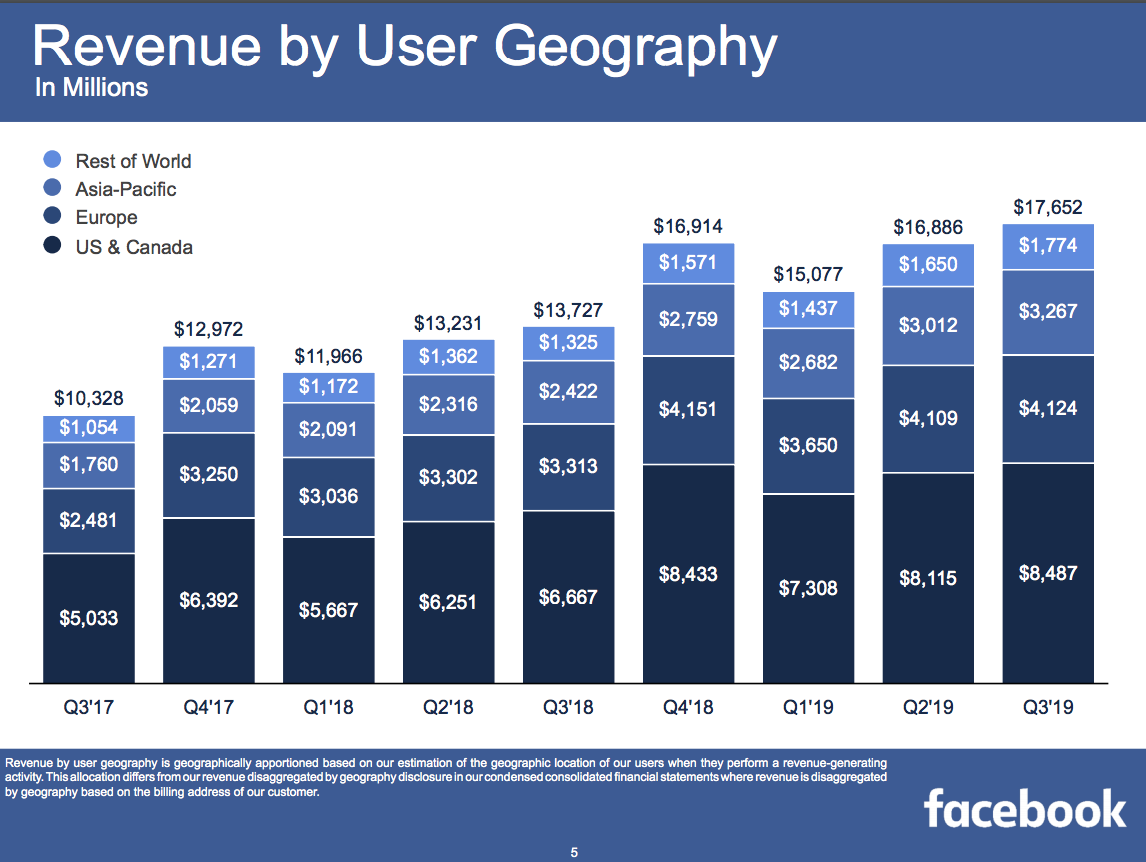
Facebook reached 2.45 billion monthly users, up 1.65%, from 2.41 billion in Q2 2019 when it grew 1.6%, and it now has 1.62 billion daily active users, up 2% from 1.587 billion last quarter when it grew 1.6%. Facebook scored $17.652 billion of revenue, up 29% year-over-year, with $2.12 in earnings per share.

Facebook Q3 2019 DAU

Facebook’s earnings beat expectations compared to Refinitiv’s consensus estimates of $17.37 billion in revenue and $1.91 earnings per share. Facebook’s quarter was mixed compared to Bloomberg’s consensus estimate of $2.28 EPS. Facebook earned $6 billion in profit after only racking up $2.6 billion last quarter due to its SEC settlement.

Facebook shares rose 5.18% in after-hours trading, to $198.01 after earnings were announced, following a day where it closed down 0.56% at $188.25.

Notably, Facebook gained 2 million users in each of its core U.S. & Canada and Europe markets that drive its business, after quarters of shrinkage, no growth or weak growth there in the past two years. Average revenue per user grew healthily across all markets, boding well for Facebook’s ability to monetize the developing world where the bulk of user growth currently comes from.

Facebook says 2.2 billion users access Facebook, Instagram, WhatsApp or Messenger every day, and 2.8 billion use one of this family of apps each month. That’s up from 2.1 billion and 2.7 billion last quarter. Facebook has managed to stay sticky even as it faces increased competition from a revived Snapchat, and more recently TikTok. However, those rivals might more heavily weigh on Instagram, for which Facebook doesn’t routinely disclose user stats.

Facebook ARPU Q3 2019

Zuckerberg defends political ads policy

Facebook’s earnings announcement was somewhat overshadowed by Twitter CEO Jack Dorsey announcing it would ban all political ads — something TechCrunch previously recommended social networks do. That move flies in the face of Facebook CEO Mark Zuckerberg’s staunch support for allowing politicians to spread misinformation without fact-checks via Facebook ads. This should put additional pressure on Facebook to rethink its policy.

Zuckerberg doubled-down on the policy, saying “I believe that the better approach is to work to increase transparency. Ads on Facebook are already more transparent than anywhere else,” he said. Attempting to dispel that the policy is driven by greed, he noted Facebook expects political ads to make up “less than 0.5% of our revenue next year.” Because people will disagree and the issue will keep coming up, Zuckerberg admitted it’s going to be “a very tough year.”

Facebook also announced that lead independent board member Susan D. Desmond-Hellmann has resigned to focus on health issues.

Earnings call highlights

Facebook expects revenue deceleration to be pronounced in Q4. But CFO David Wehner provided some hope, saying “we would expect our revenue growth deceleration in 2020 versus the Q4 rate to be much less pronounced.” That led Facebook’s share price to spike from around $191 to around $198.

However, Facebook will maintain its aggressive hiring to moderate content. While the company has touted how artificial intelligence would increasingly help, Zuckerberg said that hiring would continue because “There’s just so much content. We do need a lot of people.”

Zuckerberg Libra 1

Regarding Libra’s regulatory pushback, Zuckerberg explained that Facebook was already diversified in commerce if that doesn’t work out, citing WhatsApp Payments, Facebook Marketplace and Instagram shopping.

On anti-trust concerns, Zuckerberg reminded analysts that Instagram’s success wasn’t assured when Facebook acquired it, and it has survived a lot of competition thanks to Facebook’s contributions. In a new talking point we’re likely to hear more of, Zuckerberg noted that other competitors had used their success in one vertical to push others, saying “Apple and Google built cameras and private photo sharing and photo management directly into their operating systems.”

Scandals continue, but so does growth

Overall, it was another rough quarter for Facebook’s public perception as it dealt with outages and struggled to get buy-in from regulators for its Libra cryptocurrency project. Former co-founder Chris Hughes (who I’ll be leading a talk with at SXSW) campaigned for the social network to be broken up — a position echoed by Elizabeth Warren and other presidential candidates.

The company did spin up some new revenue sources, including taking a 30% cut of fan patronage subscriptions to content creators. It’s also trying to sell video subscriptions for publishers, and it upped the price of its Workplace collaboration suite. But gains were likely offset as the company continued to rapidly hire to address abusive content on its platform, which saw headcount grow 28% year-over-year, to 43,000. There are still problems with how it treats content moderators, and Facebook has had to repeatedly remove coordinated misinformation campaigns from abroad. Appearing concerned about its waning brand, Facebook moved to add “from Facebook” to the names of Instagram and WhatsApp.

It escaped with just a $5 billion fine as part of its FTC settlement that some consider a slap on the wrist, especially since it won’t have to significantly alter its business model. But the company will have to continue to invest and divert product resources to meet its new privacy, security and transparency requirements. These could slow its response to a growing threat: Chinese tech giant ByteDance’s TikTok.

Jack Dorsey says Twitter will ban all political ads

CEO Jack Dorsey just announced, via tweet, that Twitter will be banning all political advertising — albeit with “a few exceptions” like voter registration.

“We believe political message reach should be earned, not bought,” Dorsey said.

While it’s not totally clear how broad those exceptions will be, it sounds like the ban will apply to both ads endorsing candidates and ads advocating a position on political issues.

Dorsey said the company will share the final policy by November 15, and that it will start enforcing that policy on November 22.

“Internet political ads present entirely new challenges to civic discourse: machine learning-based optimization of messaging and micro-targeting, unchecked misleading information, and deep fakes,” he wrote. “All at increasing velocity, sophistication, and overwhelming scale.”

We’ve made the decision to stop all political advertising on Twitter globally. We believe political message reach should be earned, not bought. Why? A few reasons…?

— jack ??? (@jack) October 30, 2019

So why not continue accepting ads while trying to stamp out misinformation? He argued that the company “needs to focus our efforts on the root problems, without the additional burden and complexity taking money brings.”

A blanket policy could also help Twitter avoid the headache and controversy of making these determinations of truthfulness on a case-by-case basis.

This comes after Facebook, in particular, has faced heavy criticism around its refusal to fact-check political advertising (even as it took steps to fight election-related misinformation elsewhere), with Facebook employees writing an open letter objecting to the company’s stance.

At the same time, one of the ads that prompted the recent controversy — in which the Trump campaign promoted a conspiracy theory about Joe Biden — also ran on YouTube and Twitter (and on some TV networks, although CNN refused to air it).

So even though the discussion has focused on Facebook, the broader questions of permissiveness and responsibility are ones that all the major internet platforms have to face.

Over the summer, in fact, Twitter said it would start blocking state-run media outlets from running ads on its platform after it identified an operation to “sow political discord” around the protests in Hong Kong, which involved hundreds of accounts linked to the Chinese government.

The idea that Facebook should just ban all political ads is a solution that’s been floated by a number of pundits, including our own Josh Constine. Before today, that might have seemed like an extreme or unrealistic step. Suddenly, it looks much more possible — or at least like Mark Zuckerberg will have to keep answering questions about this for a while.

Dorsey didn’t mention Facebook by name in his tweets, but he seemed to allude to the company’s position when he wrote, “For instance, it‘s not credible for us to say: ‘We’re working hard to stop people from gaming our systems to spread misleading info, buuut if someone pays us to target and force people to see their political ad…well…they can say whatever they want! ?‘”

It’s also interesting that Twitter chose to announce this just as Facebook released its latest earnings report.

Dorsey also acknowledged that Twitter is “a small part of a much larger political advertising ecosystem,” but he said, “We have witnessed many social movements reach massive scale without any political advertising. I trust this will only grow.”

In a statement, eMarketer senior analyst Jasmine Enberg said the move is “in stark contrast to Facebook,” but also noted “it’s likely that political advertising doesn’t make up a critical part of Twitter’s core business.”

Work permit delays disrupt foreign workers’ career plans

Xiao Wang
Contributor

Xiao Wang is CEO at Boundless, a technology startup that has helped thousands of immigrant families apply for marriage green cards and U.S. citizenship while providing affordable access to independent immigration attorneys.

Immigration advocates are rightly fretting over the Trump administration’s new health insurance mandate and efforts to dismantle the asylum system. But away from the spotlight, another crisis is quietly brewing that could affect virtually every foreign-born STEM (science, technology, engineering, and math) student and worker.

The problem lies in Employment Authorization Documents (EADs). These work permits, issued by U.S. Citizenship and Immigration Services (USCIS), authorize international students and green card applicants to take jobs. Requests for EADs, known as I-765s, now account for more than a quarter of all forms USCIS receives. But technological hiccups, staffing shortages, and the pressures of conforming to new immigration policies mean the agency is taking longer and longer to process them. That’s leaving tens of thousands of students and skilled workers unable to work and hundreds of thousands of tech positions unfilled for months, or even years. 

The EAD crisis has been simmering for years but reached a head in early 2017 when officials scrapped a rule requiring USCIS to process I-765s within 90 days. Along with an influx of new EAD requests from DACA and TPS recipients, that’s led to spiraling delays. In 2015, 23 percent of EAD applications took more than three months to process; by 2018, it had doubled to 46 percent. The average processing time today for non-DACA-related EADs is almost five months, with over a third of applications taking significantly longer — last year, over 118,000 applications took more than nine months to process. 

That squares with what we’re seeing at Boundless: our internal data show that average EAD wait times have climbed above five months, with many customers waiting eight months or more for work permits. We’re also seeing an enormous disparity among processing facilities, with some USCIS service centers far more clogged than others. At the time of writing, if your I-765 is processed in Texas, for example, you could get your EAD within three weeks; if in Vermont, you could wait more than 17 months, depending on the immigration status you seek.

That adds up to an unpredictable, unfair, and deeply frustrating situation and one more obstacle for the skilled immigrants that President Donald Trump says he’s trying to attract to the United States. Whether you’re trying to make ends meet while waiting for your green card, seeking a summer job, or hoping to work after graduation, EAD delays can be excruciating — and unless your employer is willing to wait for you, the holdup could cost you your dream job. 

So what could you do if you find yourself stuck in EAD limbo? Fortunately, you have options:

If you already have a visa, hold on to it

Many immigrants file EAD requests as part of their green card applications, even if they’re already authorized to work under visas such as an H-1B or L-1. That’s a smart move: If your current work visa expires, but you’ve been issued an EAD, you’ll be able to keep working until your green card arrives. Still, if your EAD gets delayed, you’ll be glad to know that as long as your original employment-based visa remains valid, you can keep working without a problem. 

Bear in mind, though, that you won’t be able to renew your existing visa after filing a green card application. It’s worth applying for your green card as soon as you’re eligible to give you plenty of time before your existing work visa expires.  

If you’re still waiting, tell USCIS

It’s not impossible for your EAD to slip through the cracks or be sent to the wrong address, so check with USCIS if things are taking too long. Start by checking the processing times for your service center. If you filed your I-765 before the “receipt date for a case inquiry” listed on the USCIS processing times tool, you can file an e-Request or call 1-800-375-5283 for an update. 

In some cases, you can also ask USCIS to expedite your I-765. This is only available in certain circumstances, such as if delays are due to USCIS error or if you or your prospective employer would otherwise suffer major financial losses. Unfortunately, the possibility of losing or delaying acceptance of a job offer isn’t sufficient grounds for expediting an application.

Still stuck in limbo? Ask for help

Forerunner Ventures’ newest bet is Curated, a marketplace that matches pros with people buying high-ticket items

If you’ve ever tried buying a bike online, or ski equipment, or any number of expensive goods where it would be useful to know a lot more than you do, you might check out Curated, a two-year-old San Francisco-based startup that wants to help busy shoppers who know generally what they want but don’t necessarily have time to visit a specialty store to learn more.

It isn’t the first startup to help with shopping recommendations. Among its predecessors is Hunch, a company that delivered customized recommendations to users based on signals around the web (and sold to eBay in 2011). Another variation on the same theme can be traced back to the dot com era company Keen.com, a live answer community where people could get answers to their questions over the phone.

Still, Curated makes enough sense in today’s market that Forerunner Ventures, which has established a name for itself as the preeminent investor in e-commerce companies, just led its $22 million Series A round. It was the only venture firm in the round by design, says cofounder and CEO Eddie Vivas, who says the funding was filled out by the same friends and family who’d participated in Curated’s $5.5 million seed round.

As part of the deal, Forerunner founder Kirsten Green has also joined the board.

It’s easy to appreciate the company’s appeal. Curated works by matching bewildered shoppers with people who are passionate and knowledgeable and “expert” in their fields. Right now, those experts are mostly athletes or coaches, as the platform is starting out with a handful of verticals, including golf, cycling, and a few winter sports. Longer term, the idea is to launch new sections on the site every six to eight weeks, including fly fishing, kiteboarding, camping and hiking.

How the economics work: Curated strikes deals with manufacturers — say makers of snowboard equipment or mountain bikes — that sell Curated their goods at wholesale prices. Curated can then sell them at retail prices to its customers. (Curated fulfills the order itself.)

Part of that markup is used to pay its experts, who tend to be people who have jobs in related fields but could use more income and who love sharing what they know about a topic. To ensure that these experts know as much as they claim, they are vetted by other experts on the platform, answering a battery of questions as part of that process.

Vivas stresses that experts are in no way incentivized to recommend anything in particular to a customer, but he says customers can tip the experts if they wish. (Curated suggests tips of 5%, 7.5%, or 10%, and Vivas says they are sometimes given much more than that by shoppers who are thankful for their time and effort, especially when their interactions end up leading them to products that cost less than they might have paid otherwise.)

The end goal is for customers to complete transactions on the platform that they wouldn’t otherwise feel comfortable completing at a site where they aren’t actively educated.

The platform is seizing on a number of trends that make it a smart idea for this day and age. For one thing, it uses artificial intelligence to connect shoppers with the right advisors. Though everyone tosses around AI as a competitive advantage, Curated seemingly has a genuine competitive advantage on this front, owing to the background of Vivas, who sold to LinkedIn an earlier company that used AI to automate the recruiting process.

At the time, in 2014, it was LinkedIn’s biggest acquisition ever. And Vivas stayed at LinkedIn for another 3.5 years as the head of product within its talent solutions business, which is where LinkedIn derives most of its revenue. (In fact, it’s where he met some of the 32 people who now work at Curated.)

Curated is also putting to work far-flung knowledge workers who, like a lot of Americans, increasingly work for themselves or in part-time roles that they’re looking to supplement with other part-time roles.

But perhaps most meaningfully, Curated is a kind of antidote to Amazon, where shoppers can turn when they need something fast but that’s incredibly limited when it comes to providing the kind of information needed to comfortably make big purchases. Consumers may pull the trigger on items anyway, but often, they end up with merchandise that they then have to send back or never wind up using.

The question now is whether the company can scale. To do so, it’ll need to rise above the din of other e-commerce platforms to attract enough customers to support its network of experts (and vice versa), and it’s a pretty crowded landscape out there, even with the magic of search-engine optimization and Facebook ads.

Curated will also need to strike enough deals with goods manufacturers to make the platform compelling for shoppers, and to ensure that the level of the advice that’s provided to those consumers is, and remains, high.

Perhaps unsurprisingly, Vivas doesn’t sound concerned. He thinks he’s built a strong team. He’s also excited about the growing network of experts the team has pieced together since founding the company in the summer of 2017.

“You take someone who is passionate about something and you let them make money off it, and good things happen,” he says.

“In allowing people to monetize their knowledge, the unlock is just unbelievable.”

Time will tell. The service launches publicly today.

Walmart Grocery now offers curbside alcohol pickup at 2,000 US stores

The online grocery wars continue. Amazon this week just made grocery delivery free, so Walmart is now touting how its grocery service offers the booze. The retailer today announced a new milestone in terms of giving its customers the ability to shop for alcohol online, noting that more than 2,000 Walmart locations across 29 states will now let you pick up wine and beer along with your other grocery purchases.

The alcohol pickup service has to abide by local laws, which limits its expansion in some cases.

In addition, Walmart says that now more than 200 stores in California and Florida are also offering alcohol delivery. It plans expansions on this front, as well.

Walmart has been slowly ramping up its online alcohol shopping options for some time, in accordance with local, county and state regulations. Its Sam’s Club subsidiary has offered this option, too, by way of Instacart. In the latter case, Sam’s Club has been able to offer delivery of spirits, like Tito’s vodka or those from Sam’s Club’s own “Member’s Mark” brand, among others.

Today, there are a number of ways to shop alcohol online, depending on where you live.

Target-owned Shipt delivers alcohol from some of its supported retailers (including Target) in some markets. Instacart, BJ’s and Amazon (Prime Now) do as well, in select cities, states and stores. And finally, services like Drizly, Saucey, Postmates and Uber Eats can help fill in the gaps, in some markets.

The problem with all these services is that consumers often don’t know which retailers offer alcohol delivery, or which app they should use. If you live in a more permissive state, this may not be as big of a problem — you’ll likely encounter an abundance of choices for same-day alcohol delivery. But in a more conservative state, your options may be more limited — or not available at all. And when consumers have to launch a half dozen apps just to figure out how to order booze online, most people will just give up and drive to the store.

That’s in conflict with Walmart’s larger goal, which is to allow shoppers to take advantage of its online grocery shopping to fully replace the traditional grocery shopping trip to the store. After all, if consumers are driving to the store, they’ll likely choose their local grocer, not necessarily Walmart.

To meet the needs of the online shopper, Walmart Grocery has to offer it all — not just food, but also adult beverages. If successful on speeding this option to market, Walmart’s brand could become known as the place to order online everything you need from the grocery store. And that, in turn, could help boost sales.

Walmart’s alcohol shopping feature works just like shopping for groceries — you search for what you want, add it to the cart, then check out. The only difference is that, upon pickup or delivery, you’ll be required to show your ID so the Walmart team member can verify your age.

Alcohol pickup is available in big states like California, Florida and Texas, and dozens of others, while delivery is limited to the first two states, for the time being.

This robot relies on human reflexes to keep its balance

As much as we’d like to think that we’re entering an era of autonomous robots, they’re actually still pretty helpless. To keep them from falling down all the time, a human’s fast reflexes could be the solution. But the human has to feel what the robot is feeling — and that’s just what these researchers are testing.

Bipedal robots are excellent in theory for navigating human environments, but naturally are more prone to falling than quadrupedal or wheeled robots. Although they often have sophisticated algorithms that help keep them upright, in some situations those just might not be enough.

As a way to bridge that gap, researchers at MIT and the University of Illinois-Champaign put together a sort of hybrid human-robot system reminiscent of either Pacific Rim or Evangelion, depending on your nerd alignment (or Robot Jox, if you want to go that way).

Although the references may be sci-fi, the need for this kind of thing is real, explained U of I’s João Ramos, co-creator of the system with MIT’s Sangbae Kim.

“We were motivated by watching the 2011 Tohoku, Japan, earthquake, tsunami and subsequent Fukushima Dai-ichi nuclear plant disaster unfold. We thought that if a robot could have entered the power plant after the disaster, things could have ended differently,” Ramos said in a U of I news release.

The robot they created is a small bipedal one they call Little Hermes, and it is hooked up directly to a human operator, who stands on a pressure-sensing plate and wears a force-feedback vest.

hermes

The robot generally follows the operator’s movements, not in a 1:1 sense (especially as the robot is much smaller than a person), but after interpreting those movements in terms of center of gravity and force vectors, makes a corresponding one almost simultaneously. (The MIT writeup goes into a bit more detail, as does the video below.)

Meanwhile, if the robot were to, say, encounter an unexpected slope or obstacle, those forces are conveyed to the operator via the vest. Feeling pressure indicating a leftward lean, the operator will reflexively take a step in that direction using those excellent instincts we animals have developed. Naturally the robot does the same thing and, hopefully, catches itself.

This feedback loop could make on-site rescue robots and others on uncertain footing more reliable. The technology is not limited to legs, though, or even to Little Hermes. The team wants to set up similar feedback systems for feet and hands, so mobility and grip can be further improved.

The team published their work today in the journal Science Robotics.

Daily Crunch: HBO Max will launch in May

The Daily Crunch is TechCrunch’s roundup of our biggest and most important stories. If you’d like to get this delivered to your inbox every day at around 9am Pacific, you can subscribe here.

1. HBO Max will cost $14.99 per month and launch in May 2020

AT&T and WarnerMedia announced the pricing, launch timetable and content lineup of their HBO Max streaming service. They also revealed that HBO has placed a straight-to-series order for “House of the Dragon,” a spin-off of “Game of Thrones.”

Even though distinguishing between HBO and HBO Max will probably be a bit of a headache over the next few years, this is a service that I’m genuinely excited about, with a rich library of HBO shows and Warner Bros. films at its core. And while the price is high compared to competing services, there’s no additional cost compared to the existing HBO Now.

2. WhatsApp blames — and sues — mobile spyware maker NSO Group over its zero-day calling exploit

WhatsApp has filed a suit in federal court accusing Israeli mobile surveillance software maker NSO Group of creating an exploit that was used hundreds of times to hack into targets’ phones.

3. Tencent leads $111M investment in India’s video streaming service MX Player

Times Internet, which acquired a majority stake in MX Player in late 2017, also participated in the Series A financing round. The post-money valuation was $500 million, according to a source.

4. Spotify launches a dedicated Kids app for Premium Family subscribers

The app allows children three and up to listen to their own music, both online and offline, as well as explore playlists and recommendations picked by experts. The music selection is filtered so songs won’t have explicit content.

5. Slack investor Index Ventures backs Slack competitor Quill

Quill, a startup led by Stripe’s former creative director Ludwig Pettersson, claims to offer “meaningful conversations, without disturbing your team.”

6. Where top VCs are investing in cybersecurity

Many of the rising cybersecurity startups focus on the same or overlapping problems, which could lead to a “cybersecurity consolidation.” (Extra Crunch membership required.)

7. Let’s have a word about what3words with Clare Jones at Disrupt Berlin

What3words wants to map the entire world and overhaul addresses, three words at a time. The startup has divided the world into three-meter squares, each one assigned three words as an identifier.

Government is a technology, so fix it like one

Eliot Peper
Contributor

Eliot Peper is a critically acclaimed novelist who writes speculative thrillers that explore the intersection of technology and culture.
More posts by this contributor

Just as as tangible as airplanes, computers and contraception, The Roman Empire, the Iroquois Confederacy and the United States of America are also human inventions.

Technology is how we do things, and political institutions are how we collaborate at scale. Government is an immensely powerful innovation through which we take collective action.

Just like any other technology, governments open up new realms of opportunity. These opportunities are morally neutral: humans have leveraged political institutions to provide public education and murder ethnic minorities. Specific features like explicit protections for human rights and civil liberties are designed to help mitigate certain downside risks.

Like any tool, systems of governance require maintenance to keep working. We expect regular software updates, but forget that governance is also in constant flux, and begins to fail when it falls out of sync with the culture. Without preventative maintenance, pressure builds like tectonic forces along a fault line until a new order snaps into place, often violently. Malka Older points out that “democracy is not a unitary state that can be achieved, but a continuous process. We need to keep reinventing and refining government, to keep up with changes in society and technology and to keep it from being too easy for elites with resources to exploit.”

What might the future of governance actually look like?

A week-long iOS App Store bug wiped out over 20M ratings

An accidental sweep of the App Store removed more than 20 million ratings from the most popular apps — including from well-known brands like Google, Microsoft, Starbucks, Hulu, Nike and others — as well as from smaller developers. The issue began on October 23, 2019 and wasn’t resolved until yesterday, October 29. Apple says the ratings’ removal was due to a bug.

This massive ratings drop was spotted by the mobile app insights platform Appfigures.

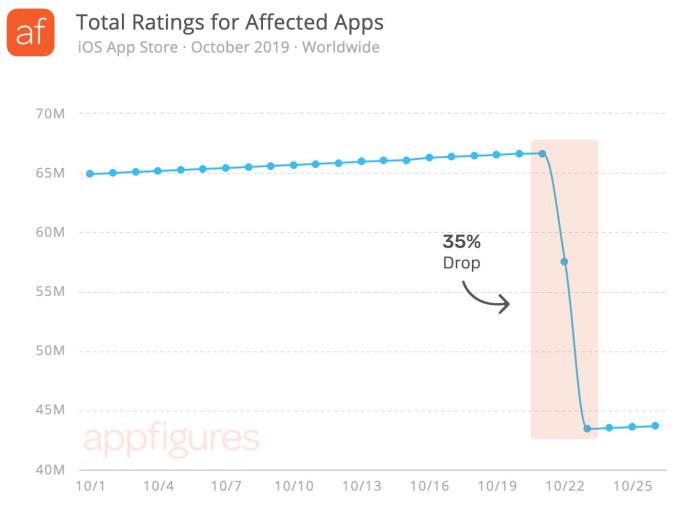
The firm found that more than 300 apps from over 200 developers were affected by the sweep, which wiped out a total of 22 million app reviews from the App Store. On average, apps saw a 50% decrease in ratings in the affected countries, which included the U.S.

total ratings

The U.S. was hit the hardest, however, as some 10 million ratings disappeared. But the sweep was global in nature, hitting all 155 countries Apple supports. China, the U.K., South Korea, Russia and Australia also felt a noticeable impact.

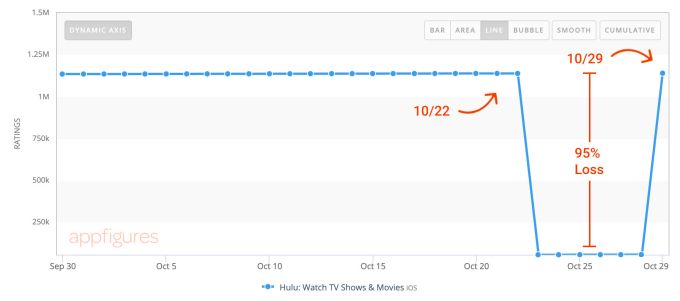
A few apps were hit harder than others. Hulu, for example, lost a whopping 95% of ratings in the U.S., while Dropbox and Chase lost 85%. Several companies affected by the bug declined to comment, but told us that the rating removals weren’t done at their request — they were just as surprised as everyone else.

hulu chart ratings drop

Other big apps that saw their ratings disappear in the U.S. included Chase, Walgreen, Venmo, Amazon Prime Video, Southwest, Hotels.com, Disneyland, Ibotta, ESPN, Amex, Xoom, Fandango, Skyscanner, Google Classroom, Nike SNKRS, My Disney Experience, Old Navy and others.

Of the more than 300 apps that got hit, about half (154) saw a drop of more than 100 ratings, Appfigures said.

WOW @Starbucks iOS app lost about 1.3mln of ratings overnight! @hulu lost about 900k, as well as dozens of other apps.
I hope this is just @AppStore bug. pic.twitter.com/cUIrb8yeeN

— ilia kukharev (@ilyakuh) October 28, 2019

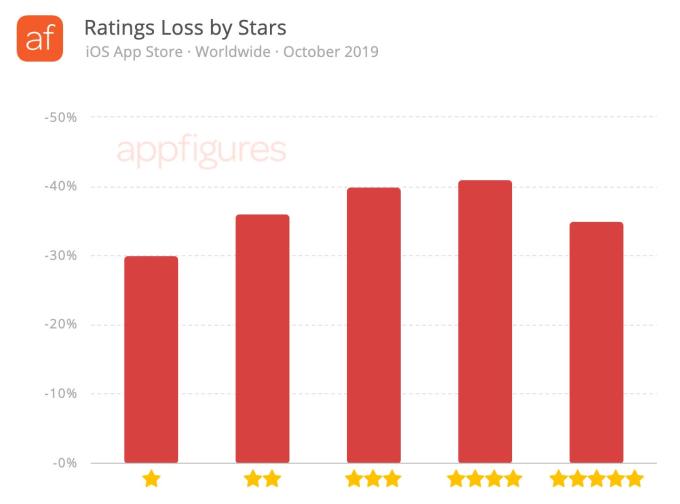
Developers speculated that Apple was possibly trying to clean up fake app ratings. This theory didn’t seem that likely, though, because Appfigures found that both positive and negative ratings were removed. Had the sweep been focused on fake ratings, then only the positive (fake) ratings would have been removed.

ratings lost 3

Another theory is that Apple was trying to speed up its ratings system and something just went wrong.

Unfortunately for some of the impacted developers, the bug had a profound effect on their app’s “Overall” rating. Their app may have dropped by several stars as a result of this problem. And that, in turn, could have hurt their ability to get downloads from App Store search results or Search Ads during the week.

Some of the impacted companies (and Appfigures) confirmed to TechCrunch the missing ratings were restored as of yesterday.

Oh man, this happened to one of my clients. When from 4.6 with ~400 ratings to 2.6 with 5 ratings. Had a support request in, but glad to see it resolved.

— Ben DiFrancesco (@BenDiFrancesco) October 29, 2019

Oddly, this isn’t the first time app ratings disappeared nearly overnight.

A similar incident took place last year, when an App Store bug led to thousands of iOS apps losing half their ratings over a weekend. Apple resolved that bug, but never offered any statements about what happened.

We heard that Apple spoke directly to some developers to explain the rating removals were done in error and it was working to fix the situation, which now appears resolved.

Reached for comment, Apple explained the issue was a bug and that the removed ratings weren’t permanently deleted and have been restored.

“App Store ratings and reviews are an important way for customers to share their experiences about apps they’ve downloaded,” a spokesperson said. “During routine maintenance to the App Store, ratings and reviews were temporarily affected by a bug that has since been resolved. While no reviews or ratings were ever deleted, the data displayed to users was impacted for a period of time. We apologize for the inconvenience this caused. All ratings and reviews have been restored,” they added.

Updated 6 PM ET with Apple statement. 

Samsung ramps up its B2B partner and developer efforts

Chances are you mostly think of Samsung as a consumer-focused electronics company, but it actually has a very sizable B2B business as well, which serves more than 15,000 large enterprises and hundreds of thousands of SMB entrepreneurs via its partners. At its developer conference this week, it’s putting the spotlight squarely on this side of its business — with a related hardware launch as well. The focus of today’s news, however, is on Knox, Samsung’s mobile security platform, and Project AppStack, which will likely get a different name soon, and which provides B2B customers with a new mechanism to deliver SaaS tools and native apps to their employees’ devices, as well as new tools for developers that make these services more discoverable.

At least in the U.S., Samsung hasn’t really marketed its B2B business all that much. With this event, the company is clearly thinking to change that.

At its core, Samsung is, of course, a hardware company, and as Taher Behbehani, the head of its U.S. mobile B2B division, told me, Samsung’s tablet sales actually doubled in the last year, and most of these were for industrial deployments and business-specific solutions. To better serve this market, the company today announced that it is bringing the rugged Tab Active Pro to the U.S. market. Previously, it was only available in Europe.

The Active Pro, with its 10.1″ display, supports Samsung’s S Pen, as well as Dex for using it on the desktop. It’s got all of the dust and water-resistance you would expect from a rugged device, is rated to easily support drops from about four feet high and promises up to 15 hours of battery life. It also features LTE connectivity and has an NFC reader on the back to allow you to badge into a secure application or take contactless payments (which are quite popular in most of the world but are only very slowly becoming a thing in the U.S.), as well as a programmable button to allow business users and frontline workers to open any application they select (like a barcode scanner).

“The traditional rugged devices out there are relatively expensive, relatively heavy to carry around for a full shift,” Samsung’s Chris Briglin told me. “Samsung is growing that market by serving users that traditionally haven’t been able to afford rugged devices or have had to share them between up to four co-workers.”

Today’s event is less about hardware than software and partnerships, though. At the core of the announcements is the new Knox Partner Program, a new way for partners to create and sell applications on Samsung devices. “We work with about 100,000 developers,” said Behbehani. “Some of these developers are inside companies. Some are outside independent developers and ISVs. And what we hear from these developer communities is when they have a solution or an app, how do I get that to a customer? How do I distribute it more effectively?”

This new partner program is Samsung’s solution for that. It’s a three-tier partner program that’s an evolution of the existing Samsung Enterprise Alliance program. At the most basic level, partners get access to support and marketing assets. At all tiers, partners can also get Knox validation for their applications to highlight that they properly implement all of the Knox APIs.

The free Bronze tier includes access to Knox SDKs and APIs, as well as licensing keys. At the Silver level, partners will get support in their region, while Gold-level members get access to the Samsung Solutions Catalog, as well as the ability to be included in the internal catalog used by Samsung sales teams globally. “This is to enable Samsung teams to find the right solutions to meet customer needs, and promote these solutions to its customers,” the company writes in today’s announcement. Gold-level partners also get access to test devices.

The other new service that will enable developers to reach more enterprises and SMBs is Project AppStack.

“When a new customer buys a Samsung device, no matter if it’s an SMB or an enterprise, depending on the information they provide to us, they get to search for and they get to select a number of different applications specifically designed to help them in their own vertical and for the size of the business,” explained Behbehani. “And once the phone is activated, these apps are downloaded through the ISV or the SaaS player through the back-end delivery mechanism which we are developing.”

For large enterprises, Samsung also runs an algorithm that looks at the size of the business and the vertical it is in to recommend specific applications, too.

Samsung will run a series of hackathons over the course of the next few months to figure out exactly how developers and its customers want to use this service. “It’s a module. It’s a technology backend. It has different components to it,” said Behbehani. “We have a number of tools already in place we have to fine- tune others and we also, to be honest, want to make sure that we come up with a POC in the marketplace that accurately reflects the requirements and the creativity of what the demand is in the marketplace.”

Google launches TensorFlow Enterprise with long-term support and managed services

Google open-sourced its TensorFlow machine learning framework back in 2015 and it quickly became one of the most popular platforms of its kind. Enterprises that wanted to use it, however, had to either work with third parties or do it themselves. To help these companies — and capture some of this lucrative market itself — Google is launching TensorFlow Enterprise, which includes hands-on, enterprise-grade support and optimized managed services on Google Cloud.

One of the most important features of TensorFlow Enterprise is that it will offer long-term support. For some versions of the framework, Google will offer patches for up to three years. For what looks to be an additional fee, Google will also offer to companies that are building AI models engineering assistance from its Google Cloud and TensorFlow teams.

All of this, of course, is deeply integrated with Google’s own cloud services. “Because Google created and open-sourced TensorFlow, Google Cloud is uniquely positioned to offer support and insights directly from the TensorFlow team itself,” the company writes in today’s announcement. “Combined with our deep expertise in AI and machine learning, this makes TensorFlow Enterprise the best way to run TensorFlow.”

Google also includes Deep Learning VMs and Deep Learning Containers to make getting started with TensorFlow easier, and the company has optimized the enterprise version for Nvidia GPUs and Google’s own Cloud TPUs.

Today’s launch is yet another example of Google Cloud’s focus on enterprises, a move the company accelerated when it hired Thomas Kurian to run the Cloud businesses. After years of mostly ignoring the enterprise, the company is now clearly looking at what enterprises are struggling with and how it can adapt its products for them.

Muy raises $15M to grow its new cloud kitchen concept

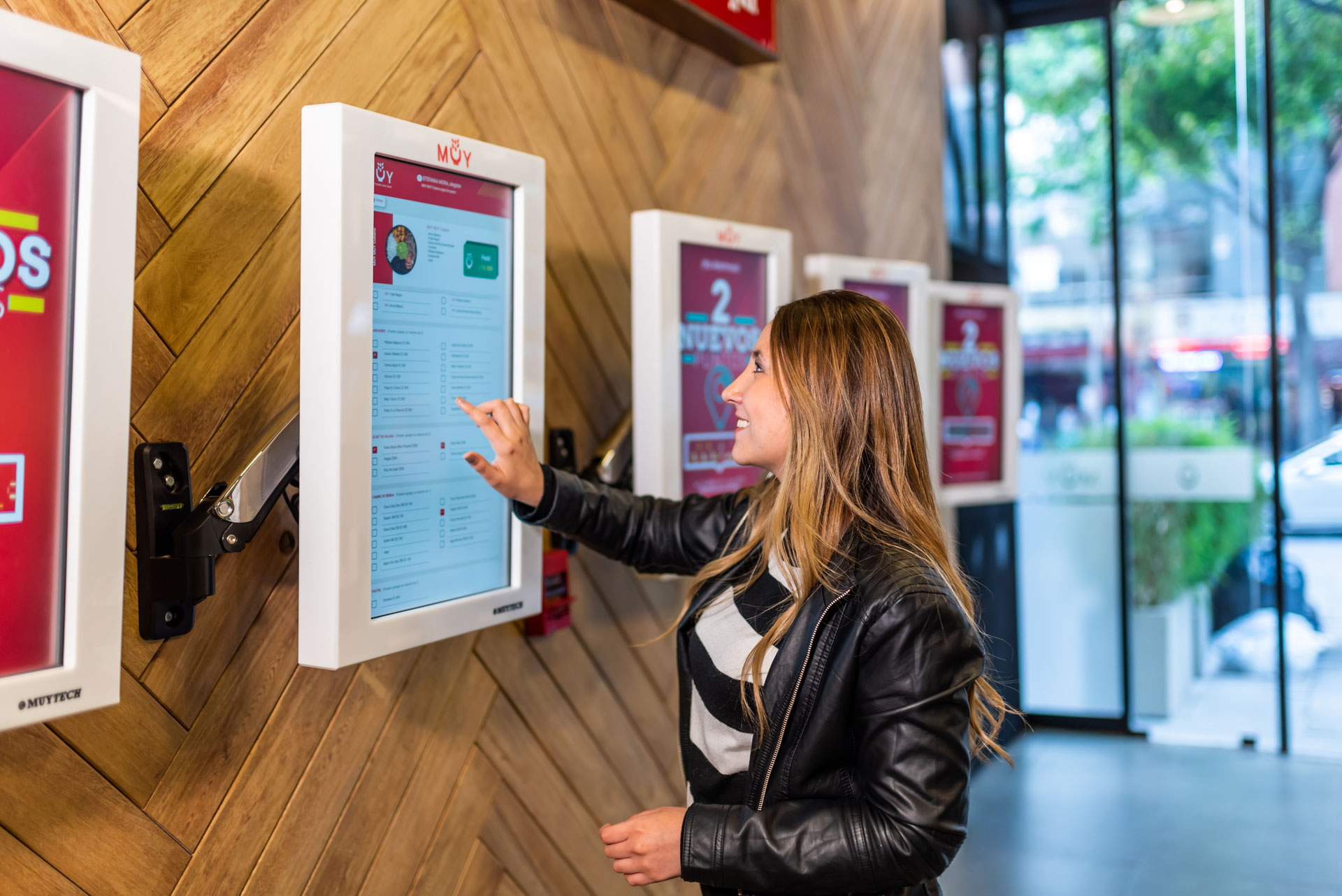
The cloud kitchen craze has reached Latin America. Food tech startup Muy landed a fresh $15 million Series B to expand into Mexico and soon Brazil. The service is currently operative in Colombia. 

Muy is a “cloud kitchen meets Chipotle,” says one investor. The company describes itself as a virtual kitchen and smart chef system that uses AI to produce food based on forecasts of demand, which can help to reduce food waste. Muy, translated from Spanish to English as “very,” allows users to place personalized orders in one of Muy’s physical restaurants or through a mobile app. Muy’s concept also exists as 20 physical dining locations offering what it says are quick, fresh and personalized dishes. Founder Jose Calderon says Muy is serving more than 200,000 dishes per month. 

The round was led by Mexico-based investor ALLVP, with previous investor Seaya returning. The $15 million Series B brings MUY’s total funding to $20.5 million.

Calderon is no newcomer to the takeaway experience space. He previously raised $47.7 million for a Colombian online food ordering startup called Domicilios, which he exited to Delivery Hero

The explosion of delivery apps has kept options competitive for customers not only in the U.S. but across Latin America. The congested highways of São Paulo, Mexico City, Bogotá and beyond are filled with motor couriers running deliveries with Rappi, UberEATS and the like.  

Calderon notes that cloud kitchens are poised to make on-demand ordering and delivery more efficient in these high-density cities due to the long commute times that keep the growing middle class out of their homes for extended periods of 12 hours or more.  

VAS2539

A MUY customer orders at one of the company’s physical locations in Colombia

Alternatives like full service restaurants can be prohibitively expensive and time consuming, and traditional casual restaurants don’t meet quality standards. A large part of the market, around 40%, brings a lunch to work, says Calderon. But as disposable income increases, he predicts that more people will avoid cooking at home and will opt for faster and higher-quality options like Muy.

Cloud kitchens — the fully equipped, shared, commercial grade spaces for restaurant owners — have left U.S. investors balking. Journalists have described these virtual spaces as “ghost kitchens” and many have noted the threat they pose to independently owned restaurants. My colleague Danny Crichton wrote that “cloud kitchens are the WeWork for restaurant kitchens,” adding that suddenly sharable kitchen space will lead to bidding wars between these virtual food brands.  

This rhetoric isn’t hindering the rise of cloud kitchens and the services that support them from launching in the U.S. and down to Latin America. According to Calderon, the food service market opportunity in Latin America will reach $270 billion by 2021.

The founder also notes that the Latin America market is highly fragmented; the top 10 chains only hold around 5% of market share in comparison to countries like the U.S. where this figure reaches 24%. “Large players will consolidate and win, and small ones will face pressure,” he says. 

Larger incumbents have already begun to dip into the cloud kitchen opportunity. Earlier this year, Amazon took a $575 million bite into Deliveroo, which opened its first shared kitchen in Paris in 2018. City Storage Systems, the holding company of CloudKitchens, was backed with a $150 million controlling stake from Uber founder and ex-CEO Travis Kalanick. 

For better or worse, delivery apps and cloud kitchens are revolutionizing the way we eat in the U.S., Asia and now in Latin America. The winners among the various global delivery apps, cloud kitchens and controlling incumbents have yet to emerge, but what we do know is that everyone needs to eat lunch.

Facebook agrees to pay UK data watchdog’s Cambridge Analytica fine but settles without admitting liability

Facebook has reached a settlement with the U.K.’s data protection watchdog, the ICO, agreeing to pay in full a £500,000 (~$643K) fine following the latter’s investigating into the Cambridge Analytica data misuse scandal.

As part of the arrangement, Facebook has agreed to drop its legal appeal against the penalty. But under the terms of the settlement it has not admitted any liability in relation to paying the fine, which is the maximum possible monetary penalty under the applicable U.K. data protection law. (The Cambridge Analytica scandal predates Europe’s GDPR framework coming into force.)

Facebook’s appeal against the ICO’s penalty was focused on a claim that there was no evidence that U.K. Facebook users’ data had being mis-used by Cambridge Analytica .

But there’s a further twist here in that the company had secured a win, from a first-tier legal tribunal — which held in June that “procedural fairness and allegations of bias” on the part of the ICO should be considered as part of its appeal.

The decision required the ICO to disclose materials relating to its decision-making process regarding the Facebook fine. The ICO, evidently less than keen for its emails to be trawled through, appealed last month. It’s now withdrawing the action as part of the settlement, Facebook having dropped its legal action.

In a statement laying out the bare bones of the settlement reached, the ICO writes: “The Commissioner considers that this agreement best serves the interests of all UK data subjects who are Facebook users. Both Facebook and the ICO are committed to continuing to work to ensure compliance with applicable data protection laws.”

An ICO spokeswoman did not respond to additional questions — telling us it does not have anything further to add than its public statement.

As part of the settlement, the ICO writes that Facebook is being allowed to retain some (unspecified) “documents” that the ICO had disclosed during the appeal process — to use for “other purposes,” including for furthering its own investigation into issues around Cambridge Analytica.

“Parts of this investigation had previously been put on hold at the ICO’s direction and can now resume,” the ICO adds.

Under the terms of the settlement the ICO and Facebook each pay their own legal costs. The £500K fine is not kept by the ICO but is paid to HM Treasury’s consolidated fund.

Commenting in a statement, deputy commissioner, James Dipple-Johnstone, said:

The ICO welcomes the agreement reached with Facebook for the withdrawal of their appeal against our Monetary Penalty Notice and agreement to pay the fine. The ICO’s main concern was that UK citizen data was exposed to a serious risk of harm. Protection of personal information and personal privacy is of fundamental importance, not only for the rights of individuals, but also as we now know, for the preservation of a strong democracy. We are pleased to hear that Facebook has taken, and will continue to take, significant steps to comply with the fundamental principles of data protection. With this strong commitment to protecting people’s personal information and privacy, we expect that Facebook will be able to move forward and learn from the events of this case.

In its own supporting statement, attached to the ICO’s remarks, Harry Kinmonth, director and associate general counsel at Facebook, added:

We are pleased to have reached a settlement with the ICO. As we have said before, we wish we had done more to investigate claims about Cambridge Analytica in 2015. We made major changes to our platform back then, significantly restricting the information which app developers could access. Protecting people’s information and privacy is a top priority for Facebook, and we are continuing to build new controls to help people protect and manage their information. The ICO has stated that it has not discovered evidence that the data of Facebook users in the EU was transferred to Cambridge Analytica by Dr Kogan. However, we look forward to continuing to cooperate with the ICO’s wider and ongoing investigation into the use of data analytics for political purposes.

A charitable interpretation of what’s gone on here is that both Facebook and the ICO have reached a stalemate where their interests are better served by taking a quick win that puts the issue to bed, rather than dragging on with legal appeals that might also have raised fresh embarrassments. 

That’s quick wins in terms of PR (a paid fine for the ICO; and drawing a line under the issue for Facebook), as well as (potentially) useful data to further Facebook’s internal investigation of the Cambridge Analytica scandal.

Good luck with anyone in the UK suing Facebook for anything to do with Cambridge Analytica after today.

— Tim Turner (@tim2040) October 30, 2019

We don’t know exactly what it’s getting from the ICO’s document stash. But we do know it’s facing a number of lawsuits and legal challenges over the scandal in the U.S. 

The ICO announced its intention to fine Facebook over the Cambridge Analytica scandal just over a year ago.

In March 2018 it raided the U.K. offices of the now defunct data company, after obtaining a warrant, taking away hard drives and computers for analysis. It had also earlier ordered Facebook to withdraw its own investigators from the company’s offices.

Speaking to a U.K. parliamentary committee a year ago the information commissioner, Elizabeth Denham, and deputy Dipple-Johnstone, discussed their (then) ongoing investigation of data seized from Cambridge Analytica — saying they believed the Facebook user data set the company had misappropriated could have been passed to more entities than were publicly known.

The ICO said at that point it was looking into “about half a dozen” entities.

It also told the committee it had evidence that, even as recently as early 2018, Cambridge Analytica might have retained some of the Facebook data — despite having claimed it had deleted everything.

“The follow up was less than robust. And that’s one of the reasons that we fined Facebook £500,000,” Denham also said at the time. 

Some of this evidence will likely be very useful for Facebook as it prepares to defend itself in legal challenges related to Cambridge Analytica. As well as aiding its claimed platform audit — when, in the wake of the scandal, Facebook said it would run a historical app audit and challenge all developers who it determined had downloaded large amounts of user data.

The audit, which it announced in March 2018, apparently remains ongoing.

IoT security startup Particle raises $40M in Series C

Particle, a platform for Internet of Things devices, has raised $40 million in its latest round of funding.

Qualcomm Ventures and Energy Impact Partners led the Series C raise, with backing from existing investors including Root Ventures, Bonfire Ventures, Industry Ventures, Spark Capital, Green D Ventures, Counterpart Ventures and SOSV.

With its latest round of funding, Particle has raised $81 million to date.

The San Francisco-based startup provides the back-end for its customers to bring Internet of Things devices to market without having to shell out for their own software infrastructure. The platform aims to be the all-in-one solution for IoT devices, with encryption and security, as well as data autonomy and scalability.

That means more traditional businesses can buy a fleet of sensors and other monitoring devices, hook them up to their own machines and use Particle’s infrastructure for monitoring.

That’s a common theme that Particle sees, according to Zach Supalla, the company’s chief executive.

“More and more of our customers are in old-fashioned, even unglamorous, businesses like stormwater management, industrial equipment, shipping or monitoring any number of compressors, pumps and valves,” he said in remarks. “These businesses are diverse, but the common thread is that they need to monitor and control mission-critical machines, and we see it as our mission to help bring their machines, vehicles and devices into the 21st century.”

Particle said the funding round follows “significant growth” for its enterprise platform, seeing 150% year-over-year growth in revenue.

The company currently has 100 staff working to support 85 enterprise clients across agriculture, automotive, smart city and other industries.