The show wrapped up five months ago, but it’s still dominating the headlines. Here’s why.
Category: Tech news
hacking,system security,protection against hackers,tech-news,gadgets,gaming
Things We Loved in October: Google Pixel, Galaxy Buds, E-Bikes
The ramp-up to the holidays means we saw gobs of new products in October. Here are some of our favorites.
Distant Galaxies? The Death Star? Nope, These Are Explosions
In his new series, photographer Kevin Cooley creates crazy images using pyrotechnics.
Wait, There’s Hope\! Here’s How Humans Might Save Antibiotics
People have a poor track record of preventing global disasters. But for antimicrobial resistance, an unlikely group of allies is making big promises.
Braun MultiServe Coffee Machine Review: Finally, a Great Single-Cup Coffee Brewer
Braun’s new MultiServe coffee machine can brew batches of different volumes, from one cup to a full pot. And they all taste great. Bye-bye, K-Cups.
How to Free Up Space in Gmail
Google offers 15 GB of free storage with every account, but many users are hitting the limit. Use these tips to clear some room, and tidy your inbox while you’re at it.
AI May Not Kill Your Job—Just Change It
Don’t fear the robots, according to a report from MIT and IBM. Worry about algorithms replacing any task that can be automated.
The Delicate Art—and Evolving Science—of Wildfire Evacuations
The still-burning Kincade Fire prompted one of the largest wildfire-related evacuations in California history—a legacy, in part, of two earlier deadly blazes.
NASA Is Getting Serious About an Interstellar Mission
Only two spacecraft have ever escaped our solar system to dip into interstellar space. Now NASA wants to go back—and soon.
HBO Max Is the New $200 iPhone
The days of carrier smartphone subsidies are long gone—but streaming subscriptions are filling the void.
Deadspin writers quit after being ordered to stick to sports
Writers Laura Wagner, Kelsey McKinney, Tom Ley, Lauren Theisen, Patrick Redford, Albert Burneko and Chris Thompson all tweeted today that they have resigned from Deadspin, the sports-focused site owned by G/O Media.
A quick refresher: G/O Media was formerly known as Gizmodo Media Group, and before that as Gawker Media. It took on its current name and current leadership earlier this year when Univision sold the unit to private equity firm Great Hill Partners, who appointed former Forbes.com CEO Jim Spanfeller as its new chief executive.
Since then, the relationship between G/O Media leadership and the editorial staff has been rocky, as you would have learned by reading Deadspin itself, particularly an in-depth story by Wagner in August about how employees were unhappy with “a lack of communication regarding company goals, seeming disregard for promoting diversity within the top ranks of the company, and by repeated and egregious interference with editorial procedures.”
Just now I resigned my position at Deadspin today along with many of my colleagues. I have been here only five months but they have been some of the best of my career and I will miss it deeply.
— kelsey mckinney (@mckinneykelsey) October 30, 2019
A few weeks later, Deadspin’s editor in chief Megan Greenwell resigned, saying that G/O Media’s new editorial director Paul Maidment was directing the staff to stick to sports coverage — a decision that she argued wasn’t dictated by traffic, since “posts on The Concourse, Deadspin’s vertical dedicated to politics and culture and other topics that are not sports, outperform posts on the main site by slightly more than two to one.”
Apparently Maidment repeated that edict in a memo earlier this week, which was leaked to The Daily Beast, and in which he said, “Deadspin will write only about sports and that which is relevant to sports in some way.”
The Deadspin homepage was subsequently filled with non-sports content, and editor Barry Petchesky tweeted that he had been “fired from Deadspin for not sticking to sports.”
I quit today too https://t.co/W7meIcW0Cx
— Laura Wagner (@laurawags) October 30, 2019
At the same time, Deadspin also posted a story criticizing auto-playing ads on the site, declaring, “We, the writers, editors, and video producers of Deadspin, are as upset with the current state of our site’s user experience as you are.” The post is no longer live, but the criticism reportedly prompted advertiser Farmers Insurance to pull the campaign.
This all appears to have prompted a mass exodus from Deadspin today. The Gizmodo Media Group union also issued this statement:
Today, a number of our colleagues at Deadspin resigned from their positions. From the outset, CEO Jim Spanfeller has worked to undermine a successful site by curtailing its most well-read coverage because it makes him personally uncomfortable. This is not what journalism looks like and it is not what editorial independence looks like.
“Stick to sports” is and always has been a thinly veiled euphemism for “don’t speak truth to power.” In addition to being bad business, Spanfeller’s actions are morally reprehensible. The GMG Union stands with our current and former Deadspin colleagues and condemns Jim Spanfeller in the strongest possible terms.
We’ve reached out to G/O Media for comment and will update if we hear back.
Turning Google traffic into leads, and what’s new in SEO
Julian Shapiro
Contributor
Contributor
Julian Shapiro is the founder of BellCurve.com, the growth marketing team that trains startups in advanced growth, helps you hire senior growth marketers, and finds you vetted growth agencies. He also writes at Julian.com.
More posts by this contributor
We’ve aggregated the world’s best growth marketers into one community. Twice a month, we ask them to share their most effective growth tactics, and we compile them into this Growth Report.
This is how you’re going stay up-to-date on growth marketing tactics — with advice you can’t get elsewhere.
Our community consists of 600 startup founders paired with VP’s of growth from later-stage companies. We have 300 YC founders plus senior marketers from companies including Medium, Docker, Invision, Intuit, Pinterest, Discord, Webflow, Lambda School, Perfect Keto, Typeform, Modern Fertility, Segment, Udemy, Puma, Cameo and Ritual.
You can participate in our community by joining Demand Curve’s marketing webinars, Slack group, or marketing training program. See past growth reports here and here.
Without further ado, onto the advice.
What are some new, advanced SEO strategies?
Our community ran an SEO masterclass in which we discussed Google’s algorithm updates and shared advanced practices for writing blog content in a data-driven manner.
Tactics for turning blog visitors into leads
Based on insights from Nat Eliason from Growth Machine.
SEO traffic can sometimes be a vanity metric if you’re not converting it into lead flow. Here are three ways to convert blog visitors into leads:
- Prompt blog readers with quizzes to help them identify the product/plan that’s best suited for them. Then require their email address to see results. Follow up with drip emails.
- Create “Buyer’s Guides” — downloadable PDFs with nice visuals that help readers figure out how to accomplish their goals (e.g. “paleo cooking starter kit.”) Again, require an email for them to download the complete guide.
- Pixel your blog visitors and retarget them with Facebook ads. Have the ads send visitors to landing pages that match whichever blog content category initially drew them to the site.
How to (re-)target business customers with Facebook ads
Based on insights from Nima Gardideh of Pearmill and Julian Shapiro of Demand Curve.
Most people use their personal email address on their Facebook/Instagram account. So if you’re collecting business emails during your user onboarding process, Facebook can have a hard time matching those emails to the corresponding Facebook profiles when creating custom targeting lists.
Here are a few tricks around this:
Twitter banning political ads is the right thing to do, so it will be attacked mercilessly
Twitter founder and CEO Jack Dorsey announced abruptly — though the timing was certainly not accidental — that the platform would soon disallow any and all political advertising. This is the right thing to do, but it’s also going to be hard as hell for a lot of reasons. As usual in tech and politics, no good deed goes unpunished.
Malicious actors, state-sponsored and otherwise, have and will continue to attempt to influence the outcome of U.S. elections via online means, including political ads and astroturfing. Banning such ads outright is an obvious, if rather heavy-handed, solution — but given that online platforms seem to have made little progress on more targeted measures, it’s the only one realistically available to deploy now.
“Not allowing for paid disinformation is one of the most basic, ethical decisions a company can make,” wrote Representative Alexandria Ocasio-Cortez (D-NY) in a tweet following the news. “If a company cannot or does not wish to run basic fact-checking on paid political advertising, then they should not run paid political ads at all.”
One of the reasons Facebook has avoided restricting political ads and content is that by doing so it establishes itself as the de facto arbiter between “appropriate” and “inappropriate,” and the fractal-complex landscape that creates across thousands of cultures, languages and events. Don’t cry for Mark Zuckerberg, though — this is a monster of his own creation. He should have retired when I suggested it.
But Twitter’s decision to use a sledgehammer rather than a scalpel doesn’t remove the inherent difficulties in the process. Twitter is just submitting itself for a different kind of punishment. Because instead of being the arbiter of what is appropriate, it will be the arbiter of what is political.
This is slightly less fraught than Facebook’s task, but Twitter will not be able to avoid accusations — perhaps even true ones — of partisanship and bias.
For instance, the fundamental decision to disallow political advertising seems pretty straightforward and nonpartisan. Incumbents rely on traditional media more and progressives tend to be younger and more social media-savvy. So is this taking away a tool suited to left-leaning challengers? But incumbents tend to have bigger budgets and their spend on social media has been increasing, so could this be considered a way to curb that trend? Who this affects and how is not a clear-cut fact but something campaigns and pundits will squabble about endlessly.
(Update: The Trump re-election campaign has already called it “yet another attempt to silence conservatives.”)
Or consider the announcement Dorsey made right off the bat that “ads in support of voter registration will still be allowed.” Voter registration is a good nonpartisan goal, right? In fact it’s something many conservative lawmakers have consistently opposed, because unregistered voters, for a multitude of reasons, skew toward the liberal side. So this too will be considered a partisan act.
Having unofficially provided some guidance, Twitter will put out official guidelines in a few weeks, but it’s hard to see how they can be satisfactory. Will industry groups be able to promote tweets about how their new factory is thriving because of a government grant? Will an advocacy organization be able to promote a tweet about a serious situation on the border? Will news outlets be able to promote a story about the election? What about a profile of a single candidate? What about an op-ed on an issue?
The difference between patrolling the interior of the politics world, and patrolling its borders, so to speak, may appear significant — but it’s really just a different kind of trouble. Twitter is entering a world of pain.
But at least it’s moving forward. It’s the right decision, even if it’s a hard one and could hit the bottom line pretty hard (not that Twitter has ever cared about that). The decision to do this while Facebook is dismantling its credibility with a series of craven, self-interested actions is a canny one. Even if Twitter fails to get this right, it can at least say it’s trying.
And lastly, it should be said that it also happens to be a good choice for users and voters, a rare exception to the parade of user-hostile decisions coming out of the big tech and media companies. Going into an election year, we can use all the good news we can get.
Zuckerberg defends politician ads that will be 0.5% of 2020 revenue
As Jack Dorsey announced his company Twitter would drop all political ads, Facebook CEO Zuckerberg doubled-down on his policy of refusing to fact check politicians’ ads. “At times of social tension there has often been an urge to pull back on free expression . . . We will be best served over the long term by resisting this urge and defending free expression.”
Still, Zuckerberg failed to delineate between freedom of expression, and freedom of paid amplification of that expression which inherently favors the rich.
During today’s Q3 2019 earnings call where Facebook beat expectations and grew monthly users 2% to 2.45 billion, Zuckerberg spent his time defending the social network’s lenient political ad policy. You can read his full prepared statement here.
One clear objective was to dispel the idea that Facebook was motivated by greed to keep these ads. Zuckerberg explained “We estimate these ads from politicians will be less than 0.5% of our revenue next year.” For reference, Facebook earned $66 billion in the 12 months ending Q3 2019, so Facebook might earn around $330 million to $400 million in political ads next year. [Update: It wasn’t clear if issue ads and PAC ads were counted in Facebook’s 0.5% figure, but now the company says that number is just for ads run directly by politicians.]
Zuckerberg also said that given Facebook removed 50 million hours per day of viral video watching from its platform to support well-being which hurt ad viewership and the company’s share price, Facebook clearly doesn’t act solely in pursuit of profit.
We just shared our community update and quarterly results. Here’s what I said on our earnings call. — Before we…
Posted by Mark Zuckerberg on Wednesday, October 30, 2019
Facebook’s CEO also tried to bat down the theory that Facebook is allowing misinformation in political ads to cater to conservatives or avoid calls of bias from them. “Some people say that this is just all a cynical political calculation and that we’re acting in a way that we don’t really believe because we’re just trying to appease conservatives” he said, responding that “frankly, if our goal was that we’re trying to make either side happy then we’re not doing a very good job because I’m pretty sure everyone is frustrated.”
Instead of banning political ads, Zuckerberg voiced support for increasing transparency about how ads look, how much is spent on them, and where they’re run. “I believe that the better approach is to work to increase transparency. Ads on Facebook are already more transparent than anywhere else. We have a political ads archive so anyone can scrutinize every ad that’s run.”
He mentioned that political ads are run by “Google, YouTube, and most internet platforms”, seeming to stumble for a second as he was likely prepared to cite Twitter too until it announced it would drop all political ads an hour earlier. He omitted that Pinterest and TikTok have also banned political ads.
It doesn’t help that hundreds of Facebook’s own employees have called on their CEO to change the policy. He concluded that no one could accuse Facebook of not deeply thinking through the question and its downstream ramifications. Zuckerberg did leave himself an out if he chooses to change the policy, though. “I’ve considered whether we should not [sell political ads] in the past, and I’ll continue to do so.”
Dorsey had tweeted that “We’ve made the decision to stop all political advertising on Twitter globally. We believe political message reach should be earned, not bought.” Democrat Representative Alexandria Ocasio-Cortez expressed support for Twitter’s move while Trump campaign manager Brad Parscale called it “a very dumb decision”
Twitter’s CEO took some clear swipes at Zuckerberg, countering his common arguments for allowing misinformation in politician’s ads. “Some might argue our actions today could favor incumbents. But we have witnessed many social movements reach massive scale without any political advertising. I trust this will only grow.” Given President Trump had outspent all Democratic candidates on Facebook ads as of March of this year, it’s clear that deep-pocketed incumbents could benefit from Facebook’s policy.
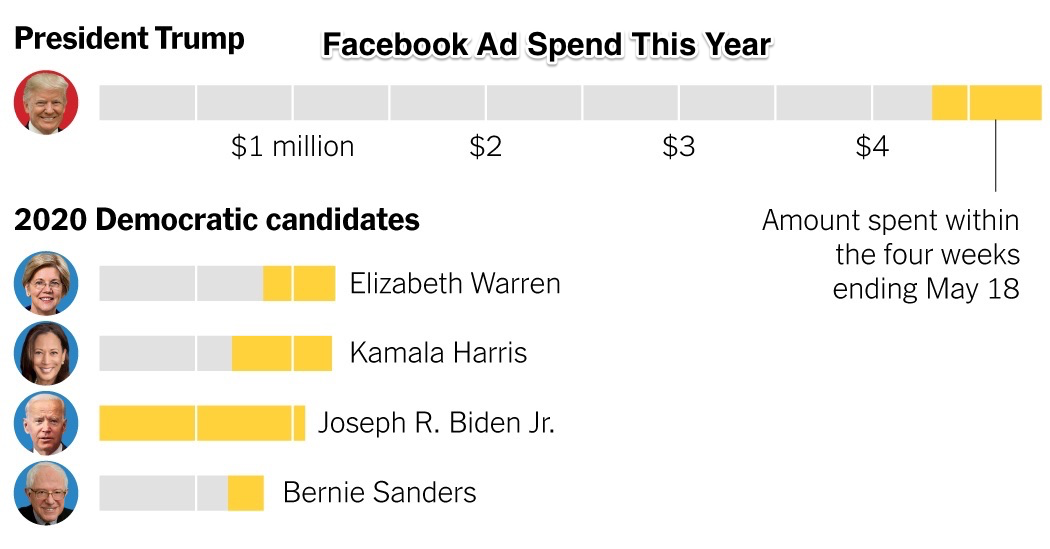
Trump continues to massively outspend Democratic rivals on Facebook ads. Via NYT
Miming Facebook’s position, Dorsey tweeted “It‘s not credible for us to say: ‘We’re working hard to stop people from gaming our systems to spread misleading info, buuut if someone pays us to target and force people to see their political ad…well…they can say whatever they want!”
Twitter doesn’t earn much from political ads, citing only $3 million in revenue from the 2018 mid-term elections, or roughly 0.1% of its $3 billion in total 2018 revenue. That means there will be no major windfall for Facebook from Twitter dropping political ads. But now all eyes will be on Facebook and Google/YouTube. If Sundar Pichai and Susan Wojcicki move in line with Dorsey, it could make Zuckerberg even more vulnerable to criticism.
$330 million might not be a big incentive for Facebook or Zuckerberg, but it still sounds like a lot of money to earn from ads that potentially lie to voters. I respect Facebook’s lenient policy when it comes to speech organically posted to users, organizations, or politicians’ own accounts. But relying on the candidates, press, and public to police speech is dangerously idealistic. We’ve seen how candidates will do anything to win, partisan press will ignore the truth to support their team, and the public aren’t educated or engaged enough to consistently understand what’s false.
Zuckerberg greatest mistakes have come from overestimating humanity. Unfortunately, not everyone wants to bring the world closer together. Without safeguards, Facebook’s tools can help tear it apart. It’s time for Facebook and Zuckerberg to recognize the difference between free expression and paid expression.
Apple beats on Q4 earnings after strong quarter for wearables, services
Apple’s iPhone sales still make up over half of its quarterly revenues, but they are slowly shrinking in importance as other divisions in the company pick up speed.
Apple’s stock remained largely unchanged after-hours following the release of its Q4 earnings. The company delivered earnings per share of $3.03 versus the street’s estimate of $2.84 on revenue of $64 billion compared with expectation at $62.99 billion.
The big story continues to be major growth in Services, iPad and Wearables while iPhone and Mac sales continue to shrink year-over-year.
As you’ll remember, Apple no longer reports unit sales of its iPhone, Mac and iPad lines, something that is largely the result of declining unit sales and higher average selling prices. Services, Wearables and Other, and iPad saw year-over-year gains, while the iPhone and Mac lines are still seeing revenue slumps.
- iPhone sales were down 9% year-over-year, to $33.36 billion
- Services were up 18% YoY, to $12.5 billion
- Mac sales were down 5% YoY, to $6.99 billion
- “Wearables, Home, and Accessories” were up 54% YoY, to $6.52 billion
- iPad sales were up 17% YoY, to $4.66 billion
The company is continuing to add to some of its highest-growth businesses. The company announced the release of a new high-end set of AirPods yesterday, which will likely increase average selling prices among its wearables division. The company also has a number of paid services, including Apple TV+, that will be launching soon.