Extension on early-bird sale to Disrupt Berlin 2019

We won’t bury the lead on this news, startup fans. We’re giving all you professional procrastinators and time-delayed decision makers an extra week to pull yourselves together and score early-bird savings on passes to Disrupt Berlin 2019 (11-12 December).

Early-bird pricing remains in play until 15 November at 11:59 p.m. (CEST). Don’t let this last-chance clock run out. Beat the deadline, buy an early-bird pass to Disrupt Berlin and keep up to €500 in your wallet.

One of the many awesome aspects of Disrupt is the opportunity to learn from a range of experts in the startup community. Here are just three examples of the knowledge you can absorb at Disrupt. Want more? Check out the full event agenda.

Series A financing is a tricky beast and one of the hardest deals to close. If this hot topic speaks to you, don’t miss this panel discussion going down on the Extra Crunch Stage.

What does it take to raise a Series A with Jessica Holzbach (founder, Penta) and Louise Samet (partner, Blossom Capital). Venture capital funds have boomed this decade, but raising money is still hard for young companies. What are investors today looking for in teams, metrics and products?

Climate change is arguably the biggest issue of our time. Learn how one founder turned sustainability into her business.

How to build sustainability as a business with Benjamina Bollag (founder/CEO, Higher Steaks). As climate change and the impacts of a warming world become more important for the consumers who are exposed to it, hear from a developer of lab-grown meat and others on how to build sustainability as a business.

Who wouldn’t love a crystal ball to divine investment trends for the coming year? We have the next best thing — minus the hocus pocus.

Investing in 2020 with Carolina Brochado (investment director, SoftBank Vision Fund) and Tom Hulme (general partner, GV). Nothing changes quite as rapidly as investment trends. Brochado and Hulme will offer perspectives from their experience both on the ground in Europe and from 50,000 feet to talk about what 2020 has in store for startups.

There’s plenty more knowledge and opportunity packed into two short days. Don’t miss the Startup Battlefield pitch competition. Be there as 15-20 stellar startups vie for the Disrupt Cup, investor love, media attention and the $50,000 prize.

Looking for skilled coders to help bring your vision to life? Head to the Extra Crunch Stage and watch the Hackathon finalists pitch working products they designed and built in 24 pressure-filled hours. Who will win the $5,000 prize for best overall hack?

Disrupt Berlin 2019 takes place on 11-12 December. This is it — one extra week. You have until 15 November at 11:59 (CEST) — an extra week to buy an early-bird pass to Disrupt Berlin. Get ‘er done!

Is your company interested in sponsoring or exhibiting at Disrupt Berlin 2019? Contact our sponsorship sales team by filling out this form.
Facebook’s first experimental apps from its ‘NPE Team’ division focus on students, chat & music

This July, Facebook announced a new division called NPE Team which would build experimental consumer-facing apps, allowing the company to try out new ideas and features to see how people would react. It soon thereafter tapped former Vine GM Jason Toff to join the team as a product manager. The first apps to emerge from the NPE Team have now quietly launched. One, Bump, is a chat app that aims to help people make new friends through conversations, not appearances. Another, Aux, is a social music listening app.

Aux seems a bit reminiscent of an older startup, Turntable.fm, that closed its doors in 2013. As in Turntable.fm, the idea with Aux is that of a virtual DJ’ing experience where people instead of algorithms are programming the music. This concept of crowdsourced DJ’ing also caught on in years past with radio stations that put their audiences in control of the playlist through their mobile app.

Later, streaming music apps like Spotify experimented with party playlists, and various startups launched their own guest-controlled playlists.

The NPE Team’s Aux app is a slightly different take on this general idea of people-powered playlists.

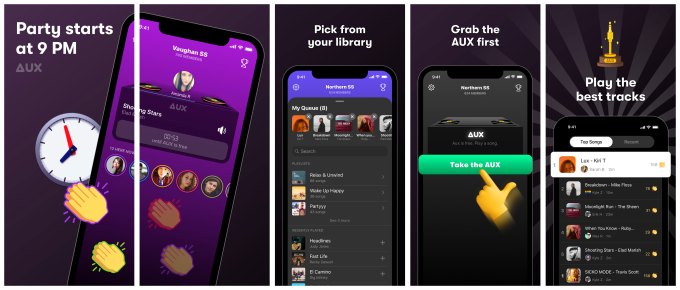
The app is aimed at school-aged kids and teens who join a party in the app every day at 9 PM. They then choose the songs they want to play and compete for the “AUX” to get theirs played first. At the end of the night, a winner is chosen based on how many “claps” are received.

As the app describes it, Aux is a “DJ for Your School” — a title that’s a bit confusing, as it brings to mind music being played over the school’s intercom system, as opposed to a social app for kids who attend school to use in the evenings.

Aux launched on August 8, 2019 in Canada, and has less than 500 downloads on iOS, according to data from Sensor Tower. It’s not available on Android. It briefly ranked No. 38 among all Music apps on the Canadian App Store on October 22, which may point to some sort of short campaign to juice the downloads.

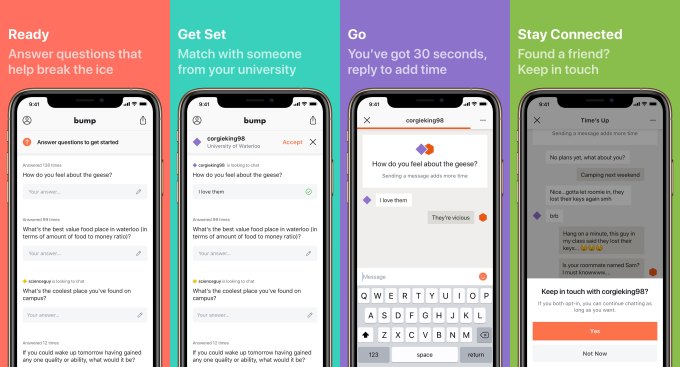
The other new NPE Team app is Bump, which aims to help people “make new friends.”

Essentially an anonymous chat app, the idea here is that Bump can help people connect by giving them icebreakers to respond to using text. There are no images, videos or links in Bump — just chats.

Based on the App Store screenshots, the app seems to be intended for college students. The screenshots show questions about “the coolest place” on campus and where to find cheap food. A sample chat shown in the screenshots mentions things like classes and roommate troubles. 

There could be a dating component to the app, as well, as it stresses that Bump helps people make a connection through “dialog versus appearances.” That levels the playing field a bit, compared with other social apps — and certainly dating apps — where the most attractive users with the best photos tend to receive the most attention.

Chats in Bump take place in real time, and you can only message in one chat at a time. There’s also a time limit of 30 seconds to respond to messages, which keeps the chat active. When the chat ends, the app will ask you if you want to keep in touch with the other person. Only if both people say yes will you be able to chat with them again.

Bump is available on both iOS and Android and is live in Canada and the Philippines. Bump once ranked as high as No. 252 in Social Networking on the Canadian App Store on September 1, 2019, according to Sensor Tower. However, it’s not ranking at all right now.

What’s interesting is that only one of these NPE Team apps, Bump, discloses in its App Store description that the NPE Team is from Facebook. The other, Aux, doesn’t mention this. However, both do point to an App privacy policy that’s hosted on Facebook.com for those who go digging.

That’s not too different from how Google’s in-house app incubator, Area 120, behaves. Some of its apps aren’t clear about their affiliation with Google, save for a link to Google’s privacy policy. It seems these companies want to see if the apps succeed or fail on their own merit, not because of their parent company’s brand name recognition.

Facebook hasn’t said much about its plans for the NPE Team beyond the fact that they will focus on new ways of building community and may be shut down quickly if they’re not useful.

Facebook has been asked for comment about the new apps and we’ll update if one is provided.

Daily Crunch: YouTube redesigns its homepage

The Daily Crunch is TechCrunch’s roundup of our biggest and most important stories. If you’d like to get this delivered to your inbox every day at around 9am Pacific, you can subscribe here.

1. YouTube’s homepage redesign focuses on usability, giving you control over recommendations

The company announced an updated, cleaner design that does away with information density, instead giving more room to the videos and their titles. Other new features include an “Add to Queue” option on the desktop, a desktop version of YouTube’s stop suggesting feature and more.

The design changes, which started rolling out yesterday, are focused on the desktop and tablet versions of YouTube, not the YouTube mobile website or app.

2. Disney+ will launch in the UK, Germany, Italy, France and Spain in March 2020

Disney has revealed more details about its international streaming plans. Keep in mind, though, that Disney+ won’t be exactly the same in every territory, thanks to rights/licensing deals that may already be in place.

3. How Microsoft is trying to become more innovative

Across the board, the company is trying to find ways to become more innovative, especially around its work in AI. Microsoft is unusually open about this process, too, and actually made it a focus at this week’s Ignite conference. (Extra Crunch membership required.)

4. Alibaba to invest $3.3B to bump its stake in logistics unit Cainiao

Alibaba is doubling down on its logistics affiliate Cainiao, two years after acquiring a majority stake in the firm. The Chinese giant said today it would invest an additional 23.3 billion yuan (about $3.33 billion) to raise its equity in Cainiao to 63%.

5. Kepler achieves a world-first for satellite broadband with 100Mbps connection to the Arctic

This is the first time there’s been a high-bandwidth satellite network for any central Arctic ground-based use, Kepler says, and this connection isn’t just a technical demo: it’s being used for the hundreds of researchers in the MOSAiC team.

6. Google hires former Disney and Star executive to head its India business

Sanjay Gupta previously served as a managing director at Disney India and Disney-owned Star. He’ll be replacing Rajan Anandan, who left the company to join VC fund Sequoia Capital.

7. Sir Martin Sorrell’s Silicon Valley charm offensive

Sir Martin Sorrell has enjoyed huge success, having built the world’s biggest advertising conglomerate, WPP, over 32 years. He’s also out for revenge, after he left WPP due to allegations of misconduct.

Vape lung ‘breakthrough’ suggests lethal culprit in THC products could be vitamin E acetate

Official word has come down from federal authorities on one potential cause of the mystery illness affecting vape users: Vitamin E acetate, a chemical found in some vaping products that has been demonstrated to linger in the lungs long afterwards. The finding has been called a “breakthrough” but is far from the last word on the situation.

Sadly, the condition has already claimed the lives of at least 39 people, and more than 2,000 cases have been reported collectively from every state but Alaska. At present the only advice offered has been to stop vaping altogether.

In a media teleconference, the heads of the investigation from the Centers for Disease Control and Prevention explained the basis for pointing the finger at Vitamin E acetate. The substance was cited as a possible problem early on but only recent testing has established it as a bona fide suspect, the team explained.

Samples taken from the lungs of 29 victims of the condition were sent in from 10 different states, and vitamin E acetate was found in all of them. “These findings provide direct evidence of vitamin E acetate as the primary site of injury within the lungs,” said Anne Schuchat, principal deputy director of the CDC .

Although she agreed that this evidence is a “breakthrough,” she noted that it is at present merely a correlative finding — more research is required to establish causation, namely the mechanism of harm, though other work has been done in that area.

“Previous non-CDC research suggests that when vitamin E acetate is inhaled, it may interfere with normal lung function,” she said.

“It’s important to note that these findings do not rule out other possible compounds or ingredients that may be causing these lung injuries,” she continued. “There may be more than one cause of the outbreak.”

Equally important are the statistics involved with the sources of the substances in question. As mentioned earlier in the investigation, a huge proportion of those suffering from this condition were using THC products, and specifically ones acquired through unregulated channels like street dealers.

The vitamin E acetate may have been added for the purpose of essentially cutting the product, Schuchat mentioned in response to a question on the call.

“That may be done for the illicit purpose, or the profit purpose, of diluting the materials, making it look nice and perhaps not having to use as much THC or other active ingredients,” she said.

Other potentially dangerous chemicals have been identified in vape products when heated and aerosolized, including many that even the creators might not have predicted.

Knowing a potential culprit doesn’t get at the heart of the problem, which would be that this chemical (perhaps among others) has already built up over months or years in the lungs of frequent vape users. Treatment is a parallel line of research, but knowing at least one substance responsible should be helpful.

The CDC’s previous advice still stands, the officials noted: They advise avoiding vaping altogether, as there are very few controls at present over which ingredients are allowed in vape products, and what must be declared on the packaging, or indeed whether those declarations are in any way accurate.

I ran digital ads for a presidential campaign, and Twitter is right to ban them

Aaron Bartnick (@AaronBartnick) served as Digital Director for Congressman Seth Moulton’s presidential campaign. He is currently completing graduate studies at the Harvard Kennedy School of Government.

As the digital director for Congressman Seth Moulton’s 2020 presidential campaign, I was responsible for everything the campaign did on the internet: the emails you claim to hate, the videos we hoped would go viral, the online infrastructure that supported organizers in the field, and more. But our biggest investment of both time and money, by far, was in digital advertising.

For our campaign and many others, digital ads were the single biggest expense outside of payroll. Yet these ads are terrible for campaigns, toxic for democracy and are even bad for the companies who profit off them. Last week, Twitter CEO Jack Dorsey took a bold first step in banning political ads — Facebook CEO Mark Zuckerberg and Google CEO Sundar Pichai should follow suit.

Digital ads are one of the most important channels for acquiring new supporters and serving them that all-important question: “Will you chip in $10, $5, or whatever you can to support our campaign? Even $1 helps!” When the Democratic National Committee announced in February that presidential candidates would need a minimum of 65,000 individual donors to qualify for the first two debates, acquiring these small dollar donors became a do-or-die priority for campaigns.

The trouble is, when 25 campaigns are competing in a Democratic donor market that had just five competitors in 2016, and when each campaign is desperate to acquire new donors, prices go up. Way up.

We — and I suspect many others — routinely ran what were supposed to be revenue-generating ads at a loss, spending $10, $20, or even $30 in order to acquire one new donor and their contribution of as little as $1. This is a terrible deal for campaigns: they hemorrhage cash in order to lose money acquiring more, costing weeks or months of valuable runway, all while Facebook pockets the difference. At scale, the consequence is massive: the remaining 18 Democratic candidates have already spent over $53 million on Facebook and Google this cycle, most of it these kinds of ads.

This is $53 million — plus millions more from prolific former candidates like Sen. Kirsten Gillibrand and Gov. Jay Inslee — which would have otherwise been invested in infrastructure to turn out voters and help Democrats in November no matter who is the nominee. Instead, it went straight into Facebook and Google’s coffers.

These ads are toxic to our democracy.

Due to short online attention spans, the character limits that enforce them and the engagement algorithms that act as gatekeepers to the digital world, campaigns must distill complex issues down to a two sentence pseudo-essence that would leave even debate moderators unsatisfied. And if you want to have a prayer of anyone clicking on your ad, it had better be as inflammatory as possible — people click when they’re angry.

The easiest way to do this is to simply make things up, something most campaigns would never consider, but which Zuckerberg made clear in congressional testimony this week his platform would happily enable. Companies like Facebook and Google force us to present voters with a world that is black and white, in which all nuance is distraction, and in which civic engagement is something that can be done from your phone for just $1 (Unless you’d like to make this a monthly recurring donation? Your support has never been more crucial!). This does not an informed, healthy democracy make.

Political ads are not even good for the companies that serve them. On a quarterly earnings call the same day as Dorsey’s announcement, Zuckerberg estimated that political ads run by candidates would make up just 0.5% of Facebook’s 2020 revenue. Assuming similar performance to the previous 12 months, in which Facebook earned $66 billion, this would be about $330 million in political ad revenue.

In exchange, Facebook has earned itself years of bad PR, increased regulatory risk as congressional leaders are beginning to see it as a national security problem, and even existential risk as leading presidential candidate Sen. Elizabeth Warren has vowed to break up the company if elected. All over revenues that hardly even justify the opportunity cost of Zuckerberg’s hours of preparation for congressional hearings.

So who benefits from these kinds of ads? Those who want to create a chaotic information environment in the United States in which facts are subjective, reality is ephemeral and the only information you can trust comes from the people manipulating social media to feed it to you. It is therefore no surprise that one of the first organizations to condemn Dorsey’s decision was the Russian state-sponsored media outlet Russia Today.

Presented with a choice between minuscule revenues and existential risk, between patching a bug in American democracy and abetting Russian propaganda, Dorsey made a wise choice for both his bottom line and his country. Zuckerberg and Pichai would do well to follow his lead.

Alphabet’s board is investigating execs over claims of sexual harassment and other misconduct

Alphabet’s board of directors has opened an investigation into how executives at the company have handled misconduct claims, CNBC reported earlier today after viewing materials that it says show an independent subcommittee has been formed — and a law firm hired — to look into the issues.

One of the subjects of those claims is the company’s chief legal officer, David Drummond, whose long-ago extramarital affair with an employee was first surfaced in a story by The Information in 2017, one day after the outlet reported that another former executive, Android creator Andy Rubin, had earlier left the company after an internal investigation determined that he had carried on an inappropriate relationship with a subordinate.

Rubin, who has since cofounded the consumer electronic products startup Essential, has consistently denied any wrongdoing. Still,  it infuriated Google employees who learned nearly a year later in a New York Times investigation that he’d negotiated a $90 million severance pay package on his way out the door.

He wasn’t the only executive who was paid by Google after being accused of sexual harassment. Former senior search vice president Amit Singhal was also accused of sexual harassment, deciding to leave the company as it was reportedly looking into the incident. Singhal, who spent 15 years with Google and also denied any wrongdoing, was given a payout that ultimately amounted to $15 million.

Both payouts were approved by Google’s Leadership Development and Compensation Committee. Today, that committee is helmed by investors John Doerr and Ram Shriram, along with GIlead Sciences CFO Robin Washington, though Washington was only brought onto Alphabet’s board in April.

Other employees have also accused the company of not doing enough to stop sexual harassment in previous years, including a former Google engineer who announced on Twitter in 2015 that she was long sexually harassed by management at Google and that the company, despite her complaints, did nothing about it and even supported her harassers.

Why the company has waited until now to take this action isn’t yet clear, but CNBC suggests that recent headlines involving Drummond are at least part of the driver.

It was in late August that his former colleague, Jennifer Blakely, published a post on Medium in which she described Drummond as a serial philanderer who left his wife for Blakely, then left Blakely and the son that he fathered with her for another now-former Google employee.

Blakely also claimed Drummond had had “an affair with his ‘personal assistant’ who he moved into one of his new homes.”

One day later, Drummond issued a statement of his own, acknowledging his relationship with Blakely and their “difficult break-up 10 years ago.” He went on to state that, “As you would expect, there are two sides to all of the conversations and details Jennifer recounts, and I take a very different view about what happened. I have discussed these claims directly with Jennifer, and I addressed the details of our relationship with our employer at the time.”

Then Drummond said in his statement that he wanted to “address one claim that touches on professional matters. Other than Jennifer, I never started a relationship with anyone else who was working at Google or Alphabet. Any suggestion otherwise is simply untrue.”

Days after issuing the statement, Drummond married a Google employee who he’d been dating.

Drummond, who has continued on in his top role at Alphabet and was paid $47 million last year, this week sold $27 million worth of shares, according to SEC filings. He may need some of it for legal fees.

Saudi Arabia reportedly recruited Twitter employees to steal personal data of activists

Saudi Arabian officials allegedly paid at least two employees of Twitter to access personal information on users the government there was interested in, according to recently unsealed court documents. Those users were warned of the attempt in 2015, but the full picture is only now emerging.

According to an AP report citing the federal complaint, Ahmad Abouammo and Ali Alzabarah were both approached by the Saudi government, which promised “a designer watch and tens of thousands of dollars” if they could retrieve personal information on certain users.

Abouammo worked for Twitter in media partnerships in the Middle East, and Alzabarah was an engineer; both are charged with acting as unregistered Saudi agents — spies.

Alzabarah reportedly met with a member of the Saudi royal family in Washington, D.C. in 2015, and within a week he had begun accessing data on thousands of users, including at least 33 that Saudi Arabia had officially contacted Twitter to request information on. These users included political activists and journalists critical of the royal family and Saudi government.

This did not go unnoticed and Alzabarah, when questioned by his supervisors, reportedly said he had only done it out of curiosity. But when he was forced to leave work, he flew to Saudi Arabia with his family literally the next day, and now works for the government there.

The attempt resulted in Twitter alerting thousands of users that they were the potential targets of a state-sponsored attack, but that there was no evidence their personal data had actually been exfiltrated. Last year, The New York Times reported that this event had been prompted by a Twitter employee groomed by Saudi officials for the purpose. And now we learn there was another employee engaged in similar activity.

The cases in question are still open and as such more information will likely come to light soon. I asked Twitter for comment on the events and what specifically it had done to prevent similar attacks in the future. It did not respond directly to these queries, instead providing the following statement:

We would like to thank the FBI and the U.S. Department of Justice for their support with this investigation. We recognize the lengths bad actors will go to try and undermine our service. Our company limits access to sensitive account information to a limited group of trained and vetted employees. We understand the incredible risks faced by many who use Twitter to share their perspectives with the world and to hold those in power accountable. We have tools in place to protect their privacy and their ability to do their vital work. We’re committed to protecting those who use our service to advocate for equality, individual freedoms, and human rights.

There’s no ‘perfect time’ for giving employees feedback

Mayke Nagtegaal
Contributor

Mayke Nagtegaal is the COO of MessageBird, an Amsterdam-based cloud communications platform which, in 2017, raised the largest-ever investment — $60 million — by a European software company.

As COO of a company with more than 350 employees from 40 different nationalities of all ages who speak 20+ languages, I’ve noticed that everyone likes to know where they stand when it comes to their job performance.

Yet, for many managers, giving feedback often falls to the bottom of their priority list. According to Gallup, less than half of employees surveyed said they received feedback even a few times a year. So, if 69% of employees say they would work harder if they felt their efforts were better recognized, implementing more regular feedback practices would seem like a no-brainer.

What’s stopping us?

Anyone who has experienced startup life knows there are times when it feels as though everything is moving at warp speed — that’s certainly the rate things have been moving at MessageBird for the last 18 months. After our Series A in late 2017, we hired aggressively to rapidly execute on our product roadmap and increased our employee base by more than 100% in a matter of months. For established companies, that would be a pretty aggressive hiring blitz, but for a younger business without all the necessary processes in place, the times occasionally bordered on chaotic.

It’s difficult to call that hiring frenzy a mistake, because we learned so much from it. Most notably, you can’t put performance feedback on hold until you have everything “ironed out.” The pace of business today is too quick to wait for the perfect time, because the “perfect time” may be too late or worse — it may never come at all.

What you lose in time, you’ll gain in dollars

It turns out that when the word “continuous” is added to the words “performance management,” you can almost hear the groans. Taking time to give feedback may feel like a luxury that managers don’t have when a startup is in hyper-growth mode, and giving employees feedback “continuously” sounds a bit obsessive, but the fact is, you can’t afford not to do it. Companies that implement regular performance feedback are reported to have nearly 15% less turnover, and with the staggering cost of rehiring estimated to be between 90 and 200% of an employee’s salary, keeping them engaged is a good investment.

Whether you put these strategies under the banner of continuous performance management, internal communications strategies or management 101, here are four learnings around giving regular feedback that have proven to be effective for us:

You don’t need to have everything figured out before setting short-term goals

It would certainly be easier if every road we headed down led directly to our intended destination, but that’s not always the case. Sometimes we’re faced with detours, roadblocks, or may even decide on another destination altogether. It’s the same with building a startup, where being customer-oriented means that priorities will often change to reflect the needs of your customer base.

HP confirms it has received a proposal from Xerox about being acquired

Rumors have been flying today about Xerox possibly buying HP Inc., the printer and computer company. The company issued a public statement this afternoon confirming that there are talks ongoing, and that it will do whatever is in the best interest of shareholders.

The Wall Street Journal got things rolling earlier today when it published a report that Xerox was interested in the printer company, reporting the offer could be for more than $27 billion. That’s a lot of money and the company has to at least consider it (assuming it’s accurate).

HP acknowledged there are ongoing discussions between the two companies and that it received an offer letter from Xerox yesterday. What’s odd about this particular deal is that HP is the company with a much larger market cap of $29 billion, while Xerox is just a tad over $8 billion. The canary is eating the cat here.

Here is HP’s complete statement on the situation:

As reviewed at HP’s most recent Securities Analyst Meeting, we have great confidence in our multi-year strategy and our ability to position the company for continued success in an evolving industry, particularly given the multiple levers available to drive value creation.

Against this backdrop, we have had conversations with Xerox Holdings Corporation (NYSE: XRX) from time to time about a potential business combination. We have considered, among other things, what would be required to merit a transaction. Most recently, we received a proposal transmitted yesterday.

We have a record of taking action if there is a better path forward and will continue to act with deliberation, discipline and an eye towards what is in the best interest of all our shareholders.

Hewlett-Packard, one of the early stalwarts of Silicon Valley, split into two companies in 2014. HP Inc. got printers and PCs. HP Enterprise got servers and enterprise software.

HP stock was up 6.36% today as of publication. Xerox was up 3.55%.

Can’t find the new Apple TV+ shows, like ‘Dickinson?’ This shortcut can help.

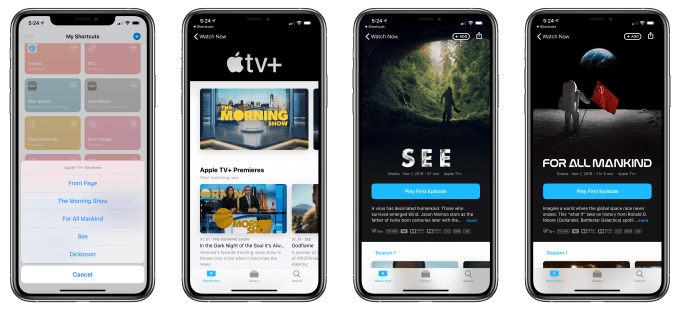
The Apple TV app is so bad, someone had to create a shortcut just to make it easier to navigate to the new Apple TV+ content. Apple may have invested billions in its Apple TV+ streaming service and hosted star-studded events to tout its new shows, but what it apparently didn’t do is give much thought to designing its TV app to help direct users to its exclusive content.

Instead, the Apple TV+ shows were mixed in with everything else at launch — forcing users to scroll past What to Watch recommendations and more from the larger iTunes catalog just to find the Apple TV+ section.

And even if and when you found that Apple TV+ section, each individual show page is poorly organized, too. Instead of following the standard format where a season’s episodes are listed in vertical order on an iPhone, Apple’s TV app opts for a horizontal scroll instead. It’s frustrating. It’s confusing. No one likes it.

Apple's TV app needs so much work. It doesn't even tell you if and when there are more episodes coming to a TV+ show. It's a mistake to not capture sentiment data (?/?) from the get-go, as in a year or two, 80 shows down the road, personalized recommendations will be essential
— Steve Troughton-Smith (@stroughtonsmith) November 4, 2019

Apple TV+ may only include a handful of shows at launch, but it still deserves its own, dedicated tab — like Apple’s very own Netflix within the larger construct of the TV app. Part of the problem, as detailed by 9to5Mac here, is that Apple’s TV app has been designed to be a jack-of-all-trades. It connects you to your iTunes library of rentals and purchases, to your add-on premium subscriptions, to your TV Everywhere-authenticated apps, and to some — but not all — of your favorite streaming services.

But the end result is an app that’s sort of a mess and one that failed to carve out a dedicated space for Apple TV+.

This problem also annoyed MacStories Editor-in-Chief Federico Viticci, who wanted an easier way to navigate directly to the Apple TV+ catalog content.

His solution? An iOS shortcut.

Viticci figured out a way to create URLs that will open any Apple TV+ section you want to get to in the TV app. Similar to how Apple Music web links can be edited to direct to content right in the Apple Music app, Apple TV+ web links can also be tweaked to launch the TV app — without redirecting you through Safari first. This is done by replacing the “https” part of the content URL with “com.apple.tv,” he explains.

With this discovery, Viticci was then able to create a shortcut that lets you go directly to any Apple TV+ page — including the “front page” for Apple TV+ or the individual show pages for shows like The Morning Show, For All Mankind, See, and Dickinson.

Apple TV+’s catalog is a bit larger than that, of course, and will continue to grow. But you can continue to edit the shortcut to meet your needs.

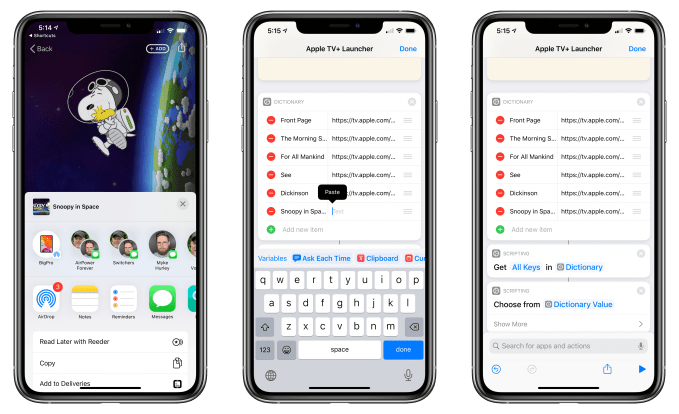
To add something new to the default list of shows, you’ll first have to locate the show in the TV+ app — good luck! You’ll then tap the “Share” button then choose “Copy” to copy the link to your clipboard. In the shortcut, you’ll add a new “Text” item to the action that’s at the beginning of the shortcut, and name it what you like. Finally, you’ll paste in the link you had copied into the “Value” field.

Ta-da! You updated the shortcut!

Or if you just want to use the iOS shortcut as is, so you can get right to Dickinson, you can add it by clicking here.

Viticci tells TechCrunch he expects to keep adding sections as well as links for more shows, as these become available. The shortcut, which is called simply “Apple TV+ Launcher,” will be updated in the MacStories Archive so people can re-download the latest version as needed, he says.

Of course, when people are building a shortcut to work around an app’s poor navigation, there’s a bigger problem that needs to be addressed.

Now, it’s possible that Apple intentionally mixed in Apple TV+ content in such a way to not make it look like it was using its platform power to give its own service a boost, in light of the recent antitrust and anticompetitive investigations into its business practices. But Apple usually doesn’t go so far as to offer a poor user experience — that’s just not in its ethos.

Besides, Apple certainly wasn’t shy about marketing the streaming service in other ways — as with the push notifications or the big Apple TV+ banner at the top of the Apple TV homescreen, for example.

Instead, this just looks like a case of needing to tweak the app’s design.

Until then, we can just use the shortcut to help.

(Image credits: MacStories)


The first hires are the hardest

Tim Hsia & Neil Devani
Contributor

Tim Hsia is the CEO of Media Mobilize and a Venture Partner at Digital Garage. Neil Devani is an angel investor and venture capitalist focused on companies solving hard problems.

Welcome to this edition of The Operators, a recurring Extra Crunch column, podcast and YouTube show that brings you insights and information from inside of tech companies. Our guests are execs with operational experience at both fast-rising startups like Brex, Calm, DocSend and Zeus Living, along with more established companies like AirBnB, Facebook, Google and Uber. Here, they share strategies and tactics for building your first company and charting your career in tech.

In this episode, we’re talking about hiring and recruiting:

  1. Why people take the risk of working at early-stage startups
  2. When and how to work with recruiters
  3. How to make your first hires

A company’s first hires are often the hardest; money is usually too tight to pay competitive salaries, there’s no recognizable brand or reputation yet and most people would prefer to work at a company their friends and family have heard of before. There’s also fair presumption of risk and unviability — who wants to take a job that might not be around in a year?

Startup founders overcome these odds on a regular basis. To figure out how, we spoke with two experts:

Farah Sharghi-Dolatabadi began her career as a software developer and financial advisor before moving into recruiting. She’s been a recruiter at startups in addition to companies like Google and Lyft. She’s currently a senior technical recruiter at Uber and an active career coach at HireClub.

Kelly Kinnard is Vice President of Talent at Battery Ventures, where she’s worked with startups like Wag, Coupa, Fastly, and Gainsight. She also has experience at top recruiting firms and in executive search at Oracle.

Below is a synthesized summary of our conversation; check out The Operators for the full episode.

Why people take the risk of working at early-stage startups

Most early-stage startups fail. That shouldn’t be news to anyone. Still, however unlikely big outcomes are, the possibility of being a part of the next Facebook or Uber is tempting, and taking a job at a brand new company may even rational on an expected value basis.

Sometimes it’s not just the chance at a big financial outcome. We’ve heard early-stage employees say they made their choice based for more intangible reasons, like having more autonomy in their work, seeking a less structured environment, working with a certain type or set of colleagues, wanting a sense of adventure or purpose and the opportunity for more rapid career progression.

It may not be possible for an early-stage startup to offer market-rate compensation, but they can personalize the opportunity for early employees.

“Be creative and do things like cater to that individual and think about it on a case by case basis,” said Kinnard. “If that candidate really wants to work from home two days a week because they have a dog and you can’t allow dogs in the office, and they want to be able to walk their dog or go pick up their child from school after school, then try to customize things according to each individual.” But don’t forget that compensation still matters, as do market rates. According to Kinnard, “cash is still king, and I think sometimes I see founders and I see CEOs be unrealistic about what they expect to be able to pay people. A part of what I do is provide them with competitive comp data so they can look at the data and [see] here’s what 3000 companies that we’ve surveyed have suggested the compensation ranges.”

Creative problem-solving pays dividends in recruiting, just like in does with most other problems startups need to solve. Experienced recruiters can help companies figure out how to get creative, but how do you know if working a recruiter is right for you?


When and how to work with recruiters