It’s yet another cautionary tale about the risks of buying internet-connected devices.
Category: Tech news
hacking,system security,protection against hackers,tech-news,gadgets,gaming
UCLA now has the first zero-emission, all-electric mobile surgical instrument lab
Electrification in the automotive industry isn’t just about consumer cars: There are plenty of commercial and specialist vehicles that are prime candidates for EVs, including in the healthcare industry. Take the new UCLA mobile surgical lab developed by Winnebago, for instance — it’s a zero-emission, all-electric vehicle that will move back and forth between two UCLA campuses, collecting, sterilizing and repairing surgical instruments for the medical staff there.
Why is that even needed? The usual process is sending out surgical instruments for this kind of service by a third-party, and it’s handled in a dedicated facility at a significant annual cost. UCLA Health Center estimates that it can save as much as $750,000 per year using the EV lab from Winnebago instead.
The traveling lab can operate for around eight hours, including round-trips between the two hospital campuses, or for a total distance traveled of between 85 and 125 miles on a single charge of its battery, depending on usage. It also offers “the same level of performance, productivity and compliance” as a lab in a fixed-location building, according to Winnebago.

Aside from annual savings on operating costs, UCLA also got some discounts toward the purchase of the lab from a few grant programs, including the Hybrid and Zero-Emission Truck and and Bus Voucher Incentive Project (an admitted mouthful, but it does have its own acronym luckily — HVIP). These programs all encourage the adoption of electric vehicles through financial incentives that help defray the upfront costs, which is yet another good reason for industries like healthcare to look at EVs as a way to not only reduce costs long term, but upfront as well.
Minecraft Earth Lands in the US—Let the Block Party Begin
The augmented-reality game isn’t just Microsoft’s most ambitious mobile title to date; it’s a play to change the way we interact with the world and each other.
The AI stack that’s changing retail personalization
Sowmiya Chocka Narayanan
Contributor
Contributor
Sowmiya Chocka Narayanan is Co-founder and CTO at Lily AI, a leading AI platform helping brands & retailers understand individual customer’s emotional context. Prior to joining Lily AI, Sowmiya helped to build Box and worked on numerous projects at Yahoo! and Pocket Games.
Consumer expectations are higher than ever as a new generation of shoppers look to shop for experiences rather than commodities. They expect instant and highly-tailored (pun intended?) customer service and recommendations across any retail channel.
To be forward-looking, brands and retailers are turning to startups in image recognition and machine learning to know, at a very deep level, what each consumer’s current context and personal preferences are and how they evolve. But while brands and retailers are sitting on enormous amounts of data, only a handful are actually leveraging it to its full potential.
To provide hyper-personalization in real time, a brand needs a deep understanding of its products and customer data. Imagine a case where a shopper is browsing the website for an edgy dress and the brand can recognize the shopper’s context and preference in other features like style, fit, occasion, color etc., then use this information implicitly while fetching similar dresses for the user.
Another situation is where the shopper searches for clothes inspired by their favorite fashion bloggers or Instagram influencers using images in place of text search. This would shorten product discovery time and help the brand build a hyper-personalized experience which the customer then rewards with loyalty.
With the sheer amount of products being sold online, shoppers primarily discover products through category or search-based navigation. However, inconsistencies in product metadata created by vendors or merchandisers lead to poor recall of products and broken search experiences. This is where image recognition and machine learning can deeply analyze enormous data sets and a vast assortment of visual features that exist in a product to automatically extract labels from the product images and improve the accuracy of search results.
Why is image recognition better than ever before?

While computer vision has been around for decades, it has recently become more powerful, thanks to the rise of deep neural networks. Traditional vision techniques laid the foundation for learning edges, corners, colors and objects from input images but it required human engineering of the features to be looked at in the images. Also, the traditional algorithms found it difficult to cope up with the changes in illumination, viewpoint, scale, image quality, etc.
Deep learning, on the other hand, takes in massive training data and more computation power and delivers the horsepower to extract features from unstructured data sets and learn without human intervention. Inspired by the biological structure of the human brain, deep learning uses neural networks to analyze patterns and find correlations in unstructured data such as images, audio, video and text. DNNs are at the heart of today’s AI resurgence as they allow more complex problems to be tackled and solved with higher accuracy and less cumbersome fine-tuning.
How much training data do you need?


A new ‘Zombieload’ flaw hits Intel’s newest Cascade Lake chips
Time to reset your “days since last major chip vulnerability” counter back to zero.
Security researchers have found another flaw in Intel processors — this time it’s a new variant of the Zombieload attack they discovered earlier this year, but targeting Intel’s latest family of chips, Cascade Lake.
Intel calls the vulnerability Transactional Asynchronous Abort, or TAA. It’s similar to the microarchitectural data sampling vulnerabilities that were the focus of earlier chip-based side-channel attacks, but TAA applies only to newer chips.
The new variant of the Zombieload attack allows hackers with physical access to a device the ability to read occasionally sensitive data stored in the processor. The vulnerability is found in how the processor tries to predict the outcome of future commands. This technique, known as speculative execution, makes the processor run faster, but its flawed design makes it possible for attackers to extract potentially sensitive data.
Zombieload was discovered by the same researchers who found Meltdown and Spectre, a set of flaws that could be used to pick out secrets — like passwords — from the processor. It was believed later chip architectures, like Cascade Lake, were toughened against speculative execution attacks, while Intel rolled out software patches to reduce the attack surface.
Neither of the other vulnerabilities in the same family as Zombieload — notably Fallout and RIDL — work on Cascade Lake, they added.
But the researchers said that Intel’s efforts to change the chip design in Cascade Lake are “not sufficient” to protect against these kinds of side-channel attacks.
The same researchers warned Intel about the vulnerability in April — as it did with the other flaws they discovered that were patched a month later. Intel took until this month to investigate, the researchers said.
Intel released patches again for its vulnerable chips on Tuesday, acknowledging that its newest chips are vulnerable to the newest Zombieload variant. But the chip making giant recognizes that the mitigations “may not completely prevent the inference of data through a side channel using these techniques.”
The chip maker said there have been “no reports” of real-world exploits of the vulnerabilities.
Intel Failed to Fix a Hackable Chip Flaw Despite a Year of Warnings
Speculative execution attacks still haunt Intel, long after researchers told the company what to fix.
Facebook wants you to pay people on Messenger, Instagram and WhatsApp with Facebook Pay
Square. Venmo. PayPal. Apple Pay. Google Pay.
There’s really no shortage of ways to give people money via your phone, but that — nor growing calls that the company is already getting too damned big — isn’t stopping Facebook.
Facebook just announced Facebook Pay, a single payment system that ties into all of the things under the FB umbrella — Messenger, Instagram, WhatsApp and, of course, Facebook proper (for sections like Marketplace). Add a payment method once, and it’ll work across any of the Facebook apps for which you enable it.
Facebook says that Pay should start rolling out this week, albeit only on Facebook/Messenger at first, and only for folks in the U.S. The company says it should work with most major credit/debit cards and PayPal, and they’re being careful to note that this is separate from its whole cryptocurrency wallet effort.
Does anyone need this? Probably not. It removes some friction from the Facebook Marketplace process and will probably find a natural user base there — but, honestly, when it comes to paying a friend back for dinner or paying for that used guitar, there’s an absolutely monstrous mountain of alternatives here.
Facebook says a bug caused its iPhone app’s inadvertent camera access
Facebook has faced a barrage of concern over an apparent bug that resulted in the social media giant’s iPhone app exposing the camera as users scroll through their feed.
A tweet over the weekend blew up after Joshua Maddux tweeted a screen recording of the Facebook app on his iPhone. He noticed that the camera would appear behind the Facebook app as he scrolled through his social media feed.
Several users had already spotted the bug earlier in the month. One person called it “a little worrying.”
Today, while watching a video on @facebook, I rotated to landscape and could see the Facebook/Instagram Story UI for a split second. When rotating back to portrait, the Story camera/UI opened entirely. A little worrying… pic.twitter.com/7lVHHGedGf
— DFC (@neo_qa) November 2, 2019
Some immediately assumed the worst — as you might expect, given the long history of security vulnerabilities, data breaches and inadvertent exposures at Facebook over the past year. Just last week, the company confirmed that some developers had improperly retained access to some Facebook user data for more than a year.
Will Strafach, chief executive at Guardian Firewall, said it looked like a “harmless but creepy looking bug.”
The bug appears to only affect iPhone users running the latest iOS 13 software, and those who have already granted the app access to the camera and microphone. It’s believed the bug relates to the “story” view in the app, which opens the camera for users to take photos.
One workaround is to simply revoke camera and microphone access to the Facebook app in their iOS settings.
Facebook vice president of integrity Guy Rosen tweeted this morning that it “sounds like a bug” and the company was investigating. Only after we published, a spokesperson confirmed to TechCrunch that the issue was in fact a bug.
“We recently discovered that version 244 of the Facebook iOS app would incorrectly launch in landscape mode,” said the spokesperson. “In fixing that issue last week in v246 — launched on November 8th — we inadvertently introduced a bug that caused the app to partially navigate to the camera screen adjacent to News Feed when users tapped on photos.”
“We have seen no evidence of photos or videos being uploaded due to this bug,” the spokesperson added. The bug fix was submitted for Apple’s approval today.
“I guess it does say something when Facebook trust has eroded so badly that it will not get the benefit of the doubt when people see such a bug,” said Strafach.
Updated with Facebook comment.
Google’s CallJoy phone agent for small businesses gets smarter, more conversational
Earlier this year, Google’s in-house incubator launched CallJoy, a virtual customer service phone agent for small businesses that could block spammers, answer calls, provide callers with basic business information and redirect to SMS other requests, like appointment booking or to-go orders. Today, CallJoy is rolling out its first major update, which now enables the computer phone agent to have more of a conversation with the customer by asking questions and providing more information, among other improvements.
Originally, CallJoy could provide customers with information like the business hours or the address, or could ask the customer for permission to send them a link over text message to help them with their request. With the update, CallJoy’s phone agent can answer questions more intelligently.
This begins by CallJoy asking the customer, “can I help you?,” which the customer then responds to, as they would usually. Their answer allows CallJoy to offer more information than before, based on what the caller said.
For example, if a caller asked a restaurant if they had any vegetarian options, the phone agent might respond: “Yes! Our menu has vegetarian and vegan-friendly choices. Can I text you the link to our online menu?”
This isn’t all done through some magical AI, however. Instead, the business owner has to program in the sort of customer inquiries it wants CallJoy to be able to respond to and handle. While some, like vegetarian options, may be common inquiries, it can be hard to remember everything that customers ask. That’s where CallJoy’s analytics could help.

The service already gathers call data — like phone numbers, audio and call transcripts — into an online dashboard for further analysis. Business owners can tag calls and run reports to get a better understanding of their call volume, peak call times and what people wanted to know. This information can be used to better staff their phone lines during busy times or to update their website or business listings, for example. And now, it can help the business owner understand what sort of inquiries it should train the CallJoy phone agent on, too.
Once trained, the agent can speak an answer, send a link to the customer’s phone with the information or offer to connect the caller to the business’ phone number to reach a real person. (CallJoy offers a virtual phone number, like Google Voice, but it can ring a “real” phone line as needed to get a person on the line.)
Another feature launching today will allow business owners to implement CallJoy as they see fit.
Some business owners may prefer to answer the phone themselves and speak to their customers directly, for example. But they could still take advantage of a service like this at other times — like after hours or when they’re too busy to answer. The updated version now allows them to program when CallJoy will answer, including by times of day, or after the phone rings a certain number of times, for example.
The business owner will also receive a daily email recap of everything CallJoy did, so they know how and when it was put to use.
The product to date has been aimed at small business owners who can’t afford the more expensive customer service phone agent systems. Instead, it’s priced at a flat $39 per month.
A spokesperson for CallJoy says the service has signed up “thousands” of small businesses since its initially invite-only launch in May 2019.
Google’s Area 120 incubator is a place for Google employees to try out new ideas, while still operating inside Google instead of leaving for a startup. It’s considered a separate entity — some of the apps produced by Area 120 don’t even mention their Google affiliation in their App Store descriptions, for instance. CallJoy, however, has received more of a spotlight than some. It has even being featured on Google’s main corporate blog, The Keyword, today. However, if CallJoy makes the leap to Google — something that hasn’t been decided yet — it wouldn’t be the first Area 120 project to do so.
Area 120’s Touring Bird recently landed inside Google, as did learn-to-code app Grasshopper and others.
We understand that joining Google is something that’s still on the table for CallJoy, but it’s not at the point of making that switch just yet.
The case against Grace Hopper Celebration
Raksha Muthukumar
Contributor
Contributor
Raksha is a software engineer at Google who is passionate about social justice and liberation through technology.
We’ve heard the criticisms that there were fewer black women speakers than white men at Grace Hopper Celebration in the past, but event organizers heard our complaints and created an entire conference pathway and new grants for “women of color from underrepresented groups and women from untapped pathways.”
We feel better now that our panels include hijabi and transgender women. The work done by women of color and others to broaden our understanding of diversity and inclusion in these spaces cannot go without recognition.
But at the end of it all, my question after a long day of panels and handshakes is, why? What are we really doing here? What ideas are we planting and fostering behind our massive paywall? Are we breaking down barriers for future generations, or simply congratulating ourselves for reaching the upper echelons of women who have vaulted them? Are we pushing to change toxic systems, or asking women to change themselves to navigate them?
Who are we benefiting and elevating with our efforts?
What we can say about the majority of corporate women is that we are currently wealthy and educated. What we can say about many corporate women in the American tech sector is that we are white or Asian-American, heterosexual, abled and a plethora of other dimensions of privileged. Through most of our women in tech events, we self-select into a space where others are educated like us, or aspire to be educated like us, and erect barriers to the tune of thousands of dollars and up to a week off from work/school. Conferences tout scholarships to offset the cost of attendance for the up and coming generation of tech women, but often times those students are required to show existing proclivities to STEM.
Extending resources to students who already have exposure to STEM biases our outreach to those with privilege already; low-income schools in California are four times less likely to offer AP computer science A courses than high-income schools, according to an independent study done by the Kapor Center. Unfortunately, it’s hard to make a case to allocate resources any other way when these events rely on corporate sponsorship and attendance and a business case must be made for return on investment (re: tech talent pipeline).
The following is a (non-comprehensive) list of recommendations for improving the way we build power as women in tech:
1. Increase economic accessibility by supporting smaller conferences
Attending a conference costs more than its ticket price, so increasing accessibility must be more comprehensive than offering scholarships. Some examples of questions to ask ourselves as organizers: will attendees with mobility needs spend more than others for their travel and lodging? Are students who receive financial aid more fearful about taking days off?
At first glance, these questions seem like they can be addressed by throwing money at the problem — more scholarships for disabled and lower-income attendees, easy! But trying to level the playing field in this manner is an exercise in futility; bringing a few lucky underprivileged people into our space does little to address the underlying hierarchy. A better way to look at it is to ask how we can make the benefits available to those of us with privilege equally accessible to those with less.
Smaller, regional events usually cost less to host and attend and spread value more widely. New speakers can practice leadership, attendees can network with professionals in their local area, and students can receive more attention and mentorship. Resources move into local communities and nonprofits instead of into recruiting pipelines for tech giants. Some examples of regional conferences targeting minorities but with more granular goals are CodeNewbies, AfroTech and Take Back Tech. These are the efforts we need to support if we want to effectively grow power in our communities that don’t already have it.
2. Focus on systemic change
If every takeaway from your event is how women can change their actions, then it might be a shallow event. Women and others are not held down because we cry at work, or because we take maternity leave, but because of how those around us perceive those things. Challenging ourselves to change our perceptions is more difficult but ultimately more valuable than stifling our authentic choices and personality to be more convenient.
It’s important to ask ourselves why we, a group of traditionally mistreated professionals, are gathering. Why are we sharing our stories of vulnerability and to what end are we building our collective strength? Marginalized people coming together helps consolidate our power so that we can change the system we’re in. It’s a form of collective action — when dozens of women want maternity leave, their employer is more inclined to provide it than when one woman asks alone. When multiple women talk to each other and realize they’ve been harassed by the same co-worker, they feel empowered to do something about it. We organize and gather so we can change injustices.
Conversations where the whole room may not agree with you can be more impactful than the ones that earn you the most laughs and nods. Challenge your audience; discomfort is where we grow. If you’re holding an event for allies, make them earn the title of ally. Catch yourself when you fall to the instinct of making everyone feel good when your goal is to make a difference.
3. Support grassroots-led change instead of corporate-lead change
Let’s not forget who the greatest winners are after a Women @ Qualcomm weekend, a Microsoft Women in Technology Event or Grace Hopper Celebration — the event organizer.
They recruit from the highly qualified pool of attendees while cultivating positive PR for valuing diversity, gaining much more overall than any one individual, though a single person may stand to gain from the opportunity. Companies have made a major push for students and employees from underrepresented groups to stay in the “tech talent pipeline.” As from any affirmative action, there are positive outcomes from that, but there are also studies that find that the pipeline has not addressed deeper issues with workplace cultures, power asymmetries, and harassment.
Put another way, companies often recruit diversity in ways that bring value to themselves without taking responsibility for the quality of life of those within the pipeline. It’s important to remind ourselves that these are not purely philanthropic goals for corporations and that recruitment and retention are to their benefit. At the very least, we’re entitled to substantive policy change in exchange for our labor.
Grassroots and community-led change is better than corporate-led change if our goal is to empower and further the opportunities for women. We must create opportunities for leadership and support efforts that truly build our strength. We should be fearless in asking for real change. By all means, do the work within the companies and within the mainstream conferences if that empowers you, but be wary of the ways that you might be keeping power in already powerful communities and keep your goals in sight. Don’t be afraid to ask why, even for things that seem to have the best of intentions. Even well-meaning systems can perpetuate harmful power dynamics if those of us within them aren’t constantly questioning and pushing back.
Where LA’s top consumer VCs are looking to invest
From a geographical perspective, the San Francisco Bay Area and Los Angeles startup ecosystems are no longer separated by a few hundred miles.
Top-tier VCs from SF visit LA regularly, and entrepreneurs raise from investors upstate and downstate in one process. Anecdotally, as an LA resident of 4 years, there’s been a palpable uptick of entrepreneurs from the Bay Area who move down here after exiting to found their next company.
The City of Angels is a hub for a wide range of startups, but it has two major groupings: consumer-facing startups that tap into Hollywood’s marketing culture, and the deep-tech ecosystem created by the city’s role as a hub for aerospace, defense and R&D.
To track how the ecosystem for software and digital media startups here is evolving, I asked a few of the top consumer VCs based there to share some of the trends they are most excited about investing in right now:
- Kevin Zhang, partner at Upfront Ventures
- Mike Palank, managing director at MaC Venture Capital
- Effie Epstein, partner at Sound Ventures
- Brett Brewer, partner at CrossCut Ventures
- Courtney Reum, partner at M13
- Ron Rofe, partner at Rainfall Ventures
- Ryan Hoover, partner at The Weekend Fund
- Dustin Rosen, partner at Wonder Ventures
- Zach White, principal at Sinai Ventures
The key takeaway is perhaps the diversity of their responses: investors here are going deep into trends across the spectrum of consumer spending. Consumer health and transportation are mentioned, as they were in my surveys of VCs in London and in New York, but this group repeatedly predicts a new wave of interactive, social media startups (albeit with different perspectives on what it looks like).
Kevin Zhang, partner at Upfront Ventures
I’m a strong believer it’s the best time to be a game developer now. Every 10 years or so distribution shakes up, now giants like MSFT, Google, Sony, Epic, etc. are rushing in to shift gamers to subscriptions and cloud gaming, which means big exclusive content library building with lots of “non-dilutive” capital for developers. Games themselves are becoming bigger, cross-platform, cheaper to build and more accessible than ever thanks to advancement in game engine and networking tech. Related: there’s a new generation of mobile entertainment brewing at the intersection of short-form video, live, audience participation and social play; it’s marrying what’s worked with UGC and live video with in-app-purchases and retention tactics of casual games to create more accessible and bite-sized entertainment destinations.
Mike Palank, managing director at MaC Venture Capital
While it used to be that great content alone made for a compelling entertainment experience, as we move into the future it will be the blending of great content and amazing tech that will truly capture and retain people’s attention. We’ve seen those funny Youtube videos of babies swiping pictures in physical magazines showcasing their expectations that everything is interactive. I think in much the same way, expectations around filmed media (movies + TV) will trend towards the interactive. We are seeing some truly interesting experimentation around interactive right now from companies like Netflix, Unrd, Eko, CtrlMovie, Playdeo, Hovercast, Aether, Within, Twitch and others.
The winners of the streaming wars understand this and I believe will supplement their content slates with interesting technology to make the viewing experience unique and participatory (Quibi has already announced some examples of this). At MaC, we are looking for those innovative companies that are re-thinking how consumers experience filmed entertainment to make it more experiential, interactive and engaging.
Effie Epstein, partner at Sound Ventures
At Sound, we believe that investors have an enormous responsibility to help shape the future we all want to see. To that end, we’ve been seeing a lot of promising innovation emerge around financial inclusion and digital healthcare. For example, Divvy Homes is a company that is making home ownership a possibility for the millions of Americans who struggle to afford a down payment, and Affirm is giving consumers a fair alternative to credit cards in an age where Americans are more in debt than ever. Meanwhile, TruePill is making it easier and more affordable for end consumers to access medication by changing the way medicine gets delivered, and Alma is making mental healthcare easier for consumers as well as for practitioners.
Pan-African e-tailer Jumia grows 3Q revenue, e-payments and losses
Pan-African e-commerce startup Jumia released its third-quarter financial results today.
The numbers and presentation reflected some of the same past trends, with a dash of new, and nary a mention of a declining share price.
The results
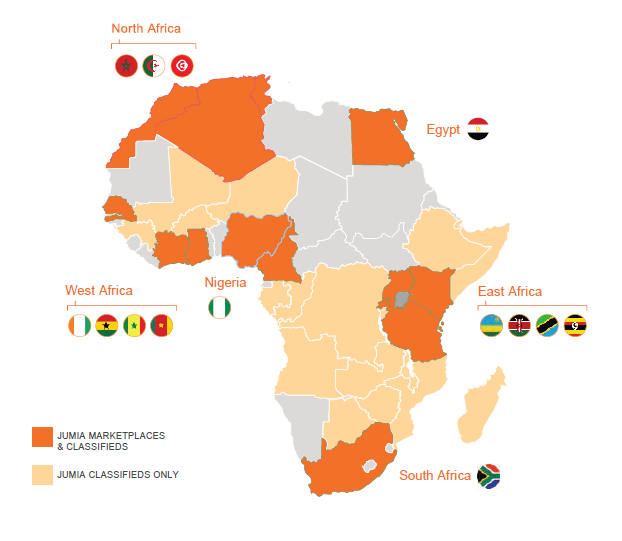
Jumia — with online goods and service verticals in 14 countries — posted third-quarter revenue growth of 19% (€40 million) and increased its active customer base 56% to 5.5 million from 3.5 million over the same period a year ago.
Jumia’s Gross Merchandise Value (GMV) — the total amount of goods sold over the period — grew by 39% to €275 million. The online retailer nearly doubled its orders from 3.6 million in Q3 2018 to 7 million in Q3 2019.
Jumia also saw growth in its JumiaPay digital finance product, with total payment volume growing 95% to €32 million in Q3 2019 from €16.4 million in Q3 2018.
This is significant, as the company has committed to generate more revenues from digital payment products and offer JumiaPay as a standalone service across Africa.
The overall pattern of growing revenues and customers YoY has been consistent for Jumia.
But so too have the company’s losses, which widened 34% in 3Q 2019 to €54.6 million, compared to €40.6 million. Negative EBITDA increased 26% to €45.4 million from €35.8 over the same period in 2018.
Jumia pegged a large part of the spike in losses to an increase in fulfillment expenses due to more cross-border goods transactions (with higher shipping costs) on its platform in 3Q 2019.
What’s new
Jumia introduced some new methodologies and measures for its results. “We believe the most relevant monetization metrics for us are market-based revenue and gross profit,” Jumia Group CFO Antoine Maillet-Mezeray explained on the call.
“We don’t see revenue as a meaningful metric to assess the monetization of our business as it is impacted by shifts in the revenue mix between first party and marketplace,” he said.
If and when Jumia does get into the black, I suspect revenue will shift back as key.
On its path to profitability, Jumia CEO Sacha Poignonnec reaffirmed the company’s commitment to generate more revenue from higher margin (straight through) products, such as JumiaPay and Jumia’s classified business, over cost-intensive (and logistically complicated) online goods sales.
“We are focused on driving the adoption and penetration of Jumia pay within our own ecosystem,” he said — meaning across Jumia’s existing buyer-seller universe.
Since its founding in 2012, the company has been forced to adapt to slower digital payments integration in its core Nigeria and allow cash-on-delivery payments, which are costly and more problematic than digital processing.
Poignonnec highlighted Jumia’s commitment to build a financial services marketplace (and revenues) from consumers and partners using JumiaPay and JumiaLending for products such as loans, third-party credit-scoring and insurance, he explained. This has led to Jumia moving into working-capital services for vendors on its platform.
On the movement of online goods, Jumia highlighted the expansion of its JumiaMall service, which offers brands — such as L’Oreal, Samsung and Unliver — more tailored selling options on its website around shipping, product positioning and consumer data analytics.
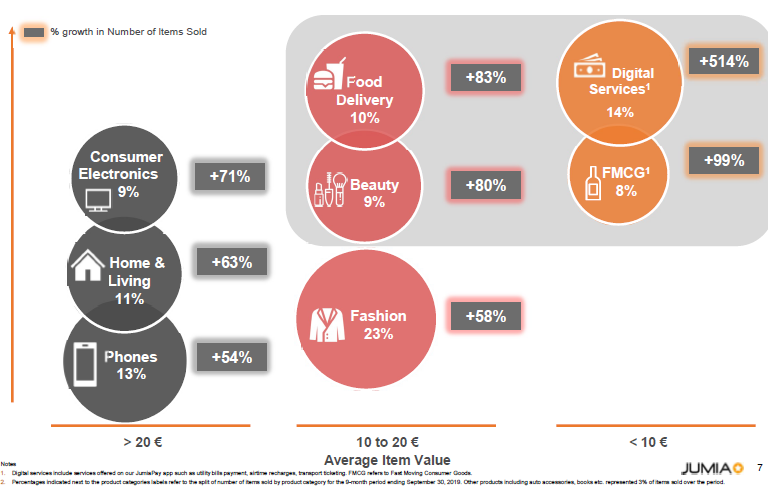
Jumia also shared info on product mix and diversification, which showed strong upward trends in digital services, the sale of consumer electronics and beauty products.
Share price
Surprisingly absent from Jumia’s earnings call and the subsequent Q&A was any discussion of the company’s share price.
Today’s reporting was slightly more anticipated, given Jumia has faced a short-seller assault, sales scandal and significant market-cap drop since its April IPO on the NYSE.
The online retailer gained investor confidence out of the gate, more than doubling its $14.50 opening share price after the IPO.
That lasted until May, when Jumia’s stock came under attack from short-seller Andrew Left, whose firm Citron Research issued a report accusing the company of fraud. That prompted several securities-related lawsuits against Jumia.
 The company’s share price plummeted 43% — from $49 to $26 — the week Left released his short-sell claims.
Then on its second-quarter earnings call in August, Jumia offered greater detail on the fraud perpetrated by some employees and agents of its JForce sales program.
The company declared the matter closed, but Jumia’s stock price plummeted more after the August earnings call (and sales-fraud disclosure), and has lingered in the $6 range for weeks.
That’s 50% below the company’s IPO opening in April and 80% below its high.
Jumia can offer new metrics to evaluate its performance, but the simplest measure — the ability to generate revenues in excess of costs to turn a profit — will still apply.
The sooner Jumia can go in that direction the faster it can revive its share price and investor confidence.
Formlabs is making a 3D printer just for dentists
Back at CES this year, we talked with 3D-printer maker Formlabs about its early experimentation in using its printers to make dentures faster and more affordably than existing alternatives.
A few months later, the company is going deep on the concept. They’re releasing a 3D printer meant specifically for dental use, opening up a whole new wing called “Formlabs Dental” and acquiring their main resin supplier in order to better make materials for the dental industry.
Unfamiliar with Formlabs? The main thing to know is that their printers use Stereolithography (SLA) rather than the Fused Deposition Modeling (or FDM) that most people probably think of when it comes to 3D printing; in other words, they use carefully aimed UV lasers to precisely harden an otherwise goopy resin into whatever you want to print, whereas FDM printers heat up a solid material until it’s malleable and then push it through a hot glue gun-style nozzle to build a model layer by layer. SLA tends to offer higher accuracy and resolution, whereas FDM tends to be cheaper and offer a wider variety of colors and material properties.
Formlabs calls its new dentistry-centric printer the “Form 3b” — which, as the name suggests, is a slight variation on the Form 3 printer the company introduced earlier this year. The base package costs about a thousand bucks more per unit over the non-dental Form 3, but comes with software meant to tie into a dental team’s existing workflow, along with a year of Formlab’s “Dental Service Plan,” which includes training, support and the ability to request a new printer if something needs repairing (rather than waiting for yours to get shipped back and forth). The company also says the 3b has been optimized to work with its dental resins, but doesn’t say much about how.

Speaking of resins: Formlabs is acquiring Spectra, which has been its primary supplier of resins since Formlabs started back in 2012. While the company isn’t disclosing any of the terms of the deal, it does say it has put over a million dollars into building an FDA-registered clean room to make medical-grade resins. Formlabs says that anyone who already buys materials and resin from Spectra can continue to do so.
The company’s new “Formlabs Dental” division, meanwhile, will focus on figuring out new dental materials and ways to better tie in to existing dentist office workflows. Right now, the company says, the Form 3b can be used to print crowns and bridges, clear retainers, surgical guides to help during dental implant procedures, custom mouth guards (or “occlusal splints”) and dentures.
Work collaboration startup Notion cozies up to Silicon Valley’s top accelerators
Startups building work software for other startups have been a huge focus of investment in Silicon Valley as eager VCs hope to grab a piece of the next Slack. Notion Labs, a profitable work tools startup that recently hit a reported $800 million valuation, isn’t making it easy for VC firms to give them money, but they are partnering with some of them alongside top accelerators like Y Combinator in an effort to become another household name in work software.
Notion has north of 1 million users and has attracted thousands of young startups to its platform, which combines notes, wikis and databases into a versatile tool that can help small teams cut down on the number of enterprise software subscriptions they’re paying for. Notion charges startups $8 per employee (when billed annually) to use the service.
Over half of the startups from Y Combinator’s most recent batch are Notion customers, the company tells TechCrunch, and the startup seems intent to accelerate their adoption among small teams. They have approached and partnered with dozens of accelerators around the globe including Y Combinator, 500 Startups and TechStars to bring their portfolio startups onto Notion’s platform, offering admitted startups $1,000 in free services each.
The new program is part of the company’s efforts to embed their platform as an “operating system” for startups early-on and then scale as their customers do.
“I think we find ourselves in a really interesting spot where I think YC startups know about us and start with it,” COO Akshay Kothari says. “Our goal with the new program is getting to the point where if you’re a new company, you don’t even think about it, you just start with Notion.”

Notion COO Akshay Kothari
Kothari says their platform seems to work best for startups in the sub-50 and sub-100 employee range, but they do have larger customers like UK banking startup Monzo which has organized their 1,300+ employees around the platform. Notion itself is unsurprisingly a power user of its product, running everything but internal and external communications on its own software.
The company offers a couple pricing tiers depending on size, but individuals can also use the software for $5 per month, something that Kothari believes offers it advantages over other tools in driving adoption inside companies. “There are a lot of similarities between us and the early stages of Slack in terms of engineering and product design people loving it, tech and media loving it, but one unique thing about us is that you can use Notion alone. Slack alone would be a bit lonely.”
The company is pitching customers a vision of consolidated workplace services that are built so end-users can customize them to their needs. Notion’s pitch contrasts pretty heavily with the overarching enterprise SaaS trends which has seen a wealth of specialized software tools hitting the market.
Notion is working on tools to help it court larger enterprise customers as well, including offline access, better permission systems and an API that can help developers connect their services to the platform. Notion has been iterating its product rather quickly for a company that has 9 engineers and no PMs, but Kothari says that they don’t believe piling more money or doubling employees is going to be the key to scaling more quickly.
“We definitely want to create a large company, a company that could eventually go public or whatever is the right — you know it’s too early for a lot of that stuff. Our preference is to stay small,” he says. “[Notion] doesn’t have a board, it doesn’t have a whole lot of external voices, pretty much everyone in this office decides what we’re doing next.”
Notion has raised millions in funding from investors like First Round Capital, Ron and Ronny Conway, Elad Gill and most recently Daniel Gross. The Information‘s Amir Efrati reported earlier this year that Notion had raised a $10 million “angel round” at an $800 million valuation. The round was less about raising more cash than it was about closing convertible notes, Kothari tells TechCrunch, noting that Notion has been profitable for the last 12-18 months.
“I guess we were profitable before profitability became cool. I think profitability helps you to control destiny a lot better because you’re not out fundraising every year or 18 months,” Kothari says. “Interestingly now, I think it’s cool to be profitable again. When I joined Notion I would tell VCs or investors ‘Oh, we’re profitable,’ and they would be like ‘Oh, so you’re building a lifestyle company.’”
Kothari himself was an investor that dumped money into Notion founders Ivan Zhao and Simon Last’s idea to create a platform that would help non-engineers build software. That was 6 years ago after Kothari sold his previous startup to LinkedIn, he joined about a year ago as COO.
Some VCs may have been skeptical early-on, but the story of Notion over the past year has been VCs fighting to score a spot on their cap table. In January, The New York Times‘s Erin Griffith reported that VCs had “dug up Notion’s office address and sent its founders cookie dough, dog treats and physical letters” to court their interest. The unrequited VC yearning has earned Notion the reputation for being venture averse, something Kothari pushed back on a few times.
“So, again, for the record, we don’t hate venture capitalists.”
The Science Is Extremely Clear: You Need to Prioritize Sleep
The more scientists learn about the slumbering brain, the more they realize how vital sleep actually is. Now some researchers hope to develop it into a form of medicine.