Takeaways from Nvidia’s latest quarterly earnings

Nvidia has been on a wild growth ride the past five years. Surfing a wave around AI deep learning and cryptocurrency where its specialized chip architecture is among the highest performing, the company’s share price rose from the low $20s in late 2014 to eventually soar to almost $300 in September 2018. And then crypto winter set in, and within weeks the company’s market cap was sliced nearly in half as crypto miners canceled their orders and inventories at Nvidia started building up a glut of chips.

Since that nadir in late 2018, the company has mostly been on the upswing as it has pushed expansion into a variety of other verticals like automotive, most notably by announcing the purchase of Israeli chip maker Mellanox for $6.9 billion in an all cash deal.

So with its latest earnings announcement coming after the bell yesterday, the big questions were how it was continuing to navigate chip inventories, and whether its transaction with Mellanox would close. The company ultimately presented a bit of a mixed bag, and Wall Street seems to have barely budged on the stock price as we all wait resolution on some of the key questions facing the company.

Before we dive into the analysis, first the high level numbers for Q3, which ended on October 27: top-line revenues declined slightly to just above $3 billion, from roughly $3.2 billion in the year ago quarter. Gross profits were flat from a year ago, but net income was down 27% to $899 million, mostly due to higher R&D costs and lower income from operations. Earnings per share was $1.47, down from $2.02 a year ago.

Now though, there were some more interesting takeaways from the results beyond the sort of lukewarm numbers emanating off the income statements.

China trade war still affecting Nvidia through Mellanox

Web Summit cancels next year’s Rise conference over tension in Hong Kong

The ongoing tension in Hong Kong between the government and pro-democracy protesters continues to spill into the tech domain.

Rise, which is among the largest tech conferences in Asia, will not run next year as planned due to “the ongoing situation in Hong Kong,” according to Web Summit, the Ireland-based company that organizes the show.

The organizer said it is postponing the sixth edition of its annual conference, which is held in Hong Kong, to March 2021 from March 2020. Web Summit, which hosts similar large-scale conferences in other parts of the world, made the announcement today in an email to previous attendees. A spokesperson confirmed the veracity of the email to TechCrunch.

“Over recent months, we have been monitoring the ongoing situation in Hong Kong. Our number one concern is the wellbeing, safety, and security of attendees at our events,” it said in a statement.

“Given the uncertainty of the situation by early 2020 and after consulting with experts and advisories, we have decided to postpone RISE until 2021.”

In recent years, Rise has emerged as one of the largest tech conferences in Asia. Some of its recent speakers have included top executives of Uber, Byju’s, Grab, Gojek, Razor and Stripe, as well as many key partners from top VC funds and officials from several governments.

This year, the conference attracted more than 16,000 attendees ranging from the “world’s leading founders, Fortune 500 CEOs, investors, media, and the most promising startups from over 100 countries,” according to official figures provided by Rise.

Web Summit’s announcement today comes hours after Clockenflap, the biggest music festival in Hong Kong, was cancelled citing the same reason. American singer-songwriter Halsey, rapper Lil Pump, British band Mumford & Sons and Japanese headbangers Babymetal were set to play at the festival. Several more events have been postponed or cancelled in recent weeks.

Rita Liao contributed to this report.

WeWork gives 0 forks, and Docker containerizes its future into a casket

Hello and welcome back to Equity, TechCrunch’s venture capital-focused podcast, where we unpack the numbers behind the headlines.

This week Kate was in China, so TechCrunch’s Danny Crichton and Alex took the helm while she was out grilling Lime. So, with our producer (the excellent Mr. Gates) in San Francisco and Danny in New York and Alex in the provinces, we got into the following to start:

Pivoting into the biggest news from the week, 1Password raised a comically large $200 million Series A round of funding. The firm quite obviously hadn’t raised much capital before, but had grown to be quite large. Hence the large check. Recall that Series A really means a company’s first institutional round, not a specific dollar range.

Next we discussed DoorDash and its possible $100 million add-on to its $600 million round from earlier this year. The new capital should keep the on-demand technology company’s valuation pegged just above where it was set during its preceding round. So, a down round this is not.

Meanwhile, Docker received a $35 million investment from Benchmark and sold much of its business to Marantis, which has all the appearances of a recap for the formerly high-flying unicorn.

What else? Juul is laying off staff, WeWork is still losing an ocean of dollars and Line is partnering up with Yahoo Japan.

Equity drops every Friday at 6:00 am PT, so subscribe to us on Apple PodcastsOvercastSpotify and all the casts.

Despite bans, Giphy still hosts self-harm, hate speech and child sex abuse content

Image search engine Giphy bills itself as providing a “fun and safe way” to search and create animated GIFs. But despite its ban on illicit content, the site is littered with self-harm and child sex abuse imagery, TechCrunch has learned.

A new report from Israeli online child protection startup L1ght — previously AntiToxin Technologies — has uncovered a host of toxic content hiding within the popular GIF-sharing community, including illegal child abuse content, depictions of rape and other toxic imagery associated with topics like white supremacy and hate speech. The report, shared exclusively with TechCrunch, also showed content encouraging viewers into unhealthy weight loss and glamorizing eating disorders.

TechCrunch verified some of the company’s findings by searching the site using certain keywords. (We did not search for terms that may have returned child sex abuse content, as doing so would be illegal.) Although Giphy blocks many hashtags and search terms from returning results, search engines like Google and Bing still cache images with certain keywords.

When we tested using several words associated with illicit content, Giphy sometimes showed content from its own results. When it didn’t return any banned materials, search engines often returned a stream of would-be banned results.

L1ght develops advanced solutions to combat online toxicity. Through its tests, one search of illicit material returned 195 pictures on the first search page alone. L1ght’s team then followed tags from one item to the next, uncovering networks of illegal or toxic content along the way. The tags themselves were often innocuous in order to help users escape detection, but they served as a gateway to the toxic material.
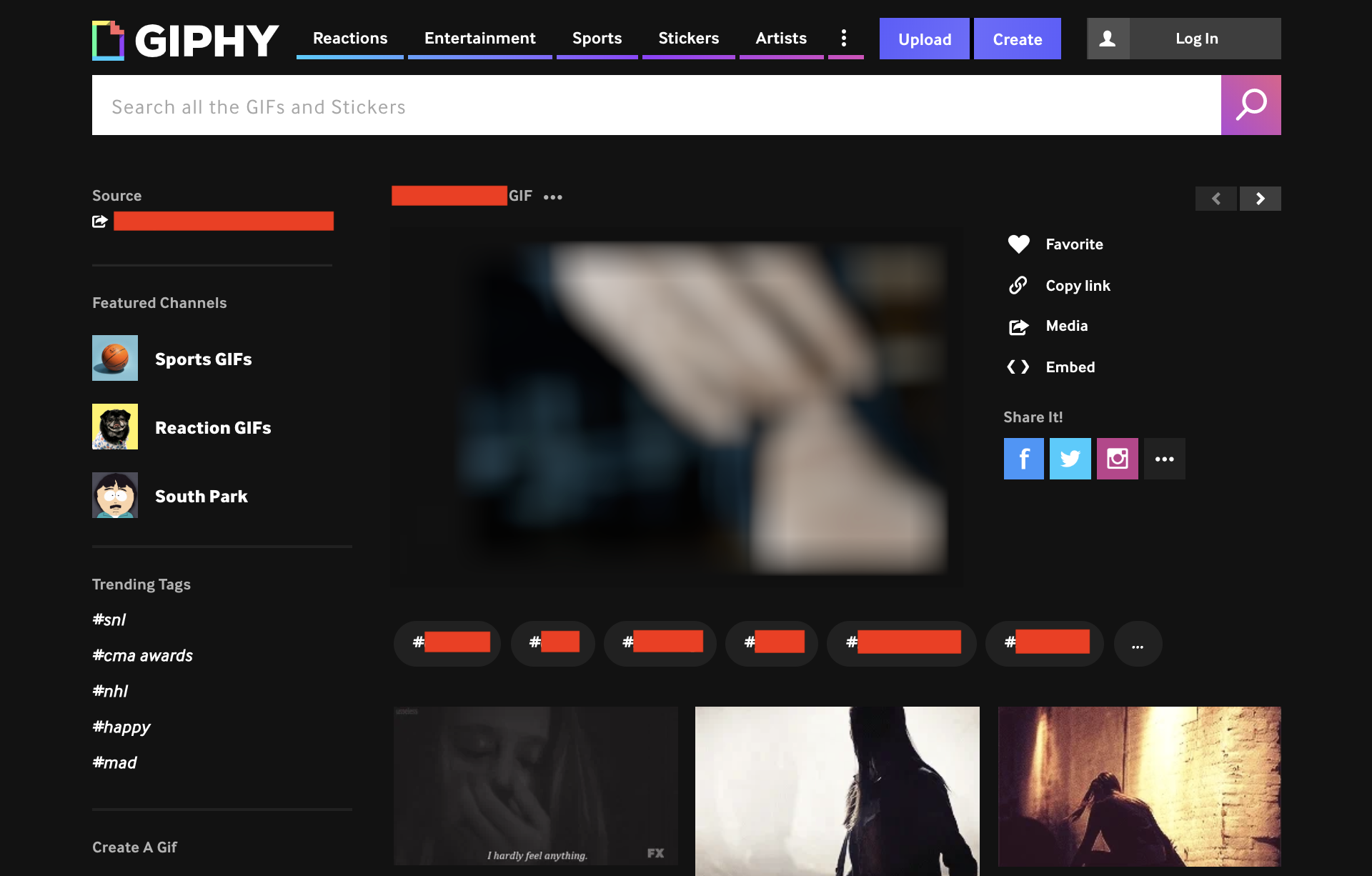
Despite a ban on self-harm content, researchers found numerous keywords and search terms to find the banned content. We have blurred this graphic image. (Image: TechCrunch)

Many of the more extreme content — including images of child sex abuse — are said to have been tagged using keywords associated with known child exploitation sites.

We are not publishing the hashtags, search terms or sites used to access the content, but we passed on the information to the National Center for Missing and Exploited Children, a national nonprofit established by Congress to fight child exploitation.

Simon Gibson, Giphy’s head of audience, told TechCrunch that content safety was of the “utmost importance” to the company and that it employs “extensive moderation protocols.” He said that when illegal content is identified, the company works with the authorities to report and remove it.

He also expressed frustration that L1ght had not contacted Giphy with the allegations first. L1ght said that Giphy is already aware of its content moderation problems.

Gibson said Giphy’s moderation system “leverages a combination of imaging technologies and human validation,” which involves users having to “apply for verification in order for their content to appear in our searchable index.” Content is “then reviewed by a crowdsourced group of human moderators,” he said. “If a consensus for rating among moderators is not met, or if there is low confidence in the moderator’s decision, the content is escalated to Giphy’s internal trust and safety team for additional review,” he said.

“Giphy also conducts proactive keyword searches, within and outside of our search index, in order to find and remove content that is against our policies,” said Gibson.

L1ght researchers used their proprietary artificial intelligence engine to uncover illegal and other offensive content. Using that platform, the researchers can find other related content, allowing them to find vast caches of illegal or banned content that would otherwise and for the most part go unseen.

This sort of toxic content plagues online platforms, but algorithms only play a part. More tech companies are finding human moderation is critical to keeping their sites clean. But much of the focus to date has been on the larger players in the space, like Facebook, Instagram, YouTube and Twitter.

Facebook, for example, has been routinely criticized for outsourcing moderation to teams of lowly paid contractors who often struggle to cope with the sorts of things they have to watch, even experiencing post-traumatic stress-like symptoms as a result of their work. Meanwhile, Google’s YouTube this year was found to have become a haven for online sex abuse rings, where criminals had used the comments section to guide one another to other videos to watch while making predatory remarks.

Giphy and other smaller platforms have largely stayed out of the limelight, during the past several years. But L1ght’s new findings indicate that no platform is immune to these sorts of problems.

L1ght says the Giphy users sharing this sort of content would make their accounts private so they wouldn’t be easily searchable by outsiders or the company itself. But even in the case of private accounts, the abusive content was being indexed by some search engines, like Google, Bing and Yandex, which made it easy to find. The firm also discovered that pedophiles were using Giphy as the means of spreading their materials online, including communicating with each other and exchanging materials. And they weren’t just using Giphy’s tagging system to communicate — they were also using more advanced techniques like tags placed on images through text overlays.

This same process was utilized in other communities, including those associated with white supremacy, bullying, child abuse and more.

This isn’t the first time Giphy has faced criticism for content on its site. Last year a report by The Verge described the company’s struggles to fend off illegal and banned content. Last year the company was booted from Instagram for letting through racist content.

Giphy is far from alone, but it is the latest example of companies not getting it right. Earlier this year and following a tip, TechCrunch commissioned then-AntiToxin to investigate the child sex abuse imagery problem on Microsoft’s search engine Bing. Under close supervision by the Israeli authorities, the company found dozens of illegal images in the results from searching certain keywords. When The New York Times followed up on TechCrunch’s report last week, its reporters found Bing had done little in the months that had passed to prevent child sex abuse content appearing in its search results.

It was a damning rebuke on the company’s efforts to combat child abuse in its search results, despite pioneering its PhotoDNA photo detection tool, which the software giant built a decade ago to identify illegal images based off a huge database of hashes of known child abuse content.

Giphy’s Gibson said the company was “recently approved” to use Microsoft’s PhotoDNA but did not say if it was currently in use.

Where some of the richest, largest and most-resourced tech companies are failing to preemptively limit their platforms’ exposure to illegal content, startups are filling in the content moderation gaps.

L1ght, which has a commercial interest in this space, was founded a year ago to help combat online predators, bullying, hate speech, scams and more.

The company was started by former Amobee chief executive Zohar Levkovitz and cybersecurity expert Ron Porat, previously the founder of ad-blocker Shine, after Porat’s own son experienced online abuse in the online game Minecraft. The company realized the problem with these platforms was something that had outgrown users’ own ability to protect themselves, and that technology needed to come to their aid.

L1ght’s business involves deploying its technology in similar ways as it has done here with Giphy — in order to identify, analyze and predict online toxicity with near real-time accuracy.

Ford’s Mustang Mach-E all-electric SUV revealed in leaked photos, prices and configurations

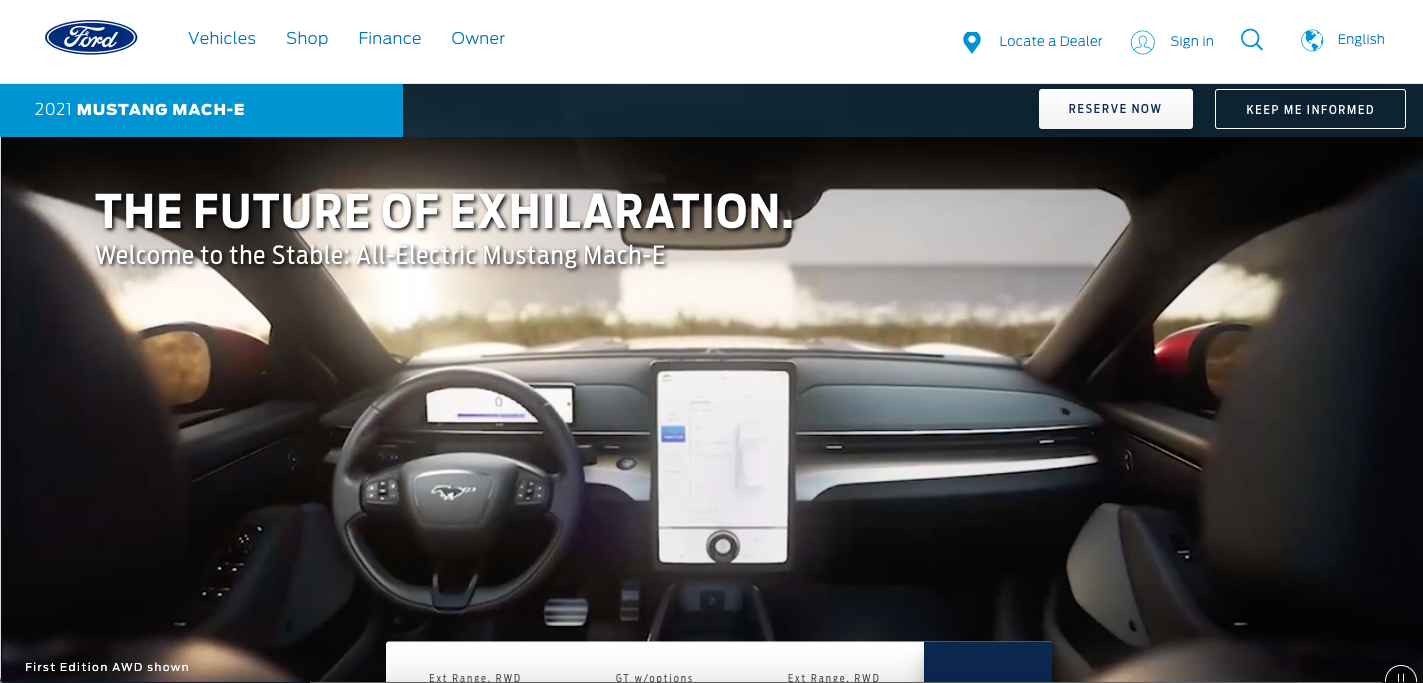
Ford is officially debuting its fully electric crossover SUV on Sunday, November 17 — but we got a look at the new Mach-E (which was just officially named yesterday) a couple of days early. The leak comes from Ford’s own website, as screenshotted for posterity by Jalopnick, and includes photos of most angles of the car, including the interior, as well as pricing and configuration details for the model variants available at launch.

The Mach-E will start at $43,895 U.S., before any state or tax incentives are applied (and that turns into $36,395 once you apply the maximum $7,500 federal tax credit). The “Select” trim Mach-E as configured at that price gets you 230 EPA-rated miles of range, either AWD or RWD (which presumably alters the price) and a 0-60MPH time in the mid five-second range.

Next up is the “Premium” trim starting at $50,600, again offering an AWD or RWD option, with 300 miles of estimated EPA-rated range, and that same mid five-second 0-60MPH time. The “California Route 1” model above that comes in only AWD, has that longer 300 miles of EPA range and promises a mid six-second 0-60MPH time. It’s a bit slower off the jump, but it’s “named for its cruise-worthy engineering,” so presumably it’s got a more luxe interior for long-distance highway scenic drives.

Next up is a $59,900 “First Edition,” which will be in limited availability and only at launch for the first batch of customers to reserve. It’s got AWD, a range of around 270 miles, a mid five-second 0-60MPH time and exclusive exterior color options, special scuff plates, brushed aluminum pedals and red brake callipers, as well as contrast-colored interior stitching. There’s a GT edition at the top end, with an MSRP starting at $60,500, that will manage to get a 0-60MPH time in the mid three-second range, so that’s clearly the peak performance options for thrill-seekers. Estimated EPA range on that one is around 230 miles.

In terms of looks, the Mustang Mach-E’s design won’t be a surprise to anyone who’s seen the camouflaged spy shots, or the teaser peeks officially released by Ford. It’s definitely got Mustang vibes, and looks a bit like a Mustang that has been lifted up with paneling extended down toward the road. It looks like a panorama roof is an option, and that hatchback will probably please a lot of small SUV fans. There’s also something funky going on with the door handles — the front ones appear very small and near the base of the door windows, while I’m not sure how exactly it works on the rear passenger doors based on these photos.

There’s also a panoramic sunroof at least as an option, and you can see the interior looks pretty blatantly Tesla -inspired, with a large vertical touchscreen taking up most of the center of the dash — albeit with something that looks like a large physical dial right at the base, instead of going for fully touch-only input. A second digital display appears to replace the instrument cluster behind the steering wheel.

Ford has since taken this down, as it’s hosting a splashy event on Sunday with Idris Elba in LA for the full official reveal. TechCrunch will be on site to bring you more photos and details around availability, customization options and more on the day.

Chinese EV startup Xpeng Motors raises $400 million, takes on Xiaomi as strategic investor

Xpeng Motors, the Chinese electric vehicle startup backed by Alibaba and Foxconn, has raised a fresh injection of $400 million in capital and has taken on Xiaomi as a strategic investor, the company announced.

The Series C includes an unidentified group of strategic and institutional investors. XPeng Motors Chairman and CEO He Xiaopeng, who also participated in the Series C, said the received strong support from many of its current shareholders. Xiaomi founder and CEO Lei Jun previously invested in the company.

“Xiaomi Corporation and Xpeng Motors have achieved significant progress through in-depth collaboration in developing technologies connecting smart phones and smart cars,” Xiaomi’s Jun said in a statement. “We believe that this strategic investment will further deepen our partnership with Xpeng in advancing innovation for intelligent hardware and the Internet of Things.”

The company didn’t disclose what its post-money valuation is now. However, a source familiar with the deal said it is “better” than the 25 billion yuan valuation it had in its last round in August 2018.

The announcement confirms an earlier report from Reuters that cited anonymous sources.

XPeng also said it has garnered “several billions” in Chinese yuan of unsecured credit lines from institutions such as China Merchants Bank, China CITIC Bank and HSBC. XPeng didn’t elaborate when asked what “several billions” means.

Brian Gu, Xpeng Motors Vice Chairman and President added that the company has been able to hit most of its business and financing targets despite economic headwinds, uncertainties in the global markets and government policy changes that have had direct impact on overall auto sales in China.

The round comes as XPeng prepares to launch its electric P7 sedan in spring 2020. Deliveries of the P7 are expected to begin in the second quarter of 2020.

Xpeng began deliveries of its first production model the G3 2019 SUV in December and shipped 10,000 models by mid-June. The company has since released an enhanced version of the G3 with a 520 km NEDC driving range.

The company plans to launch the P7 sedan in the spring 2020 and will start delivery in 2Q 2020.

XPeng has said it wants to IPO, but it’s unclear when the company might file to become a public company. No specific IPO timetable has been set and a spokesperson said the company is monitoring market conditions closely, but its current focus is on building core businesses.

Minecraft Earth is live, so get tapping

Microsoft’s big experiment in real-world augmented reality gaming, Minecraft Earth, is live now for players in North America, the U.K. and a number of other areas. The pocket-size AR game lets you collect blocks and critters wherever you go, undertake little adventures with friends and, of course, build sweet castles.

I played an early version of Minecraft Earth earlier this year, and found it entertaining and the AR aspect surprisingly seamless. The gameplay many were first introduced to in Pokémon GO is adapted here in a more creative and collaborative way.

You still walk around your neighborhood, rendered in this case charmingly like a Minecraft world, and tap little icons that pop up around your character. These may be blocks you can use to build, animals you can collect or events like combat encounters that you can do alone or with friends for rewards.

Ultimately all this is in service of building stuff, which you do on “build plates” of various sizes. These you place in AR mode on a flat surface, which they lock onto, letting you move around freely to edit and play with them. This sounded like it could be fussy or buggy when I first heard about it, but actually doing it was smooth and easy. It’s easy to “zoom in” to edit a structure by just moving your phone closer, and multiple people can play with the same blocks and plate at the same time.

Once you’ve put together something fun, you can take it to an outdoor location and have it represented at essentially “real” size, so you can walk around the interior of your castle or dungeon. Of course, you can’t climb steps, because they’re not real, but the other aspects work as expected: you can manipulate doors and other items, breed cave chickens and generally enjoy yourself.

The game is definitely more open-ended than the collection-focused Pokémon GO and Harry Potter: Wizards Unite. Whether that proves to be to its benefit or detriment when it comes to appeal and lasting power remains to be seen — but one thing is for sure: People love Minecraft and they’re going to want to at least try this out.

And now they can, if they’re in one of the following countries — with others coming throughout the holiday season:

  • United States
  • United Kingdom
  • Canada
  • South Korea
  • Philippines
  • Sweden
  • Mexico
  • Australia
  • New Zealand
  • Iceland

You can download Minecraft Earth for iOS here and for Android here.


Twitch publicly launches its free broadcasting software, Twitch Studio

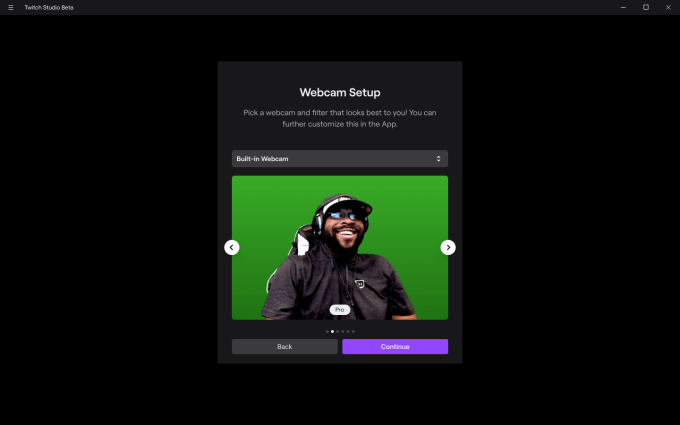
Twitch today publicly launched Twitch Studio, its new software designed to help new streamers get started broadcasting. The idea behind the app is to make it simple for someone new to the space to get started, by offering a quick setup process and other tools to make the stream both look and sound more professional — even if the streamer doesn’t have broadcasting experience.

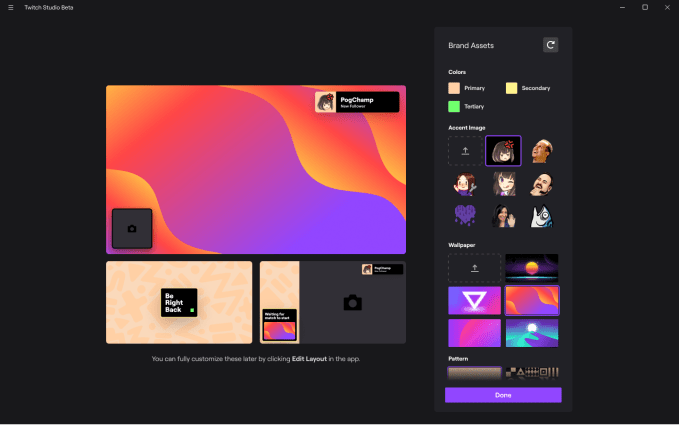
The software, which was only available in closed beta until today, will detect the user’s mic, webcam, monitor resolution, bitrate and more through a guided setup process. Streamers can then choose from a variety of starter layouts and overlays that will help them personalize their stream’s look-and-feel.

Once live on Twitch, the software will also help streamers interact with the online community and viewers, including by way of built-in alerts, an activity feed and integrated Twitch chat.

As the company previously explained, many people have thought about streaming but gave up on doing so because the process was too difficult. The new software aims to get them over that hurdle of setting up a stream for the first time.

As the streamer becomes more knowledgable and capable, they may outgrow their need for Twitch Studio — and that would be fine. The goal is to get them involved with Twitch streaming in the first place, not necessarily keep them on the platform longer-term.

Twitch Studio is currently available only on Windows PCs, not Mac, iOS or Android “at this time,” Twitch says — a hint that cross-platform support could come further down the road. However, in the near-term, Twitch is working to better integrate the software with other Twitch functionality, as well as roll out tools that make it easier to chat and engage viewers.

The launch timing is notable as Twitch has recently lost its biggest streamer, Tyler “Ninja” Blevins, to Microsoft’s Mixer. The loss was then followed by the exit of Michael “Shroud” Grzesiek, also to Mixer. Meanwhile, Google’s Stadia, which is about to launch on November 19, will make it easy to stream directly to YouTube. 

Twitch says the new Twitch Studio software is available today, in beta, for anyone on Windows 7 or newer.

HBO’s former CEO said to be in talks with Apple TV+ for an exclusive production deal

The man who oversaw the creation of some of HBO’s most highly praised “prestige TV” could soon be making shows for Apple TV+, according to a new report from The Wall Street Journal. Richard Plepler, who was HBO’s chairman and CEO up until he parted ways with the company last February following its acquisition by AT&T, is nearing an exclusive production deal with Apple’s new original content streaming service, the report says.

Plepler, who spent almost 30 years at HBO, including six as its CEO during which the media company aired some of its biggest hits, including “Game of Thrones,” would definitely bring some big-name industry influence to Apple’s efforts. Not that Apple TV+ lacks for that in its early offing, either: The premiere slate of original shows include Jennifer Aniston and Reese Witherspoon-led “The Morning Show,” and a show centerd around Oprah’s Book Club, just to name a couple of examples.

The deal, which isn’t yet final but might be signed officially “within the next few weeks,” per the report, would be between Apple and Plepler’s RLP & Co., a production company he established after leaving HBO. There’s nothing yet to indicate what kind of projects he’d be working on for Apple TV+, but it’s a logical target for Apple’s new original content enterprise to pursue, given that its focus thus far appears to be on fewer, big-budget, high-profile projects, but critical reception hasn’t been up to par with the kind of TV that HBO has a track record of producing.

A US federal court finds suspicionless searches of phones at the border is illegal

A federal court in Boston has ruled that the government is not allowed to search travelers’ phones or other electronic devices at the U.S. border without first having reasonable suspicion of a crime.

That’s a significant victory for civil liberties advocates, who say the government’s own rules allowing its border agents to search electronic devices at the border without a warrant are unconstitutional.

The court said the government’s policies on warrantless searches of devices without reasonable suspicion “violate the Fourth Amendment,” which provides constitutional protections against warrantless searches and seizures.

The case was brought by 11 travelers — 10 of whom are U.S. citizens — with support from the American Civil Liberties Union and the Electronic Frontier Foundation, who said border agents searched their smartphones and laptops without a warrant or any suspicion of wrongdoing or criminal activity.

The border remains a bizarre legal grey area, where the government asserts powers that it cannot claim against citizens or residents within the United States but citizens and travelers are not afforded all of their rights as if they were on U.S. soil. The government has long said it doesn’t need a warrant to search devices at the border. Any data collected by Customs & Border Protection without a warrant can still be shared with federal, state, local and foreign law enforcement.

Esha Bhandari, staff attorney with the ACLU’s Speech, Privacy, and Technology Project, said the ruling “significantly advances” protections under the Fourth Amendment.

“This is a great day for travelers who now can cross the international border without fear that the government will, in the absence of any suspicion, ransack the extraordinarily sensitive information we all carry in our electronic devices,” said Sophia Cope, a senior staff attorney at the EFF.

Millions of travelers arrive into the U.S. every day. Last year, border officials searched 33,000 travelers’ devices — a fourfold increase since 2015 — without any need for reasonable suspicion. In recent months, travelers have been told to inform the government of any social media handles they have, all of which are subject to search prior to being let in to the United States. But some have been denied entry to the U.S. for content on their phones shared by other people.

A spokesperson for Customs and Border Protection did not immediately comment.

Elon Musk picks Berlin for Tesla’s Europe Gigafactory

Elon Musk said Tuesday during an awards ceremony in Germany that Tesla’s European gigafactory will be built in the Berlin area.

Musk was on stage to receive a Golden Steering Wheel Award given by BILD.

“There’s not enough time tonight to tell all the details,” Musk said during an on stage interview with Volkswagen Group CEO Herbert Diess. “But it’s in the Berlin area, and it’s near the new airport.”

Tesla is also going to create an engineering and design center in Berlin because “I think Berlin has some of the best art in the world,” Musk said.

Musk took to Twitter after the ceremony and provided a bit more detail, including that this factory will build batteries, powertrains and vehicles, beginning with the Model Y.

Will build batteries, powertrains & vehicles, starting with Model Y

— Elon Musk (@elonmusk) November 12, 2019

Diess thanked Musk while on stage for “pushing us” towards electrification. Diess later said that Musk and Telsa is demonstrating that moving towards electrification works.

“I don’t think Germany is that far behind,” Musk said when asked about why German automakers were behind in electric vehicles. He later added that some of the best cars in the world are made in Germany.

“Everyone knows that German engineering is outstanding and that’s part of the reason we’re locating our gigafactory Europe in Germany,” Musk said.

MACLUNKEY! The Han/Greedo scene has an inexplicable change on Disney+ because George Lucas will never stop changing it

Who shot first? Han? Greedo? Who cares. MACLUNKEY!

Disney+ launched this morning, and with it comes a mostly inexplicable change to one of cinema’s most debated scenes — the encounter between Han and Greedo at the Mos Eisley cantina. For reasons unknown to anyone but George Lucas right now, a super brief but newly inserted clip has Greedo shout what the internet has decided is “MACLUNKEY!” before taking his failed shot at Han.

The change was first noted by StarWarsVisComp, a wonderful Twitter account that tears apart the countless different editions of Star Wars and highlights their endless (and sometimes quite subtle!) differences.

Before you go and get too mad at Disney for changing things for the sake of changing things: apparently this edit came from George Lucas — the uncontested champion of post-release cinematic change himself — with the new clip purportedly being inserted years ago during a 4K restoration that didn’t see the light of day until now.

Comparison clips have already started hitting YouTube:

And yes, for the curious: the “Maclunkey” line really is in the Disney+ release. If you’ve got Disney+, you can find it at around the 50:52 mark in “A New Hope.”

So what’s a Maclunkey? No one knows. As Uproxx points out, the rest of the dialog throughout the conversation is captioned. But Maclunkey? That’s left to the viewer’s interpretation.

Until we get further explanation, I like to think that it’s the Rodian/Huttese equivalent of “Eh, screw it.” Found a stain on your shirt 10 minutes after getting to work? Maclunkey. Gonna take a cheap shot at the baddest smuggler in the galaxy without bothering to, you know, aim? Maclunkey. Edited a new bit of alien dialog into your classic film but forgot to come up with a translation before it shipped? Maclunkey!

BREAKING: Greedo shouting "Maclunkey" isn't the only major change to the Original #starwars trilogy on #DisneyPlus pic.twitter.com/7HMRKGQkc0

— Eric Fell (@ericfell) November 12, 2019

Looks like the seed money that Maclunkey Toilet Pucks™ gave to Disney+ is really paying off. #maclunkey https://t.co/ttgwz1BZLV
— Patton Oswalt (@pattonoswalt) November 12, 2019

Review: Samsung’s Space Monitor is handsome and minimal — if you have the desk for it

When Samsung announced the Space Monitor, I knew in an instant that it was going to be something I had to try out in person. Now that I’ve had time to do so, I’m happy to say it’s much as advertised, a streamlined and solid monitor with a smart new design — but not necessarily one for everybody.

Samsung Space Monitor

Pros:

  • Clever space-saving design
  • Quiet, attractive look
  • Solid color out of the box

Cons:

  • Doesn’t rotate and height depends on distance from wall
  • Sub-par viewing angles
  • Doesn’t work with every desk

Price: $400 (27-inch); $500 (32-inch)

We don’t review a lot of monitors at TechCrunch — none, really. This was more of a curiosity to me. I’m interested in design and monitors are usually ugly at best. But I was impressed with Samsung’s approach here and wanted to see if it worked in real life.

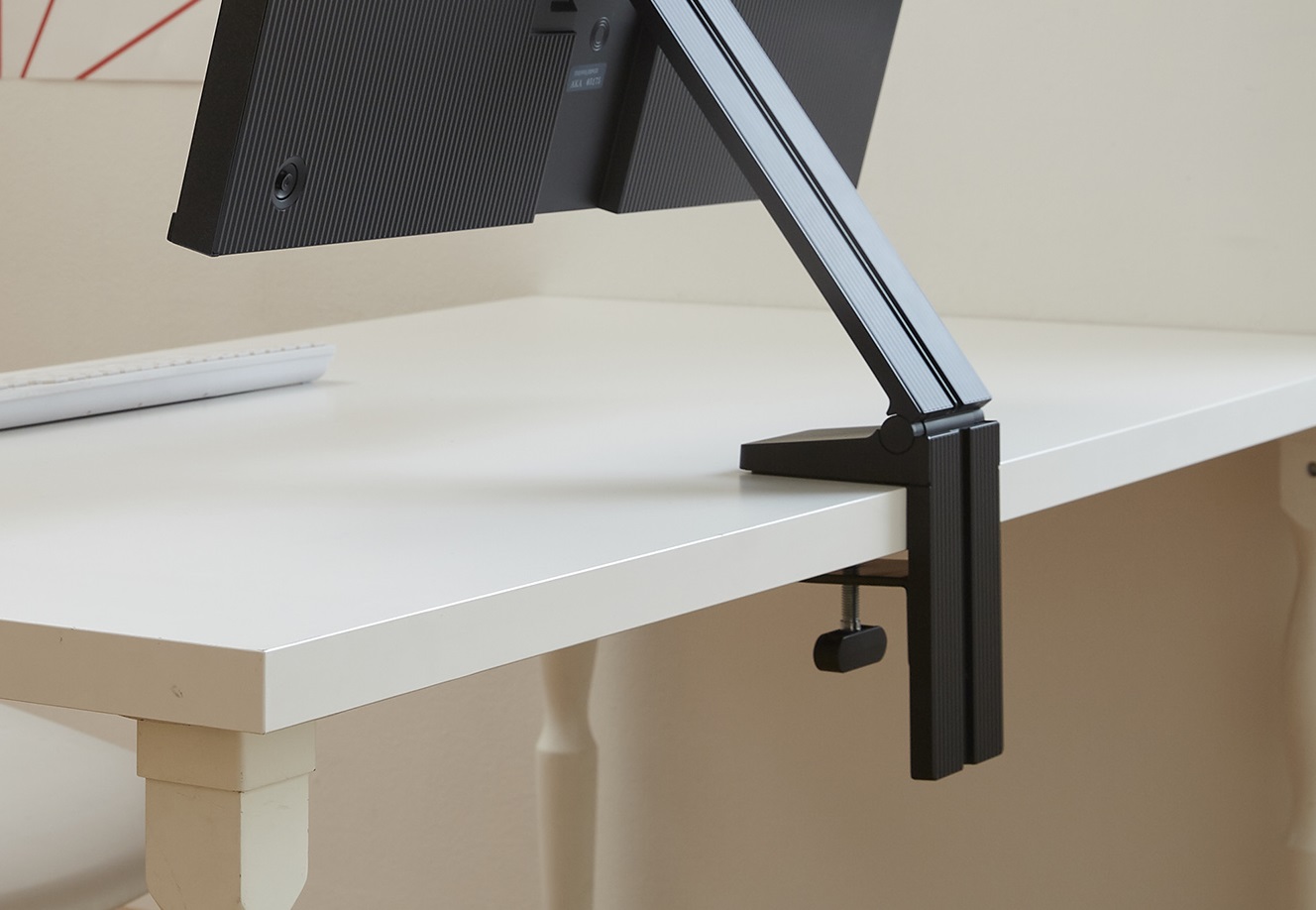
The big advance of the Space Monitor is its very low-profile mount, which grips the edge of your desk on the wall side and can be folded up flat against said wall. It can rotate up and down, the monitor tilting to taste — not so far as the Surface Studio, but with that same general range of motion.

The monitor itself comes in two varieties: a larger 32-inch 4K one and a smaller 27-inch one at 2560×1440. I reviewed the smaller one, as the large one has a lower refresh rate and I really don’t have any use for 4K in my workflow.

The ideal situation for this thing is a relatively small work space where having the monitor actually sitting on your desk kind of invalidates all the space around it. With the Space Monitor, the stand is flush with the wall, clearing up the area below and in front of it even when it’s folded outwards. It’s easier than piercing the wall for a free-floating display.

The performance of the monitor, as far as I am able to tell, is good but not great. The colors are vibrant and the default settings are solid, if perhaps a little warm (easily adjusted, of course). The refresh rate goes up to 144 Hz, which is more than enough for gaming, and can easily be tweaked to 120 for those of us who are very picky about video pulldown and other deep frame rate stuff.

One thing that isn’t impressive is the viewing angle. I feel like the sweet spot for this monitor is far narrower than on the Dell Ultrasharp IPS panel I’ve used for years. If you’re not sitting directly in front of it, you’re going to get color and brightness falloff at the edge you’re farthest from.

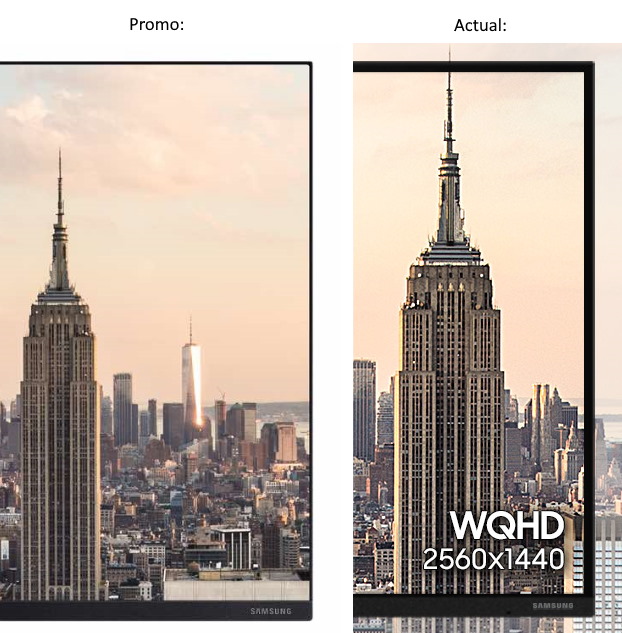
The bezel is narrow, a bit more than a quarter inch, a little thicker on the bottom side. It’s also nearly flush on the top and sides so you don’t feel like the bezels protrude toward you. All in all it’s a very handsome and understated design, as these things go. It’s worth noting that Samsung appears to have fudged the press imagery a bit and the microscopic bezel you see in official images is not actually what you get.

Installation isn’t quite as easy as just setting something down on your desk, but if you have a compatible desk, it’s literally as easy as sliding the clamp on and tightening it. A custom cable (optional, but convenient) combines HDMI and power into one, and fits into a groove on the back of the stand, eliminating clutter.

But you’ll want to take a good look at your desk to make sure it is compatible. I didn’t, and had to jury-rig a solution.

Basically, unless your desk is more or less solid and has a ledge that the clamp can close down on, you might have a problem. My desk is solid and about an inch and a half thick, but has a sort of wall that juts down about two more inches. I removed and reattached the bottom part of the clamp so it could just barely be slipped around the wall, but then the screw wouldn’t reach the bottom surface of the desk, so I had to fill the gap with a book. (It’s okay, I’ve got lots.)

The stand is plenty stiff and the monitor stays exactly where you’ve put it, but it is a little wobbly — understandable, given that it sits at the very tip of a 14-inch-long arm. I only really noticed when I was typing very hard or bumped the desk, when I noticed it wobbled more and longer than the Dell on its traditional stand.

Now, if you’ve looked closely at the way this monitor and stand is set up, you may have noticed something else: this thing can’t rotate. Yes, unfortunately, the nature of the Space Monitor means that it must always be parallel to the desk edge it’s attached to, and can only move directly perpendicular to it. There is also no way to slide the monitor up and down, or rather to do so you must also move it toward or away from you.

For some this is unacceptable. And although it’s fine for me as a primary monitor, it would never work as a secondary one, like the Dell I now have angled toward me adjacent to the Samsung.

That does significantly limit its use cases, and the spaces in which it works well. But I still feel it’s a great option for some. If you have limited space and plan to primarily work from the sweet spot directly in front of it, this is a solid monitor big enough for productivity, movies and games.

For those seeking a low-profile, space-saving alternative to the usual monitors, the Space Monitor is a great option. But for multiple-monitor setups or people who shift the angle a lot, it probably isn’t the best. At $400 it has strong competition from the usual suspects, but for some people the slight increase in image quality or the ability to slide the monitor up and down isn’t worth losing the desk space or having a clunky design. The Space Monitor is available now, at Samsung’s site or your usual electronics retailer.