MIT researchers develop a much better way to optimize the control of soft robots

MIT researchers have developed a new way to optimize how soft robots perform specific tasks — a huge challenge when it comes to soft robotics in particular, because robots with flexible bodies can basically move in an infinite number of ways at any given moment, so programming them to do something in the best way possible is a monumental task.

To make the whole process easier and less computationally intensive, the research team has developed a way to take what is effectively a robot that can move in infinite possible dimensions and simplify it to a representative “low-dimensional” model that can accurately be used to optimize movement, based on environmental physics and the natural ways that soft objects shaped like any individual soft robot is actually most likely to bend in a giving setting.

So far, the MIT team behind this has demonstrated it in simulation only, but in this simulated environment it has seen significant improvements in terms of both speed and accuracy of programmed movement of robots versus methods used today that are more complex. In fact, across a number of tests of simulated robots with both 2D and 3D designs, and two and four-legged physical designs, the researchers were able to show that optimizations that would normally task as many as 30,000 simulations to achieve were instead possible in just 400.

Why is any of this even important? Because it basically shrinks drastically the amount of computational overhead required to get good movement results out of soft robots, which is a key ingredient in helping make them partial to actually use in real-life applications. If programming a soft robot to do something genuinely useful like navigate and effect an underwater damage assessment and repair requires huge amounts of processing power, and significant actual time, it’s not really viable for anyone to actually deploy.

In the future, the research team hopes to bring their optimization method out of simulation and into real-world testing, as well as full-scale development of soft robots from start to finish.

Define and manage growth on your own terms

Tim Hsia & Neil Devani
Contributor

Tim Hsia is the CEO of Media Mobilize and a Venture Partner at Digital Garage. Neil Devani is an angel investor and venture capitalist focused on companies solving hard problems.

Welcome to this edition of The Operators, a recurring Extra Crunch column, podcast, and YouTube show that brings you insights and information from inside top tech companies. Our guests are execs with operational experience at fast-rising startups, like Brex, Calm, DocSend, and Zeus Living, and more established companies, like AirBnB, Facebook, Google, and Uber. Here, they share strategies and tactics for building your first company and charting your career in tech.

In this episode, we’re talking about growth. Growth means different things inside different organizations, but correctly identifying avenues for sustainable and scalable growth is a priority for almost all companies. We’ll cover:

  1. Defining growth and being good at it
  2. Managing growth without losing sight of the big picture
  3. How companies should approach growth

To learn more, we spoke with two experts:

Isaac Silverman began his career as an entrepreneur before joining Zynga to work on growth development. At Zynga, he focused on some of the most cutting-edge approaches to growth and development. He then moved to Postmates, where he focused on growth product and is now the head of rider growth at Uber.

Matias Honorato is a senior manager on the growth team at Tally, a growth-stage tech company, and also brings his own entrepreneurial roots and experience at companies like Earnest and Tradecraft.

Below is a summary of our conversation; check out The Operators for the full episode.

Defining growth and being good at it

Growth as a concept and discipline originates from the term “growth hacking.” It can be hard to grasp as distinct from functions and goals that usually sit with the marketing team or product development team and may be best thought of as a combination of both. We think of it as the domain responsible for designing, implementing, and measuring approaches to acquiring and retaining customers. It’s a mix of marketing and product, but also sales and data analytics, and sometimes even operations.

Great growth professionals can be successful with a wide variety of work or educational backgrounds, and are most often curious, persistent, and adept at thinking holistically, creatively, quantitatively, and interdisciplinarily.

“There’s definitely a lot of deep analysis and how all the pieces fit together and there’s a lot of product work, and there’s a lot of marketing work,” said Silverman. “I think part of what I find so deeply interesting and engaging about it is it brings together everything. It’s really the exercise we go through, and I don’t want to overstate our role, but the exercise we go through is, ‘let’s imagine that we’re the CEO and what are the things that we think are really important. Let’s see the whole picture and then figure out what are the areas that we should ultimately focus on within it.’ So that is ultimately deeply, deeply, stimulating and dynamic and changes on a day to day basis. And sometimes it’s more product manager-y, sometimes it’s more something else.”

Honorato said that to be a great growth professional, “you have to have a really good understanding of your business, what are your goals, how the product works, how their financial side of the business works.”

The responsibilities of growth teams range from simple tasks like split-testing marketing copy and landing pages to more complex strategies like enabling the integration of a file storage and management solution into workflow applications and then subsequently partnering with those workflow applications to acquire users and become a default solution. Being cross-functional in nature, growth initiatives often require resources and contributions from other teams like marketing, design, and engineering. This can create conflict due to resource constraints and company politics, regardless of how small or large a company is. These are meaningful challenges before even evaluating the effectiveness of growth initiatives! Great growth teams must know how to navigate these types of issues as well, making effective growth teams hard to build, but very valuable if you can build an effective one.

“I tend to believe teams exist on spectrum,” said Silverman. “You got that sort of optimizer or specific functionality or specific parts of the funnel or whatever growth themes and then in the spectrum you have, the entire purpose of the company after you’ve achieved product market fit is to grow. I tend to believe that a lot of companies think they need the former and actually need the latter… One thing that I want to make sure is absolutely clear, the growth at Uber is the product of a very high number of very, very competent people, very diligently thinking about their part of the business, and [growth is] a portion of that much, much larger equation.”

Managing growth without losing sight of the big picture

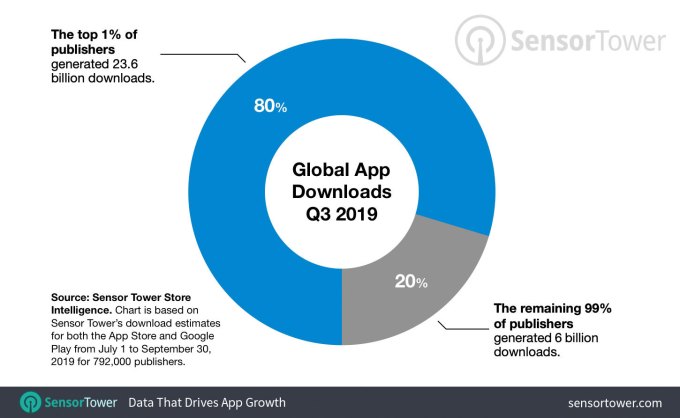
The top 1% of app store publishers drive 80% of new downloads

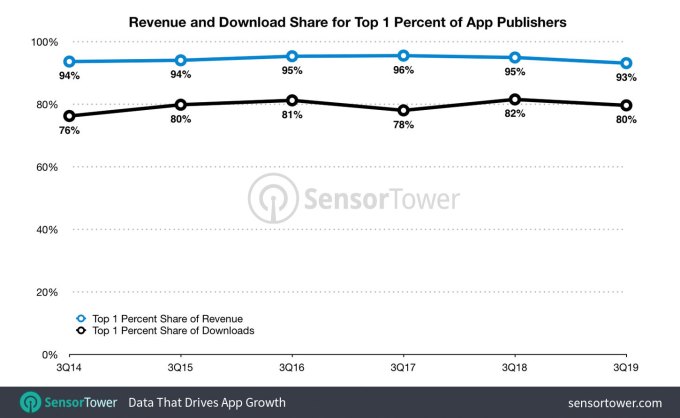
The current app store ecosystem doesn’t favor the indie developer. According to new data from Sensor Tower, the top 1% of publishers globally accounted for a whopping 80% of the total 29.6 billion app downloads in the third quarter of 2019. That means just 20%, or 6 billion, downloads are left for the rest of the publishers.

This bottom 99%, which equates to roughly 784,080 publishers, averaged approximately 7,650 downloads each during the quarter. To put that in context, that’s less than one-thousandth of a percent of the downloads Facebook generated in the quarter (682 million).

The data should not be all that surprising, given that larger, social platforms like Facebook and YouTube already serve audiences of over a billion. But it is concerning how uneven the market for new apps remains, especially considering that the number of available apps continues to expand, which makes the competition even more difficult.

The report notes there were more than 3.4 million apps available across the App Store and Google Play in 2018, up 65% from the 2.2 million apps available in 2014. But the number of apps that were able to achieve at least 1,000 installs has been declining over that same period — from 30% to 26%.

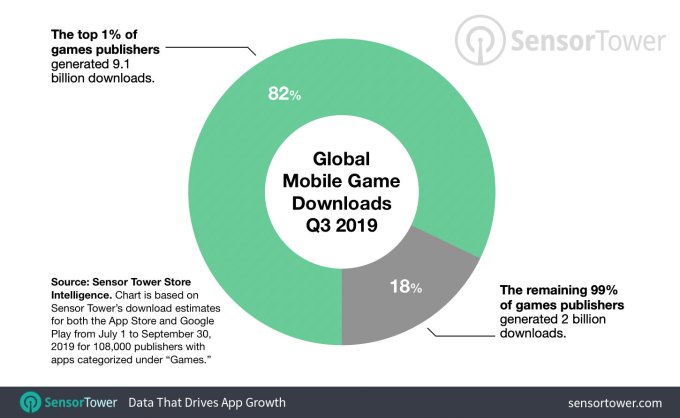
Focusing only on games, the top 1% of publishers — or 1,080 out of a total 108,000 publishers — saw 9.1 billion downloads out of the total 11.1 billion, or 82%. This averages out to more than 8.4 million installs each. The remaining 18% of downloads, or 2 billion, were shared among the remaining 106,920 publishers. That averages out to around 18,000 downloads each.

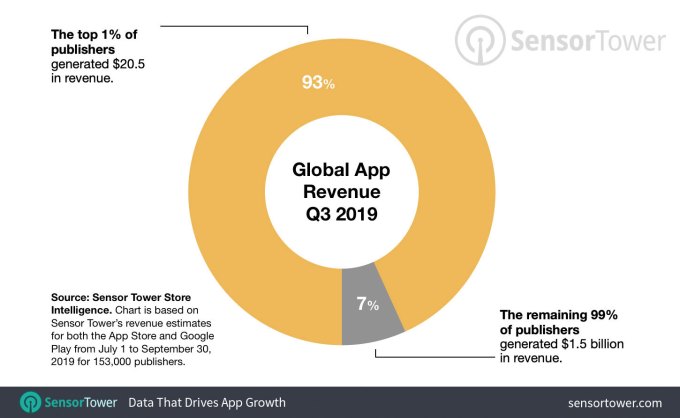
When apps were analyzed by revenue, the gap was wider. Just 1,526 publishers generated $20.5 billion out of the total $22 billion in revenue in the quarter. Meanwhile, the remaining $1.5 billion was split among 151,056 publishers, averaging out around $9,990 each.

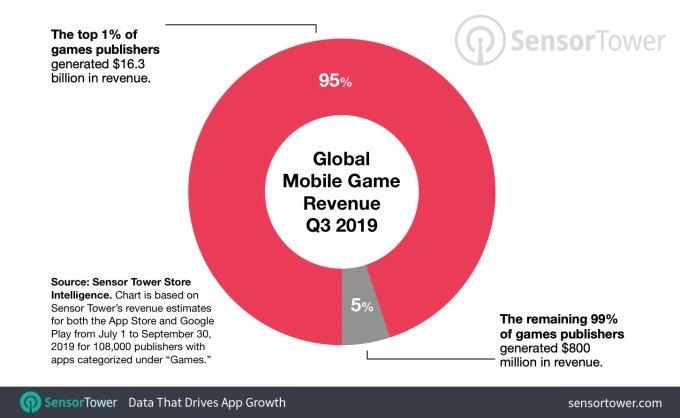
In terms of games revenue alone, the 445 publishers that make up the top 1% generated $15.5 billion in revenue, or 95% of all revenue, with the remaining $800 million split between the 44,029 publishers in the bottom 99%. This averages out to around $18,100 each.

None of these are new trends, Sensor Tower also notes. There hasn’t been much fluctuation in the top 1% share of installs or revenue for years. That means the majority of publishers will compete for a minority of new users and installs.

Image credits: Sensor Tower


GM will bring an electric truck to market in 2021

GM CEO Mary Barra said Thursday that the automaker will bring its first electric truck to market in the fall of 2021.

The comments were made Thursday during GM’s investor day. Later this evening, Tesla, which also plans to start selling an electric truck in 2021, will reveal its “cybertruck” at an event in Hawthorne, Calif. Reuters first reported the GM news.

“General Motors understands truck buyers and… people who are new coming into the truck market,” Barra said during the investor conference, explaining the company’s rationale for the move.

GM’s foray into electric trucks has been public before. Last month, the Detroit Free Press reported that GM’s Detroit-Hamtramck Assembly Plant would remain open to produce an electric pickup under a deal between the UAW and the automaker.

This is the first time the company has provided a timeline.

Several other companies are expected to bring electric trucks to the marketplace in the next several years, including newcomer Rivian, Tesla and Ford.

Toyota’s first plug-in hybrid RAV4 piles on the power and fuel efficiency

Toyota gave its first plug-in hybrid RAV4 more than just a plug. It piled on the power as well.

The 2021 Toyota RAV4 Prime, which was unveiled this week at the LA Auto Show, will achieve two seemingly conflicting goals. The vehicle will be its most fuel efficient and one of its most powerful.

This variant of the RAV4 will have an all-wheel drive, sport-tuned suspension. It has a tuned 2.5-liter, four-cylinder gasoline engine and when combined with the electric motors will deliver 302 horsepower and be able to travel from 0 to 60 miles per hour in a projected 5.8 seconds. Toyota hasn’t announced a price yet, but expect it to be more expensive than the hybrid version of the RAV4, which starts at $28,100.

toyota rav4 prime

The 2021 Toyota RAV4 Prime, a plug-in hybrid, on the floor of the 2019 LA Auto Show

That might seem slow compared to some of the pure electric sedans on the market. But it’s far zippier than previous models and marks a much needed improvement in the RAV4. The vehicle’s electric battery will provide an estimated 39 miles of range before kicking back to the gas-powered engine.

The RAV4 Prime has a manufacturer-estimated 90 combined MPGe. The 2021 model will be available in the sportier SE and luxury focused XSE trims, and will hit the marketplace in summer 2020.

To understand the improvement, consider this. Toyota offered a 3.5-liter V6 in the 2006 to 2012 model years of the RAV4. And yet, despite having more cylinders and bigger displacement, it only produced 269 horsepower and combined fuel economy rating of 21 miles per gallon.

The vehicle will also come standard with advanced driver assistance features, including pre-collision pedestrian detection, radar cruise control, lane departure alert with steering assist, automatic high beam and road sign assistance.

As Toyota offers more electrified versions of its popular SUVs, the company is upping the warranty on its hybrid battery. The automaker said that beginning with the 2020 model year, its hybrid battery warranty will be increased from eight years or 100,000 miles to 10 years from original date of first use, or 150,000 miles, whichever comes first.

New York State Attorney General reportedly investigating WeWork

WeWork is reportedly being investigated by the New York State Attorney General. According to Reuters, the NYAG’s questions include if WeWork founder and former CEO Adam Neumann engaged in self-dealing.

A WeWork spokesperson said in an email that “we have received an inquiry from the office of the New York State Attorney General and are cooperating in the matter.” TechCrunch also contacted the New York State Attorney General’s office for comment. WeWork is headquartered in New York City.

This comes less than a week after Bloomberg reported WeWork is the subject of a U.S. Securities and Exchange Commission inquiry into potential rule violations related to its cancelled IPO.

WeWork’s parent company, The We Company, announced on Sept. 30 that it was withdrawing its S-1 filing for an initial public offering, shortly after Neumann stepped down as CEO. In addition to questions about the company’s financial state, red flags for investors included that Neumann had borrowed against his WeWork shares and leased properties he owned back to the company.

An entity Neumann controlled also sold the company the right to use the word “We” for $5.9 million, though he later asked the company to unwind the agreement and returned the money after public criticism.

After receiving a lifeline from investor SoftBank worth up to $8 billion, WeWork is now engaging in major cost-cutting measures, including layoffs at Meetup, which it acquired for $200 million in 2017.

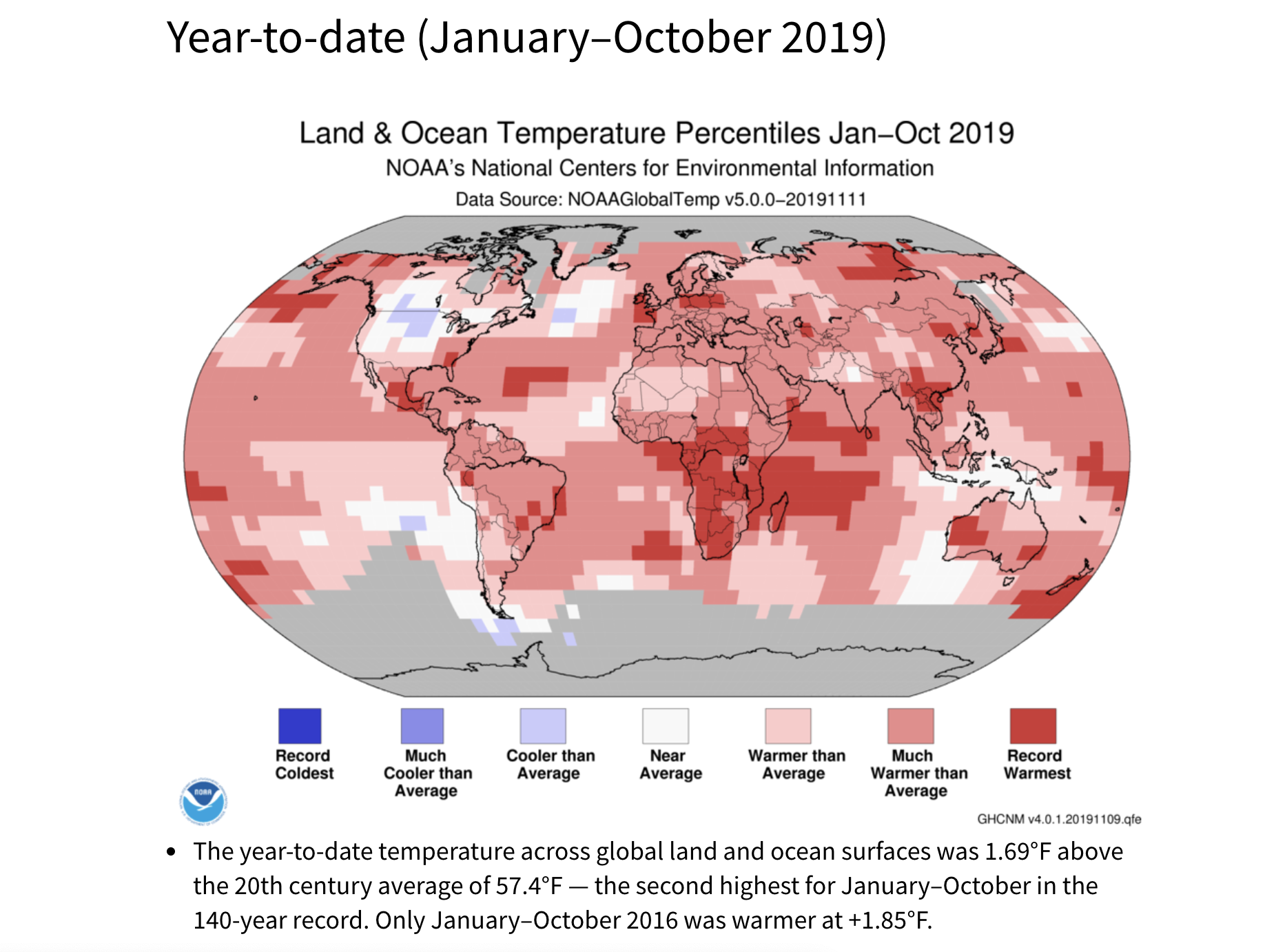
Earth is headed for its second warmest year in recorded history (the record was three years ago)

Data from the U.S. government sure seems to indicate that the Earth is warming (despite what the current leadership may say).

Apparently, the globe just experienced the second-hottest October ever recorded and is on track for the second-hottest year to date on record, according to data from the National Oceanic and Atmospheric Administration.

Not only are we experiencing a run of hot Octobers (this is the tenth year that temperatures have hit recorded-history highs since 2003 and all five of the highest temperature years were in the past five years), but arctic ice has also shrunk to its lowest extent since satellite records began in 1979.

Even as the Trump Administration enacts policies to reverse course on curbing the emissions that seem to be leading to a changing global climate, federal agencies like the NOAA keep releasing reports that reveal exactly how much the planet is changing.

Earlier this month Secretary of State Mike Pompeo began the process of formally withdrawing the U.S. from the Paris Agreement on climate change. As with most momentous events of the Administration, the world was notified via Twitter.

Today we begin the formal process of withdrawing from the Paris Agreement. The U.S. is proud of our record as a world leader in reducing all emissions, fostering resilience, growing our economy, and ensuring energy for our citizens. Ours is a realistic and pragmatic model.

— Secretary Pompeo (@SecPompeo) November 4, 2019

While Secretary Pompeo was praising the nation’s approach to “reducing all emissions”, Europe, Africa, Oceania, the Caribbean and Hawaiian Islands hit historic record-setting temperatures and the world’s average sea surface temperature hit its second-warmest ever-recorded temperature.

Meanwhile, new projections are revising the risk that cities face from rising sea levels that are caused by melting glaciers due to warmer temperatures.

Maps created by the research organization Climate Central, and published in the journal Nature Communications indicate that rising seas could flood land that’s currently home to some 150 million people at high-tide by 2050, if steps aren’t taken to improve the resiliency of cities to flooding or reverse course on climate.

Even the Federal Reserve is waking up to climate change risks. The regulator responsible for U.S. monetary policy convened an event earlier this month to focus on the financial impacts of climate change.

“By participating more actively in climate-related research and practice, the Federal Reserve can be more effective in supporting a strong economy and a stable financial system,” Lael Brainard, a member of the Fed’s board in Washington, said in prepared remarks at the same event, according to a report in The New York Times. 

The coming fight over who controls digital health data

Spending for consumer digital healthcare companies is set to explode in the next few years; the Office of the National Coordinator for Health Information Technology is currently reviewing the requirements for data sharing with the Department of Health and Human Services, and their initiatives will unlock a wave of data access never before seen in the U.S. healthcare system.

Already, startups and large technology companies are jockeying for position over how to leverage this access and take advantage of new sensor technologies that provide unprecedented windows into patient health.

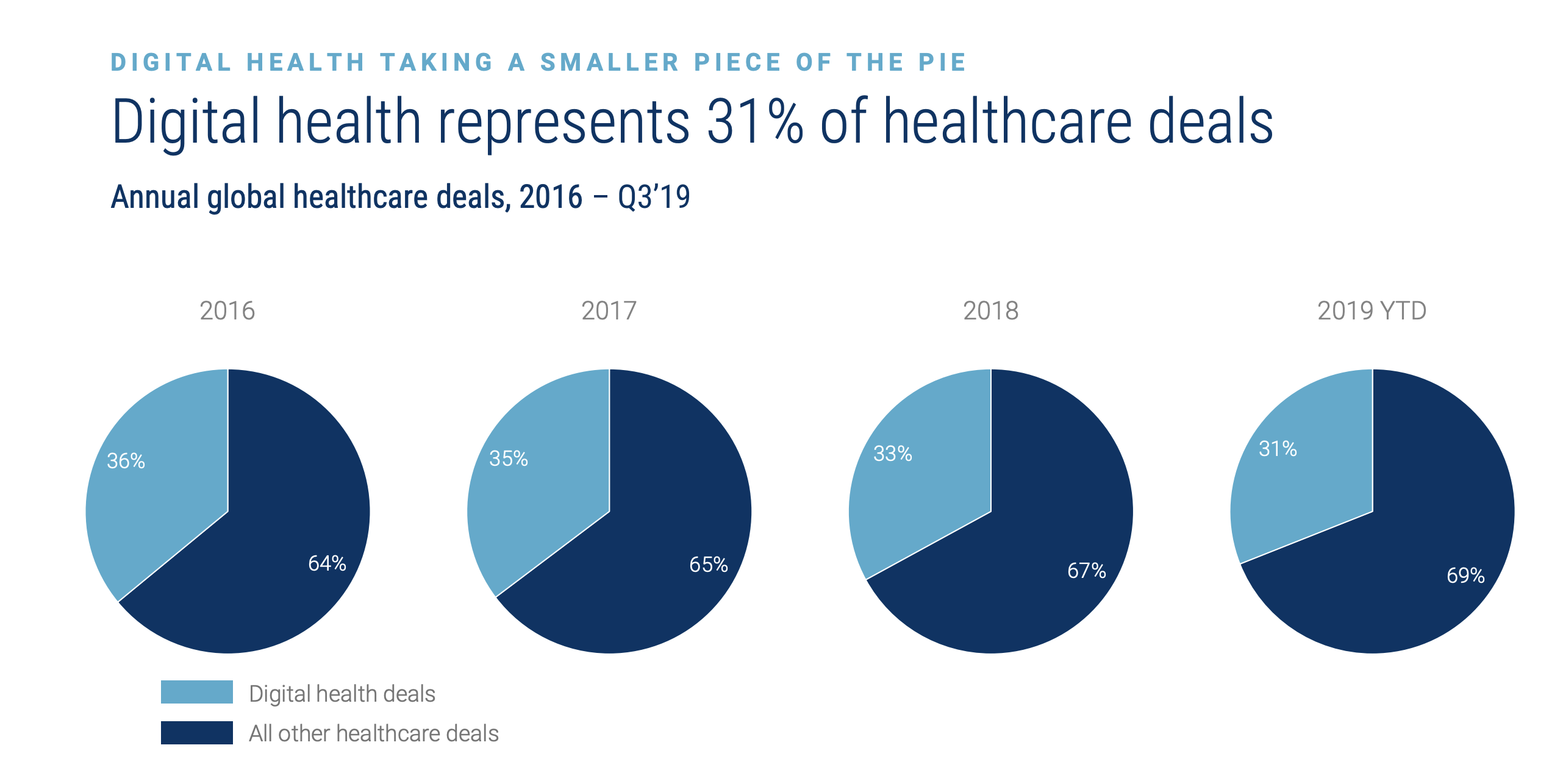
Venture capital investors are expected to invest roughly $50 billion in approximately 4,500 startups in the healthcare industry, according to data from CB Insights. In all, there have been 3,409 investments made in the healthcare market through the third quarter of 2019, with 31% of those deals done in what CB Insights identifies as digital health companies.

The explosion of data is unprecedented and already companies like Apple and Google are jockeying for control over how that data will be served up to healthcare practitioners and patients.

Chart courtesy of CB Insights

Apple and Google are setting out two divergent paths for handling patient data. For patient advocates, there’s a clear winner, and as startups look to play in these emerging ecosystems, it’s what the patient wants that may matter most.

The second that this data hits those shiny Silicon Valley apps, instead of being under HIPAA that’s covered, you become a user and you have no rights,” says one patient advocate. 

Last week, after reports in The Wall Street Journal and The New York Times, Google confirmed the details of a partnership with religiously-affiliated hospital and assisted living network, Ascension, a deal that involved the movement of millions of patient records into Google’s infrastructure.

The Alphabet subsidiary had first announced the agreement in its July earnings call, but the precise details of its work with the hospital records of Ascension patients were undisclosed until a more detailed description of the project was leaked by a whistleblower.

Google was not only moving patient records onto its cloud infrastructure, but was also developing tools to “help Ascension’s doctors and nurses more quickly and easily access relevant patient information, in a consolidated view,” the company confirmed in a blog post.

For the source of the Journal’s reporting, there were too many pieces of information about the project that both the Google engineers who were working on “Nightingale” and the doctors and patients in the Ascension healthcare system were kept in the dark about.

As the whistleblower wrote in a Guardian editorial late last week:

With a deal as sensitive as the transfer of the personal data of more than 50 million Americans to Google the oversight should be extensive. Every aspect needed to be pored over to ensure that it complied with federal rules controlling the confidential handling of protected health information under the 1996 HIPAA legislation.

Working with a team of 150 Google employees and 100 or so Ascension staff was eye-opening. But I kept being struck by how little context and information we were operating within.

What AI algorithms were at work in real time as the data was being transferred across from hospital groups to the search giant? What was Google planning to do with the data they were being given access to? No-one seemed to know.

Above all: why was the information being handed over in a form that had not been “de-identified” – the term the industry uses for removing all personal details so that a patient’s medical record could not be directly linked back to them? And why had no patients and doctors been told what was happening?

I was worried too about the security aspect of placing vast amounts of medical data in the digital cloud. Think about the recent hacks on banks or the 2013 data breach suffered by the retail giant Target – now imagine a similar event was inflicted on the healthcare data of millions.

Google insists that no patient data is being used to sell ads, or being coupled with either its own consumer data or data from other customers it may be working with in healthcare (a list that includes the Cleveland Clinic, Hunterdon Healthcare, and McKesson).

However, Google’s handling of patient data — through its own work with other partners and through DeepMind Health (a division of a Google spinout which the search giant recently acquired) — has been controversial.

In 2018, the search giant’s work with the U.K.’s National Health Service was criticized for not adhering to data governance standards and potentially breaking the law. And, earlier this year, Google was sued for allegedly mishandling patient data by including too much potentially identifiable patient information used in a study conducted by the University of Chicago Medical Center, Google, and the University of Chicago.

In each instance, Google insisted that it followed all appropriate regulations, but the problem that the company faces is growing concern from a new crop of lawmakers and concerned consumers that the regulations which exist on the books are no longer appropriate.

Technology is coming for healthcare data

The news of Google’s work with Ascension and the concerns it has raised among consumers is just one example of the company’s broader efforts to capture more of the multi-trillion dollar healthcare market.

Google kicked off November with a $2.1 billion bid for Fitbit — a deal that would potentially put an incredible amount of currently unregulated consumer health data squarely under the magnifying glass of Google’s mammoth data analysis tools.

Mubi launches streaming service in India

Mubi, a 12-year-old on-demand movie streaming and rental service, has arrived in India. Like other streaming services giants such as Netflix, Amazon Prime Video, Apple TV+ and Disney’s Hotstar, Mubi is offering its service at a slightly lower price in the key overseas entertainment market.

The London-headquartered firm is offering a three-month subscription in India at Rs 199 ($2.8), after which it would charge $7 a month or $67 a year (this way, the monthly cost works out to about $5.5). This is substantially lower than the £9.99 monthly subscription fee it charges to subscribers in the U.K., and the $10.99 it charges in the U.S.

Perhaps the lesser-known streaming service among all the usual names, Mubi has earned a name for itself by offering a selection of critically acclaimed movies. Unlike other services, Mubi’s catalog is incredibly thin. At any moment, the service offers only 30 recent and vintage movies. One new title arrives every day and another vanishes at the same time. No movie stays longer than 30 days on the platform.

Mubi, founded in 2007, started with the ambition of becoming just like what Netflix is today. But it became apparent to the company that they couldn’t afford to offer thousands of titles to users, founder and chief executive of the company Efe Cakarel told The New York Times in an interview two years ago.

“In the beginning, we wanted to be like Netflix, but the unit economies of an ‘all-you-can-eat’ site is very capital-intensive,” Cakarel told the Times. “The question becomes, how do you create a compelling experience? If you can’t get 10,000 titles, how about a limited selection?”

Mubi has amassed 9 million subscribers, the company said. (Cakarel will be speaking at Disrupt Berlin next month.)

In an interview last month, Cakarel said most streaming platforms are today focused on the biggest TV series. “But Mubi focuses on finding gems, often going back decades, that very few people know of. We are giving distribution to such films. You may not like a film, but it is there for a reason,” he said.

In India, Mubi has additionally launched a dedicated channel (first time it has done so for any market), where local movies are being showcased. (Customers in India have access to the global feed as well.) Additionally, like in other markets, Mubi is offering a rental service to subscribers in India, allowing them to pick any movie from a selection of a few dozen for $3.5.

For its India business, the company has appointed film producer and Academy Award winner Guneet Monga (known for titles such as Gangs of Wasseypur, The Lunchbox and Masaan) as its content advisor. It also maintains a partnership with Times Bridge, the venture arm of Indian internet services and content conglomerate Times Internet.

“Monga has the sensibility for great cinema. The kind of films she produces, the kind of films she champions are the type of films more people should see. I cannot be more fortunate that she sees our vision in India,” Cakarel said in an interview.

In a statement, Monga said, “I’m thrilled we have launched a dedicated channel for Indian cinema as it means that film lovers can now watch amazing films like Salaam Bombay and Andaz Apna Apna, alongside globally renowned gems like Moonlight.”

The company has secured deals with local distributors FilmKaravan, NFDC, PVR Pictures, Shemaroo, and Ultra to populate titles on India section every day. Some of the upcoming titles include Kamal Swaroop’s cult film Om Dar-B-Dar, Kanu Behl’s Binnu Ka Sapna, which premiered at Clermont-Ferrand International Short Film Festival this year, and ghost film Duvidha from Indian art-house master Mani Kaul.

Mubi Go, a service available in the U.K. and Ireland, which allows subscribers in those markets to get a movie ticket each week in a local theatre, is not available to customers in India.

This room-sized LED egg captures amazing 3D models of the people inside it

Capturing human performances in high-definition 3D is a complicated proposition, and among the many challenges is getting the lighting right. This impressive new project from Google researchers puts the subject in the center of what can only be described as an prismatic LED egg, but the resulting 3D models are remarkable — and more importantly, relightable.

What’s called volumetric capture uses multiple cameras in a 360-degree setup to capture what can look like a photorealistic representation of a subject, including all the little details like clothing deformation, hair movement, and so on. It has two serious weaknesses: First, it’s more like a 3D movie than a model, since you can’t pose the person or change their attributes or clothing; The second is an extension of the first, in that you can’t change the way the person is lit — whatever lighting they had when you captured them, that’s what you get.

“The Relightables” is an attempt by a team at Google AI to address this second issue, since the first is pretty much baked in. Their system not only produces a highly detailed 3D model of a person in motion, but allows that model to be lit realistically by virtual light sources, making it possible to place it in games, movies, and other situations where lighting can change.

Images from the Google AI paper that show the capture process and resulting 3D model alone and in a lighted virtual environment.

It’s all thanks to the aforementioned prismatic egg (and a couple lines of code, of course). The egg is lined with 331 LED lights that can produce any color, and as the person is being captured, those LEDs shift in a special structured pattern that produces a lighting-agnostic model.

The resulting models can be placed in any virtual environment and will reflect not the lighting they were captured in but the lighting of that little world. The examples in the video below aren’t exactly Hollywood-level quality, but you can see the general idea of what they’re going for.

The limitations of volumetric capture make it unsuitable for many uses in film, but being relightable brings these performances a lot closer to ordinary 3D models than they were before. Of course, you still have to do all your acting inside a giant egg.

“The Relightables” will be presented by the team at SIGGRAPH Asia.

The House Fund closes its second fund with $44 million to pour into UC Berkeley grads, alums and faculty

In 2016, we profiled a then-24-year-old named Jeremy Fiance who had managed to pool together $6 million for a fund focused on his alma mater, UC Berkeley, where as a student he’d brought to campus Kairos Society, an organization for budding entrepreneurs, as well as created a student accelerator called Free Ventures.

Fiance wasn’t waiting on someone to give him a job in venture; he wanted to create his own vehicle — dubbed The House Fund — with the support of the school to invest in its talented students, alums and professors, and eventually channel some of its gains back into the university system. To his mind, regional VCs were too focused on Stanford, creating a funding vacuum — and an opportunity. Why not address it himself?

Fast-forward two years and it’s apparent that investors give Fiance high marks. To wit, The House Fund is today announcing a second fund with $44 million in capital commitments, including backing from University of California (which oversees a $126 billion endowment) and the Berkeley Endowment Management Company, which provides stewardship of endowment gifts given expressly to UC Berkeley. Other investors include funds of funds, including Ahoy Capital; unnamed family offices; Berkeley alums; and tech execs.

The specific pitch these investors are buying ties partly to the school’s size, says Fiance. UC Berkeley has 500,000 alums in the world and another 60,000 students on campus. Some of those graduates have also built some very valuable, still-private companies, including Flexport, Nextdoor, Warby Parker, Databricks and DoorDash (all are so-called “unicorn” companies). Others have taken their companies public (think Redfin, Coupa and Cloudera, among others). Naturally, some percentage of UC Berkeley alums have also sold their companies, including Caviar, which was acquired by Square (and then by DoorDash), and PillPack, which sold to Amazon.

Investors are also betting on Fiance’s developing track record. Though The House Fund’s debut vehicle was relatively small, it managed to get checks into the logistics firm Flexport, the email service Superhuman, the teen app Tbh (acquired by Facebook) and Dyndrite, a maker of additive manufacturing software that we first encountered back in April. The House Fund’s second fund already holds some promising stakes, too. Among its bets so far is the blockchain gaming company Forte, founded by esports veteran Kevin Chou, who previously founded (and sold) Kabam; Oasis Labs, a cryptographic project whose founder previously sold an earlier startup, Ensighta, to FireEye; and Placement.com, a seven-month-old company that aims to help people find better jobs in new cities. (Its co-founders, Sean Linehan and Katie Kent, came out of Flexport.)

Most of all, perhaps, they’re counting on Fiance’s ability to continue growing a network that has already allowed The House Fund to meet with more than 3,000 startups with ties to UC Berkeley. (It has funded 50 in total.)

He has help. Though The House Fund remains a capital pool with just one general partner, Fiance is quick to acknowledge the team he has built. Among these members is Cameron Baradar, who was the third engineer at the mapping visualization startup Mapsense before it was acquired by Apple and who is now a partner at the firm; Brett Wilson, who founded the ad tech startup TubeMogul and sold it to Adobe in 2017 and is a venture partner; Annie Tsai, a former CMO at the marketing automation company Demandforce who is a part-time partner; and Arjun Arora, who founded and sold an ad tech startup, worked as an investor for both Expa and 500 Startups, and is now also a part-time partner.

As for the size checks the team is writing, Fiance says the firm “sized the fund in such a way that we were right-sizing to the opportunity in front of us.” What that means: while The House Fund once wrote checks of $50,000 to $100,000, it’s now investing up to $1 million in seed rounds, with an undisclosed amount of money targeted for reserves.

It also dives in before a lot of venture funds will, insists Fiance. “There are actually very few funds that are willing to take a first leap,” he says. But we put together pre-seed syndicates. We help companies fundraise by putting together a personalized demo day for them with 20 to 30 investors” who might conceivably be interested in the startup.

“We have a very strong sense of the market and other funds and where and how they’re investing,” adds Fiance. The suggestion, seemingly, is that like the university on which it’s so focused, The House Fund does its research.

Apple launches a dedicated mobile app for its developer community

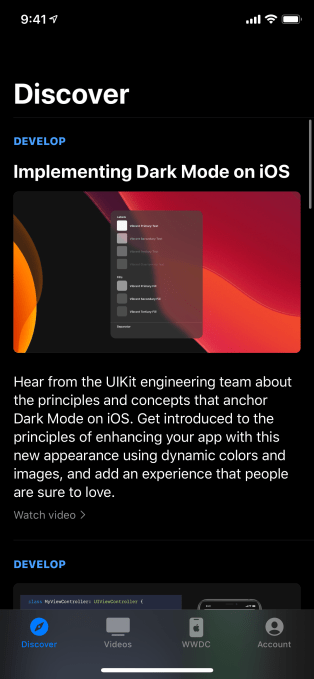
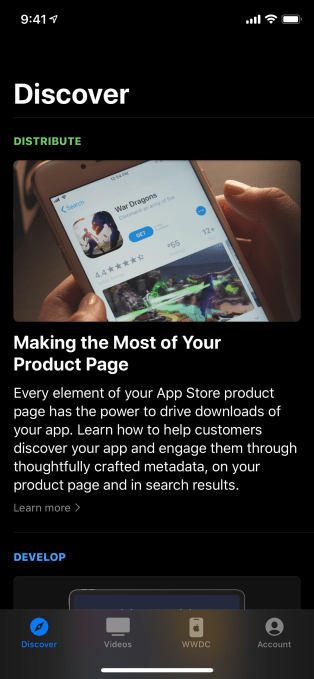
Apple today is introducing a new resource for the over 23 million registered members of its developer community, with the launch of a dedicated Apple Developer mobile app. The new app is an expansion on the existing WWDC app for Apple’s Worldwide Developer Conference, which it will now replace. Instead of only including information about the developer event itself, the app will expand to include other relevant resources — like technical and design articles, developer news and updates, videos and more. It also will offer a way for developers to enroll in the Apple Developer program and maintain their membership.

Today, developer information is spread out across Apple’s website, and elsewhere. It even arrives in developers’ inbox in the form of email updates from various product teams. Now it will be available in a single, streamlined mobile app experience.

At launch, the Apple Developer app may not have everything you could otherwise find on Apple’s Developer website, but its offerings will grow over time. For example, today you’ll find technical information and more than 600 videos, but you won’t find things like the Apple Developer Forums or a way to connect a local Apple Developer program — like Apple’s App Accelerators, Design Labs or Developer Academies.

Instead, the app’s content is organized across four main sections: Discover, for finding developer information, news and updates; Videos, where you’ll find the videos the WWDC app once hosted; WWDC, for event attendees; and Account, where developers can manage their account and program membership.

Apple’s goal is to use the app to get relevant content in front of developers in a timely fashion and to point them to things they may not even realize exist on the Apple Developer website, or even at Apple, overall. And in some cases, the app will include more mobile-friendly content — like articles that attempt to educate in a more digestible, short-form manner.

In other words, it may be the same content as found online in technical papers, but packaged in a slightly different way. Later, the app will also expand to address some of the things that Apple hasn’t yet documented — a topic of increasing concern among developers as of late. (One developer even built a website called “No Overview Available” that helps you find out if an Apple API is missing documentation.)

Elsewhere in the app, developers will continue to be able to watch WWDC session videos and review the WWDC schedule, when available. They’ll also be able to sign up for or renew an Apple Developer program membership, then pay for it using Apple Pay or other payment methods.

The app’s launch comes at a time when Apple has been focused on growing its international community of developers through investments in local developer academies and accelerators — efforts that have been paying off.

For example, over the past year, the developer community in Indonesia grew its membership by 60% after the opening of two Developer Academy facilities in 2019. In Brazil, the original location for an Apple Developer Academy, the community grew by 50% this year. In India, the location of Apple’s first accelerator lab, the community grew by 45%. Other areas that grew their developer base this year included the U.K. (up 40%), France (30%), Italy (28%) and China (17%).

In serving these regions, Apple found that some developers are more inclined to open an app than they are an email — which is another reason it wanted to offer a mobile-optimized, mobile-friendly developer resource. Plus, the company discovered it had developer resources that some people didn’t even know about, like its App Store mini site. By centralizing all this content into an app, it’s more accessible.

The Apple Developer app is being soft-launched today in all worldwide markets, but Apple Developer program membership management tools are U.S.-only for now. Apple considers this a version 1, and aims to get developer feedback as it expands.

The Apple Developer app is available on iOS, including Apple Watch and iMessage.

18 months after acquisition, MuleSoft is integrating more deeply into Salesforce

A year and a half after getting acquired by Salesforce for $6.5 billion, MuleSoft is beginning to resemble a Salesforce company — using its language and its methodologies to describe new products and services. This week at Dreamforce, as the company’s mega customer conference begins in San Francisco, MuleSoft announced a slew of new services as it integrates more deeply into the Salesforce family of products.

MuleSoft creates APIs to connect different systems together. This could be quite useful for Salesforce as a bridge between older software that may be on-prem or in the cloud. It allows Salesforce and its customers to access data wherever it lives, even from different parts of the Salesforce ecosystem itself.

MuleSoft made a number of announcements designed to simplify that process and put it in the hands of more customers. For starters, it’s announcing Accelerators, which are pre-defined integrations that let companies connect more easily to other systems. Not surprisingly, two of the first ones connect data from external products and services to Salesforce Service Cloud and Salesforce Commerce Cloud.

“What we’ve done is we’ve pre-built integrations to common back-end systems like ServiceNow and JIRA in Service Cloud, and we prebuilt those integrations, and then automatically connected that data and services through a Salesforce Lightning component directly in the Service console,” Lindsey Irvine, chief marketing officer at MuleSoft, explained.

What this does is allow the agent to get a more complete view of the customer by getting not just the data that’s stored in Salesforce, but in other systems as well.

The company also wants to put these kinds of integration skills in the hands of more Salesforce customers, so they have designed a set of courses in Trailhead, the company’s training platform, with the goal of helping 100,000 Salesforce admins, developers, integration architects and line of business users develop expertise around creating and managing these kinds of integrations.

The company is also putting resources into creating the API Community Manager, a place where people involved in building and managing these integrations can get help from a community of users, all built on Salesforce products and services, says Mark Dao, chief product officer at MuleSoft.

“We’re leveraging Community Cloud, Service Cloud and Marketing Cloud to create a true developer experience platform. And what’s interesting is that it’s targeting both the business users — in other words, business development teams and marketing teams — as well as external developers,” he said. He added that the fact this is working with business users as well as the integration experts is something new, and the goal is to drive increased usage of APIs using MuleSoft inside Salesforce customer organizations.

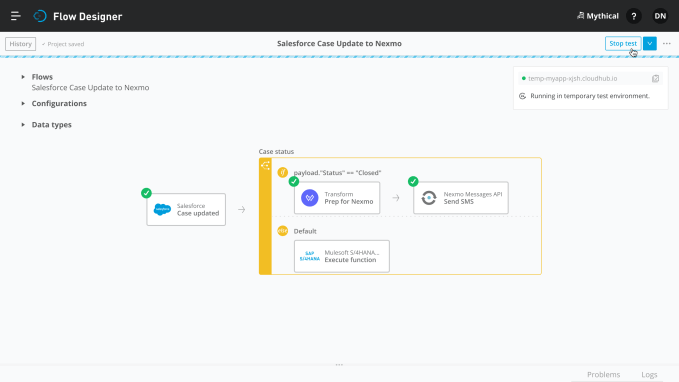
Finally, the company announced Flow Designer, a new tool fueled by Einstein AI, which helps automate the creation of workflows and integrations between systems in a more automated fashion without requiring coding skills.

MuleSoft Flow Designer requires no coding (Screenshot: MuleSoft)

Dao says this is about putting MuleSoft in reach of more users. “It’s about enabling use cases for less technical users in the context of the MuleSoft Anypoint Platform. This really requires a new way of thinking around creating integrations, and we’ve been making Flow Designer simpler and simpler, and removing that technical layer from those users,” he said.

API Community Manager is available now. Accelerators will be available by the end of the year and Flow Designer updates will be available Q2 2020, according to the company.

These and other features are all designed to take some of the complexity out of using MuleSoft to help connect various systems across the organization, including both Salesforce and external programs, to make use of data wherever it lives. MuleSoft does requires a fair bit of technical skill, so if the company is able to simplify integration tasks, it could help put it in the hands of more users.

Valve confirms it’s making a ‘flagship’ Half-Life VR game

After what feels like years of rumors, it’s official: Valve is making a virtual reality Half-Life game.

Official word of the new title comes via Valve’s (brand new, but verified) Twitter account, where the company is promising more details later this week:

While it’s a bit curious to drop news like this as the first tweet from a brand new account, Valve’s long-established official Steam twitter account retweeted it — so signs are pointing toward it being legit.

Alas, we know next to nothing besides the name — Half-Life: Alyx — until 10 am on Thursday. Will we finally get a proper conclusion for Alyx Vance, whose storyline ended so abruptly when Valve dropped the Half-Life storyline mid-sentence 12 years ago ?