More than 1 million T-Mobile customers exposed by breach

T-Mobile has confirmed a data breach affecting more than a million of its customers, whose personal data (but no financial or password data) was exposed to a malicious actor. The company alerted the affected customers but did not provide many details in its official account of the hack.

The company said in its disclosure to affected users that its security team had shut down “malicious, unauthorized access” to prepaid data customers. The data exposed appears to have been:

  • Name
  • Billing address
  • Phone number
  • Account number
  • Rate, plan and calling features (such as paying for international calls)

The latter data is considered “customer proprietary network information” and under telecoms regulations they are required to notify customers if it is leaked. The implication seems to be that they might not have done so otherwise. Of course some hacks, even hacks of historic magnitude, go undisclosed sometimes for years.

In this case, however, it seems that T-Mobile has disclosed the hack in a fairly prompt manner, though it provided very few details. When I asked, a T-Mobile representative indicated that “less than 1.5 percent” of customers were affected, which of the company’s approximately 75 million users adds up to somewhat over a million.

The company reports that “we take the security of your information very seriously,” a canard we’ve asked companies to stop saying in these situations.

The T-Mobile representative stated that the attack was discovered in early November and shut down “immediately.” They did not answer other questions I asked, such as whether it was on a public-facing or internal website or database, how long the data was exposed and what specifically the company had done to rectify the problem.

The data listed above is not necessarily highly damaging on its own, but it’s the kind of data with which someone might attempt to steal your identity or take over your account. Account hijacking is a fairly common tactic among cyber-ne’er-do-wells these days and it helps to have details like the target’s plan, home address and so on at one’s fingertips.

If you’re a T-Mobile customer, it may be a good idea to change your password there and check up on your account details.

Maryanna Saenko and Steve Jurvetson of Future Ventures talk SpaceX, the Boring Co. and . . . ayahuasca

Last week, at a StrictlyVC event in San Francisco, we sat down with Maryanna Saenko and Steve Jurvetson, investors who came together to create the investment outfit Future Ventures roughly one year ago. It was their first public appearance together since announcing their $200 million fund, and we started by asking Jurvetson about his high-profile split from his old firm DFJ. (He said of the experience that “sometimes life forces a dislocation in what you’re doing, and it got me to become an entrepreneur for the first time in a long time.”)

We also talked about how the two came together and where they’re shopping, as they have fewer constraints than most firms. It was a wide-ranging chat that covered SpaceX and to a lesser extent Tesla, whose boards of directors Jurvetson sits on. We also talked about The Boring Company, in which Future Ventures has a stake, the profound dangers of the AI race between companies (and countries), and whether the powerful psychedelic ayahuasca — or something like it — might represent an investment opportunity. Included in the mix was what Jurvetson described as potentially the “biggest money-making opportunity” he has “ever seen.”

Read on to learn more. Our conversation has been edited lightly for length.

You’ve come together to build this new fund that has a 15-year investing horizon. Your interests overlap quite a bit. Maryanna, you’re a robotics expert with degrees from Carnegie Mellon; you were with Airbus Ventures before joining DFJ then heading later to Khosla Ventures. Who is better at what?

SJ: She’s better at everything, is the answer, but I think we’re better as a pair. The beauty of small team is you’re better than you would be on your own. I knew when I set off that I didn’t want to do it alone. I know that the people I’ve worked with over the last 20 years have made me better. The best investments I did at DFJ I largely attribute to the junior partner I was working with at the time, and I might not have done those best deals if I was on my own.

There’s something about the dialectic, the discussion, the debates with someone you respect whose opinion is valuable, so rather than thinking, ‘You handle this, I’ll handle that’ and partitioning it, it’s more of a [back and forth]. So we have partner meetings all the time, just not any scheduled meetings.

Certainly, Maryanna’s deep background in robotics is a vein of interest, as is all the aerospace stuff. But just a reminder, when I first interviewed her [Jurvetson originally hired her at DFJ], I was blown away that she had already invested in several of the quirky sectors from quantum computer to phasor antennas for satellites to [inaudible but relating to space].

Of course you would be investing [in this thing I’ve never heard of before].

MS: It’s going to become relevant, I promise.

Speaking of aerospace, you two have invested in SpaceX, a company that DFJ had also backed. Is this company ever going to go public?

SJ: I think the official last tweet on this matter was that the company will go public after there are regularly scheduled flights to Mars.

Which is when?

SJ: It might not be that far off. Probably within the 15-year [investing] cycle that we have now. Clearly the business is much more dramatic than just that. That’s the big storm on the horizon [that captures a lot of interest] but in the near term, there are multiple billions of dollars in revenue. They’re a profitable business. And frankly, they’re about to launch what may be the biggest money-making opportunity I’ve ever seen in my life, which is the broadband satellite data business [Starlink, which is a constellation being constructed by SpaceX to provide satellite Internet access].

So there’s plenty of good stuff happening before we get to Mars. That was just a way to put all the investment bankers off. They’re continuously hounding the company, ‘When are you going public? When are you going public?’

It is 17 years old. Have you made money off it [as an investor] thus far?

SJ: Oh, yeah, at our prior firm, they’ve [enjoyed] well over $1 billion in profit [through secondary sales].

What do you think of scientists’ concerns that these satellites going to ruin astronomy because they’re so bright? I know SpaceX has tried to paint them. I also know SpaceX isn’t alone and that Amazon is also trying to put up a constellation, for example. But you’re a mission-driven firm. Should we be worried that we’re littering the sky with these things?

MS: One of the fundamental questions when you invest in technology is what are the second-order effects that we’re aware of and what are the second-order effects that we’re not clever enough to foresee ahead of time [and] to look holistically at these problems.

So first and foremost, right, it’s not just Space X. Many companies these days are trying to put up a constellation whether in [Low Earth Orbit] or [Medium Earth Orbit] or increasingly in [Geostationary Orbit]. We need to think mindfully and work with the scientific communities and say, ‘What are the needs?’ Because the reality is that the communication is going to go up, and if it’s not from U.S. companies, it’ll be from European or from Asian companies. So I think the scientific community needs to wake up, unfortunately, to the reality that the Luddite form of saying, ‘Technology isn’t going up to space’ . . . and they should say say, ‘Here’s a set of metrics that we’d like to continue moving forward with.’

Ideally we can design to those specs. Beyond that, I fundamentally believe we’ll find ways to shine brighter lights and move further [out]. Honestly, most of the interesting imaging happens well past [Low Earth Orbit] and I think when we start building a lunar base, we’ll solve a lot of these problems.

At StrictlyVC’s last event, we played host to a supersonic jet company called Boom. There are a handful of companies with which it competes, too–

MS: Oh, more than [a handful]. If you count just pure electric aircraft companies, I’ve met with 55 of, I would guess, around 200 or 300. Within that, supersonic is smaller, but it’s still in the dozens.

Whoa, that many? Does the world need supersonic jets — again?

MS: [As a] recovering engineer and scientist, the way that I look at the space is does the business model fundamentally [make more sense] than when we tried this the last time in the ’80s. If the answer is, ‘This time, we’re a bunch of clever software kids building an aerospace device and don’t worry about it, we’ll figure out how to build an aircraft,’ I’m going to tell you all the reasons that isn’t necessarily going to work.

I think on the electric aircraft side, we have a bunch of questions to answer about what is the timeline of battery density versus what is a mission profile for these flights that actually makes sense. On the long-range side, we can look at what SpaceX might do with point-to-point capsules. [At the intermediate stage, hypersonic fight], I have not yet seen an engineering trajectory matched with a business model that I think closes in this space, at all, so I’m not sure what the bankers are doing,

SJ: Also, the FAA regulatory cycle is very long. But [in addition to these reasons], our life becomes very simple the moment we know there are 55 to maybe 200 companies in a sector, and this is true for small sat launch or eVTOL aircraft — huge swaths of the landscape. Whenever there’s more than one or two [companies in a space], we don’t even want to meet unless we’re just trying to understand what’s going on. Why would anyone invest in the 130th small sat launch company? We try to look for companies that are unlike anything that’s been seen before at the time.

On that note, there’s only one new company that I know of that’s digging a tunnel-based transportation system, Boring Company. It’s another investment of Future Ventures . Did it come with a board seat?

SJ: No. We’re in the first round of investment.

Is this a real company? I’ve read it takes $1 billion to tunnel through a mile.

SJ: It depends where you’re digging. That’s the worst case, but it can be up there, like when Boring Company won this contract in Las Vegas for a very short segment, the competition was bidding like $400 million for just a mile. It was like, really?

If you think about the pattern across aerospace with SpaceX, [the motor] issue with Tesla, and now potentially in construction, fintech, and agriculture, there are industries that haven’t [seen major innovation] in a long time. So the top four companies in America that are digging tunnels all started in the 1800s. That’s an especially long time ago. And the whole point, too, with Boring is switching diesel to electric, to do continuous digging, to reengineer the entire thing with a software and simulation mindset, to dramatically increase the speed and lower the cost. Think two orders of magnitude cheaper at least.

Steve, you’d said once before that in most of the deals you’ve funded across your career, yours was the only check, that there just wasn’t any competition. But more people are focused on the ‘future’ as an investment theme now. Is it harder to find those outliers?

SJ: It’s a little harder. We usually use that as a signal to look to a new market whenever there are multiple checks, When it’s a category, when there are conferences about it, when other venture firms are talking about it, that’s usually a sure-enough sign that we already should have moved on to something else.

MS: The simple reality, too, is the industry is focused on a handful of sectors — enterprise software, consumer internet, and the like — and often there are fantastic funds with one or two edge-case investments, and that’s great, because we love those funds and we want to work with them. But there are very few funds where that trajectory is the straight and narrow of their fundamental thesis.

You raised $200 million for this fund from tech CEOs and hedge funds and VCs; do you have the same constraints that other firms have?

MS: I don’t think we have particularly fine constraints on anything, but we do have the constraint of our own conviction, our word and the quality of our characters, so one of the theses when we raised the fund was that we don’t prey on human frailty, so no addictive substances, no [social media influencers] — and not just because we’re bad at being cool hunters. But that’s not our intention; that’s not what we’re trying to create in the world.

I know you’re interested in AI. What does that mean? Are you funding drug development?

SJ: What have you heard? That’s a really good guess.

There are so many companies — hundreds of them —  using AI to try and uncover drug candidates, but they don’t seem to be getting very far or maybe they’re aren’t getting far enough along as fast as I’d expected.

SJ: [We have a related deal in process]. Interestingly, we’ve done ten deals that have closed; we have three more that are in the process, two in the signed term sheet phase. Four are in the area of edge intelligence . . .

MS: I’ll often come at things from how would I build this robot in the world to do some critical task and Steve often looks at it more from the chip and power and processing and how you lay the algorithm onto the silicon. And between those two, we arrive at a really interesting thesis up and down the stack. So we’ve done Mythic, an edge intelligence chip company, but we’ve also looked at this idea that we’re going to send out these AIs into the world but we basically bake them into these edge devices that are terrible [because they don’t work well].

The real issue is an AI that’s getting trained somewhere in some cloud then getting pushed to your edge device and then, good luck. But increasingly [we’re thinking] about continuous improvement of those AIs as they’re running in real time and mindful of how we shuttle the data back to the mother ship data centers. [We’re looking to] enable continuous improvement and acceleration of that learning. We have a number of portfolio companies up and down that stack that I’m incredibly excited about.

That all sounds comfortably pedestrian compared to the very big picture, wherein a small group of companies is amassing all the richest data to train AI and are growing more powerful by the day. Steve, you’ve talked about this before, about your concerns that one day there could be very few companies, which would exacerbate income inequality. You said this could be a bigger threat to society than climate change. Do you think these companies — Facebook, Amazon, Google — should be broken up?

SJ: No, I don’t think they should be broken up, but I do think it’s an inexorable trend in the the technology business that there are power laws within firms and between firms . . . If you want to maintain capitalism and democracy, it’s not self-rectifying and it’s only going to get worse. Compared to when we last spoke about this [in 2015], it’s gotten a lot worse. The data concentration, the usage of it.

Think, for example, of SenseTime in China . . . it recognizes faces better than any other algorithm on earth right now . . . So you have the U.S. power laws and power laws between countries as well. That’s just one new pejoration as AI and quantum computing escalates.

So everyone in technology and who invests in it should be thoughtful about what this means and think about entrepreneurial paths to the future we want to live in . . . how we get from here to there is not obvious. The markets [will handle some but not all of these things]. So it’s very worrisome and when I said it’s worse than climate change, I meant it will have more impact on whether humanity makes it through the next 20 years. Climate change [may do us in] 200 years from now but there’s some serious pressing issues over the next 20 years.

And breaking up these companies isn’t part of the solution.

It’s almost like this notion of controlling an AI that’s greater than human intelligence. How would you ever imagine you would control such a thing? How would you even imagine understanding its inner workings? So the notion that through regulation you could break up a natural monopoly when everything that fixes the industry creates a natural monopoly, it’d be like whack-a-mole.

What’s the answer? Looking around the corner, what are you funding that’s going to blow people’s minds? Ayahuasca? Is there a market for that? I know it’s everywhere.

SJ: [Looking shocked.] There are two companies, one we wired funds earlier today and the other is a signed term sheet and they relate to your questions.

MS: We should check if the office is bugged [laughs].

SJ: There’s a lot going on. Curing mental illness. Alternative modalities.

MS: The largest rising global epidemic is depression. Adolescent suicide rates are up 300 percent in the U.S. in the last 10 years. And we don’t have the resources, the skills, the technologies and the licensed therapists available. We know there are medicinal compounds, often from plant vines, that have shown incredible value in addressing treatment-resistant depressions and addiction and abusive substances. And often participation in those things is a privilege of particular groups in society and so how do we democratize access to mental health.

Wait, I can’t believe I guessed it. You’re investing in an ayahuasca-related startup!?

SJ: It’s close, not exactly. [Laughs.]

Inside Prosus Ventures’ $4.5 billion bet on India

Prosus Ventures last week filed a hostile offer for British food delivery startup Just Eat, an attempt to defeat a unanimous rejection from its board and simultaneously fend off a bid from rival Takeaway.

The giant Naspers spinoff said it was willing to pay as much as $6.3 billion in cash to lure Just Eat, one of Europe’s largest foodtech players.

Prosus’ major bet on online food startups shouldn’t come as a surprise; the recently-listed subsidiary, whose parent firm has invested in companies in more than 90 nations, has shown a great appetite for food delivery startups globally.

How deeply Prosus believes in foodtech is perhaps on display in emerging markets such as India, one of the most buzziest nations for the investment firm, where the unit economics doesn’t work yet for almost any internet startup and probably won’t for another few years.

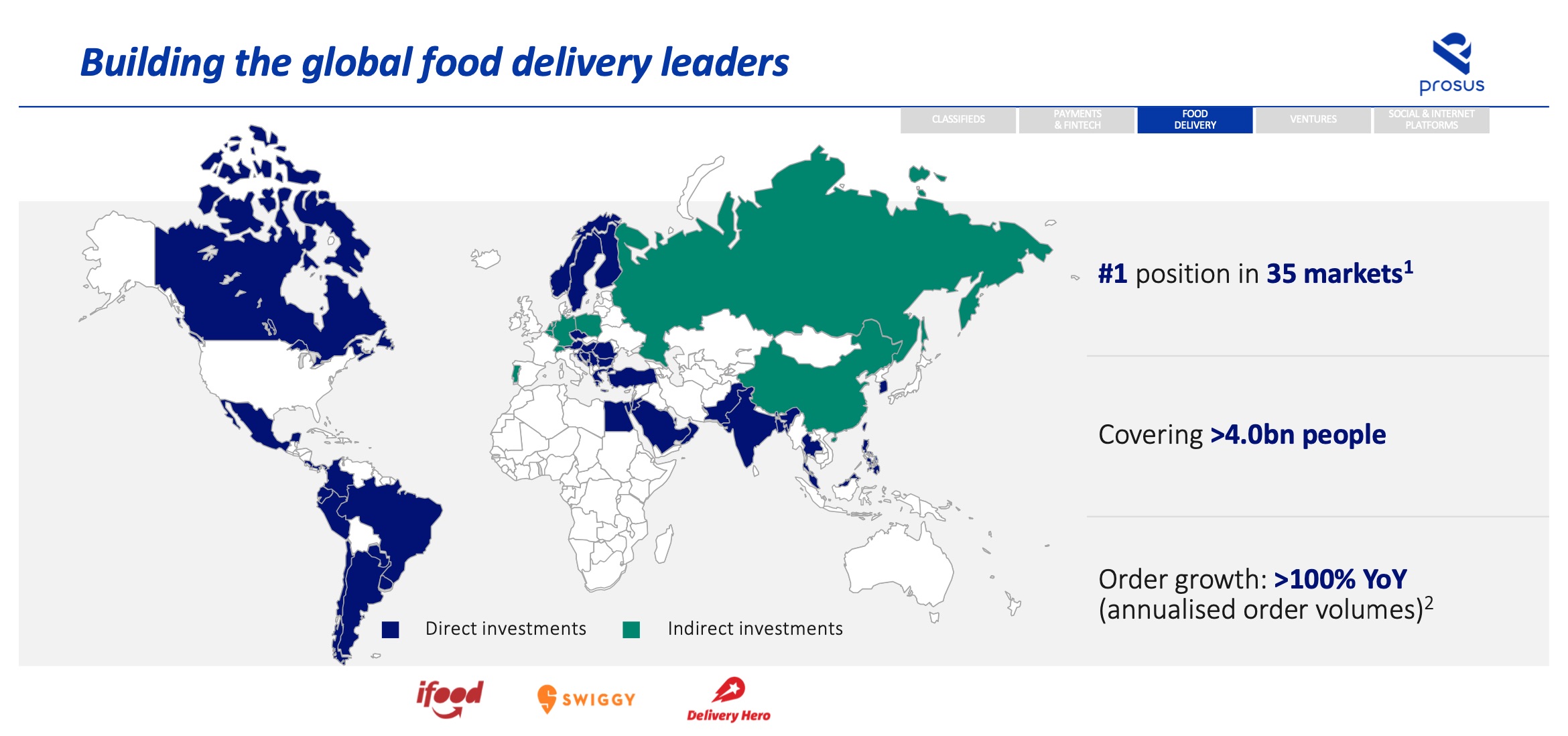
Prosus Ventures’ investments in food delivery startups globally

Last year, South Africa-based Naspers led a $1 billion financing round for Indian food delivery startup Swiggy. The investment firm contributed $716 million to the round, just shy of the roughly $750 million that Swiggy’s chief rival, Zomato, has raised in its 11 years of existence.

TechCrunch spoke with Larry Illg, CEO of Prosus Ventures and Food, and Ashutosh Sharma, head of investments for India at the venture firm, to understand how significant foodtech is for the investment firm and the bets it is making in India.

Swiggy

“We had a thesis on food delivery globally,” said Illg, describing the company’s first search for a food delivery company in India. “We knew that at least one big player will be there in India in the future. We went around the town and spoke to a lot of startups.”

And then they found Swiggy. But, Illg said, it was a very different Swiggy from the one that currently dominates the Indian market. “So here was a food delivery startup that was already profitable. The only challenge was that it was operational in just six cities in India.”

And thus began Naspers’ journey to convince Swiggy to expand its service nationwide. Now operational in more than 500 cities around the country, Swiggy today competes with Zomato, UberEats, and Ola-owned FoodPanda (now known as Ola Foods).

Prosus Ventures’ Sharma, who heads India business, cautioned that it is early for food startups in India. “I want to say we are on day one, but it might as well be day zero. The number of smartphone users in India who are ordering food online is still less than 2%,” he said.

But even this nascent category has attracted some tough competitors. While UberEats and Ola’s Foods are struggling to make a significant dent, Swiggy and Ant Financial-backed Zomato are locked in an intense battle.

Both companies, according to industry reports, are losing more than $20 million each month. Zomato was burning about $45 million each month a year ago, Info Edge, a publicly-listed investor in the startup revealed in its recent earnings call with analysts.

Illg is not really bothered with the frenzy cash burn in India’s food delivery market, and said Prosus has no shortage of cash, either.

That cash might come in handy very soon. A source at Zomato told TechCrunch that the company is in talks to raise as much as $550 million in a round led by Ant Financial .

TechCrunch reported earlier this year that Zomato is quietly setting up its own supply chain to control the raw material its restaurant partners use. Two sources familiar with Zomato say the food delivery startup is thinking of expanding beyond delivering food items.

Earlier this year, Swiggy announced that its delivery fleet can now move just about anything from one part of the city to another. The service, called Swiggy Go, is currently limited to select cities. Zomato plans to replicate this, sources say. Neither of these developments have been previously reported.

Additionally, cloud kitchens are current area of focus for Swiggy. This week, the company announced it has established more than 1,000 cloud kitchens in the country, more so than any of its rivals.

Illg said cloud kitchens are crucial for a country like India, which has a low density of restaurants. “We have the visibility of all the market dynamics,” he said. “We can look at a location, comb through the data and know what kind of restaurants and food supplies would work there.”

Chinese spy defects to Australia, alleging election interference and cybercrimes

A purported agent of the Chinese intelligence service is seeking asylum in Australia, bringing with him explosive allegations of widespread interference in political affairs in that country, Taiwan and elsewhere. He claims also to have run a cyberterrorism campaign against supporters of Hong Kong independence.

Wang “William” Liqiang indicated to Australian news outlet The Age that during a deep-cover assignment intended to manipulate the 2020 presidential election in Taiwan, he decided to defect and expose the Chinese networks from abroad.

In addition to The Age, Wang spoke with The Sydney Morning Herald and 60 Minutes; the various outlets appear to be planning a broader release of the contents of his interviews on Monday.

Wang has reportedly explained in detail the inner workings of a Hong Kong-listed company called China Innovation Investment Limited, which the government has allegedly been using as a front to infiltrate various universities, political groups and media companies.

He claims to have personally been involved in the infamous kidnapping of Lee Bo and other booksellers in Hong Kong whose disappearance prompted widespread protests.

He also says that he helped direct a “cyber army” to dox, attack and otherwise harass Hong Kong’s independence protestors, and that he was working on establishing one to affect the 2020 election in Taiwan.

Operations in Australia and other countries were implied but not detailed in initial reports of Wang’s defection. He is reportedly currently at an undisclosed location in Sydney pending formal protections from the Australian government.

More information is expected to be revealed on Monday by the outlets Wang spoke to, so stay tuned.

Facebook prototypes Favorites for close friends microsharing

Facebook is building its own version of Instagram Close Friends, the company confirms to TechCrunch. There are a lot people that don’t share on Facebook because it can feel risky or awkward as its definition of “friends” has swelled to include family, work colleagues and distant acquaintances. No one wants their boss or grandma seeing their weekend partying or edgy memes. There are whole types of sharing, like Snapchat’s Snap Map-style live location tracking, that feel creepy to expose to such a wide audience.

The social network needs to get a handle on microsharing. Yet Facebook has tried and failed over the years to get people to build Friend Lists for posting to different subsets of their network.

Back in 2011, Facebook said that 95% of users hadn’t made a single list. So it tried auto-grouping people into Smart Lists like High School Friends and Co-Workers, and offered manual always-see-in-feed Close Friends and only-see-important-updates Acquaintances lists. But they too saw little traction and few product updates in the past eight years. Facebook ended up shutting down Friend Lists Feeds last year for viewing what certain sets of friends shared.

Then a year ago, Instagram made a breakthrough. Instead of making a complicated array of Friend Lists you could never remember who was on, it made a single Close Friends list with a dedicated button for sharing to them from Stories. Instagram’s research found 85% of a user’s Direct messages go to the same three people, so why not make that easier for Stories without pulling everyone into a group thread? Last month I wrote that “I’m surprised Facebook doesn’t already have its own Close Friends feature, and it’d be smart to build one.”

How Facebook Favorites works

Now Facebook is in fact prototyping its a feature similar to Instagram Close Friends called Favorites. It lets users designate certain friends as Favorites, and then instantly send them their Facebook Story or a  camera-based post from Messenger to just those people, each in their own message thread.

The feature was first spotted inside Messenger by reverse engineering master and frequent TechCrunch tipster Jane Manchun Wong. Buried in the Android app is the code that let Wong generate the screenshots (above) of this unreleased feature. They show how when users go to share a Story or camera post from Messenger, they can instantly send it over chat to everyone on in their Favorites, and edit who’s on that list by adding up to 10 people manually or from algorithmic suggestions. For now Favorites isn’t an audience for sharing Stories like Instagram Close Friends is, but you could imagine Facebook expanding Favorites to have that functionality down the line.

[Update: Facebook had originally confirmed Favorites was for sharing via Stories, but later corrected itself saying posts are sent to Favorites via Messenger.]


A Facebook spokesperson confirmed to me that this feature is a prototype that the Messenger team created. It’s an early exploration of the microsharing opportunity, and the feature isn’t officially testing internally with employees or publicly in the wild. The spokesperson describes the Favorites feature as a type of shortcut for sharing to a specific set of people. They tell me that Facebook is always exploring new ways to share, and as discussed at its F8 conference this year, Facebook is focused on improving the experience of sharing with and staying more connected to your closest friends.

Unlocking creepier sharing

There are a ton of benefits Facebook could get from a Favorites feature if it ever launches. First, users might share more often if they can make content visible to just their best pals, as those people wouldn’t get annoyed by over-posting. Second, Facebook could get new, more intimate types of content shared, from the heartfelt and vulnerable to the silly and spontaneous to the racy and shocking — stuff people don’t want every single person they’ve ever accepted a friend request from to see. Favorites could reduce self-censorship.

“No one has ever mastered a close friends graph and made it easy for people to understand . . . People get friend requests and they feel pressure to accept,” Instagram director of product Robby Stein told me when it launched Close Friends last year. “The curve is actually that your sharing goes up and as you add more people initially, as more people can respond to you. But then there’s a point where it reduces sharing over time.” Google+, Path and other apps have died chasing this purposefully selective microsharing behavior.

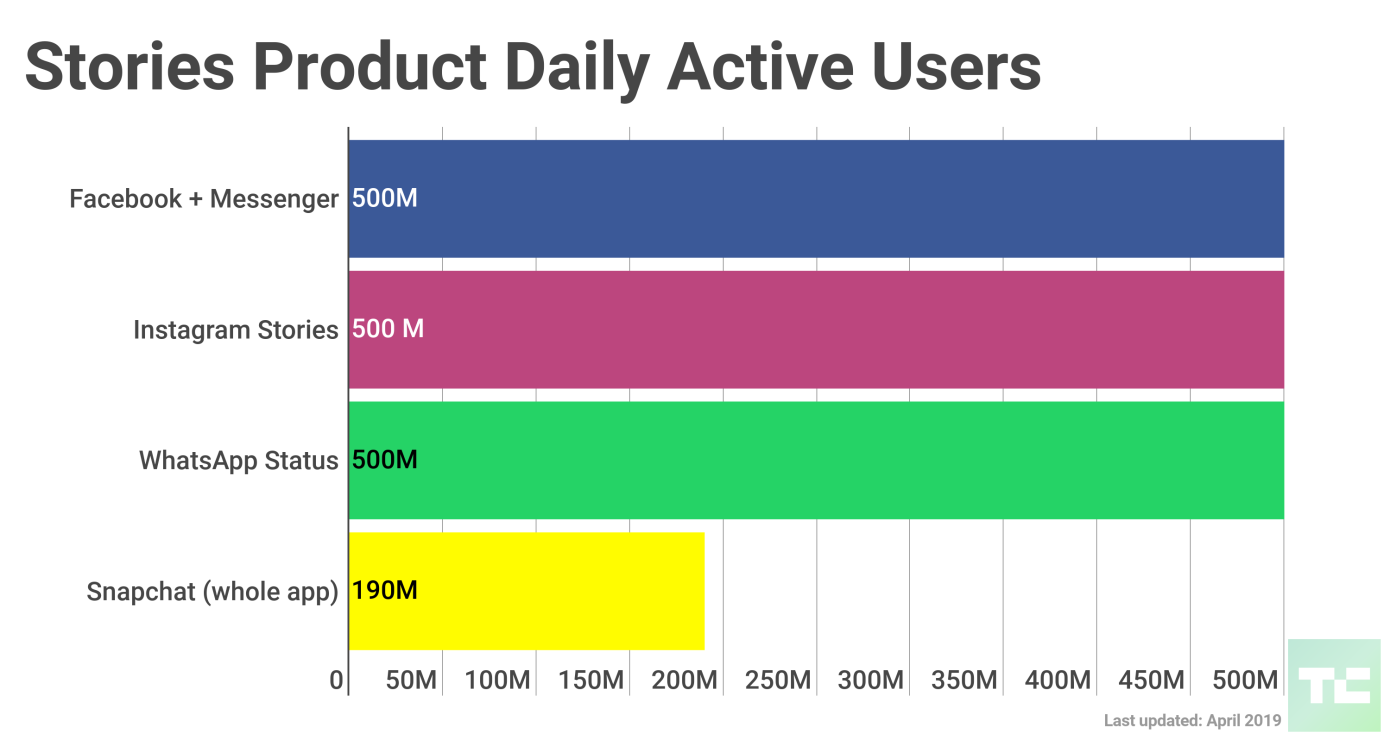
Facebook Favorites could stimulate lots of sharing of content unique to its network, thereby driving usage. After all, Facebook said in April that it had 500 million daily Stories users across Facebook and Messenger posting from the camera, and the same number as Instagram Stories and WhatsApp Status.

Before Instagram launched Close Friends, it actually tested the feature under the name Favorites and allowed you to share feed posts as well as Stories to just that subset of people. And last month Instagram launched the Close Friends-only messaging app Threads that lets you share your Auto-Status about where or what you’re up to.

Facebook Favorites could similarly unlock whole new ways to connect. Facebook can’t follow some apps like Snapchat down more privacy-centric product paths because it knows users are already uneasy about it after 15 years of privacy scandals. Apps built for sharing to different graphs than Facebook have been some of the few social products that have succeeded outside its empire, from Twitter’s interest graph, to TikTok’s fandoms of public entertainment, to Snapchat’s messaging threads with besties.

Instagram Threads

A competent and popular Facebook Favorites could let it try products in location, memes, performances, Q&A, messaging, live streaming and more. It could build its own take on Instagram Threads, let people share exact location just with Favorites instead of just what neighborhood they’re in with Nearby Friends or create a dedicated meme resharing hub like the LOL experiment for teens it shut down. At the very least, it could integrate with Instagram Close Friends so you could syndicate posts from Instagram to your Facebook Favorites.

The whole concept of Favorites aligns with Facebook CEO Mark Zuckerberg’s privacy-focused vision for social networking. “Many people prefer the intimacy of communicating one-on-one or with just a few friends,” he writes. Facebook can’t just be the general purpose catch-all social network we occasionally check for acquaintances’ broadcasted life updates. To survive another 15 years, it must be where people come back each day to get real with their dearest friends. Less can be more.

Making sense of a multi-cloud, hybrid world at KubeCon

More than 12,000 attendees gathered this week in San Diego to discuss all things containers, Kubernetes and cloud-native at KubeCon.

Kubernetes, the container orchestration tool, turned five this year, and the technology appears to be reaching a maturity phase where it accelerates beyond early adopters to reach a more mainstream group of larger business users.

That’s not to say that there isn’t plenty of work to be done, or that most enterprise companies have completely bought in, but it’s clearly reached a point where containerization is on the table. If you think about it, the whole cloud-native ethos makes sense for the current state of computing and how large companies tend to operate.

If this week’s conference showed us anything, it’s an acknowledgment that it’s a multi-cloud, hybrid world. That means most companies are working with multiple public cloud vendors, while managing a hybrid environment that includes those vendors — as well as existing legacy tools that are probably still on-premises — and they want a single way to manage all of this.

The promise of Kubernetes and cloud-native technologies, in general, is that it gives these companies a way to thread this particular needle, or at least that’s the theory.

Kubernetes to the rescue

Photo: Ron Miller/TechCrunch

If you were to look at the Kubernetes hype cycle, we are probably right about at the peak where many think Kubernetes can solve every computing problem they might have. That’s probably asking too much, but cloud-native approaches have a lot of promise.

Craig McLuckie, VP of R&D for cloud-native apps at VMware, was one of the original developers of Kubernetes at Google in 2014. VMware thought enough of the importance of cloud-native technologies that it bought his former company, Heptio, for $550 million last year.

As we head into this phase of pushing Kubernetes and related tech into larger companies, McLuckie acknowledges it creates a set of new challenges. “We are at this crossing the chasm moment where you look at the way the world is — and you look at the opportunity of what the world might become — and a big part of what motivated me to join VMware is that it’s successfully proven its ability to help enterprise organizations navigate their way through these disruptive changes,” McLuckie told TechCrunch.

He says that Kubernetes does actually solve this fundamental management problem companies face in this multi-cloud, hybrid world. “At the end of the day, Kubernetes is an abstraction. It’s just a way of organizing your infrastructure and making it accessible to the people that need to consume it.

“And I think it’s a fundamentally better abstraction than we have access to today. It has some very nice properties. It is pretty consistent in every environment that you might want to operate, so it really makes your on-prem software feel like it’s operating in the public cloud,” he explained.

Simplifying a complex world

One of the reasons Kubernetes and cloud-native technologies are gaining in popularity is because the technology allows companies to think about hardware differently. There is a big difference between virtual machines and containers, says Joe Fernandes, VP of product for Red Hat cloud platform.

“Sometimes people conflate containers as another form of virtualization, but with virtualization, you’re virtualizing hardware, and the virtual machines that you’re creating are like an actual machine with its own operating system. With containers, you’re virtualizing the process,” he said.

He said that this means it’s not coupled with the hardware. The only thing it needs to worry about is making sure it can run Linux, and Linux runs everywhere, which explains how containers make it easier to manage across different types of infrastructure. “It’s more efficient, more affordable, and ultimately, cloud-native allows folks to drive more automation,” he said.

Bringing it into the enterprise

Photo: Ron Miller/TechCrunch

It’s one thing to convince early adopters to change the way they work, but as this technology enters the mainstream. Gabe Monroy, partner program manager at Microsoft says to carry this technology to the next level, we have to change the way we talk about it.

Microsoft adds M?ori to translator as New Zealand pushes to revitalize the language

The benefits of machine translation are easy to see and experience for ourselves, but those practical applications are only one part of what makes the technology valuable. Microsoft and the government of New Zealand are demonstrating the potential of translation tech to help preserve and hopefully breathe new life into the M?ori language.

Te reo M?ori, as it is called in full, is of course the language of New Zealand’s largest indigenous community. But as is common elsewhere as well, the tongue has fallen into obscurity as generations of M?ori have assimilated into the dominant culture of their colonizers.

M?ori people make up about 15% of the population, and only a quarter of them speak the language, making for a grand total of 3% that speak te reo M?ori. The country is hoping to reverse the trend by pushing M?ori language education broadly and taking steps to keep it relevant.

Microsoft and New Zealand’s Te Taura Whiri i te Reo M?ori, or M?ori Language Commission, have been working together for years to make sure that the company’s software is inclusive of this vanishing language. The latest event in that partnership is the inclusion of M?ori into Microsoft’s Translator service, meaning it can now be automatically translated into any of the other 60 supported languages, and vice versa.

That’s a strong force for inclusion and education, of course, as automatic translation tools are a great way to engage with content, check work, explore previously untranslated documents, and so on.

Creating an accurate translation model is difficult for any language, and the key is generally to have a large corpus of documents to compare. So a necessary part of the development, and certainly something the Commission helped with, was putting together that corpus and doing the necessary quality checks to make sure translations were correct. With few speakers of the language, this would be a more difficult process than, say, creating a French-German translator.

One of the speakers who helped, Te Taka Keegan from the University of Waikato, said (from this Microsoft blog post):

The development of this M?ori language tool would not have been possible without many people working towards a common goal over many years. We hope our work doesn’t simply help revitalize and normalize te reo M?ori for future generations of New Zealanders, but enables it to be shared, learned and valued around the world. It’s very important for me that the technology we use reflects and reinforces our cultural heritage, and language is the heart of that.

Languages are dying out left and right, and although we can’t prevent that entirely, we can use technology to help make sure that they are both recorded and capable of being used alongside the dwindling number of active languages.

The M?ori translation program is part of Microsoft’s AI for Cultural Heritage program.

Direct mail still works if you avoid common mistakes

Julian Shapiro
Contributor

Julian Shapiro is the founder of BellCurve.com, the growth marketing team that trains startups in advanced growth, helps you hire senior growth marketers, and finds you vetted growth agencies. He also writes at Julian.com.

We’ve aggregated many of the world’s best growth marketers into one community. Twice a month, we ask them to share their most effective growth tactics, and we compile them into this Growth Report.

This is how you stay up-to-date on growth marketing tactics — with advice that’s hard to find elsewhere.

Our community consists of 1,000 startup founders and VP’s of growth from later-stage companies. We have 400 YC founders, plus senior marketers from companies including Medium, Docker, Invision, Intuit, Pinterest, Discord, Webflow, Lambda School, Perfect Keto, Typeform, Modern Fertility, Segment, Udemy, Puma, Cameo and Ritual .

You can participate in our community by joining Demand Curve’s marketing webinars, Slack group, or marketing training program.

Without further ado, onto our community’s advice.

Advertising in Discord/Telegram communities

Insights from Varun Mathure of Midnite

Discord/Telegram can be a great place to find engaged, niche communities for advertising. However, do not treat it like a typical ad channel. Community marketing is its own art, and there are many principles to doing it effectively. Here are just a few:

  • Treat Discord/Telegram users like you would Reddit users: they’ll reject being advertised to unless there’s legitimate, authentic value being provided.
  • Work with moderators to offer services that make their moderation duties easier. Perhaps a bot or tool that would be legitimately useful to the community while also organically pitching your startup.
  • Have a well-respected community member vouch for you — it goes a long way toward building trust with the rest of the community. Always start by building relationships.
  • Have a member of your team active in the community. Don’t just advertise; contribute regularly.
  • Run promos/incentives that encourage members to post your product screenshots or share your product output in the community. In other words, incentivize a frictionless way for community members to become your brand ambassadors.

Landing page tear-downs [Video]

Watch us critique landing pages. In the process, you’ll learn how to improve your own.

Most common direct mail mistakes

FCC bans spending on Huawei, ZTE and other ‘national security threats’

The FCC has finally put the seal of approval on its plan to cut funding going to equipment from companies it deems a “national security threat,” currently an exclusive club of two: Huawei and ZTE.

No money from the FCC’s $8.5 billion Universal Service Fund, used to subsidize purchases to support the rollout of communications infrastructure, will be spent on equipment from these companies.

“We take these actions based on evidence in the record as well as longstanding concerns from the executive and legislative branches,” said FCC Chairman Ajit Pai in a statement. “Both companies have close ties to China’s Communist government and military apparatus. Both companies are subject to Chinese laws broadly obligating them to cooperate with any request from the country’s intelligence services and to keep those requests secret. Both companies have engaged in conduct like intellectual property theft, bribery, and corruption.”

The Chinese companies have faced federal scrutiny for years, and vague suspicions of selling compromised hardware that the government there could take advantage of, but it was only at the beginning of 2019 that things began to heat up with the controversial arrest of Huawei CFO Meng Wanzhou. The companies, it hardly needs mentioning, have vehemently denied all allegations.

Increasingly complicated relations between China and the U.S. generally compounded the difficulty of ZTE and Huawei operating in the States, as well as selling to or purchasing from American companies.

The FCC’s new rule was actually proposed well before things escalated, a fact that Commissioner Jessica Rosenworcel, though she supported the measure, emphasized.

“This is not hard,” she wrote in a statement accompanying the new rule. “It should not have taken us eighteen months to reach the conclusion that federal funds should not be used to purchase equipment that undermines national security.”

Working out the details may have been difficult, however, given the generally chaotic state of the federal government right now. For instance, one month this summer it was going to be illegal for U.S. firms to sell their products to Huawei — and then it wasn’t. Just yesterday several senators wrote to protest the Department of Commerce issuing licenses to firms doing business with Huawei.

Another proposal discussed today but not yet adopted would require companies that receive USF funds to remove equipment from those companies that they may have already installed.

Admittedly it may be a financial burden for smaller carriers to comply with these rules. There’s a plan for that, though, as Chairman Pai explained: “To mitigate the financial impact of this requirement, particularly on small, rural carriers, we propose to establish a reimbursement program to help offset the cost of transitioning to more trusted vendors.”

Tesla’s Cybertruck will have a solar charging option, says Musk


Tesla revealed its Cybertruck pickup last night, a SciFi-tastic wedge built from the same steel alloy that SpaceX is using for its Starship spaceship.

Elon Musk spent about 20 minutes showing off the truck, with demos ranging from a game of tug-of-war against an F-150, to racing a Porsche, to a window strength test that didn’t go quite as planned.

This morning, Elon is trickling out other details he didn’t get around to mentioning onstage — like that they’re planning to offer a solar charging option.

While it sounds like Tesla is still working out the exact details, Elon shed some light on the solar option via tweet:

The Cybertruck’s long, angled sides seem like they’d lend themselves well to doubling as solar panels — the whole cover of the “Vault” truck bed is effectively one big flat surface, after all. Even so, don’t go expecting a solar charging Cybertruck to get all of its power from the sun; solar panels just aren’t that efficient. Musk suggests that their current design could generate about 15 miles of charge per day, while conceptual “fold out solar wings” could potentially pull in 30-40 miles per day. Enough to get you around town, but you’ll still probably need to juice up the standard way for long hauls. But hey, that’s 15+ miles pulled from the sun!

(It also totally lends itself to the wildly post-apocalyptic look/feel of the Cybertruck. No grid? No problem. SEEYA LATER, ROBOCOP.)

There are still plenty of things to be worked out — how much the option could cost, what those “solar wings” might look like, whether it’ll be ready at launch, etc. With Cybertruck not expected to go into production until late 2021, though, they’ve got time to figure all that out.

Daily Crunch: Tesla unveils its futuristic Cybertruck

The Daily Crunch is TechCrunch’s roundup of our biggest and most important stories. If you’d like to get this delivered to your inbox every day at around 9am Pacific, you can subscribe here.

1. Behold, the Tesla Cybertruck is here

Elon Musk has unveiled a vehicle that looks like it was ripped straight out of a post-apocalyptic science fiction movie.

The Tesla Cybertruck is made of cold-rolled steel, armored glass (which cracked in one demonstration at yesterday’s event) and adaptive air suspension. The cheapest version — a single-motor and rear-wheel drive model — will cost $39,900.

2. Twitter will finally let you turn on two-factor authentication without giving it a phone number

After countless tales of people having their phone numbers and inbound messages hijacked by way of SIM swapping, it’s clear that SMS just isn’t the right solution for sending people secondary login codes. And yet for many years, it’s been the mandatory go-to on Twitter — you could switch to another option later, but you had to give Twitter a phone number to turn it on in the first place.

3. Y Combinator abruptly shutters YC China

Startup accelerator Y Combinator has abandoned plans to establish a branch in China. The company cites a general change in strategy, but the firm’s silence on the complexity and controversy of working with China right now suggests there’s more at play.

4. Hyundai and Seoul set to test self-driving cars on city roads starting next month

Seoul will provide smart infrastructure to communicate with the vehicles, including connected traffic signals, and will also relay traffic and other info as frequently as every 0.1 seconds to the Hyundai vehicles.

5. Alphabet’s X details a garbage-sorting bot that’s part of its plan to make robots an everyday thing

X — formerly Google X — focuses exclusively on ambitious “moonshots,” a.k.a. tech you’d expect to find in science fiction (a recurring theme in today’s newsletter), not a real product in development. For example: A robot that can sort through office trash.

6. OutVoice officially launches its freelancer payment tools

The startup, which allows editors to pay freelance writers and photographers with the push of a button, has also raised seed funding from content monetization startup Coil.

7. Morgan Stanley’s ‘Teflon banker’ talks direct listings and much more

Michael Grimes, a banker for 32 years — 25 of them with Morgan Stanley — has played a role in the IPOs of Salesforce, LinkedIn, Workday and hundreds of other companies. In an interview, Grimes told us why he supports direct listings. (Extra Crunch membership required.)