Rossum raises $4.5M to make OCR-like data entry many times more accurate

Every day, people slog over inputting date from invoices and other forms. So instead of using traditional Optical Character Recognition (OCR) extraction software, you could apply a new form of machine learning to documents to speed up the process. That’s the thinking behind Rossum’s technology, which uses ‘Cognitive Data Capture’ to teach computers to understand documents in the way humans do. It says its AI tool has been proven to extract data six times faster than at a human rate while saving companies up to 80% of the costs.

The company has now secured $4.5 million after one $1million pre-seed with Miton and StartupYard, followed by a second $3.5 million seed round, led by LocalGlobe out of London. Seedcamp also participated.

A number of Angels also took part: Elad Gil (Twitter’s former VP of strategy and investor in Airbnb, Square, and Pinterest); Michael Stoppelman (investor in Wish, Lyft and the former SVP of Engineering at Yelp); Vijay Pandurangan (investor and advisor for Wish and Get Room and former Director of Engineering at Twitter); and Ryan Petersen (founder and CEO Flexport and Import Genius).

Rossum’s software was built by its three founders, former AI PhD students Tomas Gogar, Petr Baudis and Tomas Tunys. Baudis’ work is credited in Google’s scientific paper on its historic AlphaGo AI victory in 2016.

Rather than replacing employees, Rossum’s aim is to speed up human operators, giving businesses more flexibility and reliability for their customers, and helping employees focus their attention on more complex tasks or tasks that require creativity. Rossum says its accuracy rates average at around 95% and for any data fields Rossum’s software can’t identify, it asks for feedback from a human worker. Each time it receives feedback, the software learns, improves and this accuracy increases.

Rossum’s product is already used by companies in every continent, including multiple Fortune 500 enterprises, such as Siemens.

Rossum’s current system is helping its clients chiefly process invoices and similar documents, like delivery notes. However, the technology can be used to process documents across many segments including accounting, logistics, insurance, real estate management, among others. It plans to use its investments to further develop this technology for multiple sectors, open a US office and continue its global expansion.

Rossum’s co-founder Tomas Gogar said: “Technology should make data entry easier and cheaper but businesses have become too reliant on using old systems that no longer meet their needs. Rossum solves these problems without complicated, clunky integrations; without teams of developers; and without high costs. ”

Reshma Sohoni from SeedCamp said: “Rossum’s technology is a game-changer for business. We’re excited to work with such a passionate and highly skilled team to bring the cost and time savings of its AI data-extraction tool to even more businesses.”

Techstars’s new CEO on the state of the famed accelerator and what’s next for 2020

Like another famous accelerator program founded around the same time, Techstars has grown considerably since its 2006 launch in Boulder, Colorado.

In fact, the brand seems to be in so many places that it’s hard to keep track of its reach, along with its impact. Where is Techstars, exactly? Who funds it? And how many startups have passed through its program?

We caught up yesterday with co-founder and CEO David Brown, who shared CEO duties with co-founder David Cohen until recently, and he got us up to speed while getting his family out of town for the upcoming Thanksgiving holiday.

First, some stats: Techstars accelerators are now in 49 cities around the world, including across the U.S., as well as in Europe, Australia, Singapore and South Korea, among other countries. Each accepts 10 companies each year that pass through a three-month-long program that ends in a so-called demo day. This is typically at a physical hub, though, like YC, Techstars began to experiment with virtual batches a couple of years ago. Two weeks ago, for example, it launched a program in partnership with the U.S. Air Force, the Netherlands Ministry of Defence, the Norwegian Ministry of Defence and the Norwegian Space Agency called the Techstars Allied Space Accelerator.  Beyond its focus on startups that operate, the programming is almost entirely remote.

Altogether, 2,000 companies have now gone through the Techstars program. Some of its better-known alums include email service provider Sendgrid, which went public before being acquired last year by Twilio; and the pharmacy company Pillpack, which sold last year to Amazon. Other high-fliers that have yet to exit include drone delivery company Zipline, cloud infrastructure startup DigitalOcean, and password manager LastPass.

Alexa is about to be very disappointed

A general lack of judgment has always been one of the strongest appeals of smart assistants. Whatever bad pop song or terrible online video you play for the 10,000th time — they don’t care. They’re simply there to help, judgment free.

Amazon, however, has been working on some features behind the scenes to help make Alexa more lifelike. Those involve bringing more emotional resonance to the smart assistant — namely the ability to make its voice sound varying levels of excited and disappointed.

“Alexa emotions” feature three levels of intensity. For the full effect, here’s “I just listened to the Smiths and then Googled what Morrissey has been up to lately” mode:

We all get down around the holidays, Alexa. Are you sure there’s nothing you want to talk about here? Amazon says users are feeling the newly empathetic assistant. “ Early customer feedback indicates that overall satisfaction with the voice experience increased by 30% when Alexa responded with emotions,” it writes in a post.

The feature is available to developers starting today, primarily focused on gaming skills. That means they’ll probably start rolling out to applications in the near future. No word on whether it’s possible to set those flash news briefings to perpetual disappointment.

The company is also rolling out a content-tailored delivery, design to give Alexa a style more akin to a news anchor or radio host.

Here’s what happens when you decide to sell your startup

Joe Procopio
Contributor

Joe Procopio is a multi-exit, multi-failure entrepreneur. Joe is currently building Spiffy, and previously sold Automated Insights, sold ExitEvent and built Intrepid Media.

Are you considering selling your company as a potential exit? Now? A year from now? Five years from now? 

In more than 20 years of startup, with over a dozen acquisitions under my belt as an entrepreneur, advisor and investor, I can assure you that an acquisition is always a massive and complex transaction that you’re never 100% prepared for. In fact, the one regret I hear over and over again from my peers is that they got less than what they should have when they signed the deal.

Whether you’re a founder or just have some equity, there’s a bunch of stuff you need to know before you decide to sell your startup, stuff that you won’t actually learn until you’ve been through it.

I sat down with a friend last week who is in the position to seriously consider selling her company. It’s her first startup, so we went over a high-level outline of the process. Then I added a bunch of notes from my own experience for this post. 

How to know when it’s time to sell

There are basically four reasons to sell your company.

  1. Things are going poorly. This obviously isn’t good, and unless you’re in a position where you have to sell, I would recommend against it. Instead, I’d do everything in my power to stabilize and reconsider later.
  2. Things are going extremely well. On the other side, this is the best position to be in, but it’s also the time when the founders are least interested in selling. The deal has to be outstanding.
  3. An external factor. Something has happened outside of the company that has made selling an attractive option. For example, I wound up running two companies at the same time, and decided to get out of the small one to focus on the big one.
  4. You’ve taken it as far as you can. This is most often the primary reason why founders choose to sell their company. They see a lot of opportunity down the road, and decide that a specific acquirer can take much better advantage of that opportunity.

Usually, the decision to sell is based on a combination of these reasons.

How to make the decision to sell

There are basically three ways to get acquired.

  1. A larger company. This is someone in your space or close to it. To them, your company represents either an advance in innovation or just a bunch of new customers. This is the most popular option.
  2. Private equity. These firms usually buy out all of the existing owners and investors and may put company leadership on a profit plan to keep them around and motivated. These transactions usually happen at high levels of valuation, like approaching the billions.
  3. A new investment round. At lower levels of valuation, the same kind of transaction can take place where a new investor or group of investors buys out all of the current owners and investors.

There are two things you need to do before you decide to sell. First, consider your negotiating position from strongest to weakest. 

Ideally, you should already have at least one offer on the table, or have rejected one or more offers in the recent past. This is the strongest position, as one offer usually attracts more offers.

If you don’t have a solid offer, you should at least be investigating one or more implied offers. These hints and clues will come from partners, customers, competition, even investors and advisors with connections to other investors and PE firms. 

If you have none of these, selling the company is going to be a lot more difficult, but not impossible. In this case, acquisition is a lot like fundraising. If you don’t have any offers or leads, you need to build connections and relationships. You’re basically putting together a pitch deck and going door to door. If you’re not patient, you’ll end up giving up a lot of value on your equity.

You might also consider bringing in a fixer, an experienced person who will come in as CEO for a large chunk of equity and get your company into a better position to sell, both operationally and in terms of connections. I rarely see this work, but I have indeed seen it work. Here, you’re trading shares for the hopes of increased value of those shares. 

Finally, you might find private money that just wants to take over your company. These transactions happen at much lower valuations. Kind of a fire sale.  

The second thing you need to do before you make the decision to sell is talk to your board, your current investors, your executive team, and your advisors. Everyone has to be in line, on board, and the proper expectations need to be set and agreed upon. 

Preparing the company to be sold

There are basically three ways to calculate the sale price of your company.

  1. A service-based company is usually valued at 1x to 2x annual revenue. In cases where the company is a hybrid of product or intellectual property that may be spun off, this can creep to 3x or maybe a little more.
  2. A product company is usually valued at 2x to 10x annual revenue, depending on the market for the product, the protected unique differentiators, the higher the tech, and a number of other things, usually related to opportunity.
  3. In cases of extreme opportunity and innovation, a product company can be sold for 20x to 50x.

There are two things you’ll have to do to sell your company: Show you’re worth the sale price and prove the legitimacy of your operation.

To show your worth, if your company is taking in $10 million in revenue and your valuation comes out at 10x, or $100 million, you need to be able to show the acquirer the path to $100 million within a three- to five-year time frame. The more objectively you can show that return, the more likely you’ll get your asking price.

There are a number of ways you can do this, but spreadsheets and hockey-stick charts probably aren’t enough to open the checkbook. For example, in one case we had to actually conduct a one-month experimental project and hit certain milestones dictated by the acquirer. In another, we went through a three month period where we pushed the accelerator to the ground to show 100% month over month growth for three straight months. 

To prove your legitimacy, you’re going to have to go through due diligence. This will happen after an offer sheet has been put together and hopefully there’s a penalty clause if the buyer pulls out. 

During due diligence, you’ll have to show that the structural integrity of your company is clean. This means you’ll need to: 

  • Show a clean cap table, with all the equity in the company past, present, and future accounted for.
  • Open your books so they can audit your financials.
  • Sit your lawyers with their lawyers to sniff out liability and risk, and also make sure your intellectual property is properly protected.
  • Interview and background check your management team to uncover skeletons in anyone’s closet. And also make sure everyone important will stay on.

There will be no time between the initial interest from the acquirer and microscope time, so you’ll need to have all your ducks in a row before you put your company on the market.

Timeline

Your guess is as good as mine, so make your best guess, then double it.

The fastest I’ve ever been through an acquisition deal was four months, the longest was seven months. Again, it’s like raising a funding round, so the shape your company and the strength of your negotiating position will determine a lot of the timeline, but there will always be external factors to deal with. 

For example, one time we had the buyer just drop off the face of the earth for 45 days. At about day 30 we resigned ourselves to the fact that it wasn’t going to happen. Then it did.

Think 1–2 months to prepare and line up suitors, 2–3 months to get a solid offer in place, 1–2 months of due diligence. It is not quick, but it should not drag. Regardless of my anecdote above, both sides have an incentive to move quickly, it just takes time. 

Preparing yourself for life after startup

The last thing my friend and I talked about was what she was going to do once her startup was folded into a new company. Even from her early vantage point, in almost all outcomes, she was looking at a comfy VP position at a nice salary. She could do that. The question, of course, was for how long.

The last time my company was acquired was the first time I planned to stick around to hit the next milestone. I didn’t make it. Two years in, I hit a wall that I never recovered from, even after a few more months of soul-searching. It was a mix of internal changes, external factors, and me just being done. I felt like I was dragging a bag of bricks to work every morning. 

I’d try to stick around again. I’ve never been one to hop from startup to startup, and I’ve been immersed enough in the corporate world to know I can navigate it. But there’s a reason they usually lock the executive team in for two years. That’s about all either side can take of the other. 

The thing is, because it was the first time I planned to stay put after the acquisition, I never developed a contingency plan going into the acquisition, and I paid for it afterwards. When I did leave, it took three months just to find my feet. 

I’ve seen other folks take way longer to decompress, and I’ve seen some of them do some crazy stuff along the way, like start that folly of a company they always wanted to start and now that they had the means to start it and no one to tell them no… disaster. 

So whether your plan is to stick around or run away screaming, make sure you build in time to think about what’s next. You can do whatever you want after that time, maybe start a new project, maybe take a new position. What you do might not even be startup-related at all.

But chances are it will be. Entrepreneurs are like addicts; we don’t know when to quit.

US online shoppers already spent $50B in November, holiday season on track for $143.7B

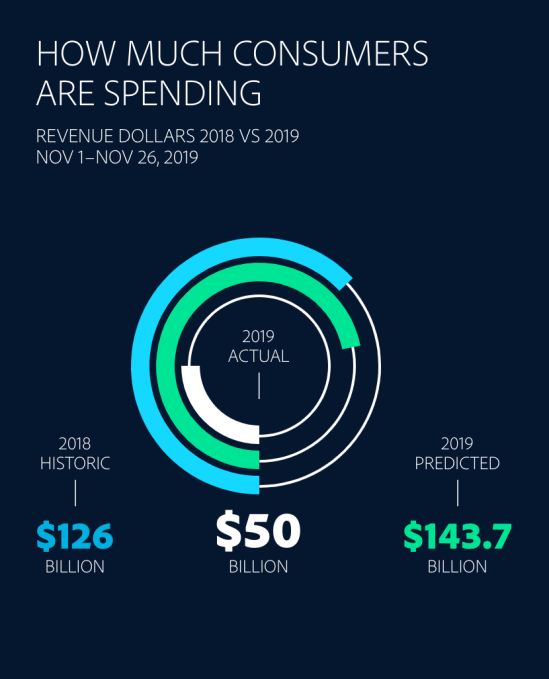
Facing a shorter holiday shopping season this year, U.S. retailers started rolling out their Black Friday deals earlier than usual. That move has paid off, according to new e-commerce data shared by Adobe Analytics this morning, which found that U.S. consumers have already spent $50.1 billion online between November 1 and November 26, 2019 — which represents a comparable increase of 15.8 percent year-over-year.

This year, Thanksgiving arrived on November 28, a full week later than it did in 2018 when it came on November 22. That left retailers with 6 fewer days to drive post-Thanksgiving Day sales — a situation it hadn’t been in since 2013, when the shorter time frame led to serious delivery struggles. To salvage the lost shopping days (and to not again find themselves in a similar situation as 2013), retailers simply rolled out their deals a week early.

For example, Amazon kicked off a Black Friday deals week on November 22. Walmart introduced early savings through “Buy Now” deals on Walmart.com, in addition to a pre-Black Friday event that started on Nov. 22. Target integrated Shipt’s same-day shopping service into its app and ran a preview sale, weekend deals, and today, Nov. 27, an early access sale. Other retailers followed suit, as well.

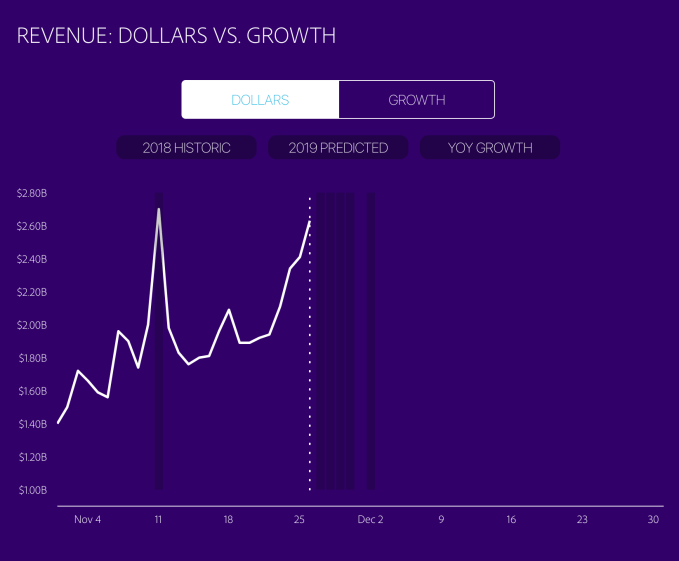
But consumers weren’t even waiting for these Black Friday preview deals to start shopping. According to Adobe Analytics, which tracks online transactions for 80 of the top 100 U.S. retailers, all 26 days in November so far have surpassed $1 billion in online sales. Seven days even passed $2 billion in sales, which made 2019 the first year to see multiple $2 billion days this early in the shopping season.

And as of this morning, $240 million has already been spent online, representing 19.3% growth year-over-year, and putting the day on track to hit $2.9 billion.


Based on this data, Adobe believes its earlier forecast of $143.7 billion spent during the full holiday shopping season (Nov.-Dec.) remains accurate. That estimate represents a 14.1% rise from a year ago, according to Adobe. In addition, the three biggest shopping days — Thanksgiving, Black Friday, and Cyber Monday — will also see increases, it says.

Thanksgiving Day sales are forecast to jump 19.7% year-over-year to $4.4 billion; Black Friday is expected to grow by 20.5% to reach $7.5 billion; and Cyber Monday sales are expected to top the charts at $9.4 billion, an increase of 19.1% year-over-year — a new record.

The firm also sees a surge in mobile shopping this year, with 34.3% of all e-commerce sales being made via a smartphone, up 24.2% year-over-year. App Annie’s mobile shopping forecast had also predicted a record number of mobile shoppers, with a 25% year-over-year increase in time spent mobile shopping during the weeks of Black Friday and Cyber Monday. The firm said shoppers will spend 2.2 billion hours globally (outside China) across shopping apps this holiday season.

Other notable trends include a rise in “buy online, pickup in-store” shopping — 61% will take advantage of this, leading to 27% more in sales over last year. Plus email promotions this season have led to 16.5% of all online revenue, up 10% year-over-year. Paid search accounted for 23.7% of sales, while social media led to just 2.8%.

In terms of products, shoppers are buying Apple AirPods, Apple Laptops, Samsung and LG TV’s, Frozen 2 toys, L.O.L Surprise Dolls, NERF toys, Pikmi Pops, Fortnite toys, and games like Pokemon Sword/Shield, Jedi Fallen Order, and Madden 20.

“With the shorter shopping season and retailers starting their promotions earlier, Adobe is seeing holiday discounts already well underway even before Thanksgiving Day,” said Jason Woosley, Vice President of Commerce Product & Platform at Adobe. “For televisions alone, shoppers are already seeing discounts twice as deep as expected with average savings yesterday of 17.5%. Those consumers who grab their smartphone to do some quick online shopping after dinner are likely to find offers that are even better than this time last year,” he added.


Max Q: NASA signs up new Moon delivery companies

Sign up here to receive Max Q weekly in your inbox, starting December 15.

There were lot of highlights in the space industry this past week (even though a rocket launch that was supposed to happened is now pushed to Monday). The biggest news for commercial space might just be that NASA signed on five new companies to its list of approved vendors for lunar payload delivery services, bringing the total group to 14.

SpaceX is among them, and Musk’s company had its own fair share of news this week, too – some good, some bad. One things’ for sure: Even going in to the last week in November, there’s still plenty of news to come in this industry before the year’s out.

  1. NASA selects five new vendors for commercial lunar payloads

Artist’s rendering of Blue Origin’s Blue Moon lander.

The five include Blue Origin, SpaceX, Ceres Robotics, Sierra Nevada Corporation and Tyvak Nano-Satellite Systems. This doesn’t necessarily mean all or any of these companies will actually fly anything to the Moon on behalf of NASA, but it does mean they can officially bid for the chance. Alongside 9 other companies selected previously by NASA, their bids will be considered by the NASA based on cost, viability and other factors.

  1. SpaceX Starship prototype blows its lid

This is the bad news I referred to earlier: SpaceX’s Starship Mk1 prototype in Texas blew up just a little bit during cryo testing. This test is designed to simulate extreme cold conditions that the spacecraft could endure during flight, and it clearly didn’t. But Elon Musk was optimistic, saying just after the incident that they’ll move on to a more advanced design right away.

  1. Sierra Nevada Corporation details an expendable cargo container for its Dream Chaser spaceship

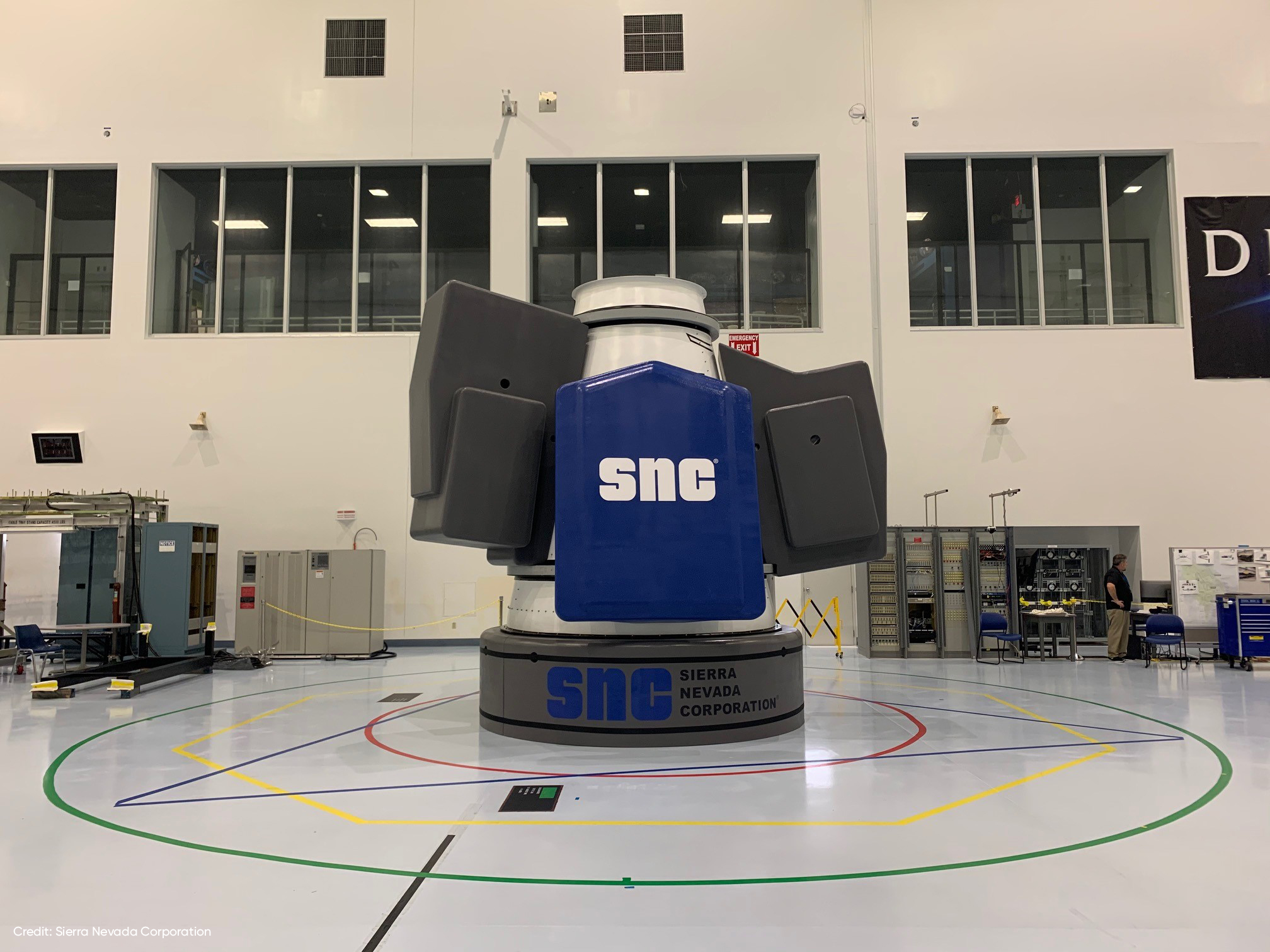
SNC’s Shooting Star module. Credit: SNC.

One of the companies that is now included in NASA’s lunar payload service provider list is Sierra Nevada Corporation (SNC). They’re currently developing and building their Dream Chaser spacecraft, which is reusable and lands like the Space Shuttle. At an event at Cape Canaveral in Florida, they unveiled what they call the ‘Shooting Star’ – an ejectable single use cargo container for the Dream Chaser that can really add to its versatility.

  1. Nanoracks will launch a test craft that can convert old spaceships into orbital habitats

This demonstration mission is just a start, but the tech that Nanoracks is launching aboard a future SpaceX launch will be able to cut metal in space, marking the first time a robotic piece of equipment has done that. The ultimate goal is to use this tech to take spent spacecraft upper stages and give them new life – as research platforms, satellites or even habitats in orbit.

  1. NASA’s JPL is using the Antarctic to test a rover for a trip to Enceladus

That’s one of Saturn’s moons, and it’s made up of icy oceans. Normally, that’s not an optimal place for a rover to get around, but the agency’s laboratory has been testing a design in the Earth’s coldest oceans to see how viable it will be, and now they’re going to use the Antarctic, which is where it’ll test it for months at a time.

  1. Tesla’s Cybertruck is made of Starship steel

Elon Musk revealed Tesla’s crazy, beautiful, ugly, strange Cybertruck pickup last week, and he noted that the stainless steel alloy that makes up its skin is the same material that SpaceX is developing and using on its new Starship spacecraft. Sometimes, being CEO of both a car company and a space company at the same time really pays off.

  1. Space is inspiring new kinds of startups

A lot of large companies outsource at least part of their innovation management and design, and with the space boom on, there’s a new opportunity for companies to emerge that specialize in helping those same large companies find out where they fit in this new frontier. Luna is one such co, putting the puzzle pieces together for health tech companies.

India’s financial services firm Paytm raises $1B

Paytm said on Monday it has raised $1 billion in a new financing round as the Noida-headquartered firm, which once dominated the local mobile payments market, attempts to fight back giants Google, Walmart’s PhonePe, and Facebook.

The company said the new financing round, dubbed Series G, was led by U.S. asset manager T Rowe Price. Existing investors Ant Financials (contributed $400 million), SoftBank Vision Fund (contributed $200 million), and Discovery Capital also participated in the round, which valued the company at about $16 billion — higher than any other local startup and some of the high-profile Asian startups such as Grab and Gojek.

Paytm mobile wallet enables users to transfer money to each other, pay for food delivery and clear utility bills, buy train and movie tickets as well as secure small loans. One97 Communications, which operates Paytm, has raised more than $3.3 billion to date.

Paytm founder and chief executive Vijay Shekhar Sharma (pictured above) said the firm will use the fresh capital to court merchants as the company looks to expand its presence among small and medium-sized businesses. The company will also work on expanding its financial offerings such as lending and insurance. Paytm, which also offers its mobile wallet service in Japan, has amassed 15 million merchants, most of whom have come online in recent years, in India, he said.

“This new investment by our current and new investors is a reaffirmation of our commitment to serve Indians with new-age financial services,” he said.

The big buck comes as India turns into the newest payments battleground for major global giants Google, Walmart, and Facebook . According to Credit Suisse, the digital payments market in India will be worth $1 trillion in the next four years, up from about $200 billion currently.

According to industry estimates, more than 100 million people in India today use mobile payments services. Paytm, which led the local market in peer-to-peer mobile payments two years ago, saw its daily usage skyrocket after New Delhi invalidated much of the cash in circulation in the country in late 2016. (Other local mobile wallet services such MobiKwik and Freecharge also reported growth during the period.)

At a company party in late 2016, Sharma told ecstatic employees that “nobody can beat Paytm. India finally has its own technology giant.” But in the following months, a score of companies including Amazon, Google, and Samsung entered the payments market in India, leveraging an open payments infrastructure called UPI (Unified Payments Interface) built by a coalition of banks — and backed by the government.

National Payments Corporation of India, which oversees UPI infrastructure, revealed earlier this month that UPI had surpassed a 100 million users. In October alone this year, UPI topped a billion transactions.

Google Pay and Flipkart’s PhonePe today lead the peer-to-peer payments, according to industry estimates. Google Pay has amassed over 67 million monthly active users, the company revealed earlier this year. Flipkart’s PhonePe is valued at $10 billion.

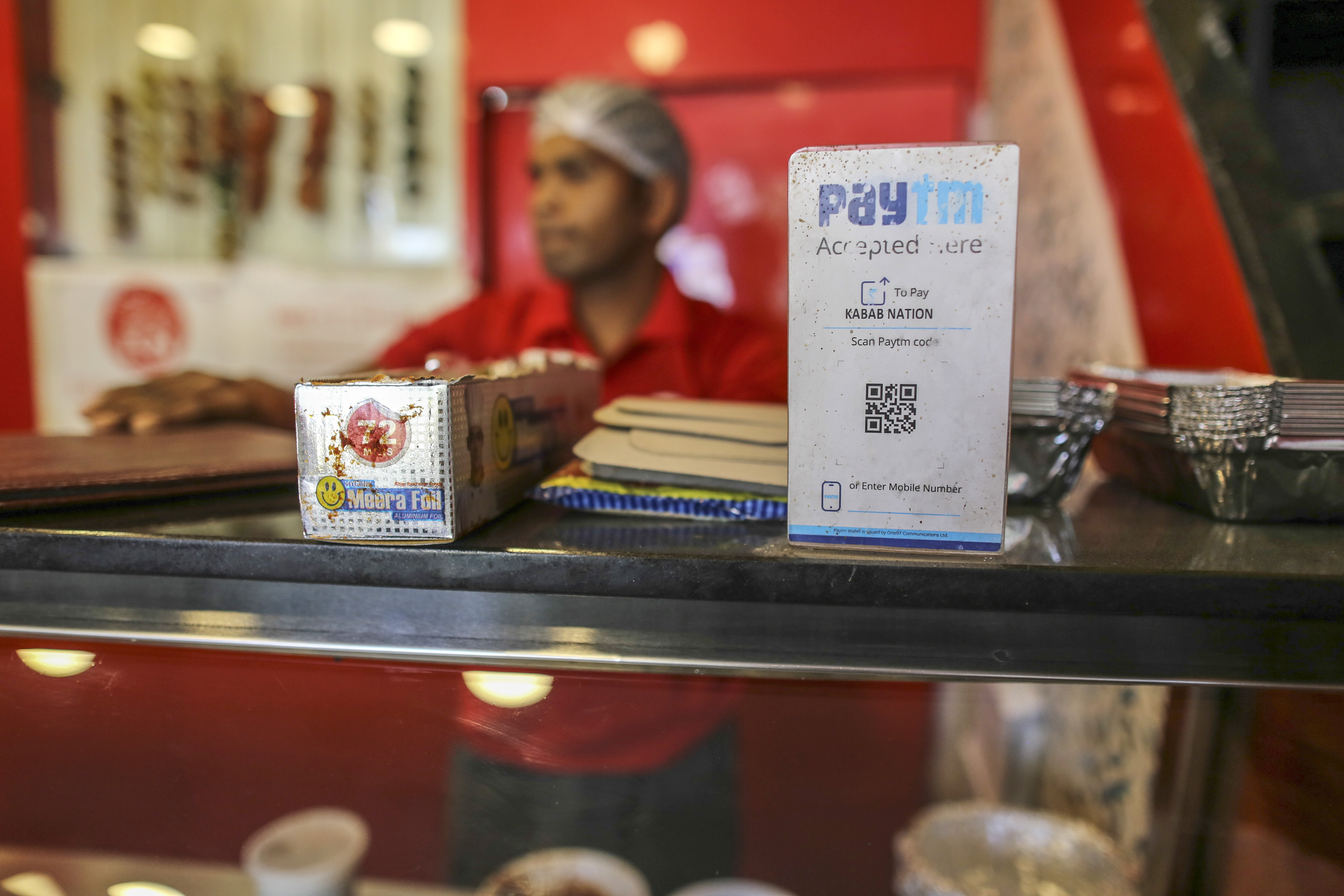
An employee stands at a counter as a sign for PayTM online payment method, operated by One97 Communications Ltd., is displayed at a fast food restaurant in Bengaluru, India. Photographer: Dhiraj Singh/Bloomberg via Getty Images

Paytm, in the meantime, has focused on expanding to other categories such as e-commerce platform, games, and ticketing business. The company is also aggressively trying to sign up merchants across small cities and towns in India. The company, which is serving merchants in over 2,000 towns and cities in the country, leads the peer-to-merchant market, according to internal slides seen by TechCrunch.

As competition in India increases, so have the expenses for various players. Paytm posted a loss of $549 million in the financial year that ended in March, up from $206 million it reported in loss the year before. PhonePe and Amazon Pay, posted a collective losses that totaled over $500 million in the financial year ending March.

In September, Paytm said that over the next two years it would invest another $2.7 billion in the business. Sharma told TechCrunch in an interview earlier that the company plans to consider filing for its IPO after two to three years. In last six months, he claimed the company has cut its “burn” by more than a third.

Today, we open next chapter in Paytm’s journey of India’s financial inclusion. We commit to invest additional ?10,000 crore to serve financially unserved / underserved.
Thank you for your guidance and support.
Dedicating it with my school time favorite Jai Shankar Prasad poem:

— Vijay Shekhar (@vijayshekhar) November 25, 2019

Engaging with merchants is one of the few ways a payments firm in the country can currently make profits. At a fintech conference in Bangalore last week, hosted by firm Razorpay, Sajith Sivanandan, Managing Director and Business Head of Google Pay and Next Billion User Initiatives, said current local rules have forced Google Pay to operate without a clear business model.

Answering a question from the audience, he urged the local payments bodies to “find ways for payment players to make money” to ensure every stakeholder had incentives to operate.

If those challenges weren’t enough, WhatsApp, which has amassed more users than any other service in India, is expected to roll out its payments service to all of its 400 million users in the country in the coming weeks.

At the same conference, Abhijit Bose, head of WhatsApp in India, said the Facebook-owned firm believes that India has just begun its payments revolution. At another conference earlier this month, Bose said the company sees massive opportunities in India and hopes to offer a range of financial services to people in the nation over the coming years.

Asked about WhatsApp Pay’s inevitable rollout, Google Pay’s Sivanandan said, “it’s fantastic. Much of the market remains untapped and we need more players.”

Hulu is down, appears to be a major outage

Hulu is currently down.

We’re not sure why, and neither does Hulu. A stream of tweets complaining about the outage surfaced Sunday morning on the U.S. east coast, but it seems like a global outage. In response, Hulu’s Twitter support didn’t seem to know either, instead telling frustrated users that it’s looking into it.

Fantastic.

For what it’s worth and in my many experiences covering cybersecurity, the chance that this is anything other than someone tripping over a cable or accidentally pushing out production code to the wrong pipe is extremely slim. Hulu will be back. When? No idea, but these things never take too long.

We’ve reached out for comment but we haven’t heard back yet. Stay tuned for more. (Or listen to our Original Content podcast instead.)

Original Content podcast: Netflix’s ‘Rhythm + Flow’ tweaks the music competition formula

“Rhythm + Flow” is Netflix’s take on a reality TV staple — the music competition show. With Cardi B, Chance the Rapper and Tip “T.I.” Harris on-board as judges, the series searches for the next big hip-hop star.

In some ways, “Rhythm + Flow” sticks to the formula popularized by “American Idol,” “The Voice” and similar shows, with several episodes devoted to auditions in Los Angeles, New York, Atlanta and Chicago, followed by a gauntlet of challenges in which contestants hone their skills and prove their worth, culminating in a final showdown with one big winner.

But as fellow TechCrunch writer Megan Rose Dickey helps us explain on the latest episode of the Original Content podcast, the series stands out in a few key ways. For one thing, it’s the first music competition to focus on hip hop. And rather than asking the audience to watch live/week-to-week, the show is now fully binge-able (it was initially released in batches of episodes over a two-week period).

We appreciated the fact that “Rhythm + Flow” didn’t linger on the spectacularly bad performers (and there were some) — it reserved most of its screen time for the genuine talents.

We also enjoyed the judges, who seemed to be enjoying themselves while also offering thoughtful commentary. Cardi B, in particular, was always entertaining, whether she was being enthusiastic, supportive or dismissive.

You can listen in the player below, subscribe using Apple Podcasts or find us in your podcast player of choice. If you like the show, please let us know by leaving a review on Apple. You can also send us feedback directly. (Or suggest shows and movies for us to review!)

A quick warning: While we felt that you can’t really “spoil” a reality show that’s been out for a month, we do reveal who won.

And if you’d like to skip ahead, here’s how the episode breaks down:
0:00 Intro
1:30 Disney+ follow-up
8:28 “Rhythm + Flow” review

Reasons to be climate cheerful (ish)

The International Energy Agency published its annual World Energy Outlook ten days ago. In this era of climate crisis, that outlook includes, as you would expect, stern warnings of catastrophic warming. But it also includes interesting nuggets of hope and optimism — and they aren’t alone. Global warming is a slow-motion in-progress planetary train-wreck, true; but you don’t have to look too hard to find evidence that new technology might yet, eventually, after enormous expense and had work, get us halfway back on non-catastrophic rails.

Consider the dreaded coal mine. Coal mines are really, really bad. How bad? New research suggests that methane leakage from coal mines, alone — without even considering burning the coal after it’s mined! — has “a greater warming impact than aviation and shipping combined.” (Italics mine.) Fly less and drink from paper straws if it makes you feel better, but if you really want to fight global warming, help close coal mines and/or prevent new ones from opening.

Alarming new @IEA research in #WEO19 shows..
Coal mine methane leaks are worse for climate than shipping+aviation emissions combined????

It adds 10% to coal's lifecycle emissions on average.

We wrote a blog to expand on the IEA's analysis…https://t.co/besT4Ja5EM pic.twitter.com/9eKWinMYvc

— Sandbag (@sandbagorg) November 13, 2019

The WEO projects a long plateau in our collective reliance on coal over the next decades. That may seem surprising, but: “rising demand in India is one of the key factors holding global coal use steady, despite rapid falls in developed economies.” However, in India, “510GW of new coal has been cancelled since 2010 due to competition from cheaper renewables, financial distress at utility firms and public opposition” while Indian “coal power generation shows a declining trend since August 2019.” (Again, italics mine.) This is because of a decrease in demand, but it’s one that’s especially well-timed …

…because at the same time, renewables are on a tear in India, and around the world. They just keep getting cheaper. The IEA is infamous for drastically, comically underestimating how fast solar power capacity will grow around the world. (Here’s a paper which tries to explain why.) Bewilderingly, they are sticking to this, despite having been proven spectacularly wrong every year for the last decade:

It’s very easy to envision a scenario in which solar continues to skyrocket, coal diminishes faster than the IEA currently projects, and we emit significantly less methane and carbon dioxide than expected. (Oh, and reap massive public health benefits, too.) Yes, renewables will eventually run into significant unsolved, intermittency problems, but as Ramez Naam puts it, “these problems are distant.”

In the shorter term, even if the IEA’s impressively pessimistic projections are correct, they are still actually reason for relative optimism. The famous IPCC Fifth Assessment report on climate change gave us four scenarios. The worst case is known as RPC8.5 (RPC for Representative Concentration Pathway, a name only a bureaucrat could love, and 8.5 for the watts per meter squared of radiative forcing, i.e. the difference between energy received from the sun and that radiated back out to space.) The second-worse is RPC6.0. And the IEA’s World Energy Outlook seems to indicate that we’re currently tracking better than either of those cases;

Conclusion: IEA scenarios are a more realistic projection of the global energy system’s current ‘baseline’ trajectory; showing we are far from RCP8.5 & RCP6.0. World currently tracking between RCP4.5 & lower climate change scenarios – consistent with 1.5? to 2.5?C. Thread: 11/11

— Justin Ritchie (@jritch) November 18, 2019

Again, this is relative optimism: it’s by no means “everything is going to be fine,” but it is “thanks to the spectacular growth of renewable energy, we do not seem to be on course for the IPCC’s worst or even second-worst projection.” Of course this is all estimation. Models are complex and comparisons are hard. For instance, the IEA projections do not include cement:

A technical interlude: The IEA does not include cement, but very few scenarios submitted to the IPCC SR15 separated cement from energy. This makes comparisons hard. Either do an inconsistent comparison (previous tweet) or a comparison with fewer scenarios (this tweet)

2/ pic.twitter.com/Z8rKW4Vizi

— Glen Peters (@Peters_Glen) November 19, 2019

But speaking of cement, there’s a recent potential breakthrough there, too. Cement is responsible for some 8% of global carbon emissions, and 40% of those come from simply heating limestone to over 1,000 degrees. Heliogen’s new solar thermal plant can do that with sunlight — using machine learning.

Of course what we ultimately want is carbon capture. But wait! There’s a recent potential breakthrough there, as well. A few years ago the cost of capturing carbon from the air was estimated at hundreds of dollars per ton. But that is on a steep decline, with estimates for new technologies now as low as $50/ton. (A typical car releases about 5 tons per year.)

Hockey-sticking renewable energies. Solar thermal cement. Cheaper carbon capture. In what may often seem like the forthcoming wasteland of the climate crisis, there are a surprising number of green shoots. Of course not all of them may grow. There’s many a slip ‘twixt breakthrough proof-of-concept and actual production at scale. And there’s always the chance that better data and models may undercut apparent (relatively) good news.

But at the same time, in addition to the apocalypticists who seem to take a grim glee in oncoming catastrophe, and the hairshirt moralizers who seem to believe that suggesting anything other than “we’re all doomed, unless we go back to living in carbon-neutral caves!” is dangerous, there is another narrative. One which says “we, as a species, have a huge amount of incredibly expensive work to do, yes, but despair is not the only thing on the menu.” It’s true that politicians seem unlikely to save us from a climate disaster. Technology, however, still might.