Verizon and AWS announce 5G Edge computing partnership

Just as Qualcomm was starting to highlight its 5G plans for the coming years, Verizon CEO Hans Vestberg hit the stage at AWS re:Invent to discuss the carrier’s team up with the cloud computing giant.

As part of Verizon’s (TechCrunch’s parent company, disclosure, disclosure, disclosure) upcoming focus on 5G edge computing, the carrier will be the first to use the newly announced AWS Wavelength. The platform is designed to let developers build super-low-latency apps for 5G devices.

Currently, it’s being piloted in Chicago with a handful of high-profile partners, including the NFL and Bethesda, the game developer behind Fallout and Elder Scrolls. No details yet on those specific applications (though remote gaming and live streaming seem like the obvious ones), but potential future uses include things like smart cars, IoT devices, AR/VR — you know, the sorts of things people cite when discussing 5G’s life beyond the smartphone.

“AWS Wavelength provides the same AWS environment — APIs, management console and tools — that they’re using today at the edge of the 5G network,” AWS CEO Andy Jassy said onstage. Starting with Verizon’s 5G network locations in the U.S., customers will be able to deploy the latency-sensitive portions of an application at the edge to provide single-digit millisecond latency to mobile and connected devices.”

As Verizon’s CEO joined Vestberg onstage, CNO Nicki Palmer joined Qualcomm in Hawaii to discuss the carrier’s mmwave approach to the next-gen wireless. The technology has raised some questions around its coverage area. Verizon has addressed this to some degree with partnerships with third-parties like Boingo.

The company plans to have coverage in 30 U.S. cities by end of year. That number is currently at 18.

AWS announces new enterprise search tool powered by machine learning

Today at AWS re:Invent in Las Vegas, the company announced a new search tool called Kendra, which provides natural language search across a variety of content repositories using machine learning.

Matt Wood, AWS VP of artificial intelligence, said the new search tool uses machine learning, but doesn’t actually require machine learning expertise of any kind. Amazon is taking care of that for customers under the hood.

You start by identifying your content repositories. This could be anything from an S3 storage repository to OneDrive to Salesforce — anywhere you store content. You can use pre-built connectors from AWS, provide your credentials and connect to all of these different tools.

Kendra then builds an index based on the content it finds in the connected repositories, and users can begin to interact with the search tool using natural language queries. The tool understands concepts like time, so if the question is something like “When is the IT Help Desk is open,” the search engine understands that this is about time, checks the index and delivers the right information to the user.

The beauty of this search tool is not only that it uses machine learning, but based on simple feedback from a user, like a smiley face or sad face emoji, it can learn which answers are good and which ones require improvement, and it does this automatically for the search team.

Once you have it set up, you can drop the search on your company intranet or you can use it internally inside an application and it behaves as you would expect a search tool to do, with features like type ahead.

Postscript raises $4.5M to help Shopify shops stay connected with customers over SMS

Back in February, we wrote that Postscript “wants to be the Mailchimp for SMS.” Now they’ve raised $4.5 million to help get it done.

This round was led by Accomplice, and backed by Kayak co-founder Paul English, Wufoo co-founder Kevin Hale, Klaviyo co-founder Andrew Bialecki, Drift co-founder Elias Torres, Front co-founder Mathilde Collin and Podium co-founders Eric Rea and Dennis Steele. The Postscript team is currently made up of 14 people.

Postscript is meant to help e-commerce companies — specifically Shopify shops, currently — connect with their existing customers over SMS. Their Shopify plugin lets store owners run SMS marketing campaigns with customers who’ve opted in, have two-way conversations with users who respond and analyze the data to figure out what’s working.

Got a new product hitting the shelves and want to let your most frequent customers know first? Plug the message into Postscript’s dashboard, tell it what segment of your customer base you want to receive it and send away. Their analytics backend will tell you how many people received it, how many actually clicked through and how much revenue you pulled in from those clicks.

If a customer types out a text and responds, it’ll pop up in the backend like a support ticket. Shop owners and employees can respond and have direct conversations, answer questions and close out the ticket through the dashboard — or they can automatically pipe them into services like Zendesk or Zapier.

But what about spam? Our text message inboxes tend to feel like the last refuge from the overwhelming onslaught of marketing messages that have ruined e-mail; do we really want shops pinging our phones directly every time they’ve got a new pair of pants?

It seems like Postscript is pretty mindful of this, and is building things in a way that limits just how “spammy” anyone on the platform can be — partly because (as we’ve seen with e-mail) flooding users with unwanted messages ensures that messages just don’t get opened, and partly because SMS is much more tightly regulated than many other messaging protocols. Under the Telephone Consumer Protection Act (TCPA) in the U.S., for example, SMSing marketing messages to someone without an explicit opt-in can get the company nailed with fines of thousands of dollars per text.

As Lucas Matney wrote in February:

The opt-in process for phone communications is already a bit more codified in the U.S., and as companies attempt to stay in the good graces of GDPR for fear of the EU god, it might be more likely they tread carefully.

As such, everything is opt-in, and easily opted out of if a user changes their mind. It also helps, of course, that sending SMS isn’t free for the companies. Each SMS you send to a customer who doesn’t care is money wasted — so there’s interest on all sides on limiting messages to just the folks who actually want them.

Postscript pricing varies depending on how many messages a shop is looking to send each month. Paid plans start at $50 a month for 1,500 SMS, climbing up to $2,000 per month for 83,000 messages — after that, they ask shops to reach out for a custom plan. Postscript co-founder Alex Beller tells me the company currently has around 530 paying customers, each spending anything from $50 per month to “the mid five figures.”

SoftBank pours $100M into Mexico’s Konfio

Three months after Goldman Sachs lent $100 million to Mexican fintech Konfio, SoftBank has invested another $100 million into the financial services company. The investment confirms Reuters’ August report that SoftBank was in advanced talks with the startup — now one of the most heavily funded fintechs in Mexico. 

SoftBank is continuing to expand its Mexican portfolio, which now includes used car buying platform Kavak and payments startup Clip. Aside from Mexico, SoftBank has primarily focused its $5 billion Latin America fund on Brazil — and recently marked its entry into Argentina with an injection into financial services company Uala in a $150 million investment co-led by Tencent. 

As traditional banks shy away from small to medium-sized business loans in Mexico, Konfio’s credit underwriting service provides a faster alternative. Konfio uses a data-first approach to enable fast credit assessment for SMBs looking to grow their businesses. The service can disburse credit in a one-day turnaround, as opposed to locking users into a traditional months-long approval process that can often require collateral. 

Meanwhile, if you’re a startup gathering massive amounts of data on Latin America’s growing middle class, SoftBank might be interested in your growth funding. The Japanese conglomerate seems to want to know everything it can about Latin America’s consumer spending habits, mobile usage and personal banking user behavior.

Watch Konfio founder and CEO David Arana’s panel at TechCrunch’s São Paulo event here.

Alfred Lin, the Sequoia VC and former Zappos COO, thinks this retail startup could be a generation-defining brand

When the storied venture firm Sequoia likes a deal, it will sometimes not only lead one of its financing rounds but fund it exclusively — no matter how that impacts earlier investors. Given the firm’s powerful brand, it’s hard to complain (too much), even if it means that earlier backers see their stakes diluted.

Such looks to be the case with Dolls Kill, an eight-year-old, San Francisco-based online boutique for “misfits” and “miss legits” that began selling platform shoes and other club-type clothing and has apparently grown like a weed, alongside the festivals that its customers attend, from Burning Man to Coachella.

The company has just raised $40 million in Series B funding from Sequoia, and when we talked yesterday with co-founder and CEO Bobby Farahi about the deal — which brings Dolls Kill’s funding to roughly $60 million — he said there was “no room” for earlier backers, including the consumer-focused venture firm Maveron.

He quickly added that the company’s board members — specifically Maveron partner Jason Stoffer, along with former Hot Topic CEO Betsy McLaughlin — have been instrumental in helping the company “think through growth while maintaining authenticity.”

It’s easy to appreciate enthusiasm around the brand, which employs around 400 people, has retail stores in both San Francisco and LA and sells its own clothes under an array of different labels, as well as sells the apparel of third parties whose aesthetic happens to fit that of Dolls Kill at any particular moment in time.

As says Farahi, “Right now there’s a resurgence in ’90s fashion, but in another year, we could move on to other third-party brands that we believe will resonate with our customers.”

Farahi doesn’t break out how much of the company’s clothing is made by the startup itself — in China and the U.S., among other “international” locations. He shies from sharing many metrics at all, in fact. But the company, whose counter-culture approach began at the fringes of society, has seemingly gone mainstream as young shoppers increasingly ditch logos and look to express who they are through what Farahi calls their “inner IDGF.”

Adds Farahi, “The macro world changed a lot to give us a lot of tailwinds.”

Dolls Kill also has — for now, at least — a deep connection to its customers, thanks partly to its creative approach. When the company told its three million Instagram followers earlier this year that it would drive an ice cream truck filled with its Billionaire Bling combat boot to dozens of U.S. cities, customers “four blocks long” waited in line to buy them, says Farahi.

In another inventive twist, it opened its LA location — which looks more like a nightclub — to shoppers at midnight on Black Friday and it stayed open the following 24 hours.

Sequoia — which reached out to the company directly — told Farahi that it had looked at a lot of fashion brands and “they said we believe you’re the next generation-defining brand, the way The Gap was in the ’80s,” recounts Farahi. “I think they see the company not just as a brand but also a movement.”

Certainly, Sequoia’s Alfred Lin — who as Zappos’s COO helped grow the company into the giant that Amazon acquired in 2009 — understands such things, given a strong early emphasis at Zappos on company culture and growing while remaining true to its early employees and customers.

As for the name Dolls Kill, in case you were curious, the brand was the idea of Farahi’s wife and co-founder Shoddy Lynn. She liked the “dichotomous words, one very soft and one very hard,” says Fahari, explaining that while “the brand is very girly, these girls aren’t taking shit from anybody.”

Adds Farahi, “And the domain was available.”

Black Friday sees record $7.4B in online sales, $2.9B spent using smartphones

Following swiftly on the heels of a Thanksgiving that broke records with $4.2 billion in online sales, Black Friday also hit a new high, although it just fell short of predictions. According to analytics from Adobe, consumers spent $7.4 billion online yesterday buying goods online via computers, tablets and smartphones. The figures were up by $1.2 billion on Black Friday 2018, but they actually fell short of Adobe’s prediction for the day, which was $7.5 billion.

Salesforce, meanwhile, said that its checks revealed $7.2 billion in sales (even further off the forecast).

Popular products included toys on the themes of Frozen 2, L.O.L Surprise, and Paw Patrol. Best selling video games included FIFA 20, Madden 20, and Nintendo Switch. And top electronics, meanwhile, included Apple Laptops, Airpods, and Samsung TVs.

A full $2.9 billion of Black Friday sales happened on smartphones. These conversions are growing faster than online shopping overall, so we are now approaching a tipping point where soon smartphones might outweigh web-based purchases through computers.

“With Christmas now rapidly approaching, consumers increasingly jumped on their phones rather than standing in line,” said Taylor Schreiner, Principal Analyst & Head of Adobe Digital Insights, in a statement. “Even when shoppers went to stores, they were now buying nearly 41% more online before going to the store to pick up. As such, mobile represents a growing opportunity for smaller businesses to extend the support they see from consumers buying locally in-store on Small Business Saturday to the rest of the holiday season. Small Business Saturday will accelerate sales for those retailers who can offer unique products or services that the retail giants can’t provide.”

Adobe Analytics tracks sales in real-time for 80 of the top 100 US retailers, covering 55 million SKUs and some 1 trillion transactions during the holiday sales period. Salesforce uses Commerce Cloud data and insights covering more than half a billion global shoppers across more than 30 countries.

One of the reasons we may be seeing slightly less fervent sales than the analysts had predicted is because the holiday sales season is starting earlier and earlier. Black Friday, the day after Thanksgiving when many people have days off, has for a long time been seen by retailers as the start of holiday shopping season. That has changed as retailers hope to catch more sales over a longer period of time.

As more people shop, they are also shopping for more expensive items. Adobe noted that Average Order Value was $168, a new record level yesterday for Black Friday, up 5.9% on a year ago.

Smartphone sales were up 21% over last year and those who were not buying were, as a start, browsing, with whopping 61% of all online traffic to retailers coming from smartphones, up 15.8% since last year.

As with yesterday, e-commerce “giants” with over $1 billion in sales annually were doing better than smaller sites: they had more smartphone sales, and 66% conversions on browsers on smartphones, Adobe said. They have overall also seen a 62% boost in sales this season, versus 27% for smaller retailers.

As with the Thanksgiving sales patterns — when bigger retailers also appeared to do better than their smaller counterparts — there are a couple of reasons for this. One is that the bigger sites have a wider selection of goods and can afford to take hits with deep discounts on some items, in order to lure users in to add other items to their shopping cars that are not as deeply discounted. Or, bigger online retailers can simply afford to give bigger markdowns.

The other is that the bigger stores often have more flexible delivery options. Adobe noted that those using click-and-collect orders, or buy online, pick up in store / curbside grew by 43 percent.

The story is not all rosy for big retailers, however. Edison Trends notes that some big platforms are actually seeing very mixed results this time around.
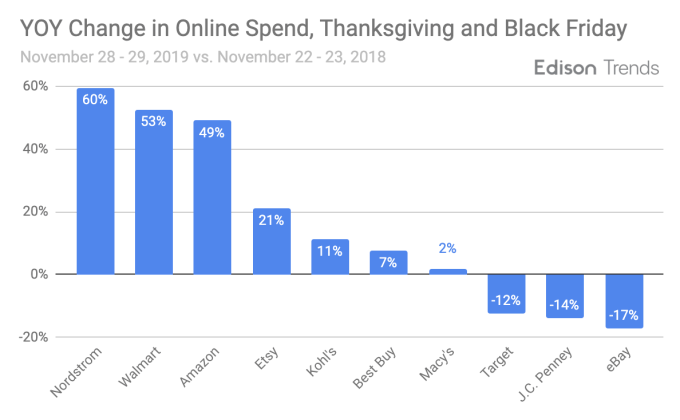
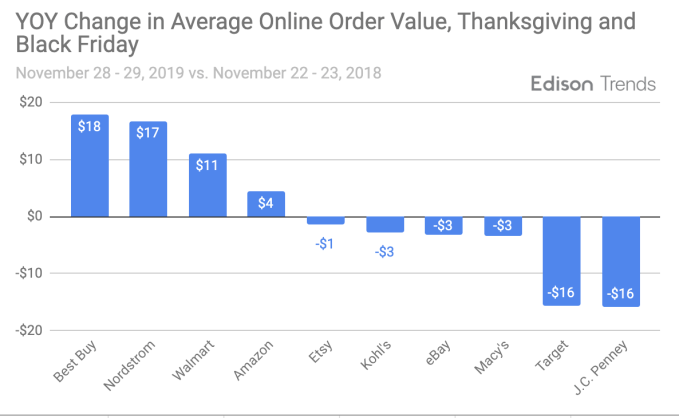
It will be interesting to see how and if patterns change for smaller retailers on Sunday, which is being dubbed “small business Sunday” to focus on buying from smaller and independent shops. Shoppers have already spent $470 million, and Adobe believes it will pass the $3 billion mark. Cyber Monday, the biggest of them all, is expected to make $9.4 billion in sales.

Ockam raises $4.9 million in seed funding to make it easier for developers to secure and scale their IoT apps

Ockam, a two-year-old, Bay Area-based company that’s selling tools to developers so they can establish an “architecture for trust” within their connected device applications, has raised $4.9 million in seed funding, including from Core Ventures, Okta Ventures, SGH Capital, and Future Ventures.

This serverless platform for IoT development is being led by CEO Matthew Gregory and CTO Mrinal Wadhwa, two cofounders with noteworthy backgrounds.

Before launching Ockam in the fall of 2017, Gregory was an “intrapreneur” at Microsoft, where he says he helped lead Azure’s pivot into open source software and container services. He also spent a couple of years at Salesforce as a product manager and, interestingly, spent a few years years ago as a system engineer working for Stars & Stripes, a syndicate of the yacht-racing competition America’s Cup where he tells us he led an engineering effort to build custom systems of sensors, analytics software and wireless communications tools needed to help the racing team make better decisions.

Wadhwa was meanwhile the CTO of another privately held IoT company, Fybr, that promises real-time data analytics capable of decision making at the edge (versus in the cloud).

Some of what the startup is promising is that, using its technology, IoT systems developers will be able to build more scalable connected systems — as well, crucially, as more secure ones How? Partly through crytpographic keys and partly by assigning credentials to different entities, from devices to people to assets to services.

The company is one of a growing spate of companies hoping developers will increasingly turn to them instead of building out their own software infrastructure.

For example, Particle, a seven-year-old, San Francisco-based platform for Internet of Things devices that has ambitions similar to those of Ockam, recently closed on $40 million in funding in a round that brought its total funding to $81 million).

Ockam raised its seed funding over two tranches, including a $3.2 million round that closed in May and an additional $1.7 million injection from Future Ventures in more recent weeks.

Storm Ventures just closed its sixth fund with $130 million

Storm Ventures, a now 19-year-old, Sand Hill Road venture firm in Menlo Park, Ca., has closed on $130.4 million, shows a new SEC filing. The outfit began its fundraising late last year, according to an earlier filing. It had closed its previous fund with $180 million in 2015.

Storm distinguishes itself in numerous ways, including its exclusive focus on seed and Series A stage enterprise startups, including mobile, SaaS and cloud infrastructure companies.

The partners also have a penchant for helping far-flung startups grow their footprint around the world. Tae Hea Nahm, for example, a founding managing director of the firm (and cofounder of four mobile companies before that, including Airespace and MobileIron), was born in Seoul and has told us in the past that he spends a considerable amount of time in South Korea to attend startup board meetings, as well as to visit with Samsung and others of Storm’s LPs, which includes Korea Telecom.

Ryan Floyd, another of the firm’s cofounders, meanwhile recently wrote about his “hunt” for European founders, partly because they are more focused on revenue from the outset than some of their U.S. peers (an increasingly attractive quality in all startups suddenly).

One of Storm’s most notable bets at the moment include Workato, a fast-growing, Cupertino, Ca.-based work automation platform, which two weeks ago announced $70 million in Series C funding led by Redpoint.

Storm — which was involved in the company’s Series A  and B rounds — also participated in the financing.

Another bet is Honeycomb, a three-year-old, San Francisco-based startup whose product promises developer teams that they can see production more clearly so they can resolve issues more quickly. The company raised $11.4 million in Series A funding led by Scale Venture Partners in September; Storm, which had participated in the company’s seed round, also participated among others.

Among Storm’s other, more recent first-time investments, the outfit joined the $6.75 million Series A round of Talview, a two-year-old, Palo Alto, Ca.-based talent assessment and hiring platform, that announced its newest funding in August.

Storm is also an early investor in the nine-year-old, sales-software company Pipedrive. In fact, according to a report in the WSJ from last spring, Storm took the unusual step of suing the company when it raised its Series C round of funding last year and, according to Storm, allotted the firm fewer shares than it was entitled to own based on its $800,000 convertible note seed investment, made in 2013.

Facebook bowed to a Singapore government order to brand a news post as false

Facebook added a correction notice to a post by a fringe news site that Singapore’s government said contained false information. It’s the first time the government has tried to enforce a new law against ‘fake news’ outside its borders.

The post by fringe news site States Times Review (STR), contained “scurrilous accusations” according to the Singapore government.

The States Times Review post contained accusations about the arrest of an alleged whistleblower and election-rigging.

Singapore authorities had previously ordered STR editor Alex Tan to correct the post but the Australian citizen said he would “not comply with any order from a foreign government”.

Mr Tan, who was born in Singapore, said he was an Australian citizen living in Australia and was not subject to the law. In a follow-up post, he said he would “defy and resist every unjust law”. He also posted the article on Twitter, LinkedIn and Google Docs and challenged the government to order corrections there as well.

On the note Facebook said it “is legally required to tell you that the Singapore government says this post has false information”. They then embedded the note at the bottom of the original post, which was not altered. Only social media users in Singapore could see the note.

In a statement, Facebook said it had applied the label as required under the “fake news” law. The law, known as the Protection from Online Falsehoods and Manipulation bill, came into effect in October.

According to Facebook’s “transparency report” it often blocks content that governments allege violate local laws, with nearly 18,000 cases globally in the year to June.

Facebook — which has its Asia headquarters in Singapore — said it hoped assurances that the law would not impact on free expression “will lead to a measured and transparent approach to implementation”.

Anyone who breaks the law could be fined heavily and face a prison sentence of up to five years. The law also bans the use of fake accounts or bots to spread fake news, with penalties of up to S$1m (£563,000, $733,700) and a jail term of up to 10 years.

Critics say the law’s reach could jeopardize freedom of expression both in the city-state and outside its borders.