Reelgood raises $6.75 million for its universal streaming guide

Streaming aggregator Reelgood capitalized on the overabundance of streaming services available today by offering consumers a universal dashboard where you can track what you’re watching and discover your next binge. It then translated the activity from its over 10 million users into data it licenses to major companies, including Roku, Microsoft, smart TV makers, NYPost and even hedge funds. Now the company has closed on $6.75 million in Series A funding to continue to grow its business.

The round was led by Runa Capital and includes participation from Reelgood’s seed round investor, August Capital. To date, Reelgood has raised $11 million.

The company’s app to some extent competes with those designed to help you keep track of the episodes you’ve watched across streaming services and TV, like TV Time, iTV, JustWatch and others. But Reelgood’s service stands out for its breadth of catalog — it tracks both movies and TV across some 336 streaming services, the website says. This includes free services like Tubi, Crackle and those from TV networks, plus authenticated “TV Everywhere” services for pay-TV subscribers, and subscription services like Netflix, Hulu, HBO, Amazon Prime and others. It also can help you compare prices on rental options.

And its robust search and filtering features can help you find titles that are new, coming or leaving services, or by any other filter — like genre, year, Rotten Tomatoes rating, IMDB score and more. The more you use and personalize the service, the better its suggestions for what to watch next then become.

Once you find something to watch, you just press play to launch the streaming service’s app or website.
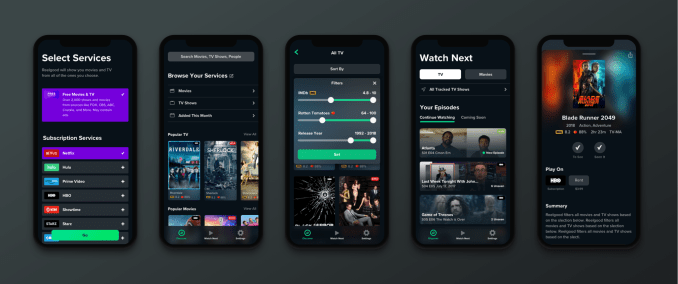
The work involved in making a simple concept — a universal dashboard for streaming — is fairly complex, Reelgood says.

“Putting together these streaming service libraries involves ingesting massive and unstructured amounts of data from hundreds of different sources for real-time matching and combination using machine learning and human curators,” noted Reelgood’s head of Data, Pablo Lucio Paredes.

Reelgood also touts the quality of its data (averaging 98% across all 300+ services), which it then licenses to publishers, search engines, media players, TVs, voice assistants and other smart devices. Currently, the company has around 50 business customers who pay either for the raw data, the insights or both.

Roku, for example, uses Reelgood’s data for its own universal search feature. NYPost displays streaming availability data on their articles via a widget. Hedge funds look at the data to better understand consumer behavior in streaming services and the movement of content between catalogs.

This year, Reelgood hired Nielsen’s former SVP of global measurement, Mark Green, to lead its B2B data licensing business, called Reelgood Insights.

“I sought out and joined Reelgood because they are poised to capture the billions in revenue spent on viewership data as viewing continues to shift towards OTT,” said Green.

The additional funding will be used to expand the number of platforms where Reelgood is offered, including on a range of smart TVs through partnerships. The company has signed five smart TV deals with major brands that will begin to roll out in 2020, but LG is the only name Reelgood can currently disclose.

Reelgood is headquartered in San Francisco. It has 18 employees, both local and remote, and is hiring across a number of roles.

This Lego Cybertruck is one even Elon can love

Lego already debuted its own take on the divisive Tesla Cybertruck design, but theirs was purely for the lols. This Lego Cybertruck, however, submitted to the official Lego Ideas crowdsourcing website, is actually a remarkably faithful representation, and comes complete with fully articulating tailgate and “frunk” (front trunk, for the uninitiated).

The design, by Lego Ideas user BrickinNick, recreates remarkably well the throwback polygonal cyberpunk aesthetic of the actual Cybertruck, and BrickinNick says that it could be adapted to have even more moving parts, including opening passenger doors, a slide-out ramp and maybe even a companion Tesla ATV kit so you can replicate the stage demo in even more detail. This would, of course, mean we absolutely must get a minifig Elon, too — and maybe swappable shattered windows.

Lego Ideas allows anyone to create an account and submit their down design, then the community votes on those submissions. Get enough votes and Lego will consider actually producing said design as a kit. Obviously, when there’s IP from other companies involved it’s not a sure thing, but this campaign already has around 2,000 supporters as of this writing, so it’s doing well in the realm of user support.

Love it or hate it, the Cybertruck does make a pretty great Lego design, so here’s hoping this actually one day becomes a shipping kit.

Rocket Lab launches 10th Electron mission with successful rocket booster re-entry

Rocket Lab launched its tenth Electron spacecraft on Friday morning, successfully delivering payloads for clients Spaceflight and Alba Orbital. The launch company also had an important secondary mission for this launch: testing the guidance, control and navigation systems of their first-stage rocket recovery system.

Rocket Lab announced earlier this year that it would be aiming to convert its Electron launch system into a partially reusable one, after initially designing and operating it as a one-time-use launcher and spacecraft. To that end, Rocket Lab CEO Peter Beck revealed how the company will look to effect a controlled re-entry for the Electron first-stage rocket booster, after which it’ll be caught mid-air by a helicopter as it descends at a speed slowed by an onboard parachute.

This morning’s launch provided a test for a key element of that system — the re-entry control and navigation equipment and software that helps the first-stage effect the crucial first part of recovery, by returning to Earth’s atmosphere after separating from the rest of the launch vehicle.

The first-stage re-entry seems to have gone according to plan, as Rocket Lab on Twitter termed it a “successful guided re-entry of stage 1.” In fact, Beck said that the Stage 1 recovery actually went “better than expected,” which indicates it outperformed whatever parameters the company had set to define success in this case — probably pretty broad, because the whole purpose of the re-entry in this instance was to test and gather data.

Rocket Lab’s approach differs from SpaceX’s first-stage recovery process, which the company demonstrated yet again during a launch earlier this week. Rocket Lab won’t be using propulsion to achieve either re-entry or landing, like SpaceX does, which will be more efficient and practical for a smaller launch vehicle. Instead, it’s turning the booster around in space using a controlled burn to orient it optimally for a re-entry that helps it shed enough of its speed to allow it to deploy its parachute and descend at a rate where it can be caught by the helicopter — a maneuver that’s actually relatively simple compared to a propulsive landing, despite its seeming complexity.

Depending on what happens with recovery of this booster, which Rocket Lab didn’t attempt to catch mid-air but which it is hoping to recover from the ocean, we should get an idea of next steps — including possibly when we’ll see an attempt to not just recover a rocket, but also refurbish and reuse it.

Style Theory, a fashion rental startup in Southeast Asia, raises $15 million led by SoftBank Ventures Asia

Style Theory, a platform for renting designer apparel in Indonesia and Singapore, announced today it has raised $15 million in Series B funding. The startup says this is the first closing of the round. It was led by SoftBank Ventures Asia, the early-stage venture arm of SoftBank Group, with participation from other investors, including Alpha JWC Ventures and the Paradise Group.

Both SoftBank Ventures Asia and Alpha JWC Ventures are returning investors, having previously participated in Style Theory’s Series A.

Founded in 2016 by Raena Lim and Chris Halim to counteract the waste created by fast fashion, Style Theory currently has more than 50,000 pieces of clothing and 2,000 designer bags in its inventory. In addition to its app, the company opened a flagship store on Orchard Road in Singapore last month. On average, Style Theory’s subscribers rent up to 20 pieces of clothing and two designer bags a month and it has delivered more than one million items since launching, its founders say.

Style Theory co-founders Raena Lim and Chris Halim

Part of the funding will be used to further develop Style Theory’s tech platform. In an email interview, Lim and Halim told TechCrunch that Style Theory uses machine-learning algorithms to personalize clothing and fit recommendations for users based on their browsing and rental history and decide which designers and styles to carry. The startup also built a customized warehouse management system and distribution network that uses its own fleet of couriers to lower costs. In order to manage its inventory as the company scales up and expands into new markets, it plans to start using RFID tagging and will attach passive RFID tags on each of its rental items.

Lim and Halim say they plan to launch new apparel categories in Singapore and Indonesia before possibly expanding into more countries in 2020.

While Rent the Runway and Le Tote are the best-known fashion rental apps in the United States, Style Theory’s operating model has several key differences to serve the Southeast Asia market, Lim and Halim say. Longer work hours means many customers are often not at home to receive deliveries. They also rely on public transportation more than most Americans. In order to make the service more convenient, Style Theory opened its brick-and-mortar store and partners with automated locker providers, co-working spaces and department stores. Its app includes different payment solutions, as the regions they serve have relatively lower credit card penetration rates.

Style Theory’s inventory is also picked with a diverse array of customers in mind.

“With the melting pot of cultures, we have to approach our merchandise mix with consideration to the different societal standards of formality and modesty in the workplace and social environment,” said Lim and Halim.

“Not only does our assortment have to serve the all-year tropical climate, with a seasonal selection for travel, we have to also meet the demands for the different cultural groups and customer preferences. We have introduced a line up of modest wear in Indonesia and more festive wear during the celebratory seasons in the year.”

In a press release, SoftBank Ventures Asia senior partner Sean Lee said, “Fashion has emerged as one of the last frontiers of the sharing economy, and with an attractive business model, Style Theory has proven that the company can change the way people consume fashion in Southeast Asia. I am excited to support Style Theory’s expansion across the region as well as continuous disruption.”

Used-car marketplace Vroom nabs $254M to take its growth up a gear

There have been a lot of bumps in the road for startups building used-car marketplaces, but now one of the longer-standing of them has closed a major round of funding — a clear sign of the mileage left in this category. Vroom has raised $254 million, a Series H that it plans to use to keep scaling the business, and specifically also to expand a product and engineering hub based out of Detroit.

Vroom is based out of New York but operates across the U.S., and its platform has to date been used by more than 250,000 buyers and sellers, according to the company. It has some 3,000 vehicles listed at any time, covering some 400 makes and models, and the company tells me that it has seen “triple-digit growth in shipped unit sales” since last year.

Vroom declined to comment on its specific valuation, but a source close to the startup confirmed it is an up round. For some context, Vroom last raised money almost exactly one year ago, $146 million, which came in at a post-money valuation of $796 million, according to PitchBook. Putting that together with this being an up round, that would, on a basic level, now put Vroom’s valuation at more than $1 billion.

This latest round of funding is being led by Durable Capital Partners LP, with participation also from funds advised by T. Rowe Price Associates, L Catterton and others that are not being named.

Vroom has now raised a total of $721 million since it launched in 2013. Previous investors have included General Catalyst, Altimeter Capital and Allen & Co.

Vroom is led by former Priceline.com CEO Paul Hennessy, and the plan is to use the injection of capital to hire more employees, particularly for product and engineering jobs. Vroom said it expects in 2020 to “significantly increase” staff at its Detroit office.

The Detroit hub opened in August 2019 and is a symbolic as well as practical location: it’s the center of the U.S. automotive industry, making it a prime place for Vroom to recruit talent and build inroads in with carmakers and others.

“This new round of funding provides the necessary resources to further grow and scale our business,”  Hennessy said in a statement. “We are thrilled to receive continued support from investors and partners, reinforcing the Vroom model as a tremendous opportunity to bring about a fundamental and enduring change in the used vehicle industry.”

More funding, indeed, is critical in what is a capitally intensive business, and for Vroom itself, it’s a sign of how its restructuring appears to be paying off. Back in 2018, Vroom laid off about 30% of its staff after a failed attempt at building brick-and-mortar car dealerships, amid a time when we were seeing several other problems hit its competitors.

Hennessy noted that using a try-anything and staying flexible approach has been a critical part of why it has managed to keep its engines running when so many others have stalled.

“We’ve taken a disciplined, asset-light approach to scaling our business. Where it makes sense for us to fully own part of our operation, like the development of our e-commerce platform, we do that. If it makes sense for us to work with others to scale our operations efficiently, like through partnerships for third-party reconditioning, we do that,” he told TechCrunch via email. “This approach gives us the flexibility to quickly adapt to market changes and consumer demand and has been instrumental in our growth.”

Vroom has focused its efforts since the layoffs on building out its leadership team. Vroom has added several executives in recent months, including Dave Jones, who spent more than a decade at Penske Automotive Group and recently joined as its chief financial officer.

The lead investor in this Series H is notable. Durable Capital Partners is the new fund led by former star T. Rowe Price portfolio manager Henry Ellenbogen, and the firm has now started investing in earnest.

This is the second investment it has made in the wider transportation category, after taking part in a $400 million round for Convoy. It also invested in a fintech startup Rapyd, which is moving into logistics now. All three of these investments have been announced in the space of a month.

Ellenbogen first became familiar with the company because T. Rowe Price made an investment in 2015.

“I’ve worked with the Vroom team for years and I’m pleased to announce that it is one of the first companies that my new firm is investing in,” he said in a statement. “We’re very excited to be a part of the future of automotive retail and support Vroom in its efforts to move the car buying and selling process online for consumers across the country.”

Vroom was part of a wave of online used marketplace startups that launched about seven years ago. Several of these companies have shuttered, while others such as Shift and Carvana have survived and even scaled.

Carvana became a public company in 2017 and its market cap is currently around $13 billion. In the meantime, others have waded into the field with alternative business models, such as Fair.com and its approach of “flexible” car ownership that looks similar to leasing (and these new players have faced their own challenges).

The center of Vroom’s business is an e-commerce platform that handles the entire transaction for buyers and sellers of used vehicles.

Vroom’s platform gives customers who want to sell or trade in their vehicles real-time appraisals, loan payoffs and at-home vehicle pickup. The company reconditions the vehicles it takes possession of and then includes them on its online catalog.

Buyers can get financing through a number of lending partners that Vroom has partnered with, including Capital One, Ally and, more recently, Chase. Once the sale is complete, Vroom delivers the vehicle directly to customers’ doorsteps in the U.S.