SignalFire, just six years old, has raised $500 million across two new funds

SignalFire, a six-year-old, San Francisco-based venture firm that prides itself on mining what it says is more actionable data about, well, the world, has just raised a pair of funds that total $500 million in capital commitments.

One of the vehicles is a $200 million “seed” fund that SignalFire will use to write checks up to $5 million in nascent startups; the other is a $300 million fund designed to invest in those of the firm’s portfolio companies that are beginning to pull away from the pack and need growth-stage funding.

Both are a major step up for the young firm, which closed its debut fund with $53 million in 2015 before raising $330 million in capital across two funds in 2017.

According to firm founder Chris Farmer — who founded SignalFire after logging several years at both Bessemer Venture Partners and General Catalyst — the firm also has many more people investing the money. Altogether, SignalFire now employs 30 people across an engineering and data science unit; a unit dedicated to portfolio operations; and a unit that does the actual venture investing.

The latter now features three general partners in addition to Farmer. Among them: Ilya Kirnos, a former software engineer at Oracle, then Google, who joined Farmer at the outset and is also the firm’s CTO; Wayne Hu, who joined SignalFire in 2015 and today leads many of its seed-stage investments; and Walter Kortschak, who joined the firm in 2016 after spending 26 years at the private equity firm Summit Partners, where he established the firm’s West Coast investment practice.

Others associated with the company include Alex Garden, the co-founder and CEO of the food-focused robotics company Zume, and Ross Mason, the British-born founder of MuleSoft, both of whom are venture partners; along with Tawni Cranz, who spent a decade with Netflix, including as its chief talent officer, and is today an advisor who holds the title of venture operating partner with the firm. (Another managing partner, Tony Huie, says on LinkedIn that he left the firm full-time to become the COO of one of its portfolio companies, an online privacy startup called Pango.)

Certainly, SignalFire is a firm that trusts its instincts. Its bets “north of $20 million” or else “in that ballpark,” according to Farmer, include the push notification tools company OneSignal; Jyve, a company that connects retailers with on-demand workers who can stock their shelves; ClassDojo, which makes a communications app for primary schools; Stampli, which makes a cloud-based accounts payable system; and Grammarly, which makes a digital writing assistant.

If you’re trying to suss out a theme among these, don’t bother. SignalFire claims to have access to 100 major data sets that its “competitive data nerds” pore over to figure out what’s happening in the world — and where things are moving (think talent flows and consumer spending, among other things). In short, it doesn’t “invest in people” or else take a thematic approach, as do many of its venture peers.

What SignalFire doesn’t have yet is a big exit. In fact, Farmer says its only notable exit to date was the sale early last year of TextRecruit, a text message, live online chat and AI platform for hiring, to iCIMS, an applicant tracking system. (Terms were undisclosed.)

Then again, SignalFire looks to be just getting started, as do many of its startups, a growing number of which are highly valued by the private investors who’ve piled into them.

Just one example, the men’s health company Ro, is not quite three year’s old yet it was most recently valued at half a billion dollars, on roughly $175 million in funding.

There’s also Zume, which is just four years old and backed by SignalFire and was reportedly valued at $2.25 billion when it closed on a giant round from SoftBank Vision Fund late last year. It’s now reportedly in talks to close more funding at a $4 billion valuation.

Mindstrong Health hires leadership team with all-star tech product experience

Mindstrong Health is tackling one of the most difficult challenges in healthcare: Severe mental illness, commonly referred to as SMI in the healthcare industry. The startup, founded in 2013 by Paul Dagum, Richard Klausner and Thomas Insel, recently brought on former Uber VP of Product Daniel Graf as CEO, and is now announcing a number of new hires to its senior product leadership team as it moves to turn into an even more compelling and user-friendly product the technology and research it has developed over the past six years.

As mentioned, Graf was Mindstrong Health‘s first high-profile hire this year, when the former Uber, Twitter and Google product leader joined in October. Graf’s turn as the company’s chief executive is his return to the operational side after spending some time away from building product as an investor. He and Mindstrong have brought in four new C-suite execs to lead the company, including a new CPO, COO and CTO, as well as a new VP of Data Science and new VP of Marketing.

The CPO role is the only one Mindstrong can’t yet disclose, but the incoming person has been a product leader at large tech companies, Graf told me in an interview. Meanwhile, the company is revealing that Brandon Trew (ex Uber, Google) will join as COO, Erik Albair (ex Google Maps, DeepMind) will join as CTO, Kane Sweeney (ex Uber, StubHub) comes in as VP of Data Science and Dena Olyaie (ex Facebook, Oscar Health) joins as VP of Marketing.

“The inflection point we’re going through now is really building out the whole foundation,” Graf told me. “If you look at our [current] app, it’s not an app, I would describe us as a consumer and from an experience point of view – it’s a science app. We basically have to build this whole foundation and platform, so for a technology person, for a product person, for a data scientist, for a marketing person, it’s kind of a dream. When you look at the planning stage, you look at the mission, with amazing investors, we don’t really have to worry about investments, and we can build this now. We can build this amazing platform and that’s why all these folks are joining.”

Mindstrong Health’s primary product is a platform that provides remote care on-demand for patients dealing with SMI. This group in particular faces challenges with current healthcare options, because they often face long wait times for appointments with qualified medical professionals, but their issues are pressing, hard to predict and often immediate in nature. Traditional care is also very expensive, and Mindstrong’s model has been shown to drive better results for patients, and to lower cost for insurance companies and other payers. Backed by ARCH Venture Partners, General Catalyst, Bezos Expeditions and more, the company has a number of ongoing trials with healthcare providers and patients, and based on the positive outcomes they’ve seen from this work, the goal now is to refine and prepare the product for commercial use.

Graf’s new leadership team also shares a lot of experience building products that benefit from optimization based on interpretation of large data sets, and that’s also not a coincidence. Part of Mindstrong’s unique approach has been developing a way to quantify SMI issues in a way that makes it possible to anticipate problems based on signals from how a user is interacting with the app, including typing speed an other cues, as compared to an established personal baseline. It’s a big data problem, but instead of solving something like routing on-demand transportation, it’s tackling the issue of delivering reliable, quality care to individuals who are most in need.

Google’s Pixels get a ‘feature drop’ with call screen and camera enhancements

Google this morning announced the arrival of its first “feature drop.” The new offering will continue the company’s regular feature enhancements, now arriving every month like clockwork. This first one brings a whole bunch of upgrades, including a few already noted by some eagle eye views.

The call screen update is probably the biggest of the bunch. This one drops for Pixel 4 users in the U.S. to start, giving users a screen for unknown callers, filtering out robocalls in the process. When it’s not spam, users will get a notification shortly after, featuring a transcript of the message. Google notes that all of that info is kept private to the the user, per the below gif. 

The Photos app gets a handy update, making it possible to add a background faux-bokeh blur to portrait photos… for the those times you forget to turn on the feature while shooting.

The Pixel 4 gets some key Duo improvements, as well, including auto framing, which keeps one or two people centered. The feature appears to look similar to the more sophisticated versions found on the Nest Home Max (and Facebook’s Portal before it), zooming in and out to get people in frame.

Duo calls on the Pixel 2-4 also to get a bokeh effect to blur out the background during calls, along with Smooth Display, which should offer better playback on spotty connections.

Also of note is the recently announced arrival of the extremely handy Recorder app on older Pixel models, along with the addition of Live Caption for the Pixel 3 and 3a. Users in the U.K., Canada, Ireland, Singapore and Australia, meanwhile, will be getting the updated version of Google Assistant soon, as well. 

Volocopter awarded key designation by European aviation safety regulator

Electric vertical takeoff and landing (eVTOL) aircraft maker Volocotper has received a Design Organization Approval (DOA) from the European Union Aviation Safety Agency (EASA). This is basically a recognition by the EU that the processes Volocopter has in place in developing and building its aircraft are of a high enough standard that it can expedite the process of deploying its eVTOLs for commercial use.

That’s a big advantage for Volocopter as it moves forward with its commercialization plans. The German company announced plans this year to produce a cargo version of its vehicle designed for hauling goods, and also revealed it’ll be doing a pilot of that vehicle in partnership with John Deere focused on testing its use in agriculture. Meanwhile, it’s also moving ahead with its plans for an “air taxi” version that’s meant to transport people in urban environments.

Volocopter has flown its personal transport with passengers on board in Singapore and Stuttgart so far, in tests designed to help demonstrate its feasibility ahead of a true commercial launch. The company announced a €50 million (around $55 million USD) funding round earlier this year, and it hopes to launch its service for the public in around two to three years’ time.

Apple TV+ picks up first Golden Globe nominations, while Netflix leads across film and TV

Netflix and Apple TV+ have good news to report following this morning’s release of the Golden Globe nominations. Netflix landed on top with 34 nominations across film and TV, while Apple TV+ earned its first nods only weeks after the service’s launch.

Despite lukewarm reviews from critics, Apple TV+ received multiple Golden Globe nominations for its flagship series “The Morning Show,” starring Jennifer Aniston, Reese Whitherspoon, and Steve Carell. The show was nominated for best drama series, and its two female stars, Aniston and Whitherspoon, were both nominated for lead actress in a drama series.

Apple TV+ launched on November 1 with only a handful of shows, including fan-favorite “Dickinson,” space race drama “For All Mankind” and dystopian drama “See,” among others. However, “The Morning Show” which deals with the aftermath of a sexual misconduct scandal in the world of morning TV, is easily the best Apple TV+ series thanks to its star power. Even reviewers who dinged the show for its sometimes overwrought dialog admitted that Jennifer Aniston’s performance has been fantastic. 

Following the launch of Apple TV+, many viewers found themselves at odds with the critics’ take, as they were actually enjoying many of the service’s shows. “The Morning Show” executive producers, Mimi Leder and Kerry Ehrin, later said they believed all the bad reviews were aimed more at Apple than at the shows themselves.

The nominations are Apple’s first for the Golden Globes, though the company had dabbled in TV before the streaming service’s launch, with shows like “Carpool Karaoke” and “Planet of the Apps.” Neither of those seemed to be award show-worthy series, but the former did get (undeserved) Emmy attention in the variety special category.

While Apple TV+ was having a breakout moment, Netflix was having an even bigger year.

Netflix this year landed 34 nominations across film and TV, including six for Noah Baumach’s drama “Marriage Story,” five for Martin Scorsese’s “The Irishman” and four each for its original series “The Crown” and “Unbelievable.” Netflix’s “The Kominsky Method” and “The Politician” were also nominated for best TV series, musical or comedy, and its film “The Two Popes” was nominated for best motion picture.

The nods to “Marriage Story” included best picture, actor, actress and screenplay, while “The Irishman” snagged nominations for best director, best-supporting actors (Joe Pesci and Al Pacino) and best screenplay.

In total, Netflix led all programmers with 17 Golden Globe TV nominations to HBO’s 15.

HBO’s “Chernobyl,” “Barry,” “Succession” and “Big Little Lies” also earned nods, as did Amazon’s “Fleabag.”

Netflix and HBO were followed by Hulu (5), Prime Video (5) and Apple TV+ (3). Outside digital, FX scored four TV noms, followed by Showtime (3), BBC America (2) and USA Network (1).

On the film side, Netflix landed 17 nominations, more than double the next nearest competitor Sony Pictures Releasing (8). Amazon Studios also scored three.

Elon Musk found not liable in case brought against him by British diver

After a three-day trial, Elon Musk was found not liable for defamation in a federal court today in Los Angeles, where Musk reportedly owns a cluster of six homes as well as oversees the operations of both SpaceX and Tesla.

British diver Vernon Unsworth had brought the suit against Musk in the fall of 2018 after Musk tweeted that Unsworth was a “pedo guy,” meaning a pedophile. Why: after Musk and his employees developed what they called a mini-submarine or escape pod to save a children’s soccer team from a flooded cave in Thailand in July of 2018, Unsworth — a stranger to Musk and an experienced diver with knowledge of the cave — called the production a “PR stunt” when asked about the effort in an interview with CNN.

Musk could “stick his submarine where it hurts,” Unsworth told the reporter.

Soon after, Musk hit the “tweet” button, publishing the now-infamous insult.

Unsworth brought the suit after Musk doubled down on his accusation, describing Unsworth as a “child rapist” in August 2018 emails to BuzzFeed. He claimed in court this week that since “being branded a pedophile” by Musk, he has felt “vulnerable and sometimes, when I’m in the U.K., I feel isolated.”

Unsworth — who in addition to being a diver is a financial consultant who divides his time between England and Thailand — was seeking damages from Musk to the tune of $190 million, including actual, assumed and punitive damages. Indeed, this week, his team tried to make the point that what he was seeking is a pittance for Musk, who was told to estimate his own net worth during the trial and guessed it to be roughly $20 billion, based on his Tesla and SpaceX holdings.

During the trial, Musk apologized repeatedly for the “pedo guy” tweet, saying that what he’d really meant was “creepy old man.” Musk’s attorney also defended Musk’s temper, telling Unworth at one point: “Do you believe Mr. Musk is so cold-hearted that he was sending over this sub with no regard for the children’s lives? . . . Are you willing to apologize to Mr. Musk for saying that it was just a PR stunt?”

Unsworth declined, saying his insult was “to the tube and not Mr. Musk personally.”

In the end, the court decided Musk’s outburst wasn’t meant as a statement of fact.

CNBC notes in a separate report that the verdict could “set a precedent where free speech online, libel and slander are concerned” as among the first court cases brought by a private individual over a tweet.

Whether it emboldens Musk is another question. Musk is an avid user of Twitter and this isn’t the first time tweets have landed him in hot water.

A tweet-related battle with the Securities and Exchange Commission last year ultimately cost Musk $20 million and his role as chairman of Tesla for at least three years.

As part of the settlement, Musk also agreed to a condition stipulating that he get pre-approval before sending social media posts containing information that is “material” to Tesla investors. In April of this year, the two sides struck an updated deal that narrowed the scope of what Musk can’t tweet about without first receiving outside approval.

Unsworth had reportedly fought not to cry during the trial, saying he was “effectively given a life sentence with no parole.” He said, “It feels very raw. I feel humiliated, ashamed, dirtied.”

Unsworth was among the rescuers who ultimately led the young soccer team to safety. He received an honorable mention from the Thai government along with 186 other people. Among them: Elon Musk.

To measure sales efficiency, SaaS startups should use the 4×2

Brian Ascher
Contributor

Brian Ascher is a partner at Venrock, where he invests broadly across enterprise and fintech and serves on the boards of several companies, including Personal Capital, 6Sense, Socrates AI, Dynamic Signal, Retail Solutions, SmartBiz Loans, and Inrix.

Once you’ve found product/market fit, scaling a SaaS business is all about honing go-to-market efficiency.

Many extremely helpful metrics and analytics have been developed to provide instrumentation for this journey: LTV (lifetime value of a customer), CAC (customer acquisition cost), Magic Number and SaaS Quick Ratio are all very valuable tools. But the challenge in using derived metrics such as these is that there are often many assumptions, simplifications and sampling choices that need to go into these calculations, thus leaving the door open to skewed results.

For example, when your company has only been selling for a year or two, it is extremely hard to know your true lifetime customer value. For starters, how do you know the right length of a “lifetime?”

Taking one divided by your annual dollar churn rate is quite imperfect, especially if all or most of your customers have not yet reached their first renewal decision. How much account expansion is reasonable to assume if you only have limited evidence?

LTV is most helpful if based on gross margin, not revenue, but gross margins are often skewed initially. When there are only a few customers to service, cost of goods sold (COGS) can appear artificially low because the true costs to serve have not yet been tracked as distinct cost centers as most of your team members wear multiple hats and pitch in ad hoc.

Likewise, metrics derived from sales and marketing costs, such as CAC and Magic Number, can also require many subjective assumptions. When it’s just founders selling, how much of their time and overhead do you put into sales costs? Did you include all sales-related travel, event marketing and PR costs? I can’t tell you the number of times entrepreneurs have touted having a near-zero CAC when they are just starting out and have only handfuls of customers — which were mostly sold by the founder or are “friendly” relationships.

Even if you think you have nearly zero CAC today, you should expect dramatically rising sales costs once professional sellers, marketers, managers, and programs are put in place as you scale.

One alternative to using derived metrics is to examine raw data, which is less prone to assumptions and subjectivity. The problem is how to do this efficiently and without losing the forest for the trees. The best tool I have encountered for measuring sales efficiency is called the 4×2 (that’s “four by two”) which I credit to Steve Walske, one of the master strategists of software sales, and the former CEO of PTC, a company renowned for its sales effectiveness and sales culture. [Here’s a podcast I did with Steve on How to Build a Sales Team.]

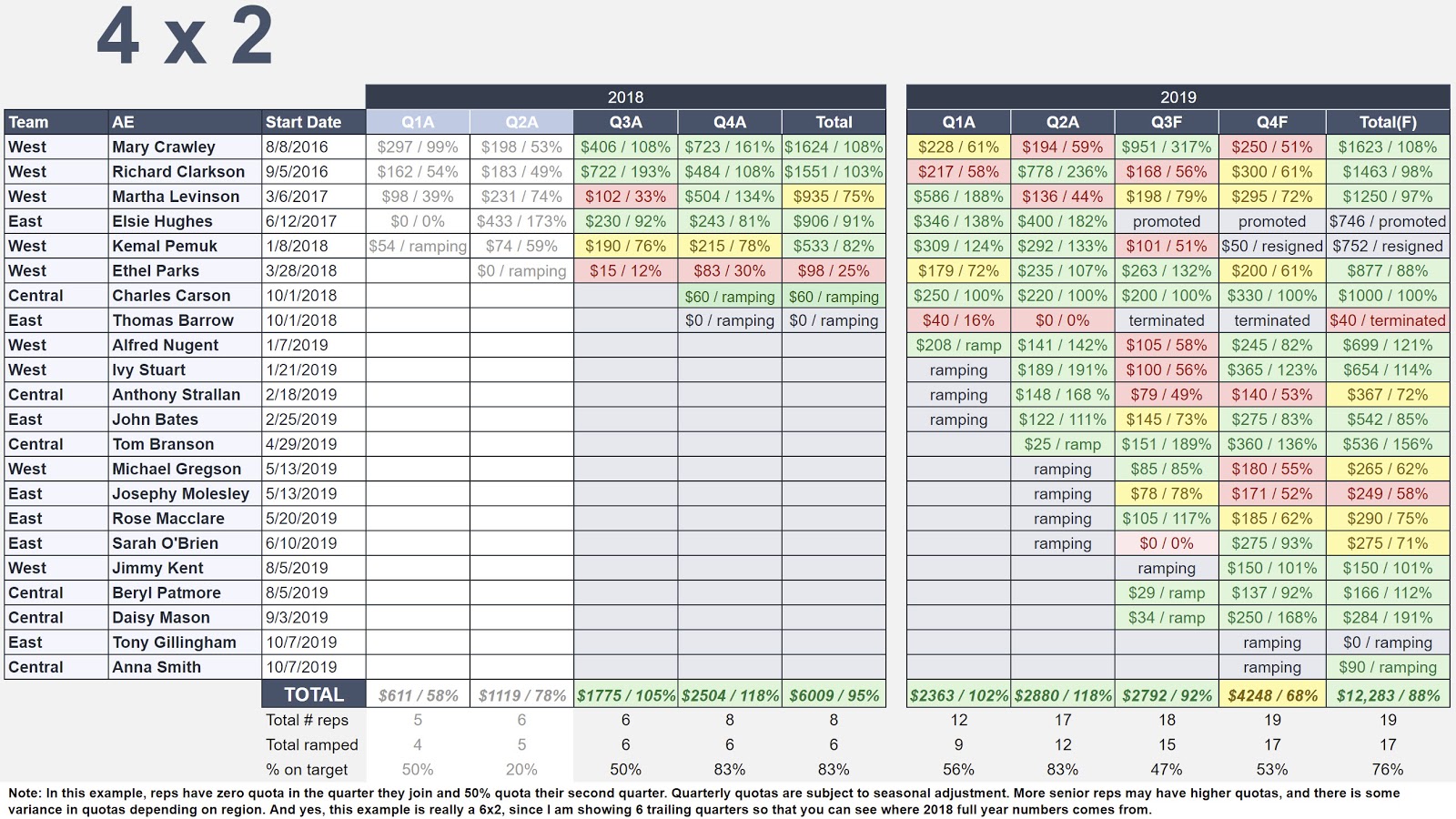
The 4×2 is a color-coded chart where each row is an individual seller on your team and the columns are their quarterly performance shown as dollars sold. [See a 4×2 chart example below].

Sales are usually measured as net new ARR, which includes new accounts and existing account expansions net of contraction, but you can also use new TCV (total contract value), depending on which number your team most focuses. In addition to sales dollars, the percentage of quarterly quota attainment is shown. The name 4×2 comes from the time frame shown: trailing four quarters, the current quarter, and the next quarter.

Color-coding the cells turns this tool from a dense table of numbers into a powerful data visualization. Thresholds for the heatmap can be determined according to your own needs and culture. For example, green can be 80% of quota attainment or above, yellow can be 60% to 79% of quota, and red can be anything below 60%.

Examining individual seller performance in every board meeting or deck is a terrific way to quickly answer many important questions, especially early on as you try to figure out your true position on the Sales Learning Curve. Publishing such leaderboards for your Board to see also tends to motivate your sales people, who are usually highly competitive and appreciate public recognition for a job well done, and likewise loathe to fall short of their targets in a public setting.

4x2 chart venrock saas

A sample 4×2 chart.

Some questions the 4×2 can answer:

Overall performance and quota targets

How are you doing against your sales plan? Lots of red is obviously bad, while lots of green is good. But all green may mean that quotas are being set too low. Raising quotas even by a small increment for each seller quickly compounds to yield big difference as you scale, so having evidence to help you adjust your targets can be powerful. A reasonable assumption would be annual quota for a given rep set at 4 to 5 times their on-target earnings potential.

Boeing Starliner crew capsule and Atlas V rocket complete dress rehearsal ahead of test flight

Boeing and launch partner United Launch Alliance (ULA) completed a key step today in pursuit of launching U.S. astronauts aboard their commercial spacecraft. The Boeing CST-100 Starliner crew capsule was atop the ULA Atlas V rocket at Cape Canaveral Air Force Station’s Launch Complext 41 in Florida, with the rocket fully fuelled while the combined crew all took part in a dress rehearsal called the “integrated Day of Launch Test – aka IDOLT because space people all love acronyms so much.

The rehearsal paves the way for the uncrewed Orbital Flight Test (OFT) that NASA, ULA and Boeing are targeting for December 20 (which just changed today from December 19), which will be exactly what the first crewed mission aboard the Starliner will be, but without the crew on board. Today’s test involved everything leading up to the actual launch, including real feeling, a launch countdown, preparing and checking the access hatch to the crew capsule and more.

This kind of practice was standard during the days of Shuttle launches, and helps ensure that everyone knows what to do and when, and that more than just knowing, they can demonstrate that it works exactly as it’s supposed in a real-world setting. The full integrated dress rehearsal is especially important, since while you can always drill teams independently, you never know exactly how things are going to work until you run them all together.

As mentioned,d next up is the crucial OFT that will set the stage for a crewed launch early next year. The current target is December 20, so Boeing and its partners should get this in just before year’s end, if all goes to plan.

Bird lays off several Scoot employees

Bird has laid off less than two dozen employees, The San Francisco Chronicle first reported. The layoffs affect employees Bird brought on board as part of its ~$25 million acquisition of Scoot earlier this year.

Those affected were salaried employees and/or people with technical backgrounds, according to Bird.

“The integration of Bird and Scoot does not impact or change our previous or future commitments to San Francisco or to providing its residents and visitors access to the highest quality and most reliable shared micromobility vehicles and services,” a Bird spokesperson told TechCrunch. “We are planning to relocate a number of Scoot team members to our Santa Monica headquarters while also maintaining an office in San Francisco for our operations and maintenance teams as well as a number of regionally specific roles.”

Scoot currently operates electric kick scooters and mopeds in San Francisco, where it’s one of four companies permitted to do so, as well as other types of vehicles in Santiago and Barcelona.

This round marks Bird’s second set of layoffs this year. In March, Bird laid off between 4-5% of its workforce. Those layoffs were part of Bird’s annual performance review process and only affected U.S.-based employees.

In October, Bird closed a $275 million Series D round led by CDPQ and Sequoia Capital at a $2.5 billion pre-money valuation. That same month, at TechCrunch Disrupt San Francisco, Bird CEO Travis VanderZanden told me he wants the Scoot brand to live on.

“We think it is a strong brand particularly with cities and so we want it to live on,” he said. “It’ll certainly live on in San Francisco. And then we’re still trying to figure out in other cities what makes the most sense for the brand.”

The inevitable takedown of the female CEO

Sara Mauskopf
Contributor

Sara Mauskopf is the CEO and co-founder of Winnie, a marketplace for daycare and preschool helping over 4 million parents across the U.S. Prior to founding Winnie, Sara held product leadership roles at Postmates, Twitter, YouTube and Google.

Four years ago when I founded Winnie, I set out to build a different kind of startup. Above and beyond any success our business achieved, it was most important to me that we create a culture where people would want to work. As a new mom at the time, I intentionally decided to build a company where employees would not work on nights or weekends, where there was flexibility for employees to manage their lives outside of the office, where motherhood would no longer be a penalty but a bonus and where underrepresented groups would be valued and promoted. If we failed because we did those things, so be it.

Four years later, I’m proud of the culture my co-founder Anne Halsall and I have built. As it turns out, treating employees well, valuing their families and personal time and diversifying our team are not only the right things to do, but also competitive advantages.

Even so, I worry that being a woman and taking on the role of co-founder and CEO places a target on my back.

Aggressive. Blunt. Furious. These are words that have been used to criticize the behavior of female CEOs of prominent companies like Thinx, Cleo, Rent the Runway and ThirdLove, to name a few. Away is the latest female-led company to come under fire, in an article in The Verge on Thursday.

First, let me be clear: A toxic work culture is never acceptable. Regardless of who started a company or what kind of stress the company is under, it’s never okay to mistreat employees. Some of the things that came to light in these pieces are particularly abhorrent: sexual harassment, lying about one’s credentials, creating an unsafe space for underrepresented groups, overworking employees. These are dynamics that need to be called out and eliminated at all companies, whether female or male-led. The Away example is no exception.

But as a female founder and CEO of a growing company, I have to ask: Why does it seem like so many of the toxic companies in the news are founded and led by women? The number of major public corporations led by female CEOs is less than 5%, and of the 134 U.S.-based unicorns, only 14 even have a woman with a co-founder title.

For such a small fraction of female-led companies, the amount of negative press female CEOs receive is glaringly disproportionate. I have a couple of ideas why.

First, while much of what is revealed in these reports is disgusting, what also comes through is the stereotype of women leaders as “bitches.” Articles often highlight when female CEOs curse, yell and show anger or bawdiness, because the shock value is higher than when male CEOs demonstrate these behaviors. We ask women leaders not only to be successful, but also to be ladylike and likable. I have lost count of the number of times I’ve been criticized for not being warm and friendly enough, or saying things that were too blunt.

Second, studies show that when it comes to ethical failures, women are “judged more harshly than men.” The ThirdLove article calls out that “at a by women, for women company” ThirdLove’s practice of discouraging salary negotiation was particularly disappointing. Cleo’s last-minute setup of a mother’s room using hanging curtains and a TaskRabbit was described by employees as one of the “more outrageous” behaviors of the founder. As a breastfeeding mom myself, I hate when mother’s rooms are inadequate, but male-led companies have poor lactation accommodations all the time.

The way we are targeting female founders and CEOs is doing nothing to encourage gender equality. It is only ensuring that the number of female CEOs is dwindling under the pressure of having to live up to stricter standards than men. So what can each of us do to create a more fair and accurate picture?

Reporters should continue to hold companies accountable, but just seek stories of male CEOs in equal proportion to the number of male-led companies out there. Those stories are there and only a few of the very worst examples have been exposed. Let’s have it take much less time to expose the next Travis Kalanick or Adam Neumann.

As readers, it is also worth being aware of our own biases. We can ask ourselves if we’re more outraged at a behavior because it comes from a woman, and if there are men we’re allowing to go unscrutinized. We can ask ourselves if maybe we enjoy seeing successful women taken down a notch (I certainly hope the answer is no).

I will continue to implement a healthy work environment at Winnie, grow a company where my employees can thrive and hold myself to the highest standards of conduct. But as we continue to take down the already few female CEOs one by one, I can only hope that what I do will be enough.

Will the 2020s be online advertising’s holistic decade?

Todd Dipaola
Contributor

Todd Dipaola founded inMarket to bring the performance and accountability of digital advertising to offline brands.

With less than two months left in the decade, advertising is again entering a new phase of rapid expansion with customer experience front and center.

The explosion of data and identity management, combined with technical advancements in real-time signal detection and machine learning, present new opportunities to respond to consumers, but mastering this ability enables marketers to create “magic moments” — instances of hyper-relevant content, delivered at the perfect time and place. 

We’ll see evolutions on the back end in terms of delivery and measurement — as well as on the consumer-facing end — through new creative deployments that enhance the brick-and-mortar shopping trip. Marketers will be held to a higher standard, both by clients demanding world-class performance and proof, as well as consumers who want relevancy, helpfulness and privacy from their brand relationships. 

Achieving this balance won’t be an easy task, but the most progressive marketers will succeed in driving this industry toward a more customer-centric future because they took steps to evolve before it was too late. With that in mind, here are five ways we expect advertising to become more holistic in the 2020s: 

Smart data will take priority over big data

Most marketers have heard the adage, “garbage in, garbage out.” For too long, the industry relied on sheer quantity of data with no quality metrics for making key audience assumptions. This mentality has had a detrimental effect on our industry, creating an ecosystem where people simply hate ads and brands focus on viewability over ROI.

To truly understand our audiences, we must first turn data from multi-channel interactions into smart, actionable insights. This involves not only understanding who the customer is, but what motivates them. 

Progressive marketers will continue to invest heavily in identity graphs to tie critical data and behaviors to individual profiles across channels. Using data science and machine learning, marketers will then be able to advance their knowledge about consumers to new levels, employing new messaging tactics based not only on value, but also on what inspires action. Key nuances, like distinguishing a deal-seeker from a value-seeker, will lead to more engaging personalized experiences and ultimately better ROI for advertisers.

We’ll see a flurry of investment in real-time engagement

We live in a world where our technology predicts where we are going, what we are seeking and how long it will take to get there by recognizing our patterns and everyday behaviors. The benefits in terms of convenience and knowledge are addictive. Look no further than email, social and Alexa to see how real-time awareness and time savings from these interactions impact our everyday lives.  

For marketers, capturing this lightning in a bottle has always been elusive — until now. The rise of real-time advertising, customer data platforms (CDPs), data science and machine learning have created the ability to detect purchases as well as online and real world location signals in real-time. This enables marketers to not only predict the next shopping trip, but what a consumer is likely to buy, when it matters most.

These sense-and-respond capabilities will enable progressive marketers to create experiences of enormous value at the moments that matter, such as triggering an offer of relevance upon entering a store or delivering a tailored experience at a specific time and location. The new decade will bring about massive investments into these technologies given their immediate ability to influence consumers during the actual purchase process. We’ll see budgets being specifically carved out to support real-time advertising and technologies as marketers optimize and convert users with greater effectiveness.  

For consumers, it means that the in-store experience will continue to become more interactive, with mobile devices as the connecting point between e-commerce and brick and mortar. Brands that thrive in this environment will win by delivering meaningful creative that connects both online and offline worlds in a helpful and relevant way.

Cutting-edge tech will create new ad experiences