Banning vaping just might drive teens to the black market—and send adult smokers back to their cancer sticks.
Category: Tech news
hacking,system security,protection against hackers,tech-news,gadgets,gaming
Join TechCrunch for our 3rd Annual Winter Party
After last year’s stellar turn out of almost 1,000 Silicon Valley shakers and movers, TechCrunch is returning with the 3rd Annual Winter Party at Galvanize in San Francisco on February 7.
The party will feature tasty beers, wine and canapés, party games and activities, plenty of photo ops (and our infamous karaoke), giveaways and some fun surprises. As you network your way across the sea of attendees, you’ll also get to check-out a handful of promising early-stage startups just waiting for their big break.
The shindig will be held in the multi-level facility at Galvanize in San Francisco on Friday, February 7. While the venue is large, it won’t be able to hold all of Silicon Valley, so tickets are very limited and will be released on a rolling basis for $85 each. If you’re a startup and want to demo your product at this event, demo tables are available for purchase at $1,500 each. Demo tickets are limited too, so get yours before we sell out!
More about the Winter Party:
When? Friday, February 7, 6:00 p.m. – 9:00 p.m.
Where? Galvanize, 44 Tehama St., San Francisco, CA 94105
How? Get tickets here for just $85 each. There are only a limited number of tickets for this event. Tickets will be released in batches, so if you don’t see any availability, stay tuned to TechCrunch for our next release, as they sell out quickly. TechCrunch parties have a history of being the place you want to meet your future investor, acquirer or co-founder. And to top it all off, we’re going to give away some really great door prizes, like TC swag and tickets to Disrupt SF, our flagship event coming in September 2020.
Hope to see you all there!
Our sponsors help make TechCrunch events happen. If you are interested in learning more about sponsorship opportunities, please contact our sponsorship team by filling out this form.
Google makes moving data to its cloud easier
Google Cloud today announced Transfer Service, a new service for enterprises that want to move their data from on-premise systems to the cloud. This new managed service is meant for large-scale transfers on the scale of billions of files and petabytes of data. It complements similar services from Google that allow you to ship data to its data centers via a hardware appliance and FedEx or to automate data transfers from SaaS applications to Google’s BigQuery service.
Transfer Service handles all of the hard work of validating your data’s integrity as it moves to the cloud. The agent automatically handles failures and uses as much available bandwidth as it can to reduce transfer times.

To do this, all you have to do is install an agent on your on-premises servers, select the directories you want to copy and let the service do its job. You can then monitor and manage your transfer jobs from the Google Cloud console.
The obvious use case for this is archiving and disaster recovery. But Google is also targeting companies that are looking to lift and shift workloads (and their attached data), as well as analytics and machine learning use cases.
As with most of Google Cloud’s recent product launches, the focus here is squarely on enterprise customers. Google wants to make it easier for them to move their workloads to its cloud, and for most workloads, that also involves moving lots of data as well.
The War on Polio Just Entered Its Most Dangerous Phase
Though victory is close, the eradication campaign is on some very fragile ground.
The last decade in real estate, and a peek into the next one
Allen Miller
Contributor
Contributor
Allen Miller is a principal at Oak HC/FT based in San Francisco. He’s excited by bold entrepreneurs building great companies across categories, especially in fintech.
As we barrel towards the start of a new decade, it’s amazing to think about the ongoing transformation within real estate.
In the U.S., housing’s contribution to our GDP is ~15-18% spread across residential transactions, construction and housing services (i.e. rent, utilities, insurance, etc.) For the average homeowner, their primary residence is the biggest component of their net worth. And for employers, affordable housing programs can increase employee retention, productivity and success on the job. Apple, Google and Facebook have all launched different programs focused on addressing the high cost of living, particularly in the San Francisco Bay Area.
Technology has allowed for some real progress
Technology has accelerated the rate of progress within the real estate vertical. There are now more than a dozen real estate tech companies valued at an aggregate ~$75 billion (depending on where The We Company lands in the coming months). This batch includes three publicly-traded companies (Zillow, Real Page and Redfin), two others primed to go public in the next year (Airbnb and Procore) and one other that recently put its IPO plans on hold (Lemonade).
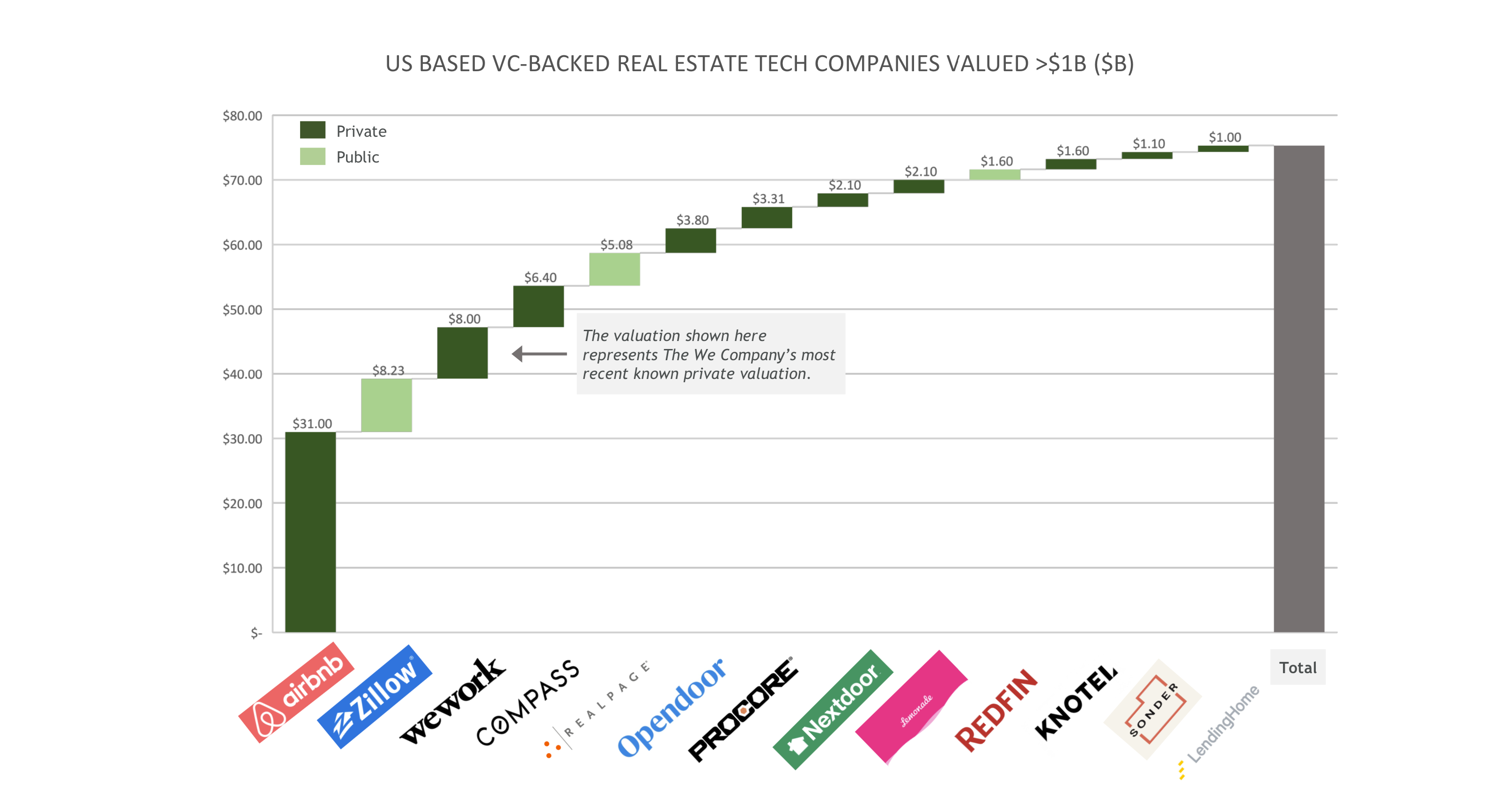
New entrants have succeeded by bringing a fresh take to the category and/or creating entirely new categories. Airbnb, WeWork, Knotel and Sonder have all used the “monetize underutilized assets” playbook — applied in either residential or commercial settings. Compass and Redfin are re-imagining what it means to be a modern, tech-enabled brokerage firm. Realpage and Procore are bringing application software solutions to property management and construction. Lemonade and LendingHome are more traditional fintech companies applied to the real estate transaction ecosystem.
Significant opportunities remain
Over the coming decade, we at Oak HC/FT expect more innovation to come within real estate as we anticipate a continued influx of talent into the sector. And we think the total market cap of real estate tech companies could more than double to $200 billion in aggregate value by 2030. Here are some of the innovations and companies we are watching in 2020 and beyond:
- More value for buyers and sellers: Zillow brought much needed transparency into what was “on the market” (i.e. the top of the funnel). But the home transaction process is still convoluted and prohibitively expensive. In recent years, there has been a wave of new entrants focused on improving the transaction process in different ways, each with a slightly different approach. The iBuyers, like Opendoor and Offerpad, allow for sellers to sell instantly. Flyhomes allows buyers to put down cash offers. ZeroDown and Divvy lower the barrier to entry to buying a home. And Homie brings assembly-line specialization and vertical integration to drive down agent commissions. In the coming years there will be multiple wins here, with each appealing to different segments of this massive market.
- Better tools for ecosystem players: Agents and other providers are itching for better software tools to do their jobs. Side provides agents with all the tools they need (across marketing, vendor management, legal, insurance and transaction coordination) to run their own business — rather than relying on the incumbent brokerages with their hefty fees. Qualia, Spruce and Modus provide next generation title and escrow services. Great Jones, TenantCloud, Avail and Mynd help landlords better manage their properties.
- Increased access to data: The availability of data for decision making, especially on the commercial side, is still very much underdeveloped. Crexi has brought a Zillow-like experience to listing commercial properties. Reonomy has made nice progress using machine learning to surface key financial and asset-level data on commercial properties. We expect these and other new entrants to win big by bringing more transparency to commercial real estate.
- Greater flexibility in how we work and live: As the demands of modern life have changed, so too have the ways in which consumers desire to work and live. The Wing and HubHaus provide communities that appeal to more targeted groups. Feather allows its customers to rent furniture wherever they live or work. And prefab housing companies, including Dvele, enable consumers to design their home before moving in.
But core challenges need to be addressed


Is Facebook dead to Gen Z?
Olivia Moore
Contributor
Contributor
Olivia Moore is a venture investor at CRV and co-founded Cardinal Ventures alongside her sister, Justine.
More posts by this contributor
Justine Moore
Contributor
Contributor
Justine Moore is a venture investor at CRV and co-founded Cardinal Ventures alongside her sister, Olivia.
More posts by this contributor
The writing is on the wall for Facebook — the platform is losing market share, fast, among young users.
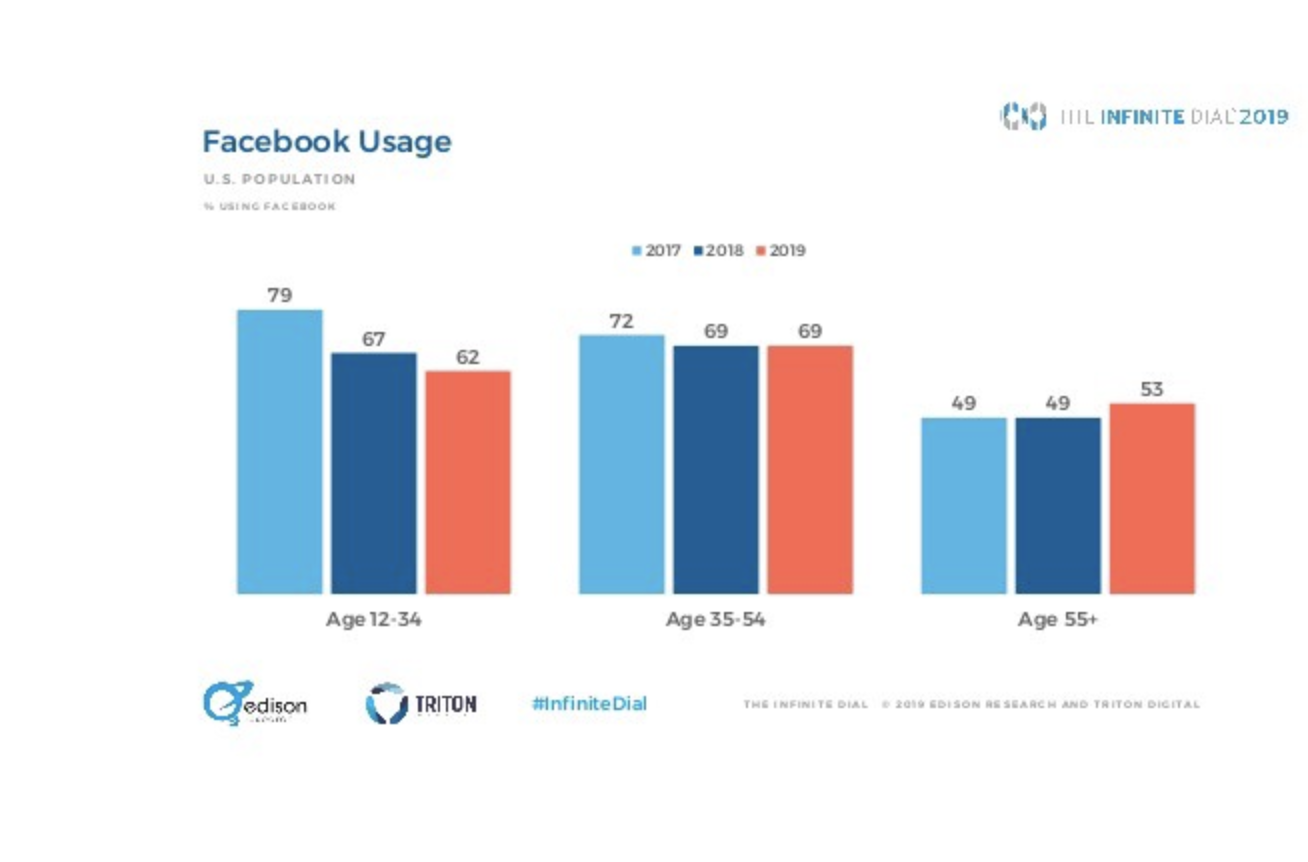
Edison Research’s Infinite Dial study from early 2019 showed that 62% of U.S. 12–34 year-olds are Facebook users, down from 67% in 2018 and 79% in 2017. This decrease is particularly notable as 35–54 and 55+ age group usage has been constant or even increased.
There are many theories behind Facebook’s fall from grace among millennials and Gen Zers — an influx of older users that change the dynamics of the platform, competition from more mobile and visual-friendly platforms like Instagram and Snapchat, and the company’s privacy scandals are just a few.
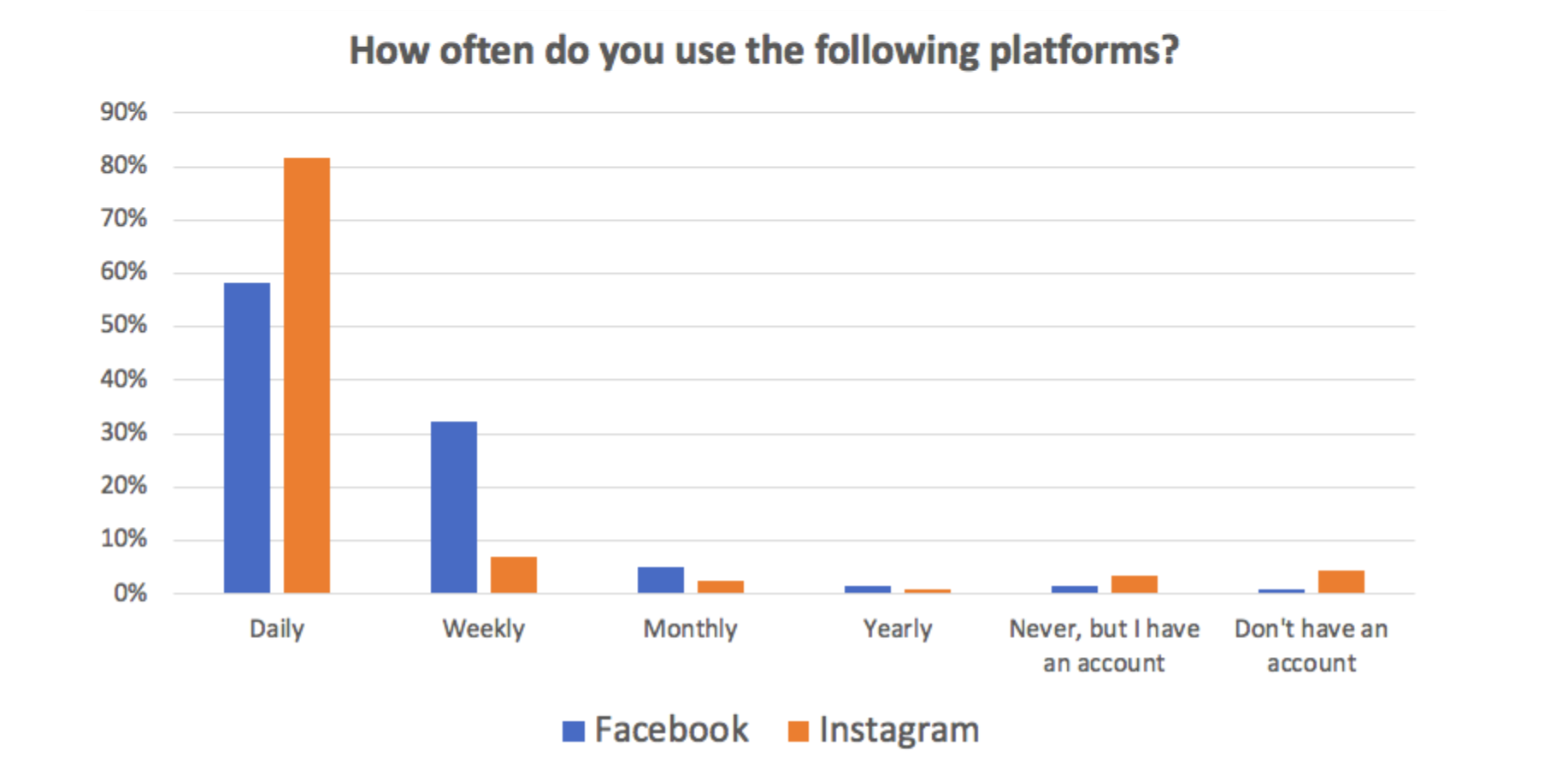
We surveyed 115 of our Accelerated campus ambassadors to learn more about how they’re using Facebook today. It’s worth noting that this group skews older Gen Z (ages 18–24); we suspect you’d get different results if you surveyed younger teens.
Overall penetration is still high, as 99% of our respondents have Facebook accounts. And most aren’t abandoning the platform entirely — 59% are on Facebook every day, and another 32% are on weekly. Daily Facebook usage is much lower than Instagram, however, which 82% of our respondents use daily and 7% use weekly.
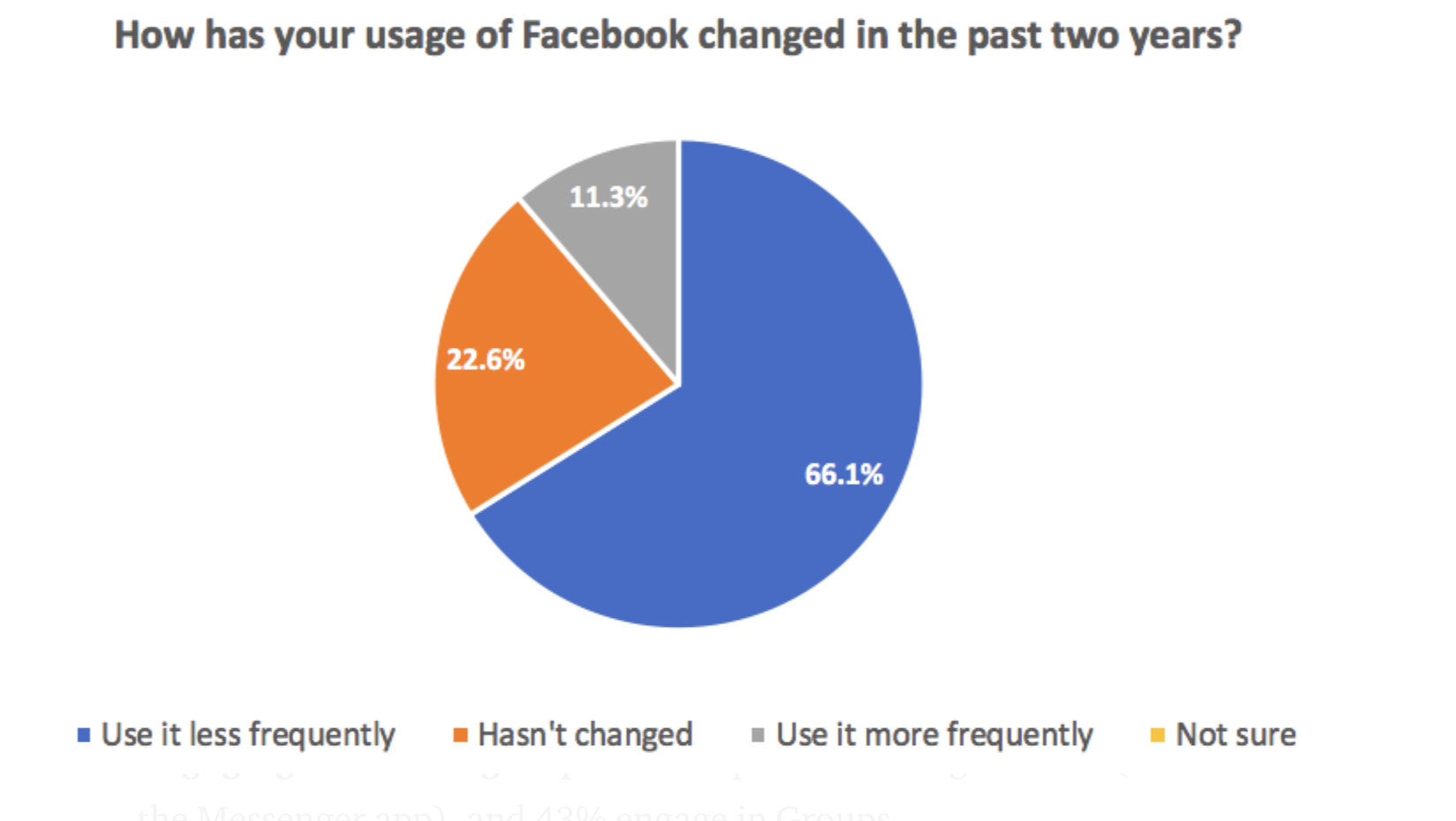
Data from our scouts also confirms that the shift in usage in the last few years is particularly dramatic among younger users. 66% report using Facebook less frequently over the past two years, compared to 11% who use it more frequently (23% say their usage hasn’t changed).
What’s most interesting is what college students are using Facebook for. When we were in high school and college in the early/mid 2010s, our friends used Facebook to post (broadcast) content via their status, photos, and posts on friends’ Walls. Today, very few students use Facebook to “broadcast” content. Only 5% of our respondents say they regularly upload photos to Facebook, 4% post on friends’ Walls, and 3.5% post content to the Newsfeed (statuses). What are they doing instead?
Kepler to launch two batches of nanosatellites aboard SpaceX’s Falcon 9
Small-satellite startup Kepler Communications is teaming up with SpaceX to make good on its deployment goals for its first nanosatellite constellation. SpaceX will carry two separate batches of nanosatellites from Kepler aboard its Falcon 9 launch vehicles.
Kepler Communications, a Toronto-based space startup, will be building out a low-power, direct IoT connectivity satellite-based network, as well as a more high-capacity network powered with the same satellites to provide high-speed data transfer capabilities.
In total, Kepler will launch 400 kg (around 880 lbs) of payload with SpaceX, making use of the rideshare program that the Elon Musk-run company announced earlier this year. This launch will put the Kepler spacecraft into Sun-synchronous orbit, which means that they will pass over specific points on Earth at the same time each day as judged by the Sun’s position.
All told, Kepler will aim to put a total of 140 satellites in orbit across three phases of launch spanning 2020 to 2023. The goal is to operate the constellation as a relay system to help transfer data to other satellite constellations in orbit.
The Tale of WeWork Is Being Made Into a TV Show
*Succession* star Nicholas Braun, aka Cousin Greg, is set to star as WeWork’s founder Adam Neumann.
Hulu launches its viewer-friendly ‘binge watch ads’
Hulu today is launching a new kind of ad experience that allows brands to specifically target binge-watchers — that is, viewers who are watching multiple episodes of a favorite program over a long stretch of time. These “binge watch ads” utilize machine learning techniques to predict when a viewer has begun to binge watch a show, then serves up contextually relevant ads that acknowledge a binge is underway. This culminates when the viewer reaches the third episode, at which point they’re informed the next episode is ad-free or presents a personalized offer from the brand partner.
The binge watch ad concept was first announced at Hulu’s annual NewFronts presentation in May, where it introduces to advertisers its new shows, features and ad formats. The company regularly experiments with new advertising formats designed to better cater to a streaming audience in a less obtrusive way. For example, Hulu already offers “pause ads,” which only appear when the viewer presses the pause button.

Hulu says it made sense to target binge watchers because binging is now such a common way for people to watch their favorite shows. Today, 75% of U.S. consumers say they binge watch, and on Hulu specifically, nearly 50% of ad-supported viewing hours are spent during binge watch sessions. Hulu defines a “binge” as a viewer watching three or more episodes of a series at a given time.
The debut advertisers to capitalize on the new binge watch ad format include Kellogg’s, Maker’s Mark and Georgia-Pacific, by way of Hulu’s exclusive launch agency partner, Publicis Media.
Kellogg’s will promote Cheez-It Snap’d snacks during their binge ads, while Georgia Pacific will tout its Sparkle paper towels. Marker’s Mark, of course, will promote its bourbon.

The brands say they were interested in the new format because it gives them a way to reach and reward the consumer during a marathon entertainment session, and because it’s a better fit with how today’s consumers watch TV. Thanks to the rise of ad-free subscription video services like Netflix, viewers are less receptive to disruptive advertising that interrupts their viewing. In fact, they can even sour on a brand when its ad plays repeatedly throughout the viewing session.
Offering brands the ability to sponsor an episode, ad-free, instead creates more positive sentiments among viewers.

Hulu’s focus on developing new ad formats that better fit how today’s consumers watch TV may give it an advantage over rivals. Its ad-supported product is now one of many options for streaming TV — and one that goes up against a number of free services, including The Roku Channel, Amazon’s IMDb TV, Sinclair’s Stirr, Viacom’ s Pluto TV, Tubi, YouTube, Vudu’s Movies on Us (Walmart), Plex and others.
Atlassian launches new serverless cloud development platform
Atlassian has a portfolio of developer tools like Bitbucket, Jira and Confluence. It also has a marketplace with thousands of add-ons. But what it lacked was a development platform to call its own. Today, that changed when the company announced the Forge platform.
“Forge will empower developers to more easily build and run enterprise-ready cloud apps that integrate with Atlassian products,” the company wrote in a blog post announcing the new tools.
The platform consists of three main components. For starters, it’s providing a serverless Function as a Service (FaaS) for developers to build hosted applications on Forge without worrying about the underlying infrastructure resources required to run the applications. The tool is actually built on AWS Lambda, AWS’s FaaS.
This should allow more developers to get involved because it strips away a layer of complexity around managing infrastructure. “A FaaS platform also lets us eliminate common pain points such as authentication, identity, scaling and tenancy,” the company wrote in the blog post.
The tool kit also includes a UI component called Forge UI for building user interfaces on the web or devices. Forge UI uses a declarative language that should make it easier to build user interfaces, and as with the function layer, the idea here is to simplify the process for users. Atlassian will deal with all of the security involved in building a user interface, something that many developers struggle with.
“By abstracting away the process of rendering the UI layer, Forge makes stronger guarantees about how apps present or transmit sensitive data, such as user-generated content and personally identifying information,” the company wrote.
The final piece is a command line interface (CLI) called Forge CLI. The idea here is to build continuous delivery pipelines with Bitbucket and run them from the command line. If you put all three of these components together, you have a pretty comprehensive development environment with tools for building functionality and designing user interfaces, while managing operations from a command line.
There are lots of platform service offerings out there, so Atlassian faces some competition here, but for developers who planned on building apps for the Atlassian marketplace, this set of tools could prove useful and help push more developers to join in.
Twitter is bringing back Election Labels to identify 2020 US election candidates
With just less than a year until U.S. Election Day, Twitter is bringing back its Election Labels, which provide information about political candidates — including which office they’re running for and their state and district number. The labels will also have a small ballot box icon to accompany this information. The feature was first launched during the 2018 U.S. midterms, where the labels were seen 100 million times per day by Twitter users in the week before Election Day.
In addition, 13% of U.S. election-related conversations on Twitter included a tweet with an Election Label, the company says.
Now the labels are making a return ahead of the 2020 U.S. elections.
The labels will appear on accounts of candidates who are running for the U.S. House of Representatives, U.S. Senate or Governor in the 2020 election who have qualified for the general election ballot, says Twitter. And they will begin to appear on candidates’ Twitter accounts after they qualify, which will happen on a rolling basis as states have different caucus and election dates, the company notes. The first takes place on March 3.
To enable the feature, Twitter has again partnered with Ballotpedia, a civic nonprofit that publishes non-partisan information about federal, state and local politics. The organization will help Twitter identify which candidates have qualified for the general election ballot so their accounts can be appropriately labeled.
The Election Label will appear on the profile page of a candidate’s Twitter account and on every tweet and retweet they post to their account, even when embedded on sites off of Twitter.
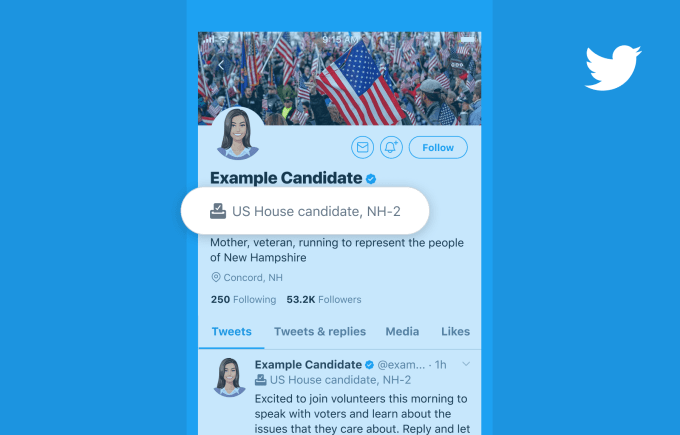
Ahead of this, Twitter today will also start to verify the campaign Twitter accounts of those who have qualified for primary elections for the U.S. House, Senate or Governor. This is different from how Twitter handled candidate verification during the 2018 midterms. Back then, it only verified candidates after they qualified for the general election ballot. This time around, Twitter says it will proactively verify the primary candidates.
This verification is the same checkmark other high-profile accounts receive — like those belonging to celebrities or other public figures. These verifications will start today and will continue on a rolling basis as states have different filing deadlines. Ballotpedia is also assisting on this effort as well, by helping Twitter identify the candidates.
Twitter, like other social platforms, was heavily impacted by foreign interference with the U.S. 2016 presidential election. Last year, Twitter said that 1.4 million people interacted with Russian trolls during the presidential campaign, which is more than double the 677,775 that Twitter originally believed had either seen, followed or retweeted one of those accounts. These interference issues have been ongoing, as thousands of Twitter accounts spreading false information remained active in the weeks ahead of the U.S. midterms.
Bots continue today to infect the platform in an effort to sway public opinion. For example, in April, Twitter removed more than 5,000 bots with ties to a social media operation that previously promoted messages sympathetic to Saudi Arabia’s government. The bots had more recently been promoting the “Russiagate” hoax.
Disinformation efforts like this are not just impacting social platforms in the U.S., nor are they only associated with Russian bots. In a report released at the beginning of 2019, Twitter said it had banned more than 4,000 disinformation accounts originating in Russia, 3,300 from Iran and more than 750 from Venezuela.
When Twitter first introduced the Election Labels for the U.S. midterms, it stressed how important it is for people using its platform to be able to identify the original sources and authentic information.
Today, Twitter’s system to label and verify politicians and candidates’ campaigns is now a part of a number of efforts Twitter has underway to make sure conversations taking place on its platform are authentic. The company says it will later release more tools to help better find quality news and have more informative conversations on Twitter.
Rocket Lab cuts the ribbon on its US launch facility, with the Air Force as its first customer
Launch provider Rocket Lab has opened the doors on LC-2, its first launch facility in the U.S., adding capacity and versatility for providing trips to orbit. And LC-2 already has its first customer: the U.S. Air Force’s Space Test Program.
The company had a little shindig today at the facility, located on Wallops Island in Virginia — home to NASA’s Wallops Flight Facility, as well. There they took the wrapper off LC-2, which has been under construction since it was announced last October.

The team breaks ground back in 2018
It’s not some wild new concept, just a typical launchpad and support facilities where the rockets live, get checked, fueled and so on. The most important difference with this one, for Rocket Lab, is that it’s here in the U.S. — so far, all its 10 commercial launches have been from Launch Complex 1 in New Zealand, where the company is based.
The new facility will be put to use soon: the Air Force is first in line to put a payload into orbit in a launch currently planned for Q2 of 2020. All we know about the mission, STP-27RM, is that it will “test new capabilities that we will need in the future.”
“It’s an honor and privilege to be launching a U.S. Air Force’s Space Test Program payload as the inaugural mission from Launch Complex 2,” said Rocket Lab founder and CEO Peter Beck in a press release. “We’ve already successfully delivered STP payloads on Electron from Launch Complex 1, and we’re proud to be providing that same rapid, responsive, and tailored access to orbit from U.S. soil.”
Right now LC-2 is “only” equipped to handle up to 12 launches a year, while LC-1 can theoretically do 120. Rocket Lab is nowhere near hitting those rates just yet, but they’re well on their way with a perfect track record and a demonstration of its ability to quickly adjust time frames. The goal is eventually to be launching weekly, or even more frequently than that. And the more launch sites they have to pull that off, the better.
Amazon launches Audible Suno free app featuring short-stories in India
Amazon is having another go at expanding its reach to listeners in India. The company, which launched pay-to-use Audible in the country last year, today introduced a new service called Audible Suno that offers free access to “hundreds of hours of audio entertainment, enlightenment and learning.”
And it’s banking on major Indian celebrities to draw the listeners.
Audible Suno, which is exclusively available to users in India, features more than 60 original and exclusive episodes (of 20 to 60 minutes in length) in both Hindi and English languages. Audible, the world’s largest seller and producer of audio content, said Suno is aimed at filling the “idle time” listeners have each day during their commutes and performing other daily chores.
The company says Audible Suno, available to users through a dedicated Android app and via iOS Audible app, is also free of advertisements.
The launch of Audible Suno in India illustrates the commitment the company has in the country, said Audible founder and chief executive Don Katz. Amazon has invested more than $5.5 billion in its business in India to date. The company’s tentacles today reach a number of categories in the country, including e-commerce, payments, online ticketing business, video and audio streaming and VC deals.
“I’ve always been passionate about the transformative power of the spoken word, and I’m delighted to be able to offer this breadth of famous voices and culturally resonant genres with unlimited access, ad-free and free of charge,” said Katz.
Who are these famous voices you ask? Here’s the list: Amitabh Bachchan, Katrina Kaif, Karan Johar, Anil Kapoor, Farhan Akhtar, Mouni Roy, Anurag Kashyap, Neelesh Misra, Tabu, Nawazuddin Siddiqui, Diljit Dosanjh, Vir Das and Vicky Kaushal.
Audible Suno currently offers shows in a range of genres, including horror (Kaali Awaazein), romance and relationships (Matrimonial Anonymous and Piya Milan Chowk), suspense (Thriller Factory) and comedy series (The Unexperts by Abish Mathew). Non-fiction series include interviews with some of the country’s biggest stars, and socially relevant subjects such as mental health, sex education and the rights of the LGBTQI+ community.
Samsung has sold 1 million Galaxy Fold smartphones
Today at TechCrunch Disrupt Berlin, Samsung Electronic’s President Young Sohn revealed the company had sold 1 million foldable Galaxy Fold smartphones. Estimates from October pegged sales at that time at 500,000 units.
“And I think that the point is, we’re selling [a] million of these products,” Sohn said. “There’s a million people that want to use this product at $2,000.”
Today’s conversation at Disrupt Berlin focused around growth through innovation. Sohn commented on the sales number while explaining Samsung’s process of releasing products to get feedback. He said, in part, if they kept devices like the Fold in labs, they wouldn’t get the input they needed.
And Samsung got a lot of feedback about the Galaxy Fold.
The foldable phone was first announced early this year at MWC 2019, where it was among a handful of foldable devices. It launched several months later in April, where reviewers quickly discovered multiple problems, including screens that cracked. The company soon (though perhaps not quickly enough) reworked the product, re-releasing it in late September.
The re-released Galaxy Fold was more durable, though our review unit still had screen issues.
Today at Disrupt Berlin, I asked if Samsung is comfortable selling a $2,000 device that is essentially a beta device. He said yes, and pointed to the new sales number as justification.
Previous media reports stated Samsung is ramping up plans to sell 6 million foldable devices in 2020.
And the winner of Startup Battlefield at Disrupt Berlin 2019 is… Scaled Robotics
At the very beginning, there were 14 startups. After two days of incredibly fierce competition, we now have a winner.
Startups participating in the Startup Battlefield have all been hand-picked to participate in our highly competitive startup competition. They all presented in front of multiple groups of VCs and tech leaders serving as judges for a chance to win $50,000 and the coveted Disrupt Cup.
After hours of deliberations, TechCrunch editors pored over the judges’ notes and narrowed the list down to five finalists: Gmelius, Hawa Dawa, Inovat, Scaled Robotics and Stable.
These startups made their way to the finale to demo in front of our final panel of judges, which included: Andrei Brasoveanu (Accel), Andrew Reed (Sequoia Capital), Carolina Brochado (SoftBank Vision Fund), Lila Preston (Generation Investment Management) and Mike Butcher (TechCrunch).
Winner: Scaled Robotics
Scaled Robotics has designed a robot that can produce 3D progress maps of construction sites in minutes, precise enough to detect that a beam is just a centimeter or two off. Supervisors can then use the software to check things like which pieces are in place on which floor, whether they have been placed within the required tolerances or if there are safety issues like too much detritus on the ground in work areas.
Read more about Scaled Robotics in our separate post.
Runner-up: Stable
Stable offers a solution as simple as car insurance, designed to protect farmers around the world from pricing volatility. Through the startup, food buyers ranging from owners of a small smoothie shop to Coca-Cola employees can insure thousands of agricultural commodities, as well as packaging and energy products.
Read more about Stable in our separate post.