While other tech giants fund housing initiatives, Amazon is opening a homeless shelter — inside its HQ

As big tech gets bigger, industry leaders have begun making more noise about helping homeless populations, particularly in those regions where high salaries have driven up the cost of living to heights not seen before. Last January, for example, Facebook and the Chan Zuckerberg Initiative, among other participants, formed a group called the Partnership for the Bay’s Future that said it was going to commit hundreds of millions of dollars to expand affordable housing and strengthen “low-income tenant protections” in the five main counties in and around San Francisco. Microsoft meanwhile made a similar pledge in January of last year, promising $500 million to increase housing options in Seattle where low- and middle-income workers are being priced out of the city and its surrounding suburbs.

Amazon has made similar pledges in the past, with CEO Jeff Bezos pledging $2 billion to combat homelessness and to fund a network of “Montessori-inspired preschools in underserved communities,” as he said in a statement posted on Twitter at the time, in September 2018.

Now, however, Amazon is taking an approach that immediately raises the bar for its rivals in tech: it’s opening up a space in its Seattle headquarters to a homeless shelter, one that’s expected to become the largest family shelter in the state of Washington.

Business Insider reported the news earlier today, and it says the space will be able to accommodate 275 people each night and that it will offer individual, private rooms for families who are allowed to bring pets. It will also feature an industrial kitchen that’s expected to produce 600,000 meals per year.

The space is scheduled to open in the first quarter of the new year and is part of a partnership Amazon has enjoyed for years with a nonprofit called Mary’s Place that has been operating a shelter out of a Travelodge hotel on Amazon’s campus since 2016.

The new space, which BI says will have enough beds and blankets for 400 families each year, isn’t just owned by Amazon but the company has offered to pay for the nonprofit’s utilities, maintenance, and security for the next 10 years or as long as Mary’s Place needs it.

BI notes that the shelter will make a mere dent in Seattle’s homeless population, which includes 12,500 people in King County, where Seattle is located. But it’s still notable, not least because of the company’s willingness to house the shelter in its own headquarters.

It’s a move that no other tech company of which we’re aware has taken. The decision also underscores other cities’ equivocation over where their own, growing homeless populations should receive support.

In just one memorable instance, after San Francisco Mayor London Breed last March floated an idea of turning a parking lot along the city’s Embarcadero into a center that would provide health, housing services, and stays for up to 200 of the city’s 7,000-plus homeless residents, neighboring residents launched a campaign to squash the proposal. It was later passed anyway.

Vox noted in report about Microsoft’s $500 million pledge that many of these corporate efforts tend to elicit two types of reactions: either admiration for the companies’ efforts — or frustration over the publicity these initiatives receive. After all, it’s hard to forget that Amazon paid no federal tax in the U.S. in 2018 on more than $11 billion in profit before taxes. The company also threatened in 2018 to stop construction in Seattle if the city passed a tax on major businesses that would have raised money for affordable housing.

Whether Amazon — one of the most valuable companies in the world, with a current $915 billion market cap — is doing its fair share is certainly worthy of exploring in an ongoing way. The same is true of every tech company that’s ‘eating the world.’

Still, a homeless shelter at the heart of a company like Amazon is worth acknowledging — and perhaps emulating — too.

“It’s not one entity that’s going to solve this” issue of urban homelessness, Marty Hartman, the executive director of Mary’s Place, tells BI. “It’s not on corporations. It’s not on congregations. It’s not on government. It’s not on foundations.

“It’s all of us working together.”

Pictured above: A view of the new Mary’s Place Family Center from the street, courtesy of Amazon.
China-based NIO’s shares skyrocket as the Tesla rival beats investor expectations

Shares of NIO, a China-based electric car manufacturer, are soaring this morning after the company’s Q3 2019 earnings beat investor expectations. NIO’s surprise win comes directly on the heels of Tesla, a competitor, announcing the delivery of its first cars made in China, NIO’s home market.

NIO went public on the New York Stock Exchange in 2018 for $6.26 per share. Its value has plunged as a public company, seeing its per-share price fall to as little as $1.19. Today, after its earnings report, NIO shares are up more than $1 apiece, to $3.47 per share as of the time of writing. That new price represents a gain of a touch less than 44% in today’s trading.

Earnings

NIO managed to beat both revenue and profit expectations in the quarter. And, the company’s forecast for its next quarter’s car deliveries show a sharp rise in automotive deliveries.

According to Yahoo Finance, investors expected NIO to lose $0.34 per share in Q3 on an adjusted basis off revenue of $230.8 million. In fact, NIO reported $257.0 million in revenue leading to an adjusted $0.33 per share loss. NIO managed a top-and-bottom beat while growing its total revenues by 21.8% compared to the sequentially preceding quarter, and 25% compared to the year-ago period.

While NIO did beat expectations, it remains a company deep in its investment cycle. That’s a polite way of saying that it loses lots of money. For example, in its most recent quarter, NIO’s gross margin on selling automobiles came to -6.8%. That was a bit worse than its year-ago result of -4.3%, if better than what it managed earlier in Q2 2019.

NIO’s core business can’t even cover its cost of revenues, let alone the operating costs of the rest of the company. This means that the company is consuming cash, putting an end date on its ability to operate without more cash.

As NIO put it in its earnings letter (emphasis: TechCrunch):

The Company operates with continuous loss and negative equity. The Company’s cash balance is not adequate to provide the required working capital and liquidity for continuous operation in the next 12 months. The Company’s continuous operation, which has also constituted the basis of preparing the Company’s third quarter unaudited financial information, depends on the Company’s capability to obtain sufficient external equity or debt financing. The Company is currently working on several financing projects, the consummation of which is subject to certain uncertainties. The Company will announce any material developments or information subject to the requirements by applicable laws.

So, NIO needs more money. Luckily for it, with a newly risen share price the firm has a better shot at selling more of itself to raise the capital it needs to stay in business and grow.

And grow it intends, with a written expectation of delivering “over 8,000” vehicles in Q4 2019, which it notes is about two-thirds more than it managed in Q3 2019; so NIO is telling investors that its revenue will be sharply higher in the current period than it was in the preceding three-month period.

All good news for NIO, even if Musk and company are breathing down its neck. And good news for the 2018 IPO class.

Buy your tickets to the 3rd Annual TechCrunch Winter Party

We love parties almost as much as we love startups, but we go absolutely bonkers for a hot startup/party mashup. That’s why we’re returning to host our 3rd Annual TechCrunch Winter Party in San Francisco on Friday, February 7. Even better news, party-goers — additional (the second batch) coveted tickets to this wild winter romp are available now. Better get your tickets while you can.

Last year’s inaugural event was a huge success, as nearly 1,000 of Silicon Valley’s brightest minds came to relax, connect and celebrate the entrepreneurial spirit of the startup community — and cast a keen eye over some promising startups.

This year’s soiree takes place at Galvanize and features tasty libations, delicious hors d’oeuvres and engaging conversation. That sounds so very civilized, right? Well, don’t dry clean your stuffed shirt just yet, because we’ll have plenty of party games and activities, giveaways and fun surprises. And, of course, plenty of photo ops, baby!

Galvanize may be a multi-level venue, but the space is still limited — as are the tickets. We’re rolling them out in batches over the next few weeks, so keep checking back if you can’t snag a ticket.

Here are the pertinent Winter Party details:

When: Friday, February 7, 6:00 p.m. – 9:00 p.m.
Where: Galvanize, 44 Tehama St., San Francisco, CA 94105
Ticket price: $85 (buy them here)

Here’s another great idea. Why just mingle and schmooze when you can mingle, schmooze and demo your early-stage startup in front of hundreds of the Valley’s top star-makers? Buy a demo table for $1,500 (the price also includes four attendee tickets). Demo tables are limited, so act now before other founders snatch ’em up.

Of course, no TechCrunch party is complete without plenty of awesome prizes, including TC swag and tickets to Disrupt San Francisco 2020. Come on out for a great midwinter’s night of relaxed connection, fun and opportunity. Get your tickets to the 3rd Annual TechCrunch Winter Party at Galvanize today.

Seed investors favor enterprise over consumer for first time this decade

Hello and welcome back to our regular morning look at private companies, public markets and the gray space in between.

It’s the second to last day of 2019, meaning we’re very nearly out of time this year; our space for repretrospection is quickly coming to a close. Before we do run out of hours, however, I wanted to peek at some data that former Kleiner Perkins investor and Packagd founder Eric Feng recently compiled.

Feng dug into the changing ratio between enterprise-focused Seed deals and consumer-oriented Seed investments over the past decade or so, including 2019. The consumer-enterprise split, a loose divide that cleaves the startup world into two somewhat-neat buckets, has flipped. Feng’s data details a change in the majority, with startups selling to other companies raising more Seed deals than upstarts trying to build a customer base amongst folks like ourselves in 2019.

The change matters. As we continue to explore new unicorn creation (quick) and the pace of unicorn exits (comparatively slow), it’s also worth keeping an eye on the other end of the startup lifecycle. After all, what happens with Seed deals today will turn into changes to the unicorn market in years to come.

Let’s peek at a key chart from Feng, talk about Seed deal volume more generally, and close by positing a few reasons (only one of which is Snap’s IPO) as to why the market has changed as much as it has for the earliest stage of startup investing.

Changes

Feng’s piece, which you can read here, tracks the investment patterns of startup accelerator Y Combinator against its market. We care more about total deal volume, but I can’t recommend the dataset enough if you have the time.

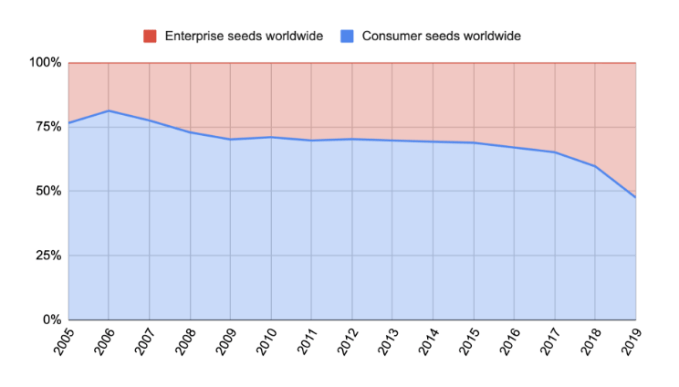
Concerning the universe of Seed deals, here’s Feng’s key chart:

Chart via Eric Feng / Medium

As you can see, the chart shows that in the pre-2008 era, Seed deals were amply skewed towards consumer-focused Seed investments. A new normal was found after the 2008 crisis, with just a smidge under 75% of Seed deals focused on selling to the masses for nearly a decade.

In 2016, however, a new trend emerged: a gradual decline in consumer Seed deals and a shift towards enterprise investments.

This became more pronounced in 2017, sharper in 2018, and by 2019 fewer than half of Seed deals focused on consumers. Now, more than half are targeting other companies as their future customer base. (Y Combinator, as Feng notes, got there first, making a majority of investments into enterprise startups since 2010, with just a few outlying classes.)

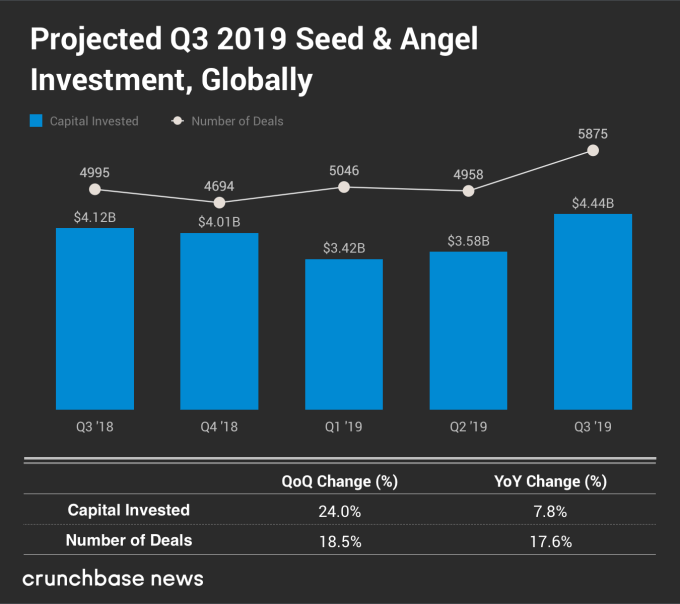
This flip comes as Seed deals sit at the 5,000-per-quarter mark. As Crunchbase News published as Q3 2019 ended, global Seed volume is strong:

So, we’re seeing a healthy number of deals as the consumer-enterprise ratio changes. This means that the change to more enterprise deals as a portion of all Seed investments isn’t predicated on their number holding steady while Seed deals dried up. Instead, enterprise deals are taking a rising share while volume appears healthy.

Now we get to the fun stuff; why is this happening?

Blame SaaS

As with many trends long in the making, there is no single reason why Seed investors have changed up their investing patterns. Instead, there are likely a myriad that added up to the eventual change. I’m going to ping a number of Seed investors this week to get some more input for us to chew on, but there are some obvious candidates that we can discuss today.

In no particular order, here are a few:

  • Snap’s IPO: Snap went public in early 2017 at $17 per share. Its equity quickly spiked to into the high 20s. By July of that same year, Snap slipped under its IPO price. Its high-growth, high-spend model was under attack by both high costs and slim gross margins. Snap then went into a multi-year purgatory before returning to form — somewhat — in 2019. It’s not great for a category’s investment pace if one of its most prominent companies stumble very publicly, especially for Seed investors who make the riskiest bets in venture.

Google Pixel 4a renders include a headphone jack and hole-punch display

It’s the slowest week of the year for gadget news. Christmas is in the rearview, and it’s a few days until the new year. After that, it’s a straight shot to CES and then MWC. Meantime, best we’ve got going for us are a handful of rumors, including a peek at what Google’s next budget handset might could potentially possibly conceivably look like.

Per renders from OnLeaks and 91Mobiles, a vision of the Pixel 4a has appeared — or, a render, rather. The handset will no doubt be an important one for Google. After all, the 3a (pictured at top) helped the company recover from some lackluster sales last year. A couple of pieces jump out at first glance. The display appears to finally buck the company’s longtime notch dependency, in favor of a hole punch camera on the front.

Perhaps even more compelling, the device seems to hold the torch for the headphone jack. In 2020, that could well be a standout feature even among mid-range handsets. As the company eloquently put it around the time of the 3a’s release, “a lot of people have headphones.”

And here comes my last late #Christmas gift in form of your very first and early look at the #Google #Pixel4a!
360° video + gorgeous 5K renders + dimensions, on behalf of my Friends over @91mobiles -> https://t.co/rsvRkjVOln pic.twitter.com/sqG6J5knSR

— Steve H.McFly (@OnLeaks) December 28, 2019

Other notable features on the forthcoming device includes the addition of the squircle phone bump on the rear, a design element borrowed from the Pixel 4. Likely the handset will stick to a single camera, instead of adopting the flagship’s truly excellent dual-camera setup. Even so, Google’s been able to accomplish some solid imaging technology with just the one sensor, courtesy of clever ML software.

The display, too, will be slightly larger than its predecessor, bumping up one or two tenths of an inch. The handset is reportedly dropping around May, probably just in time for I/O 2020.

VMware completes $2.7 billion Pivotal acquisition

VMware is closing the year with a significant new component in its arsenal. Today it announced it has closed the $2.7 billion Pivotal acquisition it originally announced in August.

The acquisition gives VMware another component in its march to transform from a pure virtual machine company into a cloud native vendor that can manage infrastructure wherever it lives. It fits alongside other recent deals like buying Heptio and Bitnami, two other deals that closed this year.

They hope this all fits neatly into VMware Tanzu, which is designed to bring Kubernetes containers and VMware virtual machines together in a single management platform.

“VMware Tanzu is built upon our recognized infrastructure products and further expanded with the technologies that Pivotal, Heptio, Bitnami and many other VMware teams bring to this new portfolio of products and services,” Ray O’Farrell, executive vice president and general manager of the Modern Application Platforms Business Unit at VMware, wrote in a blog post announcing the deal had closed.

Craig McLuckie, who came over in the Heptio deal and is now VP of R&D at VMware, told TechCrunch in November at KubeCon that while the deal hadn’t closed at that point, he saw a future where Pivotal could help at a professional services level, as well.

“In the future when Pivotal is a part of this story, they won’t be just delivering technology, but also deep expertise to support application transformation initiatives,” he said.

Up until the closing, the company had been publicly traded on the New York Stock Exchange, but as of today, Pivotal becomes a wholly owned subsidiary of VMware. It’s important to note that this transaction didn’t happen in a vacuum, where two random companies came together.

In fact, VMware and Pivotal were part of the consortium of companies that Dell purchased when it acquired EMC in 2015 for $67 billion. While both were part of EMC and then Dell, each one operated separately and independently. At the time of the sale to Dell, Pivotal was considered a key piece, one that could stand strongly on its own.

Pivotal and VMware had another strong connection. Pivotal was originally created by a combination of EMC, VMware and GE (which owned a 10% stake for a time) to give these large organizations a separate company to undertake transformation initiatives.

It raised a hefty $1.7 billion before going public in 2018. A big chunk of that came in one heady day in 2016 when it announced $650 million in funding led by Ford’s $180 million investment.

The future looked bright at that point, but life as a public company was rough, and after a catastrophic June earnings report, things began to fall apart. The stock dropped 42% in one day. As I wrote in an analysis of the deal:

The stock price plunged from a high of $21.44 on May 30th to a low of $8.30 on August 14th. The company’s market cap plunged in that same time period falling from $5.828 billion on May 30th to $2.257 billion on August 14th. That’s when VMware admitted it was thinking about buying the struggling company.

VMware came to the rescue and offered $15.00 a share, a substantial premium above that August low point. As of today, it’s part of VMware.

Maxar is selling space robotics company MDA for around $765 million

Satellite industry giant Maxar is selling MDA, its subsidiary focused on space robotics, for $1 billion CAD (around $765.23 million USD), Reuter reports. The purchasing entity is a consortium of companies led by private investment firm Northern Private Capital, which will acquire the entirety of MDA’s Canadian operations, which is responsible for the development of the Canadarm and Canadarm2 robotic manipulators used on the Space Shuttle and the International Space Station, respectively.

Maxar’s goal in selling the business is to help alleviate some of its considerable debt, which stood at $3.1 billion as of this past September. The company was already known to be seeking potential buyers for MDA, so it’s not much of a surprise. MDA will continue to operate as its own company under the terms of the new ownership, which should mean that its current plans and contracts will continue.

MDA is working on a number of projects for various clients, including developing wildfire-monitoring satellites, navigation antennas for use on other company’s satellites and to develop Canadarm3, the next version of its robotic appendage, for use on the NASA Lunar Gateway that will be a research and staging station orbiting the Moon as part of the U.S. space agency’s Artemis mission series.

Elon Musk details SpaceX progress on latest Starship spacecraft build and flight timelines

The holidays might be a time of slowed activity for most companies in the tech sector, but for SpaceX, it was a time to ramp production efforts on the latest Starship prototype — “Starship SN1” as it’s called, according to SpaceX CEO Elon Musk . This flight design prototype of Starship is under construction at SpaceX’s Boca Chica, Texas development facility, and Musk was in attendance over the weekend overseeing its build and assembly.

Musk shared video of the SpaceX team working on producing the curved dome that will sit atop the completed Starship SN1 (likely stands for “serial number 1,” a move to a more iterative naming system and away from the “Mark” nomenclature used for the original prototype), a part he called “the most difficult” in terms of the main components of the new spacecraft. He added that each new SN version of the rocket SpaceX builds will have minor improvements “at least” through the first 20 or so versions, so it’s clear they expect to iterate and test these quickly.

As for when it might actually fly, Musk said that he hopes this Starship will take off sometime around “2 to 3 months” from now, which is still within range of the projections for a first Starship high-altitude test flight given by the CEO earlier this year at the unveiling of the Starship Mk1 prototype. That prototype was originally positioned as the one that would fly for the high-altitude test, but it blew its top during testing in November and Musk said they’d be moving on to a new design rather than repair or rebuild the Mk1.

Musk also shared new details about the construction process for Starship, including that SpaceX will move its build process for future spacecraft to an enclosed building starting with Starship “SN2” in January — though mostly to block out the winds experienced in Boca Chica, as Musk says that welding for stainless steel (the primary material for the Starship fuselage) is much less sensitive to dust and debris than aluminum.

In another tweet, Musk detailed another change from SpaceX’s previous operating model in developing Starship: The future spacecraft’s development is being focused at Boca Chica currently, he said, while SpaceX’s Cape Canaveral teams are “focused on Falcon/Dragon.” Up until now, SpaceX has been operating two separate teams working in parallel on Starship prototypes at both sites. Musk didn’t detail what will become of Starship Mk2, the other earlier prototype that was currently in development at Cape Canaveral in Florida.

Musk also shared updates about his tunneling company, The Boring Co. (they hope to open their Vegas tunnel to drivers in 2020), Starlink (could be available to customers in the Caribbean either in 2020 or 2021) and chocolate chip muffins.

Simulation of first crewed flight of Falcon 9 / Dragon 2020 @NASA pic.twitter.com/BSDPYTcVIG

— Elon Musk (@elonmusk) December 30, 2019