Clearcover and Lemonade tout improving margins as they scale fundraising, ARR

Hello and welcome back to our regular morning look at private companies, public markets and the gray space in between.

Today we’re taking a quick glance at the venture-backed insurance space. On the heels of ARR milestones set by the well-capitalized Lemonade, another startup in the space, Clearcover, announced a new funding round this week. TechCrunch corresponded with each company, giving us an interesting window into how their economics improve with scale and how they think about their revenue.

The venture-backed insurance market also includes MetroMile and Root Insurance, players in the automobile insurance market. Why do we care about these four firms and their progress as later-stage, private companies? Because a mountain of cash has been pumped into their coffers. TechCrunch calculates that these four firms have raised $1.4 billion in aggregate to date.

The better we understand the space, the better we’ll understand the future IPO and exit markets.

We’ll start with Clearcover’s latest round, and then dig into our two interviews.

Clearcover raises $50 million

Clearcover, a Chicago-based, technology-powered insurance startup, announced today that it has raised a $50 million Series C. The round comes a little under a year since Clearcover raised a $43 million Series B. The company has raised around $104 million to-date.

OMERS Ventures led the round while previous investors, including its Series B lead Cox Enterprises, also took part in the funding event.1

The company intends to use the capital to add state-markets to its roster (it currently operates in five states, but wants to reach all fifty). But even with a constrained geographic footprint, Clearcover is growing nicely. The firm cited “tripled policy sales” in 2019 compared to 2018, leading to “quadrupling premium [revenue].”

Those are the sorts of growth rates that investors love. Especially as, for venture-backed insurance startups, margins improve with scale.

Improving margins

Both Clearcover (automotive insurance) and Lemonade (renter’s insurance) have shown improving loss ratios (an insurance term) as they’ve scaled.

Yesterday, while examining a new set of private companies that have reached the $100 million ARR milestone, TechCrunch included Lemonade, which reached the mark in Q4 2019. More exciting than its mere revenue growth, however, were its improving margins. Those improvements were predicated on a falling loss ratio. From paying “out $3.68 in claims” for “every dollar [it] earned” back in 2017, Lemonade has improved the figure to $0.78, it reported in November.

Clearcover is seeing similar improvements. TechCrunch asked how far its loss ratio has improved over the last 12 months, and while the company declined to provide a specific number, its answer is still useful:

We take a state-by-state, cohort-centric view of loss results, and those loss ratios have improved substantially over the last 12 months. In some states, this was due to our own risk management choice. In other states, this simply has to do with scale.

So margins can be improved with scale and better management. Each should improve with corporate maturity, which makes the sector an attractive bet; it gets better with growth, not worse with scale.

But can we really call insurance premium revenues annual recurring revenue (ARR)? Let’s explore the question.

Is that ARR?

Tesla surpasses 2019 goal and delivers 367,500 electric vehicles

Tesla said Friday that it delivered 367,500 electric vehicles in 2019 — 50% more than the previous year — a record-breaking figure largely supported by sales of the cheaper Model 3.

More than one-third of those deliveries — about 112,000 vehicles — occurred in the fourth quarter.

The electric automaker reported production also grew 10% from the previous quarter, to 105,000 vehicles.

The results pushed shares up 3.8% in trading Friday morning.

The fourth quarter caps a year that started poorly for Tesla. The company delivered just 63,000 vehicles in the first quarter, nearly a one-third drop from the previous period. The low first-quarter delivery numbers signaled what was to come: wider-than-expected loss of $702 million driven by disappointing delivery numbers, costs and pricing adjustments to its vehicles.

However, the company then rebounded, delivering 95,200 vehicles in the second quarter and 97,000 electric vehicles in the third quarter.

The positive report comes as Tesla ramps up production of Model 3 vehicles at its new factory in China. Earlier this week, more than a dozen Tesla employees took delivery of the Model 3.

The first public deliveries of Model 3 sedans produced at its Shanghai factory will begin January 7, one year after Tesla began construction on its first factory outside the United States.

Tesla said that it has produced “just under 1,000 customer salable cars and have begun deliveries” in China. “We have also demonstrated production run-rate capability of greater than 3,000 units per week, excluding local battery pack production which began in late December,” the company added in its report.

Samsung announces ‘Lite’ versions of the Galaxy S10 and Note 10

Seems Samsung couldn’t wait a few more days for CES to arrive. The hardware giant this morning just announced the launch of “Lite” versions of its popular handsets, designed to bring key features from the Galaxy S10 and Note 10, without breaking the bank.

The devices are a clear response to a sea change in consumer demand over the last several years. While Samsung has long offered mid-range devices, the additions of the Galaxy S10 Lite and Note 10 Lite are an appeal to users looking for something in the flagship ballpark. While Samsung has yet to offer specifics on pricing, one imagines they’ll fall somewhere between its mid-range A series and the $1,000+ cost of the high-end products.

Notably, both devices appear to feature actually the same display, a 6.7-inch full HD+ at 394 PPI, with a hole-punch “Infinity-O” camera up top. The downgraded screen is one of the clear cost-cutting measures here. Aside from some fairly minor spec differences, the Note’s S Pen and some camera differences appear to be the primary distinction between the products.

Both feature a three-camera array on a large, rectangular bump on the rear. Each version has their strengths. The S10 has a five-megapixel macro, 48-megapixel wide angel and 12-megapixel ultra wide (123-degree). The Note, meanwhile, has a 12-megapixel ultra wide, 12-megapixel wide-wide-angle and 12-megapixel telephoto.

Inside, both sport a hefty 4,500 mAh battery (with some differences from market to market), coupled with either 6 or 8GB of RAM and a default 128GB of storage. There’s some differences in the processor, though both are 64-bit octo-core models. They’ll both ship with Android 10. 

“The Galaxy S and Galaxy Note devices have met consumer wants and demands around the world. These devices represent our continuous effort to deliver industry leading innovations, from performance and power to intelligence and services,” Mobile CEO DJ Koh said in a release tied to the news. “The Galaxy S10 Lite and Galaxy Note10 Lite will introduce those distinct key premium features that make up a Galaxy S and Galaxy Note experience.”

That’s about all we know for now on either, though one imagines that Samsung will offer up more info, including pricing and availability, next week at CES. From the looks of it, both prices appear to still be fairly premium (more after some hands-on time next week), which likely means the pricing won’t vary too far from the premium models.

We’ve written plenty about slowing smartphone sales in the past couple of years. There are plenty of factors driving the trends, including slowed pace of innovation and longer shelf lives for older models, but the tendency of big companies to bump up premium prices above $1,000 is a pretty key factor. Google, for one, has found success with its Pixel A series, helping jumpstart slow sales. Samsung has previously taken a swing at the market with the Galaxy S10e, though the product was still positioned alongside its premium devices. The downgraded display puts the device in the company of products like Apple’s iPhone XR and 11.

Segway-Ninebot unveils a transportation pod and new kick scooter

Segway has unveiled a self-balancing vehicle that can go up to 24 mph. Called the S-Pod, it’s designed for sitting while navigating enclosed campuses.

Details on how to actually use the vehicle are scarce, but Segway says the “S-Pod uses an adaptive center-of-gravity automatic control system to enable the passenger to easily adjust the speed by handling the knob to change the center of gravity in the pod.”

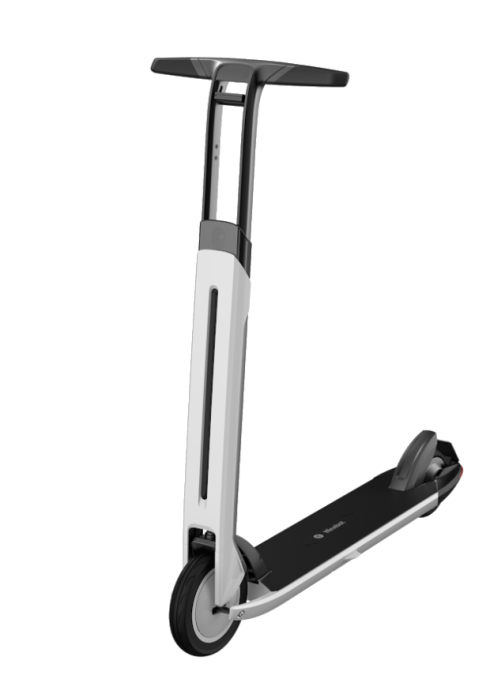
Segway-Ninebot also unveiled a kick scooter with a maximum speed of 12.4 mph with a $699 price tag.* I haven’t tried this scooter, but its light weight of 22 pounds is a plus, as is its alleged ability to handle 15% inclines without slowing down.

Though, the pricier and heavier Boosted electric scooter can handle hills with 25% inclines. In general, personal scooters can cost as low as $250 and up to $1,599.

Segway plans to unveil more details at the Consumer Electronics Show next week.

*Segway has since updated its pricing.

Away, #PelotonGate and predictions for 2020

Hello and welcome back to Equity, TechCrunch’s venture capital-focused podcast, where we unpack the numbers behind the headlines.

Kate and Alex and the ever-intrepid man behind the dials, Chris, took the time this week to dig into the two biggest stories from the end of 2019 and look into the future. But as you’ll quickly hear, there was news on the show. Kate Clark is moving on from Equity and TechCrunch to The Information. We wish her nothing but the best, but it’s still a big blah to say goodbye all the same. (A big congrats to the folks at The Information, Kate’s tremendous.)

But we still had Kate this week, so here’s a short rundown of what we talked about as a team:

  • The Away fiasco: We’ve discussed Away on the show a number of times, but this time it wasn’t for something good. The company found itself in the midst of a media firestorm about how it treated its staff. The first story led to follow-on coverage, the earlier-than-internally-expected exit of the company’s CEO and more. Also in the conversation was the question of whether CEOs who are women are held to higher standards than men. After all, overbearing male CEOs in startupland is a tale as old as startups themselves.
  • #Pelotongate: We couldn’t help but chat a bit about everyone’s favorite Christmas-time brand meltdown. And as Peloton was a 2019 IPO, it still fits in our private company wheelhouse. Or at least closely enough. Expect more eyes than usual on the exercise company’s next earnings report.

We then turned to predictions, taking a turn apiece to detail what we thought was coming up in 2020. Traditionally, Equity is somewhat poor at making predictions that actually come true, so we roped our producer in to help talk about the future. He is, after all, the person in the world who has listened to more Equity than anyone else in the world.

What’s ahead for Equity in our post-Kate future? We have a huge 2020 planned. We have new formats, new hosts, new guests and more coming your way. So don’t worry, Alex and Chris are still around and the show will go on! (Check TechCrunch.com next Monday for more.)

Equity drops every Friday at 6:00 am PT, so subscribe to us on Apple PodcastsOvercastSpotify and all the casts.