The US has operated an extensive network of missile warning systems for over half a century, but next-generation missiles will put it to the test.
Category: Tech news
hacking,system security,protection against hackers,tech-news,gadgets,gaming
Netflix’s ‘The Circle’ Is the Best TV Show About the Internet
A reality show about people alone in their rooms trying to be cool online—could anything be more cursed?
Wildfires Are Obliterating Australia’s Iconic Ecosystems
Australia’s bushfires aren’t just unprecedented—they’re catastrophic. The continent’s ecosystems could be forever changed.
Quibi Bets On a Future of Quick Clips and Tiny Screens
Entertainment startup Quibi has already won over industry A-listers with its vision for short-form mobile streaming. But will it catch on with viewers?
Did Donald Trump and Iran Use Twitter to Prevent a War?
Tweets from US president Donald Trump and Iranian foreign minister Javad Zarif Tuesday offered a fascinating glimpse at how world leaders can communicate more quickly and directly than ever in times of crisis.
Samsung hints at AR ambitions, shows off prototype glasses
What a weird Samsung press conference. The company didn’t waste time on the familiar. Things like Galaxy phones and washing machines got little love on stage tonight. Instead the company was focused on a workout exoskeleton and a friendly robotic call assistant.
And then there’s was AR. The technology was more hinted at than outright explained. First it took part in the aforementioned GEMS workout, in which the wearer took out her pair of “Samsung AR glasses.” That demo involved an AR assistant that was, admittedly fairly creepy.
After 1-on-1 training with #GEMS, workout results are aggregated and analyzed to provide professional feedback. #CES2020 #SamsungCES2020 pic.twitter.com/e5GJRNu9Jh
— Samsung US Newsroom (@SamsungNewsUS) January 7, 2020
The subject was dropped a bit, only to come back to it a little while later. First there was am uplifting video featuring Gear VR headsets repurposed to help vision impaired users see their loved ones (definite tear jerker material), followed by what appeared to be a different take on the AR glasses, complete with a camera in the middle of the frames.
Of course, we need to use the same caution here that we have with all of the other strange stuff shown off on stage tonight: this is all that prototypes. At best, it’s a potential roadmap. At worst, it’s speculative fiction. Either way, I wouldn’t wager a good deal of money on the the company replacing Gear VR with a pair of AR sunglasses this year.
That said, given larger industry trends, it’s completely understandable why the company is exploring such potential paths.

Samsung’s GEMS exoskeleton is now an ‘immersive workout experience’
Remember the G.E.M.S. (Gait Enhancing and Motivation System) exoskeleton Samsung introduced last year? Plot-twist. It’s a workout device now. One of the weirdest elements of a super weird keynotes was actually a fascinating pivot.
I wore a prototype of the device lates year, which offered both walking assistance and resistance. The latter is what’s at play here, with the robotic wearing giving you increasingly difficult workouts.
That pairs with AR glasses and a handset, giving you a creepy ass AR workout instructor Like Ballie before it — not to mention all of the different Samsung robotic offerings — the exoskeleton is still very early stages. Keep in mind, the theme of the night was “Age of Experience,” meaning that basically everything we saw tonight was conceptual.
After 1-on-1 training with #GEMS, workout results are aggregated and analyzed to provide professional feedback. #CES2020 #SamsungCES2020 pic.twitter.com/e5GJRNu9Jh
— Samsung US Newsroom (@SamsungNewsUS) January 7, 2020
In Samsung’s defense, this application could provide a clearer revenue path. There are already a number of companies vying for the assistive wearable exoskeleton category. Samsung is potentially going after an even larger portion of the population, essentially serving as an at-home gym. Though if and when such a device does come to market, it’s likely going to be a lot more than a monthly gym subscription.
Homeland Security warns businesses to brace for Iranian cyberattacks
Homeland Security is warning U.S. companies to “consider and assess” the possible impacts and threat of a cyberattack on their businesses following heightened tensions with Iran.
It’s the first official guidance published by the government’s dedicated cyber advisory unit, the Cybersecurity and Infrastructure Security Agency, just days after the killing of a leading Iranian military commander, Qasem Soleimani. The U.S. government had accused Soleimani of targeting and killing U.S. personnel across the Middle East.
Soleimani, an Iranian general who was slated as second-in-command in Iran’s leadership, was killed on Friday by a U.S drone strike authorized by President Trump. The same drone strike killed Abu Mahdi al-Muhandis, a deputy in a coalition of Iran-backed militias in neighboring Iraq.
In its latest advisory, posted Monday, CISA said that the increased geopolitical tensions “may result in cyber and physical attacks against the homeland and also destructive hybrid attacks by proxies against U.S. targets and interests abroad.”
The agency said Iran and its allies could launch “disruptive and destructive cyber operations” against strategic targets, such as phone and energy companies, and also carry out “cyber-enabled espionage” that aim to better understand U.S. foreign policy decision making.
CISA also warned of disinformation campaigns, as well as kinetic attacks — including bombings. Companies should take precautions in the event of cyberattacks — such as setting up offline backups, the agency advised.
The warnings come shortly after security experts in the private sector warned of the possibility of retaliatory action following the drone strikes.
“We will probably see an uptick in espionage, primarily focused on government systems, as Iranian actors seek to gather intelligence and better understand the dynamic geopolitical environment,” said John Hultquist, director of intelligence analysis at cybersecurity firm FireEye. “We also anticipate disruptive and destructive cyberattacks against the private sphere,” he said.
Iran is one of the world’s most powerful adversaries in cyberspace, experts say.
Tehran has a considerable arsenal of offensive cyber tools, including wipers — malware designed to infiltrate computers and destroy data. Hackers associated with Iran have been active in targeting facilities in the Middle East in recent years. Dmitri Alperovitch, who co-founded security firm Crowdstrike, said in a tweet that Iran may target critical infrastructure, such as energy grids and financial institutions.
More recently, Microsoft said it had notified thousands of customers over the past year who have been targeted by nation-state attackers, including hackers associated with Iran. The software and services giant previously took legal action against Iranian-controlled domains in an effort to disrupt their cyber activities. In October, Microsoft said Iranian hackers targeted a 2020 presidential candidate, which Reuters later confirmed was President Trump’s reelection campaign.
The move to assassinate Soleimani was widely panned by both opponents and allies of the Trump administration. Critics say the government had not thought of the consequences of the strike, including both Iranian retaliation with kinetic force but also cyberattacks.
Sen. Ron Wyden, a senior lawmaker on the Senate Intelligence Committee, said the killing was “a reckless escalation that will take us further down the road to ruinous war.” Meanwhile in a lengthy tweet thread, Rep. Elissa Slotkin, a former CIA analyst who served under President Bush, also criticized the action.
Eargo’s latest hearing aid improves bandwidth and noise cancelation
Bay-area based medical device startup Eargo just announced its fourth gen product at CES. The Neo HiFi builds on past learnings from the six-year-old company. The improvements are mostly around sound quality, including increased bandwidth and improved wind noise reduction and feedback cancelation. Eargo says all of the above should combine to offer, “a more natural listening experience with a more full-bodied sound.”

Other new features include to the line’s “Flexi Palm design” — those funny little spikes on the end designed to keep the hearing aid better positioned in the ear. The app has been updated for easier adjustment to different listening environments. That’s currently available for iOS, with an Android version due out at the end of the month.
The new device is available for purchase now, through Eargo’s site. It’s not cheap, at $2,650, but the company offers monthly financing for the product. Starting in march, the price will jump up to $2,950.
Eargo released its first product in 2017, and has received some significant funding along the way. Last March’s $52 million Series D brought the total funding amount up to $135.6 million.
Netflix and Gwyneth Paltrow’s ‘Goop Lab’ will launch on January 24
“The Goop Show,” an upcoming reality series co-hosted by Gwyneth Paltrow and tied to her lifestyle company Goop, now has a launch date and a trailer.
Goop has faced many accusations of promoting and selling pseudoscience — most notoriously, perhaps, in selling jade eggs for vaginas — and it seems like the series is embracing the site’s reputation, as it will feature what Netflix calls “boundary-pushing wellness topics.”
In fact, the company also released an eyebrow-raising poster today, with the tagline “reach new depths.”
Gwyneth Paltrow welcomes you to The Goop Lab on January 24 pic.twitter.com/ZzeEEbAy9L
— See What's Next (@seewhatsnext) January 6, 2020
And if you watch the trailer, you’ll see that the topics will include energy healing, psychedelics, cold therapy, psychic mediums and orgasms. At one point, Goop’s chief content officer Elise Loehnen (who’s co-hosting with Paltrow) declares, “What we try to do at Goop is explore ideas that may seem out there or too scary.”
The show was first announced in February 2019. It will premiere on January 24.
This may also be a good time to remind people of Netflix CEO Reed Hastings’ remarks last year, in response to questions about the decision to pull an episode of Hasan Minaj’s “Patriot Act” in Saudi Arabia: “We’re not in the truth to power business, we’re in the entertainment business.”
Meet Ballie, Samsung’s rolling personal assistant that does…stuff
This time last year, we asked the question: is Samsung getting serious about robotics. I’m not sure we’re that much closer to an answer, but tonight’s CES keynote pointed to a company that clearly wants to convince us of as much. Though much like the demos shown off last year, tonight’s devices were concepts — indications of what a Samsung could bring to market if it was determined to do so.
The headliner is Ballie (pronounced Ball-E). Still very much a concept, the device is Samsung’s take on Aibo. Instead of a robot dog, however, the “life companion robot” is simply a rolling ball designed to help out around the house. The robot, “understands you, supports you, and reacts to your needs..”
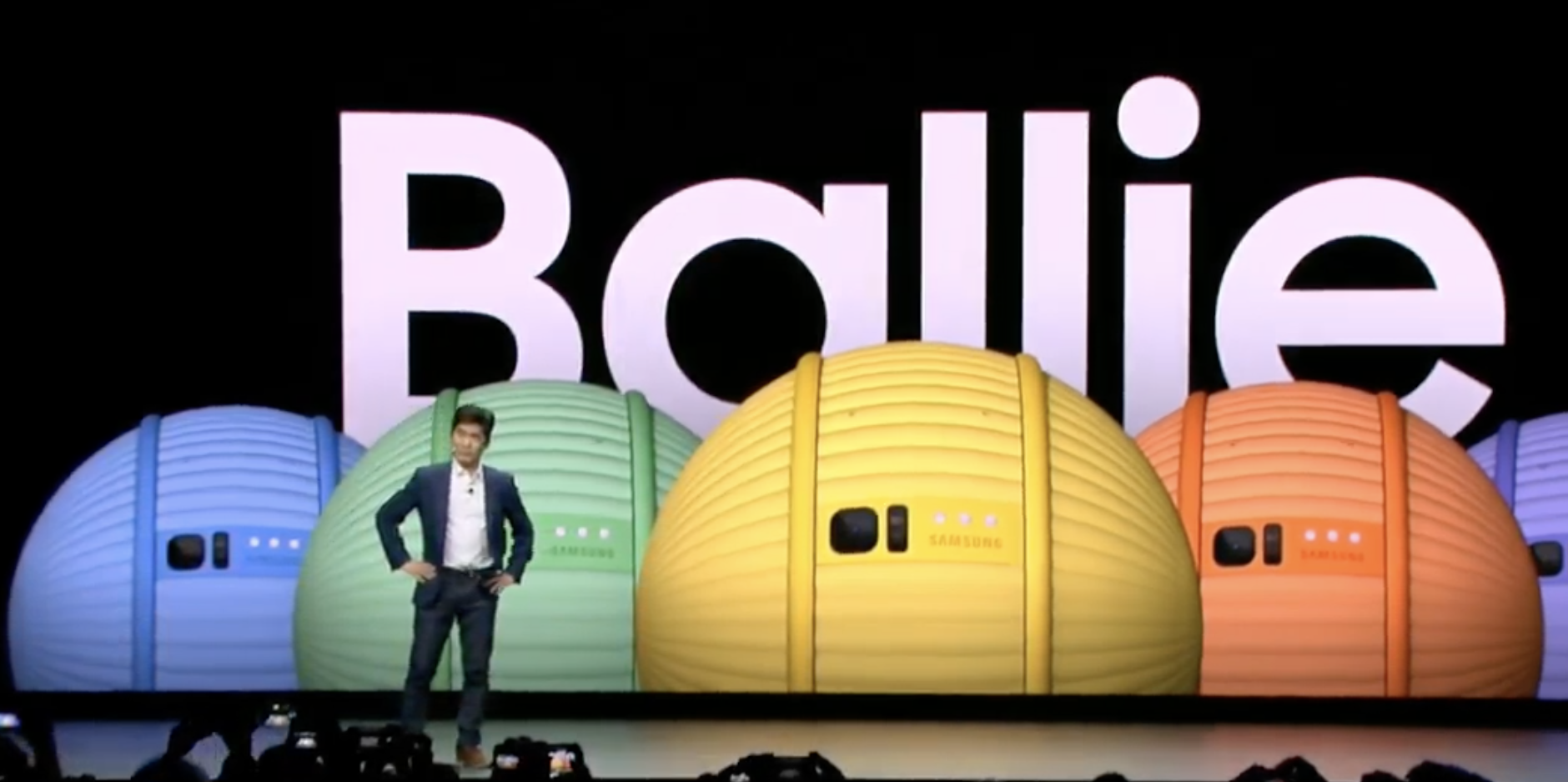
There’s not a ton of info about the robot, but it clearly has a camera on the front from navigating around the home. It utilizes on-device AI to perform a series of (mostly unannounced) tasks, including home security and fitness.
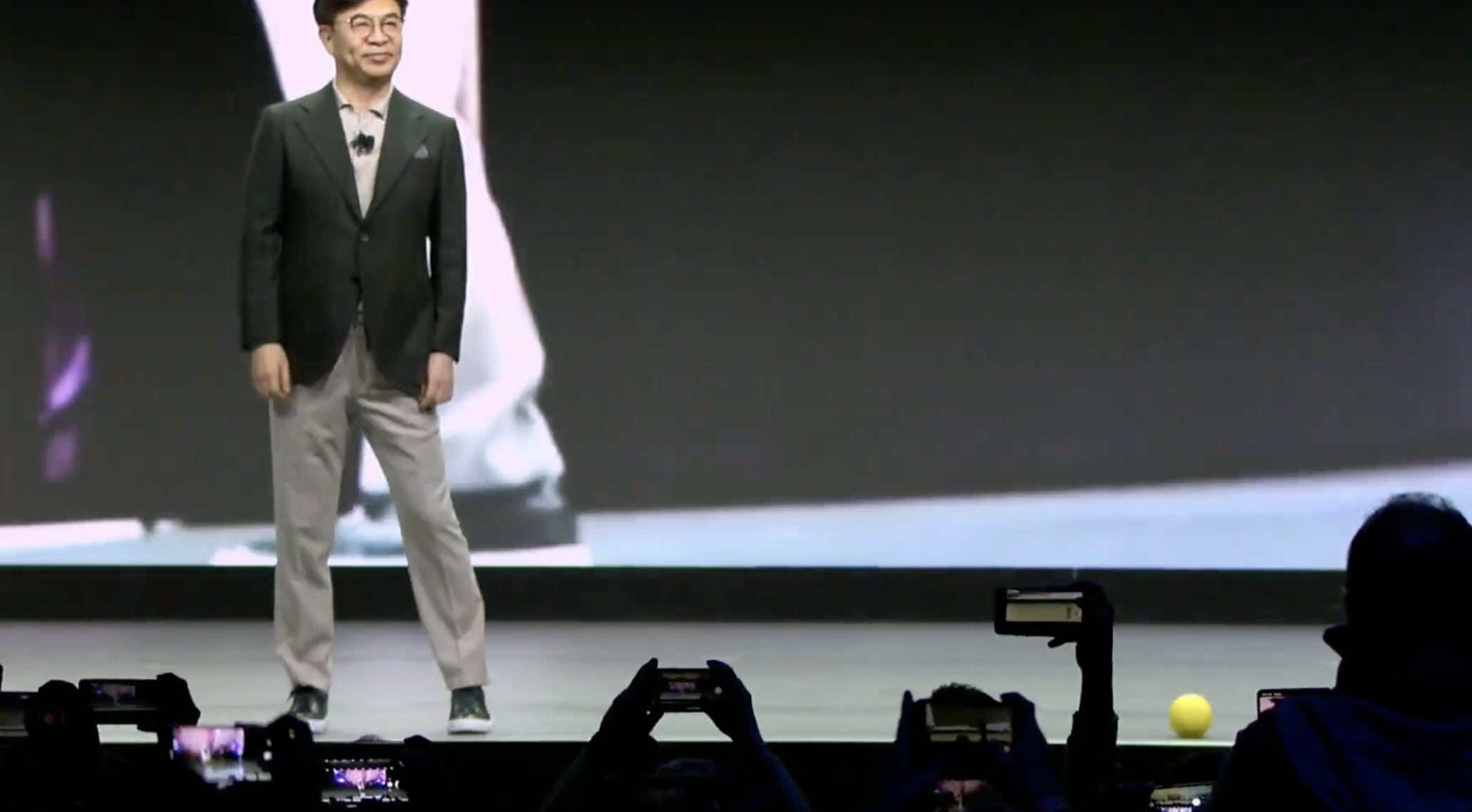
“We believe AI is the future of personalized care,” EVP Sebastian Seung said in a release. “We see on-device AI as central to truly personalized experiences. On-device AI puts you in control of your information and protects your privacy, while still delivering the power of personalization.”
The on stage demo mostly consisted of Ballie following CEO H.S. Kim around the stage and coming while called. Asked to say “hi,” the robot ball let out a kind of R2D2-style sound effect. A quick demo video, meanwhile, had Ballie communicating with various smart home features and interacting with the family dog. Once the pup made a mess, Ballie triggered the robot vacuum to clean it up.
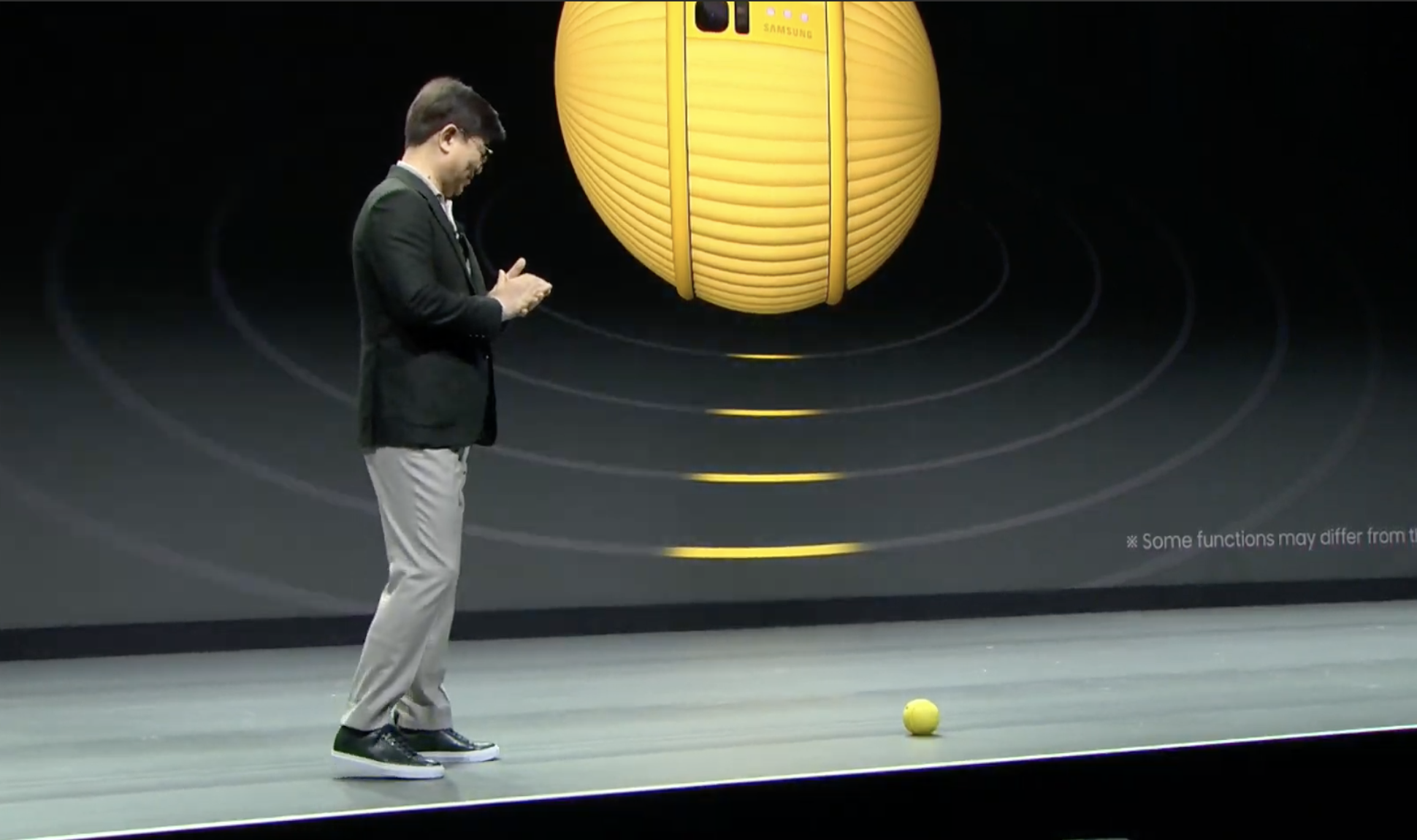
Still very much a concept, there’s no word when — or even if — Ballie might come to market. At this point, Samsung mostly just wants us all to know that it’s working on it. That said, the underlying technology here certainly seems far more realistic that the devices it showed off on stage this time next year.
Hyundai is Uber’s newest partner for building flying taxis
A little less than three years after it first announced its vision for adding flying taxi service to its portfolio of offerings, Uber has landed its first auto manufacturing partner on the skyway to making its Air Taxis real.
The company announced at the Consumer Electronics Show that it would be working with Hyundai Motor Company as the first major auto manufacturer to join Uber’s Elevate program.
The two companies unveiled their air vehicle concept today.
As part of the partnership, Hyundai said it will produce and deploy the air vehicles with Uber providing the logistics services including airspace support, connections to ground transportation and customer interfaces through its aerial ride sharing network.
“Our vision of Urban Air Mobility will transform the concept of urban transportation,” said Jaiwon Shin, Executive Vice President and Head of Hyundai’s Urban Air Mobility (UAM) Division. “We expect UAM to vitalize urban communities and provide more quality time to people. We are confident that Uber Elevate is the right partner to make this innovative product readily available to as many customers as possible.”
There’s no word from Uber on what the new partnership means for Uber’s other announced partners which include Karem Aircraft, Aurora Flight Sciences, Embraer, Bell Helicopter, Pistrel Aircraft, and Mooney.
“Hyundai is our first vehicle partner with experience of manufacturing passenger cars on a global scale,” said Eric Allison, the head of Uber Elevate, in a statement. “We believe Hyundai has the potential to build Uber Air vehicles at rates unseen in the current aerospace industry, producing high quality, reliable aircraft at high volumes to drive down passenger costs per trip. Combining Hyundai’s manufacturing muscle with Uber’s technology platform represents a giant leap forward for launching a vibrant air taxi network in the coming years.”
The two companies have worked to develop a “PAV (Personal Air Vehicle)” that uses Uber Elevate’s common research models to develop new concepts for wing design, noise reduction, aerodynamics and simulation verification.
The concept vehicle from Hyundai — dubbed the model S-A1 — includes a design for a cruising speed up to 180 miles per hour; will be 100% electric; requires only five to seven minutes to recharge; has a distributed electric propulsion system that powers multiple rotors and propellers around an airframe (which reduces noise and increases safety by decreasing single points of failure); and seats four comfortably, according to the two companies.
To make sure that there’s real estate to support the hub model Uber has outlined for its aerial transit the company has partnered with real estate developers including Hillwood Properties, Related, Macquire, Oaktree, and Signature. The company has also signed Space Act agreements with NASA for the development of unmanned traffic management concepts and unmanned aerial systems and another for urban air mobility.
Uber expects its first air taxi services to launch in 2023.
SpaceX successfully launches 60 more satellites for its Starlink broadband internet constellation
SpaceX successfully launched its third batch of 60 Starlink satellites – the second designated ‘production’ hardware, after launching an initial group of 60 early in 2019 to test the technology. This group launched aboard a Falcon 9 with a first stage booster that has already seen service in three previous missions, including two in 2019, one of which was the first bulk Starlink mission in May 2019.
This launch took off from Cape Canaveral Air Force Station in Florida, and delivered the satellites to an orbit 290 km (around 180 miles) above Earth, and then the satellites will perform diagnostics to ensure they’re in proper working order before moving to their final target orbits using their own onboard thrusters.
SpaceX also brought back the Falcon 9 booster used on this mission for a controlled landing aboard their ‘Of Course I Still Love You’ drone landing ship. The company will also look to recover half of the payload fairing on this launch, with an attempt to catch the protective cargo cover gin using ‘Ms. Tree,’ one of two ships SpaceX has custom configured to catch the spacecraft component in a large net.
Likely to help mitigate criticism from the scientific community regarding the Starlink constellation’s potential to impact visibility of space from Earth, SpaceX also detailed the steps its taking to address this. It notes that though the satellites it’s launching will be very visible immediately after launch, after between one and four months, they’ll climb to their final target orbit and re-orient themselves to become “significantly less visible from the ground.” The company also says it’s “testing an experimental marketing treatment on one satellite” to see if that further reduces their effect on night sky visibility for high-sensitivity research instruments.
Starlink will provide high-speed, relatively low-latency broadband internet connectivity to customers on the ground, starting with those in the U.S. and Canada, with service potentially becoming available as early as later this year.
NASA’s planet hunting satellite found another potentially habitable earth-sized planet
NASA’s Transiting Exoplanet Survey Satellite (TESS) has discovered another earth-sized, potentially habitable planet orbiting around a star in the range of distances where conditions could allow for the presence of liquid water on the planet’s surface.
Using NASA’s Spitzer Space Telescope scientists confirmed the find, called TOI 700 d, according to a statement from NASA’s Jet Propulsion Laboratory in Pasadena.
The new planet joins other Earth-sized planets discovered by NASA including several in the TRAPPIST-1 system and other worlds discovered by NASA’s Kepler Space Telescope. JPL said.
“TESS was designed and launched specifically to find Earth-sized planets orbiting nearby stars,” said Paul Hertz, astrophysics division director at NASA Headquarters in Washington, in a statementThe . “Planets around nearby stars are easiest to follow-up with larger telescopes in space and on Earth. Discovering TOI 700 d is a key science finding for TESS. Confirming the planet’s size and habitable zone status with Spitzer is another win for Spitzer as it approaches the end of science operations this January.”
The TESS satellite monitors sectors of the sky for 27 days at a time, allowing the satellite to track changes in the brightness of a star caused by an orbiting planet crossing in front of it.
Scientists determined that TOI 700 is a small, cool M dwarf star (also known as a red dwarf) located over 100 light-years away in the southern constellation Dorado, according to JPL.

The star that TESS examined has about 40% of the mass of the Sun and has a lower surface temperature — roughly half of the Sun’s 9940.73 degrees Fahrenheit. Three planets orbit the star, which initially appeared larger and hotter than they now are considered, thanks to a misclassification in the TESS database which originally labeled its star as more similar to the Sun (the error was spotted by a team of researchers including a high school student — Alton Spencer).
“When we corrected the star’s parameters, the sizes of its planets dropped, and we realized the outermost one was about the size of Earth and in the habitable zone,” said Emily Gilbert, a graduate student at the University of Chicago. “Additionally, in 11 months of data we saw no flares from the star, which improves the chances TOI 700 d is habitable and makes it easier to model its atmospheric and surface conditions.”
The nearest planet to the star is almost exactly the same size of the Earth, according to JPL, and completes its orbit every ten days. The star’s middle planet is 2.6 times larger than Earth — between the sizes of Earth and Neptune — and has a 16-day orbit.
It’s the outermost planet — one about 20% larger than Earth — that exists in the habitable zone. That planet orbits every 37 days and receives about 86% of the energy from its star that Earth receives from the sun.
All of the planets are thought to be tidally locked to their star, which means that they rotate once per orbit. And because TOI 700 d is tidally locked to its star, the planet’s cloud formations and wind patterns may be strikingly different from Earth’s.
Right now, scientists will rely on computer modeling based on the planet’s size and the type of star it’s orbiting to make predictions about its composition and potential geography.
In one simulation, scientists envisioned an ocean-covered world with a dense, carbon-dioxide rich atmosphere akin to their assumptions about what Mars was like when it was first forming. That model of the atmosphere has a deep layer of clouds on the star-facing side. Meanwhile, another potential vision of the planet predicts a cloudless entirely land-covered version of Earth, where winds whip from the night side of the planet and converge on a point directly facing the planet’s star.
Researchers use signals called spectral lines, which are detected from the passage of starlight through the planet’s atmosphere to project what the planet’s surface might look like.
When starlight passes through a planet’s atmosphere, it interacts with molecules like carbon dioxide and nitrogen to produce distinct signals, called spectral lines. produced simulated spectra for the 20 modeled versions of TOI 700 d.
“Someday, when we have real spectra from TOI 700 d, we can backtrack, match them to the closest simulated spectrum, and then match that to a model,” said Gabrielle Englemann-Suissa, a Universities Space Research Association visiting research assistant at Goddard, and the leader of the modeling team. “It’s exciting because no matter what we find out about the planet, it’s going to look completely different from what we have here on Earth.”
TESS is a NASA Astrophysics Explorer mission led and operated by MIT in Cambridge, Massachusetts, and managed by NASA’s Goddard Space Flight Center. Additional partners include Northrop Grumman, based in Falls Church, Virginia; NASA’s Ames Research Center in California’s Silicon Valley; the Harvard-Smithsonian Center for Astrophysics in Cambridge, Massachusetts; MIT’s Lincoln Laboratory; and the Space Telescope Science Institute in Baltimore, according to a statement.
Three years later, Sony is still hitting sales milestones for its VR headset
Sony hasn’t had much to say about their virtual reality platform lately, but the company’s PlayStation VR headset, which was released more than 3 years ago, has still been racking up sales. At the company’s CES press conference this evening, they announced that they have now sold 5 million PS VR units.
In regards to this latest metric, there isn’t much to compare it to out there as most VR companies aren’t keen to share just how slow the industry has moved over the past 5 years, but Sony seems to feel pretty good about how their first release has fared. While HTC, Valve and Facebook have all been pretty loud in marketing their VR efforts, an industry secret is that the PlayStation VR makes up a pretty sizable percentage of most developers’ active player bases, representing a lot of dev’s most engaged platform.
The PlayStation VR hasn’t received a major update since its release, and it doesn’t seem that Sony plans to ship an update to coincide with the PlayStation 5’s launch — though the current generation headset will be compatible with the new system, the company has detailed.