Google Cloud gets a premium support plan with 15-minute response times

Google Cloud today announced the launch of its premium support plans for enterprise and mission-critical needs. This new plan brings Google’s support offerings for the Google Cloud Platform (GCP) in line with its premium G Suite support options.

“Premium Support has been designed to better meet the needs of our customers running modern cloud technology,” writes Google’s VP of Cloud Support, Atul Nanda. “And we’ve made investments to improve the customer experience, with an updated support model that is proactive, unified, centered around the customer, and flexible to meet the differing needs of their businesses.”

The premium plan, which Google will charge for based on your monthly GCP spent (with a minimum cost of what looks to be about $12,500 per month), promises a 15-minute response time for P1 cases. Those are situations when an application or infrastructure is unusable in production. Other features include training and new product reviews, as well as support for troubleshooting third-party systems.
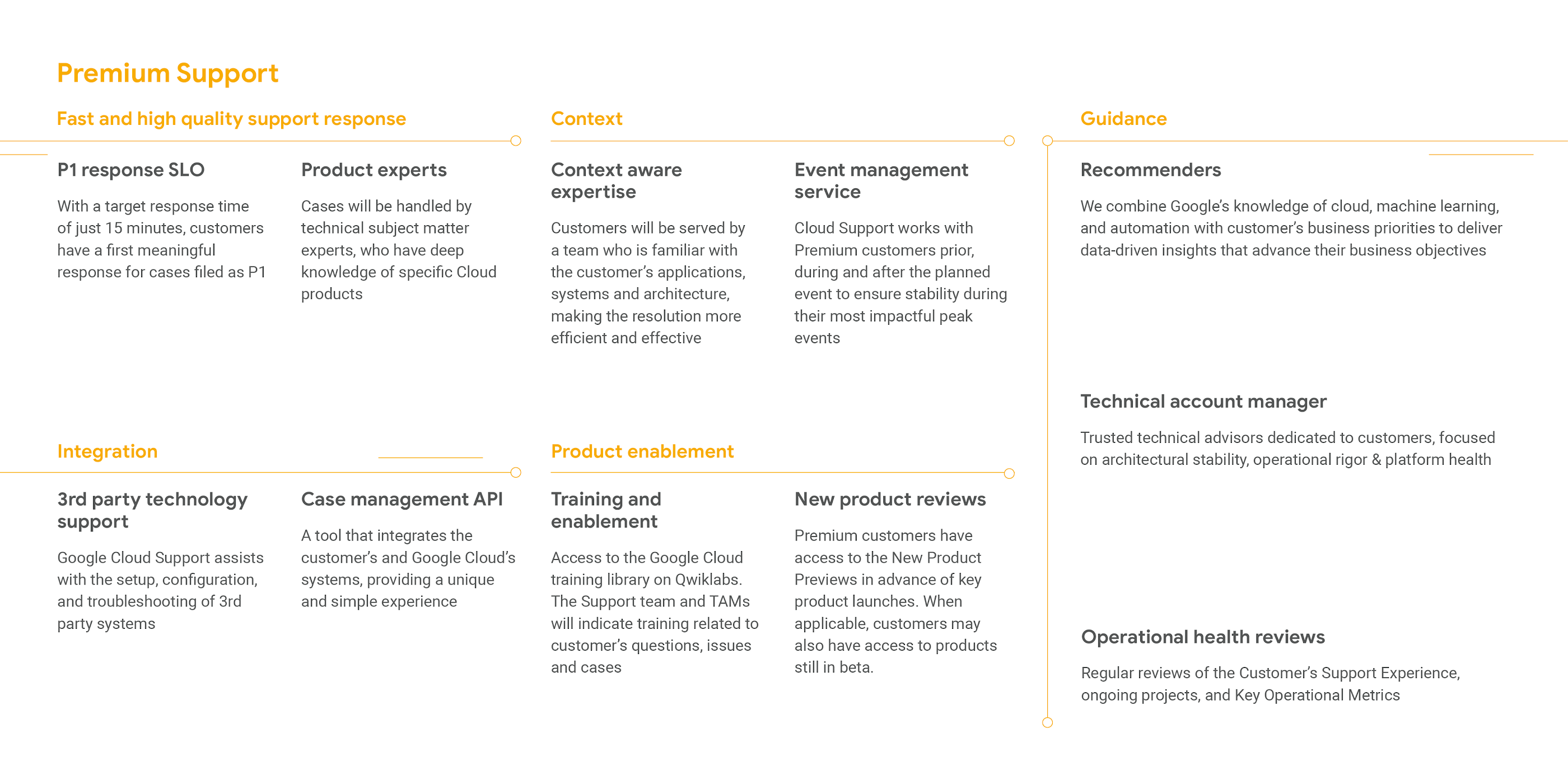
Google stresses that the team that will answer a company’s calls will consist of “content-aware experts” that know your application stack and architecture. As with similar premium plans from other vendors, enterprises will have a Technical Account manager who works through these issues with them. Companies with global operations can opt to have (and pay for) technical account managers available during business hours in multiple regions.

The idea here, however, is also to give GCP users more proactive support, which will soon include a site reliability engineering engagement, for example, that is meant to help customers “design a wrapper of supportability around the Google Cloud customer projects that have the highest sensitivity to downtime.” The Support team will also work with customers to get them ready for special events like Black Friday or other peak events in their industry. Over time, the company plans to add more features and additional support plans.

As with virtually all of Google’s recent cloud moves, today’s announcement is part of the company’s efforts to get more enterprises to move to its cloud. Earlier this week, for example, it launched support for IBM’s Power Systems architecture, as well as new infrastructure solutions for retailers. In addition, it also acquired no-code service AppSheet.

Formlabs CEO on the state of 3D printing and its remaining challenges

3D printing isn’t the buzzy, hype-tastic topic it was just a few years ago — at least not with consumers. 3D printing news out of CES last week seemed considerably quieter than years prior; the physical booths for many 3D printing companies I saw took up fractions of the footprints they did just last year. Tapered, it seems, are the dreams of a 3D printer in every home.

In professional production environments, however, 3D printing remains a crucial tool. Companies big and small tap 3D printing to design and test new concepts, creating one-off prototypes in-house at a fraction of the cost and time compared to going back-and-forth with a factory. Sneaker companies are using it to create new types of shoe soles from experimental materials. Dentists are using it to create things like dentures and bridges in-office, in hours rather than days.

One of the companies that has long focused on pushing 3D printing into production is Formlabs, the Massachusetts-based team behind the aptly named Form series of pro-grade desktop 3D printers. The company launched its first product in 2012 after raising nearly $3 million on Kickstarter; by 2018, it was raising millions at a valuation of over a billion dollars.

YouTube launches Profile cards that show a user’s comment history

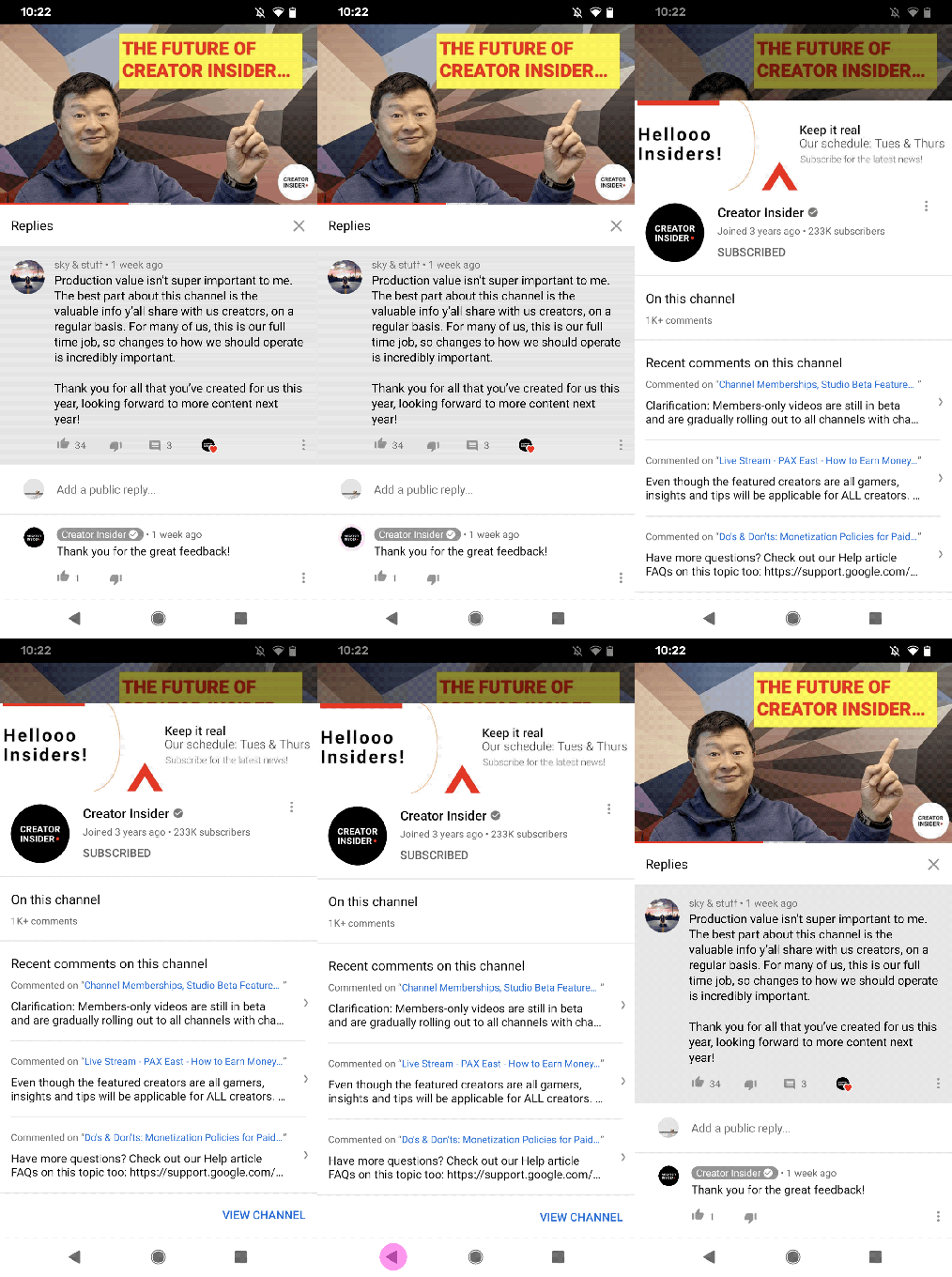
Last September, YouTube began testing a new feature called profile cards, which showed a user’s public information and comment history on the current channel. The feature was touted as a way for creators to more easily identify their biggest fans by offering easy access to their past comments. Now, YouTube is launching the product to the general public, initially on Android.

YouTube hopes the new feature will help users “explore comments, build connections with others, and contribute to a more welcoming YouTube overall,” the company explains.

To use Profile cards, you’ll just tap on the profile picture of anyone who’s commenting to view their card. Here, information like their name, profile photo, subscriptions, subscriber counts, and recent comments will appear in a pop-up card. All this information is publicly available on YouTube, but the Profile card consolidates it in one place.

If you’re already subscribed to the commenter’s channel, the Profile card will indicate this; otherwise, you can click the red “Subscribe” link to start following the commenter on YouTube.

To be clear, the comment history that displays isn’t a user’s full YouTube comment history (though that would be interesting!). Instead, the Profile card only shows the comments on the channel you’re viewing when you click to view the card.

A link to the commenter’s channel is also included, towards the bottom.

While YouTube has promoted the feature as a way to connect with community members and identify a channel’s best commenters, it could also be useful for identifying trolls. Being able to see the commenter’s history on the channel can help creators or moderators make more informed decisions about whether future comments from the same users should be hidden, or if the user is trustworthy enough to earn a spot on the “approved users” list, for example.

When the feature launched into testing this fall, feedback was largely positive — especially since some see it as a way to help raise their own channel’s profile by being an active commenter. More recent feedback, however, has a few users asking for an opt-out option so their comments aren’t shown, citing concerns about out-of-context remarks or privacy issues.

YouTube says the feature is available now on Android and will launch on other devices in the future.

Profile cards are one of a few changes launching on YouTube. Also new are optional topics in the Subscriptions feed on iOS, which make it easier for subscribers to filter their subscriptions by topics like “Today,” “Unwatched,” “Live,” “Posts,” “Continue Watching,” and more.

Daily Crunch: Goodbye Hipmunk

The Daily Crunch is TechCrunch’s roundup of our biggest and most important stories. If you’d like to get this delivered to your inbox every day at around 9am Pacific, you can subscribe here.

1. Four years after being acquired, Hipmunk is shutting down

Founded by Adam J. Goldstein and Reddit co-founder Steve “spez” Huffman, Hipmunk was one of the first well-made “metasearch” travel sites. It scrounged up flights (and hotels/car rentals/etc.) from across myriad services like Expedia, Priceline, etc., presenting all the times and prices in one big, skimmable interface.

Now the Hipmunk team says the website and app are both shutting down. Oh, and we’ve confirmed that Goldstein and Huffman tried to buy the company back from SAP Concur, but that doesn’t seem to have panned out.

2. Google finally brings its security key feature to iPhones

Google said it’ll bring the feature to iPhones in an effort to give at-risk users, like journalists and politicians, access to additional account and security safeguards, effectively removing the need to use a physical security key like a Yubico or a Google Titan key.

3. Obvious Ventures closes an irrationally sized third fund

The firm co-founded by Medium CEO and Twitter co-founder Ev Williams announced that it has closed its third fund, “OV3,” at $271,828,182 — a number that the graphing calculator-owning among us may recognize as e, or Euler’s number.

4. Don’t be a selfless startup

It might sound strange to describe WeWork or MoviePass as “selfless,” but Danny Crichton argues that despite their failures, they successfully introduced new and popular business models. (Extra Crunch membership required.)

5. Microsoft and NSA say a security bug affects millions of Windows 10 computers

Microsoft has released a security patch for a dangerous vulnerability affecting hundreds of millions of computers running Windows 10. The bug could allow attackers to spoof legitimate software, potentially making it easier to run malicious software on a vulnerable computer.

6. Dear Spotify, add rabbits to your pet playlists

Spotify is introducing pet playlists, but Brian Heater has a very important request on behalf of his rabbit, Lucy.

7. Announcing the agenda for Robotics+AI — March 3 at UC Berkeley

For months we’ve been recruiting speakers from the ranks of the most innovative founders, top technologists and hard-charging VCs working in robotics and AI, and the speaker line-up will capture the remarkable acceleration across the field in the past year. Also: 2020 marks the 100th anniversary of the first use of the word “robot.”

Plant-based milk substitute market gets frothy with $225 million for Califia Farms

The market for companies developing dairy substitutes is really getting frothy.

In December, the startup Perfect Day Foods announced it had raised $110 million in financing for its dairy replacement and now Califia Farms, the producer of a range of oat and almond milk products (along with a slew of coffees, juices and non-dairy snacks) has raised $225 million in fresh financing.

Investors in the round include the Qatar Investment Authority, Singapore’s sovereign wealth fund, Temasek, Canada’s Claridge and Hong Kong-based Green Monday Ventures (among others).

For Temasek, the deal comes on the heels of an incredibly successful investment in Beyond Meat, the plant-based meat substitute that has partnership agreements with food chains like Dunkin’, McDonald’s and Carl’s Jr., and whose meteoric rise in its public offering was one of the most successful IPOs of the last year.

Money from the new investor base, which joins previous investors Sun Pacific, Stripes and Ambrosia in backing the company, will be used to expand its oat-based suite of products and to launch other new product lines. The company said it also will use the money to increase its production capacity, research and development efforts, and geographical expansion.

Founded in 2010, Califia Farms is one of several startups making dairy replacements — either using plant-based ingredients or genetically modified organisms to produce the proteins and sugars that make dairy what it is.

Other companies like Perfect Day, Ripple Foods and Oatly have all raised capital to capture some aspect of the over $1 trillion dairy market.

“The more than $1 trillion global dairy and ready-to-drink coffee industry is ripe for continued disruption with individuals all over the world seeking to transform their health & wellness through the adoption of minimally processed and nutrient rich foods that are better for both the planet and the animals,” said Greg Steltenpohl, Califia founder and chief executive, in a statement.

Barclays served as the financial advisor and placement agent for Califia on the capital raise.