“When you send a text, you can’t really take it back,” the Twitter CEO says. “We wanted to preserve that vibe and that feeling in the early days.”
Category: Tech news
hacking,system security,protection against hackers,tech-news,gadgets,gaming
Save over $200 with discounted student tickets to Robotics + AI 2020
If you’re a current student and you love robots — and the AI that drives them — you do not want to miss out on TC Sessions: Robotics + AI 2020. Our day-long deep dive into these two life-altering technologies takes place on March 3 at UC Berkeley and features the best and brightest minds, makers and influencers.
We’ve set aside a limited number of deeply discounted tickets for students because, let’s face it, the future of robotics and AI can’t happen without cultivating the next generation. Tickets cost $50, which means you save more than $200. Reserve your student ticket now.
Not a student? No problem, we have a savings deal for you, too. If you register now, you’ll save $150 when you book an early-bird ticket by February 14.
More than 1,000 robotics and AI enthusiasts, experts and visionaries attended last year’s event, and we expect even more this year. Talk about a targeted audience and the perfect place for students to network for an internship, employment or even a future co-founder.
What can you expect this year? For starters, we have an outstanding lineup of speaker and demos — more than 20 presentations — on tap. Let’s take a quick look at just some of the offerings you don’t want to miss:
- Saving Humanity from AI: Stuart Russell, UC Berkeley professor and AI authority, argues in his acclaimed new book, “Human Compatible,” that AI will doom humanity unless technologists fundamentally reform how they build AI algorithms.
- Opening the Black Box with Explainable AI: Machine learning and AI models can be found in nearly every aspect of society today, but their inner workings are often as much a mystery to their creators as to those who use them. UC Berkeley’s Trevor Darrell, Krishna Gade of Fiddler Labs and Karen Myers from SRI International will discuss what we’re doing about it and what still needs to be done.
- Engineering for the Red Planet: Maxar Technologies has been involved with U.S. space efforts for decades and is about to send its fifth robotic arm to Mars aboard NASA’s Mars 2020 rover. Lucy Condakchian, general manager of robotics at Maxar, will speak to the difficulty and exhilaration of designing robotics for use in the harsh environments of space and other planets.
That’s just a sample — take a gander at the event agenda to help you plan your time accordingly. We’ll add even more speakers in the coming weeks, so keep checking back.
TC Sessions: Robotics + AI 2020 takes place on March 3 at UC Berkeley. It’s a full day focused on exploring the future of robotics and a great opportunity for students to connect with leading technologists, founders, researchers and investors. Join us in Berkeley. Buy your student ticket today and get ready to build the future.
Is your company interested in sponsoring or exhibiting at TC Sessions: Robotics + AI 2020? Contact our sponsorship sales team by filling out this form.
The US government should stop demanding tech companies compromise on encryption
In a tweet late Tuesday, President Trump criticized Apple for refusing “to unlock phones used by killers, drug dealers and other violent criminal elements.” Trump was specifically referring to a locked iPhone that belonged to a Saudi airman who killed three U.S sailors in an attack on a Florida base in December.
It’s only the latest example of the government trying to gain access to a terror suspect’s device it claims it can’t access because of the encryption that scrambles the device’s data without the owner’s passcode.
The government spent the past week bartering for Apple’s help. Apple said it had given to investigators “gigabytes of information,” including “iCloud backups, account information and transactional data for multiple accounts.” In every instance it received a legal demand, Apple said it “responded with all of the information” it had. But U.S. Attorney General William Barr accused Apple of not giving investigators “any substantive assistance” in unlocking the phone.
23andMe co-founder’s new startup, Precise.ly, brings genomics to India through Narayana partnership
Precise.ly, the new genomics startup launched by 23andMe co-founder Linda Avey and Aneil Mallavarapu, is taking its spin on direct to consumer personalized genomics to India through a partnership with Naryana Health, one of India’s leading specialty hospital networks.
Narayana, a company that operates a network of 24 hospitals serving 2.5 million patients, is one of the most fascinating stories in healthcare. By emphasizing efficiencies and cost savings, the hospital network has managed to bring costs down dramatically for many procedures — including providing cancer surgeries for as little as $700 and heart bypass surgeries for $3,000 (as this fascinating article in Bloomberg BusinessWeek illustrates).
Precise.ly’s mission — to collect and analyze genetic data from populations that typically haven’t had access to the services — is one that resonates in a world where the majority of research has been conducted on wealthier populations in wealthy countries. Other startups, like 54Gene, are trying to bring a similar message to the African continent.
“To date, most human genetics research has focused on European populations. But genetic insights need to be tuned to the rest of the world,” said Mallavarapu, in a statement. “We’ve assembled a team of experts who are pioneering advances in genetic analysis and its application to the huge populations of people in south Asia and beyond.”
Some of that work is being done in concert with Narayana health, the hospital network founded by Dr. Devi Prasad Shetty nearly twenty years ago. Dr. Shetty is initially hoping that Precise.ly’s genetic database will be able to help his hospitals build out a stem cell donor registry that could help hundreds of thousands of Indians who need transplants.
“Personal genetic testing is recognized by the U.S. FDA to test genetic risk for Parkinsonism, late onset Alzheimer’s disease and celiac disease. It is only a matter of time before most diseases get added to the list,” Dr. Shetty said in a statement. “Because of the simplicity of genetic testing from saliva samples, it’s possible to conduct large-scale population screening at a reasonable cost. We are working with Precise.ly’s team of researchers to add HLA typing, which has the potential to transform cancer and other disease treatments in India.”
The path to entering the Indian market was slightly circuitous for Precise.ly. When Avey first left 23andMe, she went to RockHealth (an investor in the company’s $1 million seed round), and began exploring ways to organize and store more of a patient’s quantified health data.
As that company failed to gain traction, Avey took another look at the genetics market and found that there were significant opportunities in underserved markets — and that India, with its rising middle class and burgeoning healthcare industry would be a good target.
“We decided we would build on this Helix platform all kinds of apps for people who had specific diagnosis,” says Avey. But the market was already chock full of startups (including 23andMe), so an early investor in the company from, Civilization Ventures, and its founder Shahram Seyedin-Noor suggested that they begin to look globally for growth.
“Precise.ly’s mission is to deliver validated genetic insights to the billions of people living outside the western world. We’re initially focused on India where there are urgent health issues readily addressable through access to personal genomic data,” said Avey, the chief executive officer of Precise.ly, in a statement. “Our partnership with Narayana is vital to delivering on the promise of precise, data-driven health.”
Mobileye takes aim at Waymo
Mobileye has built a multi-billion-dollar business supplying automakers with computer vision technology that powers advanced driver assistance systems. It’s a business that last year generated nearly $1 billion in sales for the company. Today, 54 million vehicles on the road are using Mobileye’s computer vision technology.
In 2018, the company made what many considered a bold and risky move when it expanded its focus beyond being a mere supplier to becoming a robotaxi operator. The upshot: Mobileye wants to compete directly with the likes of Waymo and other big players aiming to deploy commercial robotaxi services.
TechCrunch sat down with Amnon Shashua, Mobileye’s president and CEO and Intel senior vice president, to find out why and how — yep, acquisitions are in the future — the company will hit its mark.
Accel-backed Clockwise launches an AI assistant for Google Calendar
Startups are paying for more subscription services than ever to drive collaboration during working hours, but — whether or not the Slack-lash is indeed a real thing — the truth is that filling your day with meetings can sometimes be detrimental to actually… working.
Time management software and daily planners put the accountability on the individual, but when you’re in several hours of meetings per day, there’s a lot that’s out of your control. I recently met with Matt Martin, the CEO of Accel-backed Clockwise. His startup has a really interesting pitch for taking a look at individual employee schedules through the lens of the entire team and moving meetings around to maximize “focus time,” which Martin defines as blocks of at least two uninterrupted hours during your day.
Clockwise’s customers already include Lyft, Asana, Strava and Twitter; they’ve been aiming to build out a wide footprint of customers by offering their product for free at first. They’ve raised more than $13 million over two rounds from investors including Accel, Greylock and Slack Fund.
The startup’s software, which integrates with Google Calendar, has been bringing people into the fold for shifting these meetings around, but their latest update aims to give teams the option to let its Clockwise Calendar Assistant do some of the heavy lifting automatically.
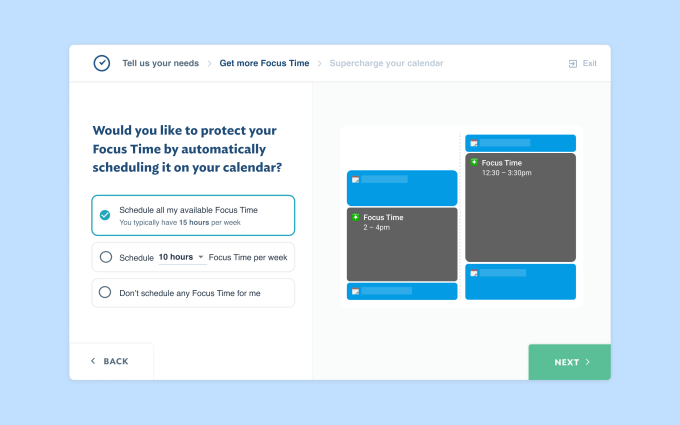
Managing calendars en masse obviously has the potential to piss people off. Clockwise has tried to build in certain accommodations to keep friction low, and they’ve gotten good feedback from early testers.
Certain employees, like engineers, likely benefit from more uninterrupted time to work, so Clockwise gave employees a way to designate how much “focus time” they generally need per week. They’ve also added the ability to bring personal calendars into the mix so that users can designate time when they have unmovable personal conflicts. Not every meeting is in your office; when there are locations in the invites, Clockwise will account for travel between the two addresses inside your calendar.
Some meetings can’t be moved, others rely on off-site folks in different time zones, sometimes a high-level exec needs to be in a meeting and their schedule is all that matters. Not all meetings need to be flexible, but Clockwise hopes that by automatically resolving conflicts for team meetings, they can leave employees with fewer useless half-hour chunks of time during their day.
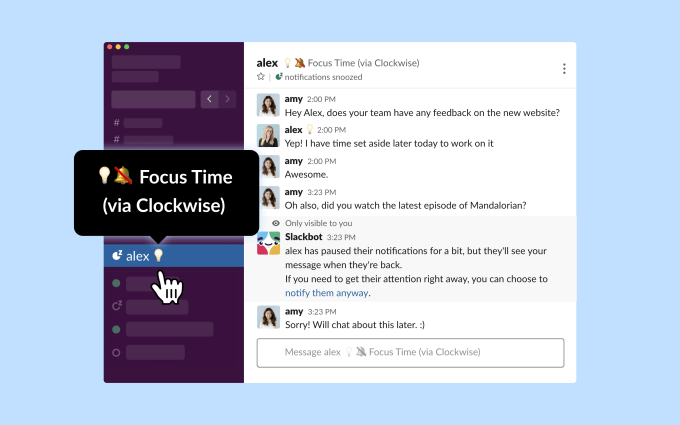
Alongside today’s Assistant update, Clockwise is also boosting its compatibility with Slack. Users have the ability to let Clockwise turn on do-not-disturb automatically during designated “focus time” and can let the app populate their Slack status with the current meeting they’re in.
When you think about how much energy has been spent by startups looking to reinvent email or chat, it’s fascinating that there hasn’t been more energy fixed on the humble calendar. Anecdotally, there seems to be plenty of demand for a “luxury” Google Calendar, and yet there hasn’t seemed to be a proportional amount of action. Clockwise has one of the more interesting offerings, though I’m sure more will be popping up alongside it soon.
Why Elizabeth Warren’s Feeds Are Flooded With Snake Emoji
Remember the dust-up between Taylor Swift and Kanye West and Kim Kardashian West? It’s like that, but politics.
NextNav raises $120M to deploy its indoor positioning tech to find people in skyscrapers
NextNav LLC has raised $120 million in equity and debt to commercially deploy an indoor positioning system that can pinpoint a device’s location — including which floor it’s on — without GPS .
The company has developed what it calls a Metropolitan Beacon System, which can find the location of devices like smartphones, drones, IoT products or even self-driving vehicles in indoor and urban areas where GPS or other satellite location signals cannot be reliably received. Anyone trying to use their phone to hail an Uber or Lyft in the Loop area of Chicago has likely experienced spotty GPS signals.
The MBS infrastructure is essentially bolted onto cellular towers. The positioning system uses a cellular signal, not line-of-sight signal from satellites like GPS does. The system focuses on determining the “altitude” of a device, CEO and co-founder Ganesh Pattabiraman told TechCrunch.
GPS can provide the horizontal position of a smartphone or IoT device. And Wi-Fi and Bluetooth can step in to provide that horizontal positioning indoors. NextNav says its MBS has added a vertical or “Z dimension” to the positioning system. This means the MBS can determine within less than three meters the floor level of a device in a multi-story building.
It’s the kind of system that can provide emergency services with critical information, such as the number of people located on a particular floor. It’s this specific use case that NextNav is betting on. Last year, the Federal Communication Commission issued new 911 emergency requirements for wireless carriers that mandates the ability to determine the vertical position of devices to help responders find people in multi-story buildings.
Today, the MBS is in the Bay Area and Washington, D.C. The company plans to use this new injection of capital to expand its network to the 50 biggest markets in the U.S., in part to take advantage of the new FCC requirement.
The technology has other applications. For instance, this so-called Z dimension could come in handy for locating drones. Last year, NASA said it will use NextNav’s MBS network as part of its City Environment for Range Testing of Autonomous Integrated Navigation facilities at its Langley Research Center in Hampton, Va.
The round was led by funds managed by affiliates of Fortress Investment Group . Existing investors Columbia Capital, Future Fund, Telcom Ventures, funds managed by Goldman Sachs Asset Management, NEA and Oak Investment Partners also participated.
XM Satellite Radio founder Gary Parsons is executive chairman of the Sunnyvale, Calif.-based company.
Collaborative Fund just hired a former top Goldman Sachs investor to do later-stage deals
Collaborative Fund emerged on the scene nearly 10 years ago to fund seed-stage and, as time passed, early-stage startups, many of them in New York, where the firm is based.
Apparently, the firm has ambitions to do more later-stage investing, too. It just brought aboard Ian Friedman, former co-head of Goldman Sachs Investment Partners, Venture Capital & Growth Equity, as a general partner.
We spoke yesterday with Friedman, a Canadian who graduated from the University of Western Ontario before heading to sunny LA to work for the Boston Consulting Group. After that, he moved to Bain Capital in Boston, followed by a stint at Stanford to get his MBA, where he was recruited by Goldman to work in New York, where he still lives.
Twitch Has Become a Haven for Live Sports Piracy
As the platform gains more mainstream popularity, illicit livestreams of soccer, boxing, and MMA matches have become trivial to find.
Mozilla lays off 70 as it waits for new products to generate revenue
Mozilla laid off about 70 employees today, TechCrunch has learned.
In an internal memo, Mozilla chairwoman and interim CEO Mitchell Baker specifically mentions the slow rollout of the organization’s new revenue-generating products as the reason for why it needed to take this action. The overall number may still be higher, though, as Mozilla is still looking into how this decision will affect workers in the U.K. and France. In 2018, Mozilla Corporation (as opposed to the much smaller Mozilla Foundation) said it had about 1,000 employees worldwide.
“You may recall that we expected to be earning revenue in 2019 and 2020 from new subscription products as well as higher revenue from sources outside of search. This did not happen,” Baker writes in her memo. “Our 2019 plan underestimated how long it would take to build and ship new, revenue-generating products. Given that, and all we learned in 2019 about the pace of innovation, we decided to take a more conservative approach to projecting our revenue for 2020. We also agreed to a principle of living within our means, of not spending more than we earn for the foreseeable future.”
Mozilla has decided to lay some folks off and restructure things. All the leads in QA got let go. I haven’t been let go (so far). No idea what I will be working on or who I will be reporting to. Some good work friends let go 🙁
— Chris Hartjes (@grmpyprogrammer) January 15, 2020
Baker says laid-off employees will receive “generous exit packages” and outplacement support. She also notes that the leadership team looked into shutting down the Mozilla innovation fund but decided that it needed it in order to continue developing new products. In total, Mozilla is dedicating $43 million to building new products.
“As we look to the future, we know we must take bold steps to evolve and ensure the strength and longevity of our mission,” Baker writes. “Mozilla has a strong line of sight to future revenue generation, but we are taking a more conservative approach to our finances. This will enable us to pivot as needed to respond to market threats to internet health, and champion user privacy and agency.”
The organization last reported major layoffs in 2017.
Over the course of the last few months, Mozilla started testing a number of new products, most of which will be subscription-based once they launch. The marquee feature here is including its Firefox Private Network and a device-level VPN service that is yet to launch, but will cost around $4.99 per month.
All of this is part of the organization’s plans to become less reliant on income from search partnerships and to create more revenue channels. In 2018, the latest year for which Mozilla has published its financial records, about 91% of its royalty revenues came from search contracts.
We have reached out to Mozilla for comment and will update this post once we hear more.
Update (1pm PT): In a statement posted to the Mozilla blog, Mitchell Baker reiterates that Mozilla had to make these cuts in order to fund innovation. “Mozilla has a strong line of sight on future revenue generation from our core business,” she writes. “In some ways, this makes this action harder, and we are deeply distressed about the effect on our colleagues. However, to responsibly make additional investments in innovation to improve the internet, we can and must work within the limits of our core finances”
Here is the full memo:
Office of the CEO <[email protected]>
to all-moco-mofoHi all,
I have some difficult news to share. With the support of the entire Steering Committee and our Board, we have made an extremely tough decision: over the course of today, we plan to eliminate about 70 roles from across MoCo. This number may be slightly larger as we are still in a consultation process in the UK and France, as the law requires, on the exact roles that may be eliminated there. We are doing this with the utmost respect for each and every person who is impacted and will go to great lengths to take care of them by providing generous exit packages and outplacement support. Most will not join us in Berlin. I will send another note when we have been able to talk to the affected people wherever possible, so that you will know when the notifications/outreach are complete.
This news likely comes as a shock and I am sorry that we could not have been more transparent with you along the way. This is never my desire. Reducing our headcount was something the Steering Committee considered as part of our 2020 planning and budgeting exercise only after all other avenues were explored. The final decision was made just before the holiday break with the work to finalize the exact set of roles affected continuing into early January (there are exceptions in the UK and France where we are consulting on decisions.) I made the decision not to communicate about this until we had a near-final list of roles and individuals affected.
Even though I expect it will be difficult to digest right now, I would like to share more about what led to this decision. Perhaps you can come back to it later, if that’s easier.
You may recall that we expected to be earning revenue in 2019 and 2020 from new subscription products as well as higher revenue from sources outside of search. This did not happen. Our 2019 plan underestimated how long it would take to build and ship new, revenue-generating products. Given that, and all we learned in 2019 about the pace of innovation, we decided to take a more conservative approach to projecting our revenue for 2020. We also agreed to a principle of living within our means, of not spending more than we earn for the foreseeable future.
This approach is prudent certainly, but challenging practically. In our case, it required difficult decisions with painful results. Regular annual pay increases, bonuses and other costs which increase from year-to-year as well as a continuing need to maintain a separate, substantial innovation fund, meant that we had to look for considerable savings across Mozilla as part of our 2020 planning and budgeting process. This process ultimately led us to the decision to reduce our workforce.
At this point, you might ask if we considered foregoing the separate innovation fund, continuing as we did in 2019. The answer is yes but we ultimately decided we could not, in good faith, adopt this. Mozilla’s future depends on us excelling at our current work and developing new offerings to expand our impact. And creating the new products we need to change the future requires us to do things differently, including allocating funds, $43M to be specific, for this purpose. We will discuss our plans for making innovation robust and successful in increasing detail as we head into, and then again at, the All Hands, rather than trying to do so here.
As we look to the future, we know we must take bold steps to evolve and ensure the strength and longevity of our mission. Mozilla has a strong line of sight to future revenue generation, but we are taking a more conservative approach to our finances. This will enable us to pivot as needed to respond to market threats to internet health, and champion user privacy and agency.
I ask that we all do what we can to support each other through this difficult period.
Mitchell
Cloudinary passes $60M ARR without VC money
Hello and welcome back to our regular morning look at private companies, public markets and the gray space in between.
Today we’re continuing our exploration of companies that have reached material scale, usually viewed through the lens of annual recurring revenue (ARR). We’ve looked at companies that have reached the $100 million ARR mark and a few that haven’t quite yet, but are on the way.
Today, a special entry. We’re looking at a company that isn’t yet at the $100 million ARR mark. It’s 60% of the way there, but with a twist. The company is bootstrapped. Yep, from pre-life as a consultancy that built a product to fit its own needs, Cloudinary is cruising toward nine-figure recurring revenue and an IPO under its own steam.
How Much Could Prince Harry and Meghan Markle Make From Ads?
What if the Duke and Duchess of Sussex became influencers? First, they probably aren’t. But even if they did, experts say calculating their value is complicated.
Check out the view from inside Boeing’s crew spacecraft during its orbital flight test
Late last year, Boeing flew a key orbital flight test of its Starliner commercial crew spacecraft, a key test prior to the vehicle being able to actually carry astronauts on board. That test didn’t go exactly as planned, as the Starliner didn’t rendezvous and dock with the International Space Station as outlined in the actual mission specs, due to a mission timer error, but a lot still went right, and cameras on board captured the whole flight.
Boeing cut together footage from each part of the flight (including immediately following the timer mishap), from cameras both trained on one of the capsule’s windows for an outside look, as well as interior angles that show the dummy astronaut used on the mission to see how a real human would fare on board. You also can see the secured cargo, as well as the Snoopy doll that acted as a “zero-G indicator” within the cabin.
Eventually, Boeing says it’ll release all of the footage capture on board during the mission, a good measure of transparency and the right move, given that the provider has to convince NASA and the general public that its commercial crew craft is totally safe for astronauts to climb aboard for their first orbital flight, which will hopefully take place sometime later this year.
Buttigieg’s CISO resigns, leaving no known cybersecurity chiefs among the 2020 candidates
Presidential candidate Pete Buttigieg has lost his campaign’s chief information security officer, citing “differences” with the campaign over its security practices.
Mick Baccio, who served under the former South Bend mayor’s campaign for the White House, left his position earlier this month.
The Wall Street Journal first reported the news. TechCrunch also confirmed Baccio’s resignation, who left less than a year after joining the Buttigieg campaign.
“I had fundamental philosophical differences with campaign management regarding the architecture and scope of the information security program,” Baccio told TechCrunch.
“We thank him for the work he did to protect our campaign against attacks,” said Buttigieg spokesperson Chris Meagher. The spokesperson said that the campaign had retained a new security firm, but would not say which company.
Baccio was the only known staffer to oversee cybersecurity out of all the presidential campaigns. News of his departure comes at a time just months to go before millions of Americans are set to vote in the 2020 presidential campaign.
But concerns have been raised about the overall security posture of the candidates’ campaigns, as well as voting and election infrastructure across the United States, ahead of the vote.
A report from a government watchdog last March said Homeland Security “does not have dedicated staff” focused on election infrastructure. Since then, security researchers found many of the largest voting districts are vulnerable to simple cyberattacks, such as sending malicious emails designed to look like a legitimate message, a type of tactic used by Russian operatives during the 2016 presidential election.
In October, Iran-backed hackers unsuccessfully targeted President Trump’s re-election campaign.