Amazon partners with thousands of mom-and-pop stores in India

Neighborhood stores dot tens of thousands of cities, towns and villages in India. They have survived — and thrived, despite — retail giants’ billions of investment in the country. Now, Amazon is beginning to embrace them.

Amazon said on Saturday it has partnered with thousands of neighborhood stores — locally known as kirana stores — across India to use them to store and deliver goods.

The company said it’s a win-win scenario for all stakeholders. “It’s good for customers, and it helps the shop owners earn additional income,” tweeted Amazon founder and chief executive Jeff Bezos .

Amazon, which piloted the program dubbed “I have Space” years ago, has partnered with more than 20,000 kirana stores, the company said.

“Today, we have thousands of retail outlets partnering with us under this program. The network of ‘I Have Space’ partners is spread across Tier 1, 2 and 3 cities – and beyond,” the company told TechCrunch.

Bezos’ announcement today, as he concludes his fourth India trip, underscores just how vital neighborhood stores remain for shoppers in the country despite the world’s largest e-commerce giant’s major push into the country and an emergence of heavily backed ecosystem of shopping startups.

Amazon partners with thousands of kirana stores all over India as delivery points. It’s good for customers, and it helps the shop owners earn additional income. Got to visit one in Mumbai. Thank you, Amol, for letting me deliver a package. #MSME pic.twitter.com/VpoHUoJOIH

— Jeff Bezos (@JeffBezos) January 18, 2020

These mom-and-pop stores offer all kinds of items, pay low wages and little to no rent. Since they are ubiquitous (there are more than 10 million neighborhood stores in India, according to industry estimates), no retail giant can offer a faster delivery. And on top of that, their economics is often better than most. E-commerce is still at an early stage in India, accounting for just 3% of total retail sales, according to industry estimates.

Walmart -owned Flipkart has also arrived at the same conclusion. Last month, it invested $30 million in four-year-old Bangalore-based startup ShadowFax, which works with neighborhood stores in 300 cities to use their real estate to store inventory, and utilize their large network of freelancers for the delivery.

Amazon also maintains a program called Amazon Easy in India, as part of which it trains shopkeepers to guide first time internet users shop online.

Any alliance with neighborhood stores would come in handy to Amazon India and Flipkart as a new contender readies its e-commerce play. India’s richest man Mukesh Ambani late last month started signing up customers for a soft launch of JioMart in suburban Mumbai.

JioMart is a joint venture between Ambani’s Reliance Jio, which reshaped the country’s telecom market with ultra-cheap mobile data, and his Reliance Retail, the nation’s largest retail chain with over 10,000 outlets in 6,500 Indian cities and towns.

The new venture is courting shopkeepers in many parts of India to use a handheld Jio terminal to help them better manage their inventory and order new stock from Reliance’s network of wholesalers. (Amazon, on its part, is slowly deepening its partnership with Future Retail, the second largest retailer in India.)

“Jio and Reliance Retail will launch a unique new commerce platform to empower and enrich our 12 lakh (1.2 million) small retailers and shopkeepers in Gujarat,” Ambani said last year.

Today’s announcement caps what could easily be one of the most remarkable weeks for Amazon in India, a market it entered six and a half years ago. Earlier this week, India’s anti-trust watchdog announced a probe into alleged predatory practices by Amazon India and Flipkart.

It was followed by Bezos’ arrival in India. At an event in New Delhi, he announced the company was investing a fresh $1 billion to its India operations and said it would work to help millions of small merchants come online for the first time. (This is on top of $5.5 billion the company has previously committed to its India business.)

Not far from the event venue, dozens of merchants assembled to protest the alleged anticompetitive practices of Amazon and Flipkart. On top of that, India’s trade minister Piyush Goyal chimed in on Amazon’s new investment to India, and said the investment was not a big favor to the nation. A day later, he backtracked on his comment.

On Friday, Amazon said it would create a million jobs in India by 2025, and ran a letter signed by Bezos on Amazon India website and app. Bezos had also sought to meet with Indian Prime Minister Narendra Modi — a request that was not fulfilled.

Deep tech VCs on what they view as some of the most impactful young startups right now

During this week’s Democratic debate, there was a lot of talk, unsurprisingly, about ensuring the future of this country’s children and grandchildren. Climate change was of particular interest to billionaire Tom Steyer, who said repeatedly that addressing it would be his top priority were he elected U.S. president.

As it happens, earlier the same day, we’d spent time on the phone with two venture capitalists who think of almost nothing else every day. The reason: they both invest in so-called deep tech, and they meet routinely with startups whose central focus is on making the world habitable for generations of people to come — as well as trying to produce outsize financial returns, of course.

The two VCs with whom we talked know each other well. Siraj Khaliq is a partner at the global venture firm Atomico, where he tries to find world-changing startups that are enabled by machine learning, AI, and computer vision. He has strong experience in the area, having cofounded The Climate Corporation back in 2006, a company that helps farmers optimize crop yield and that was acquired by Monsanto in 2013 for roughly $1 billion.

Seth Bannon is meanwhile a founding partner of Fifty Years, a nearly five-year-old, San Francisco-based seed-stage fund whose stated ambition is backing founders who want to solve the world’s biggest problems. The investors’ interests overlap so much that Khaliq is also one of Fifty Years’s investors.

From both, we wanted to know which companies or trends are capturing their imagination and, in some cases, their investment dollars. Following are excerpts from our extended conversation earlier this week. (We thought it was interesting; hopefully you will, too.)

TC: Seth, how would you describe what you’re looking to fund at your firm?

SB: There’s a Winston Churchill essay [penned nearly 100 years ago] called “Fifty Years Hence” that describes what we do. He predicts genomic engineering, synthetic biology, growing meat without animals, nuclear power, satellite telephony.  Churchill also notes that because tech changes so quickly that it’s important that technologists take a principled approach to their work. [Inspired by him] we’re backing founders who can make a ton of money while doing good and focusing on health, disease, the climate crisis . . .

TC: What does that mean exactly? Are you investing in software?

SB: We’re not so enthusiastic about pure software because it’s been so abstracted away that it’s become a commodity. High school students can now build an app, which is great, but it also means that competitive pressures are very high. There are a thousand funds focused on software seed investing. Fortunately, you can now launch a synthetic biology startup with seed funding, and that wasn’t possible 10 years ago. There are a lot of infrastructural advancements happening that makes [deep tech investing even with smaller checks] interesting.

TC: Siraj, you also invest exclusively on frontier, or deep tech, at Atomico . What’s your approach to funding startups?

SK: We do Series A [deals] onward and don’t do seed stage. We primarily focus on Europe. But there’s lot of common thinking between us and Seth. As a fund, we’re looking for big problems that change the world, sometimes at companies that won’t necessarily be big in five years but if you look out 10 years could be necessary for humanity. So we’re trying to anticipate all of these big trends and focus on three or four theses a year and talk as much as we can with academics and other experts to understand what’s going on. Founders then know we have an informed view.

Last year, we focused on synthetic biology, which is a becoming so broad a category that it’s time to start subdividing it. We were also doing AI-based drug discovery and quantum computing and we started to spend some time on energy as well. We also [continued an earlier focus on ] the future of manufacturing and industry. We see a number of trends that make [the latter] attractive, especially in Europe where manufacturing hasn’t yet been digitized.

TC: Seth, you mentioned synthetic biology infrastructure. Can you elaborate on what you’re seeing that’s interesting on this front?

SB: You’ve maybe heard of directed evolution, technology that allows biologists to use the power of evolution to get microbes or other biological machines to do what they want them to do that would have been impossible before. [Editor’s note: here, Bannon talks a bit about Frances Arnold, the Nobel Prize-winning chemist who was awarded the honor in 2018 for developing the technique.]

So we’re excited to back [related] startups. One, Solugen, enzymatically makes industrial chemicals [by combining genetically modified enzymes with organic compounds, like plant sugars]. Hydrogen peroxide is a $6 billion dollar industry, and it’s currently made through a petroleum-based process in seven-football-field-long production plants that sometimes explode and kill people.

TC: Is this then akin to Zymergen, which develops molecules in order to create unique specialty materials?

SB: Zymergen mainly works as a kind of consultant to help companies engineer strains that they want. Solugen is a vertically integrated chemicals company, so it [creates its formulations], then sells directly into industry.

TC: How does this relate to new architectures?

SB: The way to think about it is that there’s a bunch of application-level companies, but as synthetic biology companies start to take off, there’s a bunch of emerging infrastructure layer companies. One of these is Ansa Biotechnologies, which has a fully enzymatic process for writing DNA. Like Twist, which went public, they make DNA to sell to customers in the biotech industry. But whereas Twist is using a chemical process to make DNA, Ansa’s approach is fully enzymatic. [Editor’s note: More on the competition in this emerging space here.]

Also, if you look at plant-based alternatives to meat, they’re more sustainable but also far more expensive than traditional beef. Why is that? Well plant-based chicken is more expensive because the processing infrastructure being used is more than 10 years behind real chicken processing, where you’ll see robot arms that cut up chicken so efficiently that it looks like a Tesla factory.

[Alternative meat] companies are basically using these extruders built in the ’70s because the industry has been so small, and that’s because there’s been a lot of skepticism from the investment community in these companies. Or there was. The performance of Beyond Meat’s IPO ended it. Now there’s a rush of founders and dollars into that space, and whenever you have a space where the core infrastructure has been neglected, there’s opportunity. A former mechanical engineer with Boeing has started a company, Rebellyous Foods, to basically build the AWS for the plant-based food industry, for example. She’s using [the machines she’s building] to sell plant-based chicken nuggets, [but that’s the longer-term plan].

TC: Siraj, you say last year you started to spend time on energy. What’s interesting to you as it relates to energy?
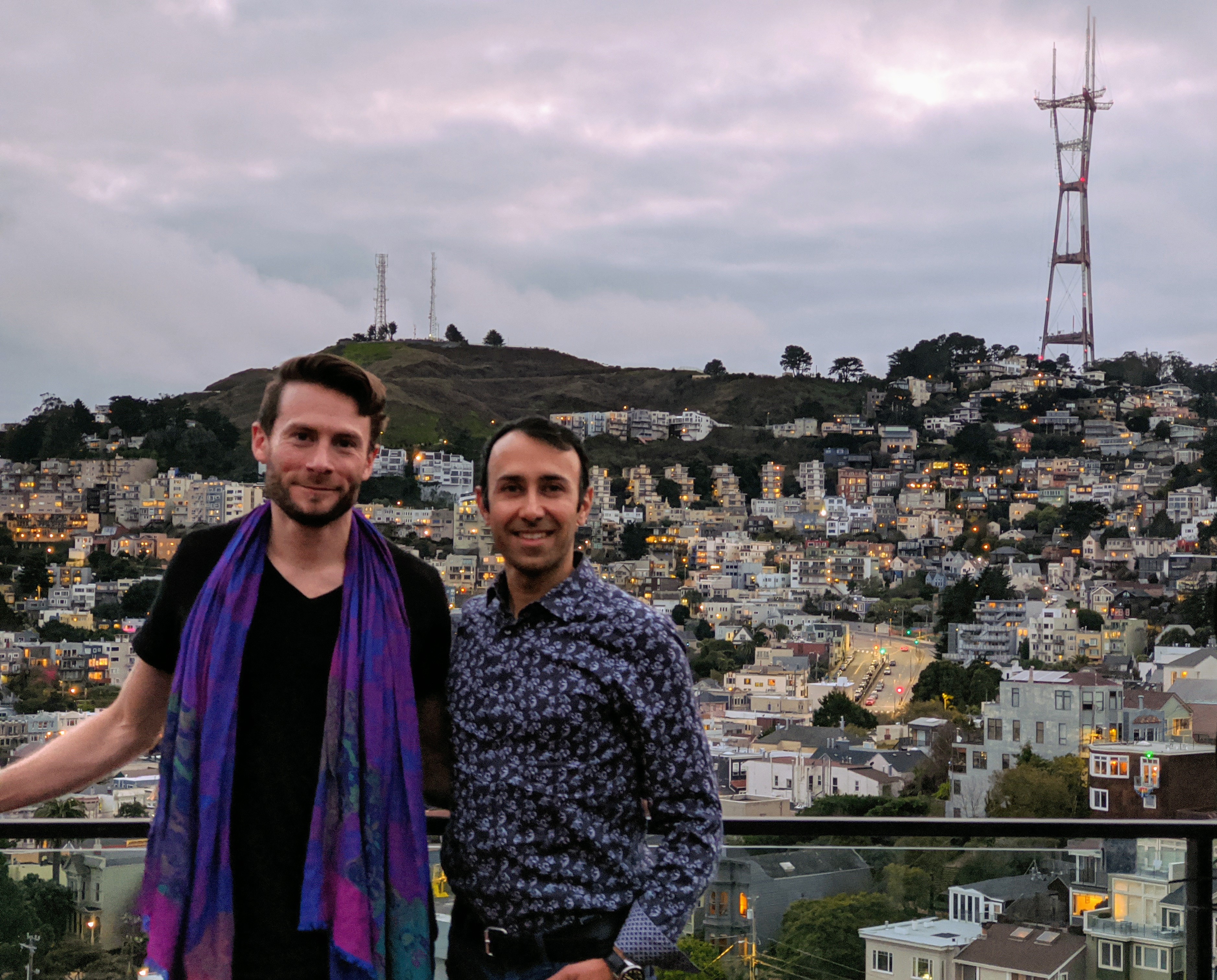
SK: There’s been some improvement in how we capture emissions, but [carbon emissions] are still very deleterious to our health and the planet’s health, and there are a few areas to think about [to address the problem]. Helping people measure and control their consumption is one approach, but also we think about how to produce new energy, which is a shift we [meaning mankind] need to undertake. The challenge [in making that shift] is often [capital expenditures]. It’s hard for venture investors to back companies that are [building nuclear reactors], which makes government grants the best choice for early innovation oftentimes. There is one company, Seaborg, that has figured out a clever reactor. It’s not a portfolio company but it’s [compelling].

SB: We also really like what Seaborg is doing. These [fourth generation] nuclear companies have a whole host of approaches that allow for smaller, safer reactors that you wouldn’t mind having in your backyard. But Siraj put his finger on it: as an early-stage deep tech investor, we have to consider the capital plan of a company, and if it needs to raise billions of dollars, early investors will get really diluted, so early-stage venture just isn’t the best fit.

TC: There are other areas you like, though, because costs have fallen so much.

SB: Yes. Satellite telephony used to be one of those areas. Some of the satellites in space right now cost $350 million [to launch] and took three to four years to build, which would be really hard for any early-stage investor to fund. But now, a new generation of companies is building satellites for one-tenth of the cost in months, not years. That’s a game changer. They can iterate faster. They can build a better product. They don’t have to raise equity to build and launch either; they can raise from a debt financier [from whom they can] borrow money and pay it back over time. That model isn’t available to a company like Uber or Lyft, because those companies can’t say, ‘X is going to cost us Y dollars and it will pay back Z over time.’

TC: What of concerns that all these cheap satellites are going to clog up the sky pretty quickly?

SB: It’s a real concern. Most [of today’s satellites] are low earth satellites, and the closer to the earth they are, the brighter they are; they reflect the sun more, the more satellites we’re seeing instead of stars. I do think it’s incumbent on all of these companies to think about how they are contributing to the future of humanity. But when you connect the unconnected, educational outcomes improve, health improves, inequality decreases, and the stability of governments improves, so maybe the developed world needs to sacrifice a bit. I think that’s a reasonable tradeoff. If on the other hand, we’re putting up satellites to help people buy more crap . . .

TC: It’s like the argument for self-driving cars in a way. Life becomes more efficient, but they’ll require far more energy generation, for example. There are always second-order consequences.

SK: But think of how many people are killed in driving accidents, versus terrorist attacks. Humans have many great qualities, but being able to drive a lethal machine consistently isn’t one of them. So when we take that into perspective, it’s really important that we build autonomous vehicles.

You [voice] a legitimate concern, and often when there are step changes, there are discontinuities along the way that lead to side effects that aren’t great. That comes down to several things. First, infrastructure will have to keep up. We’ll also have to create regulations that don’t lead to the worst outcomes. One our investments, Lilium in Munich, has built an entirely electric air taxi service that’s built on vertical takeoff. It’s nimble. It’s quiet enough to operate in city environments.

On roads, cars are constrained by 2D terrain and buildings, but [in the air] if you can do dynamic air traffic control, it opens up far much efficient transport. If you can get from downtown London to Heathrow [airport] in five minutes versus 50 minutes in a Tesla? That’s far more energy efficient.

SpaceX’s Crew Dragon astronaut spacecraft has a key launch Saturday — here’s what’s going down

Update: Due to weather conditions, SpaceX and NASA won’t be attempting their launch Saturday, and will instead look to their backup window on Sunday. Weather for Sunday also isn’t looking great today, so this could shift again. Stay tuned for updates.

SpaceX and NASA are getting ready for a key test of SpaceX’s Crew Dragon commercial crew spacecraft on Saturday, and this should be the last major milestone that SpaceX has to pass in terms of demonstration missions before actual crew climb aboard the spaceship for a trip to the International Space Station. Starting at 8 AM ET (5 AM PT), a launch window opens during which SpaceX will hopefully perform what’s called an “in-flight abort” test of its Crew Dragon spacecraft and Falcon 9 launch vehicle, to demonstrate how its safety systems would protect astronauts on board in the unlikely event of an unexpected incident during a real crew flight.

The plan for this mission is to launch the Crew Dragon capsule atop a Falcon 9 — in this case, one that’s using a refurbished booster stage previously flown on three prior missions. This will be the Falcon 9’s last flight, however, as the plan includes loss of the rocket this time around instead of a controlled landing. The launch is intentionally being terminated early — just after the rocket achieves its “Max Q” point, or the moment during its flight when it’s under maximum atmospheric stress, at about 84 seconds post-liftoff.

At that point, the rocket will be about 19 kilometres (roughly 62,000 feet) above the surface of the Earth, and about four kilometres (2.5 miles) from its launch pad at Cape Canaveral Air Force Station in Florida. SpaceX has rigged the Dragon spacecraft’s launch escape system to automatically trigger at this point, which will separate the crew spacecraft from the Falcon and propel it away from the rocket very quickly in order to get it to a safe distance to protect any future passengers. After around five minutes past launch, the Dragon will deploy its parachute system, and then at around 10 minutes after it should splash down in the Atlantic Ocean between 3 and 3.5 km (roughly 2 miles) from shore.

After that, crews will recover the Dragon capsule from the ocean, and return it to Cape Canaveral, where SpaceX will study the spacecraft, including human-sized dummies acting as passengers and sensors within to monitor what happened in the cabin during the test. They’ll use this to ideally show that the abort process works as designed and will protect astronauts on board the spacecraft in case of any emergency that results in an early mission termination.

In addition to the in-flight abort system, SpaceX and NASA are also using this mission to prepare for crewed flight in a number of other ways. Today, astronauts Bob Behnken and Doug Hurley, who will crew the first piloted mission hopefully later this year, ran through a dry run of what they would experience in a live mission. They donned space suits and walked the transom that connects the Crew Dragon and Falcon 9 to its launchpad support structure, as NASA Administrator Jim Bridenstine noted on Twitter.

Suited up! While crew members won't be aboard #CrewDragon during tomorrow's @SpaceX In-Flight Abort Test, astronauts Bob Behnken & Doug Hurley rehearsed what they'll experience during @Commercial_Crew missions. I'm excited we'll soon launch American astronauts from American soil! pic.twitter.com/Fr3CjGTm4s

— Jim Bridenstine (@JimBridenstine) January 17, 2020

The test will not involve any attempt to recover the rocket, as mentioned, and SpaceX Crew Mission Management Director Benji Reed said during a press conference today that they do anticipate some kind of “ignition” event with the Falcon 9’s second stage, which could possibly be large enough to be seen from the ground, he said. SpaceX crews will be on standby to recover as much as possible from the rocket wreckage, which will be useful to study, and they’ll also be on hand to minimize any potential environmental impact from the test.

This test was originally scheduled for roughly six months ago, but SpaceX’s Crew Dragon capsule intended for the mission was destroyed during an unexpected incident while test firing its engines. SpaceX and NASA investigated that explosion, and are now confident that they understand the cause of that incident, and have taken steps to ensure that a similar problem doesn’t happen again. The Crew Dragon being used now for Saturday’s test was originally intended to be the one used for actually flying astronauts, and another capsule is currently in development to serve that purpose.

SpaceX’s launch window for this test opens at 8 AM ET tomorrow, but spans four hours, and Reed said it could actually extend longer tomorrow if need be. NASA Commercial Crew program manager Kathy Leuders explained today that it’s crucial that not only launch conditions, but also recovery conditions, are optimal for the purposes of this test, so both will play a factor in when exactly they launch. Unlike with launches actually designed to reach a specific orbit, timing doesn’t have to be quite as on the nose, so there’s more flexibility in terms of making the decision to proceed or stand down. SpaceX has backup opportunities on both Sunday and Monday should they be required.

We’ll have a live stream and live coverage of the test starting tomorrow morning, so check back early Saturday. The stream will kick off around 15 minutes prior to the scheduled opening of the launch window, so at around 7:45 AM ET.

As Alphabet crests the $1T mark, SaaS stocks reach all-time highs of their own

Continuing our irregular surveys of the public markets, two things happened this week that are worth our time. First, a third domestic technology company — Alphabet — passed the $1 trillion market capitalization threshold. And, second, software as a service (SaaS) stocks reached record highs on the public markets after retreating over last summer.

The two milestones, only modestly related events, indicate how temperate the public waters are for technology companies today, a fact that should extend warmth into the private market where startups, and their venture capital backers, work.

The happenings are good news for technology startups for a number of reasons, including that major tech players have never had as much wealth in hand with which to buy smaller companies, and strong SaaS valuations help both smaller startups fundraise, and their larger brethren possibly exit.

Indeed, the stridently good valuations that major tech companies and their smaller siblings enjoy today should be just the sort of market conditions under which unicorns want to debut. We’ll continue to make this point so long as the public markets continue to rise, pricing tech companies that have already floated higher like the cliche’s own tide.

But while Alphabet, Microsoft and Apple are worth $3.68 trillion as a trio, and SaaS stocks are now worth 12.3x times their revenue (using enterprise value instead of market cap, for those keeping score at home), not every private, venture-backed company will necessarily benefit from public investor largesse.

What about tech-ish startups?

How much the current public-market tech valuation expansion will help companies that are increasingly sorted into the tech-enabled bucket isn’t clear; some companies that went public in 2019 were quickly spit up by investors unwilling to support valuations that matched or rose above their final private valuations. SmileDirectClub was one such offering.

The dividing line between what counts as tech — often fuzzy — appears to be slicing along gross margin lines, and the repeatability of business. The higher margin, and more recurring a company is, the more it’s worth. This market reality is why SaaS stocks’ recent return to form is not a surprise.

For Casper and One Medical, the first two venture-backed IPO hopefuls of the year, the more tech-ish they can appear between now and pricing the better. Because technology companies today are valued so highly, perhaps even a faint dusting of tech will save their valuations as they cross the chasm between private and adult.

Cruise calls for a new way to determine commercial readiness of self-driving cars

Cruise co-founder and CTO Kyle Vogt said Friday that disengagement reports released annually by California regulators are not a proxy for the commercial readiness or safety of self-driving cars.

Vogt, in a lengthy post on Medium, called for a new metric to determine whether an autonomous vehicle is ready for commercial deployment. The post suggests that the autonomous vehicle company, which had a valuation of $19 billion as of May, is already developing more comprehensive metrics.

The California Department of Motor Vehicles, which regulates the permits for autonomous vehicle testing on public roads in the state, requires companies to submit an annual report detailing “disengagements,” a term that means the number of times drivers have had to take control of a car. The DMV defines a disengagement as any time a test vehicle operating on public roads has switched from autonomous to manual mode for an immediate safety-related reason or due to a failure of the system. 

“It’s woefully inadequate for most uses beyond those of the DMV,” Vogt wrote. “The idea that disengagements give a meaningful signal about whether an AV is ready for commercial deployment is a myth.”

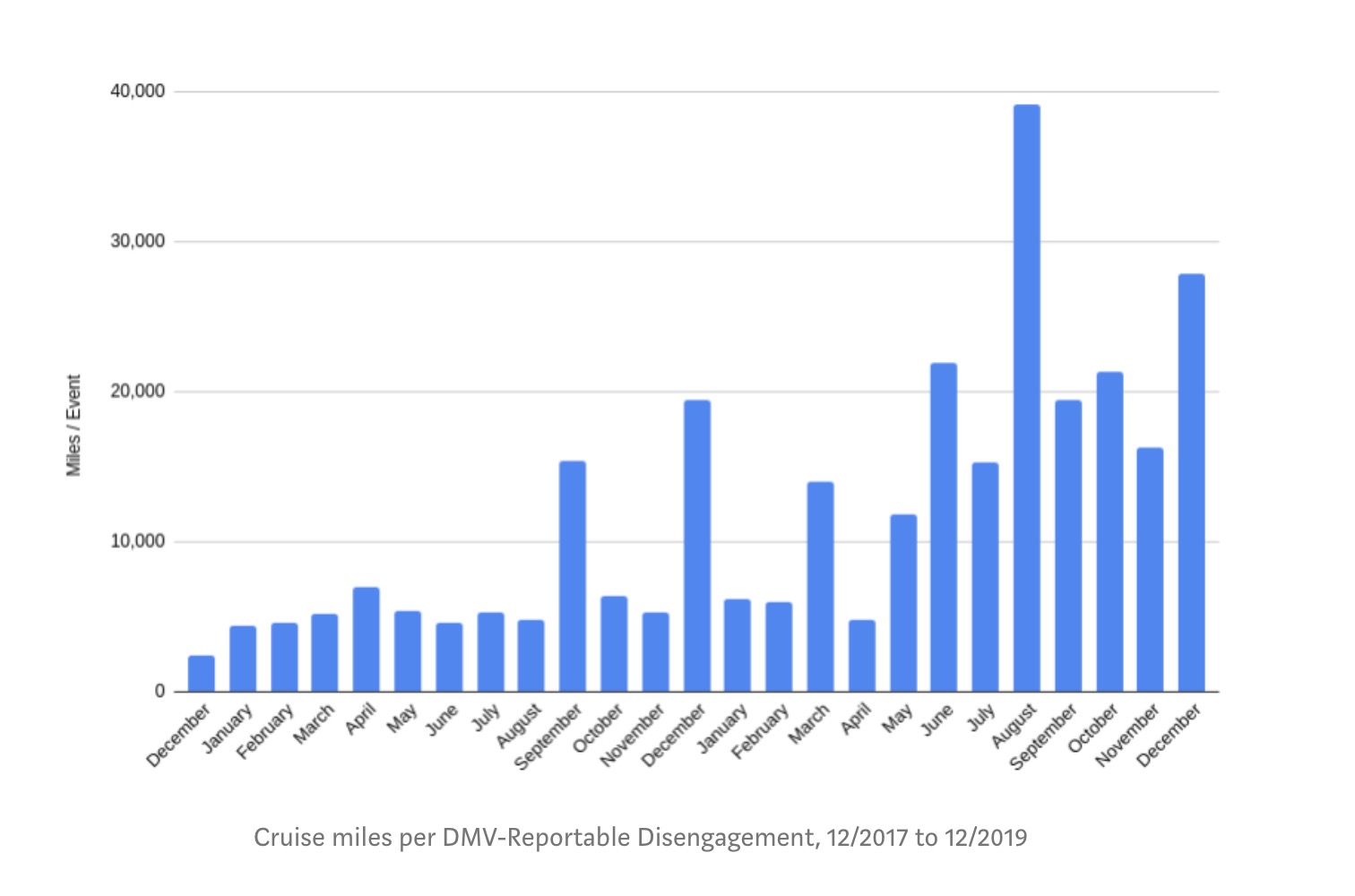
These disengagement reports will be released in a few weeks. Cruise did share some of its disengagement data, specifically the number of miles driven per disengagement event, between 2017 and 2019.

cruise disengagement data 2019

The so-called race to commercialize autonomous vehicles has involved a fair amount of theater, including demos. This lack of data has made it nearly impossible to determine if a company’s self-driving cars are safe enough or ready for the big and very real stage of shuttling people from Point A to Point B on city streets. Disengagement reports — as flawed as they might be — have been one of the only pieces of data that the public, and the media, have access to.

How safe is safe enough?

While that data might provide some insights, it doesn’t help answer the fundamental question for every AV developer planning to deploy robotaxis for the public: “How safe is safe enough?”

Vogt’s comments signal Cruise’s efforts to find a practical means of answering that question.

But if we can’t use the disengagement rate to gauge commercial readiness, what can we use? Ultimately, I believe that in order for an AV operator to deploy AVs at scale in a ridesharing fleet, the general public and regulators deserve hard, empirical evidence that an AV has performance that is super-human (better than the average human driver) so that the deployment of the AV technology has a positive overall impact on automotive safety and public health.
This requires a) data on the true performance of human drivers and AVs in a given environment and b) an objective, apples-to-apples comparison with statistically significant results. We will deliver exactly that once our AVs are validated and ready for deployment. Expect to hear more from us about this very important topic soon.

Competitors agree

Cruise is hardly the only company to question the disengagement reports, although this might be the most strongly worded and public call to date. Waymo told TechCrunch that it takes a similar view.

The reports have long been a source of angst among AV developers. The reports do provide information that can be useful to the public, such as number of vehicles testing on public roads. But it’s hardly a complete picture of any company’s technology.

The reports are wildly different; each company provides varying amounts of information, all in different formats. There is also disagreement over what is and what is not a disengagement. For instance, this issue got more attention in 2018 when Jalopnik questioned an incident involving a Cruise vehicle. In that case, a driver took manual control of the wheel as it passed through an intersection, but it wasn’t reported as a disengagement. Cruise told Jalopnik at the time that it didn’t meet the standard for California regulations.

The other issue is that disengagements don’t provide an “apples to apples” comparison of technology, as these test vehicles operate in a variety of environments and conditions.

Disengagements also often rise and fall along with the scale of testing. Waymo, for instance, told TechCrunch that its disengagements will likely increase as it scales up its testing in California.

And finally, more companies are using simulation or virtual testing instead of sending fleets of cars on public roads to test every new software build. Aurora, another AV developer, emphasizes its use of its virtual testing suite. The disengagement reports don’t include any of that data.

Vogt’s post also called out the industry for conducting carefully “curated demo routes that avoid urban areas with cyclists and pedestrians, constrain geofences and pickup/dropoff locations, and limit the kinds of maneuvers the AV will attempt during the ride.”

The shot could be interpreted as a shot at Waymo, which has recently conducted driverless demos on public streets in Chandler, Ariz. with reporters. TechCrunch was one of the first to have a driverless ride last year. However, demos are common practice among many other self-driving vehicle startups, and are particularly popular around events like CES. Cruise has conducted at least one demo, which was with the press in 2017.

Vogt suggested that raw, unedited drive footage that “covers long stretches of driving in real world situations” is hard to fake and a more qualitative indicator of technology maturity.

Eaze’s struggles reflect falling VC interest in cannabis startups

Hello and welcome back to our regular morning look at private companies, public markets and the gray space in between.

Yesterday, TechCrunch reported that Eaze, a well-known cannabis-focused startup, is struggling to stay in business amidst a cash crunch, leadership turmoil, banking issues and a business model pivot. It’s a compelling, critical read.

The news, however, asks a question: How are other cannabis-focused startups faring? We’ll explore the question through the lens of fundraising and the public market results of public cannabis companies in Canada.

Fundraising

EU lawmakers are eyeing risk-based rules for AI, per leaked white paper

The European Commission is considering a temporary ban on the use of facial recognition technology, according to a draft proposal for regulating artificial intelligence obtained by Euroactiv.

Creating rules to ensure AI is ‘trustworthy and human’ has been an early flagship policy promise of the new Commission, led by president Ursula von der Leyen.

But the leaked proposal suggests the EU’s executive body is in fact leaning towards tweaks of existing rules and sector/app specific risk-assessments and requirements, rather than anything as firm as blanket sectoral requirements or bans.

The leaked Commission white paper floats the idea of a three-to-five-year period in which the use of facial recognition technology could be prohibited in public places — to give EU lawmakers time to devise ways to assess and manage risks around the use of the technology, such as to people’s privacy rights or the risk of discriminatory impacts from biased algorithms.

“This would safeguard the rights of individuals, in particular against any possible abuse of the technology,” the Commission writes, adding that: “It would be necessary to foresee some exceptions, notably for activities in the context of research and development and for security purposes.”

However the text raises immediate concerns about imposing even a time-limited ban — which is described as “a far-reaching measure that might hamper the development and uptake of this technology” — and the Commission goes on to state that its preference “at this stage” is to rely on existing EU data protection rules, aka the General Data Protection Regulation (GDPR).

The white paper contains a number of options the Commission is still considering for regulating the use of artificial intelligence more generally.

These range from voluntary labelling; to imposing sectorial requirements for the public sector (including on the use of facial recognition tech); to mandatory risk-based requirements for “high-risk” applications (such as within risky sectors like healthcare, transport, policing and the judiciary, as well as for applications which can “produce legal effects for the individual or the legal entity or pose risk of injury, death or significant material damage”); to targeted amendments to existing EU product safety and liability legislation.

The proposal also emphasizes the need for an oversight governance regime to ensure rules are followed — though the Commission suggests leaving it open to Member States to choose whether to rely on existing governance bodies for this task or create new ones dedicated to regulating AI.

Per the draft white paper, the Commission says its preference for regulating AI are options 3 combined with 4 & 5: Aka mandatory risk-based requirements on developers (of whatever sub-set of AI apps are deemed “high-risk”) that could result in some “mandatory criteria”, combined with relevant tweaks to existing product safety and liability legislation, and an overarching governance framework.

Hence it appears to be leaning towards a relatively light-touch approach, focused on “building on existing EU legislation” and creating app-specific rules for a sub-set of “high-risk” AI apps/uses — and which likely won’t stretch to even a temporary ban on facial recognition technology.

Much of the white paper is also take up with discussion of strategies about “supporting the development and uptake of AI” and “facilitating access to data”.

“This risk-based approach would focus on areas where the public is at risk or an important legal interest is at stake,” the Commission writes. “This strictly targeted approach would not add any new additional administrative burden on applications that are deemed ‘low-risk’.”

EU commissioner Thierry Breton, who oversees the internal market portfolio, expressed resistance to creating rules for artificial intelligence last year — telling the EU parliament then that he “won’t be the voice of regulating AI“.

For “low-risk” AI apps, the white paper notes that provisions in the GDPR which give individuals the right to receive information about automated processing and profiling, and set a requirement to carry out a data protection impact assessment, would apply.

Albeit the regulation only defines limited rights and restrictions over automated processing — in instances where there’s a legal or similarly significant effect on the people involved. So it’s not clear how extensively it would in fact apply to “low-risk” apps.

If it’s the Commission’s intention to also rely on GDPR to regulate higher risk stuff — such as, for example, police forces’ use of facial recognition tech — instead of creating a more explicit sectoral framework to restrict their use of a highly privacy-hostile AI technologies — it could exacerbate an already confusingly legislative picture where law enforcement is concerned, according to Dr Michael Veale, a lecturer in digital rights and regulation at UCL.

“The situation is extremely unclear in the area of law enforcement, and particularly the use of public private partnerships in law enforcement. I would argue the GDPR in practice forbids facial recognition by private companies in a surveillance context without member states actively legislating an exemption into the law using their powers to derogate. However, the merchants of doubt at facial recognition firms wish to sow heavy uncertainty into that area of law to legitimise their businesses,” he told TechCrunch.

“As a result, extra clarity would be extremely welcome,” Veale added. “The issue isn’t restricted to facial recognition however: Any type of biometric monitoring, such a voice or gait recognition, should be covered by any ban, because in practice they have the same effect on individuals.”

An advisory body set up to advise the Commission on AI policy set out a number of recommendations in a report last year — including suggesting a ban on the use of AI for mass surveillance and social credit scoring systems of citizens.

But its recommendations were criticized by privacy and rights experts for falling short by failing to grasp wider societal power imbalances and structural inequality issues which AI risks exacerbating — including by supercharging existing rights-eroding business models.

In a paper last year Veale dubbed the advisory body’s work a “missed opportunity” — writing that the group “largely ignore infrastructure and power, which should be one of, if not the most, central concern around the regulation and governance of data, optimisation and ‘artificial intelligence’ in Europe going forwards”.

Baraja’s unique and ingenious take on lidar shines in a crowded industry

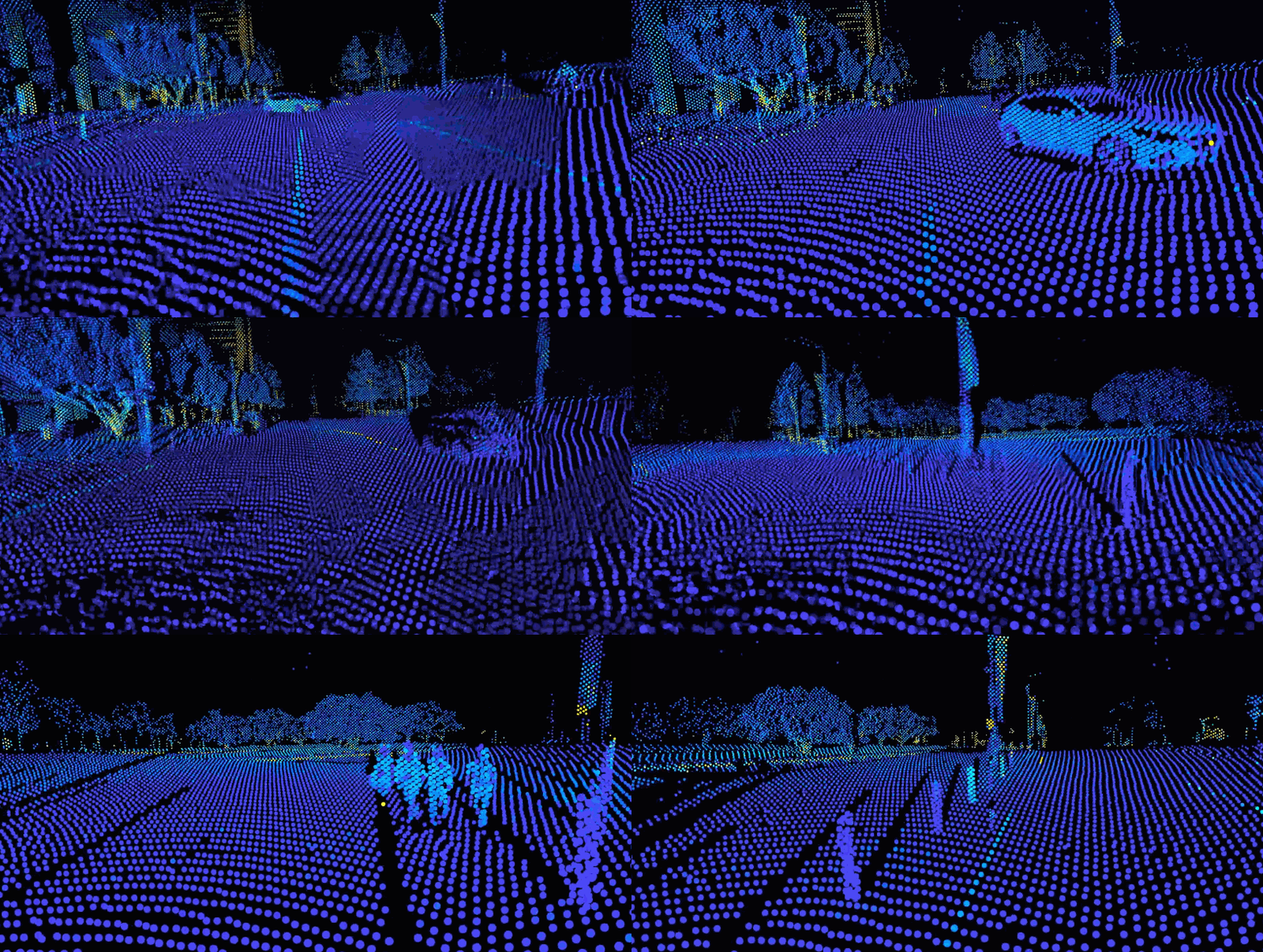
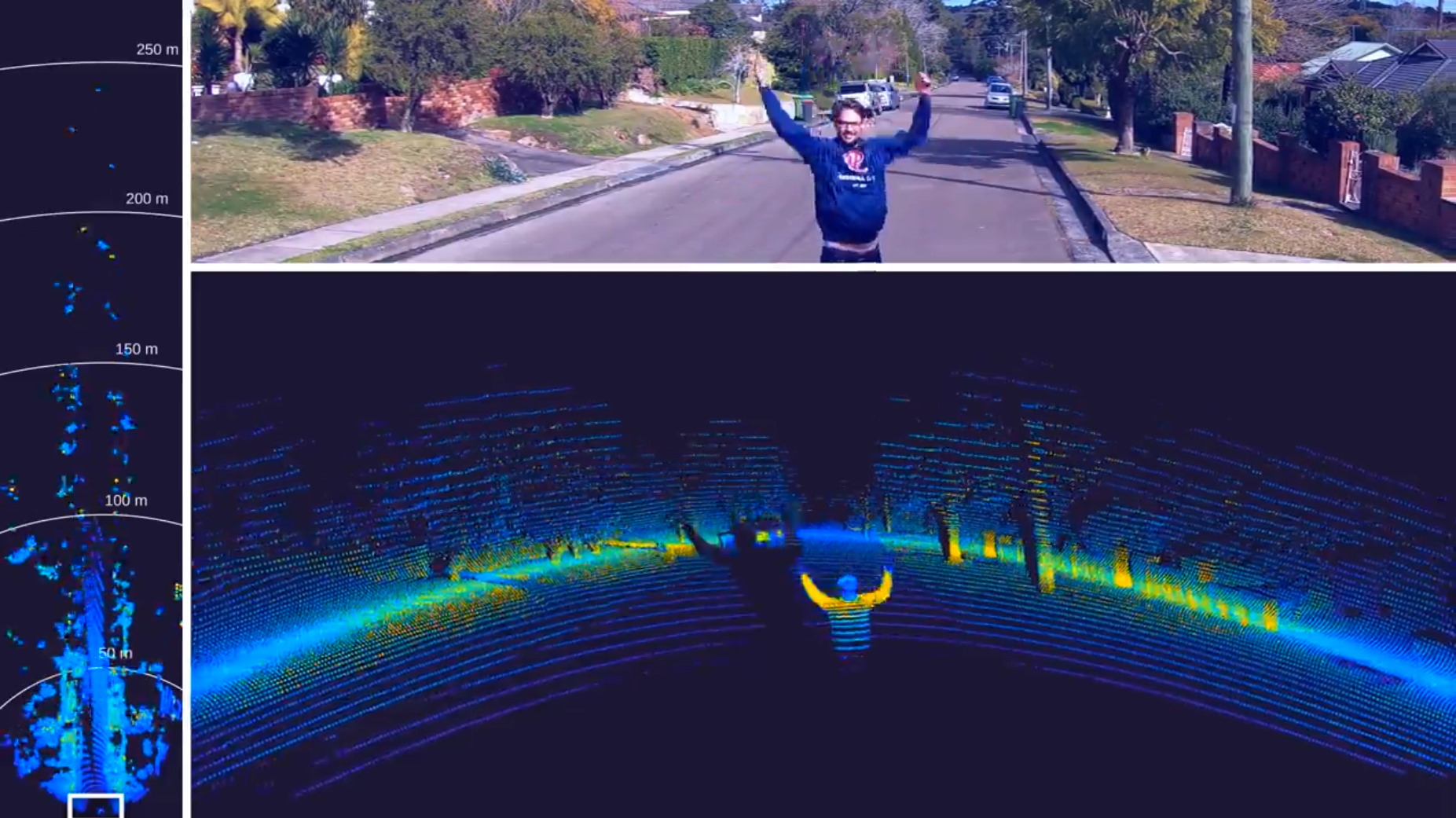
It seems like every company making lidar has a new and clever approach, but Baraja takes the cake. Its method is not only elegant and powerful, but fundamentally avoids many issues that nag other lidar technologies. But it’ll need more than smart tech to make headway in this complex and evolving industry.

To understand how lidar works in general, consult my handy introduction to the topic. Essentially a laser emitted by a device skims across or otherwise very quickly illuminates the scene, and the time it takes for that laser’s photons to return allows it to quite precisely determine the distance of every spot it points at.

But to picture how Baraja’s lidar works, you need to picture the cover of Pink Floyd’s “Dark Side of the Moon.”

GIFs kind of choke on rainbows, but you get the idea.

Imagine a flashlight shooting through a prism like that, illuminating the scene in front of it — now imagine you could focus that flashlight by selecting which color came out of the prism, sending more light to the top part of the scene (red and orange) or middle (yellow and green). That’s what Baraja’s lidar does, except naturally it’s a bit more complicated than that.

The company has been developing its tech for years with the backing of Sequoia and Australian VC outfit Blackbird, which led a $32 million round late in 2018 — Baraja only revealed its tech the next year and was exhibiting it at CES, where I met with co-founder and CEO Federico Collarte.

“We’ve stayed in stealth for a long, long time,” he told me. “The people who needed to know already knew about us.”

The idea for the tech came out of the telecommunications industry, where Collarte and co-founder Cibby Pulikkaseril thought of a novel use for a fiber optic laser that could reconfigure itself extremely quickly.

We thought if we could set the light free, send it through prism-like optics, then we could steer a laser beam without moving parts. The idea seemed too simple — we thought, ‘if it worked, then everybody would be doing it this way,’ ” he told me, but they quit their jobs and worked on it for a few months with a friends and family round, anyway. “It turns out it does work, and the invention is very novel and hence we’ve been successful in patenting it.”

Rather than send a coherent laser at a single wavelength (1550 nanometers, well into the infrared, is the lidar standard), Baraja uses a set of fixed lenses to refract that beam into a spectrum spread vertically over its field of view. Yet it isn’t one single beam being split but a series of coded pulses, each at a slightly different wavelength that travels ever so slightly differently through the lenses. It returns the same way, the lenses bending it the opposite direction to return to its origin for detection.

It’s a bit difficult to grasp this concept, but once one does it’s hard to see it as anything but astonishingly clever. Not just because of the fascinating optics (something I’m partial to, if it isn’t obvious), but because it obviates a number of serious problems other lidars are facing or about to face.

First, there are next to no moving parts whatsoever in the entire Baraja system. Spinning lidars like the popular early devices from Velodyne are being replaced at large by ones using metamaterials, MEMS, and other methods that don’t have bearings or hinges that can wear out.

Baraja’s “head” unit, connected by fiber optic to the brain.

In Baraja’s system, there are two units, a “dumb” head and an “engine.” The head has no moving parts and no electronics; it’s all glass, just a set of lenses. The engine, which can be located nearby or a foot or two away, produces the laser and sends it to the head via a fiber-optic cable (and some kind of proprietary mechanism that rotates slowly enough that it could theoretically work for years continuously). This means it’s not only very robust physically, but its volume can be spread out wherever is convenient in the car’s body. The head itself also can be resized more or less arbitrarily without significantly altering the optical design, Collarte said.

Second, the method of diffracting the beam gives the system considerable leeway in how it covers the scene. Different wavelengths are sent out at different vertical angles; a shorter wavelength goes out toward the top of the scene and a slightly longer one goes a little lower. But the band of 1550 +/- 20 nanometers allows for millions of fractional wavelengths that the system can choose between, giving it the ability to set its own vertical resolution.

It could for instance (these numbers are imaginary) send out a beam every quarter of a nanometer in wavelength, corresponding to a beam going out every quarter of a degree vertically, and by going from the bottom to the top of its frequency range cover the top to the bottom of the scene with equally spaced beams at reasonable intervals.

But why waste a bunch of beams on the sky, say, when you know most of the action is taking place in the middle part of the scene, where the street and roads are? In that case you can send out a few high frequency beams to check up there, then skip down to the middle frequencies, where you can then send out beams with intervals of a thousandth of a nanometer, emerging correspondingly close together to create a denser picture of that central region.

If this is making your brain hurt a little, don’t worry. Just think of Dark Side of the Moon and imagine if you could skip red, orange and purple, and send out more beams in green and blue — and because you’re only using those colors, you can send out more shades of green-blue and deep blue than before.

Third, the method of creating the spectrum beam provides against interference from other lidar systems. It is an emerging concern that lidar systems of a type could inadvertently send or reflect beams into one another, producing noise and hindering normal operation. Most companies are attempting to mitigate this by some means or another, but Baraja’s method avoids the possibility altogether.

“The interference problem — they’re living with it. We solved it,” said Collarte.

The spectrum system means that for a beam to interfere with the sensor it would have to be both a perfect frequency match and come in at the precise angle at which that frequency emerges from and returns to the lens. That’s already vanishingly unlikely, but to make it astronomically so, each beam from the Baraja device is not a single pulse but a coded set of pulses that can be individually identified. The company’s core technology and secret sauce is the ability to modulate and pulse the laser millions of times per second, and it puts this to good use here.

Collarte acknowledged that competition is fierce in the lidar space, but not necessarily competition for customers. “They have not solved the autonomy problem,” he points out, “so the volumes are too small. Many are running out of money. So if you don’t differentiate, you die.” And some have.

Instead companies are competing for partners and investors, and must show that their solution is not merely a good idea technically, but that it is a sound investment and reasonable to deploy at volume. Collarte praised his investors, Sequoia and Blackbird, but also said that the company will be announcing significant partnerships soon, both in automotive and beyond.

Where FaZe Clan sees the future of gaming and entertainment

Lee Trink has spent nearly his entire career in the entertainment business. The former president of Capitol Records is now the head of FaZe Clan, an esports juggernaut that is one of the most recognizable names in the wildly popular phenomenon of competitive gaming.

Trink sees FaZe Clan as the voice of a new generation of consumers who are finding their voice and their identity through gaming — and it’s a voice that’s increasingly speaking volumes in the entertainment industry through a clutch of competitive esports teams, a clothing and lifestyle brand and a network of creators who feed the appetites of millions of young gamers.

As the company struggles with a lawsuit brought by one of its most famous players, Trink is looking to the future — and setting his sights on new markets and new games as he consolidates FaZe Clan’s role as the voice of a new generation.

“The teams and social media output that we create is all marketing,” he says. “It’s not that we have an overall marketing strategy that we then populate with all of these opportunities. We’re not maximizing all of our brands.”

The paradox of 2020 VC is that the largest funds are doing the smallest rounds

I talked yesterday about how VCs are just tired these days. Too many deals, too little time per deal, and constant hyper-competition with other VCs for the same equity.

One founder friend of mine noted to me last night that he has already received inbound requests from more than 90 investors over the past year about his next round — and he’s not even (presumably) fundraising. “I may have missed a few,” he deadpans — and really, how could one not?

All that frenetic activity, though, leads us to the paradox at the heart of 2020 venture capital: It’s the largest funds that are writing the earliest, smallest checks.

That’s a paradox because big funds need big rounds to invest in. A billion-dollar fund can’t write 800 $1 million seed checks with dollars left over for management fees (well, they could, but that would be obnoxious and impossible to track). Instead, the usual pattern is that as a firm’s fund size grows, its managing partners increasingly move to later-stage rounds to be able to efficiently deploy that capital. So the $200 million fund that used to write $8 million Series As transforms into a $1 billion fund writing $40 million Series Bs and Cs.

That’s logical. Yet, the real logic is a bit more complicated. Namely, that everyone is raising huge funds.

As this week’s big VC report from the National Venture Capital Association made clear, 2019 was in many ways the year of the big fund (and SoftBank didn’t even raise!). Twenty-one “mega-funds” launched last year (defined as raising more than $500 million), and that was actually below the numbers in 2018.

All that late-stage capital is scouring for late-stage deals, but there just aren’t that many deals to do. Sure, there are great companies and potentially great returns lying around, but there are also dozens of funds plotting to get access to that cap table, and valuation is one of the only levers these investors have to stand out from the fray.

This is the story of Plaid in many ways. The fintech data API layer, which Visa announced it is intending to acquire for $5.3 billion, raised a $250 million Series C in late 2018 from Index and Kleiner, all according to Crunchbase. Multiple VC sources have told me that “everyone” looked at the deal (everyone being the tired VCs if you will).

But as one VC who said “no” on the C round defended to me this week, the valuation last year was incredibly rich. The company had revenues in 2018 in the upper tens of millions, or so I have been told, which coupled with its publicly reported $2.65 billion Series C valuation implies a revenue multiple somewhere in the 30-50x range — extremely pricey given the company’s ongoing fight with banks to ensure it can maintain data access to its users’ accounts.

Jeff Kauflin at Forbes reported that the company’s revenues in 2019 are now in the lower three digits of millions, which means that Visa likely paid a similarly expensive multiple to acquire the company. Kleiner and Index doubled their money in a year or so, and no one should complain about that kind of IRR (particularly in growth investing), but if it weren’t for Visa and the beneficial alchemy of exit timing, all might have turned out very differently.

Worse than just expensive valuations, these later-stage rounds can become very proprietary and exclusive. From the sounds of it, Plaid ran a fairly open process for its Series C round, which allowed a lot of firms to look at the deal, helping to drive the valuation up while limiting dilution for earlier investors and the founder. But that’s not the only way to handle it.

Increasingly, firms that invested early are also trying to invest later. That Series A investor who put in $5 million also wants to put in the $50 million Series B and the $250 million Series C. After all, they have the capital, already know the company, have a relationship with the CEO and can avoid a time-consuming fundraise in the process.

So for many deals today, those later-stage cap tables are essentially locking out new investors, because there is already so much capital sitting around the cap table just salivating to double down.

That gets us straight to the paradox. In order to have access to later-stage rounds, you have to already be on the cap table, which means that you have to do the smaller, earlier-stage rounds. Suddenly, growth investors are coming back to early-stage rounds (including seed) just to have optionality on access to these startups and their fundraises.

As one VC explained to me last week (paraphrasing), “What’s weird today is that you have firms like Sequoia who show up for seed rounds, but they don’t really care about … anything. Valuation, terms, etc. It’s all a play for those later-stage rounds.” I think that’s a bit of an exaggeration, to be clear, but ultimately, those one million-dollar checks are essentially a rounding error for the largest funds. The real return is in the mega rounds down the road.

Does that mean seed funds will cease to exist? Certainly not, but it’s hard to make money and build a balanced, risk-adjusted portfolio when your competitors literally don’t care and consider the investment a marketing and access expense. As for founders — the times are still really, really good if you can check the right VC boxes.

Crowdfunded hardware startups are breathing fresh life into music making

I love music. Seriously, it’s one of the few things that brings solace in this cold, lonely world. Want to go deep on Joni Mitchell, William Onyeabor or Pablo Casals? I’m game. Yes, I worked at multiple record stores years before TechCrunch. Yes, I will always be that guy. What I will never be, however, is a musician, professional or otherwise.

I’m resolved to this fact at this point in my life. I’ll never be a rock star like I’ll never be a professional baseball player — both facts I’ve mostly made peace with. We don’t need to go into the two years of junior high when I played the trombone, or the decade and a half I attempted to master the guitar. All you need to know is I had absolutely zero aptitude for either.

It’s not for lack of desire to make music. It’s just a straight-up, good-old-fashioned lack of talent. For precisely this reason, I view any new piece of musical equipment with great interest. There’s a ton of money to be made for the startup that can truly unlock the potential of music making for those lacking the basic skills to do so.

Roli has long been of interest to me for this reason. I was one of the first people to cover the Seaboard when it debuted at SXSW a number of years ago. It’s a fascinating instrument, letting users bend notes courtesy of a soft material makeup, but mastering it — or, really, making any music at all — requires some ability to play piano.The company’s modular block system, announced a few years ago, was even more compelling, but similarly failed to scratch that itch.

Last week at CES, the fine folks at Kickstarter introduced me to the founders of a trio of crowdfunding companies that fit the bill to some degree. French startup Joué actually went on to win top prize at our CES pitch-off this year, with its modular MIDI controller of the same name.

The device operates on a similar principle as the Sensel Morph we’ve covered before, with silicone skins that overlay atop a touch surface to offer a variety of different controllers. Joué’s take is more music-focused than Sensel’s ever was. And besides, based on a conversation with Sensel at the show, I think it’s pretty fair to say that the company is turning most of its focus away from that device, in favor of compelling touch components it’s working to build into third-party handsets.

The Kickstarter project is an impressive one, as evidenced by the brief demo. It’s extremely versatile, requiring just a new skin and sound pack for the system to take on completely different aural qualities. The company also discussed the potential for customized sound packs. Joué brought NWA founder Arabian Prince in to perform at its both all week. An odd fit for CES, to be sure, but an interesting example of the kinds of artists such a product might be able to draw. It’s easy to see musicians expressing interest in a customized pad.

That said, while the company seems to be positioning the product as perfect for beginners, I do expect there’s a reasonably large learning curve here. That seems removed somewhat from Rhythmo. The Austin-based startup’s project combines music making with a guided dip into the maker world.

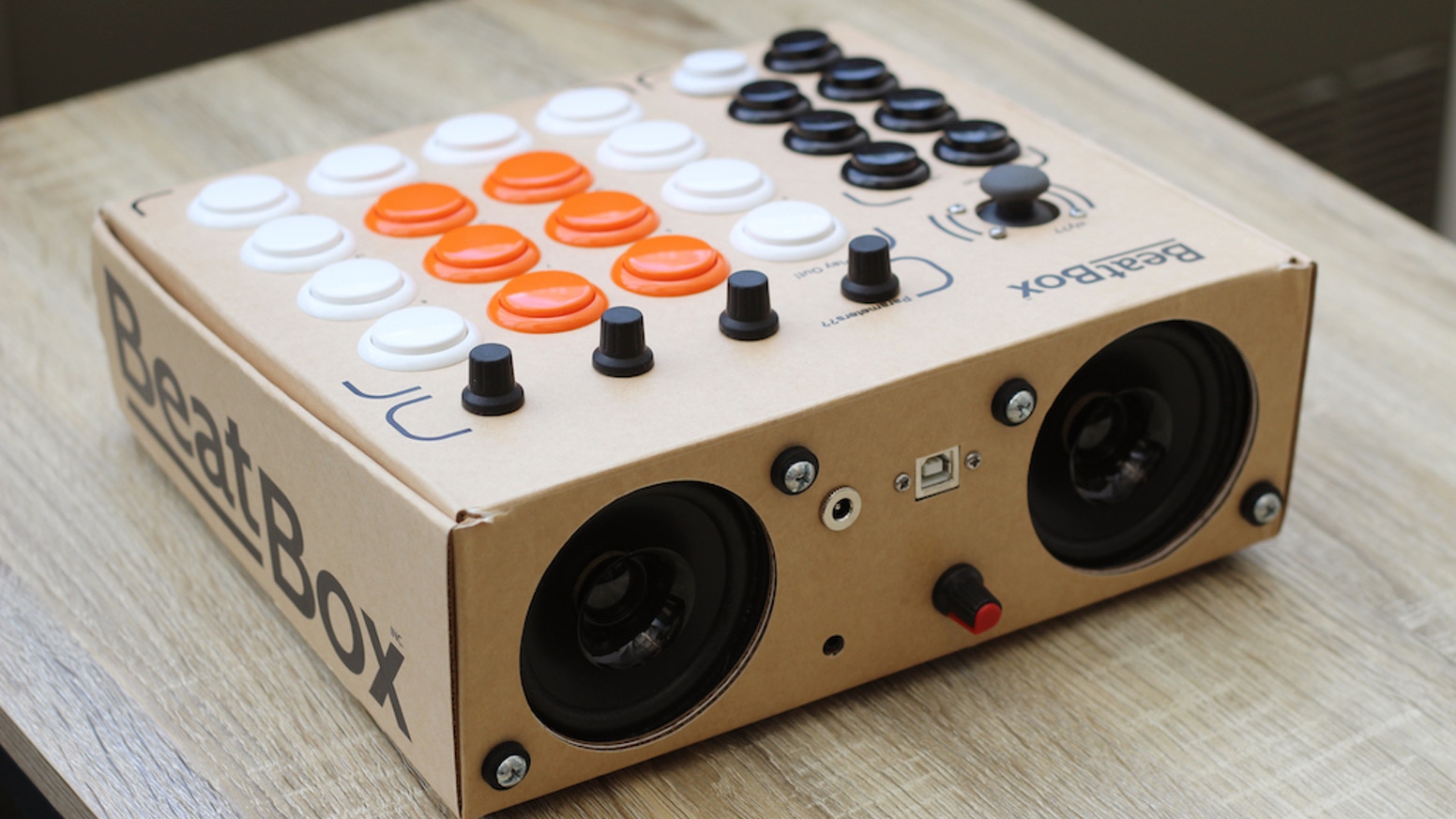
It’s a MIDI controller drum kit that you make out of a cardboard box. It ships with all of the pieces, and putting it together offers a nice connection into the process of creating a musical instrument. Founder Ethan Jin let me take a constructed model for a spin on the CES floor. The demo was a little glitchy for various reasons, but it was fun. The kit features large arcade buttons that can be mapped to a variety of sounds. You can use the Rhythmo app or interface with your music software of choice in iPad, desktop, etc. It’s a fun entry into that world.

Artiphon, however, is probably closest to fulfilling my very specific desires. The company is best known for its massively successful Kickstarter project, Instrument 1. That racked in a mind-boggling $1.3 million with the promise of delivering a guitar, violin, piano and drum machine all in a single device.

The newer Orba ($1.4 million this time), however, really caught my eye. The puck-shaped device is a pocket synthesizer/looper/MIDI controller that requires little if any musical knowledge to get up and running. After a conversation with founder Mike Butera, I’ve come to regard it at a very base-level as a sort of musical fidget spinner.

That is to say, it’s simple enough that you can use it absentmindedly to make music while you pace around your apartment, trying to come up with a half-decent headline for the story of crowdfunded music projects at CES you’ve been writing (a purely hypothetical example that in no way reflects my life).

Of the three, that’s the one I’m most key to review, in hopes of finally scratching that musical itch.

CES 2020 coverage - TechCrunch

Companies take baby steps toward home robots at CES

“I think there are fewer fake robots this year.” I spoke to a lot of roboticists and robot-adjacent folks at this year’s CES, but that comment from Labrador Systems co-funder/CEO Mike Dooley summed up the situation nicely. The show is slowly, but steadily, starting to take robotics more seriously.

It’s true that words like “fake” and “seriously” are quite subjective; surely all of those classified by one of us as the former would take great issue with the tag. It’s also true that there are still many devices that fit firmly within the realm of novelty and hypothetical, both on the show floor and in press conferences, but after a week at CES — including several behind-the-scenes conversations with investors and startups — the consensus seems to be that the show is slowly embracing the more series side of robotics.

I believe the reason for this shift is two-fold. First, the world of consumer robotics hasn’t caught on as quickly as many had planned/hoped. Second, enterprise and industrial robotics actually have. Let’s tackle those points in order.

As my colleague Darrell pointed out in a recent piece, consumer robotics were showing signs of life at this year’s event. However, those who predicted a watershed for the industry after the Roomba’s arrival on the scene some 18 years ago have no doubt been largely disappointed with the ensuing decades.

Joby Aviation raises $590 million led by Toyota to launch an electric air taxi service

Joby Aviation has raised a $590 million Series C round of funding, including $394 million from lead investor Toyota Motor Corporation, the company announced today. Joby is in the process of developing an electric air taxi service, which will make use of in-house developed electric vertical take-off and landing (eVTOL) aircraft that will in part benefit from strategic partner Toyota’s vehicle manufacturing experience.

This brings the total number of funding in Joby Aviation to $720 million, and its list of investors includes Intel Capital, JetBlue Technology Ventures, Toyota AI Ventures and more. Alongside this new round of funding, Joby gains a new board member: Toyota Motor Corporation EVP Shigeki Tomoyama.

Founded in 2009, Joby Aviation is based in Santa Cruz, California. The company was founded by JoeBen Bevirt, who also founded consumer photo and electronics accessory maker Joby. Its proprietary aircraft is a piloted eVTOL, which can fly at up to 200 miles per hour for a total distance of over 150 miles on a single charge. Because it uses an electric drivetrain and multi rotor design, Joby Aviation says it’s “100 times quieter than conventional aircraft during takeoff and landing, and near-silent when flying overhead.”

These benefits make eVTOL craft prime candidates for developing urban aerial transportation networks, and a number of companies, including Joby as well as China’s EHang, Airbus and more are all working on this type of craft for use in this kind of city-based short-hop transit for both people and cargo.

The sizeable investment made by Toyota in this round is a considerable bet for the automaker on the future of air transportation. In a press release detailing the round, Toyota President and CEO Akio Toyoda indicated that the company is serious about eVTOLs and air transport in general.

“Air transportation has been a long-term goal for Toyota, and while we continue our work in the automobile business, this agreement sets our sights to the sky,” Toyoda is quoted as saying. “As we take up the challenge of air transportation together with Joby, an innovator in the emerging eVTOL space, we tap the potential to revolutionize future transportation and life. Through this new and exciting endeavor, we hope to deliver freedom of movement and enjoyment to customers everywhere, on land, and now, in the sky.”

Joby Aviation believes that it can achieve significant cost benefits vs. traditional helicopters for short aerial flights, eventually lowering costs through maximizing utilization and fuel savings to the point where it can be “accessible to everyone.” To date, Joby has completed sub-scale testing on its aircraft design, and begun full flight tests of production prototypes, along with beginning the certification process for its aircraft with the Federal Aviation Administration (FAA) at the end of 2018.

Apple buys edge-based AI startup Xnor.ai for a reported $200M

Xnor.ai, spun off in 2017 from the nonprofit Allen Institute for AI (AI2), has been acquired by Apple for about $200 million. A source close to the company corroborated a report this morning from GeekWire to that effect.

Apple confirmed the reports with its standard statement for this sort of quiet acquisition: “Apple buys smaller technology companies from time to time and we generally do not discuss our purpose or plans.” (I’ve asked for clarification just in case.)

Xnor.ai began as a process for making machine learning algorithms highly efficient — so efficient that they could run on even the lowest tier of hardware out there, things like embedded electronics in security cameras that use only a modicum of power. Yet using Xnor’s algorithms they could accomplish tasks like object recognition, which in other circumstances might require a powerful processor or connection to the cloud.

CEO Ali Farhadi and his founding team put the company together at AI2 and spun it out just before the organization formally launched its incubator program. It raised $2.7M in early 2017 and $12M in 2018, both rounds led by Seattle’s Madrona Venture Group, and has steadily grown its local operations and areas of business.

The $200M acquisition price is only approximate, the source indicated, but even if the final number were less by half that would be a big return for Madrona and other investors.

The company will likely move to Apple’s Seattle offices; GeekWire, visiting the Xnor.ai offices (in inclement weather, no less), reported that a move was clearly underway. AI2 confirmed that Farhadi is no longer working there, but he will retain his faculty position at the University of Washington.

An acquisition by Apple makes perfect sense when one thinks of how that company has been directing its efforts towards edge computing. With a chip dedicated to executing machine learning workflows in a variety of situations, Apple clearly intends for its devices to operate independent of the cloud for such tasks as facial recognition, natural language processing, and augmented reality. It’s as much for performance as privacy purposes.

Its camera software especially makes extensive use of machine learning algorithms for both capturing and processing images, a compute-heavy task that could potentially be made much lighter with the inclusion of Xnor’s economizing techniques. The future of photography is code, after all — so the more of it you can execute, and the less time and power it takes to do so, the better.


It could also indicate new forays in the smart home, toward which with HomePod Apple has made some tentative steps. But Xnor’s technology is highly adaptable and as such rather difficult to predict as far as what it enables for such a vast company as Apple.