Most tech companies aren’t WeWork

Shin Kim
Contributor

Shin Kim is working on a new SaaS startup and is also chief of staff to entrepreneur Elad Gil . Previously, Shin was at Oak Hill Capital and J.P. Morgan and earned a Master’s in EECS (data science) from UC Berkeley.
More posts by this contributor

With the recent emphasis on Uber and WeWork, much media attention has been focused on high-burn, “software-enabled” startups. However, most of the IPOs of the last few years in tech have been in higher capital efficiency software-as-a-service startups (SaaS).

In the last 30 months (2017 2H onwards), a total of 21 U.S.-based, VC-backed SaaS companies have gone public, including Zoom, Slack, Datadog and others1. I analyzed all 21 companies to understand their fundraising and revenue-generating trajectories. A deep dive into the individual companies’ trajectories can be found in this Extra Crunch article.

Here are the summary takeaways from this data set:

1. At IPO, total capital raised2 was slightly ahead of annual run-rate revenue (ARR)3 for the median company
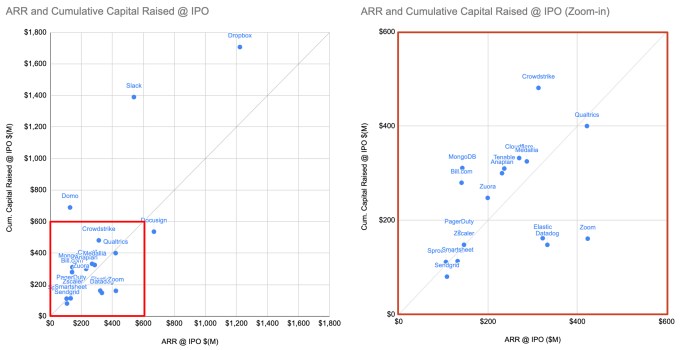
Here is a scatterplot of the ARR and cumulative capital raised at the time each company went public. Most companies are clustered close to the diagonal line that represents ARR and capital raised matching each other. Total capital raised is often neck-and-neck or slightly higher than ARR.

For example, Zscaler raised $148 million to get to $146 million of ARR at IPO and Sprout Social raised $112 million to get to $106 million of ARR.

It is useful to introduce a metric instead of looking at gross dollars, given the high variance in revenue of the companies in the data set — Sprout Social had $106 million and Dropbox had $1,222 million in ARR, a 10x+ difference. Total capital raised as a multiple of ARR normalizes this variance. Below is a histogram of the distribution of this metric.
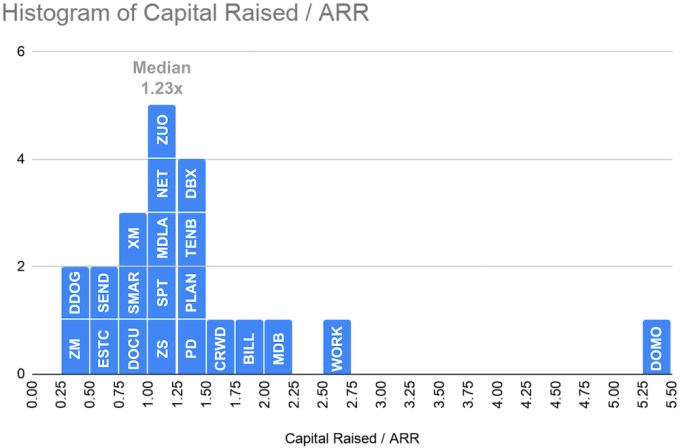
The distribution is concentrated around 1.00x-1.25x, with the median company raising 1.23x of ARR by the time of its IPO.

There are outliers on both ends. Domo is a profligate outlier that had raised $690 million to get to $128 million of ARR, or 5.4x of ARR — no other company comes remotely close. Zoom and Datadog are efficient outliers. Zoom raised $161 million to get to $423 million of ARR and Datadog raised $148 million to get to $333 million of ARR, both representing only 0.4x of ARR.

2. Cash burn is a more accurate measure of capital efficiency and may diverge significantly from capital raised (depending on the company)

How much capital a company raised tells only half of the story of capital efficiency, because many companies are sitting on a significant cash balance. For example, PagerDuty raised a total of $174 million but had $128 million of cash left when it went public. As another example, Slack raised a total of $1,390 million prior to going public but had $841 million of unspent cash.

Why do some SaaS companies end up seemingly over-raising capital beyond their immediate cash needs despite the dilution to existing shareholders?

One reason might be that companies are being opportunistic, raising capital far ahead of actual needs when market conditions are favorable.

Another reason may be that VCs that want to meet ownership targets are pushing for larger rounds. For example, a company valued at $400 million pre-money may only need $50 million of cash but could end up taking $100 million from a VC that wants to achieve 20% post-money ownership.

These confounding factors make cash burn — calculated by subtracting the cash balance from total capital raised4 — a more accurate measure of capital efficiency than total capital raised. Here is a distribution of total cash burn as a multiple of ARR.
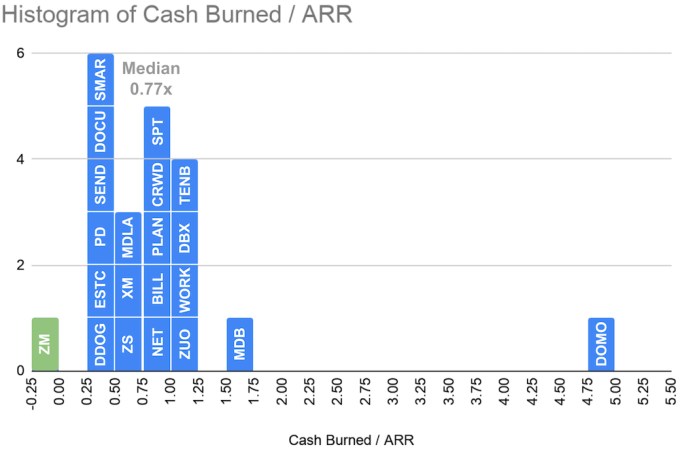
Remarkably, Zoom achieved negative cash burn, meaning Zoom went public with more cash on its balance sheet than all of the capital it raised.

The median company’s cash burn at IPO was 0.77x of ARR, quite a bit less than the total capital raised of 1.23x of ARR.

3. The healthiest SaaS companies (as measured by the Rule of 40) are often the most capital-efficient

The Rule of 40 is a popular heuristic to gauge the business health of a SaaS company. It asserts that a healthy SaaS company’s revenue growth rate and profit margins should sum to 40%+. The below chart shows how the 21 companies score on the Rule of 405.
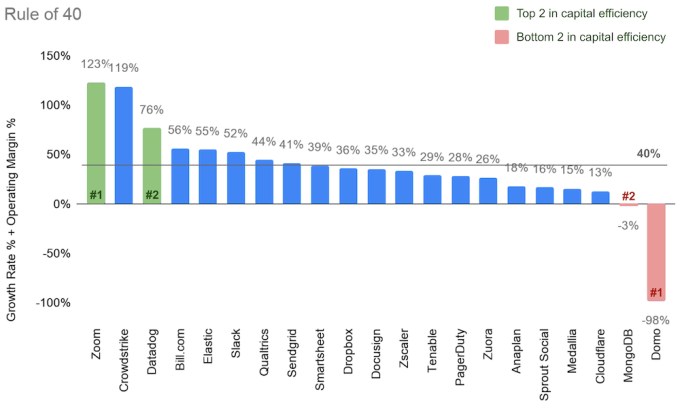
Among the 21 companies, eight companies exceed the 40% threshold: Zoom (123%), Crowdstrike (119%), Datadog (76%), Bill.com (56%), Elastic (55%), Slack (52%), Qualtrics (44%) and SendGrid (41%).

Interestingly, the same outliers in terms of capital efficiency as measured by cash burn, on both extremes, are the same outliers in the Rule of 40. Zoom and Datadog, which have the highest capital efficiency, score the highest and third highest on the Rule of 40. And inversely, Domo and MongoDB, which have the lowest capital efficiency, also score lowest on the Rule of 40.

This is not surprising, because the Rule and capital efficiency are really two sides of the same coin. If a company can sustain high growth without sacrificing profit margins too much (i.e. score high on the Rule of 40), it will over time naturally end up burning less cash compared to peers.

Conclusion

To apply all of this to your favorite SaaS business, here are some questions to consider. What is the total capital raised in multiples of ARR? What is the total cash burn in multiples of ARR? Where does it stack compared to the 21 companies above? Is it closer to Zoom or Domo? How does it score on the Rule of 40? Does it help explain the company’s capital efficiency or lack thereof?

Thanks to Elad Gil and Denton Xu for reviewing drafts of this article.

Endnotes

1Only includes U.S.-based, VC-backed SaaS companies. Includes Quatrics, even though it did not go public, as it was acquired right before its scheduled IPO.

2Includes institutional investments prior to the IPO. Does not include founders’ personal capital investment.

3Note that this is not annual recurring revenue, which is not a reporting requirement for public companies. Annual run-rate revenue is calculated by annualizing quarterly revenue (multiplying by four). The two metrics will track closely for SaaS businesses, given that SaaS revenue is predominantly recurring software subscriptions.

4This is a simplified definition as it will capture non-operational uses of cash such as share repurchase from founders.

5Revenue growth is calculated as the growth rate of the revenue during the last 12 months (LTM) over the revenue during the 12 months prior to that. Profit margins are non-GAAP operating margins, calculated as operating income plus stock-based compensation expense divided by revenue over the last 12 months (LTM).

What’s the right pace for raising capital?

Shin Kim
Contributor

Shin Kim is working on a new SaaS startup and is also chief of staff to entrepreneur Elad Gil . Previously, Shin was at Oak Hill Capital and J.P. Morgan and earned a Master’s in EECS (data science) from UC Berkeley.
More posts by this contributor

A common question in the minds of many SaaS founders is the pace of raising capital. How much is too much too early? What amount of capital raise is typical for comparable peers? How capital-efficient are the best-in-class companies?

In the last 30 months (2017 2H onwards), a total of 21 SaaS U.S.-based, VC-backed companies have gone public, including Zoom, Slack, Datadog and others1. To answer the above questions, I analyzed all 21 companies to understand their fundraising and revenue-generating trajectories.

The charts below show each company’s annual run-rate revenue (ARR)2 and cumulative equity funding3 over time. Read endnotes for details on data source4 and methodology5. The backup for the full analysis can be accessed here.

I divided the companies into four patterns:

An adult sexting site exposed thousands of models’ passports and driver’s licenses

A popular sexting website has exposed thousands of photo IDs belonging to models and sex workers who earn commissions from the site.

SextPanther, an Arizona-based adult site, stored more than 11,000 identity documents on an exposed Amazon Web Services (AWS) storage bucket, including passports, driver’s licenses and Social Security numbers, without a password. The company says on its website that it uses these documents to verify the ages of models with whom users communicate.

Most of the exposed identity documents contain personal information, such as names, home addresses, dates of birth, biometrics and their photos.

Although most of the data came from models in the U.S., some of the documents were supplied by workers in Canada, India and the United Kingdom.

The site allows models and sex workers to earn money by exchanging with paying users text messages, photos and videos, including explicit and nude content. The exposed storage bucket also contained more than 100,000 photos and videos sent and received by the workers.

It was not immediately clear who owned the storage bucket. TechCrunch asked U.K.-based penetration testing company Fidus Information Security, which has experience in discovering and identifying exposed data, to help.

Researchers at Fidus quickly found evidence suggesting the exposed data could belong to SextPanther.

An hour after we alerted the site’s operator, Alexander Guizzetti, to the exposed data, the storage bucket was pulled offline.

“We have passed this on to our security and legal teams to investigate further. We take accusations like this very seriously,” Guizzetti said in an email, who did not explicitly confirm the bucket belonged to his company.

Using information from identity documents matched against public records, we contacted several models whose information was exposed by the security lapse.

“I’m sure I sent it to them,” said one model, referring to her driver’s license, which was exposed. (We agreed to withhold her name given the sensitivity of the data.) We passed along a photo of her license found in the exposed bucket. She confirmed it was her license, but said that the information on her license is no longer current.

“I truly feel awful for others whom have signed up with their legit information,” she said.

The security lapse comes a week after researchers found a similar cache of highly sensitive personal information of sex workers on adult webcam streaming site, PussyCash.

More than 850,000 documents were insecurely stored in another unprotected storage bucket.

Read more:


Got a tip? You can send tips securely over Signal and WhatsApp to +1 646-755–8849.

The App Store is down [Update: It’s back]

[Update: The App Store has returned. Back to your regularly scheduled Fridays.]

Midday on Friday it appeared that Apple’s App Store, a critical piece of the digital and mobile economies, struggled with uptime issues. Apple’s own status page indicated that the application vendor was having an “ongoing” issue that affected “some users.”

The company said that it was investigating the issue, according to its website.

Users weren’t pleased. A quick Twitter search shows a host of complaints from users noting that they can’t make purchases on the App Store, were struggling with sign-on issues and that downloads had ground to a halt.

Despite launching after the original iPhone, the App Store has become an industry to itself. According to certain data, the App Store drove $50 billion gross sales in 2019 — Apple takes a cut of transactions and sales, generating material revenue for itself.

The App Store will come back, but Apple is losing money along with its developer partners as we speak. More when it’s back. Until then, well, there’s Android or a walk.

Goldman Sachs’ new board member diversity rule misses the mark

Goldman Sachs CEO David Solomon recently said the investment bank won’t take companies public that don’t have at least one board member from an underrepresented group. The main focus will be on female board members, he told CNBC, because companies that have gone public in the last four years with at least one woman on their board of directors performed “significantly better” than those without. The new rule is set to go into effect in the U.S. and Europe on July 1.

While the move is significant, what Solomon and Goldman are doing is not a novel idea, nor is it the best version of an outdated idea. It reminds me of something Salesforce CEO Marc Benioff said a few years ago at Dreamforce:

Overall, diversity is extremely important to us. Right now, this is the major issue [gesturing to the room/crowd]. I think when we feel like we’ve got this, you know, a little bit more under control, then I think that one is gonna surface as the major thing we’re focusing on. We’re not ignoring it, it’s something that we support, it’s something that we’re working on, but this is our major focus right now, is the women’s issue.

At the time, Benioff failed to address the complexity of diversity, which is what Goldman Sachs is doing. A “focus on women” does not take into account the intersectional identities many people have. And it’s those intersectional identities — whether it’s being a black woman, a trans man and so forth — that bring both intellectual and financial value to the table. By focusing on women, as Solomon said, Goldman Sachs is setting itself up to exclude women of color, as they are oftentimes left out of women-focused initiatives. This outdated and misguided strategy, where diversity equals more (white) women, needs to be squashed.

While this requirement will likely increase returns for Goldman Sachs and operate as a forcing function to boost diversity at startups, it needs to go further. By focusing on a broader definition of diversity, Goldman Sachs could be more inclusive and make its returns even greater.

Early-bird savings end next Friday on tickets to Robotics+AI 2020

TechCrunch Sessions: Robotics+AI 2020 is gearing up to be one amazing show. This annual day-long event draws the brightest minds and makers from these two industries — 1,500 attendees last year alone. And if you really want to make 2020 a game-changing year, grab yourself an early-bird ticket and save $150 on tickets before prices go up after January 31.

Not convinced yet? Check out some agenda highlights featuring some of today’s leading robotics and AI leaders:

  • Saving Humanity from AI with Stuart Russell (UC Berkeley)
    The UC Berkeley professor and AI authority argues in his acclaimed new book, “Human Compatible,” that AI will doom humanity unless technologists fundamentally reform how they build AI algorithms.
  • Automating Amazon with Tye Brady (Amazon Robotics)
    Amazon Robotics’ chief technology officer will discuss how the company is using the latest in robotics and AI to optimize its massive logistics. He’ll also discuss the future of warehouse automation and how humans and robots share a work space.
  • Engineering for the Red Planet with Lucy Condakchian (Maxar Technologies)
    Maxar Technologies has been involved with U.S. space efforts for decades, and is about to send its sixth (!) robotic arm to Mars aboard NASA’s Mars 2020 rover. Lucy Condakchian is general manager of robotics at Maxar and will speak to the difficulty and exhilaration of designing robotics for use in the harsh environments of space and other planets.
  • Toward a Driverless Future with Anca Dragan (Waymo/UC Berkeley) and Jur van den Berg (Ike)
    Autonomous driving is set to be one of the biggest categories for robotics and AI. But there are plenty of roadblocks standing in its way. Experts will discuss how we get there from here. 

See the full agenda here.

If you’re a startup, nab one of the five demo tables left and showcase your company to new customers, press, and potential investors. Demo tables run $2,200 and come with four attendee tickets so you can divide and conquer the networking scene at the conference.

Students, get your super-reduced $50 ticket here and learn from some of the biggest names in the biz and meet your future employer or internship opportunity.

Don’t forget, the early-bird ticket sale ends on January 31. After that, prices go up by $150. Purchase your tickets here and save an additional 18% when you book a group of four or more.

Vivo beats Samsung for 2nd spot in Indian smartphone market

Samsung, which once led the smartphone market in India, slid to the third position in the quarter that ended in December, even as the South Korean giant continues to make major bets on the rare handset market that is still growing. 158 million smartphones shipped in India in 2019, up from 145 million the year before, according to research firm Counterpoint.

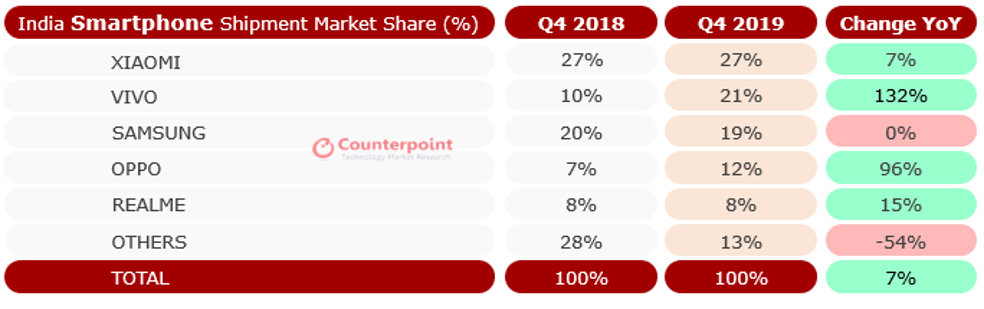
Chinese firm Vivo surpassed Samsung to become the second biggest smartphone vendor in India in Q4 2019. Xiaomi, with command over 27% of the market, maintained its top spot in the nation for the tenth consecutive quarter.

Vivo’s annual smartphone shipment grew 76% in 2019. The Chinese firm’s aggressive positioning of its budget S series of smartphones — priced between $100 to $150 (the sweet spot in India) — in the brick and mortar market and acceptance of e-commerce sales helped it beat Samsung, said Counterpoint analysts.

Vivo’s market share jumped 132% between Q4 of 2018 and Q4 of 2019, according to the research firm.

Realme, which spun out of Chinese smartphone maker Oppo, claimed the fifth spot. Oppo assumed the fourth position.

Samsung has dramatically lowered prices of some of its handsets in the country and also introduced smartphones with local features, but it is struggling to compete with an army of Chinese smartphone makers. The company did not respond to a request for comment.

Realme has taken the Indian market by storm. The two-year-old firm has replicated Xiaomi’s playbook in the country and so far focused on selling aggressively low-cost Android smartphones online.

Vivo and Oppo, on the other hand, have over the years expanded to smaller cities and towns in the country and inked deals with merchants. The companies have offered merchants fat commission to incentivize them to promote their handsets over those of the rivals.

Xiaomi, which entered India six years ago, sold handsets exclusively through online channels to cut overhead, but has since established presence in about 10,000 brick and mortar stores (including some through partnership with big retail chains). The company said in September last year that it had shipped 100 million smartphones in the country.

India surpasses the U.S.

The report, released late Friday (local time), also states that India, with 158 million smartphone shipments in 2019, took over the U.S. in annual smartphone shipment for the first time.

India, which was already the world’s second largest smartphone market for total handset install base, is now also the second largest market for annual shipment of smartphones.

Tarun Pathak, a senior analyst at Counterpoint, told TechCrunch that about 150 million to 155 million smartphone units were shipped in the U.S. in 2019.

As smartphone shipments decline in most countries, India has emerged as a rare market where people are still showing great appetite for new handsets. There are nearly half a billion smartphones in use in the country today — but more than half a billion people in the nation are yet to get one.

The nation’s slowing economy, however, is understandably making its mark on the smartphone market as well. The Indian smartphone market grew by 8.9% last year, compared to 10% in the previous year.

Facebook’s dodgy defaults face more scrutiny in Europe

Italy’s Competition and Markets Authority has launched proceedings against Facebook for failing to fully inform users about the commercial uses it makes of their data.

At the same time, a German court has today upheld a consumer group’s right to challenge the tech giant over data and privacy issues in the national courts.

Lack of transparency

The Italian authority’s action, which could result in a fine of €5 million for Facebook, follows an earlier decision by the regulator, in November 2018 — when it found the company had not been dealing plainly with users about the underlying value exchange involved in signing up to the “free” service, and fined Facebook €5 million for failing to properly inform users how their information would be used commercially.

In a press notice about its latest action, the watchdog notes Facebook has removed a claim from its homepage — which had stated that the service “is free and always will be” — but finds users are still not being informed, “with clarity and immediacy” about how the tech giant monetizes their data.

The Authority had prohibited Facebook from continuing what it dubs “deceptive practice” and ordered it to publish an amending declaration on its homepage in Italy, as well as on the Facebook app and on the personal page of each registered Italian user.

In a statement responding to the watchdog’s latest action, a Facebook spokesperson told us:

We are reviewing the Authority decision. We made changes last year — including to our Terms of Service — to further clarify how Facebook makes money. These changes were part of our ongoing commitment to give people more transparency and control over their information.

Last year Italy’s data protection agency also fined Facebook $1.1 million — in that case for privacy violations attached to the Cambridge Analytics data misuse scandal.

Dodgy defaults

In separate but related news, a ruling by a German court today found that Facebook can continue to use the advertising slogan that its service is “free and always will be” — on the grounds that it does not require users to hand over monetary payments in exchange for using the service.

A local consumer rights group, vzbv, had sought to challenge Facebook’s use of the slogan — arguing it’s misleading, given the platform’s harvesting of user data for targeted ads. But the court disagreed.

However, that was only one of a number of data protection complaints filed by the group — 26 in all. And the Berlin court found in its favor on a number of other fronts.

Significantly, vzbv has won the right to bring data protection-related legal challenges within Germany even with the pan-EU General Data Protection Regulation in force — opening the door to strategic litigation by consumer advocacy bodies and privacy rights groups in what is a very pro-privacy market.

This looks interesting because one of Facebook’s favored legal arguments in a bid to derail privacy challenges at an EU Member State level has been to argue those courts lack jurisdiction — given that its European HQ is sited in Ireland (and GDPR includes provision for a one-stop shop mechanism that pushes cross-border complaints to a lead regulator).

But this ruling looks like it will make it tougher for Facebook to funnel all data and privacy complaints via the heavily backlogged Irish regulator — which has, for example, been sitting on a GDPR complaint over forced consent by adtech giants (including Facebook) since May 2018.

The Berlin court also agreed with vzbv’s argument that Facebook’s privacy settings and T&Cs violate laws around consent — such as a location service being already activated in the Facebook mobile app; and a pre-ticked setting that made users’ profiles indexable by search engines by default

The court also agreed that certain pre-formulated conditions in Facebook’s T&C do not meet the required legal standard — such as a requirement that users agree to their name and profile picture being used “for commercial, sponsored or related content,” and another stipulation that users agree in advance to all future changes to the policy.

Commenting in a statement, Heiko Dünkel from the law enforcement team at vzbv, said: “It is not the first time that Facebook has been convicted of careless handling of its users’ data. The Chamber of Justice has made it clear that consumer advice centers can take action against violations of the GDPR.”

We’ve reached out to Facebook for a response.

Sonos clarifies how unsupported devices will be treated

Smart speaker manufacturer Sonos clarified its stance when it comes to old devices that are no longer supported. The company faced some criticisms after its original announcement. Sonos now says that you’ll be able to create two separate Sonos systems so that your newer devices stay up to date.

If you use a Zone Player, Connect, first-generation Play:5, CR200, Bridge or pre-2015 Connect:Amp, Sonos is still going to drop support for those devices. According to the company, those devices have reached their technical limits when it comes to memory and processing power.

While nothing lasts forever, it’s still a shame that speakers that work perfectly fine are going to get worse over time. For instance, if Spotify and Apple Music update their application programming interface in the future, your devices could stop working with those services altogether.

But the announcement felt even more insulting as the company originally said that your entire ecosystem of Sonos devices would stop receiving updates so that all your devices remain on the same firmware version. Even if you just bought a Sonos One, it would stop receiving updates if there’s an old speaker on your network.

“We are working on a way to split your system so that modern products work together and get the latest features, while legacy products work together and remain in their current state,” the company writes.

It’s not ideal, but the company is no longer holding your Sonos system back. Sonos also clarifies that old devices will still receive security updates and bug fixes — but there won’t be any new features.

I still think Sonos should add a computing card slot to its devices. This way, you wouldn’t have to replace speakers altogether. You could get a new computing card with more memory and faster processors and swap your existing card. Modularity is going to be essential if tech companies want to adopt a more environmentally friendly stance.

As SaaS stocks set new records, Atlassian’s earnings show there’s still room to grow

Hello and welcome back to our regular morning look at private companies, public markets and the gray space in between.

SaaS stocks had a good run in late 2019. TechCrunch covered their ascent, a recovery from early-year doldrums and a summer slowdown. In 2020 so far, SaaS and cloud stocks have surged to all-time highs. The latest records are only a hair higher than what the same companies saw in July of last year, but they represent a return to form all the same.

Given that public SaaS companies have now managed to crest their prior highs and have been rewarded for doing so with several days of flat trading, you might think that there isn’t much room left for them to rise. Not so, at least according to Atlassian . The well-known software company reported earnings after-hours yesterday and the market quickly pushed its shares up by more than 10%.

Why? It’s worth understanding, because if we know why Atlassian is suddenly worth lots more, we’ll better grok what investors — public and private — are hunting for in SaaS companies and how much more room they may have to rise.

Cruise unveils Origin, an electric driverless vehicle designed for sharing

Cruise unveiled Tuesday evening a “production ready” driverless vehicle called Origin, the product of a multi-year collaboration with parent company GM and investor Honda that is designed for a ride-sharing service.

The shuttle-like vehicle — branded with Cruise’s trademark orange and black colors — has no steering wheel or pedals and is designed to travel at highway speeds. The interior is roomy with seats that face each other, similar to what a traveler might find on some trains. Each seat is meant to accommodate the needs of an individual with personal USB ports, CTO and co-founder Kyle Vogt noted during the presentation. Digital displays are located above, presumably to give travelers information about their rides.

The doors don’t hinge outward, Vogt added. Instead, he said, “they slide open, so bikers are safer.”

Splashy looks aside, the Origin is meant to show Cruise’s muscle and intent to deploy an autonomous ride-sharing service at scale. What and when and how that will happen are the important questions left unanswered.

cruise inside

CEO Dan Ammann stressed that the vehicle is not a concept, but instead is a production vehicle that the company intends to use for a ride-sharing service.

However, don’t expect the Origin to be on public roads anytime soon. The driverless vehicle doesn’t meet U.S. federal regulations known as FMVSS, which specify design, construction, performance and durability requirements for motor vehicles.

For now, the Origin will be used on private, closed environments such as GM facilities in Michigan or even Honda’s campus outside of the U.S, Ammann said in an interview after the presentation.

Cruise Origin

Cruise unveiled Tuesday Origin, a driverless shuttle designed for ride-sharing.

Ammann also emphasized the low cost of the vehicle, which he added is designed to operate 1 million miles.

“We’ve been just as obsessed with making the Origin experience as inexpensive as possible,” Ammann said while on stage.Because if we’re really serious about improving life, and our cities, we need huge numbers of people to use the Cruise origin. And that won’t happen unless we deliver on a very simple proposition, a better experience at a lower price than what you pay to get around today.”

GM will manufacture the vehicle, although Ammann wouldn’t provide more details on where except to say “you’ll find out in a couple of days.” He did say that the vehicle will be produced “for roughly half the cost of what a conventional electric SUV costs today.”

The reveal offered more clues about Cruise’s hardware development, which has been growing in the past 18 months under the leadership of its vice president of hardware Carl Jenkins and Brendan Hermalyn, director of autonomous hardware systems.

The vehicle is outfitted with what Vogt called an “owl,” a hybrid sensor assembly that seems to combine camera and radar.

Still, there remains a number of questions from when and where the Origin will deploy to what Ammann means by manufacture at “scale,” and what rides will cost.

Goldman Sachs’s CEO just called WeWork’s pulled IPO — which Goldman was underwriting — proof that the market works

It’s hard to put a positive spin on terrible situation, but that didn’t stop Goldman Sachs CEO David Solomon earlier today. Asked during a session at the World Economic Forum in Davos about WeWork’s yanked IPO in September,  Solomon suggested it was proof that the listing process works, despite that the CFO of Goldman — one of the offering’s underwriters — disclosed last fall that the pulled deal cost the bank a whopping $80 million.

Reuters was on the scene, reporting that Solomon acknowledged the process was “not as pretty as everybody would like it to be,” while also eschewing any responsibility, telling those gathered that the “banks were not valuing [WeWork]. Banks give you a model. You say to the company, ‘Well, if you can prove to us that the model actually does what it does, then it’s possible that the company is worth this in the public markets,’” Solomon said.

Investment banks had reportedly courted WeWork’s business by discussing a variety of figures that led cofounder Adam Neumann to overestimate how it might be received by public market shareholders. According to the New York Times, in 2018, JPMorgan was telling Neumann that it could find buyers to value the company at more than $60 billion; while Goldman Sachs said $90 billion was a possibility, and Morgan Stanley — which has been assigned as lead underwriter of many of the buzziest tech offerings over the last decade — reportedly posited that even more than $100 billion was possible.

Ultimately, the IPO was canceled several weeks after Neumann was asked to resign and WeWork’s biggest investor, SoftBank — which itself nearly tripled the company’s private market valuation across funding rounds — stepped in to rescue its (at least) $18.5 billion investment in the company.

Solomon isn’t the only one defending some of the often cofounding logic of IPO pricing. This editor sat down in November with Morgan Stanley’s head tech banker Michael Grimes, who has been called “Wall Street’s Silicon Valley whisperer” for landing a seemingly endless string of coveted deals for the bank.

Because Morgan Stanley pulled out of the process of underwriting WeWork’s IPO (reportedly after WeWork rejected its pitch to be the company’s lead underwriter), we talked with Grimes instead about Uber, whose offering last year Morgan Stanley did lead. We asked how Uber could have been reportedly told by investment bankers that its valuation might be as high as $120 billion in an IPO when, as we now know, public market shareholders deemed it worth far less. (Its current market cap is roughly half that amount, at $64 billion.)

Grimes said matter-of-factly that price estimates can routinely be all over the place, explaining that “if you look at how companies are valued, at any given point of time right now, public companies with growth prospects and margins that are not yet at their mature margin, I think you’ll find on average price targets by either analysts who work at banks or buy-side investors that can be 100%, 200% and 300% different from low to high.”

He called that a “typical spread.”

The reason, he said, had to do with each bank’s or analyst’s guess at “penetration.”

“Let’s say, what, 100 million people or so [worldwide] have have been monthly active users of Uber,” said Grimes during our sit-down. “What percentage of the population is that? Less than 1% or something. Is that 1% going to be  2%, 3%, 6%, 10%, 20%? Half a percent, because people stop using it and turn instead to some flying [taxi]?

“So if you take all those variable, possible outcomes, you get huge variability in outcome. So it’s easy to say that everything should trade the same every day, but [look at what happened with Google]. You have some people saying maybe that is an outcome that can happen here for companies, or maybe it won’t. Maybe they’ll [hit their] saturation [point] or face new competitors.”

Grimes then turned the tables on reporters and others in the industry who wonder how banks could get the numbers so wrong, with Uber but also with a lot of other companies. “It’s really easy to be a pundit and say, ‘It should be higher’ or ‘It should be lower,’” Grimes said. “But investors are making decisions about that every day.”

Besides, he added, “We think our job is to be realistically optimistic” about where things will land. “If tech stops changing everything and software stops eating the world, there probably would be less of an optimistic bias.”

Female Founders Alliance absorbs Monarq accelerator to better promote women and non-binary founders

Seattle’s Female Founders Alliance, which runs the Ready Set Raise accelerator for women and non-binary founders, has acquired New York’s Monarq, an incubator with similar goals and origins. The latter will be integrated into the former, but it seems to be a happy collaboration rather than a consolidation of necessity.

Monarq was founded three years ago by Irene Ryabaya and Diana Murakhovskaya, and 32 companies have gone through its process. FFA has accepted half that number into its program as of the second cohort, with a third underway for 2020. I covered graduate Give InKind in November when it raised a $1.5 million seed round.

“Monarq and FFA share a common sponsor that introduced us years ago, and we’ve been connected and supportive of each other since,” explained FFA CEO Leslie Feinzaig to TechCrunch. “This year, Diana and Irena’s side gigs started to take off — Diana raised a $20 million VC fund, and Irena’s startup, WarmIntro, started signing up substantial customers. It made strategic sense for FFA to solidify our national expansion and strengthen our network of investors and mentors that are East Coast based.”

Ryabaya and Murakhovskaya will be focusing on The Artemis Fund and WarmIntro respectively, and Monarq’s accelerator will be tucked into the Ready Set Raise brand. The merge will create what FFA claims is the country’s largest network of female and non-binary industry folks, which should prove an asset for those in the program.

It’s possible to see this as consolidation within a specialized branch of the startup industry, but Feinzaig said business is booming.

“The market for women’s leadership is absolutely growing, and creating a lot of opportunities in the process,” she said. “What’s different now is that there is a recognition that this is good business, not a charitable cause.”

The FFA’s stated goal of gender parity among founders only grows more achievable with increased reach. It may be that the increased scale also improves results in an already impressive portfolio.