The World Health Organization declared the China outbreak an international threat, raising questions about many countries’ health infrastructure.
Category: Tech news
hacking,system security,protection against hackers,tech-news,gadgets,gaming
CalTech scores massive $1.1B verdict against Apple and Broadcom in patent case
After a years-long legal battle, a judge ordered Apple and Broadcom to pay a combined $1.1 billion in a patent infringement case with the California Institute of Technology, Bloomberg reports. The report states that Apple was ordered to pay $837.8 million and Broadcom is looking at a $270.2 million verdict.
Apple has been ensnared in legal proceedings over the past several years regarding the technologies in the company’s wireless chipsets. Last year, the company settled a long-standing dispute with Qualcomm regarding the royalty payments.
CalTech’s suit was filed in federal court in Los Angeles in 2016, and alleged that hundreds of millions of Apple’s devices with Broadcom Wi-Fi chips infringed on their patents. Broadcom supplies wireless chips for a variety of Apple products, including the iPhone.
“We are pleased the jury found that Apple and Broadcom infringed Caltech patents,” CalTech said in a statement. “As a non-profit institution of higher education, Caltech is committed to protecting its intellectual property in furtherance of its mission to expand human knowledge and benefit society through research integrated with education.”
Bloomberg reported that this was the 6th largest patent-related verdict ever. Naturally, both Apple and Broadcom have voiced that they plan to appeal the ruling.
Former BET Networks CEO Debra Lee hints at launching a tech fund to back women of color
In May 2018, after spending more than 30 years at BET Networks, Debra Lee stepped down as chairman and CEO, following a series of reorganizations within Viacom cable networks.
But Lee, who also oversaw the launch of the first network for black women (BET Her) and the related invite-only annual women’s conference Leading Women Defined, has hardly retired from public view. On the contrary, she remains an active and vocal proponent for all women, and women of color particularly, and at the Upfront Summit in Pasadena, Calif., yesterday, Lee used a speaking opportunity to applaud a new IPO diversity initiative announced by Goldman Sachs last week — and to hint at a new investment fund that would support women founders of color in tech.
Lee was first asked by reporter Julia Boorstin about California’s mandate that boards of directors overseeing public companies include women — a law that passed in late 2018 and that is reportedly catching fire as lawmakers in numerous other states consider similar mandates. Boorstin then asked about Goldman Sachs’s announcement from Davos last week that beginning in July, it won’t take public any company that doesn’t have at least one “diverse” board member, with a particular focus on women.
It’s a bigger deal than some might imagine. The initiative would have cost Goldman up to $101 million in underwriting fees from as many as 18 U.S. IPOs had the policy been effective in 2019, according to a new analysis by Bloomberg Law. That’s roughly one-third of the $318.68 million that Goldman earned in advisory fees from the 59 U.S. IPOs it underwrote last year.
“I mean, we’ve been talking about this for so long that I understand why they did it,” answered Lee. “I think [both initiatives] are a good thing, because the companies aren’t going to do it,” she said. “We’ve been talking about it for 30 years, and for a company to have a board now with no women or no people of color, they should be truly embarrassed. But there’s still a lot out there . . . it’s sad to see that we have to implement either, you know — California, Goldman — but we really have to hold these companies’ feet to the fire.”
Having diversity on the board can have more impact than some appreciate, said Lee, when asked about the ripple effect that boards can have in terms of impacting companies’ policies. She first referenced her work with the Time’s Up organization, saying that “all the issues that Time’s Up was investigating — the harassment, revenge, retribution, women being harassed — those things can’t happen if you have women in decision-making roles. You can’t have a ‘casting couch’ if you have women in the C suite at the studios, [or at least] it’s less likely [than] if men have all the power and can do whatever they want.”
Lee also emphasized that when companies have “diverse people on your board, they’re going to hold you accountable. I’m not going to sit in a boardroom where I’m the only black woman, and not ask why there isn’t another black woman, or why there aren’t other people of color.”
Lee spent three years on the board of Twitter, for example, and was a director at Eastman Kodak years earlier. In both places, she sat on nominating committees where she said she expected to see a diverse slate of candidates when it came to roles that needed to be filled. In fact, she said, she “didn’t hire a search firm that was trying to get Twitter’s business because they told me there were no black CEOs. I’m like, ‘Don’t you know [former Amex CEO] Ken Chenault? Don’t know you [current Merck CEO Ken Frazier]? I’m just naming people off the top of my head . . .”
“Once you have one person in the room or a couple of people, you can hold the company’s feet to the fire,” Lee continued. “When issues come up, you can make sure they’re dealt with in a more equal way. If it’s a discrimination suit or a harassment suit, you can ensure that those kind of things aren’t swept under the rug. So boards are really important. It’s not only to oversee strategy and financials and all of that, but also succession planning. One of the questions I ask on the boards all the time is, ‘What do the people coming behind the CEO look like? Are there women? Are there people of color? . . . You gotta tell me who they are and what they look like so I can ensure that it’s going to be a diverse group that’s ready to take over.”
Lee separately talked about her annual conference, where she brings together prominent women of color to talk about “everything from what’s going on in Haiti, to getting out the vote, to elder care and financial planning, to how do we raise our black boys.” (Michelle Obama has attended twice.)
Crucially, she noted, she tries to pair up women who know each other and who nominate other women, which has turned the affair “into something much more important than I ever thought.”
It may also give her fuel for her next act. After noting that a “couple of businesses have even come out of the conference,” she suggested that she and others of her powerful friends are talking currently about creating a fund that would support women of color in tech.
Undoubtedly, there’s a need for it. While U.S. venture funds poured more capital than ever into female-founded startups last year, it was still a small fraction of the overall dollars raised by companies — $3.3 billion, or 2.8% of capital invested across the entire U.S. startup ecosystem. And a far smaller fraction of that already tiny percentage was raised by women of color.
Peering into the audience of largely investors at the event yesterday, Boorstin joked with her from the stage, “So if you do create a fund, perhaps there’s some potential LPs [you could talk with here].”
“I would love that,” said Lee. “If you all know of anyone . . .
Why Sony’s PlayStation Vue failed
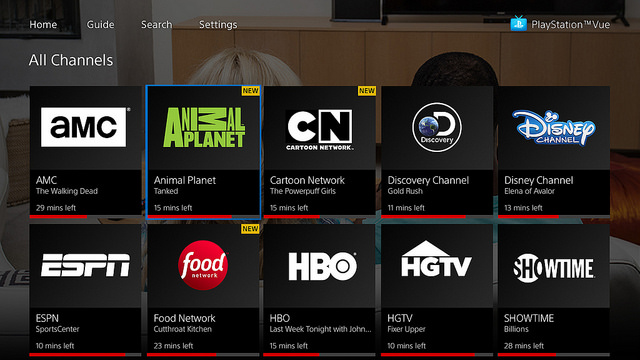
Sony’s PlayStation Vue, one of the first services to offer streaming live TV over the internet, is shutting down today. The service launched in March 2015, offering live and on-demand content from more than 85 channels, including many local broadcast stations, to select U.S. markets. Over the years, Vue expanded across the U.S. as it added more channels, more local stations and features like multi-channel viewing on the same screen, among other innovations.
But Vue failed to catch on with a broader audience, despite — or perhaps, because of — its integration with Sony’s PS3 and PS4 devices.
Sony’s decision to name the service “PlayStation Vue” didn’t do it any favors from a branding perspective. Many consumers, if they heard of it at all, assumed it was something only available to PlayStation console owners.
The company also took too long to expand the service to include popular platforms many cord-cutters were using at the time to watch streaming services. It added support for Amazon Fire TV by November 2015, but full support for Google Chromecast, as well as Apple TV and Roku — the latter of which grew to become the most popular connected TV platform in the U.S. — didn’t arrive until the following year. That limited Vue’s availability at a time when people were beginning to look for new streaming options.
The Fractured Future of Browser Privacy
Better anti-tracking measures have become the norm for Chrome, Firefox, Safari, and other modern browsers. But they still disagree on how exactly they should work.
Ring’s new security ‘control center’ isn’t nearly enough
On the same day that a Mississippi family is suing Amazon -owned smart camera maker Ring for not doing enough to prevent hackers from spying on their kids, the company has rolled out its previously announced “control center,” which it hopes will make you forget about its verifiably “awful” security practices.
In a blog post out Thursday, Ring said the new “control center,” “empowers” customers to manage their security and privacy settings.
Ring users can check to see if they’ve enabled two-factor authentication, add and remove users from the account, see which third-party services can access their Ring cameras and opt-out of allowing police to access their video recordings without the user’s consent.
But dig deeper and Ring’s latest changes still do practically nothing to change some of its most basic, yet highly criticized security practices.
Questions were raised over these practices months ago after hackers were caught breaking into Ring cameras and remotely watching and speaking to small children. The hackers were using previously compromised email addresses and passwords — a technique known as credential stuffing — to break into the accounts. Some of those credentials, many of which were simple and easy to guess, were later published on the dark web.
Yet, Ring still has not done anything to mitigate this most basic security problem.
TechCrunch ran several passwords through Ring’s sign-up page and found we could enter any easy to guess password, like “12345678” and “password” — which have consistently ranked as some of the most common passwords for several years running.
To combat the problem, Ring said at the time users should enable two-factor authentication, a security feature that adds an additional check to prevent account breaches like password spraying, where hackers use a list of common passwords in an effort to brute force their way into accounts.
But Ring still uses a weak form of two-factor authentication, sending you a code by text message. Text messages are not secure and can be compromised through interception and SIM swapping attacks. Even NIST, the government’s technology standards body, has deprecated support for text message-based two-factor. Experts say although text-based two-factor is better than not using it at all, it’s far less secure than app-based two-factor, where codes are delivered over an encrypted connection to an app on your phone.
Ring said it’ll make its two-factor authentication feature mandatory later this year, but has yet to say if it will ever support app-based two-factor authentication in the future.
The smart camera maker has also faced criticism for its cozy relationship with law enforcement, which has lawmakers concerned and demanding answers.
Ring allows police access to users’ videos without a subpoena or a warrant. (Unlike its parent company Amazon, Ring still does not publish the number of times police demand access to customer videos, with or without a legal request.)
Ring now says its control center will allow users to decide if police can access their videos or not.
But don’t be fooled by Ring’s promise that police “cannot see your video recordings unless you explicitly choose to share them by responding to a specific video request.” Police can still get a search warrant or a court order to obtain your videos, which isn’t particularly difficult if police can show there’s reasonable grounds that it may contain evidence — such as video footage — of a crime.
There’s nothing stopping Ring, or any other smart home maker, from offering a zero-knowledge approach to customer data, where only the user has the encryption keys to access their data. Ring cutting itself (and everyone else) out of the loop would be the only meaningful thing it could do if it truly cares about its users’ security and privacy. The company would have to decide if the trade-off is worth it — true privacy for its users versus losing out on access to user data, which would effectively kill its ongoing cooperation with police departments.
Ring says that security and privacy has “always been our top priority.” But if it’s not willing to work on the basics, its words are little more than empty promises.
Rocket Lab points out that not all rideshare rocket launches are created equal
The commercial rideshare model for spacefaring cargo is increasingly popular, and for good reason: It lowers the cost of launching something to space even further than companies like SpaceX have managed by splitting the available space on a rocket among multiple customers. Last August, SpaceX announced that it would be offering dedicated “rideshare” missions for customers using its Falcon 9 launch vehicle, but at FAA’s Commercial Space Transportation Conference this year, Rocket Lab VP of Global Commercial Launch Services Shane Fleming wanted to remind people that his company still believes their offering is likely the better option for most smallsat operators.
“SpaceX has been around for some time now obviously, but rideshare has not,” explained Fleming during a panel on space startups and VC. “There have been heavy launch vehicles around for quite some time, and small CubeSat customers and microsat customers have always had a challenge getting to orbit because they’re not the top priority. The top priority is a big geosat [geostationary satellite] mission, or national security mission, and those CubeSat customers, or rideshare customers are just hitching a ride essentially, to space, using a bus analogy. So today, customers with those specific smallsat needs haven’t really had the luxury of really tailored, dedicated small launch services like we provide at Rocket Lab.”
SpaceX has said that its smallsat customers taking part in rideshare missions can send payloads of either up to 330 lbs for as little as $2.25 million, or 660 lbs for just $4.5 million, which is a big discount when compared to the cost of a full Falcon 9 launch. Rocket Lab’s base price for a dedicated launch begins at just $5.7 million, and splitting the cost would obviously drop that further still. But Fleming says that price isn’t actually the central issue when comparing the services.
“Whether SpaceX is dropping its prices or not, that service is still relatively the same and SpaceX has a number of priorities — they’re doing human missions, and doing national security missions, and they’re doing Starlink,” Fleming said. “Yes, they are offering rideshare services, but it’s not their business. At Rocket Lab smallsat customers are our number one business, and that’s what we do. We offer very dedicated, tailored service exactly where you want to go, when you want to go, and for a lot of customers that’s really important. And we also offer a lot more orbital inclinations; not everyone wants to go to SSO; there are orbits that are more unique than that where customers need to go in and we fulfill that. So whether they drop their price or not, it’s really a service-backed industry and that’s what we’re supporting.”
Rocket Lab has a lot more activity coming up this year that could help it further differentiate its offerings, including its first Photon mission, which is a new in-house spacecraft the company is developing to offer essentially satellite-as-a-service capabilities to its customers, so that they can focus on just working out the sensor payload or specific mission they want to accomplish, and leave the satellite building to Rocket Lab. It’s also continuing to work on its plan for recovering and reusing its Electron booster stage, and aims to recover its first stage for re-use later this year.
GM is bringing back the Hummer as an electric ‘super truck’ with 1,000 horsepower
GM is bringing back the Hummer in a new electric form. The automaker confirmed Thursday plans to produce an all-electric Hummer with 1,000 horsepower and the ability to accelerate from zero to 60 miles per hour in 3 seconds.
This “super truck,” which GM teased in several videos, will be under its GMC brand. The teasers, one of which is posted below, were released ahead of a 30-second Super Bowl ad for the Hummer called “Quiet Revolution” that will star NBA phenom LeBron James.
All of these videos and the ad will lead into a big reveal scheduled for May 20.
GM isn’t releasing information on the base price of the Hummer. The automaker did share some eye-popping specs, including it will produce the equivalent of 1,000 horsepower, have a 0 to 60 mph acceleration of 3 seconds and 11,500 feet of torque.
“GMC builds premium and capable trucks and SUVs and the GMC HUMMER EV takes this to new heights,” Duncan Aldred, vice president of global Buick and GMC, said in a statement.
The company said the Hummer EV will be produced at its Detroit-Hamtramck assembly plant in Michigan. On Monday, GM announced plans to invest $2.2 billion into its Detroit-Hamtramck assembly plant to produce all-electric trucks and SUVs, as well as a self-driving vehicle unveiled by its subsidiary Cruise. The automaker said it will invest an additional $800 million in supplier tooling and other projects related to the launch of the new electric trucks.
GM will kick off this new program with an all-electric pickup truck that will go into production in late 2021. The Cruise Origin, the electric self-driving shuttle designed for ridesharing, will be the second vehicle to go into production at the Detroit area plant.
Detroit-Hamtramck will be GM’s first fully dedicated electric vehicle assembly plant. When fully operational, the plant will create more than 2,200 jobs, according to GM.
AWS partners with sports leagues to change how we watch games
Since the inception of professional sports, fans have sought statistics about how their favorite teams and players are performing. Until recently, these stats were generated from basic counting, like batting averages, home runs or touchdowns.
Today, sports leagues are looking to learn more about players and find a competitive edge through more advanced stats. Beyond that, they want to engage fans more with tools like AWS NFL’s Next Gen Stats and MLB’s Statcast, software that uses compelling visuals to illustrate statistics like the probability of receiving a catch in the end zone or a runner’s speed between home and first base.
AWS counts Major League Baseball, the National Football League, the German Bundesliga soccer league, NASCAR, Formula 1 racing and Six Countries Rugby among its customers. How, exactly, are advanced cloud technology and machine learning helping change how we watch live sports?
Building on Moneyball


Apple’s redesigned Maps app is available across the US, adds real-time transit for Miami
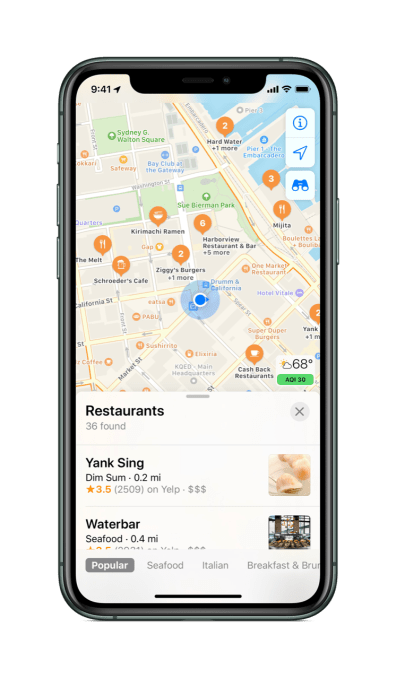
Apple’s updated and more detailed Maps experience has now rolled out across the U.S., the company announced this morning. The redesigned app will include more accurate information overall as well as comprehensive views of roads, buildings, parks, airports, malls and other public places. It will also bring Look Around to more cities and real-time transit to Miami.
The company has now spent years upgrading its Maps experience to better compete with Google Maps, which Apple replaced with its own Maps app in 2012. That launch didn’t go well, to say the least. Apple CEO Tim Cook even had to apologize for how Maps fell short of customers’ expectations and promised Apple would do better going forward.
Over time, Apple has been making good on those promises, by updating Maps with better data and notably, by announcing a ground-up rebuild of the Maps platform back in 2018. Last year, Apple also introduced the new “Look Around” feature in iOS 13 — essentially Apple’s version of Google Street View, but one that uses high-resolution 3D views that offer more detail and smoother transitions.
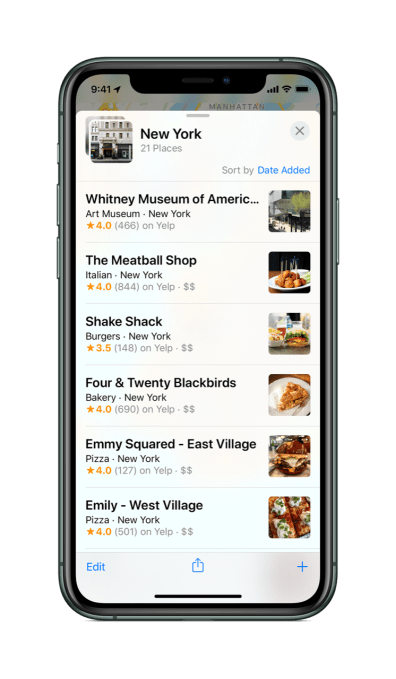
iOS 13 also brought more Maps features, like real-time transit schedules, a list-making feature called Collections, Favorites and more.
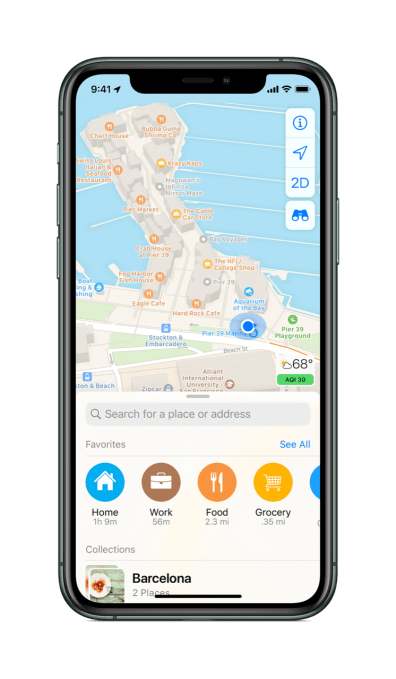
However, some of these Maps updates have been slow to roll out. Look Around, for example, has only been live in major cities, including New York, the San Francisco Bay Area, LA, Las Vegas, Houston and Oahu. With the nationwide launch, it’s safe to assume you’re about to see it pop up in more major metros, though Apple hasn’t provided names of which ones will get it first. Real-time transit information is offered only in select major cities, including the San Francisco Bay Area, Washington, D.C., New York and LA.
Today, Apple is adding Miami to that list of supported cities offering real-time transit, just in time for Super Bowl weekend.
Over the course of 2019, Apple’s improved, more detailed Maps experience has steadily expanded across the U.S., finally arriving in the North East as of last fall.
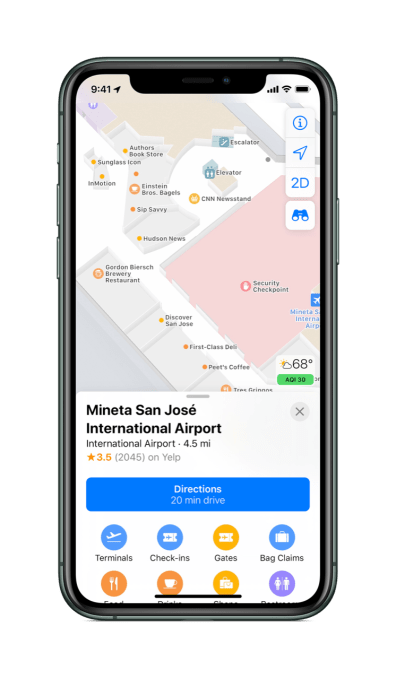
Today, the new Maps experience it’s starting to go live across all of the U.S. But that doesn’t necessarily mean you’ll see it right away when you launch the Maps app — the rollout is phased.
“We set out to create the best and most private maps app on the planet that is reflective of how people explore the world today,” said Eddy Cue, Apple’s senior vice president of Internet Software and Services, in a statement about the launch. “It is an effort we are deeply invested in and required that we rebuild the map from the ground up to reimagine how Maps enhances people’s lives — from navigating to work or school or planning an important vacation — all with privacy at its core. The completion of the new map in the United States and delivering new features like Look Around and Collections are important steps in bringing that vision to life. We look forward to bringing this new map to the rest of the world starting with Europe later this year,” he added.
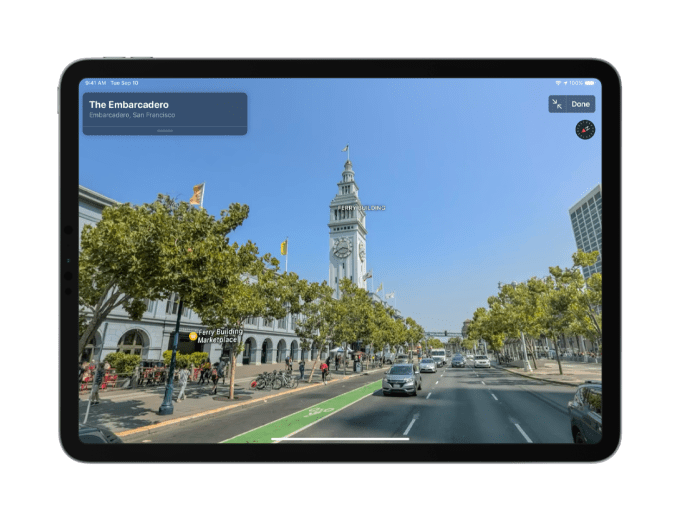 The updated Apple Maps includes Look Around and real-time transit in some markets, Collections, Favorites, a Share ETA feature, flight status information for upcoming travel, indoor maps for malls and airports, Siri natural language guidance and Flyover — a feature offering immersive, 3D views of major metros, as seen from above. The latter is available across more than 350 cities.
Going forward, Apple will use the imagery it collects to deliver Look Around to more U.S. markets and begin to upgrade the Maps platform in Europe.
Maps’ biggest selling point today, however, may not be the sum of its feature sets. Instead, Maps’ standout feature is its focus on privacy.
While Google does use the data collected from Google Maps for many handy features — like reporting on a business’s busiest times, for example — it’s not a private app. In fact, it’s so not private that Google had to add an “incognito mode” as an option for users who didn’t want their Maps app collecting data on them.
Apple, meanwhile, notes that its app requires no-sign in, isn’t connected to your Apple ID and its personalized features are implemented using on-device intelligence, not by sending data to cloud servers. In addition, any data collected when using Maps, like search terms, navigation routing and traffic information, is only associated with random identifiers that continually reset to protect user privacy.
Apple also uses a process called “fuzzing” that converts a precise location where a Maps search originated to a less precise one after 24 hours. And it doesn’t retain a history of what a user has searched for or where they’ve been.
In an era where people assume, usually correctly, that the mere act of launching an app is an agreement to have their data collected, Apple’s increased emphasis on user privacy is welcome and a good reason to try Apple Maps again, if you never came back to it after the shaky launch.
Apple Maps, now used in over 200 countries, is available on iPhone, iPad, Mac, Apple Watch and in cars via CarPlay.
IPO pricing for One Medical and Casper will set the tone for 2020’s unicorn debuts
Hello and welcome back to our regular morning look at private companies, public markets and the gray space in between.
As One Medical looks to become the first venture-backed company to price its IPO in 2020 this afternoon and Casper aims to price its own shares next Wednesday, the market is gearing up for a pair of tests.
If you listen to the Nasdaq and the NYSE, IPO volume in 2020 will prove vibrant. A surprise, perhaps, in the wake of the WeWork meltdown that many had expected might reduce IPO cadence. One Medical and Casper, though, are charging ahead, meaning that their debuts will help set the tone for the 2020 IPO market.
If they struggle with weak pricing and slow initial trading, their disappointing offerings could slow the IPO market. If they price well and are welcomed by the street, however, the opposite.
Let’s take a look at how many IPOs are coming, what One Medical and Casper are hoping for and what their results might mean for unicorn liquidity. Don’t forget that we’re still living in the midst of a unicorn liquidity crisis — there are hundreds of private companies worth $1 billion or more around the world that need an exist, and the market is creating them faster than it can get them out the door. If IPOs stumble in 2020, lots just won’t make it out before the market turns.
An IPO crowd
Yesterday, CNBC reported notes from Nasdaq CEO Adena Friedman and NYSE President Stacey Cunningham, each speaking about their expected IPO cadence in 2020. Friedman said there are “lot of companies looking to tap the public markets in the first half,” implying a strong flow of potential debuts.
With $30 million in fresh funds, The Bouqs plans to plant its flower delivery business in Japan
The Bouqs plans to take a slice of Japan’s $6 billion flower market this year with a $30 million strategic growth round from Japanese enterprise business investor Yamasa. While The Bouqs still must compete with bigger contenders like 1-800-Flowers and FTD in the U.S., it will now have to take on incumbents like Ayoma Flower Market and FloraJapan, both of which also offer same-day delivery throughout the land of the rising sun.
So why Japan? According to The Bouqs founder and CEO John Tabis, his company had been looking to expand internationally for awhile and Japan seemed to fit well within that plan.

The Bouqs CEO and founder John Tabis
But as far as bigger competition in any country, Tabis is undeterred, telling TechCrunch there’s plenty of opportunities in the flower delivery business if you know where to look. “There’ve been four or five other startups that tried something similar — some of them no longer exist,” Tabis said. “But the thing that’s worked for us, the first is the way that we’ve sourced is unique and it’s really the foundation of our brand.”
The Bouqs sprung up in a wave of Silicon Valley funded flower delivery startups like BloomThat, Farm Girl and Urban Stems, all promising Pinterest -worthy bouquets at the click of a button. But what set it apart was its farm-direct supply chain, cutting out costs from middlemen and delivering flowers that last longer.
This particular round now puts The Bouqs up top as far as total funding raised among its flower delivery startup peers, bringing in $74 million in total funding to date, with competitor Urban Stems in second place with $27 million in funding, according to Crunchbase.
Tabis also tells TechCrunch the new funds will further the company’s development into brick-and-mortar stores and that it’s jumping into the wedding biz. As anyone who’s ever planned a wedding will tell you, it’s an industry ripe for disruption — with brides and grooms spending about 8% of the budget on the flowers alone.
One other renewed focus for the company will be its subscription business, keeping customers set up with a fresh bunch of flowers once the old bouquet is ready for tossing. “It’s sort of the linchpin of our business that’s grown very nicely…expanding both our revenue and profitability,” Tabis told TechCrunch.
The SVP of Yamasa, Norikazu Sano, also mentioned further expansion into Asia for the company in a company press release, so we could see The Bouqs in more international areas over time, if all goes right in Japan.
“This financing will enable us to fully realize our vision to create a global network of top-quality farms paired with a category-defining local floral brand enabled by proprietary supply chain technology and vertically integrated sourcing capabilities. We’re so excited for this next phase of the business, and all of the opportunities that lie ahead,” Tabis said.
Daily Crunch: Facebook’s profits disappoint
The Daily Crunch is TechCrunch’s roundup of our biggest and most important stories. If you’d like to get this delivered to your inbox every day at around 9am Pacific, you can subscribe here.
1. Facebook hits 2.5B users in Q4 but shares sink from slow profits
In its latest quarterly earnings report, Facebook said it now reaches 2.5 billion monthly users, up 2% from Q3 2019. And it brought in $21.08 billion in revenue, up 25% year-over-year.
But profits aren’t growing as quickly as Wall Street would like. One big source of those expenses? Headcount grew 26% year-over-year to 44,942, and Facebook now has over 1,000 engineers working on privacy.
2. Avast shuts down marketing analytics subsidiary Jumpshot amid controversy over selling user data
It was recently revealed that the Czech-based cybersecurity specialist was cultivating another controversial revenue stream: harvesting and selling user data, some of it amassed by way of its security tools.
3. Study of YouTube comments finds evidence of radicalization effect
The study, carried out by researchers at Switzerland’s Ecole polytechnique fédérale de Lausanne and the Federal University of Minas Gerais in Brazil, found evidence that users who engaged with “Alt-lite”/”Intellectual Dark Web” right-wing content migrated to commenting on the most fringe far-right content.
4. Microsoft shares rise after it beats revenue, profit expectations, Azure posts 62% growth
Microsoft reported its fiscal 2020 second quarter (calendar Q4 2019) results yesterday, including revenue of $36.9 billion (up 14%), net income of $11.6 billion (up 38%) and diluted earnings per share of $1.51.
5. Snapchat launches Bitmoji TV: zany 4-min cartoons of your avatar
Snapchat is betting that narcissism will drive viewership for its new weekly videos that put you and your friends’ customizable Bitmoji avatars into a flurry of silly animated situations. Bitmoji TV will premiere on Saturday morning.
6. Practice Fusion, once backed by top VCs, pushed doctors to prescribe opioids in kickback scheme
According to the U.S. Department of Justice, Practice Fusion solicited and received pay from an (unnamed for now) major opioid company in exchange for using its EHR software to influence doctors in the act of prescribing opioid pain medications.
7. Where top VCs are investing in travel, tourism and hospitality tech
To get a temperature check on the state of the travel market, the outlook for fundraising and which sub-sectors might present the most attractive opportunities for startups today, we asked five leading VCs at firms spanning early to growth stages to share what’s exciting them most and where they see opportunity in travel, tourism and hospitality tech. (Extra Crunch membership required.)

Practice Fusion, once backed by top VCs, pushed doctors to prescribe opioids in kickback scheme
Practice Fusion, a medical records startup that attracted more than $150 million from VCs, including at Founders Fund, Kleiner Perkins, and Artis Ventures, has received its share of negative press since selling to its older, publicly traded rival Allscripts in a $100 million cash deal in early 2018.
Yet it appears that Practice Fusion, founded in 2005, was run even more poorly than has been previously reported. In fact, the company was just tied to same drug overdose epidemic that has killed tens of thousands of Americans in just the last few years alone.
How is it possible that a seemingly boring, venture-backed, San Francisco-based medical records startup could have that kind of impact? In a word: kickbacks.
According to the U.S. Department of Justice, Practice Fusion solicited and received pay from an (unnamed for now) opioid company in exchange for using its EHR software to influence doctors in the act of prescribing opioid pain medications.
Specifically, according to court documents released earlier today by federal prosecutors in Vermont, Practice Fusion solicited a nearly $1 million payment from the opioid company, promising that in exchange it would create alerts in its software that would cause physicians to write more prescriptions for extended release opioids than were medically needed.
Practice Fusion has agreed to pay $145 million to resolve the DOJ’s criminal and civil investigations, including a $26 million criminal fine and a $118.6 million civil settlement that “also resolves allegations of kickbacks relating to thirteen other CDS arrangements where Practice Fusion agreed with pharmaceutical companies to implement CDS alerts intended to increase sales of their products.”
Practice Fusion has also agreed to post documents about its conduct on a public website — though apparently not on its own site, which instead features very typical marketing language, beginning with the suggestion that visitors, “Meet the EHR that helps independent practices thrive.”
The news isn’t featured on Practice Fusion’s blog or press section or a separate “resource center” area, either. Neither is information available on the site of Allscripts, which says it has already taken measures to address the ordeal. A statement released by an Allscript’s vice president today reads: “Since learning of this matter we have further strengthened Practice Fusion’s compliance program. Allscripts recognizes the devastating impact that opioids have had on communities nationwide, and we are using our technology to fight this epidemic.”
Allscripts has denied from the start that it knew the depths of Practice Fusion’s woes, even while it apparently had an inkling that all was not hunky-dory. According to numerous reports, AllScripts submitted a nonbinding letter of intent in May 2017 to purchase Practice Fusion for between $225 million and $250 million, which is twice what it paid seven months later.
According to FierceBiotech, Allscripts pulled its offer in June 2017 after an other EHR vendor, eClinicalWorks, settled with federal prosecutors for $155 million to resolve allegations that it falsified EHR certification. The “settlement suddenly clarified [for Allscripts] just how expensive a similar legal battle could be,” says the outlet, noting that the DOJ had separately reached out to Practice Fusion with questions about its own EHR certification in March of 2017.
Either way, by last August, AllScripts was ready to put the entire ordeal behind it, announcing during a second quarter earning call that it had agreed to pay the $145 million settlement after reaching an agreement with the DOJ related to what was then an ongoing investigation.
At the time, Allscripts President Rick Poulton told shareholders, “As you know from our previous SEC filings, DOJ began investigations into certain practices of Practice Fusion before we acquired the business early last year. These investigations had many similarities that have either been settled or remain active with many of our industry competitors.”
Poulton added during that same call, “After acquiring Practice Fusion, the DOJ investigations continued to expand and required expanding levels of resources from us to support.”
The company’s new admission of guilt and accompanying settlement is a black mark for those involved with Practice Fusion from its earliest days, particularly given that this latest news punctuates a string of concerning revelations about the way that Practice Fusion was managed.
Soon after the startup was acquired by Allscripts, for example, CNBC published a report outlining “several years of missed targets,” a “management shake-up that resulted in the ouster of founder and CEO Ryan Howard,” and a board that was “quietly looking for a way out.”
CNBC also reported that many longtime employees left the company with nothing while managers “banked millions” in a pre-arranged carve-out.
Christina Nolan, U.S. Attorney for the District of Vermont had her own harsh words in delivering news of the settlement earlier today, calling Practice Fusion’s conduct “abhorrent.”
Said Nolan, “During the height of the opioid crisis, the company took a million-dollar kickback to allow an opioid company to inject itself in the sacred doctor-patient relationship so that it could peddle even more of its highly addictive and dangerous opioids.
“The companies illegally conspired to allow the drug company to have its thumb on the scale at precisely the moment a doctor was making incredibly intimate, personal, and important decisions about a patient’s medical care, including the need for pain medication and prescription amounts.”
According to the Centers for Disease Control and Prevention, overdose deaths from opioids have increased almost six times since 1999. Overdoses involving opioids killed close to 50,000 in 2017, and 36% of those deaths involved prescription opioids.
The Practice Fusion case is the first-ever criminal action against a vendor of electronic health records, according to Nolan’s office.
H1 Insights is giving the healthcare industry the ultimate professional database
“I want to build a business which profiles every single researcher and healthcare professional in the world and I want to sell it to industry,” says Ariel Katz, the co-founder and chief executive of H1 Insights.
With the healthcare industry on a mission to digitize and analyze every conceivable datapoint it can to wring more efficiencies out of its incredibly fragmented and broken system, for Katz, there’s no opportunity that seems more obvious than giving the industry data on its own professionals.
The idea may sound like nothing more than creating a LinkedIn for healthcare professionals, but building an accurate account of the professional ecosystem could be a huge help to businesses as diverse as pharmaceutical companies, hospitals, insurers, and, eventually, consumers.
For Katz, it’s the continuation of a longstanding mission to create transparency for datasets that were previously opaque. Katz sold his first company, Research Connection (which became LabSpot), three years ago. That company was designed to uncover the research underway at universities around the country so students could see where they should apply for undergraduate and graduate studies.
After the sale the young entrepreneur went on a vacation to India, and it was there that he met his co-founder Ian Sax. “He backpacked there to follow his wife who was volunteering with Mother Theresa [and] ended up starting a staffing company.”
The two men became friends and collaborated on projects — including a software that would help medical school students find jobs.
Conversations between the two soon hit upon the lack of transparency around what research was happening at what universities and which clinical trials were underway at which hospitals. A visible network of experts, the two men thought, would go a long way toward solving a number of the healthcare industry’s seemingly intractable problems.
“Pharma, biotech, and medical devices spend $30 billion per year partnering with researchers and hospitals,” says Katz. “If you could allow a user sitting on the pharmaceutical side to sort and search and rank and analyze researchers… it would help reduce the cost and solve the problem.”
While Katz says the transparency can help solve a number of healthcare’s drug development and discovery problems, he’s wary about creating others. H1 Insights has built certain rules on how its database should be used, which Katz hopes will limit abuse.
“We don’t sell to sales and marketing arms at pharmaceutical companies,” he says. The risk there is that these sales and marketing arms could put undue pressure on doctors to skew research.
The data that H1 collects is already public, so there’s no need for the company to use user generated data to build out its dataset. “It’s all public. The biggest problem is de-duping it,” says Katz.
The company already has 350,000 academic researchers and 4 million healthcare professionals in its database already.
That body of knowledge was enough to attract Y Combinator, which accepted H1 Insight into its latest cohort of companies.
With the accelerator’s help, H1 Insights wants to take its business global and develop applications for the pharmaceutical industry, care providers and ultimately consumers.
The initial application for all of that data is clinical trials.
“The number one reason why clinical trials fail is recruitment,” says Katz. “If you can find a principal investigator who has done a successful clinical trial in an adjacent space,” pharma companies can improve their chances for success, according to Katz.