Hate football but love Squarespace? Watch all the ads now so you can skip the Big Game.
Category: Tech news
hacking,system security,protection against hackers,tech-news,gadgets,gaming
This Week’s Cartoons: It’s Parenting Week at WIRED!
Hashtag dad life.
Gadget Lab Podcast: Byte Video Sharing, and Motorola’s Razr Reboot
On this week’s show we talk about Vine’s rebirth as Byte and the new Razr reboot, which now comes with (of course) a folding screen.
Microsoft will now pay up to $20k for Xbox Live security exploits
Think you’ve found a glaring security hole in Xbox Live? Microsoft is interested.
The company announced a new bug bounty program today, focused specifically on its Xbox Live network and services. Depending on how serious the exploit is and how complete your report is, they’re paying up to $20,000.
Like most bug bounty programs, Microsoft is looking for pretty specific/serious security flaws here. Found a way to execute unauthorized code on Microsoft’s servers? They’ll pay for that. Keep getting disconnected from Live when you play as a certain legend in Apex? Not quite the kind of bug they’re looking for.
Microsoft also specifically rules out a few types of vulnerabilities as out-of-scope, including DDoS attacks, anything that involves phishing Microsoft employees or Xbox customers, or getting servers to cough up basic info like server name or internal IP. You can find the full breakdown here.
This is by no means Microsoft’s first foray into bounty programs; they’ve got similar programs for the Microsoft Edge browser, their “Windows Insider” preview builds, Office 365, and plenty of other categories. The biggest bounties they offer are on their cloud computing service, Azure, where the bounty for a super specific bug (gaining admin access to an Azure Security Lab account, which are closely controlled) can net up to $300,000.
The DOJ Is Finally Suing US Telecom Providers for Robocalls
The defendants have allegedly connected hundreds of millions of fraudulent robocalls to US residents.
Amazon quietly publishes its latest transparency report
Just as Amazon was basking in the news of a massive earnings win, the tech giant quietly published — as it always does — its latest transparency report, revealing a slight dip in the number of government demands for user data.
It’s a rarely seen decline in the number of demands received by a tech company during a year where almost every other tech giant — including Facebook, Google, Microsoft and Twitter — all saw an increase in the number of demands they receive. Only Apple reported a decline in the number of demands it received.
Amazon said it received 1,841 subpoenas, 440 search warrants and 114 other court orders for user data — such as its Echo and Fire devices — during the six-month period ending 2019.
That’s about a 4% decline on the first six months of the year.
The company’s cloud unit, Amazon Web Services, also saw a decline in the number of demands for data stored by customers, down by about 10%.
Amazon also said it received between 0 and 249 national security requests for both its consumer and cloud services (rules set out by the Justice Department only allow tech and telecom companies to report in ranges).
At the time of writing, Amazon has not yet updated its law enforcement requests page to list the latest report.
Amazon’s biannual transparency report is one of the lightest reads of any company’s figures across the tech industry. We previously reported on how Amazon’s transparency reports have purposefully become more vague over the years rather than clearer — bucking the industry trend. At just three pages, the company spends most of it explaining how it responds to each kind of legal demand rather than expanding on the numbers themselves.
The company’s Ring smart camera division, which has faced heavy criticism for its poor security practices and its cozy relationship with law enforcement, still hasn’t released its own data demand figures.
Rocket Lab’s first launch of 2020 takes an NRO payload to orbit
Update: Successful lift-off and orbit achieved!
Rocket Lab’s first mission of the year, and 11th commercial flight overall, is planned to take off this afternoon from New Zealand and bring a payload from the National Reconnaissance Office to orbit. You can watch the launch, “Birds of a Feather,” right here.
The mission, which was only announced 10 days ago, is also known as NROL-151, and was awarded under a new NRO effort to “explore what the tiny rocket marketplace can provide for us,” as director Betty Sapp put it in 2018, at the outset of the agency’s Rapid Acquisition of a Small Rocket program.
Though Rocket Lab may dispute that its rocket is “tiny” (Sapp also said at the time that many companies took issue with the phrase), it’s definitely smaller than many launch vehicles that the NRO is accustomed to.
It has relied in the past on large geostationary satellites, but cheap access to lower orbit is clearly a trend worth taking advantage of.
“As the industry shifts toward the disaggregation of large, geostationary spacecraft, Electron enables unprecedented access to space to support a resilient layer of government small satellite infrastructure,” Rocket Lab SVP of global launch services Lars Hoffman said in the mission announcement.
Incidentally, the mission patches for each participant are quite charming and weird:

The launch will be an ordinary one by Rocket Lab standards, though the Electron first stage will attempt to accomplish a guided reentry, monitored by a chase plane. This is preliminary to attempting a full guided return and controlled landing, which only SpaceX has been able to pull off so far — but which is also going to be an essential method for lowering launch costs.
“Birds of a Feather” will be streamed live starting about 20 minutes before launch; you can watch it below.
Publisher engagement startup Insticator bets on commenting with Squawk-It acquisition
Insticator, a startup helping publishers add to their content elements like polls, quizzes and suggested story widgets, has made its first acquisition — a commenting platform called Squawk-It.
Insticator CEO Zack Dugow said his platform benefits online publishers by keeping audiences engaged and bringing in new ad revenue (which is split between Insticator and the publisher). And he sees commenting as a natural next step toward his goal to become “the main monetization and community engagement solution for publishers.”
While “don’t read the comments” remains one of the most reliable pieces of advice you’ll get online, Dugow said Squawk-It (it was formerly known as Solid Opinion) stands out from other commenting platforms because of its reliance on “100 percent human moderation,” with moderators working in three shifts to monitor partner sites 24 hours each day.
“Anybody can game an algorithm,” he said.
And when I brought up the concern that so much of the discussion has moved out of the comments section and onto social media, Dugow responded that “merging social commenting” so that it feels like everything is part of the same conversation is “in our roadmap.”
Like other Insticator products, Squawk-It comments (which you can see below the article here) are monetized through advertising. But Dugow noted that the ads run above the comments, rather than interrupting or distracting from the comments themselves.
The financial terms of the acquisition were not disclosed. Dugow said the entire 13-person Squawk-It team (headquartered in New York but with an engineering team in Kiev) has joined Insticator, and that the product has already been rebranded as Insticator Comments.
‘Weathering With You’ Is an Environmental Power Fantasy
The new anime film, from the creators of Your Name, puts the power to stop climate change into individuals’ hands. That’s where the real make-believe lies.
Mammoth Biosciences aims to be Illumina for the gene editing generation
In 1998, the startup company Illumina launched a revolution in the life sciences industry by developing technology to slash the costs of identifying and mapping genetic material.
Now, a little over 20 years later, Mammoth Biosciences is hoping to do the same thing for gene editing tools.
The company, co-founded by Jennifer Doudna, who did some of the pioneering work to discover the gene editing enzyme known as CRISPR, has just raised $45 million as it looks to bring to market products that can be used not only for disease detection, but are more precise editing tools for genetic material.
Rather than get bogged down in the patent dispute that raged over the provenance and ownership of applications for the original CRISPR enzyme — the Cas9 discovered by Doudna and developed for clinical applications at the Broad Institute — Mammoth has joined a number of startups in identifying new enzymes with a broader array of properties.
“From the very beginning of the company we’ve only worked with novel new enzymes to create these diagnostic products and the new novel diagnostic and editing,” says Trevor Martin, Mammoth Biosciences co-founder and chief executive.
Chiefly, the company is touting its Cas14 enzyme, which the company says opens up new possibilities for programmable biology thanks to its small size, diverse targeting ability and high fidelity — meaning that there are no unforeseen side effects to edits made using the enzyme (something that has arisen with Cas9 applications).
“There’s not one protein that’s going to be the best at everything,” says Martin. “For any particular product that you’re building, at Mammoth, we have the broadest toolbox.”
The Cas14 enzyme can be used to make gene edits in-vivo, meaning in live organisms, instead of ex-vivo, or outside of an organism. The in-vivo use-case could accelerate the time it takes to conduct experiments or develop treatments.
“Twenty years from now, when the umpteenth drug gets approved using Crispr and some nuclease named Cas132013, people are going to look back on this patent battle and think, ‘what a godawful waste of money,’ ” Jacob Sherkow a patent law scholar at New York Law School told Wired back in 2018.
Already, Horizon Discovery, a Cambridge, U.K.-based gene editing technology developer, is using the new tools developed by Mammoth Bioscience to create new CRISPR tools for Chinese Hamster Ovary cell line editing.
That partnership is an example of how Mammoth is thinking about the commercialization of the new Cas14 enzyme line and its role in biological engineering.
“You will need a full toolbox of CRISPR proteins,” says Martin. “That will allow you to interact with biology in the same way that we interact with software and computers. “From first principles, companies will programmatically modify biology to cure a disease or decrease risk for a disease. That’s going to be really kind of a turning point.”
To achieve its vision, Mammoth has managed to nab top talent from the life sciences industry, including Peter Nell, a co-founder of Casebia (a joint venture between Bayer and CRISPR Therapeutics), who came on board as chief business officer, and Ted Tisch, a former executive at Synthego and Bio-Rad, who joined the company as chief operating officer.
The company also nabbed $45 million of funding, including investment firms Mayfield, NFX, Verily (the Alphabet subsidiary) and Brook Byers, which was led by Decheng Capital — bringing the company to more than $70 million in funding.
“There are a dozen or so products that are in clinical development with CRISPR,” says Ursheet Parikh, a partner with Mayfield. “Maybe that number would go up by five or 10 without Mammoth, but it will go up by one or two orders of magnitude with Mammoth.”
To Parikh, Mammoth is the best positioned of the CRISPR development tools, because the company is building a whole platform that customers can license and use to develop products using gene editing.
The thinking, according to Parikh, is as follows, “if this technology can power lots of applications, let’s basically ensure that lots of these applications can come to market and as that happens I get my app store cut.”
“It’s an Illumina-like business,” Parikh says. “Just as anybody who is innovating with genomics needs an Illumina sequencer because they want to be able to do the sequencing… if someone wants to do editing… This gives them the access to do the right sequencing.”
Arvind Krishna will replace Ginni Rometty as IBM CEO in April
IBM announced today that the board of directors has elected IBM senior vice president for Cloud and Cognitive Software Arvind Krishna to replace current CEO Ginni Rometty. He will take over on April 6th after a couple of months of transition. Rometty will remain with the company as chairman of the board.
Krishna reportedly drove the massive $34 billion acquisition of Red Hat at the end of 2018, and there was some speculation at the time that Red Hat CEO Jim Whitehurst was the heir apparent, but the board went with a more seasoned IBM insider for the job, while naming Whitehurst as president.
In a statement Rometty called Krishna the right man for the job, as she steps back after more than eight years on the job. “Through his multiple experiences running businesses in IBM, Arvind has built an outstanding track record of bold transformations and proven business results, and is an authentic, values-driven leader. He is well-positioned to lead IBM and its clients into the cloud and cognitive era,” she said in a statement.
She added that in choosing Krishna and Whitehurst, the board chose a technically and business savvy team to lead the company moving forward. It’s clear that the board went with two men who have a deep understanding of cloud and cognitive computing technologies, two areas that are obviously going to be front and center of technology for the foreseeable future, and areas where IBM needs to thrive.
Ray Wang, founder and principal analyst at Constellation Research, sees the CEO-president model as a sound approach. “It’s and inside-outside model. To truly understand IBM, you have to come from the inside [like Krishna], but to truly innovate you need someone on the outside [like Whitehurst] and that CEO-president model is helping,” he said.
Patrick Moorhead, founder and principal analyst at Moor Insights & Strategies, says that he was surprised by the timing of the announcement, which seemed to come out of nowhere. “I am a bit surprised at the speed of this announcement as I don’t believe there was a formal succession plan with a named successor. IBM has always had these and it was always apparent who the next CEO would be,” he said. That was not the case this time.
But like Wang, Moorhead likes the approach of having an “outsider” and long-time IBMer working in tandem. “Krishna spearheaded many of the next-generation IBM initiatives like the Red Hat acquisition, blockchain and quantum. I am also very pleased to see Whitehurst appointed president as now there’s an outsider and a long-time IBMer running the company in the number one and two spots,” he said.
Wang believes the new leaders have to honestly assess the company’s strengths and weaknesses and find ways to compete with today’s cloud companies for the hearts and minds of the enterprise customers.
“Today IBM is in an interesting position where the world has changed, and people go to Amazon or Salesforce or they go to Google or Workday or Microsoft. Companies still have a lot of IBM, they still trust IBM, but the new leadership team needs to figure out where the technology gaps are, which ones they need to build, which ones they need to partner, and in some cases say, this is not our market,” he said.
SpaceX reportedly looking to build Starship rockets at Port of LA
SpaceX is said to be in talks with local government officials about setting up a new rocket factory in the Port of Los Angeles, a location that would give it easy access to the ocean for transporting its next-generation Starship and Super Heavy launch vehicles to its coastal launchpad sites in Florida. CNBC reported that these discussions were confirmed by Port of LA officials.
As CNBC points out, this isn’t the first time that SpaceX has done this dance with the Port of LA: The company had received approval to build a manufacturing facility in the port two years ago, and agreed on a 10-year, $1.4 million-per-year lease, before subsequently going back on that agreement in 2019.
Currently, SpaceX is building its Starship prototype for orbital testing at a facility in Boca Chica, Texas. That’s a one-off vehicle however, intended for the purpose of testing and working out the final design for the Starship, which is meant to be a fully reusable spacecraft, which in tandem with SpaceX’s forthcoming “Super Heavy” booster will be able to take large payloads to orbit — and ultimately to the Moon and Mars.
SpaceX CEO Elon Musk has shared eventual plans for Starship that involve flying them with very high frequency, and ultimately attaining a rate of construction of 100 Starships per year with the aim of producing 1,000 over the course of the next 10 years. Musk says that this rate of production is required to perform cargo and passenger flights with the frequency and volume needed to establish a permanent human presence on Mars — which, ultimately, has been his goal all along with SpaceX.
It stands to reason that building that many large vehicles in that span of time would require additional production facility resources. SpaceX currently manufactures Falcon 9 and Falcon Heavy at its facility in Hawthorne, Calif., and then transports those in sections over land, but Starship and Super Heavy will be considerably larger and will likely require transportation by water to reach SpaceX’s launch sites.
CNBC’s report cites LA City Councilman Joe Buscaino as saying that SpaceX might seek to be up and running with at least a temporary production facility in as little as 90 days, though no deal is yet finalized between the parties.
Being a child actress prepared me for a career in venture capital
Crystal McKellar
Contributor
Contributor
Crystal is the founder and managing partner of Anathem Ventures, and is passionate about finding and funding great teams that have developed breakthrough technology that they are pragmatically leveraging to win and own uncrowded, high-margin markets.
It takes guts to be a VC, but being a child actress prepared me well for the challenge.
In addition to the serial rejection even the most successful actors experience in audition after audition, life on set isn’t always a picnic. When I was on “The Wonder Years,” we filmed an episode called “The St. Valentine’s Day Massacre,” in which my character, Becky Slater, attempts to run over longtime foe Kevin Arnold with her bicycle.
During a dress rehearsal, as I sped up on the ancient, too-tall 1960’s-era bike, my front wheel hit a thick sound cable that hadn’t been there during a prior run-through; I went over the handlebars and spent the evening in the emergency room. A few days later, barely off crutches, I was back on set and back on the bike. We filmed the scene, and the episode was one of the series’ most successful and memorable. No one has ever accused me of timidity.
Many years later, armed with degrees from Yale and Harvard Law — plus years of experience advising companies as a lawyer and investing in them as a VC — I launched my own venture capital fund, Anathem Ventures. The grit and perseverance I first honed on studio soundstages serves me well, and these are also the qualities I look for in the founders I back.
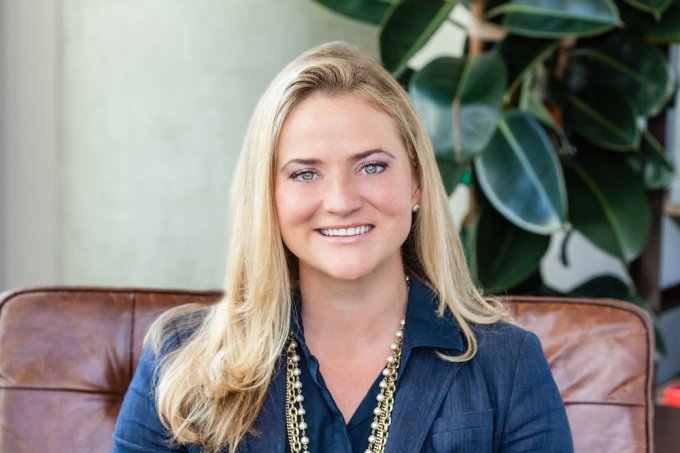
Anathem Ventures CEO/founder Crystal McKellar
The Coronavirus Global Health Emergency, an Amazon Rival, and More News
Catch up on the most important news from today in two minutes or less.
Top 10 meditation apps pulled in $195M in 2019, up 52% from 2018
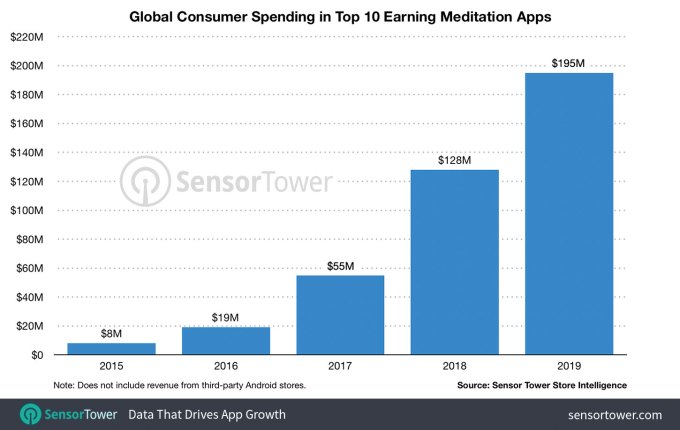
The millennial obsession with wellness and self-care has led to a booming business for meditation apps. In the first quarter of 2018, app intelligence firm Sensor Tower reported the top 10 “self-care” apps had pulled in some $27 million in revenue. Fast-forward to the end of 2019, and the numbers have gotten much higher. According to Sensor Tower’s latest data, just the top 10 highest-grossing meditation apps of 2019 — a subset of “self-care” apps — grew to $195 million. That’s a 52% year-over-year increase.
Meditation apps were already leading the self-care app market back in 2018, with apps like Calm, Headspace and 10% Happier driving revenue. Other self-care apps focused on mindfulness or yoga were popular as well, but further down the charts.
Over the course of 2018, the top 10 meditation apps alone ended up generating $128 million in revenue. That was a huge increase from just a few years prior, when the top 10 meditation apps of 2015 had only pulled in just over $8 million in revenue.
In 2019, the top 10 meditation apps grew revenues to $195 million.
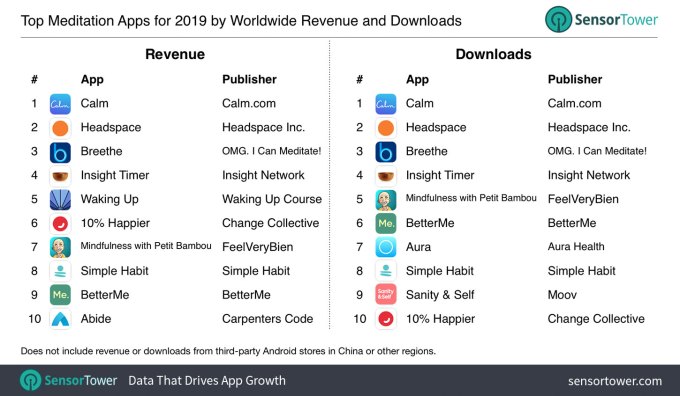
Only two apps, however, have been in the top 10 list since 2015. Calm, which is estimated to have grossed $92 million in 2019, and Headspace, which grossed $56 million. Both saw revenues up year-over-year, as well, at 46% and 33%, respectively.
The revenue growth comes from not only an active user base, but from those who are still finding these apps for the first time. In 2019, 52 million first-time users downloaded one of the top 10 meditation apps, for example, up 15.6% from 2018. Calm and Headspace led the way here, as well, with 24 million and 13 million new users in 2019, respectively.
Despite their popularity, self-care isn’t a top-level category on the App Store. Instead, the apps are usually listed in the “Health & Fitness” category alongside exercise apps, dieting apps and calorie counters, fitness trackers and others.
But the apps still do well. At present, Calm is the No. 1 “Health & Fitness” app in this category and Headspace is No. 5 on Apple’s iOS App Store.
There are a number of reasons why these apps have become so popular in recent years. To some extent, it could be tied to millennials’ lifestyles. This demographic chose to marry later in life and delay having children. That gave them more time to remain self-focused, compared with prior generations. They’ve also grown up with internet access, giving them the ability to learn more about wellness and self-care, in general.
In addition, always-on internet connectivity is reported to lead to anxiety and depression — depending on how screen time is used by the individual. While screen time alone doesn’t cause harm, the way it’s used can. Self-care apps, and particularly meditation apps, help assuage these sorts of problems. (Though, we should point out, they are not a solution for mental illnesses.)
The apps have also benefited from the shift to subscriptions, in terms of growing their revenue. Over time, the category is likely to grow further.