Josh Kopelman on how to start and run an early-stage fund in a hypercompetitive market

Last week at the Upfront Summit in Pasadena, there was no shortage of glitz, from the venue (the Rose Bowl) to the catering (Wolfgang Puck) to the guest list (Ice Cube, Paris Hilton and John Legend, to name just a few). Still, there were also plenty of sessions that provided the investors and founders in the audience practical advice, including, notably, a session led by Upfront co-founder Mark Suster, who interviewed his longtime peer Josh Kopelman of First Round Capital.

The topic was how to raise a debut venture fund — as well as keep the whole operation afloat over time. The bottom line, suggested Kopelman, is that it’s a lot harder than it looks. Indeed, according to other investors at the event with whom we chatted, the seed and early-stage funding environment has grown especially brutal. As more debut funds have sprung up on the scene, more established firms have begun throwing elbows.

Part of Kopelman’s chat with Suster made its way around the Silicon Valley last week, when Axios’s business editor, Dan Primack, tweeted a part of the conversation about First Round’s accelerated deal-making pace. We were also in the audience and think other aspects of the conversation worth flagging, too, including how to establish a brand, how to think about valuations when they’re soaring out of control and how to approach institutional limited partners (or LPs) when trying to raise a fund.

Josh Kopelman of First Round Capital: we can look at every company we’ve ever funded, and learned that the time from first email/contact to term sheet has shrunk from 90 days in 2004 to just 9 today.

— Dan Primack (@danprimack) January 29, 2020

Suster first began by talking about the crowded market, asking Kopelman how First Round has adapted to the resultant pace of dealmaking.

The biggest thing you mentioned is that something that we actually measure is time for decisioning. We’re pretty data driven, so we use Salesforce, [and] we can go back and look at every single company we funded since 2004: the date of that first email with a founder, the date we signed the term sheet. And it’s fascinating. You just see sort of what was a 90-day process shrink to an average of nine.

So that just creates real challenges in terms of your ability to make high-quality and high-confidence decisions. We now have partner meetings twice a week, rather than once a week, because we want to be able to make sure that we’re communicating and talking with our partners in order to be able to, to be able to move quickly enough.

Also, just the proliferation of funds has made brands far more important. You know, when we started, there were just a handful of funds [including those of] Ron Conway, Mike Maples, Jeff Clavier. There were, like, six funds. So imagine if you walked into a Foot Locker, and there were six sneakers on the wall. That was it. You could just try every one to see what fits, which feels the best. [Now imagine] you walk into a Foot Locker, and there are a thousand sneakers on the wall. You’re not going to try all of them. You’re going to have to use proxies. You’re going to have to say, ‘I want the Nike.’ ‘I want the Adidas.’ You’re going to [pick out something] based on brand and that brand is based on persistency, so there are benefits. There are benefits to having been associated with [particular] athletes, in the sneaker metaphor.

And so it’s helped change a little bit the way we [do things] and led us to create things, like the First Round Review; it’s why our [annual] holiday video was so important to us in the first 10 years.

Watch experts from Boston Dynamics, Built, Dusty and Toggle discuss robotic construction at TC Sessions: Robotics

After recently doing a survey of the top robotics investment rounds, it became pretty clear: construction is going to be huge for this industry. Global construction is expected to hit $13 trillion by 2022 (with China alone hitting that number in 2030), and there are plenty of dull, dirty and dangerous jobs that seem well positioned for potential automation.

With that in mind, we’ve put together a fantastic — and packed — panel set to examine how robotics, AI and automation are poised to transform the industry. There’s a wide range of potential opportunities for the right startup, from producing construction materials to surveying sites. The latter, in particular, could amount to a big market for a company that can help correct mistakes before they become too costly.

Today we’re excited to announce that Boston Dynamics’ Construction Technologist Brian Ringley will be joining an already packed panel that includes Built Robotics’ Noah Campbell-Ready, Tessa Lau of Dusty Robotics and Toggle’s Daniel Blank at TC Sessions: Robotics+AI on March 3.

A longtime robotics pioneer, Boston Dynamics is a recent entrant into the construction space. The company’s now commercially available Spot robot is currently being piloted at construction sites. With LIDAR and other imaging technologies mounted on its back, the robot is able to give a more complete picture of in-progress construction sites.

 Save $50 when you book your tickets today as prices go up at the door. We still have a small handful of Startup Exhibitor Packages available that can be booked here. Each package comes with 4 tickets so you can divide and conquer the show to increase your network.

Facebook board adds Zuckerberg’s pal, Dropbox’s CEO

Shareholders have repeatedly tried to oust Facebook’s chairman Mark Zuckerberg. The board has repeatedly rejected that demand. Outside investors are unlikely to get much help with that push from Facebook’s newest board member: Dropbox co-founder and CEO Drew Houston.

The addition of Houston is the first since the departure of Dr. Susan Desmond-Hellmann from the board in October. She was the lead independent director and that role remains empty. While the “independent” status relates to financial ties, business aside, Houston and Zuckerberg’s personal relationship might have complicated the storage startup leader asuming that position.

Zuckerberg and Houston have been close for 8 years, appearing in photos together since at least 2012 when they rode around the exclusive Allen & Co Sun Valley conference together (seen above). A less flattering moment saw Zuckerberg and ex-Uber CEO Travis Kalanick celebrating Houston’s birthday at a “Babes & Balls” themed party at ping-pong bar Spin in San Francisco.

Mark Zuckerberg plays ping-pong at SPiN in San Francisco while Drew Houston (to his right) watches on. Image by via Ryan Soule of SPiN via USA Today

Houston has also found a mentor in Zuckerberg, who went through the trials of an initial public offering with Facebook a few years before Dropbox made the journey. Houston told Bloomberg in 2015 that “[Zuckerberg’s] given me a lot of advice just on company scaling, how do you organize people, how do you set up these systems.”

Houston is an accomplished technologist, graduating in computer science from MIT where he came up with the idea for Dropbox. As Facebook undertakes an integration of its messaging apps to expand end-to-end encryption, Houston’s guidance could serve the company well.

But given Dropbox has come under less scrutiny for its content moderation and impact on society, two issues constantly facing Zuckerberg and Facebook, he may have less to add on the topics than Desmond-Hellmann. She had been the CEO of the Bill & Melinda Gates Foundation philanthropy and the chancellor of University Of California, San Francisco.

Facebook’s shareholders have proposed removing Zuckerberg from his role as Chairman of the board multiple times, including in late 2018 and mid 2019. But the rest of the board have continued to support Zuckerberg, who has accepted blame for failing to emphasize safety earlier and warned of the current profit slowdown as Facebook invests in security and content moderation. Despite constant backlash and a rough reaction to its earnings last week, Facebook’s share price remains near its all-time high.

Facebook’s board now includes Zuckerberg; Peggy Alford of PayPal,  Marc Andreessen of Andreessen Horowitz, Kenneth I. Chenault of General Catalyst, Sheryl K. Sandberg of Facebook, Peter A. Thiel of Founders Fund, Jeffrey D. Zients of the Cranemere Group, Houston.

Those hoping for board members who will put more pressure on Zuckerberg may need to look towards who eventually fills the independent board director spot. Netflix CEO Reed Hastings who was known to push back at Zuckerberg more than other members left the board last year.

Facebook would benefit greatly from an independent board director with a healthy level of skepticism about how the social network impacts democracy, human rights, and people’s attention. Zuckerberg and his inner circle are known as optimists who see the potential of technology to improve our lives. But Facebook has done a better job at fulfilling that opportunity than safeguarding against the side effects of connecting everyone — particularly those happy to exploit or degrade others out of greed for wealth or power. Facebook’s 2.5 billion users would gain more if its next board member had more perspective on the consequences of technology and the upheaval it can cause in developing nations around the world.


AI startup Cresta launches from stealth with millions from Greylock and a16z

As Silicon Valley’s entrepreneurs cluster around the worldview that artificial intelligence is poised to change how we work, investors are deciding which use cases make the most sense to pump money into right now. One focus has been the relentless communication between companies and customers that takes place at call centers.

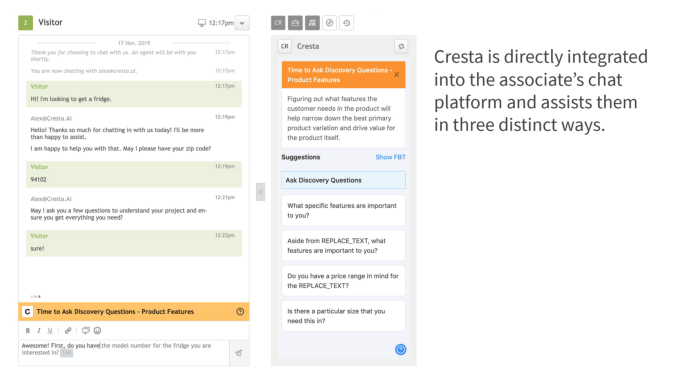
Call center tech has spawned dozens if not hundreds of AI startups, many of which have focused on automating services and using robotic voices to point customers somewhere they can spend money. There has been a lot of progress, but not all of those products have delivered. Cresta is more focused on using AI suggestions to help human contact center workers make the most of an individual call or chat session and lean on what’s worked well for past interactions that were deemed successful.

“I think that there will always be very basic boring stuff that can be automated like frequently asked questions and ‘Oh, what’s the status of my order?,’ ” CEO Zayd Enam says. “But there’s always the role of the person that’s building the relationship between the company and the customer, and that’s a really strategic role for companies in the modern age.”

Udacity co-founder Sebastian Thrun is the startup’s board chairman and is listed as a co-founder. Enam met Thrun during his PhD research at Stanford focused on workplace productivity. Cresta is launching from stealth and announcing that they’ve raised $21 million in funding from investors including Greylock Partners and Andreessen Horowitz. The company recently closed a $15 million Series A round.

Cresta wants to use AI to school customer service workers and salespeople on how to close the deal.

There’s quite a lot of turnover in contact center jobs and that can leave companies reticent to spend a ton of time investing in each employee’s training. Naturally, there are some inherent issues where the workers interacting with an individual customer might not have the experience necessary to suggest a solution that they might if they had more experience. In terms of live feedback, for many, fumbling through paper scripts at their desk can be about as good as it gets. Cresta is hoping that by tapping improvements in natural language processing, their software can help alleviate some stress for contact center workers and help them move conversations in the direction of selling something else for their company.

Cresta is entering a field where there’s already quite a bit of interest from established software giants. Salesforce, Google and Twilio all operate AI-driven products for contact centers. Even with substantial competition, Enam believes Cresta’s team of 30 can offer its customers a lot more individual attention.

“We’re one of the few technical teams where we’re just obsessed with the customer, to the point where it’s normal for people on our team to fly to the customer and live by a call center in an Airbnb for a week,” Enam said. “When Greylock led the Series A, they had heard that and said that’s what gave them so much conviction that we were the team to solve the problem.”

Sun Microsystems co-founder Andy Bechtolsheim, Mark Leslie and Vivi Nevo are also investors in Cresta.

Alphabet earnings show Google Cloud on $10B run rate

Today after the bell, Alphabet reported its fourth-quarter and full-year financial results. The company’s revenue grew from $39.3 billion in 2018 to $46.1 billion in 2019. The firm’s net income also expanded from $8.9 billion to $10.7 billion over the same time frame.

The figures, when compared to expectations, were mixed. Alphabet beat analyst estimates on profit, but missed on revenue. Shares of the company are off around 4% in after-hours trading, following its disclosure.

Why do we care?

The company’s reported Q4 and full-year 2019 results are notable for several reasons. First, Alphabet broke out the value of YouTube’s advertising empire. And, the company disclosed discrete “Google Cloud” revenues. Both are new.

YouTube’s advertising heft was made clear today, with the video platform bringing in $15.1 billion in 2019 revenue, up from $11.2 billion in 2018.

The firm’s new “Google Cloud” line item appears to include all of the company’s cloud computing efforts. YouTube’s advertising haul will grab the most headlines, but the cloud revenue figure is what we’d like to drill into.

Cloud, Google-style

Google announced an impressive $2.6 billion round for all cloud revenue, which includes G Suite, the enterprise version of GMail/Docs/Drive/Hangouts and Google’s cloud infrastructure revenue. At $2.61 billion, that puts it on a run rate over $10 billion. In the year-ago Q4, the company’s Cloud revenue came to just $1.71 billion, a run rate of $6.84 billion.

Google’s Cloud run-rate, then, grew by 53.6% in the last year.

In February of 2018, then-Google Cloud CEO Diane Greene was happy to report $1 billion quarterly revenue for the group. Last July, the company’s Cloud revenue crossed $2 billion for that quarter, putting on an $8 billion run rate, double the previous report.

Former Oracle executive Thomas Kurian took over after Greene stepped down last year, and he brought on a number of industry veterans from Oracle and SAP to help sell Google Cloud to the enterprise. So far the results are certainly encouraging in a short amount of time.

In comparison

While Google is making some gains in the cloud, its chief competitors have been doing well at the same time.

To pick one example, Amazon’s cloud revenue totaled just under $10 billion in the same calendar quarter. In a direct comparison, Google is far smaller, but the search giant is working to make up ground and the results appear encouraging. It’s worth noting that Amazon’s comparable cloud figures are more focused on infrastructure than Google’s, which includes SaaS revenue, as well.

Turning to Microsoft, it reported a combined cloud revenue, which includes SaaS (Office 365, Dynamics, etc.) and cloud computing (Azure), of $12.5 billion for the quarter. All of this shows that while Google still has a long way to grow to match its rivals for scale, it’s at least picking up the pace.

Twitter suspends ‘large network’ of fake accounts used to match phone numbers to users

Twitter announced today that over the holidays it identified and shut down “a large network of fake accounts,” as well as many others “located in a wide range of countries,” collectively abusing a feature that let them match phone numbers to user accounts.

TechCrunch previously reported this same issue on December 24, which is also the day Twitter says that it “became aware” that the abuse was taking place. Security researcher Ibrahim Balic found that a bug in Twitter’s Android app let him submit millions of phone numbers through an official API, which returned any associated user account.

We recently discovered an issue that allowed bad actors to match a specific phone number with the corresponding accounts on Twitter. We quickly corrected this issue and are sorry this happened. You can learn more about our investigation here: https://t.co/Z6Q4geQ8jo

— Twitter Support (@TwitterSupport) February 3, 2020

The feature is intended, if you have enabled it, to let friends who have your number look up your Twitter handle. But obviously submitting millions of numbers goes “beyond its intended use case.”

If you had turned this feature off, you weren’t affected by this bug. Fortunately for users in the EU this was opt-in there. But for the rest of the world it’s opt-out — so if you had a phone number associated with your account, you may have been affected.

Furthermore, the phone numbers include those provided for purposes of two-factor authentication, so those outside the EU may have been vulnerable to this exploit without realizing it.

It seems that after Twitter was alerted to the issue and shut down the original network (presumably Balic’s), its investigators identified many more accounts that were exploiting this flaw, though a representative declined to provide a number or estimate.

“We observed a particularly high volume of requests coming from individual IP addresses located within Iran, Israel, and Malaysia,” wrote the company in a security bulletin. “It is possible that some of these IP addresses may have ties to state-sponsored actors,” the post continued.

This suspicion was justified by the observation of unrestricted access to Twitter from the IPs in Iran, where the platform is blocked from general access — suggesting government involvement. Belic, when contacted by TechCrunch, said that his work was not state-sponsored in any way.

Any account suspected of abusing the feature was suspended, and the API itself has been modified to prevent any further exploitation of this type. I’ve asked the company how many accounts were suspended and will update this post if I hear back.

Twitter has had numerous incidents where it exposed or leaked user data over the last year. In addition to sharing rather too much data with its ad partners, the company admitted it used phone numbers used for two-factor authentication to serve targeted ads.

HPE acquires cloud native security startup Scytale

HPE announced today that it has acquired Scytale, a cloud native security startup that is built on the open-source Secure Production Identity Framework for Everyone (SPIFFE) protocol. The companies did not share the acquisition price.

Specifically, Scytale looks at application-to-application identity and access management, something that is increasingly important as more transactions take place between applications without any human intervention. It’s imperative that the application knows it’s OK to share information with the other application.

This is an area that HPE wants to expand into, Dave Husak, HPE fellow and GM of cloudless initiative wrote in a blog post announcing the acquisition. “As HPE progresses into this next chapter, delivering on our differentiated, edge to cloud platform as-a-service strategy, security will continue to play a fundamental role. We recognize that every organization that operates in a hybrid, multi-cloud environment requires 100% secure, zero trust systems, that can dynamically identify and authenticate data and applications in real-time,” Husak wrote.

He also was careful to stress that HPE would continue to be good stewards of the SPIFFE and SPIRE (the SPIFFE Runtime Environment) projects, both of which are under the auspices of the Cloud Native Computing Foundation.

Scytale co-founder Sunil James, writing in a blog post about the deal, indicated that this was important to the founders that HPE respect the startup’s open-source roots. “Scytale’s DNA is security, distributed systems, and open-source. Under HPE, Scytale will continue to help steward SPIFFE. Our ever-growing and vocal community will lead us. We’ll toil to maintain this transparent and vendor-neutral project, which will be fundamental in HPE’s plans to deliver a dynamic, open, and secure edge-to-cloud platform,” he wrote.

Scytale was founded in 2017 and had raised $8 million, according to PitchBook data. The bulk of that was in a $5 million Series A last March led by Bessemer. The deal closed today.

Jenfi wants to solve small business lending in Southeast Asia

Small business lending is a huge market that has attracted massive attention from VC investors in recent years. Startups like Kabbage have raised more than a billion dollars in venture capital and debt to create lending platforms for businesses, and others in the space like Fundbox for lending and BlueVine for banking are trying to build new, digital-first models for helping SMB owners grow their businesses.

While startups targeting the U.S. and European markets have proliferated, other international markets have seen less attention. Portal Finance raised $200 million to help businesses with lending in Latin America, and First Circle raised a $26 million round to do the same in the Philippines.

Now Jenfi wants to enter the mix. The company, founded by Jeffrey Liu, who sold his past startup GuavaPass to ClassPass for a few million, and Justin Louie, who was one of the first employees at GuavaPass, wants to expand access to small and medium business loans for owners in Southeast Asia, starting with their first base of operations in Singapore.

“Even in a market like Singapore which is quite well-established … half of these companies are still underbanked, [and] they don’t have access to credit,” Liu explained to me in an interview. “We realized there was a big problem there.”

The company raised a US$1 million angel round of debt and equity, and is currently going through YC’s accelerator program. So far, the startup has 50 borrowers on its platform according to Liu, and has lent SGD$600,000 so far since launch last year.

In terms of its product, the company either lends directly to a small business, or offers a virtual Jenfi Mastercard that can be used for purchases.

What’s more interesting right now, though, is Jenfi’s model, which is something that you don’t see all the time in the lending space. The company is approaching SMB lending purely from a growth perspective. The startup wants to help owners invest in the growth of their businesses primarily through digital marketing, and takes a small percentage of future revenue in lieu of a fixed repayment schedule.

Liu says that “part of the value-add is that we can help them be more effective in their alternative marketing channels…” He said that the startup doesn’t want to become a service provider, but has been building partnerships with other marketing agencies and services that can help owners find the right growth strategies for them, and then execute on them funded by Jenfi capital. “Our goal is to be able to build a network,” Liu says. “Marketing growth is our initial product focus for this company.”

The timing could be propitious. A study by Google and Bain late last year pegged Southeast Asia as a massive opportunity for digital services, with deep smartphone penetration but still a relatively limited array of digital services across a range of categories. Online marketing channels exist, but are under-optimized, particularly in comparison to the large sums devoted to them in countries like the U.S.

Over the next two years, Liu and Louie hope to expand to more geographies, build out their product offering and continually build long-term partnerships with business owners.

NASA sets 2022 launch for air quality sensor that will provide hourly updates across North America

NASA is sending to orbit aboard a Maxar 1300-class satellite (whose primary mission is to provide commercial satellite communications for Intelsat customers) a payload that could help improve air quality forecasting, the agency announced today. NASA’s new air quality measurement tool is called “TEMPO,” which stands for Tropospheric Emissions: Monitoring of Pollution, and it’ll provide hourly measurements of the levels of gases in the atmosphere over North America, including ozone, nitrogen dioxide and aerosols. That’ll paint a picture of the relative air quality, and that info will be available publicly so that weather monitoring agencies and others can provide more accurate and up-to-date air quality information to people as part of their forecasts.

The TEMPO tool won’t launch until 2022, however, which is when the Maxar satellite, called Intelsat 40e, is set to be delivered to geostationary orbit. It’s not uncommon for NASA to host its scientific payloads on commercial communications satellites, providing an opportunity for NASA to effectively hitch a ride on a large geostationary satellite that’ll cover the territory it wants to cover, while offering significant cost savings versus putting up a dedicated spacecraft.

Ball Aerospace developed the TEMPO instrument for NASA, and it’ll be transported to Maxar’s Palo Alto-based satellite manufacturing facility for incorporation into the Intelsat 40e vehicle ahead of its scheduled launch. The instrument will also be used alongside other tools, including one from the European Space Agency, and South Korea’s Geostationary Environment Monitoring Spectrometer, which will all combine to provide a more comprehensive and detailed picture of air quality across the northern hemisphere.

NASA has already contributed to improved air quality index (AQI) information, boosting accuracy of the EPA’s daily AQI by as much as 38%, according to tests conducted in August after satellite data refreshed every three hours was incorporated into that index’s calculation. Continuing to improve the quality and accuracy of these and other measures of air quality could potentially have tremendous impact on the lives of us here on Earth as air quality worsens due to the impact people have on the environment and airborne pollutants.

TechCrunch is hosting its first-ever dedicated space event in 2020 — TechCrunch Sessions: Space, happening June 25 in LA. Get your tickets now!

MIT’s RFocus technology could turn your walls into antennas

RFocus asks a simple question: What if instead of just antennas and transmitters on access points and mobile devices, we put the things just about everywhere? You know, just totally slather the walls with the stuff? The new “smart surface” from MIT’s CSAIL uses in excess of 3,000 antennas to boost signal strength by nearly 10x.

The department issued a paper today showcasing the technology, which is relatively cheap, with each antenna running a few cents. Better still, it’s low power, either reflecting a signal or allowing it through, depending on the software controller. CSAIL envisions a future where RFocus is used in homes and warehouses to boost signals for the Internet of Things and various network-connected devices.

“The core goal here was to explore whether we can use elements in the environment and arrange them to direct the signal in a way that we can actually control,” MIT professor Hari Balakrishnan said in a post detailing the technology. “If you want to have wireless devices that transmit at the lowest possible power, but give you a good signal, this seems to be one extremely promising way to do it.”

No word on a time frame to market here — that’s not really how CSAIL operates. The team also notes that similar research has been conducted by Princeton, though MIT’s focus is on low-cost and a wider range of applications. The notion of full-wall antennas certainly seems a bit far-fetched — and in most cases unnecessary. And given the sort of caution with which many have approached 5G, I suspect more research will have to be done on the long-term effects of such transitions.

Money-transfer startup Remitly launches Passbook, a neobank aimed at immigrants

Last summer, the Seattle-based startup Remitly closed a $135 million round to go beyond money-transfer services into a wider range of financial products catering to its primarily-immigrant customer base.

Today, it’s taking the wraps off a new product that puts paid to that plan: it’s launching Passbook, a new bank aimed at immigrants that lets a person use a wide number of picture IDs — whether they are from the US or not — to sign up. The service is starting first in the US — Remitly’s biggest market today among its 16 “send from” countries and 47 “send to” countries. The long-term plan is to roll out Passbook anywhere that Remitly is active over time.

Aimed at the 44 million immigrants in the country that Remitly already targets with services to send money back to their home countries, the idea is to give them options to open and use bank accounts even if they are not in possession of Social Security numbers or other forms of US-originated identification, as long as they are living in the US, have another form of identification (for example a passport from another country), and in cases where the ID lacks an address, proof of where they live.

Passbook is tapping into a problem that extends into both developed and developing markets, where collectively some 1.7 billion people globally remain “unbanked,” with no access to bank accounts and therefore mostly off the financial grid, and therefore unlikely to have access to services like credit that can potentially help them improve their financial station in life.

Passbook is interesting not just because it’s addressing a gap in the market of financial services, but because of the timely subject matter.

The subjects of migrant workers, immigration, nationality — and how to best to handle the influx of new populations of people within a country’s borders coming for a variety of reasons — are all being hotly debated in the US and elsewhere. Large political shifts and platforms are being built and pivoting around how people view the movement of people.

But while those subjects get lots of attention in the media, in the halls of government, at the bar and around the proverbial dinner table, ironically the subject of those arguments — the people themselves — regularly get overlooked when it comes to building new services and calibrating tech to focus on them, two things that could clearly improve their individual lots and the economy as a whole. Immigrants globally represent some $1.3 trillion in wages and $900 billion in spending power annually.

“No-one should be excluded from banking and financial services,” said Matt Oppenheimer, the CEO and co-founder of Remitly, in an interview in London last week about Passbook.

Passbook is a logical expansion for Remitly because there is a strong overlap between the typical Remitly’s target customer, a country’s immigrant population, and those living in a country like the US who are underbanked.

Today many of the individuals who use money transfer services are immigrants, who use them to send money to family and friends in their “home” countries. Those immigrants, in turn, are the most likely US residents to lack social security numbers and other kinds of US-issued identification.

Up to now, that has made it harder for them to open bank accounts, since many banks in the US — in an effort to avoid risk, not because of a legal requirement — often require those US-originated identification documents to open the accounts in the first place.

But that opens an opportunity for a company like Remitly, which can use a banking service to expand its services funnel with its existing users — it sends some $6 billion per year in funds on behalf of its users — and to open a new front in adding in other customers who may not already be using it for money transfer.

Since the main requirement is to satisfy “Know Your Customer” compliance, Remitly can do this using other documentation that a person is likely to have.

Remitly has set Passbook up like a typical challenger bank (these days often referred to as a “neobank”), in that it operates as a virtual, online-only bank with no physical office and has partnered with another banking partner called Sunrise that runs all the services under the hood and provides FDIC guarantees for deposits up to $250,000. On top of that, Remitly has worked in a number of features that it believes give customers not just a bank account, but one that has features specific to those that might appeal to its specific customer base.

That includes, in addition to basics like having an account into which money can be paid in and out, and having a Visa-based debit card to make cashless transactions, users getting the ability to “choose your flag” to personalise a card, no fees for transactions when the payment card is used abroad, no account maintenance fees, no overdraft fees, no ATM fees and no minimum balance.

As you would expect, Remitly will soon be adding in the ability to link the Passbook accounts to their money transfer feature to make the process more seamless, and presumably cheaper to entice more cross-service signups. No loans on the platform yet, but you can imagine credit, mortgages and other kinds of lending to make its way there over time as well.

Given the focus on immigrants as users, I asked Oppenheimer about the potential risk that they would be providing services to people who are in the US undocumented and potentially illegally, and wether that could pose problems for the company. He replied that the company is committed to protecting the privacy of its customers and since all that is needed is to satisfy KYC compliance, Remitly would never have information on a users’ immigration status one way or the other, leaving the question off the ledger altogether.

I also asked Oppenheimer where the company stands on funding. It has now raised just over $300 million, and for now is in no hurry to raise any more, he said. But when and if financing is added into the mix of services, you might imagine that will change again.

Updated to clarify how much is sent by Remitly ($6 billion annually, not to date), how many countries it serves, how much it has raised and the number of IDs it accepts.

Google Assistant now works with Tile to find your lost stuff

Google Assistant is today rolling out support for Tile’s Bluetooth tracker, designed to help you keep up with your often misplaced items — like your keys, purse, wallet, remote and more. The new integration will allow Google Assistant users on any Nest device to ask questions like, “Hey Google, where is my purse?” They can instruct the Assistant to ring their device” by saying things like “Hey Google, make my backpack ring.”

Variations on these commands are also supported, like, “Hey Google, find my…” or “Hey Google, ring my…”

In addition, you can ask for the location of an item. If the item is in the house, the Assistant will return an appropriate location using Tile’s Bluetooth capabilities, by saying something like “your keys were last seen today at 9 PM near the Kitchen speaker.” If the item is out of Bluetooth range, the Assistant will instead return the item’s last known location, based on Tile’s location services.

Tile leverages its large network of Tile app users as a crowd-finding platform to help when items are missing. To date, the company has sold 22+ million Tile devices worldwide and is locating more than 5 million items per day across 230 countries.

Google announced its partnership with Tile back in September 2019, but said at the time the feature would launch later that year.

The partnership arrives at a critical time for Tile’s business. Apple is reportedly preparing to launch a Tile competitor, possibly called AirTags, that integrates deeply with iOS. According to the latest forecast from well-known Apple analyst Ming-Chi Kuo, Apple in the first half of 2020 will introduce the product. But unlike Tile, Apple’s are ultra-wideband tags that promise greater accuracy than Bluetooth LE and Wi-Fi.

Evidence of Apple’s tags was already found in iOS 13 code, as well.

Apple’s plan to move into Tile’s business was one of the examples brought up in a recent congressional hearing about Apple’s anti-competitive practices. At the hearing, Tile general counsel Kirsten Daru commented on how hard it is to compete with Apple.

“You might be the best team in the league, but you’re playing against a team that owns the field, the ball, the stadium, and the entire league, and they can change the rules of the game at any time,” she said.

In this context, Tile’s move to partner with Google isn’t just about expanding its business — it’s also about saving it.

To take advantage of the new feature, you’ll need to set up your Tile to sync with the Google Home app.

Byte tops a million downloads amid spam issues and content concerns

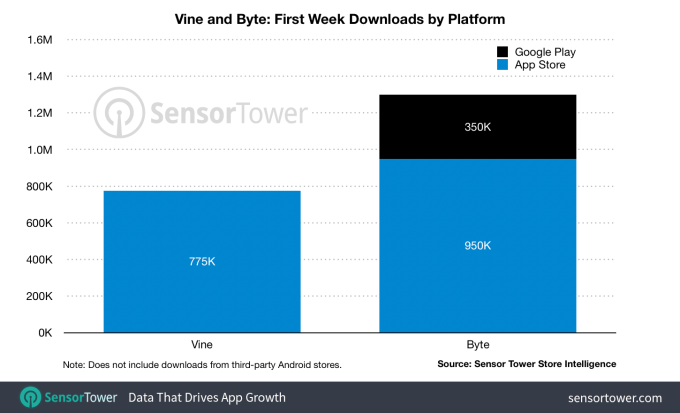
New short-form video app Byte, heralded as Vine’s successor, is off to a strong start despite its issues. The app, built by Vine co-founder Dom Hofmann, brings back the six-second videos made popular by Vine which was shut down in late 2016 after Twitter’s acquisition of the popular video-sharing platform. According to new data from Sensor Tower, Byte’s launch has been well-received with over 1.3 million downloads during its first week alone. The U.S. delivered the bulk of these new installs, followed by Great Britain then Canada.

The U.S. contributed 912,000 downloads, or 70% of the installs, the report says. While Great Britain and Canada offered 7% and 6% of installs, respectively. The majority of Byte downloads were also on iOS, with 950,000 iOS downloads compared with 350,000 installs on Android.

App Annie’s numbers differed a bit, but also found that Byte topped 1 million total downloads on iOS and Android through Sunday, Feb. 2.

Sensor Tower’s new report compares Byte’s figures to Vine’s debut in January 2013, which only saw a total of 775,000 installs during its first week on iOS. However, that doesn’t mean Byte is soon to be a much more popular app than its predecessor.

For starters, the app market has grown over the years to include more users and more devices. In 2016, for example, only 2.5 billion users worldwide had smartphones. Now that number tops 3.5 billion. In addition, Vine launched as an unknown startup into a market that had yet to really embrace short-form. Byte, on the other hand, not only takes advantage of its association with Vine, it also arrives at a time when short-form video is now hugely popular thanks to Vine’s success and TikTok, the latter which became the No. 4 most-downloaded app of 2019.

Despite its solid launch numbers, Byte’s debut was not unmarred.

The app immediately saw massive comment spam as bots rushed to fill comment sections with follow requests (and follow for follows), including requests from pornbots. Byte’s early adopters also started snatching up coveted usernames — those belonging to real people, ranging from tech folks to celebs like Taylor Swift and other prominent figures like Trump, Bezos, Tiger Woods and others, Slate reported. The company quickly moved to acknowledge the problem and promised a cleanup was underway.

But that’s not Byte’s only issue. The app originally launched with a 12+ age rating, yet was immediately filled with adult humor alongside videos from obvious minors. Surfaced in Byte’s popular feed were videos with dick jokes and sexual humor, and problematic content including distasteful jokes about child abuse and coronavirus victims.

To give you a sense of Byte’s content, a perusal of the “Popular” feed on Friday surfaced a video featuring a teenaged-to-young adult boy joking “if you call me a slut in the comments one more time, I’m going to suck all your d***s.” Another teenaged-appearing boy joked about a prostate exam performed by his dad. A boy of a similar age asks if anyone had ever pooped into someone’s….and then the video cuts off.

It’s unclear if the boys in question are 18 or older, but seeing these — as well as so many other videos featuring dick jokes — followed by videos filmed by very young children was an uncomfortable experience.

The Popular feed also featured a video of a drone trying to fly a dildo into a sex doll. One video made light of child abuse, with a man viciously hitting the phone screen. The video is filmed from above, giving you the child’s perspective. The caption read: “when a child brings up a valid argument.”

Two other videos featured toddlers – one of a dad knocking the baby down, perhaps on purpose, as they played ball, only to later fall himself. Another depicted someone spraying a baby in the face with the kitchen sink nozzle, followed by the baby crying.

One video made fun of Chinese people dying from coronavirus. Another showed a teen smoking a joint, then hearing a siren and running.

Vine videos were strange and dumb in their own way, but the best weren’t typically crass or dirty. Think:  duck army, eyebrows on fleek, hate blockers, what are those, Squidward hits the dab, and so on.

Given the amount of adult humor, Byte’s lack of an age-gate and the app’s 12+ rating was concerning. (Byte updated to 17+ over the weekend. The above videos aren’t surfacing now. We know Apple was taking a look at its content).

Another potential concern was that a lot of Byte’s content was recycled from elsewhere — there were clips from YouTube, FunnyorDie, TV shows, and even TikTok — logo and all. Users also reposted Snapchat videos and memes from around the web.

With the changes to the age rating, it seems Byte may have been alerted to some of its more problematic content. Byte now puts a curated Spotlight feed at the top of its discovery page, where videos curation is improved.

The company on Friday also published the initial details on its Partner Program, touting the potential for revenue other platforms don’t provide.

TikTok, by comparison, hasn’t quite figured out how to monetize — its app has seen 1.65 billion downloads to date, but only grossed $176.9 million in 2019. However, TikTok’s elite are making names for themselves that allow them to grow their brand in other ways, including by directing users to other social channels like YouTube and Instagram, and even doing meet-and-greets with fans.

Whether a whole new world of Byte stars emerges remains to be seen.

Daily Crunch: Hulu CEO steps down

The Daily Crunch is TechCrunch’s roundup of our biggest and most important stories. If you’d like to get this delivered to your inbox every day at around 9am Pacific, you can subscribe here.

1. Hulu restructures under Disney, CEO Randy Freer departs

Hulu CEO Randy Freer is stepping down from his role as part of a major restructuring of Disney’s streaming business. The move signals Disney’s plans to streamline its direct-to-consumer operations, which also include Disney+ and ESPN+.

Disney took control of Hulu last year following its acquisition of 21st Century Fox and a subsequent deal with the service’s other owner, NBCUniversal. However, the company had largely left Hulu alone to operate as usual — until now.

2. BlackBerry and TCL will end their handset partnership in August 2020

BlackBerry and TCL announced that they would end their four-year brand licensing and tech support partnership in August 2020, with TCL ceasing to make new models of BlackBerry handsets after that point.

3. Launch startup Skyrora successfully tests 3D-printed rocket engines powered by plastic waste

Skyrora’s rocket engines are novel not only in their use of 3D printing, but also because the fuel that powers them is developed from plastic waste — a new type of fuel called “Ecosene” the startup says makes its launch vehicles greener and more ecologically sound than the competition.

4. Apple News adds coverage of 2020 US presidential election, including guides to candidates, issues & news literacy

The coverage includes curated news, information and election data from ABC News, CBS News, CNN, FiveThirtyEight, Fox News, NBC News, ProPublica, Reuters, The Los Angeles Times, The New York Times, The Wall Street Journal, The Washington Post, TIME, USA Today and others. The Apple News editorial team has also put together a series of curated guides, special features and other resources for readers from both sides of the political spectrum.

5. Nigeria is becoming Africa’s unofficial tech capital

Nigeria has become a magnet for venture capital, a hotbed for startup formation and a strategic entry point for Silicon Valley. Still, Jake Bright acknowledges that as a frontier market, there is volatility to the country’s political and economic trajectory. (Extra Crunch membership required.)

6. Watch this year’s tech-themed Super Bowl ads from Amazon, Google and more

Some of these ads come from tech giants like Amazon and Facebook, which have hired big stars to promote their products. Meanwhile, Dashlane found a fun way to remind viewers of the nightmare of life without a password manager, while Squarespace enlisted Winona Ryder to build a website on the platform.

7. This week’s TechCrunch podcasts

The latest full episode of Equity features a discussion of why Kleiner Perkins is investing its latest fund of $600 million at a rapid pace, while the Monday news roundup looks at the global market’s response to coronavirus fears. And over at Original Content, we review the Netflix cheerleading documentary “Cheer.”

Venture investing in elder tech

Will Robbins
Contributor

Will Robbins is an early-stage investor at Contrary.

Senior citizens are not early adopters of new technology; many of our 65+ friends and family might not use much tech in the first place. That said, two-thirds of America’s 50 million seniors use the internet and more than 40% own a smartphone, according to a 2017 Pew study.

So where’s the disconnect? Why are modern software companies largely non-compatible with one of the nation’s largest demographics?

Starting with day-to-day care

The most notorious venture-funded elder tech startups were historically focused on building better healthcare and day-to-day living solutions. Honor built a managed marketplace for in-home care; YC startup GoGoGrandparent is Uber for people who don’t use apps; Umbrella* helps seniors get tasks done around the house.

The concept behind these companies is that daily basics are the root of other problems affecting seniors. If you have any issues with your home or mobility, for example, you end up exposing yourself to scams that frequently plague seniors, as well as health and safety risks. That’s not to mention the financial burden — most retirees have a modest budget or fixed income. Even if a service like TaskRabbit is somehow accessible to a senior, it’s not affordable in the long-term when lifespans and future costs are impossible to predict.