Women are the secret ingredient in Latin America’s outsized returns

Claire Diaz-Ortiz
Contributor

Claire Diaz-Ortiz is an angel investor and bestselling author of nine books that have been published in more than a dozen countries. An early employee at Twitter, she was called “The Woman Who Got the Pope on Twitter” by Wired and holds an MBA and other degrees from Stanford and Oxford.

Read the first part of this article, Latin America takes the global lead in VC directed to female co-founders, on Extra Crunch.


Latin America lags when it comes to female investors

Interestingly, these positive numbers for Latin America come in spite of a lack of female investing partners in Latin America.

New data shows that only 7% of VCs with check-writing ability in Latin America are women. This is just over half the current U.S. average of 12%.

See the full data set here.

This is a critical finding, given that studies indicate that investments in female founded or co-founded teams increase when more women sit across the table as investors.1 Specifically, 2019 research shows that women invest in female entrepreneurs at nearly three times the rate of male investors.2

This means that Latin America could be on the early side of a positive cycle. In other words, more female investors in Latin America would lead to more female co-founders, and faster exits at higher valuations.

Other parts of the world have seen the effects of this positive cycle. Sophia Bendz, a partner at leading European VC Atomico, has watched this happen: “I’ve seen first-hand the impact having female investment partners can have on increasing the amount of investment into female-led companies.”

Where are wearables going in 2020?

Apple has throttled the competition in another category.

During the company’s recent earnings call, CEO Tim Cook noted the company’s wearable division now rivals the size of a Fortune 500 company. He failed to give more specifics, but the point is striking: between Apple Watch and AirPods, Cupertino has another juggernaut on its hands.

Apple’s wearable fortunes come from two distinct sub-categories: more mature wrist-worn devices that include smartwatches and wearable trackers (and all of the overlap therein) and fully wireless earbuds or “hearables,” as they’re sometimes known.

I’m pulling IDC numbers from December for the latest, but these seem to mostly comport with what I’ve been seeing from firms over the past year. Apple’s on top with a little more than a third of total global market share — nearly 200 percent growth over the prior year. That’s thanks in no small part to the addition of AirPods Pro to the mix. Though getting back to Apple’s recent earnings, Cook notes that three-quarters of Apple Watch purchases in the previous quarter were by people who were buying the device for the first time. So there’s plenty of growth there, as well.

Xiaomi is at a distant number two with around 15 percent of the market. That’s still a commanding presence, as the company has expanded into new markets (mostly in Europe) with devices that undercut the competition. Samsung found success at around 10 percent of the global market with its diversification (watches, earbuds and fitness trackers), while Huawei maintained a strong presence in China with 80 percent of its total shipments in its home country as it struggles with other issues abroad.

15 tickets left to TechCrunch Winter Party tomorrow

On February 7, aka this Friday, the Bay Area startup community will descend on Galvanize to celebrate everything great and small about tech startups at the 3rd Annual TechCrunch Winter Party.

Lucky for you, we have just 15 tickets left! They’re available on a strictly first-come, first-served basis, so if you want to join us for an unforgettable night of fun and opportunity, get your ticket now before they’re gone for good.

The TechCrunch Winter Party provides the perfect atmosphere to relax and connect with your peers while enjoying delicious canapes, signature cocktails and convivial conversation. It’s also the chance to converse with some of the community’s major movers and shakers — including investors and partners from Uncork Capital .

Want to know the essential party particulars? We’ve got ’em right here.

  • When: Friday, February 7, 6:00 p.m. – 9:00 p.m.
  • Where: Galvanize, 44 Tehama St., San Francisco, CA 94105
  • Ticket price: $85

No TechCrunch party is complete without games, activities, swag and door prizes. And this event will deliver on all fronts. Planning to go to Disrupt San Francisco 2020? Party-goers have a chance to win free tickets.

Grab these tickets before they’re gone.

Pew: 30% of US adults have used online dating; 12% found a committed relationship from it

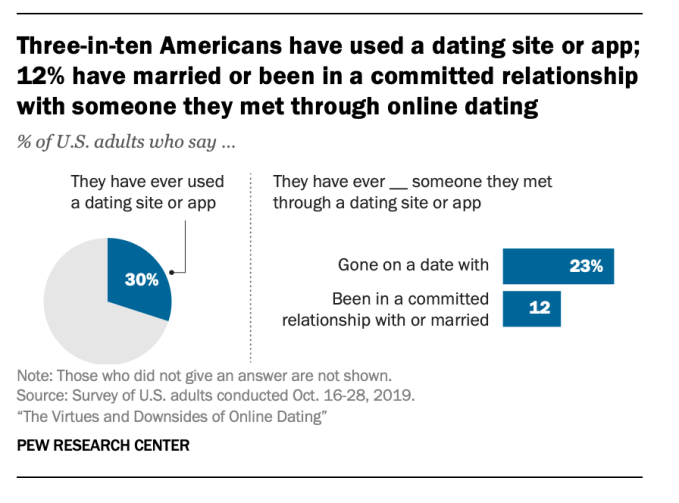
Dating app usage in the U.S. is on the rise, but so are the issues it brings. According to a new Pew Research Center report on online dating, out today, 30% of U.S. adults have at some point used a dating app or website. That’s up from just 11% in 2013. A smaller number of U.S. adults, 12%, said they found a long-term relationship via online dating. In addition, a majority of users reported an overall positive experience with online dating. But when drilling down into specific areas, some significant issues around harassment surfaced.

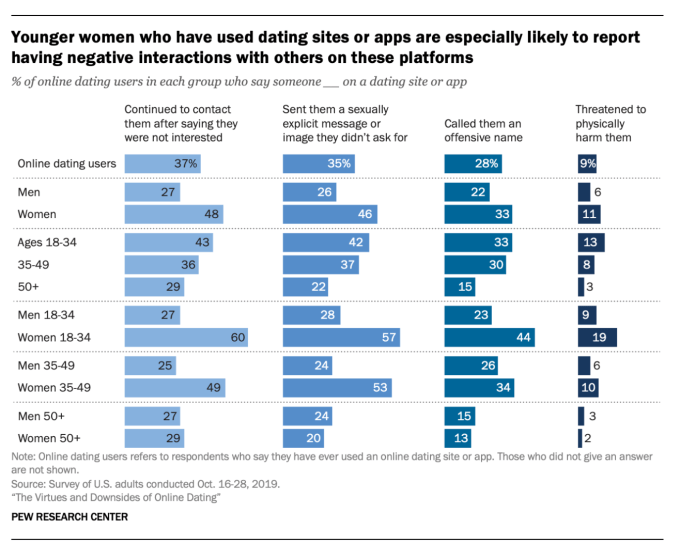
The study found that 37% of online dating users said someone on a site or app continued to contact them after they said they were not interested, 35% said they were sent an explicit message or image they didn’t ask for and 28% were called an offensive name. A smaller percentage (9%) said they were threatened with physical harm.

Across the board, these numbers were much higher for women than for men, the study found.

Indeed, 48% of women using online dating said someone continued to contact them after they said no; 46% received unwanted explicit images; 33% were called offensive names; and 11% were threatened with physical harm.

For younger women, these figures shot up even higher.

Six-in-10 women ages 18 to 34 using online dating services said someone via a dating site or app continued to contact them after they said they were not interested; 57% received unwanted explicit images; 44% were called offensive names; and 19% were threatened physically.

Younger adults were also more likely to be using online dating apps or websites than older adults. This is likely due to a combination of factors, including the younger generation’s comfort and ease with newer technology, as well as the fact that many older users leave dating apps because they eventually find themselves in long-term relationships.

Pew found that LGB adults were also twice as likely as straight adults to have used a dating app or website, at 55% to 28%.

Another interesting finding from the Pew study is the success rate of online dating.

Dating market leader Tinder has more fully embraced the younger demographic in recent months and now targets users looking for a “single” lifestyle, where dating remains casual and settling down is years away. As the largest, most successful dating platform in the U.S., raking in $1.2 billion in 2019, Tinder is capable of driving industry trends.

On that note, while 30% of U.S. adults have used online dating, only 12% of U.S. adults said they found a committed relationship or got married as a result of that usage (or 39% of online daters). That’s still higher than in 2013, when 11% of U.S. adults used online dating, but only 3% of adults said they found committed relationships or marriage with someone they met through dating apps or websites.

There were some differences between the 2013 survey and today’s, but the overall trend toward increased usage and improved results remains accurate, Pew says.

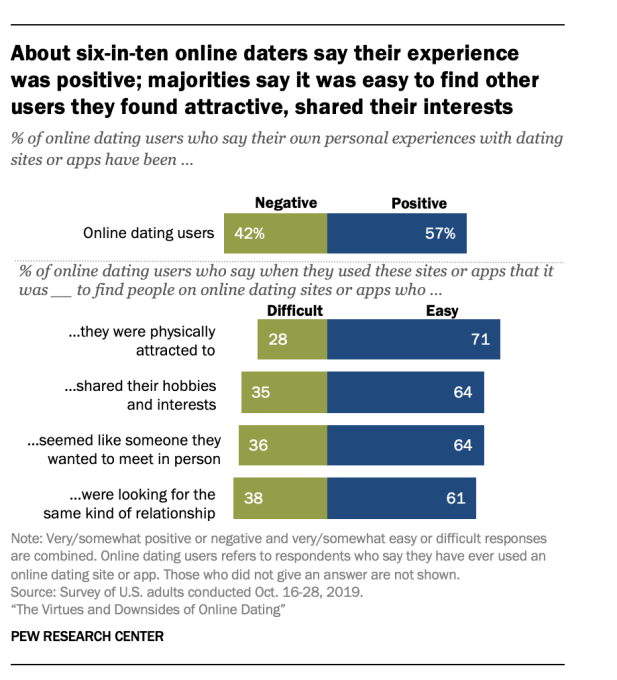
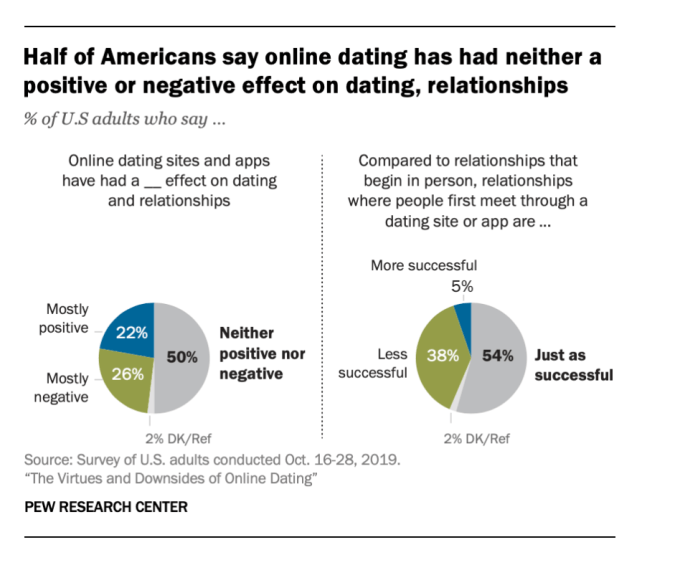
Despite the issues associated with online dating, more people (57%) reported a positive experience compared with a negative one (42%). But overall, Pew found that people were fairly ambivalent about how online dating apps and sites impact dating and relationships in America. Half of Americans believe the apps have neither a positive nor a negative impact, for example.

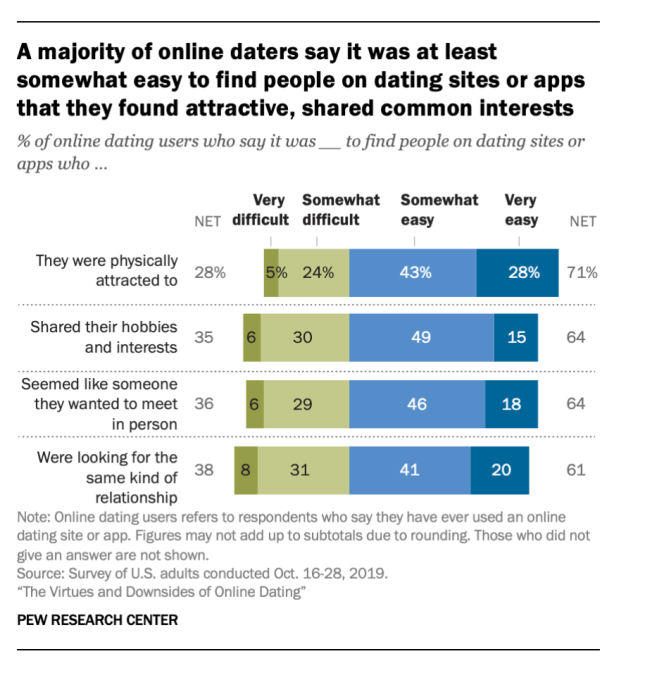
But when current dating app users were asked how the platforms made them feel, more said they felt frustrated (45%) instead of hopeful, pessimistic (35%) instead of optimistic and insecure (25%) instead of confident. This is despite the same group of users saying they found it easy to find people they were attracted to online who seemed like someone they wanted to meet, among other positives.

In addition, a significant portion of U.S. adults (46%) said they don’t think it’s safe to meet people through apps and dating sites. A larger proportion of women believed this (53%) than men (39%) — figures that are likely related to women being more often the target of harassment on the apps.

The full study delves deeper into dating app use and user sentiment along a number of lines, including demographic breakdowns, breakdowns by level of education and user opinion.

Overall, the results come across as muddled. Largely, users seem fine with online dating. Many think it’s easy enough to find potential matches, even if it’s not all that safe. To some extent, users seem to have also accepted being harassed as just part of the online dating experience, given that a majority felt positively about online dating overall, despite the harassment they received.

Other parts of the study seem to point to an understanding of the superficialness of online dating platforms, citing how important photos were to the experience (71% said that’s very important) compared with other values that may make someone more compatible — like hobbies and interests (36% said they’re very important), religion (25% said it’s very important), politics (14%), or even type of relationship someone wants (63%).

A majority of people also believed dating apps were rife with people lying and scamming — 71% and 50%, respectively, said they think it’s very common to find these activities on online dating sites and apps.

In the end, it seems that those who found success with online dating view it more positively than those who haven’t — which is similar to how things work offline, as well.

Pew’s research was conducted from October 16 to 28, 2019 across a panel of 4,860 respondents. The full report is here.

Netflix’s horrible autoplay previews can be turned off

Listen, this week sucks. Last week pretty much sucked, too. Honestly, it’s probably time to just scrap this stupid jerk of a year and give 2021 a go. (Spoiler: That one will suck, too.) But you take your victories where you can get them, and Netflix just handed us a beautiful one for once in our sad, miserable lives.

Some people find this feature helpful. Others not so much.

We’ve heard the feedback loud and clear — members can now control whether or not they see autoplay previews on Netflix . Here's how: https://t.co/6V2TjEW6HD https://t.co/zbz4E8fVab

— Netflix US (@netflix) February 6, 2020

Autoplay trailers are now optional. That’s it. That’s the news. The short but horrible tyranny of autoplay previews are at an end.

Here, do this now:

  1. Click Manage Profiles
  2. Choose your profile
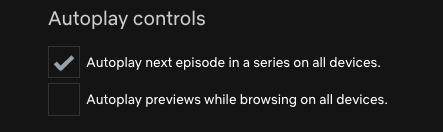
  3. Untick “Autoplay previews while browsing on all devices.
  4. Now live, damnit! Live!

Scroll free, friends. 

Netflix begins streaming in AV1 on Android

Netflix announced this week that it has started to stream titles in AV1 on Android in what could significantly help the two-year-old media codec gain wider adoption.

The world’s biggest streaming giant said on Wednesday that by switching from Google’s VP9 — which it previously used on Android — to AV1, its compression efficiency has gone up by 20%.

At the moment, only “select titles” are available to stream in AV1 for subscribers “who wish to reduce their cellular data usage by enabling the ‘Save Data’ feature,” the American firm said.

Netflix hasn’t shared much about the benefit AV1 will provide to customers, but the new media codec’s acceptance nonetheless sends a message by itself.

Tech giants, including Google, have spent years developing and improving media codecs as consumption of data skyrocketed and low-cost devices began to sell like hotcakes. But they just can’t seem to settle on one media codec and universally support it.

Think of Safari and YouTube, for instance. You can’t stream YouTube videos in 4K resolution on Safari, because Apple’s browser does not support Google’s VP9. And Google does not support HEVC for 4K videos on YouTube.

AV1 is supposed to be the savior media codec that gets universal support. It’s royalty-free and it works atop of open-source dav1d decoder that has been built by VideoLAN, best known for its widely popular media player VLC and FFmpeg communities. It is sponsored by the Alliance for Open Media.

Who are the members of Alliance for Open Media? Nearly all the big guys: Apple, Google, Amazon, Netflix, Nvidia, ARM, Facebook, Microsoft, Mozilla, Samsung and Tencent, among others.

But that’s not to say there aren’t roadblocks in the adoption of AV1. Compared to HEVC — the format that AV1 is supposed to replace in popularity — encoding in AV1 was noticeably slower a year ago, as per some benchmark tests.

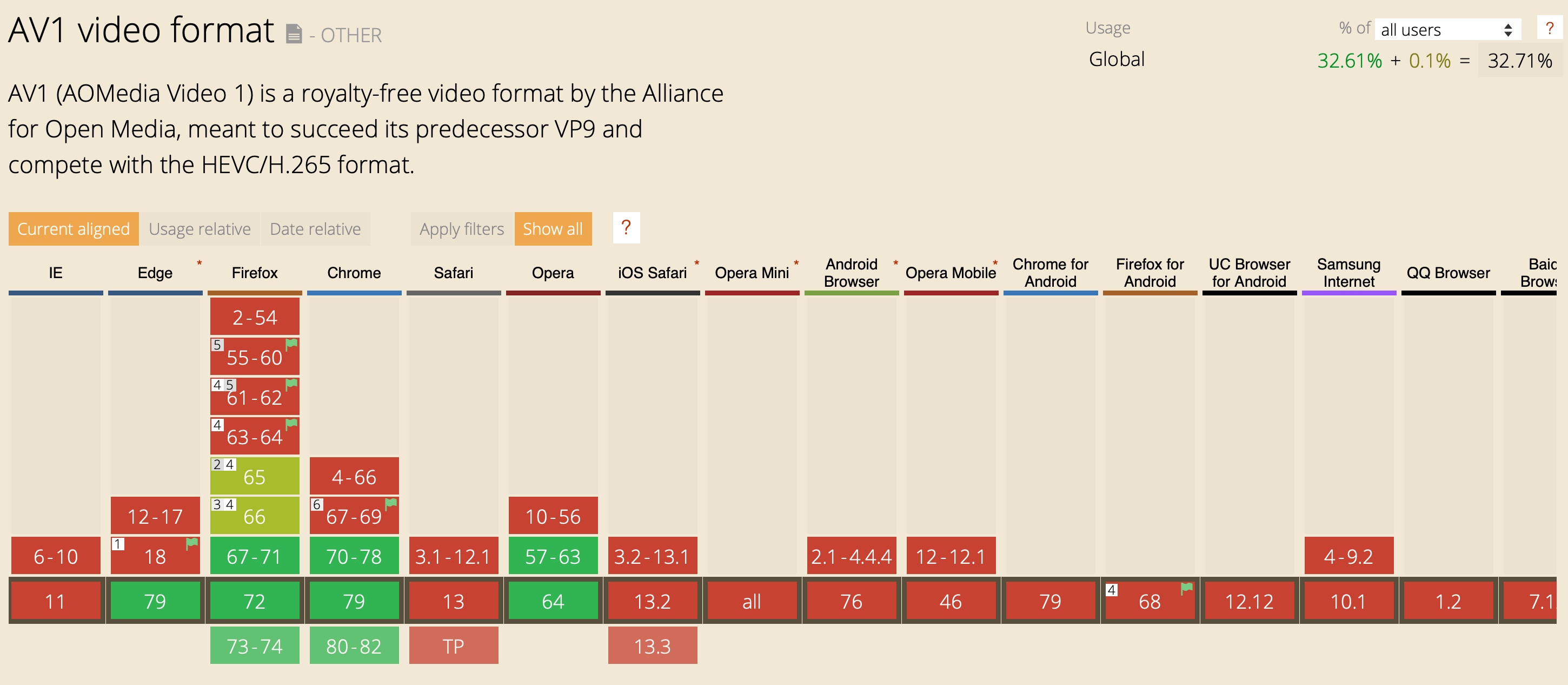
Adoption of AV1 by various browsers, according to analytics firm StatCounter. Safari is yet to support it.

Netflix’s announcement suggests that things have improved. The streaming giant said its goal is to support AV1 on all of its platforms. “In the spirit of making AV1 widely available, we are sponsoring an open-source effort to optimize 10-bit performance further and make these gains available to all,” it said in a blog post.

After Iowa caucus flub, can tech be trusted in elections?

An app intended to speed up reporting of election results for the Iowa caucuses has failed spectacularly, not only confusing the electorate but perhaps poisoning their feelings toward making any technological “improvements” to the voting process whatsoever.

TechCrunch staff reporters Brian Heater, Jonathan Shieber, Zack Whittaker, Devin Coldewey and Ingrid Lunden discussed the issue informally.

Brian Heater: We all agree that this is a good sign of a healthy democracy, right?

Jonathan Shieber: Totally agree with Brian here.

Brian Heater: I’m legitimately finding it difficult to discuss these sorts of things without delving into the conspiratorial. That said, I think it’s far more likely that this was just a massive fuck-up on the part of the Iowa Dems. Chalking it up to a conspiracy is honestly giving them entirely too much credit.

Devin Coldewey: But what’s the nature of the fuck-up? Fundamentally?

Brian Heater: An app that wasn’t tested at the scale of a statewide election. The more we move away from more traditional means of accounting, the more of these we’re going to see.

AllVoices raises $3 million to build a platform for anonymous harassment and bias reporting

As the national conversation pushes companies to reexamine the HR processes suppressing sexual harassment and bias reporting, tech startups are looking to find a way to smooth out the process and encourage communication.

LA-based AllVoices is building an encrypted communications platform for offices that allows employees to anonymously send complaints to their human resources department that can then follow-up and track the cases in an easy-to-use dashboard. CEO Claire Schmidt tells TechCrunch that her company has just closed a $3 million seed round with funding from Crosscut, Greycroft, Halogen Ventures, Vitalize VC and others.

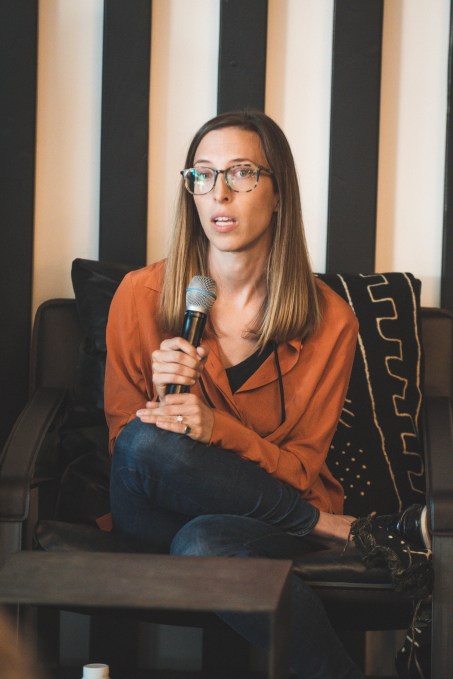
CEO Claire Schmidt

Schmidt, most recently a VP at 20th Century Fox, started AllVoices after finding inspiration in Susan Fowler’s Uber blog post to create a platform that allowed employees at companies to anonymously offer feedback and file reports about internal toxicity. Schmidt says existing processes used for reporting can leave victims of harassment hesitant to come forward and fearful of the risk of damaging their career paths.

“We’re using this really outdated process, we’re basically telling people, ‘Okay, just come in and tell someone in HR, and hope for the best,’ ” Schmidt told TechCrunch in an interview. “And to me that seemed especially unfair to the most vulnerable people in any given work environment because they’re junior, they don’t have as much job security — they’re viewed as more expendable.”

Employees at companies that use AllVoices can log into a mobile app and anonymously submit reports and receive text notifications when they’ve gotten a response from the company, a streamlined process that Schmidt hopes can encourage people to “report in real time.” HR people don’t see names or any other identifying information and AllVoices doesn’t know the name of the employee either, with all communications being encrypted.

“We do encrypt all of our data in storage, in backup, in transit, at rest — at every level,” Schmidt says.

Sixty days after a complaint is made, AllVoices sends a notification to the employee asking whether they were aware of any action being taken by the company and how satisfied they were with it. The startup then aggregates that data and provides it back to the company so they can get a clearer sense of their own responsiveness.

AllVoices isn’t the only startup tackling this issue; in 2018 we profiled Spot, which is also building an anonymous reporting platform. AllVoices’ platform goes beyond streamlining processes for sexual harassment; the startup has modules for general feedback, ethics and compliance issues, culture problems, diversity and inclusion concerns and harassment and bias complaints.

The startup has also aimed to make a free version of its product so that employees at companies that haven’t integrated AllVoices can still make anonymous complaints by entering in an email for someone in their HR department. Schmidt hopes that the free service will serve their broader mission and help them onboard new customers.

AllVoices says they now have nearly 50 companies using the platform, including Instacart, GoPro, Wieden+Kennedy, The Wing and FabFitFun.

Google and Facebook turn their backs on undersea cable to China

Google and Facebook seem to have resigned themselves to losing part of the longest and highest profile internet cable they have invested in to date. In a filing with the Federal Communications Commission last week, the two companies requested permission to activate the Pacific Light Cable Network (PLCN) between the US and the Philippines and Taiwan, leaving its controversial Hong Kong and Chinese sections dormant.

Globally, around 380 submarine cables carry over 99.5 percent of all transoceanic data traffic. Every time you visit a foreign website or send an email abroad, you are using a fiber-optic cable on the seabed. Satellites, even large planned networks like SpaceX’s Starlink system, cannot move data as quickly and cheaply as underwater cables.

When it was announced in 2017, the 13,000-kilometer PLCN was touted as the first subsea cable directly connecting Hong Kong and the United States, allowing Google and Facebook to connect speedily and securely with data centers in Asia and unlock new markets. The 120 terabit-per-second cable was due to begin commercial operation in the summer of 2018. 

“PLCN will help connect US businesses and internet users with a strong and growing internet community in Asia,” they wrote. “PLCN will interconnect … with many of the existing and planned regional and international cables, thus providing additional transmission options in the event of disruptions to other systems, whether natural or manmade.”

Instead, it has been PLCN itself that has been disrupted, by an ongoing regulatory battle in the US that has become politicized by trade and technology spats with China.

Team Telecom, a shadowy US national security unit comprised of representatives from the departments of Defense, Homeland Security, and Justice (including the FBI), is tasked with protecting America’s telecommunications systems, including international fiber optic cables. Its regulatory processes can be tortuously slow. Team Telecom took nearly seven years to decide whether to allow China Mobile, a state-owned company, access to the US telecoms market, before coming down against it in 2018 on the grounds of “substantial and serious national security and law enforcement risks.”

Although subsidiaries of Google and Facebook have been the public face of PLCN in filings to the FCC, four of the six fiber-optic pairs in the cable actually belong to a company called Pacific Light Data Communication (PLDC). When the project was first planned, PLDC was controlled by Wei Junkang, a Hong Kong businessman who had made his fortune in steel and real estate.

“It is just one of those moments where it is more difficult to land a cable, no matter who the Chinese partner is, because of the political situation.” – NYU professor Nicole Starosielski

In December 2017, Wei sold most of his stake in PLDC to Dr Peng Telecom & Media Group, a private broadband provider based in Beijing. That sent alarm bells ringing in Washington, according to a report in the Wall Street Journal last year. While Dr Peng is not itself state-owned or controlled, it works closely with Huawei, a telecoms company the Trump administration has accused of espionage and trade secret theft. Dr Peng has also worked on Chinese government projects, including a surveillance network for the Beijing police.  

PLCN has been legal limbo ever since, with Google complaining bitterly to the FCC about the expense of the ongoing uncertainty. In 2018, it wrote, “[any further holdup] would impose significant economic costs. Depending on the length of the delay, the financial viability of the project could be at risk.”

Google and Facebook finally secured special permission to lay the cable in US waters last year, and to construct, connect and temporarily test a cable landing station in Los Angeles. But while the network itself is now essentially complete, Team Telecom has yet to make a decision on whether data can start to flow through it. 

In the past, Team Telecom has permitted submarine cables, even from China, to land in the US, as long as the companies operating them signed what are called network security agreements. These agreements typically require network operations to be based in the US, using an approved list of equipment and staffed by security-screened personnel. Operators are obliged to block security threats from foreign powers, while complying with lawful surveillance requests from the US government.

In 2017, for example, Team Telecom gave the green light to the New Cross Pacific (NCP) cable directly connecting China and the US, despite it being part-owned by China Mobile, the state-owned company it later denied US access to on national security grounds.

“Normally there wouldn’t be so much fuss over a cable to China,” says Nicole Starosielski, a professor at New York University and author of The Undersea Network. “We’ve had cables to China for a long time and all of these networks interconnect, so even if they don’t land directly in China, they’re only a hop away. It is just one of those moments where it is more difficult to land a cable, no matter who the Chinese partner is, because of the political situation.”

In September, Senator Rick Scott (R-FL), who sits on Senate committees for technology, communications and homeland security, sent a letter to FCC Chairman Ajit Pai urging him to block PLCN. “[PLCN] threatens the freedom of Hong Kong and our national security,” wrote Scott. “This project is backed by a Chinese partner, Dr Peng Telecom & Media Group Co., and would ultimately provide a direct link from China into Hong Kong … China has repeatedly shown it cannot be trusted … We cannot allow China expanded access to critical American information, even if funded by US companies.”

Google and Facebook saw the writing on the wall. On January 29 last week, representatives from the two companies – but not PLDC – met with FCC officials to propose a new approach. A filing, made the same day, requests permission to operate just the two PLCN fiber pairs owned by the American companies: Google’s link to Taiwan, and Facebook’s to the Philippines. 

“[Google] and [Facebook] are not aware of any national security issues associated with operation of US-Taiwan and US-Philippine segments,” reads the application. “For clarity, the [request] would not authorize any commercial traffic on the PLCN system to or from Hong Kong, nor any operation of the PLCN system by PLDC.”

The filling goes on to describe how each fiber pair has its own terminating equipment, with Google’s and Facebook’s connections arriving at Los Angeles in cages that are inaccessible to the other companies. “PLDC is contractually prohibited from using its participation interest in the system to interfere with the ownership or rights of use of the other parties,” it notes.

Neither company would comment directly on the new filing. A Google spokesperson told TechCrunch, “We have been working through established channels in order to obtain cable landing licenses for various undersea cables, and we will continue to abide by the decisions made by designated agencies in the locations where we operate.” 

A Facebook spokesperson said, “We are continuing to navigate through all the appropriate channels on licensing and permitting for a jointly-owned subsea cable between the US and Asia to provide fast and secure internet access to more people on both continents.”

“I think stripping out the controversial [Hong Kong] link will work,” says Starosielski. “But whenever one of these projects either gets thwarted, it sends a very strong message. If even Google and Facebook can’t get a cable through, there aren’t going to be a ton of other companies advancing new cable systems between the US and China now.”

Ironically, that means that US data to and from China will continue to flow over the NCP cable controlled by China Mobile – the only company that Team Telecom and the FCC have ever turned down on national security grounds.

Scaleway launches block storage

Cloud hosting company Scaleway is adding a new service today — block storage. Consumers will be able to purchase additional storage, attach that volume to a cloud instance and use it for a database, for instance.

Block storage works pretty much like plugging an external hard drive to your laptop. You get a ton of free space that you can use with your apps on your server. Compared to object storage, it is particularly useful if you need to constantly read and write data to a database, for instance.

Cloud servers usually come with local storage, but you might reach the limit even though you still have a lot of headroom when it comes to CPU and RAM. Additionally, if you delete your cloud instance, your block storage is still available, and you can attach it to another server. You can manage your volumes in the admin interface, using the Scaleway API or standard DevOps tools, such as Terraform.

Scaleway is also working on a managed Kubernetes service to deploy containerized applications directly. That service is also going to take advantage of block storage.

As for specifications, you can create a volume on any size between 1GB and 1TB. Starting in April, you’ll also be able to scale up your volume without having to detach your volume from your instance. You also can create as many as 15 different volumes for one instance.

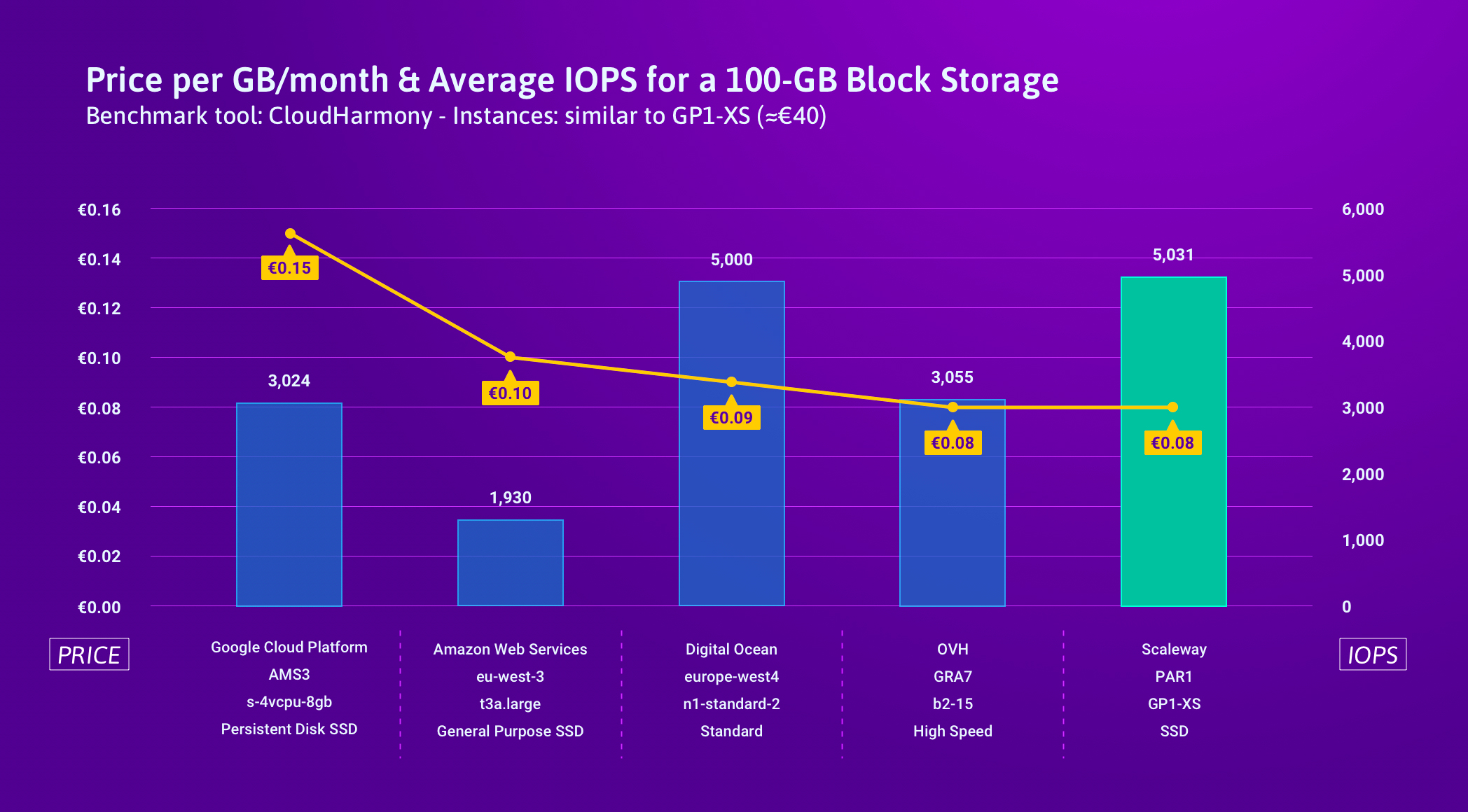
Every volume is replicated three times and you can create snapshots. Scaleway uses SSDs and can handle 5,000 input/output operations per second.

The company charges €0.08 per GB per month. For instance, a 50GB volume will cost you €4 per month. In the future, there will be a more expensive tier at €0.12 per GB per month with performance of 10,000 input/output operations per second.

Scaleway says that its solution is both cheaper and more efficient than what Google and Amazon offer:

Instagram gives unfollow suggestions in new ‘following categories’

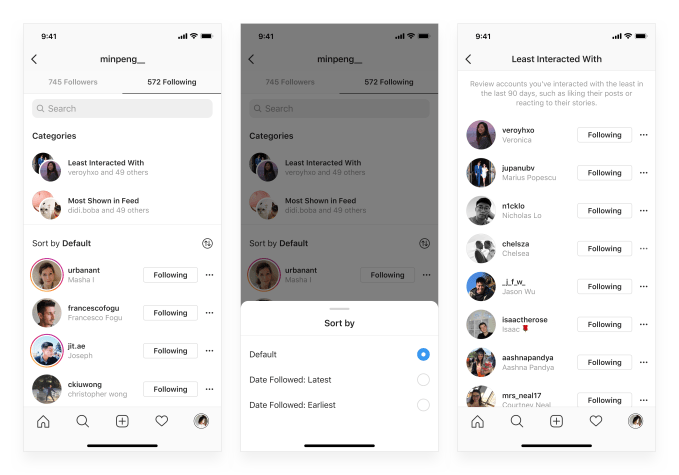
Instagram will now show you who you interact with least frequently in case you want to unfollow them. In an effort to help you keep your feed clean and relevant, today Instagram is launching “following categories” that divides the list of who you follow into batches, including “most seen in feed” and “least interacted with.” That way if someone annoying or boring is overwhelming your feed, or there’s someone whose content you’ve proven to not be interested in, you can easily remove them. Time to axe those courtesy and pity follows.

“Instagram is really about bringing you closer to the people and things you care about — but we know that over time, your interests and relationships can evolve and change,” a spokesperson tells me. “Whether you graduate, move to a new city, or become obsessed with a new interest and find a community, we want to make it easier to manage the accounts you follow on Instagram so that they best represent your current connections and interests.”

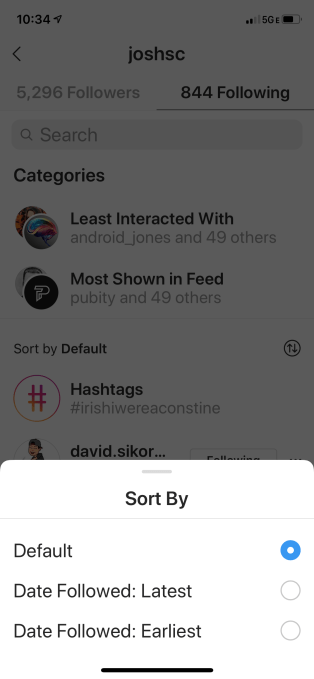
To access the feature, go to your profile, then “following,” then you’ll see the categories you can explore. You’re also able to sort who you follow by earliest to latest and vice versa, in case you want to clear out your earliest adds or make sure you actually care about the latest people you followed.

By increasing the density of high-quality posts in your feed and Stories by getting you to unfollow irrelevant accounts, Instagram could boost ad views. You’ll come across fewer lame posts that might make you close the app so you instead keep scrolling and fast-forwarding while racking up ad impressions. Instagram reportedly hit $20 billion in 2019 revenue according to Bloomberg.

I’ve been asking Twitter to build unfollow suggestions since 2013, but Instagram beat them to it. Even with filtered feeds, the algorithms can get things wrong and show too much of people you don’t care about.

Following back or adding someone who asks has become part of the modern-day social contract. It can be rude and cause drama to refuse, so people just bloat their following list. Manually sorting through, trying to remember who people are and if you see them too often or constantly ignore them can be a slow and emotionally draining chore. With Instagram now 10 years old, Twitter 14 and Facebook 16, we’ve had a long time to accidentally screw up our social graph.

Perhaps unfollow suggestions took this long because no app wants to overtly shame specific people. But Instagram’s approach via clear, quantifiable categories is just vague enough that you probably won’t screenshot them and show the friends it said to nix. With that sensitivity, Instagram has pulled off the rare feat of improving the user experience while simultaneously benefiting its revenue engine.