Facebook’s Twitter account compromised, hacker group claims credit

There’s this brilliant feeling on Fridays if you’re a reporter when you think that all the things you have to write about are complete. You kickstart some work for Monday. Maybe you tighten up a to-do list. Hell, you might even read some email.

But then on Fridays like today, something eye-catching happens and the Great Content Gods demand written sacrifice and here we are.

Facebook’s Twitter main page and Messenger were temporarily vandalized by a person or persons claiming to be from the OurMine hacker collective. The action, and the group, should sound slightly familiar as it hacked a bunch of sports-related Twitter accounts just this January.

Trawling the TechCrunch archives turns up the OurMine name more times than I reckoned it would. For example, OurMine also hacked the Twitter account of Niantic’s CEO back in 2016. Later that year, OurMind also hacked several media-related Twitter accounts. Hell, OurMine actually hacked TC once — a fact that this episode brought to my attention.

TechCrunch has reached out to Facebook for comment on the compromise. We’re not expecting to hear back anything of substance but, if we do, we’ll update this post. Twitter provided public comment regarding the hack, saying that it “locked the compromised accounts and are working closely with our partners at Facebook to restore them” when it noticed the matter.

What was posted? The following, per a screenshot taken by TechCrunch’s security sage Zack Whittaker:

lol, what is this, 2016? pic.twitter.com/G59Z5gnZfp

— Zack Whittaker (@zackwhittaker) February 7, 2020

As you can see from the screenshot, the tweet appears to have been posted via Khoros. Khoros, in case you also didn’t know, sells software to help companies use social media to interact with customers and users. So, perhaps the Folks With Time On Their Hands got in that way. Either way it was taken down quickly. (Khoros is based in Austin and has raised no known venture capital, per Crunchbase.)

And with that, Friday really is a go.

Los Angeles-based SureSale is developing an independent certification service for used cars

Donny Hall, the chief executive and co-founder of the used car certification service, SureSale, knows used cars. The serial entrepreneur built and sold a previous business, CarSure, which was an insurance plan for vehicle repairs.

After selling that business in 2017 to Innovative Aftermarket Systems, Hall decided that his next venture would be to take on the used car industry’s dominant source for historical information about a vehicle — Carfax .

His Santa Monica, Calif.-based SureSale has raised $7 million in financing from the LA-based investment firm Upfront Ventures to create a national used car certification service that dealers and car shoppers around the country can turn to for an unbiased assessment of a vehicle and its problems, according to Hall.

“66 percent of consumer want to buy cars that are certified and only 7 percent do,” says Hall. “Independents don’t have any national [certification] program and dealers don’t have national programs.”

The company integrates background checks, insurance, and provides a limited warranty and five-day exchange options for vehicles assessed through its program.

To launch the business, Hall partnered with Jeffrey Schwartz, the co-founder of the used car marketplace and review platform, Autobytel.

Used car dealerships are hurting in the ecommerce age just like other traditional retailers. SureSale is betting that its value-added services and better reporting standards can give dealers a competitive advantages versus online services like Carmax.

Dealerships pay for the service, but in return their customers get a full inspection, a title and a background check alongside the five month warranty.

“Even though there have been a number of recent startups that have seen massive exits in this category like Carvana ($13BN market cap) and Carmax ($16BN market cap), given that each company has less than 2% market share, any market this large is always ripe for continued efficiency gains,” wrote UpFront Ventures partner and SureSale director, Kobie Fuller, in a blog post.

White House reportedly aims to double AI research budget to $2B

The White House is pushing to dedicate an additional billion dollars to fund artificial intelligence research, effectively doubling the budget for that purpose outside of Defense Department spending, Reuters reported today, citing people briefed on the plan. Investment in quantum computing would also receive a major boost.

The 2021 budget proposal would reportedly increase AI R&D funding to nearly $2 billion, and quantum to about $860 million, over the next two years.

The U.S. is engaged in what some describe as a “race” with China in the field of AI, though unlike most races this one has no real finish line. Instead, any serious lead means opportunities in business and military applications that may grow to become the next globe-spanning monopoly, a la Google or Facebook — which themselves, as quasi-sovereign powers, invest heavily in the field for their own purposes.

Simply doubling the budget isn’t a magic bullet to take the lead, if anyone can be said to have it, but deploying AI to new fields is not without cost and an increase in grants and other direct funding will almost certainly enable the technology to be applied more widely. Machine learning has proven to be useful for a huge variety of purposes and for many researchers and labs is a natural next step — but expertise and processing power cost money.

It’s not clear how the funds would be disbursed; It’s possible existing programs like federal Small Business Innovation Research awards could be expanded with this topic in mind, or direct funding to research centers like the National Labs could be increased.

Research into quantum computing and related fields is likewise costly. Google’s milestone last fall of achieving “quantum superiority,” or so the claim goes, is only the beginning for the science and neither the hardware nor software involved have much in the way of precedents.

Furthermore quantum computers as they exist today and for the foreseeable future have very few valuable applications, meaning pursuing them is only an investment in the most optimistic sense. However, government funding via SBIR and grants like those are intended to de-risk exactly this kind of research.

The proposed budget for NASA is also expected to receive a large increase in order to accelerate and reinforce various efforts within the Artemis Moon landing program. It was not immediately clear how these funds would be raised or from where they would be reallocated.

HopSkipDrive raises $22 million to focus on school transportation; 70 percent of revenue is enterprise

It’s no secret that it’s hard to make the economics work at drive-share companies. That may explain the success to date of HopSkipDrive, a six-year-old, L.A.-based company that pairs drivers with both families but also, crucially, school districts. Specifically, the now 100-plus person company has deals in place with school districts in 13 markets across eight states where it works with more than 7,000 contractors. All, says cofounder and CEO Joanna McFarland, have at least five years of childcare experience before they are allowed to drive for the startup.
Interestingly, McFarland says the school systems’ most burning need is to ensure the safe arrival of both homeless and foster children, whose numbers in the U.S. have reached an astonishing 2.5 million and 440,000, respectively. On the heels of a brand-new funding round, we asked her what’s going on and why.
TC: You’re just announcing $22 million in new venture backing, congratulations. I wonder if your story was harder to tell investors than it might have been a year ago, when they were more bullish on car-share companies.
JM: We’ve never considered ourselves comparable to Uber or Lyft. We’re really caregivers on wheels, providing a very different service. We work with families, but we also contract with school districts and counties, and that has a strong path to profitability. We can predict supply and demand; we’re [enjoying] contracted revenue. It’s very different.
TC: How do you describe the market opportunity?
JM: U.S school districts spend $25 billion a year on transportation, yet only one-third of kids take a bus to school, so it’s expensive and inefficient and meanwhile districts are being asked to do more with less.
Particularly challenging for them are children with specialized needs or homeless children who are moving around a lot but have the same right to get to school. It’s hard to re-route school buses, so we help schools with alternative transportation. Once we’ve contracted with them, we’re available, including to pick up a student who might be in foster care and moved to a new place at 10:30 at night. We can still pick them up the next morning.
TC: There are thousands of homeless children attending San Francisco schools. Are you serving other markets where housing prices are forcing more families on to the streets? 
JM: Unfortunately, there’s a large and growing population in a lot of places. Districts might not even know how many students are homeless or in foster care because their situations can change so significantly throughout the year. It might start with 500 students at the beginning of the year and end with 1,000. Because it fluctuates so much, it puts a ton of demand on these transportation directors to figure it out.
We’re partnered with L.A. County, for example, and it has the largest child welfare system in the country, with 88 districts and between 20,000 and 30,000 kids in foster care at any one time. It’s not a great statistic for L.A., but it’s the reality.
TC: And it’s one driver, one child?
JM: Sometimes there will be two or three kids. We can do carpools. If there are group homes, we’ll take them to their different schools.
TC: What do your contracts look like then with these school districts?
JM: We dictate the ride price, then it’s really on as as-needed basis. They pay for what they need. We talk with them about their needs last year and this year and that does help us tremendously with supply and demand.
TC: How much of your business is coming from school partnerships versus from families that hire your company to take their kids to soccer games?

JM: Our business for families is growing organically, there’s such a need for it, but 70 percent of our revenue comes from [school districts].

TC: Your drivers are 1099 workers, so presumably they are working for other ride-share or other gig-economy companies? How busy can you keep them?
JM: They are contractors. Because they must have five years of caregiving experience and because of the vetting we do, 90 percent of them are female,  and they love what they do because they’re driving in communities where their kids grew up and they’re tied to the mission of what we’re doing.
We have some overlap with other gig companies, but with [HopSkipDrive] there’s safety on both sides of the platform, meaning they are driving kids, they aren’t driving late at night, they aren’t driving anyone who is drunk. They also have control over where they drive and when, based on personal preferences. They can choose some rides before school so they can take care of an elderly relative or grandchildren. They can see rides that are available up to a week in advance and select which ones they want depending on their schedule. Many are semi-retired and not looking for full-time income.
TC: How can parents be certain their kids are safe?
JM: We have a dual authentication process so drivers confirm a code word with the child and another piece of information that the child will know. Parents can track the rides in real time. We also have tech that monitors rides and can detect anomalies and provide support as needed. For example, they know via GPS and sensors if a driver is hitting traffic or has stopped owing to a flat tire and can react proactively, whether it is to send another car (in the case of a flat tire) or let the school and parents know that the child will be late. We designed the whole system for when a passenger may not have a phone.
TC: Why start this company?
JM: I started in finance then went into product management, working for tech companies. But as I was working, I was also growing my family, and I couldn’t get my son to karate at 3 o’clock. It was so frustrating. I didn’t need a nanny. I just needed to get him to karate.
All the moms I knew had their own version of this transportation story. [At a school function] I suggested we put out money in a pot and hire a driver, and another mom said, ‘How do we do that?’ She’s one of my cofounders.
Pictured above from left to right: HopSkipDrive cofounders Carolyn Yashari Becher. Joanna McFarland, and Janelle McGlothlin

Deep data running wearable NURVV closes $9M Series A led by Hiro Capital

Launched at CES 2020, NURVV, a biomechanics startup, has closed a $9m Series A round, led by Hiro Capital, the sports/Esports VC fund, along with co-investment from Ian Livingstone CBE (Games Workshop co-founder) and Cherry Freeman (co-founder of LoveCrafts).

It turns out that if you can figure out how to protect a smartphone from smashing, you can also work out how high a basketball player can jump.

Jason Roberts founded Tech21, one of the world’s leading smartphone case manufacturers. He and his co-founder and wife Ulrica have now used that knowledge to launch new wearable tech product, which, when inserted into the sole of a shoe, can measure the strike of a foot on the ground, or the leap of its wearer.

The wearable uses 32 sensors fitted inside lightweight insoles to capture data from the feet at 1,000 times per second, per sensor.

The money will be used to bring NURVV’s debut product, NURVV Run, to a global market and fund further R&D.

Featured among the best lists of Wired, CNET and Gear Patrol, the wearable has also been tested by the UK’s National Physical Laboratory over the past three years,

It can measure running metrics such as cadence, step length, footstrike, pronation and balance, feeding the data into the NURVV Run coaching app to show a picture of the wearer’s running technique, and thus helping runners improve their technique and pace.

While runners are already able to collect a huge amount of data about their run, the data is always after the run. Jason Roberts, founder and CEO, says NURVV Run captures a runner’s metrics “directly from the point of action at the foot, before using live coaching to help them improve in a simple, easy-to-understand way.”

Speaking to TechCrunch, Jason Roberts told me that the technology built into the sole is more “accurate than watches for steps, strides or energy dissipated. It will even detect when you are injured.”

He said “you could even broadcast a player’s live steps. Imagine if you could see that data from basketball?”

Co-founder Ulrica Roberts (pictured) added: “We kept coming back to the same question: ‘Why is running measured from the wrist, when most of the important metrics happen at the feet?… We sought out the expertise to make it happen.”

Luke Alvarez, managing Partner of Hiro, said in a statement: “Hiro is delighted to be investing in NURVV as our Fund’s fourth deal and our first Sports tech investment. NURVV’s success comes from putting the athlete’s body at the heart of everything they do. Nurvv is based on fundamental patented sensor technologies combined with deep biomechanics and data science that have revolutionary potential across sports, gaming, VR/AR and wellness.  Jason and Ulrica are extraordinary entrepreneurs and we are excited to be working with them and their team to take NURVV to the next level.”

Twitter-backed ShareChat eyes fantasy sports in India

The growing market of fantasy sports in India may soon have a new and odd entrant: ShareChat .

The local social networking app, which in August last year raised $100 million in a financing round led by Twitter, has developed a fantasy sports app and has been quietly testing it for six months, two sources familiar with the matter told TechCrunch.

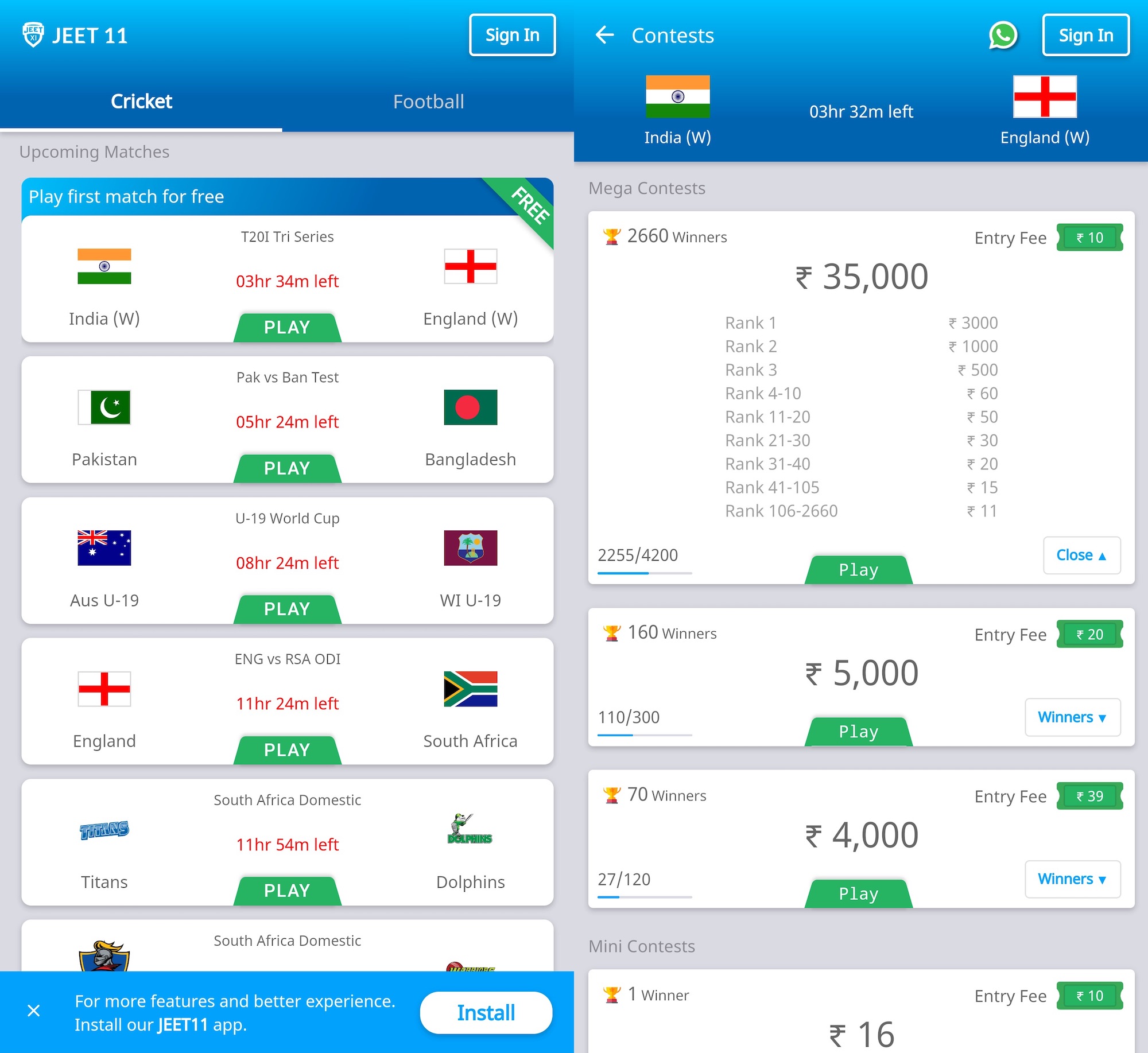
ShareChat’s fantasy sports app, called Jeet11, allows betting on cricket and football matches and has already amassed more than 120,000 registered users, the sources said. The app, or its website, does not disclose its association with ShareChat.

A ShareChat spokesperson confirmed the existence of the app and said the startup was testing the product.

Jeet11 is not available for download on the Google Play Store due to the Android maker’s guidelines on betting apps, so ShareChat has been distributing it through Xiaomi’s GetApps app store and the Jeet11 website, and has been promoting it on Instagram. It is also available as a web app.

Fantasy sports, a quite popular business in many markets, has gained some traction in India in recent years. Dream11, backed by gaming giant Tencent, claimed to have more than 65 million users early last year. It has raised about $100 million to date and is already valued north of $1 billion.

Bangalore-based MPL, which counts Sequoia Capital India as an investor and has raised more than $40 million, appointed Virat Kohli, the captain of the Indian cricket team, as its brand ambassador last year.

In the last two years, scores of startups have emerged to grab a slice of the market, and the vast majority of them are focused on cricket. Cricket is the most popular sport in India, just ask Disney’s Hotstar, which claimed to have more than 100 million daily active users during the cricket season last year.

Or ask Facebook, which unsuccessfully bid $600 million to secure streaming rights of the IPL cricket tournament. It has since grabbed rights to some cricket content and appointed the Hotstar chief as its India head.

So it comes as no surprise that many sports betting apps have signed cricketers as their brand ambassador. Hala-Play has roped in Hardik Pandya and Krunal Pandya, while Chennai-based Fantain Sports has appointed Suresh Raina.

But despite the growing popularity of fantasy sports apps, where users pick players and bet real money on their performances, the niche is still sketchy in many markets that consider it betting. In fact, Twitter itself restricts promotion of fantasy sports services in many markets across the world.

In India, too, several states, including Assam, Arunachal Pradesh, Odisha, Sikkim and Telangana, have banned fantasy sports betting. Jeet11 currently requires users to confirm that they don’t live in any of the restricted states before signing up for the service.

“It doesn’t help matters either that the fantasy sports business’ attempts at legitimacy involve trying to be seen as video games — a cursory glance at a speakers panel for any Indian video game developer event is evidence of this — rather than riding on its own merits,” said Rishi Alwani, a long-time analyst of Indian gaming market and publisher of news outlet the Mako Reactor.

An executive who works at one of the top fantasy sports startups in India, speaking on the condition of anonymity, said that despite handing out cash rewards to thousands of users each day, it is still challenging to retain customers after the conclusion of any popular cricket tournament. “And that’s after you have somehow convinced them to visit your website or download the app,” he said.

For ShareChat, which has been exploring ways to monetize its 60 million-plus users and posted a loss of about $58 million on no revenue in the financial year ending March 31, that’s anything but music to the ears. In recent months, the startup, which serves users in more than a dozen local languages, has been experimenting with ads.

NASA panel recommends Boeing software process reviews after revealing second Starliner issue

NASA’s Aerospace Safety Advisory Panel (ASAP) is recommending that Boeing’s software testing processes undergo a review, following the discovery of another problem with the on-board system that was in operation during the CST-100 Starliner uncrewed Space Station docking test launch in December. Starliner never made it to the Space Station as planned during that launch, due to a mission timer error that resulted in the capsule burning too much fuel too early in the flight.

During their meeting on Thursday, the ASAP group revealed that there was a second software “anomaly” detected during the mission, which was corrected while the capsule was in flight, Space News reports. Had the issue not been noticed and corrected, the result would’ve been misfired thrusters that could’ve ultimately led to a “catastrophic spacecraft failure,” per panel member Paul Hill via Space News.

Both Boeing and NASA are currently investigating the issues that occurred during the test mission. Both partners also stressed that the launch, which did result in a successful Starliner re-entry and landing in White Sands, New Mexico, accomplished a number of planned tests despite not making it to the ISS.

At the time, they also pointed out that the error with the mission timer would not have resulted in any danger to any astronauts on board. This newly disclosed error sounds like it may have been more severe, without correction, and it was fixed just two hours prior to the capsule’s re-entry into Earth’s atmosphere.

Accordingly, the panel would like to see review of Boeing’s systems engineering, software integration and verification testing, and that doing so should precede a decision about whether or not to go ahead with either another uncrewed yes launch, or move ahead to the crewed test flight which would’ve been the next step had everything gone to plan on the December launch.

NASA has already decided to go ahead and conduct an “organizational safety assessment,” the panel said, which it has already conducted for fellow commercial crew program participant SpaceX last year.

Speaking of SpaceX, the panel also shared that its program is “at a point where there is not a question of whether they will be flying crew in the near term, but when,” which does sound promising for their goal. Separately, a report on the Commercial Crew Program issued by the U.S. Government Accountability Office (GAO) earlier this week revealed that SpaceX is actually ahead of its current schedule on delivering the Crew Dragon capsule for the first operational crew mission.

Boeing provided TechCrunch the following statement regarding the ASAP’s statements at the meeting on Thursday:

We accept and appreciate the recommendations of the jointly led NASA-Boeing Independent Review Team (IRT) as well as suggestions from the Aerospace Safety Advisory Panel following Starliner’s Orbital Flight Test (OFT). Their insights are invaluable to the Commercial Crew Program and we will work with NASA to comprehensively apply their recommendations.

  • Regarding the Mission Elapsed Timer anomaly, the IRT believes they found root cause and provided a number of recommendations and corrective actions.
  • The IRT also investigated a valve mapping software issue, which was diagnosed and fixed in flight. That error in the software would have resulted in an incorrect thruster separation and disposal burn. What would have resulted from that is unclear.
  • The IRT is also making significant progress on understanding the command dropouts encountered during the mission and is further investigating methods to make the Starliner communications system more robust on future missions.

We are already working on many of the recommended fixes including re-verifying flight software code.

Our next task is to build a plan that incorporates IRT recommendations, NASA’s Organizational Safety Assessment (OSA) and any other oversight NASA chooses after considering IRT findings. Once NASA approves that plan, we will be able to better estimate timelines for the completion of all tasks. It remains too soon to speculate about next flight dates.

Shrunken unicorn Fair cancels car leasing to Uber drivers

When Fair laid off 40% of its staff in October, CEO Scott Painter promised it wasn’t shuttering leasing services to on-demand fleets. But just one week later, Painter was removed as CEO and replaced in the interim with Adam Hieber, a CFA from Fair investor SoftBank. Today, according to two sources, Fair announced at an all-hands meeting that it would end its Fair Go program that helped Uber drivers lease cars. The program will cease in April. Uber now confirms the news to TechCrunch, and now Fair has directly confirmed the news to us as well.

“Due to an unexpected increase in insurance premiums that would have significantly raised prices for Fair’s rideshare drivers, we will wind down our weekly rideshare service over the coming months,” a spokesperson said. “We are working to minimize the disruption for Fair’s rideshare drivers, including notifying these customers of the status of their subscription in the coming weeks. We are working closely with Uber and exploring options with third parties to provide alternative customer mobility options to ensure a seamless transition for them, as well as continuity in Uber’s vehicle supply. We are thankful for our loyal Fair rideshare drivers and are disappointed we can no longer operate the business in a cost-effective way for our customers.”

Formerly valued at $1.2 billion after raising over $2 billion in equity and debt financing from SoftBank and Lightspeed, Fair laid off 40% of its staff in October. It had bought Uber’s XChange leasing program in early 2018. The deal lets drivers lease an Uber-eligible car with subscriptions to roadside assistance and maintenance for as low as $130 per week with a $500 start fee.

But Uber had sold the leasing program because it was unprofitable and adding to its losses at a tough time for the rideshare giant. As additional fees stacked up, Fair didn’t fare much better operating it.

A source tells us Fair Go was profitable. It was an important focus for the company as it retooled its subscription services for traditional drivers. Another source says at one point Fair Go was adding about 250 to 300 car leases per day and had thousands of active leases.

But Fair Go was facing higher insurance rates from carriers, which make sense since Uber drivers can be on the road far, far longer than traditional car owners.

Rather than trying to pass those fees along to drivers — many of whom are already cash-strapped — Fair told employees it would cease to lease to Uber drivers. That’s a respectable choice, since it could have pushed Uber drivers into debt if they didn’t fully comprehend what their total costs would be.

Attempts to reach Fair for comment were complicated by many of its in-house PR team being hit with October’s layoffs. An agency representative provided the statement above after publishing time.

An Uber spokesperson confirmed the shut down of Fair Go and their partnership, telling TechCrunch that “Unlocking options for vehicle access so drivers can earn with Uber remains a top priority. We’re thankful for Fair’s collaboration, and their contributions to our vehicle rental program. We’re continuing to invest in rental partnerships, and building more flexibility beyond hourly, weekly, and monthly options available today.” 

Uber tells me it remains committed to offering rental options to drivers through partnerships with Hertz, Avis, ZipCar and Getaround, and they may be able to work with Uber drivers formerly leasing from Fair.

Painter kept a role as chairman of Fair.com when he stepped away from the CEO position at the end of October — a change we are still confirming is in place today. At the time of the layoffs in October, he maintained that the action was proactive, and not in response to SoftBank pressure.

“SoftBank is a big shareholder and supporting my focus, and that is the reality right now,” Painter said at the time. “Leaning on us is not the term,” he added in response to our questions of whether SoftBank pressured it to make these changes. “They are supporting us — there is a big difference,” he stressed.

The CEO change one week later, and today’s news about Fair Go, points to a different unfolding of events that speaks to the pressure SoftBank itself is under.

The news is the latest low point for the SoftBank portfolio in the wake of the WeWork implosion. That’s caused potential repeat LPs for SoftBank’s massive Vision Fund to tighten their purse strings and other late stage investors to focus on sustainable unit economics. Late-stage startups have been left scrambling to cut their burn rates, often through layoffs.

SoftBank’s portfolio, which may have trouble raising on good terms after what many saw as inflated valuations propped up by the megafund, has been hit the hardest. This week TechCrunch broke the news that Flexport was laying off 3% of staff, or 50 employees.

Other SoftBank-funded company layoffs include Zume Pizza (80% of staff laid off), Wag (80%), Getaround (25%), Rappi (6%), and Oyo (5%). There may be more to come: activist investor Elliott Management, which now owns more than $2.5 billion of SoftBank shares, has reportedly been in talks with the company over a range of issues including better corporate governance and more transparency and management around investments.

Updated with confirmation from Fair, and a correction that Uber will continue offering car rentals through partners but not leasing as we originally printed.

Is your startup using AI responsibly?

Ganes Kesari
Contributor

Ganes Kesari is a co-founder and head of analytics at Gramener. He helps transform organizations through advisory in building data science teams and adopting insights as data stories.
More posts by this contributor

Since they started leveraging the technology, tech companies have received numerous accusations regarding the unethical use of artificial intelligence.

One example comes from Alphabet’s Google, which created a hate speech-detection algorithm that assigned higher “toxicity scores” to the speech of African Americans than their white counterparts. Researchers at the University of Washington analyzed databases of thousands of tweets deemed “offensive” or “hateful” by the algorithm and found that black-aligned English was more likely to be labeled as hate speech.

This is one of countless instances of bias emerging from AI algorithms. Understandably, these issues have generated a lot of attention. Conversations on ethics and bias have been one of the top themes in AI in the recent past.

Organizations and actors across industries are engaging in research to eliminate bias through fairness, accountability transparency and ethics (FATE). Yet, research that is solely focused on model architecture and engineering is bound to yield limited results. So, how can you address this?

Resolving misconceptions on fighting AI bias

Fixing the model is insufficient, as that’s not where the root cause lies. To find out which measures can yield better results, we must first understand the real reasons. We can then look at potential solutions by studying what we do in the real world to tackle such biases.

AI models learn by studying patterns and identifying insights from historical data. But human history (and our present) is far from perfect. So, it’s no surprise that these models end up mimicking and amplifying the biases that lie in the data used to train them.

This is fairly clear to all of us. But, how do we handle such inherent bias in our world?

We inject bias to fight bias. When we feel that a community or segment of the population could be disadvantaged, we avoid basing our conclusion solely on past instances. At times, we go a step further and make inclusions to provide opportunity to such segments. This is a small step to reversing the trend.

This is the very step that we must take while teaching models. So, how do we inject human bias to fight the inherent “learned” bias of models? Here are some steps to achieve that.

Add diverse roles to your data science team

Advocating reform, activist investor Elliott Management takes a $2.5B stake in SoftBank

The activist investment firm Elliott Management has steadily amassed a $2.5 billion stake in the headline-grabbing, Japanese technology conglomerate SoftBank even as a series of missteps battered the company’s share price.

Famous for its investments in companies like Slack and Uber and infamous for betting billions on the co-working real estate marketplace and development company WeWork, SoftBank presented an enticing target for Elliott’s brand of financial speculation, according to an initial report in The Wall Street Journal.

Last November, SoftBank Group reported a $6.5 billion loss thanks in part to its efforts to bail out its investment in WeWork — a company once valued in private markets at $47 billion.

Those losses sent the stock price tumbling, but despite its troubles, SoftBank still holds a vast stable of portfolio companies. It’s those assets that Elliott Management thinks are appealing enough to carve out some of its $34 billion in assets under management for a minority stake.

Elliott’s substantial investment in SoftBank Group reflects its strong conviction that the market significantly undervalues SoftBank’s portfolio of assets,” a spokesperson for the firm wrote in an email. “Elliott has engaged privately with SoftBank’s leadership and is working constructively on solutions to help SoftBank materially and sustainably reduce its discount to intrinsic value.”

SoftBank made waves in the technology investment world with its massive $100 billion Vision fund, which was designed to take stakes in emerging technology companies that required lots of cash, but could potentially transform various industries.

The audacious investment strategy was financed by working with sovereign wealth funds like the Saudi Arabian Public Investment Fund (whose principals are linked to a leadership known for ordering the assassination of journalists) and companies like Apple and Microsoft.

Through its limited partners and with its own cash, SoftBank was able to take large equity stakes in companies across a range of different industries. However, it now appears that those large equity stakes will be difficult to maintain or justify.

Over the last year, several of SoftBank’s portfolio companies have run into trouble, and it’s an open question whether any changes Elliott might be able to effect at the top of the organization would have an impact on the performance of the underlying portfolio.

Indeed, given SoftBank founder Masayoshi Son’s 22% ownership stake in the business, any corporate activism that Elliott may initiate or advocate for could have limited results.

There are good businesses in the SoftBank portfolio, and public investors have rushed in to buy the company’s stock on the back of the disclosure of Elliott Management’s investment.

However, the flood of capital that came into the venture market in 2018 seems to have crested, which could leave SoftBank and its new investors soaked.

Watchdog says DHS still hasn’t got a 2020 election security plan

Homeland Security’s cybersecurity advisory unit “has not yet completed” its plans to secure the 2020 presidential election, a government watchdog has said.

The report, published on Thursday by the Government Accountability Office, said the unit, CISA, is “not well-positioned to execute a nationwide strategy for securing election infrastructure prior to the start of the 2020 election cycle.”

The watchdog said the unit should “urgently finalize” its plans to help state and local officials secure their election infrastructure.

But CISA said it was unlikely to complete half of its operations plan dedicated on protecting political campaigns and raising awareness of the threats of foreign influence.

Those same two issues caused major disruption during the 2016 presidential election following the hack of the Hillary Clinton’s campaign, and a massive coordinated disinformation effort by the Russian government.

The report said as of November, CISA had carried just 161 vulnerability assessments, aimed at preventing remote access to election infrastructure, at the local level, out of the thousands of local jurisdictions across the United States. The watchdog also said that CISA “has not developed plans” for how it will respond in the event of a security incident on Election Day.

The watchdog blamed an ongoing reorganization at CISA as partly to blame for the lack of plan. The Homeland Security division has reportedly faced low morale and at least one high-profile departure. Last year, Jeanette Manfra, CISA’s assistant director for cybersecurity, whose responsibilities included election security, left the government for a new role at Google.

The report’s damning verdict came just days after the chaotic Iowa caucus, which saw results delayed for days after the state’s Democrats used a result-reporting app that failed to work as planned. The caucus marked the first effort by the Democrats to nominate a candidate to run against the incumbent, President Trump.

Sara Sendek, a spokesperson for CISA, said the agency had spent three years working to secure elections and that the cybersecurity unit was “prepared and ready” to support the election community.

“Our work is not done, we continue to build and grow every day, but we understand the threat and the need to take action to keep our systems safe, and we are ready for 2020,” said the spokesperson.

Latin America takes the global lead in VC directed to female co-founders

Claire Diaz-Ortiz
Contributor

Claire Diaz-Ortiz is an angel investor and bestselling author of nine books that have been published in more than a dozen countries. An early employee at Twitter, she was called “The Woman Who Got the Pope on Twitter” by Wired and holds an MBA and other degrees from Stanford and Oxford.

When Flavia Deutsch and Paula Crespi were raising a groundbreaking $1.7 million seed round for their parenting startup in Brazil, they had to turn away male investors.

“The men were already writing us checks, but the women — we had to convince them,” Deutsch explained of the seed round for Theia, which ended the year as the largest all-female founded company raise in Latin America. “For every male investor we had, we wanted one female investor as well,” Deutsch said. And for good reason.

Many studies have established that female-founded companies outperform their all-male counterparts. Boston Consulting Group reports that for every dollar a female founder or co-founder raises, she generates 2.5X more revenue than a male founder.1 First Round Capital’s research held that the female-founded companies it backed performed 63% better than all-male founding teams.2 The Ewing Marion Kauffman Foundation’s showed that return on investment from women-led teams is 35% higher than their all-male counterparts.3 AllRaise, a nonprofit promoting women in VC, found that “companies with women on their founding teams are likely to exit at least one year faster compared to the rest of the market, and the number of exits for companies with at least one female founder is growing at a faster rate year-over-year than exits for companies with only male founders.”4 Jen Neundorfer, founding partner at Jane VC, succinctly explains her fund’s thesis of investing in female founders as, “investing in an overlooked asset class that is overperforming.” After all, it’s a “trillion-dollar opportunity.”5

And in the 2020s, much of that opportunity will be in emerging markets. The first year that the largest IPOs globally came from emerging markets was 2017. Since then, it has been a straight line up and to the right. Nazar Yasin, who invests in emerging markets as the founder of Rise Capital, says, “this trend isn’t going away.” Given that most GDP growth now coming from emerging markets, where most global internet users live, “the future of market capitalization growth in the internet sector globally belongs to emerging markets.”

Latin America takes the global lead in funding women

And it just may belong to the women who start companies there.

New data from Gene Teare at Crunchbase shows that Latin America currently takes the global lead in investment dollars directed to women.

via Crunchbase

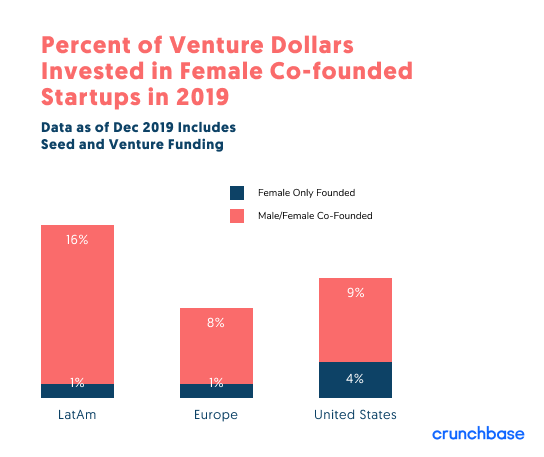
In 2019, investments into mixed female-male founding teams represented 16% of dollars invested in Latin America, 9% in the U.S. and only 8% in Europe.

This number includes a $400 million Series F into Nubank, the Brazilian challenger bank co-founded by Cristina Junqueira, who was — not for the first time — pregnant at the time of the raise. Junqueira is not only the female co-founder currently leading the largest neobank in the world, she is also the female co-founder currently leading the world’s largest venture-backed company.

via Crunchbase

Overall, total investment dollars into both mixed male-female teams and female-only teams represented 17% of total dollars invested in Latin America, 13% in the U.S. and 9% in Europe.

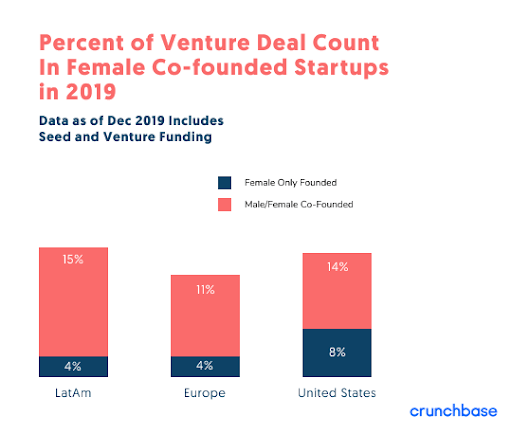
In terms of deal volume, mixed female-male founded teams make up 15% of investments in 2019 in Latin America, in comparison with 14% in the U.S. and 11% in Europe. One contributor is fintech. In Latin America, 35% of fintech companies have a female co-founder, 5X more than the global average of 7%.6

That said, in terms of funding all-female teams, the U.S. still leads. In Latin America, the women-only teams made up 4% of investment deals in 2019, on par with Europe but behind the U.S. average of 8%.

Read the conclusion, Women are the secret ingredient in Latin America’s outsized returns, on Extra Crunch.