SeeHow helps cricketers train smarter

Like baseball, cricket relies on grass, dirt, wood, cork, spit, spin, drop and rise en route to either victory or loss. And like baseball — and just about any other sport, really — cricket coaching staffs and their players worldwide are looking for more ways to track every move.

Tracking statistics is nothing new. With each action, a player produces a stat that can be used to track improvement or struggle over a given period of time. But as players get stronger and stakes — financial and otherwise — get higher, a need for more specific data is proving necessary.

India-based SeeHow transforms sports equipment into sensors to do just that, and it does so without having to alter anything on the athlete’s body. Its sensors are baked into cricket balls and bat handles to track very specific types of data that batsmen and bowlers generate. And tracking the behavior of a bowled ball and where and how it lands on a bat all play a role in the story of cricket.

“Putting the sensor inside the ball or bat handle where the action is happening is when you can capture data fundamentally at a higher accuracy,” says Dev Chandan Behera, founder and CEO of SeeHow . “Most MEMS [micro-electro-mechanical systems] can measure up to 2,000 degrees per second, i.e about 300+ RPMs. International spinners like Shane Warne can spin the ball up to 3,000 RPMs. This is something we are able to capture.”

To obtain data, a trainer first assigns a bowler and/or a batsman in the accompanying Android app before a session. (Behera says an iOS app is due this year.) During play, each action is captured in near real time for each corresponding player.

?

For bowlers, the sensor tracks speed, spin, seam position or orientation, and length — where the ball lands on the pitch. For batsmen, the sensor tracks swing speed and angle, where it hits on the bat, what kind of deliveries they played, what their responses were to a particular delivery and the velocity of the ball off the bat.

This data is then streamed in real time and can be read by players and coaches alike on the app. The app retains a history of a player’s progress in order to make any necessary adjustments and to track improvements.

“In bat on ball sport or racquetball sport, you’re doing something in response to the pitcher or your opponent, and that’s something we’re able to capture into a single system,” Behera says. Because both the data from the batter and the bowler are streaming to a single system, he adds, the app is able to tell users what the reaction time is.

Behera grew up playing cricket with the intention of improving enough to ensure his rise through the ranks.

“Growing up we would use chalk, cones or a sheet of A4 paper as markers during play to assess how we bowled,” Behera says of his early years. “A coach would use a slate to mark the number of balls bowled and selection would be based on whether you had his attention in that particular window when he happened to look at you playing. You might just have a bad day and not get selected to the next level.”

After moving to Singapore, Behera continued competing in the sport, and says he was exposed to more tools and more methodical training approaches.

“We used to record videos through mobile phone cameras and compare them to videos on YouTube or show it to our seniors or coaches for tips,” he says. “However, the process was very ad hoc, and without any data and science to it, it was subjective. We never improved and made it as cricketers.”

His experience building robots, combined with his cricket playing, prompted him to consider using a ball as a way to glean data to help improve cricketers’ performances.

“It occurred to me that we could address this issue by bringing in a new perspective to the ball itself. The experience of building such complex hardware helped me gauge the challenges we needed to build a sports operating system that will enable sensors in the field of play to provide this holistic learning experience in cricket.”

Behera says SeeHow’s sensors are being used at 12 cricket academies in nine countries. First-class cricketer Abhishek Bhat is a fast bowler whose speed topped at 120km. He writes that after two weeks, he was able to push his pace into the mid 130s:

However, it wasn’t until SeeHow came into the picture that I was able to get a consistent measurement of my bowling speed, session after session and day after day. I cannot overstate the impact bowling with the smart ball has had on my bowling speed.

I had my first bowling session with the smart ball in early November and I was bowling in the mid-120s, barely getting above 130kmph. Then with some technical adjustments in a couple of weeks time, I was consistently bowling close to the 130 kmph mark. It was then that I realized that bowling fast is more than just about technique, it’s about the mindset.

SeeHow isn’t the only company trying to improve the way cricketers train.

A company called StanceBeam has developed a system that, among other things, provides session insights, the power generated from a swing, angles and directions of a swing and a 3D analysis of a batsman’s swing. It does so through a hardware extension that players attach to the ends of their bats and that relays data via an app.

Microsoft is also in the game of cricket analysis. The company partnered with star India cricketer Anil Kumble and his company Spektacom to enhance the reach of its sensor, which is designed to help better engage fans and broadcasters through the use of embedded sensors, artificial intelligence, video modeling and augmented reality. The company’s first offering is a smart sticker for bats that contains sensor tech designed to track batting behavior that is readable via an app.

As cricket starts to find an audience beyond the Commonwealth countries and continues to draw big dollars, look for tech to play a bigger role in attracting and maintaining audiences and players.

For SeeHow, cricket is just the beginning.

“Baseball is a very natural extension to cricket if you look at how the sport is played and the equipment,” Behera says. “And we have also done mixed martial arts with sensors in the gloves.”

The company has filed for five patents, one of which, Behera says, is around the construction of the ball, specifically in order to be able to hold the vibrations.

“We have mounted the sensor in the sports equipment at the core and introduced a protective material to cushion the sensor from impact and vibration,” he says. “The patent captures the construction of the ball that mounts the sensor and introduces the protective material in a novel manner to be able to capture the motion data at the core.”

As it scales, SeeHow will look to license the hardware to equipment manufacturers and become a platform company. SeeHow is funded through a friends and family round and is currently in search of seed funding.

Senate passes ‘rip and replace’ bill to remove old Huawei and ZTE equipment from networks

The U.S. Senate today voted unanimously to pass the Secure and Trusted Telecommunications Networks Act. Written as a response to recent concerns around Chinese hardware manufacturers, the bill would ban purchase of telecom equipment from embattled Chinese manufactures like Huawei and ZTE.

H.R. 4998, which passed the House last December, would also include $1 billion in funding to help smaller rural telecoms “rip and replace” existing equipment from specific manufacturers. The bill still needs to be signed off by Trump in order to become a law, though Politico notes that the administration has already acknowledged support for the funding, which would be managed by the FCC.

“Telecommunications equipment from certain foreign adversaries poses a significant threat to our national security, economic prosperity, and the future of U.S. leadership in advanced wireless technology,” Sen. Roger Wicker of Mississippi said of the bipartisan bill in a statement. “By establishing a ‘rip and replace’ program, this legislation will provide meaningful safeguards for our communications networks and more secure connections for Americans. I thank my colleagues on both sides of the aisle for coming together to help move this bill to the President’s desk.”

Huawei in particular has been the focus of U.S. concern over alleged ties to the Chinese government for a number of years. The Trump administration has targeted the company over spying concerns — charges Huawei has long staunchly denied. Last May, the company was added to an entity list, effectively barring U.S. companies from conducting business with the hardware giant.

DocuSign acquires Seal Software for $188M to enhance its AI chops

Contract management service DocuSign today announced that it is acquiring Seal Software for $188 million in cash. The acquisition is expected to close later this year. DocuSign, it’s worth noting, previously invested $15 million in Seal Software in 2019.

Seal Software was founded in 2010, and, while it may not be a mainstream brand, its customers include the likes of PayPal, Dell, Nokia and DocuSign itself. These companies use Seal for its contract management tools, but also for its analytics, discovery and data extraction services. And it’s these AI smarts the company developed over time to help businesses analyze their contracts that made DocuSign acquire the company. This can help them significantly reduce their time for legal reviews, for example.

“Seal was built to make finding, analyzing, and extracting data from contracts simpler and faster,” Seal Software CEO John O’Melia said in today’s announcement. “We have a natural synergy with DocuSign, and our team is excited to leverage our AI expertise to help make the Agreement Cloud even smarter. Also, given the company’s scale and expansive vision, becoming part of DocuSign will provide great opportunities for our customers and partners.”

DocuSign says it will continue to sell Seal’s analytics tools. What’s surely more important to DocuSign, though, is that it will also leverage the company’s AI tools to bolster its DocuSign CLM offering. CLM is DocuSign’s service for automating the full contract life cycle, with a graphical interface for creating workflows and collaboration tools for reviewing and tracking changes, among other things. And integration with Seal’s tools, DocuSign argues, will allow it to provide its customers with a “faster, more efficient agreement process,” while Seal’s customers will benefit from deeper integrations with the DocuSign Agreement Cloud.

Stem is offering cash advances to help musicians stay independent

Stem, a startup that helps independent musicians get paid, is expanding with a new financing program called Scale.

Co-founder and CEO Milana Rabkin Lewis described the company’s core offering as a way for collaborators to “memorialize the split” of the proceeds from a song — once they’ve uploaded a track, Scale can automatically handle splitting the payments among those collaborators. It also offers a broader suite of tools, including revenue data, to help musicians manage the financial side of their careers.

However, Rabkin Lewis noticed that some musicians on Stem were starting to “graduate” by signing a deal with a record label, usually because they needed capital: “Sometimes that was money for marketing, sometimes it was money for production, sometimes it was the cost of going on tour.”

With Scale, Rabkin Lewis and her team are trying to offer something better — a way for musicians to get access to the money they need without having to sign a restrictive contract. The payment terms are transparent; they’re calculated as a percentage of monthly revenue, with musicians able to adjust how much money they take and how quickly they want to pay it back.

Plus they’re able to maintain creative control and full ownership of their master recordings. And Stem says these advances are better from a tax perspective, because they’re classified as a merchant credit advance that only gets taxed as money is actually earned.

Milana Rabkin Lewis

Money might not be the only thing a musician needs, but Rabkin Lewis (a former agent at the United Talent Agency) said that marketing and other services that were once the sole domain of record labels are now available through independent professionals. And Stem already helps connect artists to those specialists through its Stem Direct membership program.

While Scale is officially launching today, Stem has already been testing the program with select artists. Rabkin Lewis said the advances vary from $2,500 to $250,000, with most of them in the $50,000 to $100,000 range, and payback periods ranging from four to 18 months.

Artists who have already participated in the program include Brent Faiyaz, Justine Skye and Lil Donald.

Rabin Lewis added that there’s a “huge white space” when it comes to offering financial services to “the creative class.”

“In the future, I’m excited to be thinking about how artists can collateralize their music,” she said. “You should be able to take out money against your music to be able to finance your recording studio, or finance your child’s studies. I want to be the platform that understands what it means to be a creative professional and be able to provide the best-in-class services to these people that other segments of workers have access to.”

Fear and liability in algorithmic hiring 

It would be a foolish U.S. business that tried to sell chlorine-washed chicken in Europe — a region where very different food standards apply. But in the high-tech world of algorithmically assisted hiring, it’s a different story.

A number of startups are selling data-driven tech tools designed to comply with U.S. equality laws into the European Union, where their specific flavor of anti-discrimination compliance may be as legally meaningless as the marketing glitter they’re sprinkling — with eye-catching (but unquantifiable) claims of “fairness metrics” and “bias beating” AIs.

First up, if your business is trying to crystal-ball-gaze something as difficult to quantify (let alone predict) as “job fit” and workplace performance, where each individual hire will almost certainly be folded into (and have their performance shaped by) a dynamic mix of other individuals commonly referred to as “a team” — and you’re going about this job matchmaking “astrology” by working off of data sets that are absolutely not representative of our colorful, complex, messy human reality — then the most pressing question is probably, “what are you actually selling?”

Snake oil in software form? Automation of something math won’t ever be able to “fix?” An impossibly reductionist dream of friction-free recruitment?

Deep down in the small print, does your USP sum to claiming to do the least possible damage? And doesn’t that sound, well, kind of awkward?

The Dow Jones drops nearly 1,200 points as coronavirus fears batter stock markets

The Dow Jones Industrial Average dropped nearly 1,200 points today to close at 25,766.64, marking the worst intraday point decline in the history of the Dow. The Nasdaq stock market fell over 400 points.

Behind the collapse was a growing realization that COVID-19, the coronavirus strain sweeping across the globe, has indeed landed on U.S. shores and will likely have a much stronger effect on the economy than analysts and investors initially predicted.

Morning trading showed that economists and investors were not assuaged by the reassurances from President Donald Trump and Vice President Mike Pence, who repeatedly indicated that the U.S. was well-prepared to meet the threat posed by the spreading virus.

It was only minutes after the press conference concluded that the Centers for Disease Control and Prevention issued a statement that the U.S. had identified its first case of community infection — when a person who was not known to have traveled outside of the U.S. or had been in contact with anyone who had been infected with the virus was diagnosed with the disease.

Most technology companies weren’t able to avoid the crumbling faith investors displayed toward the short-term prospects of the U.S. economy if it’s forced to endure a prolonged slowdown thanks to the illness. (Though there were a few exceptions.)

Facebook shares were down nearly 4%, or $7.35, to close at $189.75, while Amazon dropped $95.29 — or 4.81% — to close at $1,884.30. Apple and Microsoft were the hardest hit, with their shares off 6.5% and 7%, respectively. Microsoft closed down $11.99 at $158.13 and Apple closed at $273.52.

SaaS stocks wound up down 2.7%, while the Nasdaq itself closed off 4.6%.

To better illustrate what is going on, here is a set of figures. Just a few days ago, in mid-February, the Nasdaq was testing the 10,000 point threshold, a result that would have been not only an all-time record, but a key psychological barrier as well. Instead, after reaching fresh highs on the 19th, the Nasdaq is worth just a bit over 8,500 on the 27th. That’s a big rejection of optimism.

More in the morning when the markets open again, and react to the night’s news.

SaaS earnings bump Dropbox, Box and Sprout Social

A quick hit as we have a podcast to record, but a few public companies in the broader SaaS market reported earnings in the past week. Their results are worth unpacking as they paint a good picture of what the markets are hunting for in modern software companies.

Of course, we’re covering the firms’ share-price movements in the context of an epic selloff stemming from global conditions that are already impacting earnings.

But, hey, not all the news out there is bad. In fact, for our three companies, public investors are waving green flags. So let’s take a peek regarding why Dropbox, Box and Sprout Social — one recent IPO and two slightly-out-of-favor SaaS shops — each shot higher after reporting their Q4-era results.

Earnings, results

Let’s proceed in alphabetical order, putting Box at the top of our list. We’ll then work through Dropbox and Sprout Social.

Box’s calendar Q4-era earnings report (the company’s Fiscal 2020 Q4) beat investor expectations three times. It reported more revenue than anticipated, $183.6 million over expectations of $181.6 million; a slimmer loss than predicted, $0.07 per-share in adjusted profit against a projected $0.04; and the storage-grounded, corporate productivity company’s quarterly forecast of $183.0 million to $184.0 million was a few million ahead of expectations ($181.8 million, per Yahoo Finance).

‘Robot’ was coined 100 years ago, in a play predicting human extinction by android hands

The big climax arrives in Act Three. There’s an uprising, as the robots take over the factory that created them. By the Epilogue, humankind is all but extinct. Fed up with their treatment, the robots have laid waste to the hands that created them, sparing only a single human — a fellow worker.

The decision may have ultimately doomed themselves, however, as they failed to save the one person capable of proliferating their kind. It is, however, the last living man who finds humanity in a pair of robots and likens them to the first two humans, in the biblical tradition. It’s a hopeful note following an extinction that mostly occurred between acts. Two robots exit the stage, leaving the last man to utter the final words, “Adam—Eve.”

To borrow a phrase from another science fiction cautionary tale released seven decades later, “Life finds a way.”

It’s the final lesson of a play loaded to the artificial gills with allegory. Published 100 years ago (and premiering 99 years ago last month) R.U.R. (Rossum’s Universal Robots), by Czech writer Karel ?apek, is best remembered for bringing the word “robot” to sci-fi — and English, generally. It’s a key piece of the seven-time Nobel Prize-nominated writer’s legacy, who infused deeply held political beliefs into his early science fiction writings.

?apek’s use of “robot” is rooted in the Old Church Slavonic word, “robot,” which translates to forced labor” or “worker” in some derivations. “The word also has cognates in German, Russian, Polish and Czech,” history professor Howard Markel explained in a 2011 interview with NPR. “And it’s really a product of the Central European system of serfdom, where a tenants’ rent was paid for in forced labor or service.”

The concept of robots as forced labor dates back at least as far as the word robot itself — so, too, does the notion of a robotic uprising. That is to say that “kill all humans” wasn’t uttered first by Bender in Futurama or in the comments section of Boston Dynamics’ Big Dog YouTube video. No, the first commonly understood robots to bear that name were wholly invested in returning power to the hands of the exploited workers — by any means necessary.

The roots of robotics in human society is commonly acknowledged to date back centuries prior, to classical cultures like Greek mythology and the golems of Jewish tradition. But ?apek is the one who gave us the word we still use today. 

Of course, the writer’s robots were more human than we presently associate with the word. In fact, perhaps, more in common with the older term, “android,” which stems from a Greek term that translates to “having the form of a man/human.” The robots of R.U.R. are living beings, built of artificial flesh, who eventually inherit the Earth.

“When the play opens, a few decades beyond the present day, the factory had turned out already, following a secret formula, hundreds of thousands, and even millions, of manufactured workmen, living automats, without souls, desires or feelings,” the official “Story of the Play” explains. “They are high-powered laborers, good for nothing but work. There are two grades, the unskilled and the skilled, and especially trained workmen are furnished on request.”

Set largely in the year 2000, the play grapples with questions of humanity decades before either Blade Runner or its source material, with the robots ultimately achieving a sort of humanity somewhere between Pinocchio and Oz’s Tin Man, albeit out from the ashes of the human creators they murdered en masse. A happy ending, perhaps, by 1920 standards.

For more robotics, check out our upcoming event March 3 at UC Berkeley. 

Pinterest adds DoorDash exec and Caviar lead Gokul Rajaram to its board

Pinterest is bringing on a new board member. The company announced today it has appointed Gokul Rajaram, Caviar lead at soon-to-go-public DoorDash, to its board of directors and as a member of its Nominating and Corporate Governance Committee. The addition signals Pinterest’s desire to bring more digital advertising expertise to its board, given Rajaram’s experience as product director of Ads at Facebook and product management director at Google AdSense.

“Gokul brings great experience and innovation to our Board and we look forward to his many contributions,” said Pinterest CEO and co-founder Ben Silbermann, in a statement. “His proven track record in shopping, digital advertising and content will be incredibly beneficial as we continue to bring inspirational experiences to users and advertisers on Pinterest,” he added.

Currently, Rajaram serves on DoorDash’s executive team where he leads the premium food ordering service, Caviar, which DoorDash acquired from Square last year for $410 million. The Caviar deal included Rajaram and team, in addition to the service’s restaurant partnerships. At Square, Rajaram spent five years heading Caviar and before that, had led several product development teams.
Rajaram’s background also includes time at Facebook and Google, where he focused on digital ads. At Facebook, he helped the company transform its ads business to become mobile-first. And at Google, he helped launch the Google AdSense product and grow it into a substantial portion of Google’s business, Pinterest notes.

Other relevant experience includes time on RetailMeNot’s board, as well as an investor and advisor to numerous startups, including those that intersected retail/e-commerce, analytics and social — like Pinterest-focused Piquora, mobile ad company Vungle, retail advertising startup PromoteIQ and many others.

Today, Rajaram additionally serves on the boards of The Trade Desk and Course Hero.

Rajaram has a bachelor’s degree in Computer Science Engineering from the Indian Institute of Technology, Kanpur where he was class valedictorian. He received an MBA from The Massachusetts Institute of Technology and a Master of Computer Science from the University of Texas at Austin, where he received the MCD University Fellowship.

His addition to Pinterest’s board comes at a time when the company’s ad business is growing.

Earlier this month, Pinterest reported revenues for 2019 had topped $1 billion, up 51% over 2018. In the fourth quarter alone, Pinterest saw $400 million in revenue, up 46% year-over-year, and beating analyst forecasts of $371.2 million. Feed-based Shopping Ads contributed heavily to this growth, with the ads more than doubling in the second half of 2019 compared with the first. Pinterest also said its investment in measurement tools had been paying off. In Q4, conversion campaigns — which let advertisers track from pin clicks to actions, like adding items to a cart — grew by 150%.

The company said during earnings that scaling its ads business would continue to be a strategic priority in 2020, as it looks to capture more mid-size and international advertisers and make the service more shoppable.

“Pinterest is a beloved brand that inspires people to create a life they love,” said Gokul Rajaram, about his board appointment. “I’ve always been excited about Pinterest’s mission and impact on people’s everyday lives, and am thrilled to help Ben, Evan, and the team continue building amazing products that empower people and advertisers around the world,” he said.

Rajaram joins other Pinterest board members Jeffrey Jordan, GP at Andreessen Horowitz; Leslie Kilgore, previously Netflix CMO; BVP partner Jeremy Levine; Fredric Reynolds, previously CFO at CBS; Michelle Wilson, previously from Amazon legal; and Pinterest co-founders Evan Sharp and Ben Silbermann.


Andreessen Horowitz has backed Run The World, a startup with a timely offering: live online events

Every day, there’s another event-related cancellation owing to concern around coronavirus. Just today Microsoft announced it will not have a presence at the Game Developers Conference in mid-March “out of an abundance of caution.” Facebook also said today that it is canceling its annual F8 conference scheduled for May over coronavirus-outbreak concerns.

The last is a particularly big deal. F8 is by far the largest event that Facebook hosts every year, so it’s little wonder that it plans to host part of the event online.

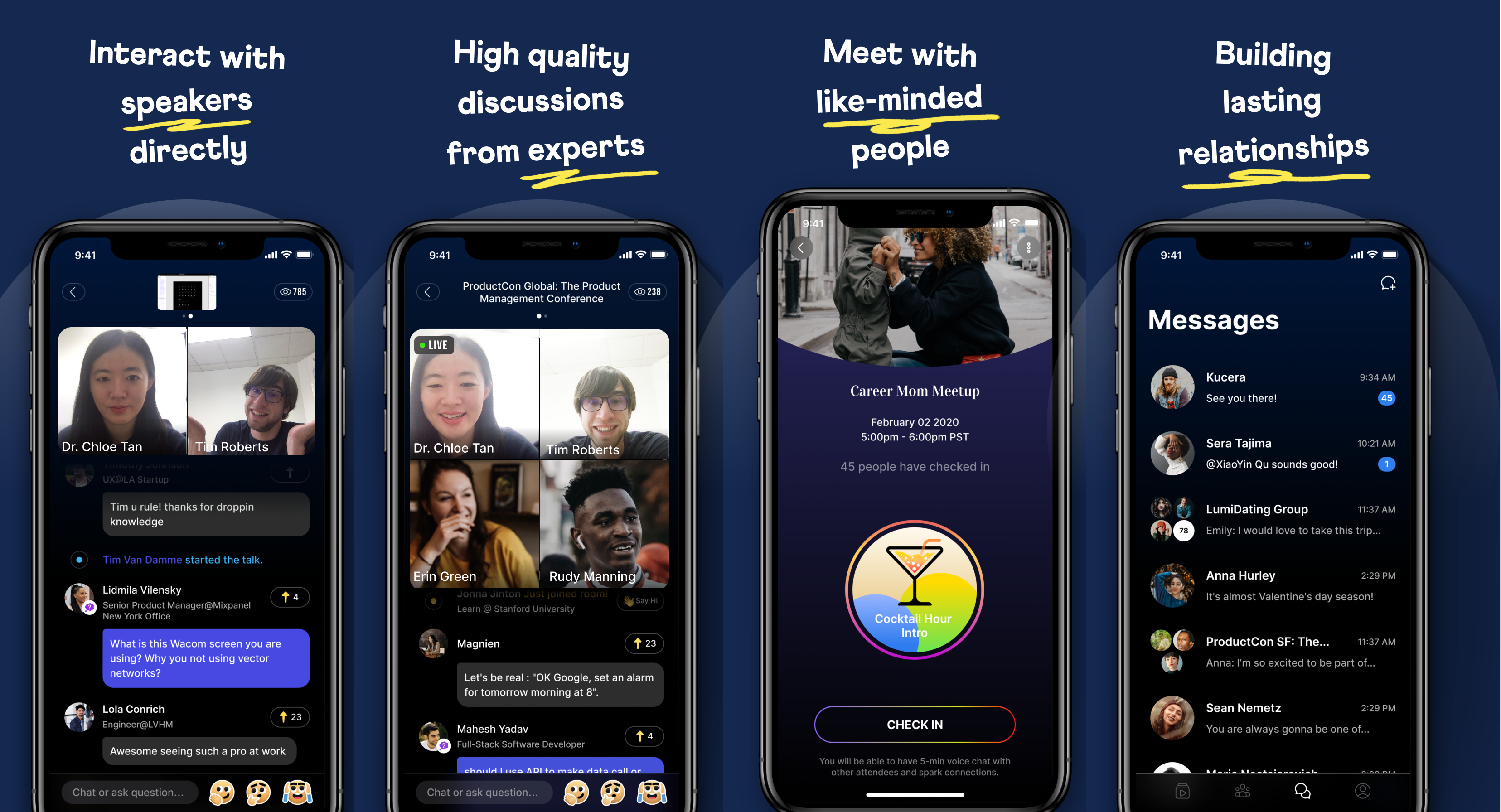
Likely, Facebook will use its own tech toward this end. But there is a new option for other companies that are right now second-guessing their event plans, and that’s Run The World, a year-old, 18-person company that’s based in Mountain View, Calif., and has small teams both in China and Taiwan.

What it’s doing: smooshing together every functionality that a conference organizer might need in a time of a pandemic. Think video conferencing, ticketing, interactivity and networking.

Who’s backing it: Andreessen Horowitz largely, though the company — which has raised $4.3 million in seed funding — also counts as investors GSR Ventures, Pear Ventures, 122 West Ventures, Unanimous Capital, and angel investors like Kevin Weil, the VP of product at the Facebook subsidiary Calibra; Patreon co-founder Sam Yam; and Jetblue Airways Chairman Joel Peterson.

Who started it: Xiaoyin Qu, who is the CEO of the company and previously led products for both Facebook and Instagram (“basically anything to do with entertainment influencers and creators,” she says of part of her time at Facebook).

She dropped out Stanford’s MBA program after a year to start the company last year with Xuan Jiang, a former colleague who was a technical lead for Facebook events, ads and stories. (Jiang does have a master’s degree — one in computer science from the Georgia Institute of Technology.)

We talked with Qu yesterday after learning about the company from Connie Chan, the general partner who led the deal for a16z.

Qu says the impetus for the startup ties to her mother, a doctor in China who focuses on meningitis and traveled to a conference in Chicago in late 2018 where she made a connection with a Dubai-based physician who was able to share with her some rare, valuable insight into his own work around meningitis.

That might not seem so exceptional to those who travel regularly, but it was enough of an ordeal for Qu’s mother — who had to secure a visa; take off two weeks around the event, including for travel days; and spent a fortune on airfare and accommodations — that it was the first major trip she’d taken in 35 years.

As Qu half-joked, “It isn’t like at Stanford, where there are events held regularly that [local] doctors can even walk over to.”

Indeed, like a lot of founders who solve a pain point for themselves or someone they love, Qu wanted to create a platform where her mother could meet and have meaningful work connections with people regularly, and this would mean remotely, through digitized events.

Turns out, her timing is pretty good. Though numerous startups have launched live online events businesses in the past (many of them since shuttered), you can bet many more organizers are thinking about exactly the type of platform that Run The World is fine-tuning right now.

Though publicly launched just four months ago, it has already hosted dozens of events and has hundreds in the pipeline, says Qu. One of its customers is Wuhan2020, a large open-source community with more than 3,000 developers who will be using the platform as part of a long-distance hackathon that hopes to produce tech solutions to those affected by coronavirus in Wuhan.

Qu also points to an elephant conservation reserve in Laos that was recently able to raise $30,000 from donors from 15 countries in two weeks through a conference it organized on the platform. The reserve had a constrained budget, but being able to bring together a distributed audience (beyond just wealthy donors) for nearly zero overhead (no venue, no catering), turned it into a major success for the organization.

Smaller events are finding the platform, too. In just one instance, a dating coach who specializes in working with engineers recently held a workshop. Just 40 people showed up, says Qu, but she was able to make $1,300 from the event.

Run The World keeps the cost structure simple, taking 25% of ticket sales in exchange for what it provides organizers, from the templates they can choose for their events, to the ability to sell tickets, to processing those payments (via Stripe), streaming the event, enabling social interactions throughout the event, and helping organizers follow up with attendees afterward.

Indeed, beyond enabling organizers to reach a wider audience at perhaps a more accessible price point, a big advantage conferred by online events is the potential for more effective networking, insists Qu. For example, rather than walk into a physical space where it’s sometimes hard to know who to talk with about what, Run The World asks every event attendee to create a quick video profile akin to an Instagram story that can help inform other attendees about who is with them online.

It also organizes related “cocktail parties” where it can match attendees for several minutes at a time.

Naturally, there are also downsides to streamed live events as the world was reminded last year, when a gunman filmed the mass murder of 51 people in Christchurch, New Zealand on Facebook Live.

One could also imagine that those video profiles could attract unwanted attention to some attendees who might rather just watch an event.

These are certainly facets of the business about which Qu and Jiang are well aware. While the plan is to keep adding new features (including, potentially, to use LinkedIn to validate attendees’ identities), Qu notes that another way to ensure the quality of the events on the platform remains high — and that attendees feel safe — is to steer clear of most free events.

“When organizers are recruiting their own people and curating a community” of paid attendees who they know or can ostensibly learn more about, it keeps things above the level, she suggests, noting that paid attendees also show up in far greater numbers.

As Run The World scales, she concedes, “we’ll need to figure out new ways.”

Certainly, the lessons learned at Facebook and Instagram should help as the business picks up momentum and creates more structure around its offerings, she says. Besides, Qu adds, “The ideal event to me isn’t one with 2 million people. I’d rather we hosted 2 million events with 50 people.”

Improving the logistics of trucking, San Diego’s Flock Freight raises $50 million

“We want to change the way freight moves,” says Oren Zaslansky, the chief executive and founder of Flock Freight.

His company, which has been operating in stealth mode for the last two years, has finally emerged with a new solution for freight shipping that purports to bring in more money to shippers, remove inefficiencies in the current hub-and-spoke model for freight and offer better deals to shipping customers.

He’s also got $50 million in financing in the bank in what is one of the largest recent investments in a San Diego-based company.

For Zaslansky, the shipping business is a family affair. “My parents grew up in the moving business… I grew up around both entrepreneurship and freight,” he says.

Those twin passions led him to start his own trucking business out of college in the San Diego area. He also launched a brokerage business to support supply chain logistics. The exposure to both is what led Zaslansky to launch Flock Freight and its big new financing round, which closed earlier this week.

The company raised its cash to change the way shippers move small amounts of goods — those less-than-a-truckload-sized amounts that have to move through hub-and-spoke operations which increase the time goods are on the road and the possibility for breakage as they’re unloaded and reloaded onto different delivery vehicles.

“We want to disintermediate the infrastructure of hub and spoke,” says Zaslansky. “We want to carpool. We use our technology to change the way freight moves.”

Zaslansky isn’t talking about very small orders that can be delivered through a service like Roadie — the delivery company that raised $39 million from investors led by Home Depot back in February 2019.

This is still trucking — it’s a carpool in a 70-foot-long tractor trailer. Flock Freight works by reaching out to small and mid-size trucking companies and integrating their orders onto the shipments that these firms are already making. “We go to the carriers that are much more used to working with a third party to fill up empty trucks,” Zaslansky says.  

Right now, that’s about 15% of the $110 billion freight and logistics trucking market, Zaslansky says.

The new investments into Flock Freight came from SignalFire and GLP Capital Partners in mid-February and they were likely drawn to the company’s claims that its service can eliminate damage claims, collect freight from multiple shippers and optimize route delivery for a 40% savings in fuel emissions, and the guaranteed delivery rate of 97.5%. 

Companies like Tuft & Needle and Titan Supply Group are already using the company’s services, according to a statement from Flock Freight.

Flock Freight makes its market by having a window into the spare capacity of trucks and charging shippers for the exact amount of capacity that they’re using. “We want to go to a shipper and say — that [cargo] is 75% of the truck and we’ll charge you 75% of the truck,” said Zaslansky. For carriers, they can say that the price they’ve charged is for 100% of the truck and Flock Freight will add another 10 feet of freight and an additional $1,000 into a carrier’s pocket, Zaslansky said.


Citroën introduces a two-seat EV that costs €19.99 a month

The Citroën Ami is a new take on urban mobility. It’s electric, cheap and doesn’t require a license. In short, it’s less of a car and more of an electric scooter with two seats, doors and a heater. Jokes aside, the Citroën Ami could be a glimpse at the future of mobility.

The innovation isn’t in the technical aspects of the Ami. Citroën is positioning the Ami as an urban mobility solution. The size is perfect for narrow streets and the price is right to be competitive against public transport. The Ami is not classified as a motor vehicle. As such, operators do not need a license and can be as young as 14 in France and 16 in other European countries.

Passengers sit side-by-side in the heated compartment and under the panoramic roof. The 5.5kWh lithium-ion battery is housed under the floor and is good for up to 70 kilometers after a three-hour charge from a standard 220v outlet. The top speed is 45 km/h (28 mph).

And because it’s a Citroën, there’s a nod to the company’s quirky past: The side windows open manually by tilting upwards like the classic 2 CV.

The Ami is available to consumers in several different ways. It can be rented long term at a cost of €19.99 (including VAT) per month with an initial payment of €2,644 (including VAT). The Ami can be rented through a car-sharing service for up to a day at a rate of €0.26 per min. Or, the Ami is available for purchase from €6,000 (including VAT).

Citroën is taking orders for the Ami starting on March 30 in France and several months later in Spain, Italy, Belgium, Portugal and then Germany. The first Ami vehicles are expected by June.

Tinder’s video series ‘Swipe Night’ gets a second season

Following a successful debut for Tinder’s first foray into original content, the company is giving its interactive video series “Swipe Night” another run. The company confirmed today it’s renewing “Swipe Night” for a second season, which will launch this summer (again) as an in-app experience within Tinder’s dating app.

Variety first reported the news of “Swipe Night’s” return. Tinder further confirmed the details to TechCrunch.

“Swipe Night,” as you may recall, first launched in October 2019 within Tinder. The experience introduced a first-person adventure played in-app, where users would make choices at key turning points to progress the narrative — like a choose-your-own-adventure story.

The series was designed to increase user engagement and help the app’s young users better connect.

Today, half of Tinder is Gen Z (ages 18-25) — a demographic that’s embracing their single lifestyle and more casual relationships compared with those on other dating apps, like Tinder parent company Match, for example, or its newer acquisition Hinge. These younger users connected with the idea of starting conversations based on a shared experience, says Tinder.

However, the reality is that “Swipe Night” had also arrived at a time when users were opening Tinder’s app less on a daily basis, even as monthly usage climbed. Though “Swipe Night” only ran on specific dates in October 2019, users’ choices within the interactive experience were added to their profiles. This allowed users to see who else agreed with their decisions and who took the opposite path. That made launching Tinder and swiping through profiles more compelling — even for those who may have been tiring of Tinder before the series’ arrival.

The experiment worked. Tinder said millions of users tuned in to “Swipe Night,” and matches and conversations increased by 26% and 12%, respectively. With “Swipe Night,” it seemed, Tinder finally gave users something to talk about.

The returning second season of “Swipe Night” will again be directed by Karena Evans, who directed Coldplay’s music video “Everyday Life” and Drake’s “In My Feelings” and “God’s Plan.” This time, it will be written by Jessica Stickles (“Portlandia,” “Another Period”) and Julie Sharbutt (“3 Days”).

“Working on Swipe Night was such a fulfilling experience for me. I got to do something that had never been done before and innovate with storytelling to bring a generation of people together. I’m in search of projects that impact, shift or curate a culture and couldn’t be more excited to return for more,” said Evans, in a statement.

“Swipe Night’s” second season may see Tinder tweaking the formula a bit, and may even introduce new mechanics to keep it feeling fresh.

In addition to the Season 2 launching in the U.S., Match previously confirmed that 10 international markets across Europe and Asia will get “Swipe Night” this year. Tinder said today that Season 1 would be launching internationally on March 14th, but declined to say when those users would receive Season 2.

Google Cloud’s newest data center opens in Salt Lake City

Google Cloud announced today that its new data center in Salt Lake City has opened, making it the 22nd such center the company has opened to date.

This Salt Lake City data center marks the third in the western region, joining LA and The Dalles, Oregon with the goal of providing lower latency compute power across the region.

“We’re committed to building the most secure, high-performance and scalable public cloud, and we continue to make critical infrastructure investments that deliver our cloud services closer to customers that need them the most,” said Jennifer Chason, director of Google Cloud Enterprise for the Western States and Southern California said in a statement.

Cloud vendors in general are trying to open more locations closer to potential customers. This is a similar approach taken by AWS when it announced its LA local zone at AWS re:Invent last year. The idea is to reduce latency by moving compute resources closer to the companies that need them, or to spread workloads across a set of regional resources.

Google also announced that PayPal, a company that was already a customer, has signed a multi-year contract, and will be moving parts of its payment systems into the western region. It’s worth noting that Salt Lake City is also home to a thriving startup scene that could benefit from having a data center located close by.

Google Cloud’s parent company Alphabet recently shared the cloud division’s quarterly earnings for the first time, indicating that it was on a run rate of more than $10 billion. While it still has a long way to go to catch rivals Microsoft and Amazon, as it expands its reach in this fashion, it could help grow that market share.

Vice President Pence bulks up Coronavirus Task Force with medical and economic experts

On the first day as the new leader of the U.S. government’s efforts to contain the spread of the coronavirus, Vice President Mike Pence announced a number of new appointments to the government’s Coronavirus Task Force.

The point person for the government (who will be reporting to Vice President Pence) is Deborah Birx, a longtime leader in the U.S. government’s efforts to contain the HIV/AIDS pandemic.

From her position within the State Department as the U.S. Global AIDS Coordinator and Special Representative for Global Health Policy, Birx coordinated the Army, Navy and Air Force in their HIV/AIDS efforts and led the Centers for Disease Control and Prevention’s Division of Global HIV/AIDS program.

In addition to Birx, the vice president also appointed to the task force Treasury Secretary Steven Mnuchin, Director of the National Economic Council Larry Kudlow and Surgeon General Dr. Jerome Adams.

The appointments emphasize the importance the White House is placing on controlling the economic impact of the crisis.

Stock markets have declined significantly over the past week as economists and investors weigh the prospects of much slower growth in 2020 as a result of the global spread of coronavirus.

Tech companies like Microsoft have already issued warnings over the effect coronavirus will have on earnings, and large technology events, including (most recently) Facebook’s developer conference and the Mobile World Congress (which was slated to begin this week) have been cancelled.