The kids are alright, except for the ones who are not.
Category: Tech news
hacking,system security,protection against hackers,tech-news,gadgets,gaming
Amazon Quietly Removes Some Dubious Coronavirus Books
The company touts its efforts to remove misleading and overpriced supplies related to the pandemic but has been more reluctant to comment on books.
Is It Ethically OK to Order Delivery During a Pandemic?
People are being encouraged to stay home to avoid exposure to the coronavirus. Should they ask others to bring them food?
BMW axes plans to bring electric iX3 SUV to US
BMW will not bring the iX3, the automaker’s first electric crossover, to the U.S., the latest automaker to shift its EV strategy to Europe and China.
BMW told Automotive News, the first media outlet to report the change, that at this time, it doesn’t have plans to bring iX3 to the U.S. market. The change is notable because the iX3 is based off of the X3, the most popular BMW model in the U.S.
The BMW iX3, which will be manufactured in China, is scheduled to come to market in the first half of 2021.
BMW unveiled the iX3 concept at the Auto China 2018 show in Beijing. The automaker is targeting the U.S., Europe and China for its broader EV strategy. However, the realities of the U.S. market, where automakers with the exception of Tesla have faced a tepid response to EVs, mixed with stricter emissions regulations in Europe, are now hitting home for BMW.
BMW isn’t the only automaker to pull back plans to bring upcoming electric vehicles to the U.S. Mercedes-Benz has delayed the U.S. launch of the electric EQC SUV by a year. The EQC is now scheduled to come to the U.S. in 2021.
Volkswagen has also tweaked its sales strategy for its upcoming ID electric lineup. The company will keep its compact hatchback, the ID.3, out of the U.S. Instead, VW plans to bring the ID.4, (otherwise known as the ID. Crozz) to the U.S., although even this vehicle will first launch in Europe.
Edtech startups prepare to become ‘not just a teaching tool but a necessity’
As Stanford, Princeton, Columbia and others shutter classrooms to limit the coronavirus outbreak, college educators around the country are clambering to move their classes online.
At the same time, tech companies that enable remote learning are finding a surge in usage and signups. Zoom Video Communications, a videoconferencing company, has been crushing it in the stock market, and Duolingo, a language teaching app, has had 100% user growth in the past month in China, citing school closures as one factor.
But Kristin Lynn Sainani, an associate professor of epidemiology and population health at Stanford, has a fair warning to those making the shift: Scrappiness has its setbacks.
“[The transition to online] is not going to be well-planned when you’re doing it to get your class done tomorrow,” said Sainani, who has been teaching online classes since 2013. “At this point, professors are going to scramble to do the best they can.”
As the outbreak spreads and universities respond, can edtech startups help legacy institutions rapidly adopt online teaching services? And perhaps more tellingly, can they do so in a seamless way?
President teases stimulus package to boost a US economy hit by COVID-19 fears
Just a few hours after the markets closed the books on one of its worst trading days since the dawn of the financial crisis, President Donald Trump and members of the coronavirus task force took to the podium in the White House press briefing room to tease an economic stimulus package in an effort to stabilize shaky markets.
In a brief statement before the press corps, the president hinted at a possible payroll tax cut and emergency support for businesses looking to guarantee that hourly workers are protected from job loss and lost wages as social distancing becomes recommended practice in response to the spread of COVID-19.
“We’re going to be talking about hourly wage earners getting help so that they can be in a position where they’re not going to miss a paycheck,” the president said. “So that they don’t get penalized for something that’s not their fault.”
Trump intends to speak with representatives of the Small Business Administration to create potential loans for small businesses affected by response efforts from federal, state and local governments.
“This is about providing proper tools and liquidity to get through the next few months,” said Treasury Secretary Steven Mnuchin, at the briefing.
The president left the podium without responding to reporters’ questions about whether he had been tested for COVID-19, after reports surfaced earlier today that several members of Congress who had met with the president had been exposed to the disease last week at a gathering of national conservative leadership.
Vice President Mike Pence then outlined the latest steps from the U.S. government to respond to the spread of the disease while emphasizing most Americans’ risk of contracting the disease remained low.
“The risk of contracting the coronavirus to the American public remains low and the risk of serious disease also remains low,” the vice president said yet again.
Meanwhile, the American private health industry is working overtime to develop vaccines, treatments and diagnostic testing tools to buttress the work being done in national laboratories.
As more private tools come to market, the question will be who will ultimately foot the bill for treatment of the disease as it spreads.
Some epidemiologists contend that the U.S. remains unprepared for the severity of the disease’s spread, and that even a good scenario means that millions of Americans will be sickened and need some sort of consultation or care.
IANAE (I am not an epidemiologist) but I did just interview the co-author of a report for the Center for Health Security on the impact of Coronavirus, he believes the ultimate number of infected / hospitalized in U.S. will be somewhere between the two estimates on this table 1/ pic.twitter.com/gIHrRhROww
— Christopher Mims
(@mims) March 9, 2020
The government’s response to stabilize markets follows the advice laid out in a series of policy suggestions from the International Monetary Fund and advocated by Dr. Scott Gottlieb, the former head of the Food and Drug Administration, who has returned to the private sector as a managing director of the venture capital firm NEA.
2/2 At the same time, we must provide direct economic assistance to cities, states, people burdened with hardship to compensate for large costs of strong mitigation steps and give cities more latitude to adopt such measures. The national interest depends on strong local actions.
— Scott Gottlieb, MD (@ScottGottliebMD) March 8, 2020
Immutouch wristband buzzes to stop you touching your face
In the age of coronavirus, we all have to resist the urge to touch our faces. It’s how the virus can travel from doorknobs or other objects to your mucus membranes and get you sick. Luckily, a startup called Slightly Robot had already developed a wristband to stop another type of harmful touching — trichotillomania, a disorder that compels people to pull out their hair.
So over the last week, Slightly Robot redesigned their wearable as the Immutouch, a wristband that vibrates if you touch your face. Its accelerometer senses your hand movement 10 times per second. Based on calibrations the Immutouch takes when you set it up, it then buzzes when you touch or come close to touching your eyes, nose, or mouth. A companion app helps you track your progress as you try to keep your dirty mitts down.
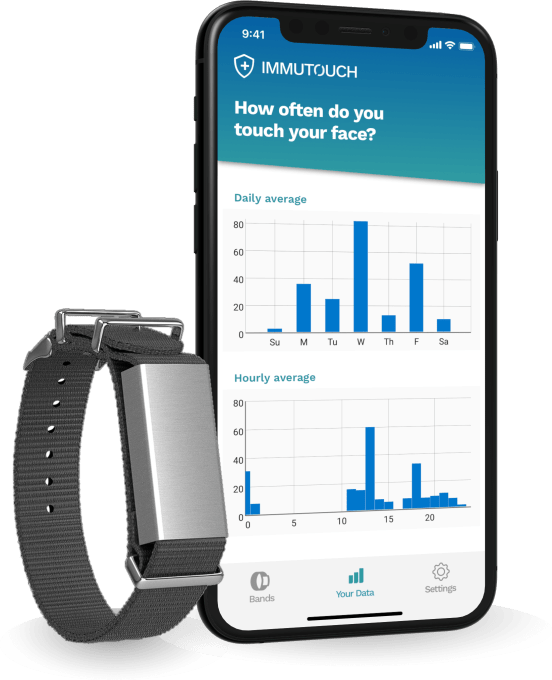
The goal is to develop a Pavlovian response whereby when you get the urge to touch your face, you don’t in order to avoid the buzzing sensation. Your brain internalizes the negative feedback of the vibration, training you with aversive conditioning to ignore the desire to scratch yourself.
“A problem the size of COVID-19 requires everyone to do their part, large or small,” says Slightly Robot co-founder Matthew Toles. “The three of us happened to be uniquely well equipped to tackle this one task and felt it was our duty to at least try.”
The Immutouch wristbands go on sale today for $50 each and they’re ready for immediate shipping. You can wear it on your dominant hand that you’re more likely to touch your face with, or get one for each arm to maximize the deterrent.
“We’re not looking to make money on this. We are selling each unit nearly at cost, accounting for cost of materials, fabrication, assembly, and handling” co-founder Justin Ith insists. Unlike a venture-backed startup beholden to generating returns for investors, Slightly Robot was funded through a small grant from the University of Washington in 2016 and bootstrapped since.

Slightly Robot and Immutouch co-founders (from left): Joseph Toles, Justin Ith, and Matthew Toles
“We built Immutouch because we knew we could do it quickly, therefore we had the obligation to. We all live in Seattle and we see our communities reacting to this outbreak with deep concern and fear” Slightly Robot co-founder Justin Ith tells me. “My father has an autoimmune disease that requires him to take immunosuppressant medication. Being in his late 60’s with a compromised immune system, I’m trying my best to keep the communities around him and my family clean and safe.”
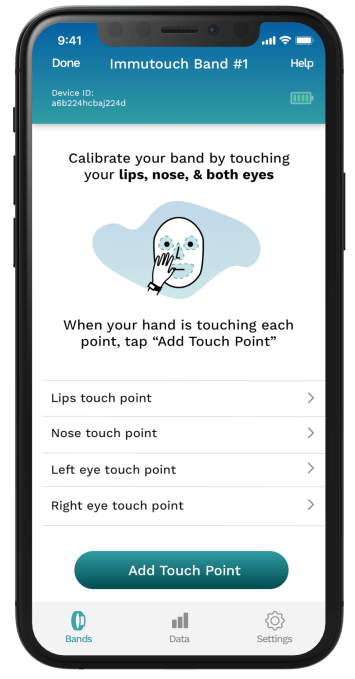
How to calibrate the Immutouch wristband
Based on a study using wearable warning devices to deter sufferers of trichotillomania from ripping out their hair, Immutouch could potentially be effective. University Of Michigan researchers found the vibrations reduced long and short-term hair pulling. Ith admits you have to actually heed the warnings and not itch to instill the right habit, and it doesn’t work while you’re lying down. The Immutouch stops short of electrically shocking you like the older gadget called Pavlok that’s designed to help people quit smoking or opening Facebook.
Perhaps smartwatch makers like Apple could develop cheap or free apps to let users train themselves using hardware they already own. But until then, Ith hopes that Immutouch can gain some initial traction so “we can order larger quantities, reduce the price, and make it more accessible.”
Modern technologies like Twitter for rapidly sharing information could encourage people to take the right cautionary measures like 20-second handwashing to slow the spread of coronavirus. But having phones we constantly touch — before, during, and after we use the restroom — and then press against our faces could create a vector for infection absent from pandemics of past centuries. That’s why everyone needs to do their part to smooth out the spike of sickness so our health systems aren’t overrun.
Ith concludes, “Outbreaks like this remind us how we each individually affect the broader community and have a responsibility to not be carriers.”
TechCrunch Events and coronavirus
We here at TechCrunch are watching the novel coronavirus situation closely, as most of you likely are.
In addition to our editorial coverage of the effects of the novel coronavirus on the business of entrepreneurship — and the ways that technology can help — we have a number of events planned for 2020, including TC Early Stage in April in San Francisco and our TechCrunch Sessions: Mobility event in May in San Jose.
As of now we have not cancelled any of our events for the year, but we continue to monitor the situation very closely on a daily basis.
Our primary goal is to make sure we proceed in a conscientious and careful manner that takes into account local, state and federal guidance as well as our own personal care for all of our event attendees.
Just as it is with all of the members of our editorial and business staff, you’re the TechCrunch family and we will make sure that any decisions we make have you at heart, no matter what.
Much like the companies we cover, TechCrunch has always tried to stay nimble and adopt new ways of serving our readers. We’re in the process now of thinking hard about how to deliver on the promise of our events in a COVID-19 world. Stay tuned, we’ll have some interesting announcements ahead.
Over the years we’ve experimented with many virtual events like our huge Disrupt SF Virtual Hackathon and hosted hybrid virtual interviews on our stages, like the memorable chat at Disrupt in 2014 with Clayton Christensen and Bill Hambrecht — not to mention our coverage of and experimentation with just about every virtual telepresence platform ever invented. Whatever happens, you can depend on us to find interesting and innovative ways to bring together tech entrepreneurs, students, academics, investors and anyone passionate about building to talk, inspire and innovate like hell.
If you want to keep track of current updates to our plans for TechCrunch events throughout the year, please use this page as your resource of record.
As always, we’ll keep you posted. Thank you.
Zapier CEO Wade Foster on scaling a remote team up to 300 employees

When Zapier was founded in 2011, it was a side project for three friends from Missouri who wanted to make it easier to connect any one web app to another. Nine years, millions of users and around 300 employees later, it’s one of the most highly valued companies to ever go through Y Combinator — and they did it all with a team that is entirely remote.
I chatted with Zapier co-founder and CEO Wade Foster to find out why they decided to go remote from the start, and how the company addresses the challenges of scaling up a distributed team. Here’s our chat, lightly edited for brevity and clarity.
TechCrunch: Why remote?
Wade Foster: I’ll give you a little of the origin story.
We started as a side project… and side projects can’t afford offices. So we’re kind of working via coffee shops, our apartments, wherever we could get the job done.
We moved out to the Bay Area from Columbia, Missouri for [Y Combinator] . That summer, we were all three in the same apartment — the only time in the company’s life cycle where the whole company was together. At the tail end of that, Mike, one of my co-founders, moved back to Missouri to be with his then-girlfriend/now-wife as she was wrapping law school. So we were remote by necessity there.
Facebook’s board is its most gender-balanced yet with two new additions
On Monday, Facebook announced the addition of two new names to its board of directors, Nancy Killefer and Tracey T. Travis.
Killefer brings potentially valuable government insight to Facebook, as she served in the U.S. Department of the Treasury during the Obama administration. With last year’s departure of former Clinton administration chief of staff Erskine Bowles, Facebook’s board lost one of its voices with deep government experience.
In addition to her time in the treasury, Killefer held various leadership roles at global consulting firm McKinsey & Company over 30 years and currently serves on the board of Cardinal Health. She previously held a board seat with Avon.
“I’m excited to join the board of Facebook, a company that is at the center of the biggest debates about technology and society,” Killefer said in the investor press release. “The next few years are likely to shape the internet for generations to come and I hope to contribute to Facebook’s efforts to be a responsible force for good in the world.”
Travis, Facebook’s other board pick, joins from Estée Lauder, where she currently serves as EVP and CFO for the cosmetics company. While Killefer brings public sector experience, Travis offers a “strong finance and corporate leadership background,” per Zuckerberg, and plenty of consumer and retail finance experience from roles with Ralph Lauren, Limited Brands, Inc., Pepsi and General Motors. In a press release, Travis expressed optimism about Facebook and the “power of technology and innovation to change our world for the better.”
Facebook lost three board members last year, first Bowles and Netflix CEO Reed Hastings, known to clash openly with Zuckerberg, and later Dr. Susan Desmond-Hellmann, former CEO of the Bill & Melinda Gates Foundation. Last month, Facebook added Mark Zuckerberg’s close personal friend, Dropbox CEO Drew Houston to its board. This month’s additions fill in the remaining gaps.
Facebook’s board now consists of Zuckerberg, PayPal’s Peggy Alford, Marc L. Andreessen of Andreessen Horowitz, General Catalyst’s Kenneth I. Chenault, Dropbox’s Houston, Founders Fund’s Peter Thiel, Cranamere Group’s Jeff Zients, Facebook COO Sheryl Sandberg and the two new names. With the addition of Killefer and Travis, the board is at its most gender-balanced yet, with four women and six men filling the seats.
In recent years, Facebook has faced multiple outside proposals from shareholders to remove Zuckerberg from his chairman position, but his board has historically held fast. It’s unlikely that the company has brought anyone on particularly willing to rock the boat, but we’ll be following the new dynamics as the company’s latest board members settle in.
Cadillac cancels debut of all-electric Lyriq over COVID-19 concerns
Cadillac has cancelled the upcoming debut of the Lyriq, an all-electric mid-sized SUV designed to be an entry point into luxury brand’s new EV lineup, over concerns about the COVID-19 outbreak.
GM’s luxury brand had planned to reveal the Lyriq on April 2 at an event in Los Angeles.
COVID-19, a disease caused by a new virus that is a member of the coronavirus family and a close cousin to the SARS and MERS viruses that have caused outbreaks in the past, has caused governments and companies to cancel tech, business and automotive events around the world. The Geneva International Motor Show was cancelled, as well as MWC in Barcelona and the SXSW festival in Austin, Texas.
The GM brand said in a statement that the event was being cancelled “out of an abundance of caution.”
Here’s the statement from Cadillac:
As you are aware, the situation in relation to the COVID-19 (novel coronavirus) outbreak in the U.S. continues to develop. Now, several states have declared a State of Emergency and the number of cases continues to climb.
Out of an abundance of caution, we have made the difficult decision to cancel the Cadillac LYRIQ reveal in Los Angeles, California on April 2nd. We are currently evaluating future plans and will be touch soon with an update. Our top priority is the safety of our media guests and employees. We have been working with GM Medical and Security to monitor the situation closely and have been following recommendations for the U.S. Centers for Disease Control and the World Health Organization.
The Lyriq is just one in a roster of electric vehicles that GM plans to bring to market in the next two years. The automaker revealed March 4 a sweeping plan to produce and sell EVs that hinges on a new electric architecture that will support a wide range of products across all of its brands, including Buick, Cadillac, Chevrolet and GMC. The EV portfolio will include everything from compact cars and work trucks to large premium SUVs and performance vehicles.
This modular architecture, called “Ultium,” will be capable of 19 different battery and drive unit configurations, 400-volt and 800-volt packs with storage ranging from 50 kWh to 200 kWh, and front-, rear- and all-wheel drive configurations.
The Cruise Origin, a self-driving, electric shared vehicle that was shown in January, was the first product under this new EV strategy to be revealed to the public. The reveal of Cadillac Lyriq SUV was supposed to come next, followed by the GMC Hummer EV on May 20. The Hummer event has not been cancelled.
SaaS stocks drop over 8%, reaching bear-market territory
Today was an awful day for the stock market, with global and domestic equities falling sharply as the world digested a collapse in oil prices, and yet another weekend of the spread of COVID-19. All major U.S. indices were down, with the tech-heavy Nasdaq falling the least of the three, slipping a comparatively modest 7.29%, to 7,950.68 on the day.
However, while the tech index didn’t fare as poorly as other American indices, a critical portion of the technology market actually fell further than the Dow Jones Industrial Average or the S&P 500: SaaS and cloud stocks, as measured by the Bessemer-Nasdaq index.
Indeed, the BVP Nasdaq Emerging Cloud Index was off 8.28% today, closing at 1,134.51. That’s the lowest level that the index has traded at since last October. Putting the basket’s swings into context, the index is just 7% above its 52-week lows, but 21% off its recent highs (52-week range data via the excellent Financial Times).
That means that SaaS and cloud stocks are off the requisite 20% needed to classify as in a bear market. A correction is defined as a 10% decline from recent highs. A bear market is 20%. Other major indices are near the bear market mark, but are still above it. They could easily reach the threshold tomorrow, but SaaS got there first.
What the hell?
It was just three days ago that SaaS stocks approached the correction threshold. Covering that marker earned me some flak on Twitter, as some folks invested in the success of SaaS read the news item as a dis of the category itself. To the contrary, really, SaaS companies are still richly valued — far above historical norms — and it seems unlikely that investors are about to price them more cheaply than other types of companies.
However, what does seem clear is that there is less short-term optimism about SaaS than there was just a few weeks ago, when, in mid-February, companies in the sector set all-time record highs on the public markets. (We’ve been covering the SaaS run for some time now.)
The carnage today was widespread, but not that bad when we take into account resulting revenue multiples. For example:
- Atlassian was off 7.87% today, but still had a price/sales multiple of over 23, per YCharts data.
- Slack was off 6.13% today, but had a price/sales multiple at the end of day of 21.24, again according to YCharts.
This doesn’t undercut the pain that public SaaS companies felt today, or the gut-drop that SaaS startups felt as they watched their leading lights get pummeled on the stock market. But SaaS highfliers are still just that, and the whole category is still expensive. So, pour one out, but just one. Another day or two like today, however, and worry becomes a bit more understandable.
Wall Street’s terrible, horrible, no good, very bad day ends with the Dow down 2,000
The markets endured their worst day of trading of this young year as the Dow Jones Industrial Average dropped 2,000 points to close at 23,850.79 — a The Nasdaq Composite Index fell 624.94, to close at 7,950.68, and losses to the S&P 500 triggered a temporary halt on trading in the early morning hours. The S&P itself closed down 225.81 at 2,746.56, a
Stocks were set up for a fall on Monday as every major financial indicator turned south.
Oil was down over a scuttled OPEC deal which will now mean that Russia and Saudi Arabia will flood the global oil market with cheap crude. The price war pushed the price of crude down to roughly $30 per barrel.
Meanwhile, markets are still trying to absorb all of the latest news around the spread of COVID-19, the disease caused by severe acute respiratory syndrome coronavirus 2. The disease continues to spread in the U.S., with 607 total confirmed cases so far, according to data compiled by Johns Hopkins University. Schools are closing, businesses are encouraging their employees to work remotely if they can and nearly everyone is canceling non-essential business travel.
Hits to oil and gas companies and airplane manufacturers were always going to weigh heavily on the Dow. And now there’s an open discussion in the halls of the U.S. government about the possibility for industry bailouts.
That kind of talk doesn’t bode well for the overall health of the U.S. economy, nor do fears over large hits to the nation’s services sector.
And the Federal Reserve has basically flipped all of the switches it possibly can to keep the U.S. economy humming, driving interest rates down to near zero in an effort to encourage investment in the stock market.
None of this seems to be helping, yet. And startups have as much to fear from a market contraction as the rest of the world. Less money flowing in financial markets reflects fewer dollars getting spent in the real world — and more cautious decision-making around how to spend the money a company has.
Wait, you all haven’t been wiping down your smartphones this whole time?
A small consolation in the growing COVID-19 crisis is that some of our moderate germophobia has begun to feel like a minor super power. As I got settled for a cross-country flight last week, I took out my hand wipes and did a whole number on the screen, tray table and arm rests, and this time no one looked at me funny.
I go to a lot of conferences and trade shows and have to shake a lot of hands (though I’ve taken to the elbow bash in recent weeks) before handling my phone. Years ago, I switched from Purell bottles to hand wipes for two reasons:
- Hand sanitizer feels like lacquering the dirt on. This is probably another weird quirk, so do with that what you will.
- I touch my phone — and computer — a lot. I almost never leave the house without a product like Wet Ones in my bag. Hell, I included them in a travel gift guide last year. Merry Christmas, Billy, here’s the packet of antibacterial wipes you wanted but were too afraid to ask.
For those concerned about damage to your devices, fear not. Apple, which has never been prone to recklessness for such things, just gave disinfecting wipes a green light on its “How to clean your Apple products” that covers Mac, iPad, iPhone and iPod, among others.
Using a 70 percent isopropyl alcohol wipe or Clorox Disinfecting Wipes, you may gently wipe the hard, nonporous surfaces of your Apple product, such as the display, keyboard, or other exterior surfaces. Don’t use bleach. Avoid getting moisture in any opening, and don’t submerge your Apple product in any cleaning agents. Don’t use on fabric or leather surfaces.
iPhones these days sport IP67 or IP68 ratings. If it detects moisture in the Lightning port, it will throw up a “Charging not Available” warning. It’s best to avoid getting the port wet if you can, but that’s a nice fall back.
So, wipe, wipe away. Assuming, of course, you can still find them.
The dollars and cents of raising VC during the coronavirus pandemic
The novel coronavirus is raging across the planet. Millions are quarantined, the stock market is violently gyrating and one of the preeminent VC firms in the Valley is back to saying RIP Good Times. The daily stream of news is terrifying, and we are going to learn even more in the coming weeks.
For founders, the biggest challenge is inoculating their teams from the vagaries of the market so they can do their jobs, continue building momentum against this market adversity and, ultimately, ensure there is enough cash in the bank to avoid layoffs and sustain their company for growth.
I want to talk today about the money details, saving some of those other topics for future posts. What does VC fundraising look like today? What’s going to change in the VC market? What might actually get better about fundraising today than just a few months ago? The daily headlines can be traumatizing, but with the right approach, you can navigate these waters safely.