5G devices were less than 1% of US smartphone purchases in 2019

No surprise, really, that 5G smartphone sales are on the way up. Frankly, there’s really no other way to go, according to the latest numbers from NPD’s Mobile Phone Tracking. The firm noted that 5G handsets accounted for less than 1% of total sales in the U.S.

The hurdles are also what you’d expect: namely, pricing and the lack of 5G availability. There’s also the fact that for much of 2019, there simply weren’t that many phones to purchase. When the devices did start arriving from companies like LG, Samsung and OnePlus, the numbers started trending upward, with an increase of roughly 9x from the first to the second half of the year.

Awareness, too, increased notably. Some nine in 10 surveyed consumers in the U.S. had some familiarity with 5G in the second half of the year, up from 73% in the first half. Meanwhile, 65% expressed “interest” in purchasing the tech. How that translates to actual sales, however, is another question entirely.

That should improve as the price of manufacturing these devices comes down, thanks to lower-cost components from companies like Qualcomm. And in markets like the U.S., 5G coverage will be greatly expanded by year’s end, making it a much more appealing purchase. And, of course, never underestimate the impact of Apple’s first 5G iPhone.

Smartphone manufacturers have very much been banking on the increased interest in 5G to help correct the larger trend of flagging sales.

Of course, it remains to be seen how COVID-19 will impact sales. It seems safe to assume that, like every aspect of our lives, there will be a notable impact on the number of people buying expensive smartphones. Certainly things like smartphone purchases tend to lessen in importance in the face of something like a global pandemic.

Hackers are jumping on the COVID-19 pandemic to spread malware

If there’s one thing certain during a pandemic, it’s that hackers will use it for their own gain.

Don’t be too surprised. Every time there’s a major news story, a world event or even regular national events like tax preparation season, hackers jump at the chance to take advantage of the uptick in chatter to launch attacks against unsuspecting victims.

As it turns out, the COVID-19 pandemic isn’t any different.

Several cybersecurity firms are reporting an uptick in attacks against a range of targets, all using the ongoing COVID-19 pandemic as a hook to hoodwink their victims into running malware. It comes as large portions of the globe are on lockdown amid the outbreak of the coronavirus strain. The World Health Organization said as of Thursday’s situation report that the coronavirus has resulted in 125,000 confirmed cases and 4,613 deaths.

FireEye said it has seen an uptick in targeted spearphishing campaigns from hackers in China, North Korea and Russia, to deliver malware. Ben Read, a senior manager in FireEye’s intelligence analysis unit, said all of the campaigns it has witnessed have leveraged the coronavirus as a lure to compromise their victims’ computers.

Recorded Future has also observed a number of cybercriminals using the coronavirus to spread a number of different types of malware against targets in the U.S., Europe and and Iran — three areas most affected by the COVID-19 outbreak outside of China, where the new coronavirus strain first emerged. The researchers found that some of these campaigns imitate “trusted” organizations like the World Health Organization and the U.S Centers for Disease Control and Prevention to infect their victims.

And Check Point, which last month found a number of coronavirus-themed disinformation campaigns, now says it has found a new malware campaign leveraging the fear of the outbreak to surreptitiously install a powerful remote access trojan designed to take full control of a victim’s computer.

But researchers say that attackers aren’t just using the coronavirus as a cover for spreading malware.

Email security firm Agari told TechCrunch that it has evidence of what appears to be the first case of a coronavirus-themed business email compromise attack, designed to trick businesses into turning over money.

While Agari said it has seen several coronavirus-related emails used to deliver spam, steal credentials and infect victims with malware, the company said it has seen a threat group it calls Ancient Tortoise using spoofed emails in an effort to trick a victim company’s customers to pay an outstanding balance but to a different bank than usual, “due to the coronavirus outbreak.” The different bank is a mule account based in Hong Kong, said Agari researchers.

As governments and companies scramble to contain the pandemic, security researchers are trying to better understand and detect the current spike in malware. And as long as the threat from the coronavirus remains, so will the risk from hackers.

Does coronavirus need a brand?

Stay with me here. As we enter the full throes of coronavirus spread in the U.S., it’s becoming incredibly evident that we cannot depend on the federal apparatus to clearly communicate any of the necessary information citizens need. From the CDC removing exact testing numbers from its site to the president saying it would just “go away” to the White House attempting to make information about the virus briefings classified

Meanwhile, everyone is trying to determine what the right level of panic is. Fear is a healthy response to danger and it helps the body get ready to fight by raising adrenaline levels and heightening awareness so that we can take in new information about our situation and process it faster. 

Too much fear without the proper information, though, and the mind goes blank. I went to the store last night and the toilet paper aisle was completely bare…but the dry goods aisle was fully stocked. 

The kind of hive-driven thinking that puts fear of a dirty ass ahead of starvation is exactly the problem that clear communication would address.

This would allow informed urgency to take the place of panic or complacency.

Now, more than ever, we need a crisply defined set of messaging and information about the coronavirus’ capabilities, spread, effects, treatment and mitigation methods. And I’m beginning to wonder whether we might take a cue from the way that cybersecurity vulnerabilities are handled now.

There have been “famous” worms and viruses in the computer world in the past, hell even the Morris worm had a name. But in the modern era, the OpenSSL security bug Heartbleed was one of the first to be branded and defined so thoroughly and so quickly.

It had a name, a memorable logo, it had a simple, clear website that outlined the causes and possible remedies for the vulnerability which could have led to a massive breakdown in the security and stability of the internet.

What does the coronavirus have? Confusion about the coronavirus being the carrier and COVID-19 being the disease and how to use each of those in the proper context. 

Instead of some central, clear resource, the teens are turning to meme accounts to try to figure out what the hell is going on. Which again brings up the way that information is spread on the internet today. Virality is about multi-modal comms. A meme works across Instagram and Twitter and TikTok and Snap and the web. So you need to provide something that is instantly recognizable across those platforms as a single origin source of quality — that’s a brand.

We know the prime faults at play here, the gutting of the CDC, a politicized viral mitigation process and subsequent massive delays in testing. 

But we’ve had time to make our own way.

We’ve known that a coronavirus pandemic is possible and even expected. Bill Gates warned attendees of a conference held by the Massachusetts Medical Society and the New England Journal of Medicine of the dangers of a pandemic in 2018 and the need to prepare ourselves as if we were going to war. The Gates Foundation and Johns Hopkins even ran an extensive simulation of a very similar kind of zoonotic coronavirus to the one that we’re experiencing today. 

The conclusion of that simulation, by the way, was something like 65 million deaths over 18 months. The virus in the suddenly very popular Matt Damon vehicle Contagion only killed 26 million people. 

The signs are all over that we need to find a way to punch through the communication failures and misinformation storm to craft a unified messaging platform that gets across the base nature of the virus and the ramifications if we don’t do something about it. 

The most effective piece of branding I’ve seen on the coronavirus and COVID-19 so far is a chart that shows, in graphic form, what the cost of not flattening the curve of contagion looks like. It has since been shared, remastered by publications and even turned into a gif

How to play your part minimising the impact of Covid-19, in one simple gif, thanks to @XTOTL & @SiouxsieW https://t.co/s2331Up39n pic.twitter.com/IDqnxAs5z5

— The Spinoff (@TheSpinoffTV) March 8, 2020

Sadly, it’s the closest thing we have to a high-impact, clarity-driven call to action in this thing so far. 

There are also some other attempts, like a 17-year-old Seattle student’s live updated website with current statistics. And, of course, the excellent Johns Hopkins case-tracking dashboard. And yes, we’re running a COVID-19 info page to help you understand what it means for your business. 

But what we really need now is a set of reference works that help people identify, understand and follow along with quality information and direction on the coronavirus. I’m honestly not sure how to maintain it, or who should shepherd it (beyond not the CDC at this point), but states are one possible steward of this kind of brand. If state surgeons general banded together with a solid product and branding team I think it could end up making a real difference in the recognition of reliable sources of information about the virus.

Or, we could just keep up the ad hoc approach and get it from whatever random tweet we see next. Either or.


Verizon increases network infrastructure investment by $500M

Verizon said Thursday it will boost investment in network infrastructure, increasing its capital guidance by $500 million, to prepare for the rise in telecommuting and online learning amid the coronavirus outbreak.

Verizon has not seen any measurable increases in data usage, even as some business, schools and other organizations are asking its employees to work remotely, Chairman and CEO Hans Vestberg told CNBC in an interview. He added that the company is monitoring it 24/7 because “patterns can change.” (TechCrunch is owned by Verizon.)

Still, the company is increasing its capital guidance from $17 billion-$18 billion to $17.5 billion-$18.5 billion in 2020. Vestberg said the company would continue to add to its network infrastructure. Verizon said in a statement that the effort aims to accelerate the company’s transition to 5G and help support the economy during this period of disruption.

“In these times, it’s important to show the market and the country that there are people investing as well,” he added in the CNBC interview.

Verizon said in a statement that it has been closely monitoring network usage in the most impacted areas and will work with and prioritize network demand to assist needs of U.S. hospitals, first responders and government agencies.

The decision follows an escalating global crisis caused by COVID-19, the coronavirus strain that was declared a pandemic by the World Health Organization earlier this week. COVID-19 has wreaked havoc on the stock market, pushing shares lower in every industry, and caused numerous closures, including professional sports games, the cancellation of the NCAA March Madness basketball tournament and Disneyland. Shares of Verizon closed down 3.65%, at $51.20.

Reporters Without Borders uses Minecraft to sneak censored works across borders

Censorship takes many forms, but even the most restrictive countries can’t block every single path for information they’d rather not get in (or out). Reporters Without Borders has identified a surprising new platform for hosting banned content: Minecraft.

The organization, collaborating with reporters, Minecraft pros and, of course, a creative agency, has produced an enormous in-game “Uncensored Library” that hosts a variety of suppressed reportage from places like like Saudi Arabia, Russia and Vietnam.

The structure is a giant neo-classical complex hosted on its own server, which Minecraft players can access freely by pointing their game toward “visit.uncensoredlibrary.com” in the server browser.

The library has a handful of wings, each dedicated to a different country, and each with a series of articles banned in those places, or their authors chased out or even killed. They’re presented in plain text inside Minecraft’s craftable books — not exactly the easiest way to take in these important essays and reports, but better than nothing.

There are documents from Nguyen Van Dai in Vietnam, Mada Masr in Egypt, Javier Valdez in Mexico, Alexander Skobov in Russia and arguably the most high-profile casualty to murderous, oppressive regimes in recent history, Jamal Khashoggi in Saudi Arabia. There are only a handful of recent articles at present, but there are also numerous documents describing the state of press freedom and oppression in 180 countries — the RSF Freedom Index.

Of course, this is not secure and private like an end-to-end encrypted chat group. A user accessing the library map might have their nickname, tied to a Minecraft account, be visible to other users, and their logs would reflect the visit. It seems unlikely Microsoft would give up that information to a curious government, but there is a certain risk involved. Fortunately, private duplicate servers can be and are already being established, as well as local copies.

As it stands, the Uncensored Library stands more as a proof of concept that information need not be delivered by traditional means in order to have a potential impact. Minecraft is one of the most popular games in the world, and can be used as an informational and promotional platform as well as just a fun place to hang out and build stuff. What other ways exist to get around the restrictions of governments that would rather their citizens not know the truth?

Stocks dive on Dow’s worst day since 1987, tech crashes and Bitcoin is no haven

Well, that was terrible.

During the day’s wild trading session, the Dow Jones Industrial Average (DJIA) dropped by just under 10% in what was the largest single-day percentage decline since the stock market crash in 1987 (when markets were sufficiently scarred to institute failsafe measures for the future, to prevent similar, shocking declines).

Investors shrugged off news that the Federal Reserve was stepping in to offer nearly $1.5 trillion in emergency relief as the major indexes all fell sharply the morning after President Donald Trump addressed the nation to outline the government’s continued response to the novel coronavirus outbreak.

Looking at the major American indices:

  • The Dow fell by 9.99% or 2,352.60 points to close at 21,200.62
  • The Nasdaq tumbled 9.43%, or 750.25, to close at 7,201.80
  • The S&P 500 dropped 9.5% or 260.74 points to close at 2,480.64 

If you are keeping score on the week, this is the third day of massive declines against a single day’s gains. Tuesday now feels very long ago.

Why the sell-off?

It’s possible that investors continued their selling streak because any short-term gains from the Federal Reserve’s efforts to reverse the slide may not be able to bolster the short and long-term health of the American — and global — economy. (The American and global economics are incredibly linked, of course).

“We continue to emphasize that this Fed will act aggressively and in particular that central banks are focused on safeguarding market functioning at this point, and will continue to provide liquidity in scale,” Ebrahim Rahbari, director of global economics at Citi Research, told CNBC. “However, despite the sharp initial risk rally, we think these measures will still not be sufficient to durably stabilize market sentiment yet in light of credit concerns and escalating health concerns.”

Meanwhile, more American institutions are being disrupted by efforts to mitigate the spread of the novel coronavirus sweeping the country. Broadway was shut down, major sports events have all been canceled and entire seasons are being put on hold.

Airlines and the travel industry were hit particularly hard today with shares of United Airlines down 12.26%, Delta off 21% and American Airlines seeing a 17.28% drop as of market close. Airlines are bearing the brunt of a decision issued Wednesday evening by President Trump to ban travel between the U.S. and Europe for the next 30 days. Today, airlines started canceling flights. Delta said it will temporarily cancel flights between cities like Amsterdam and Orlando, Portland and Salt Lake City, as well as flights to Paris from Cincinnati, Raleigh/Durham and Indianapolis.

It’s against that backdrop that investors took to the hills yet again today. And all this ahead of the country being ready to truly ramp up its COVID-19 testing regime.

Not even cryptocurrencies were safe from the rout. Bitcoin and all of the other major cryptocurrencies suffered their worst declines in years as investors also sold heavily. SaaS shares were down over 8%, and after-hours, Slack’s earnings failed to excite and its equity is being sold off. In short, if you were looking for a silver lining, there isn’t one today. (Unless you shorted oil a month ago.)

https://techcrunch.com/2020/03/12/clobbered-by-coronavirus-econ-news-heres-an-in-depth-90-day-rewind/

Slack shares plummet 20% after its growth forecast fails to excite investors

Today after the bell, Slack, a popular workplace communication product, reported its FQ4 2020 earnings, the three-month period ending January 31 2020. The company’s results came in ahead of expectations. However, its shares have rapidly lost altitude in the wake of its news.

In the fourth quarter, Slack’s revenue rose to $181.9 million, a gain of 49% compared to the year-ago quarter. Investors had expected Slack to report $174.14 million in top line. The company, therefore, beat on growth. Slack also reported gross margins of 86.6% in the period, a large operating loss of $91.2 million, and negative net income of $89.1 million.

On an adjusted basis the company did better, reporting a non-GAAP operating loss of $23.1 million and a non-GAAP net loss of just $0.04 per share. If investors will continue to allow Slack to lean on adjusted (non-GAAP) metrics long-term isn’t yet clear, but for now it seems to be the case.

But if Slack managed to beat growth expectations, and its adjusted and GAAP earnings per share came in ahead of expectations, why are its shares down so far? Let’s peek at its promised growth for its fiscal 2021 — roughly calendar 2020 — to find out.

Great expectations

To get our head around its share price declines, let’s compare and contrast what Slack promised for its fiscal 2021, and what investors had in mind. Here’s what Slack has in mind for the current quarter (Q1 fiscal 2021):

For the first quarter of fiscal year 2021, Slack currently expects: Total revenue of $185 million to $188 million, representing year-over-year growth of 37% to 39% [and] non-GAAP net loss per share of $0.07 to $0.06.

And here is the company’s full-year guidance:

For the full fiscal year 2021, Slack currently expects: Total revenue of $842 million to $862 million, representing year-over-year growth of 34% to 37% […] non-GAAP net loss per share of $0.21 to $0.19.

What did investors expect? According to Yahoo Finance figures:

  • Q1 fiscal 2021 revenue: $188.37 million
  • Fiscal 2021 revenue: $854.45 million
  • Q1 fiscal 2021 adjusted EPS: -$0.07
  • Fiscal 2021 adjusted EPS: -$0.21

So Slack’s current-quarter revenue guidance is a tiny bit light, while its full-year revenue guidance is in the middle of expectations. And, the company’s per-share profit expectations are a bit better than what investors think it will put up.

Why is the company being punished, then, if its numbers are at least as good as what investors ostensibly had priced in? Because the world has changed in the last two weeks, and Slack had a very rich valuation. Slack is still valued above most SaaS companies in terms of its revenue multiple, even taking into account its post-earnings declines. So it couldn’t just meet expectations, it needed to beat them. And while its Q4 fiscal 2020 (the quarter it just reported) did beat expectations, the company’s forward guidance appears to have failed to excite.

Especially when Zoom is reporting rising usage that could convert to revenue, Slack’s middling guidance was just not good enough.

More when it opens tomorrow and we get a better view of the investor response; also, we’ll have an interview with Monday.com about what they are seeing in today’s wild work environment. As a spoiler, it seems that the rise in demand for remote-work products isn’t landing equally among the players.

European Commission goes teleworking by default over COVID-19

The European Commission is switching all staff in “non-critical functions” to remote working from next Monday in response to the COVID-19 pandemic.

In an email sent to staff today the Commission writes that president Ursula von der Leyen has activated a business continuity plan that requires all but those in “critical functions” to telework from next Monday.

Previously the EU’s executive body had been implementing limited teleworking for high risk employees such as those returning from Italy for 14 days after their return.

It’s not clear how many Commission staff are defined as carrying out “critical” functions — but it seems likely that thousands will be working from home or remotely next week. In all, the Commission employs around 32,000 people.

Per the email, staff deemed to be carrying out a critical function will already have been informed they are expected to continue to present at work, with “modalities” and “guidelines” to explain working arrangement slated to follow “soon”.

Earlier this week the European Parliament also told staff to prep for mass remote working Monday. Initially vulnerable staff with pre-existing health conditions had been told to telework to limit their risk of being exposed to the novel coronavirus. 

The Commission had also already been instructing staff to switch to videoconferencing for missions, meetings and committees where possible.

Belgium, where the Commission is mainly based, has been reporting rising numbers of cases of COVID-19. Today its federal health authority reported 85 new cases today — bringing the total number of confirmed cases in the country to 399.

The Commission itself reported the first cases (two) of COVID-19 among staff earlier this month. 

In recent weeks a number of politicians in countries across Europe have also been confirmed as having contracted the novel coronavirus.

Yext aims to deliver more coronavirus-related answers by making its site search free

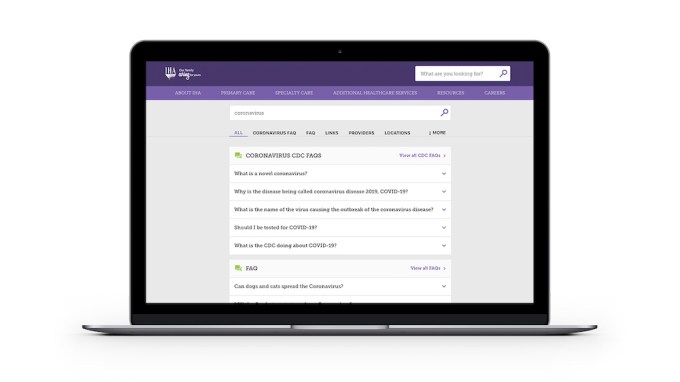
Yext says that in response to the COVID-19 pandemic, it’s making its Yext Answers site search product free for 90 days.

You might not see an obvious connection between site search and a worldwide pandemic. You might even think this sounds like a marketing gimmick. But Yext CEO Howard Lerman said that for the past 10 days, the company has seen a spike in coronavirus-related searches across sites that use Yext Answers.

After all, Lerman said Yext has a lot of customers in the healthcare industry, such as the IHA medical group. But even beyond that, companies are getting related questions, whether it’s a hotel getting asked about their cleaning procedures, or an airline being asked whether it’s safe to fly or a vodka company getting asked about whether vodka can be used as hand sanitizer.

Businesses could try to answer those questions on a single web page or blog post, but that’s probably not going to be comprehensive. Yext Answers offers a way to present and save this information in a much more structured way, so that a visitor can jump to the exact answer that interests them. In addition, it provides data on what visitors are searching for, so companies can answer the questions that people are actually asking.

Yext Answers

Yext is also offering a free plugin that includes frequently asked questions about the coronavirus, with answers sourced directly form the U.S. Centers for Disease Control and Prevention.

“We have a product that could be pretty useful right now,” Lerman said. “We don’t want people to be getting wrong answers in the time of a global pandemic.”

He added that the company would normally charge around $100,000 for three months of Yext Answers. However, the free offering will be limited to 1,000 entities (which can be FAQs, locations or anything else), and Lerman said most paying customers are already using more than that.

While the product is free, the company will still schedule an initial setup call with a Yext administrator and provide ongoing email support. You can read more on Yext’s new website.

Bored at home? Come hang out with TechCrunch at 12:30pm PT on a live call

Are you working from home? Are you lonely? Do you miss human interaction? Did you finally get your home office setup looking good? Then join us today for our first-ever (and possibly last) TechCrunch-Equity Livestream-Hangout Extravaganza.

From Team Equity we’ll have Danny Crichton, Alex Wilhelm, new addition Natasha Mascarenhas, our producer Chris Gates, TechCrunch Editorial Director Henry Pickavet, and perhaps even some puppies. It’s BYOB, naturally, but if it’s after lunch where you are, cocktails are allowed.

We’ll have a loose agenda of things to argue about, but it won’t be as much fun as it could be without you.

So join us here on Zoom. And make sure to check out TechCrunch’s Twitter handle at @TechCrunch for updates just in case we can’t figure out how to Zoom into anything.

That’s it, really. We’re excited to try this out and we’re excited to see you. Cameras on, let’s go!

Equity drops every Friday at 6:00 am PT, so subscribe to us on Apple PodcastsOvercastSpotify and all the casts.

Maintain data security when staff is working from home

The coronavirus pandemic has left governments floundering, businesses unprepared and citizens scrambling for hand sanitizer like it’s worth its weight in gold.

The sense of general unpreparedness has a lot of people on edge. Not surprising, since we’re on the edge of a global health emergency and it’s impossible to predict exactly how government, travel or day-to-day business will operate during this outbreak.

Many tech companies already allow their staffs to work from home. Remote work policies are increasingly popular across the tech industry as companies push flexible working arrangements. In doing so, these companies have to prepare their IT infrastructure to accommodate remote working.

Granted, setting up a company to allow remote work is not an overnight job. It requires time and effort — but more importantly, investment and budget. It’s an even bigger task to do it securely and without opening a door for hackers to walk in. But with the coronavirus spreading, now’s a better time than ever to roll out a plan.

Secure your remote setup: The basics

Remote work has one fundamental security principle: Let in the right people to do the right things. In other words, your employees need to be able to do their jobs as if they were at the office.

EV startup Bollinger targets commercial industry with its new chassis

Bollinger Motors, the Michigan-based startup known for its rugged electric SUV and pickup truck, unveiled Thursday a chassis designed for a Class 3 commercial vehicle that has the potential to expand its customer base.

The move reflects a broader trend among EV startups to at least consider commercial applications for its vehicles in an effort to generate more revenue in this capitally intensive business. Rivian, for instance, has struck a deal with Amazon to provide electric vans for the e-commerce company.

Now, Bollinger Motors is jumping in. The company’s CEO Robert Bollinger said they saw potential for commercial applications when the company first built its B1 SUV.

Bollinger Motors Patent-Pending E Chassis Top

“When we first built our Class 3 B1, we knew there was a commercial aspect to the platform,” Bollinger said in a statement. “Not only cab-on-chassis, but entirely new truck bodies can fit on our E-Chassis, and help propel the world to all-electric that much faster.”

This E-Chassis is the same platform shared with Bollinger’s B1 SUV and the B2 Pickup. It will also accommodate future models and other trucks developed by Bollinger Motors, the company said. The E-Chassis can be customized to meet customer requests and will include 120 kWh battery pack or an optional 180 kWh battery pack, all-wheel drive, dual motor, portal gear hubs, hydraulic anti-lock power brakes and the ability to carry a 5,000-pound payload.

The E-Chassis will be built along its B1 and B2 vehicles and will be available to commercial customers in 2021, the company said.

COVID-19 market turmoil tests NYSE’s shutdown circuit-breakers

For the second time this week trading on the New York Stock Exchange halted for 15 minutes this morning when a market drop triggered the exchange’s internal circuit breaker, shortly after 9:30am.

The control, part of the NYSE’s automatic provisions to pause trading, has been put to the test since markets first began realizing the extent of the economic damage a worsening COVID-19 outbreak could cause in the U.S.

The circuit-breaker system used by the NYSE — and other large U.S. trading platforms per SEC rules — was implemented after the Black Monday stock crash of 1987, when major exchanges fell 20% in one day.

As the economic fallout from a widening COVID-19 outbreak manifests, it may challenge the digital contingency provisions of America’s largest stock exchange.

TechCrunch received some background on the circuit-breaker system from the NYSE.

“The equities and options exchanges have procedures for coordinated cross-market trading halts if a severe market price decline reaches levels that may exhaust market liquidity,” a spokesperson said.

The NYSE has three circuit-breaker thresholds that switch on if there are significant declines in the S&P 500’s previous day value: a Level 1 (for a 7% drop), Level 2 (at 13%) and Level 3 (at a 20% decline), per info provided to TechCrunch by the NYSE.

A Level 1 or Level 2 decline shuts down the market for a minimum of 15 minutes; a Level 3 circuit-breaker suspends NYSE activity for the remainder of the trading-day, according to the exchange.

After President Trump announced a U.S.-Europe travel-ban Wednesday evening, the Dow fell 2100 points shortly after opening Thursday, activating the NYSE’s Level-1 control, to halt a rapid value drop in stocks.

NYSE 2009

“The market-wide circuit breaker triggered this morning operated exactly as designed, giving investors additional time to absorb information and understand what’s happening in the market,” an NYSE spokesperson told TechCrunch.

The Dow Jones Industrial Average and S&P 500 — which track the performance of major stocks on the NYSE and NASDAQ — have lost over 20% in value since the COVID-19 (aka coronavirus) began to the spread in the U.S.

By mid-day Thursday, the Dow was on track for its sixth-worst decline in history.

Market volatility around COVID-19 — which originated in China and has spread to Europe and the U.S. — will test the NYSE’s contingency plans for a sustained market selloff.

While there’s been some chatter about America’s largest stock exchange shutting down completely — which hasn’t happened since the September 11 attacks — there are no plans to close at the moment.

“The NYSE is carefully monitoring the spread of COVID-19 and has robust contingency plans, tested regularly, to enable continuous operation of the NYSE exchanges should any facilities be impacted,” a spokesperson told TechCrunch.

In a memo obtained by Reuters, the NYSE’s Chief Operating Officer Michael Blaugrund noted the exchange had limited visitors and closed some public-facilities within its 11 Wall Street structure.

The NYSE also shared a contingency memo with TechCrunch describing business continuity plans for the stock market, and its big digital-board, to operate trading remotely if there is a personnel shutdown of the main-floor.

Update: This story was updated to include reference on circuit-breakers being used across major U.S. securities-exchanges.